A S.U.R.E. SUMMER: The Stetson Undergraduate Research Experience
Last summer, while most students were taking a break from their studies, Pilar Astigarraga Harper was on campus in Sage Hall, experimenting with the use of rapamycin on caterpillars and butterflies to determine possible impacts on life longevity.
Júllya Lopes Machado was in her native Brazil near the beach but far from relaxing. She was investigating theories in religion for her project called “How Biblical Narratives Aid Coping in Brazilian Pentecostalism.”
Reagan Swayze was close to shorelines, too, in Pensacola Beach, St. Augustine and Miami Beach. Yet, she was exploring the intersections of memory, immigration and visual expression in Florida Jewish art and architecture at three historical synagogues.
Kevin Cartagena, meanwhile, was doing lab work centered on using yeast to determine the function of the Fus1 transmembrane domain for cell fusion. He put cellular functions under the microscope.
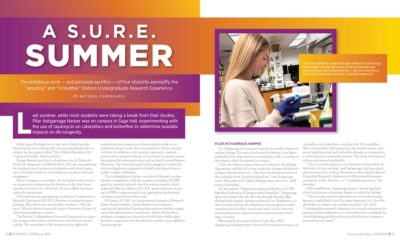
Each student was participating in a Stetson Undergraduate Research Experience (S.U.R.E.) by virtue of university grant funding. Also, there were several other students — 18 to be exact. All were driven to research topics of interest in hopes of discovering pathways to careers.
The Stetson Undergraduate Research Experience is a signature program that fosters excellence in research and creative activity. The centerpiece of the program is an eight-week research-intensive experience, where students work on an individual project under the mentorship of a Stetson faculty member. In addition to the summer experience, students present their research findings and outcomes at various venues throughout the subsequent year, such as April’s annual Stetson Showcase. The overarching goal of the program is to develop informed graduates equipped with skills and dispositions to tackle complex challenges.
The undergraduate scholars are selected through a universitywide competition, with the program providing a $2,000 grant for research initiated over the summer session, which began last May. In addition, S.U.R.E. grant recipients receive up to $500 to support travel to an appropriate professional meeting to present research results.
Of course, S.U.R.E. is a quintessential example of Stetson’s Hatter Ready initiative. Hatter Ready is an innovative approach to specialized learning that enhances student engagement through immersive experiences. Students are able to engage on a deeper level with their studies, gain hands-on experiences and benefit from smaller, more tight-knit learning groups.
PILAR ASTIGARRAGA HARPER
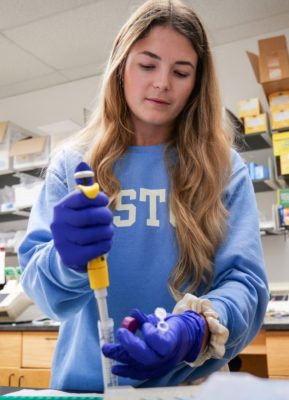
For Astigarraga, the summer research was another chance to explore biology. The senior had arrived at Stetson from Spain (originally from Argentina) as a tennis player with a curiosity in the subject, which broadened on campus.
“I saw the different classes that were offered in the biology department, and the lab course molecular biology and biotechnology really interested me — like how everything functions at the molecular level. It just fascinated me,” said Astigarraga, now a Molecular and Cellular Biology major who is on a full tennis scholarship.
For her project, “Rapamycin-induced Inhibition of TOR Signaling Pathway and Vanessa cardui Butterflies,” Astigarraga spent every day in the lab, Monday through Sunday, May through early August, starting at about 8 a.m. Rapamycin is a chemical that extends the lifespans of various genetic model organisms (such as flies, worms and mice), and is currently used in humans for organ transplant rejection and certain types of cancer.
Mentored by Associate Professor Lynn Kee, PhD, Astigarraga investigated this chemical’s development impact on caterpillars and butterflies — starting with 120 caterpillars. After treating them with rapamycin, she would measure and record developmental and molecular changes, as compared to a control group, to assess the impacts. The work was long and arduous but proved worthwhile.
“This is something that no one has done in butterflies. So that’s why it’s very exciting,” said Astigarraga, who was scheduled to present her work in November at the national Annual Biomedical Research Conference for Minoritized Scientists conference in San Antonio — a “wonderful experience,” she describes.
Following Stetson, Astigarraga hopes to attend graduate school and pursue a doctorate degree in molecular biology.
“This summer research experience was not only amazing because I really liked it and I’m super interested in it, but this also helps me achieve my post-Stetson plans,” she cited. “Undergraduate research experience is a crucial component for graduate school application, as it demonstrates my aptitude for critical thinking, problem-solving and dedication to pursue a research-focused career.”
JÚLLYA LOPES MACHADO
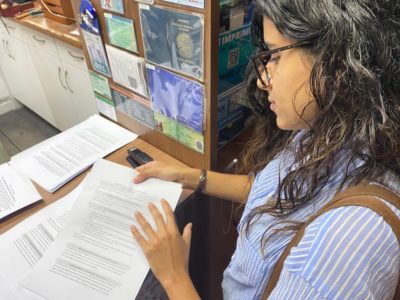
Machado, from Rio de Janeiro, Brazil, heard about Stetson from a YouTube video created by a former Stetson student. Machado was struck by a campus she thought was “gorgeous,” “sunny” and “wonderful.” Now a senior majoring in Computer Science and Religious Studies, she sought a research project that could examine religion while also employing her skills in data analysis.
You can read more of this article and the entire Fall-Winter Stetson University Magazine here.