CPOR Survey: Vaccine Misconceptions Persist — Nearly Two in Ten People Think Vaccines Cause Autism in Florida


A new survey from the Center for Public Opinion Research (CPOR) at Stetson University finds that while most Floridians believe childhood vaccines are important, stark partisan differences remain about vaccine safety, school requirements and parental choice.
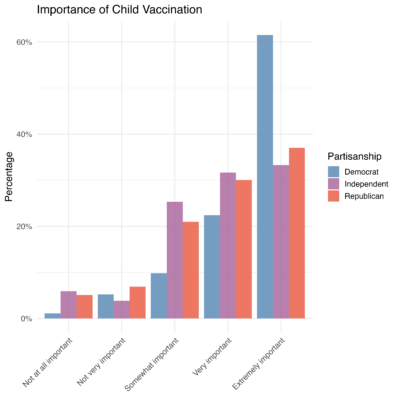
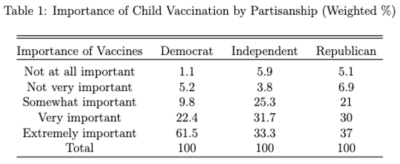
Across political groups, overall support for vaccination is strong — but far from uniform. Figure 1 suggests that 84% of Democrats say it is “extremely or very important” that parents vaccinate their children. That number drops to 67% among Republicans and 65% among Independents, showing agreement on the broad value of vaccines but declining consensus on how strongly they are prioritized. These differences are statistically significant when controlling for gender, education, and income, suggesting Democrats are more likely to agree that children vaccination is important than Republicans and Independents.
Figure 1. How important is it that parents get their children vaccinated?
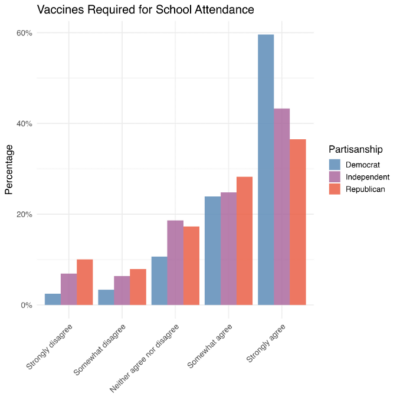
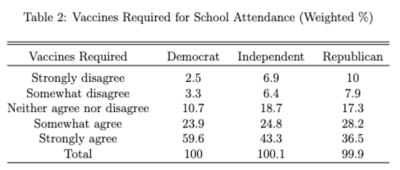
The gaps widen when respondents are asked about school policies. Figure 2 shows that84% of Democrats agree that healthy children should be required to be vaccinated to attend public school. Among Republicans, 65% support school vaccine requirements, while endorsement reaches 68% among Independents. While both sides still agree for the majority, the opposition across parties is statistically significant, with Democrats showing a higher probability to support vaccination requirements for children attending public schools.
Figure 2. Healthy children should be required to be vaccinated to attend public schools because of the potential risk to others.
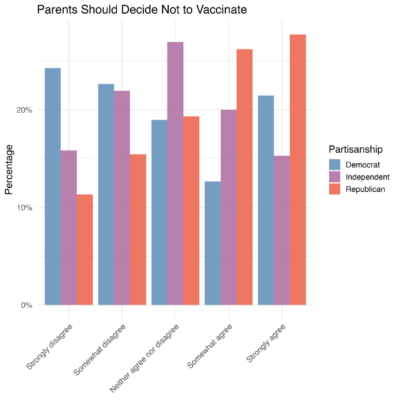
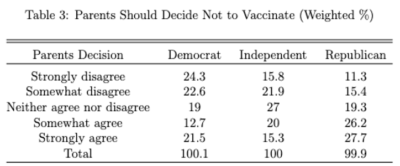
That divide appears again when respondents consider parental opt-outs. Figure 3 shows that 54% of Republicans agree parents should be allowed to refuse vaccination for their children even if doing so may pose health risks to others. Democrats are substantially more cautious: only 34% agree with allowing parental opt-outs. Independents remain mixed, with 35% agreeing with the parental decision. The difference is significant between Republicans and Democrats, with the former showing greater likelihood of supporting parents’ autonomy over children vaccination.
Figure 3. Parents should be able to decide not to vaccinate their children, even if that may create health risks for others.
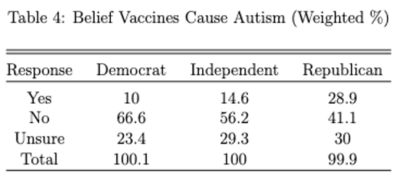
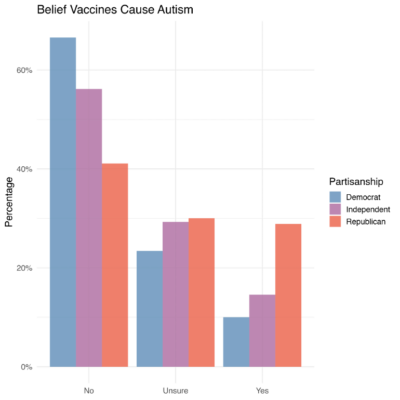
One of the most striking findings relates to the claim that vaccines cause autism. Figure 4 shows that while 67% of Democrats say vaccines do not cause autism, only 41 percent of Republicans say the same. That means 59% of Republicans are either unsure or positive about the relationship between vaccines and autism, compared with 33% of Democrats and 44% of Independents. When dropping undecisive respondents, Republicans are 29% more likely to affirm vaccines cause autism than Democrats, and the difference is statistically significant.
Figure 4. From what you have read or heard, do you personally think that certain vaccines do, or do not, cause autism in children?
The results from this survey show that Floridians broadly believe vaccines are important for children’s health, but their attitudes toward requirements, risks, and misinformation split sharply along party lines. The differences are not about whether vaccines matter — but about trust, responsibility, and how personal choice should balance with community protection.
Methodology
The survey was conducted online through Qualtrics from October 30 to November 9 and completed by 804 adult Florida residents drawn from Qualtrics’ research panels. Data were weighted to match the state’s population on race, ethnicity, age, gender, education, and DMA region using 2020 Census benchmarks. All regression results include 95 percent confidence intervals. Sample sizes for party subgroups vary, so small differences should be interpreted with caution. More information is available at stetson.edu/cpor.
About the Center for Public Opinion Research (CPOR)
The Center for Public Opinion Research at Stetson University specializes in nonpartisan public opinion polling and survey research. CPOR provides valuable insights into political, social and economic issues affecting Florida and the United States. For more information, visit stetson.edu/cpor.
Crosstabs
We are now going to ask you a series of questions regarding vaccines. How important is it that parents get their children vaccinated?
How much do you support or oppose this statement: “Healthy children should be required to be vaccinated to attend public schools because of the potential risk to others.”
How much do you support or oppose this statement: “Parents should be able to decide not to vaccinate their children, even if that may create health risks for others.”
From what you have read or heard, do you personally think that certain vaccines do, or do not, cause autism in children?