New Exhibit, New Recognition for Gillespie Museum
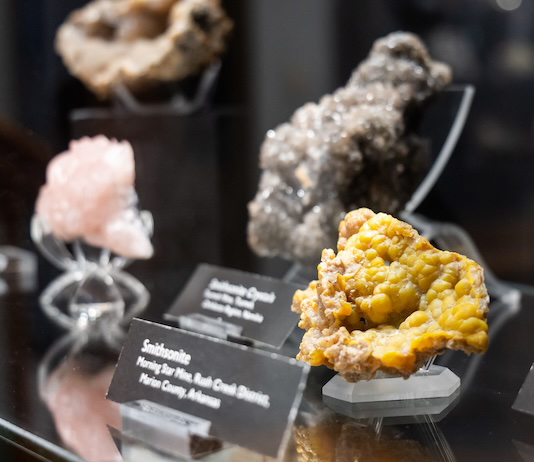
With an ongoing mystery-filled exhibit and new statewide recognition, learning about (and loving!) the natural world just got more exciting at Stetson’s Gillespie Museum.
Exceptional. Dramatic. Unusual. Crown Jewel. And, yes, mysterious. All are adjectives that aptly describe the exhibit “Treasures Out of the Attic” — lost gems and fascinating oddities that the museum’s curation team has uncovered from the depths of Gillespie Collection storage.
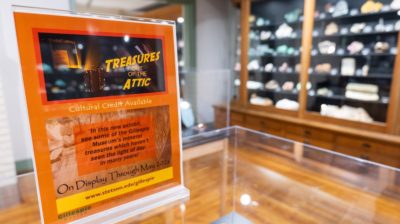
There’s almost everything and anything — from a rare diamond to a fossilized dinosaur egg nest that went missing some 20 years ago. The exhibit is open and ongoing.
Kristen Mattson, Gillespie Museum’s director, started moving toward this exhibit in January 2024, when she was able to bring in two collection management technicians.
Hidden Treasures
“As we did the initial assessment of the state of the collection, every box and case was opened to see what was there. We started talking about the interesting pieces we were finding, and the idea for the exhibit to display these ‘hidden treasures’ came to life,” Mattson explained.
Rumors of a nest of fossilized dinosaur eggs hidden away in the attic have been part of the museum lore for nearly two decades. Last spring, it was finally rediscovered.
There is a sample of azurite on malachite – treasured as one of the finest and most popular in the museum’s collection, acquired in 1937 by T.B and Nellie Gillespie. It hasn’t been displayed in many years, but it is now.
Also, there’s a rare and highly-coveted sizable piece of native copper from the Quincy Mine, located in the Keweenaw Peninsula in Michigan, Nicknamed “Old Reliable” for the frequency in which it paid investors, the mine was in operation from 1846 to 1954.
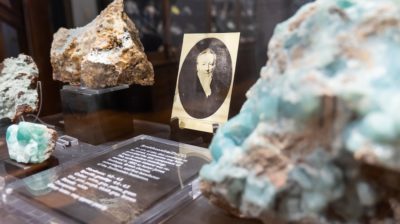
And, finally, a mystery stone is on display. “There’s a specimen discovered last year without any accompanying records,” reads the exhibit placard. It’s a beryl variety emerald in matrix. Museum employees hope further research will shed light on its origin.
“Those who are new visitors will see some sparkly and precious pieces that inspire ‘ooh’ and ‘aah,’” said Mattson. “I think the exhibit will appeal to wide range of audiences. Those who know and love the museum will get the chance to see more than 20 specimens that haven’t been on display in a number of years, that they most likely have never seen.”
Garden of Honor
As for the statewide recognition, the Volusia Sandhill Ecosystem, a teaching landscape that is part of the museum’s environmental programming, was given a “Garden of Honor” distinction during the Florida Native Plant Society’s 2025 Landscape Awards. Such awards aim to showcase exceptional projects that embody the society’s core values of stewardship, sustainability and environmental integrity. Also, the Volusia Sandhill Ecosystem — a longleaf pine micro-restoration area — is a recent grant recipient from the State of Florida.
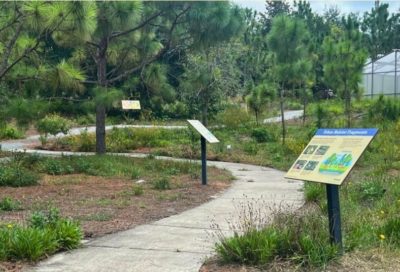
“The purpose of the Volusia Sandhill Ecosystem is to give a sense of place of the ecosystem that would have been present on Stetson’s campus prior to human development, as well as conserve plants that are associated with that now-endangered ecosystem,” Mattson noted.
Notably, the museum also presents monthly “Science Saturdays” and “Science Cafes.” Science Saturdays are family-oriented, but everyone is welcome. Science Cafes are lectures by visiting scientists that are generally geared toward adults. Registration for these via the Gillespie Museum website is encouraged but not required.
The Gillespie Museum is located at 234 E. Michigan Ave. in DeLand. Admission is free. Hours are Tuesday-Friday, 10 a.m.-4 p.m.
-Trish Wieland