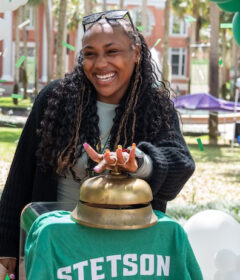
Stetson EMS Students Complete ‘Stop the Bleed’ Program
In January 2025, Stetson announced the start of a student-led Emergency Medical Services Team. The club, funded in part by the Student Government Association, consists of volunteer students who are interested in serving the community by providing emergency medical response.
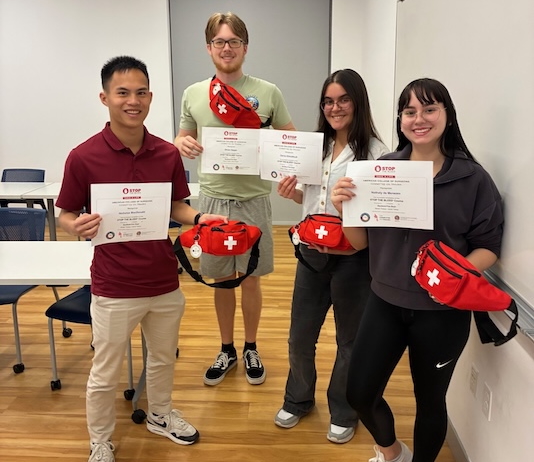
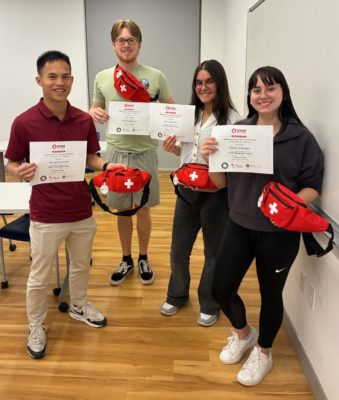
In mid-November, the students took another important step in their EMS education by successfully completing the nationally recognized Stop the Bleed training course, taught by Shawn Treloar, EMS battalion chief at the Sanford Fire Department.
Severe bleeding remains the No. 1 cause of preventable death after traumatic injury. Uncontrolled blood loss can become fatal within three to five minutes — making Stop the Bleed is the “CPR of bleeding emergencies,” described EMS Chief Noelle Zinn, a junior from Orlando majoring in Biochemistry.
“Our team members were trained to rapidly recognize and respond to life-threatening hemorrhage using three proven techniques: applying direct pressure, packing wounds, and correctly placing and using a tourniquet,” said Zinn, one of more than 20 EMS students who completed the one-hour training.
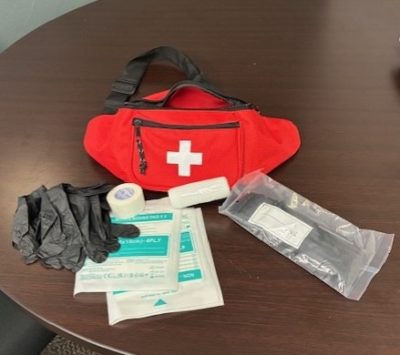
In addition to critical education, each of the students received a Stop the Bleed kit equipped with essential first-aid supplies to help manage a severe bleeding incident.
EMS Team Approach
As members of the Emergency Medical Services Team, students act as medical first responders and work alongside public safety officers on medical calls. They assist and provide patient care until the DeLand Fire Department or Volusia County ambulance services arrive on scene. Students also provide medical support for special events on campus, such as races and sporting events, sponsor and teach medical educational programs, and become part of the university’s Comprehensive Emergency Management Plan.
Team members work with Emergency Medical Technicians but aren’t required to have any certifications, and the club is open to all students. Consistent with the university-wide Hatter Ready initiative, the goal is to provide students with a real-world, hands-on learning experience that could assist them as they plan for careers or pursuit of an advanced degree in health fields. The program advisers are pre-health adviser Natalie Bittles, Health Services Director Johana Burgos and Public Safety Director James Kurtz.
Note: For more information, email [email protected].