Stetson Unveils New GenAI Guidelines for Students, Faculty and Employees
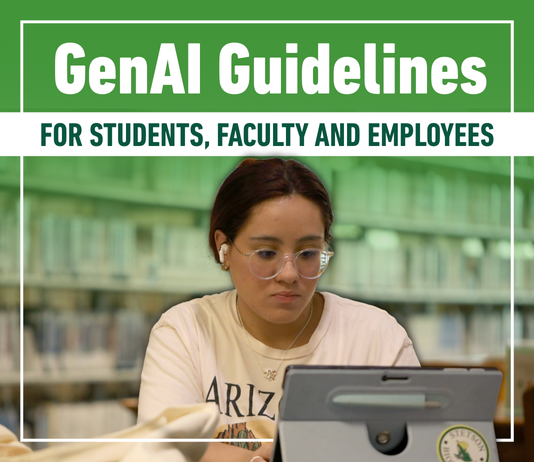
Stetson University has unveiled new guidelines for students, faculty and employees on the responsible use of generative artificial intelligence (GenAI), providing guidance on the risks and rewards of this rapidly evolving technology.
A new website, Generative AI at Stetson University, provides three sets of guidelines — one set specifically for students, one for faculty, and one for employees. The website also includes the University’s new guidelines on AI Tool Usage & Data Classification, describing what kinds of institutional data may be shared with various AI tools, such as Microsoft Copilot, ChatGPT, and Google Gemini.

The Student Guidelines, for example, explain how GenAI can be used safely and responsibly, including for course assignments and research, and how to avoid academic dishonesty. Among other guidelines, students are cautioned against becoming over-reliant on GenAI, which can hinder learning. They also must verify GenAI-generated content, given its risk of producing inaccurate information.
The Faculty Guidelines state that professors have the discretion to decide how students can use GenAI in their classes. Faculty should provide clear direction to students about their GenAI policy in the course syllabus or with every assignment. The guidelines also address such topics as the need for faculty to instruct students on the safe, sensible and responsible use of GenAI tools, as well as the risks.

The Employee Guidelines caution employees to guard against disclosing confidential and personal information with many AI tools. This includes data protected by FERPA, HIPAA and University policy. For example, employees must use the University’s approved GenAI tool, Microsoft Copilot, when inputting confidential information and never share such information with public AI tools like OpenAI ChaptGPT and Google Gemini.
“No matter how you feel about generative AI, there is no question it has had and will continue to have a significant impact on education,” said Elizabeth Skomp, PhD, Provost and Vice President of Academic Affairs, in a video about the New Generative AI Guidelines at Stetson.
“As part of the University’s commitment to preparing the next generation of well-informed and productively engaged citizens, Stetson wants to ensure that students, faculty, and staff are literate in the field of generative AI,” she explained.

Stetson’s new guidelines follow several semesters of work, including by the Provost’s Faculty Fellow for Generative Artificial Intelligence and Higher Education. Stetson Law Professor Kirsten Davis, PhD, JD, served as the Faculty Fellow from Spring 2024 through Fall 2025 and is an expert on GenAI in legal and higher education.
In that time, she administered a survey of Stetson employees about AI usage and training needs. She has also collaborated with the duPont-Ball Library and the Brown Center for Faculty Innovation and Excellence to offer programming on AI emergence in courses and pedagogical adaptations.
Beyond the Faculty Fellow’s work, engagement with AI is occurring across the University. Entering students on the DeLand campus are learning about ethical uses of AI through the Hatter Crash Course, and at the College of Law, AI content was embedded in 1L orientation.
In the College of Arts and Sciences, students have the opportunity to explore AI deeply through their coursework, and in the School of Business Administration, a faculty task force is strategically exploring AI in the curriculum. In addition to ongoing work in the Writing Center on GenAI, students can obtain a new AI certification through Career Success.
Thanks to new faculty member Victoria Antwi, the duPont-Ball Library offered a three-part AI literacy workshop series for students, focusing on responsible and effective use of generative AI tools in alignment with institutional values and data privacy best practices.
Faculty professional development continues to occur through the Brown Center with access to modules provided through the Association of College and University Educators (ACUE).
— Stetson Today