Taking Business Ethics to Great Heights
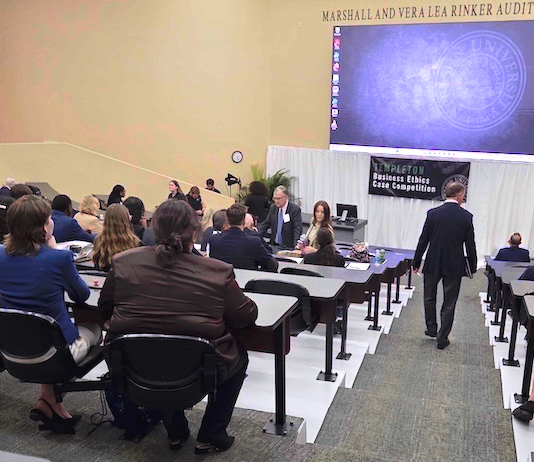
Each spring semester, through the financial support of Troy and Sissy Templeton, the Stetson Business Ethics Initiative, within the School of Business Administration, sponsors the Templeton Business Ethics Case Competition. Undergraduate students from invited institutions across the country (and Canada) receive the opportunity to analyze and present arguments on a contemporary business issue tied to financial, legal and ethical issues.
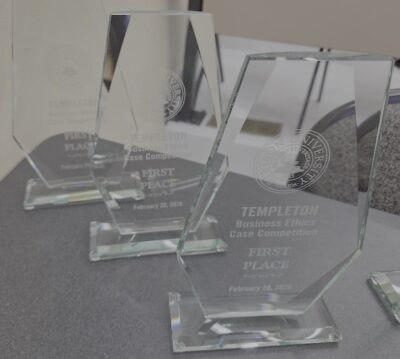
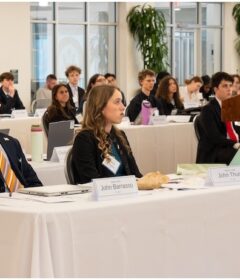
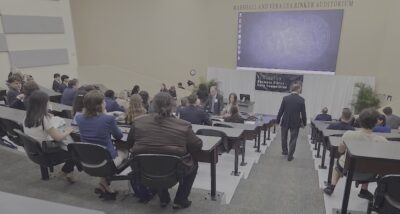
This year, Feb. 19-20, 18 schools competed while Stetson students on the Business Ethics Case Competition team served as hosts and room monitors during the competition.
The University of Florida won first place, followed by Iowa State University in second place, the University of Massachusetts – Amherst in third, and the United States Naval Academy in fourth. Bracket runners-up were McGill University (Canada), the University of Arizona, Florida Gulf Coast University and the University of Illinois Urbana-Champaign.
The Ethics Challenge
Theme of the competition was “Flying Green: Should Delta Air Lines Go All-In on SAF?” Glen Hauenstein, Delta Air Lines president (retiring Feb. 28, 2026) and a 1982 Stetson alumnus, approved use of the case and assisted in shaping it. Also, Delta representatives attended.
As outlined for the competition, SAF, or Sustainable Aviation Fuel, is a cleaner alternative to conventional jet fuel made from renewable waste materials, capable of reducing lifecycle carbon-dioxide emissions by up to 80%. However, SAF also carries a “green premium,” often being priced at two to five times more than conventional jet fuel. Although the production capacity of SAF is growing, it accounted for less than 2% of jet fuel use in 2025.
Delta Air Lines has publicly committed to net-zero emissions by 2050 and to replace approximately 10% of its jet fuel with SAF by 2030. But, as global mandates and incentives evolve, Delta must decide how aggressively to scale SAF procurement, financing and customer programs, while balancing environmental responsibility, affordability and shareholder value.
For the case competition, each school’s team assumed the identity of an independent consulting group retained to advise Delta. Among the questions posed: How aggressively should Delta Air Lines accelerate SAF adoption? Should it pay a significant premium and commit significant capital to a young and growing supply chain of SAF? Or, should it prioritize affordability and near-term profitability? How should Delta prioritize its commitments to its various stakeholders?
After multiple rounds involving written and live presentations, UF came out on top, according to the judges.
And, of course, serving as the host, Stetson was a big winner, too.
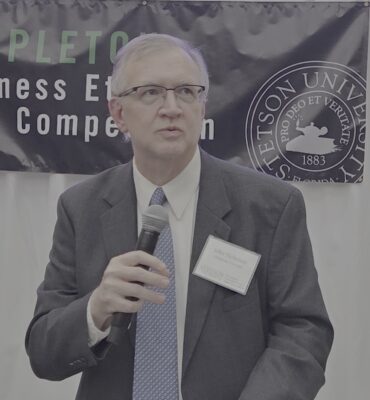
“Delta Air Line representatives were wonderful!” commented John Tichenor, PhD, Stetson Management professor and Eugene M. Lynn Chair in Business. “We had four judges from Delta, one for each bracket. They seemed very impressed with the students and their level of preparation! Just as we do at Stetson, these students took a real-life problem and designed a solution that addresses the financial, legal and ethical issues of the situation. It was a great showcase for these fine students, as well as for Stetson University.”
-Michael Candelaria