FACULTY FORWARD: Jason M. Evans, PhD
As a proud Double Hatter, I remain deeply grateful to the Stetson faculty who invested in me, challenged me, encouraged me and believed in my potential. I often reflect on the professors who took the time to pour into my dreams, helping me complete my education, become an attorney and ultimately serve my alma mater.
To recognize that lasting impact, I have launched Faculty Forward, a spotlight recognizing faculty members who continue this important work every day by preparing and inspiring the next generation of leaders.
–Lila Jaber ’88, JD ’90, Chair, Stetson University Board of Trustees
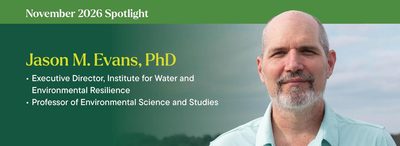
Q: Describe your work at Stetson University and what it means to be an “interdisciplinary systems and landscape ecologist.”
As a systems and landscape ecologist, I study how natural and human systems interact across different spatial scales, from individual habitats and watersheds to entire regions. I am particularly interested in how we can use our understanding of ecological processes to develop practical interventions to address challenges related to water resource protection, ecosystem restoration and climate change. My work also draws heavily on the principles of ecological engineering, which seeks to harness natural processes in the design of sustainable solutions that benefit both human communities and the ecosystems upon which we depend.
The “interdisciplinary” aspect means I work directly with engineers, architects, lawyers, economists, planners and a wide variety of social scientists, along with ecologists, biologists and geologists. A large body of my work over the past 15 years or so has focused on modeling and mitigating flooding issues, especially within coastal communities. As I frequently tell my students and community stakeholders, technical flood modeling — which involves understanding the physical hydrology of the system through advanced computations — is actually one of the easiest parts of the process. The much more challenging part is trying to figure out how to design and implement projects to address flood risk, especially if we want to provide other co-benefits to people and nature with our interventions. This generally requires working with large interdisciplinary teams that involve many other professions outside of the environmental sciences. It also requires working with members of the general public who may not have technical expertise per se, but who often do have extensive local knowledge and, of course, need to be heavily involved in decisions about the communities where they live.
One of the most rewarding aspects of my work at Stetson is the opportunity to bring these different disciplines together through projects that address real environmental challenges in our communities while engaging students directly in the process. Although mastery of disciplinary knowledge is a critically important component of higher education, I am absolutely convinced that the interdisciplinary lenses provided by a liberal arts education are the best training anyone can get for the complexities and messiness of real-world problem-solving.
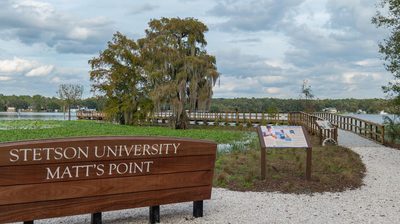
Q: Instrumental in Matt’s Point, you have long worked on sustainability initiatives promoting Florida’s wildlife, shorelines and natural habitats. How are students integrated into these initiatives?
Students are at the very heart of our work. One of the founding principles of the Institute for Water and Environmental Resilience (IWER) — and a fundamental commitment that extends across Stetson — is that undergraduate students should have opportunities to participate in meaningful research and community engagement projects.
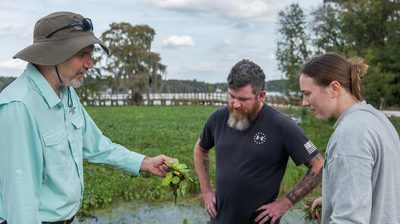
The Matt’s Point Living Shoreline project is a wonderful example of this commitment to undergraduate student engagement. One of the most important parts of the Matt’s Point story is that the original idea for the living shoreline came directly from one of our environmental studies students, Sarah-Kate Rines ’21. She was also a member of the Women’s Rowing Team and so, of course, spent considerable time at our Sandra Stetson Aquatic Center. Early in spring 2020, Sarah-Kate came into my office to discuss the shoreline erosion she had observed at what we now call Matt’s Point. By the end of our conversation, she had decided to investigate the erosion — and potential solutions — as the core of her senior research project.
Through her research, Sarah-Kate explored the concept of living shorelines, which she (correctly!) believed could be an effective solution for the site. By the end of the fall 2020 semester, President Roellke and the Oyler-Roellke families had fully committed to the idea of memorializing the life of Matthew Oyler ’05 through the living shoreline project, and the project began moving forward into serious planning and design. As we started engaging with planners, landscape architects and engineers with GMC Engineering in spring 2021, Sarah-Kate was a core member of the Stetson team giving direction to the professional consultants. Shortly after graduating, she joined GMC at one of its offices in Alabama, directly turning her undergraduate research experience into the beginning of a professional career.
Six years later, I’m incredibly proud to see a student’s vision so spectacularly realized through the Matt’s Point project. Along the way, many other Stetson students contributed in different ways: helping organize early design charrettes, identifying native and invasive plants, monitoring shoreline erosion through field surveys and drone imagery, and providing critical advocacy for the project to move forward. Looking forward, I’m confident that Matt’s Point will serve as an important outdoor classroom and research site for Stetson students and faculty for many years to come.
Q: How does your work and projects like Matt’s Point benefit Volusia County and the state overall?
Florida’s natural environment faces enormous challenges associated with rapid population growth, native habitat loss and declining water quality. Our human communities are also under pressure from weather extremes that are at times bringing us stronger storms and increased flooding, while at other times bringing us worsening droughts and increased water shortages. A core part of our mission at IWER is to help communities respond to these challenges through practical, science-based interventions.
The Matt’s Point Living Shoreline provides a prime example of this approach. The conventional way for a waterfront property owner to address an erosion issue like the one we saw at the Sandra Stetson Aquatic Center would be to construct a seawall or similar hardened structure. While a seawall might address the immediate erosion problem for the individual property owner, such structures also degrade shoreline habitat and, in some cases, exacerbate erosion on adjacent properties.
I personally think it’s quite clear that Stetson, as a respected university with longstanding commitments to environmental sustainability, has an obligation to be innovative and show leadership in addressing these kinds of challenges. The Matt’s Point project demonstrates how we can work with natural processes and materials to address shoreline erosion in ways that should help to improve the ecological health of Lake Beresford. And because Matt’s Point and the entire Sandra Stetson Aquatic Center is a public park, supported in part by grants made available through Volusia County’s ECHO program, we are providing a highly visible demonstration project that can be enjoyed and studied by anyone interested in learning more about living shorelines.
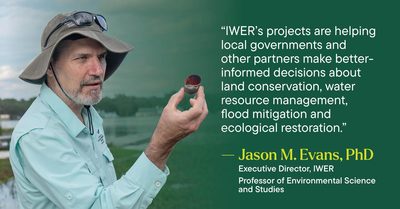
More broadly, IWER’s projects are helping local governments and other partners make better-informed decisions about land conservation, water resource management, flood mitigation and ecological restoration. One prominent example is our work with the East Central Florida Regional Planning Council to develop advanced conservation planning models, which are now being used to directly inform land acquisition decisions in both Lake and Seminole counties. In a similar vein, we have worked with the Alachua Conservation Trust over the past few years to evaluate the efficacy of conservation easements and management practices implemented on agricultural lands in the Suwannee River basin, through a large federal conservation program. Our coastal resilience planning work has also directly led to the construction of a beautiful rain garden designed to reduce street flooding in the City of Cape Canaveral, the relocation of the City of Satellite Beach Fire Station from a highly flood-prone site to a safer location on higher ground, and lower flood insurance rates for homeowners in the Florida Keys.
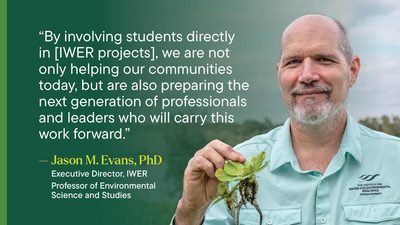
What ties all these projects together is a commitment to translate scientific knowledge into practical solutions that make a measurable difference in people’s lives. We are fortunate to have built strong partnerships with local governments, nonprofit organizations, businesses and community members who share this commitment. I think one of the most important roles a university like Stetson can play is to serve as a bridge between research and action, bringing together the expertise, creativity and partnerships needed to address challenges that no single organization or discipline could solve on its own. By involving students directly in that work, we are not only helping our communities today, but are also preparing the next generation of professionals and leaders who will carry this work forward.
Q: In your opinion, what makes a Stetson education distinctive, and what do you hope every graduate carries with them long after they leave campus?
As a small, liberal arts-based institution, Stetson provides transformative opportunities for our students to develop close relationships with faculty who are genuinely invested in their intellectual and personal growth. The value of a liberal arts education goes far beyond preparing students for their first jobs or even their eventual careers. At its best, it challenges our students to think critically, question assumptions, appreciate different perspectives and make connections across disciplines that might initially seem unrelated. I feel incredibly lucky and empowered to be part of a faculty that truly embodies this mission.
Most of the consequential challenges facing our world just do not fit very neatly into traditional academic disciplines. As I frequently tell my students, the real world is messy! There are rarely simple answers to complicated problems, and technical expertise alone is almost never sufficient for developing sustainable and just solutions. We need people who can navigate uncertainty, work collaboratively with others who have different backgrounds and grapple with the ethical complexities of the decisions they make.
Stetson has a long history of graduating students with these critical skills that, again, cut across traditional disciplines. Our future successes as an institution will, in my view, be grounded in our ability to continue building upon this proud tradition. This means preserving the intellectual breadth and personal engagement that define a liberal arts education, while also equipping students with the knowledge and skills they will need to navigate the novel sets of challenges and opportunities they will encounter throughout their lives.
Ultimately, I hope every Stetson graduate leaves with a deep sense of intellectual curiosity, the confidence to question conventional wisdom and an appreciation for the importance of lifelong learning. Perhaps most importantly, I hope our students understand that the true value of an education lies not simply in what they know or what they accomplish professionally, but in how they use their knowledge and abilities to contribute to something larger than themselves. Whether that means improving their communities through public service, taking conscious actions to protect the natural world, or applying a general sense of ethical duty in their personal and professional lives, I hope all our graduates carry with them a sense of responsibility to leave the world just a little better than how they found it.