Bestselling Author Michael Grunwald Connects Climate & the Food System
What does the food on your plate have to do with rising sea levels?
As it turns out, says best-selling author Michael Grunwald, quite a bit.
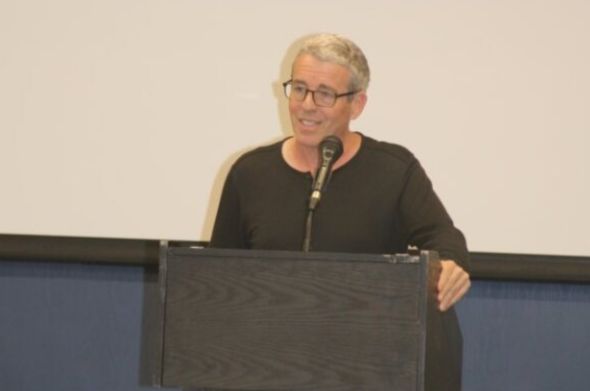
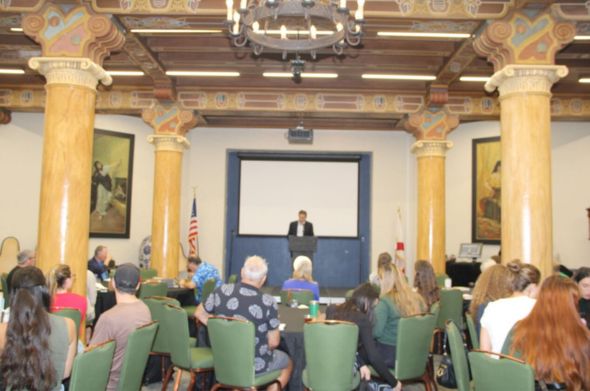
Grunwald, who spoke on the Stetson Law campus November 18 as part of the Edward and Bonnie Foreman Biodiversity Lecture Series, covers environmental policy and politics for The New York Times and other outlets. His most recent book, We Are Eating the Earth: The Race to Fix Our Food System and Save Our Climate, delves into the massive yet untold impacts industrial agriculture is having on the planet – and what we can do about it as individuals and societies.
“It’s a great read – a thought-provoking book about the connections between our food system and climate change,” said Law Professor Royal Gardner, director of Stetson’s Institute for Biodiversity Law & Policy, in his introductory remarks.
Grunwald said that while urban and suburban development cover just one percent of the planet, farmland covers a staggering 40 percent – and consumes more land every day.
“We’re losing a soccer field of forest to agriculture every six seconds,” he said. “Our natural planet is becoming an agricultural planet.”
A compounding problem
When it comes to offsetting the excess carbon emissions that are associated with rising global temperatures, trees are a critical resource for pulling carbon from the atmosphere. The loss of forests, prairies, and other natural landscapes means less carbon dioxide is being pulled from the atmosphere.
Grunwald said trying to decarbonize the planet through renewable energy and other solutions while cutting down trees is like trying to clean your house while smashing the vacuum cleaner to bits.
Much of the land now being used for agriculture grows food for the animals many humans eat. Those animals are also emitting large amounts of greenhouse gases like methane into the air.
Yet a growing human population requires a reliable, productive food system. To achieve sustainable food production for generations to come, Grunwald said, we need to take a hard but honest look at what’s on our plates.
“We’re going to need to make more food with less land and less mess,” he said.
Hard choices, sustainable solutions
The problem appears daunting, but Grunwald sees two obvious starting points: eating less meat and wasting less food.
Meat from mass-scale agricultural operations requires extensive land – including land for growing the animals’ food – and directly produces greenhouse gases like methane. Meat from cows and lambs is particularly taxing on the environment, he said.
Meanwhile, we are wasting more than 25 percent of the food we buy, which forces the food system to produce much more than is needed. The average U.S. household wastes more than $2,000 a year on food that will end up in a landfill, where it will emit methane – another powerful greenhouse gas.
“It is insane that we waste at least a quarter of our food,” Grunwald said. “That means we waste a quarter of the land and water and fertilizer that we use to grow it. We use a landmass the size of China to grow garbage.”
At the industrial level, he said, innovators are exploring ways to produce more food with less land. Food companies like Beyond and Impossible have developed meat alternatives from plants that will allow individuals to eat burgers and other foods they love without sacrificing palatability. Composting has become easier and more widespread, which helps reduce the amount of wasted food being shipped off to landfills.
As for individuals, their impact comes from the choices they make at each meal. While everyone going vegan would have a transformative impact on the planet, Grunwald – who said he is not vegan – recognizes the widespread resistance to this lifestyle, given the emotional and cultural associations made with certain foods.
“We all find a level of hypocrisy that we’re comfortable with,” he said. “Perfect isn’t usually on the menu. But better is better than worse.”
Learn more about We are Eating the Earth.
Post date: Dec. 4, 2025
Media contact: Kate Bradshaw
[email protected] | 727-430-1580