Lecture Explores Banks’ Role in Promoting Sustainability
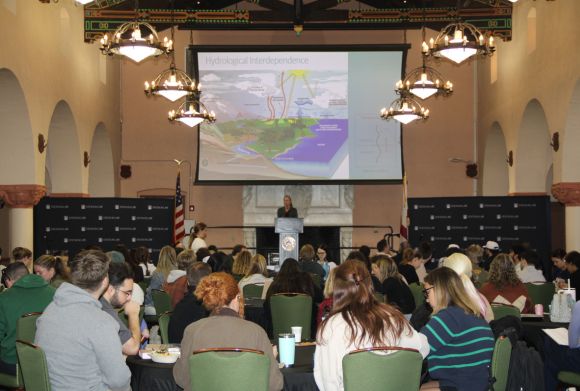
As she began her lecture in Stetson Law’s Great Hall, Christina Leb noted the opulence of the venue.
“This is probably the most fantabulous hall I’ve ever spoken in,” said Leb, who is senior counsel at the World Bank’s Environmental and International Law Department (LEGEN).
She was there to talk about the key role organizations like hers play in the development of sustainable water governance, especially in places where bodies of water cross international boundaries. Her talk, which drew a sizeable audience of students, was the February 2026 installment of Stetson’s Foreman Biodiversity Lecture Series.
Demystifying a complex topic
Leb detailed her experience working at a multilateral development bank supporting the creation and implementation of international water laws and sustainable water resources management – and how the very nature of water presents a challenge to doing so.
“We need to remember that water is in constant flux,” she said. “The hydrological cycle determines the availability of water over land. Water evaporates over land, over the ocean, rains down through the mountains, across landscapes, and percolates into the soil.”
Comparing the principles of international water law to the principles of international environmental law and international law in general, Leb said there is a general duty among participating nations to cooperate, prevent significant harm, and settle disputes.
There are more than 300 transboundary river basins in the world, and even more transboundary aquifers that provide freshwater to multiple countries. There are delicate wetlands and watersheds connected to the water supply upon which millions depend. Pollution in one country can contaminate another’s drinking water.
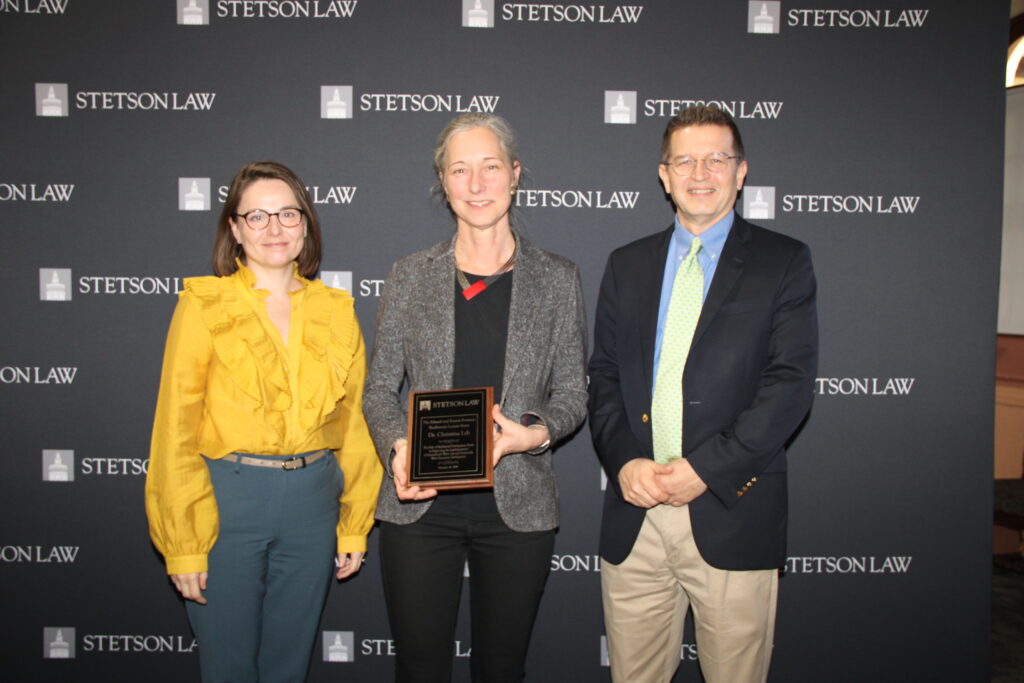
Organizations like the World Bank, which seek to lift populations out of poverty around the globe, can help motivate nations to protect the water resources they share with other nations by requiring sustainability practices as a condition of funding. Yet shifting political, economic, and environmental circumstances can present a challenge when it comes to creating a lasting agreement.
An example she cited was the Indus Basin Treaty, which was developed in 1960 when India and Pakistan were divided into two separate countries. The World Bank brokered this water-sharing agreement. Following a 2025 attack in India’s Kashmir region, India suspended the treaty.
“International treaties are a product of their times, and when negotiating a treaty, it’s very important as a lawyer to make them flexible in the long term,” she said. “To build in clauses that allow negotiation, because in most cases, the relationships between countries and their water needs evolve over time – and the treaties will become outdated one way or another.”
Advice to aspiring international law practitioners
Asked how a law student can best position him or herself for work within such initiatives, Leb said it is best to seek out professional experience through internships as well as attending relevant conferences where they can meet and interact with leading professionals in the field.
“Ultimately what helped me was having a network of people,” Leb said.
Post date: March 11
Media contact: Kate Bradshaw
[email protected] | 727-430-1580