Free Inquiry & Expression Series hosts former U.S. Ambassador to Ukraine
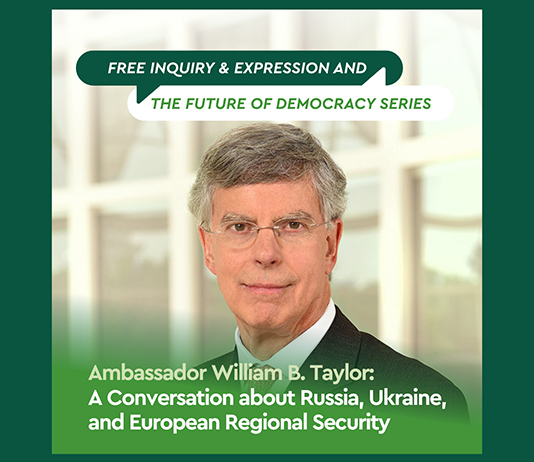
As William B. Taylor, former U.S. ambassador to Ukraine (2006-2009), addressed the large gathering at Lee’s Garage in the Carlton Union Building on campus, he was straightforward and clear.
Taylor was the guest speaker at an event sponsored by Stetson’s Alexander Hamilton Society student organization, and part of the university’s ongoing Free Inquiry & Expression and the Future of Democracy Series. He was invited to talk about the “changing American policy toward Russia, as well as the threats posed by Russia to the free world and democracy since the Soviet Union’s fall.” Student Owen Lazarus, a Presidential Fellow and president of the Alexander Hamilton Society at Stetson, was the moderator.
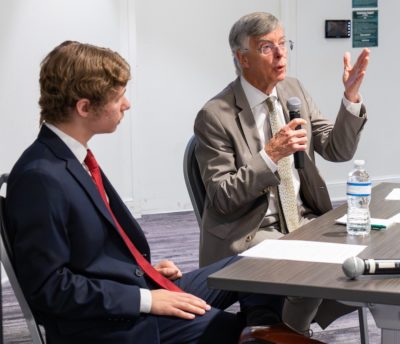
Taylor’s words centered on Ukraine and how what’s happening there — Russia’s invasion of its geographic neighbor — is impacting the United States and the world.
“This is IMPORTANT to all Americans,” he stated in no uncertain terms. “… This is really the first time in Europe since World War II that one nation invaded another nation with the intent of taking territory, of taking land, of taking part of another country, of violating orders.
“There are principles that have motivated nations since World War II — principles that the world has committed to, and not just America but the world — that basically have kept us from World War III. The principles are you respect sovereign nations, big or small, stronger or weaker, wherever you are.”
Ukraine is sovereign, Taylor explained, with citizens who “deserve that respect and don’t deserve to be invaded. Russia tossed that out. And it’s important to all of us.”
Russia had first invaded Ukraine in 2014 and again, more broadly and aggressively, in 2022.
Taylor went on to explore a topic that is complicated, and with multiple implications for Ukraine and Europe, obviously, but also for world order. In addition, he examined the U.S. stance and, without delving too deeply into party politics, outlined key points.
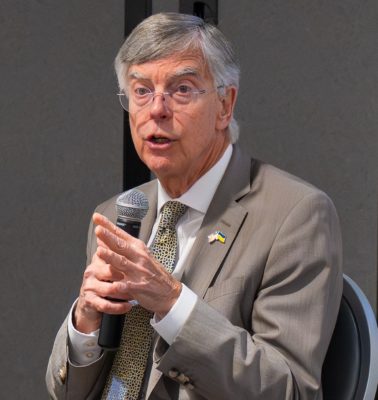
His background to do so is especially appropriate. Currently, Taylor is vice president, Europe and Russia, at the U.S. Institute of Peace. He has been special coordinator for Middle East Transitions in the U.S. State Department overseeing assistance and support to Egypt, Tunisia, Libya and Syria. Also, he has served as the U.S. government’s representative to the Mideast Quartet, which facilitated the Israeli disengagement from Gaza and parts of the West Bank. Prior to that assignment, he served in Baghdad as director, Iraq Reconstruction Management Office (2004-2005), in Kabul as coordinator of the U.S. Government and international assistance to Afghanistan (2002-2003), among other duties. A graduate of West Point and the Harvard Kennedy School, Taylor was an infantry platoon leader and combat company commander in the U.S. Army in Vietnam and Germany.
“Ukrainians have showed amazing resistance, resilience, determination and courage. Ukraine is holding off Russia,” he said near the end of his prepared talk.
“… There needs to be more pressure on [Russian President Vladimir] Putin. And the pressure needs to be in terms of military support for Ukraine; it needs to be with economic sanctions on the Russians. And there needs to be a source of funds to make it clear [to Putin] that the Ukrainians are able to pursue this war and defend themselves into the future.”
Taylor’s formal messages were followed by a lengthy question-and-answer session, which has been a signature component throughout the Free Inquiry & Expression and the Future of Democracy Series. The events have featured timely topics, national speakers and panel discussions — along with civil dialogues in all forms.
Free Inquiry & Expression and the Future of Democracy Series
Stetson’s Free Inquiry & Expression and the Future of Democracy Series was started in January 2025 to enable open dialogue about a wide variety of topics through national speakers, panel discussions and civil discourse. Thanks to initial success, the series continued this fall with events for students, faculty and staff, as well as the community.
Historically, Stetson has been committed to free expression, and recent affirmations of a formal commitment can be traced back to spring 2019, when faculty and staff in DeLand and at the College of Law in Gulfport drafted a statement of principles of free expression, which was approved by the university’s Board of Trustees.
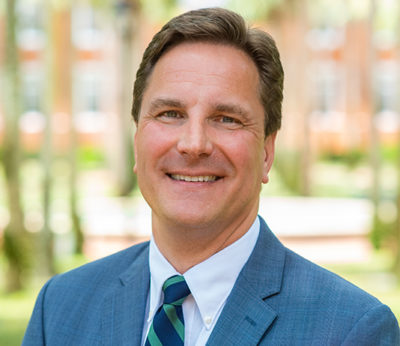
In July 2024, President Christopher F. Roellke, PhD, joined 70 other college presidents of institutions nationwide to advance higher education’s pivotal role in preparing students to be engaged citizens, as well as to uphold free expression on campus. The commitments were made through College Presidents for Civic Preparedness, a consortium designed by the presidents and convened by the Institute for Citizens & Scholars. (See the 2025 College Presidents for Civic Preparedness Impact Report.)
Additionally, in summer 2024 Stetson participated by invitation in the inaugural Academic Freedom Institute at the University of Chicago, where universities were tasked with identifying their institutional structures for academic freedom and developing ongoing plans for embracing both free speech and inclusive excellence. This June, College of Arts and Sciences Dean Kyle Longest, PhD, and David Hill, PhD, professor of Political Science, were in Chicago for the second Academic Freedom Institute. There, they joined representatives from a broad spectrum of colleges and universities — from Harvard and Dartmouth to Virginia Tech and Baylor to Ball State and the College of Charleston — and engaged in discussions regarding the “current challenges around this idea of academic freedom, freedom of expression and institutional neutrality,” Longest stated.
President Roellke’s view: “Without the free exchange of ideas and the ability to engage in civil and productive discourse, the power of education is compromised. It was not difficult for me to stand strong on these convictions, as they are so fundamental to the educational enterprise and so vital to the personal and intellectual growth of our students.”