New Business Fellows Program Brings Together 50 ‘Curious, Purpose-Motivated’ Students

Describe something you started, changed or took responsibility for without being asked. What motivated you? What obstacles did you encounter? What happened?
Tell us about a time you invested in someone else’s growth, well-being or success. Why did you do it, and what came from it?
Imagine you are given $1,000 and 30 days to create something meaningful. What would you do, and why? You may define “meaningful” however you wish, but be specific.
These are some of the questions students had to answer to apply to Stetson’s new Business Fellows program, which welcomed its inaugural cohort of 50 this fall semester. Including incoming first-year students, as well as students from the existing undergraduate population, the cohort was handpicked through a rigorous and competitive process that aimed to bring together “curious, purpose-motivated people who act with integrity, execute with agency, respond with resilience and care about something beyond themselves.”
For starters, the candidates had to answer some tough questions.
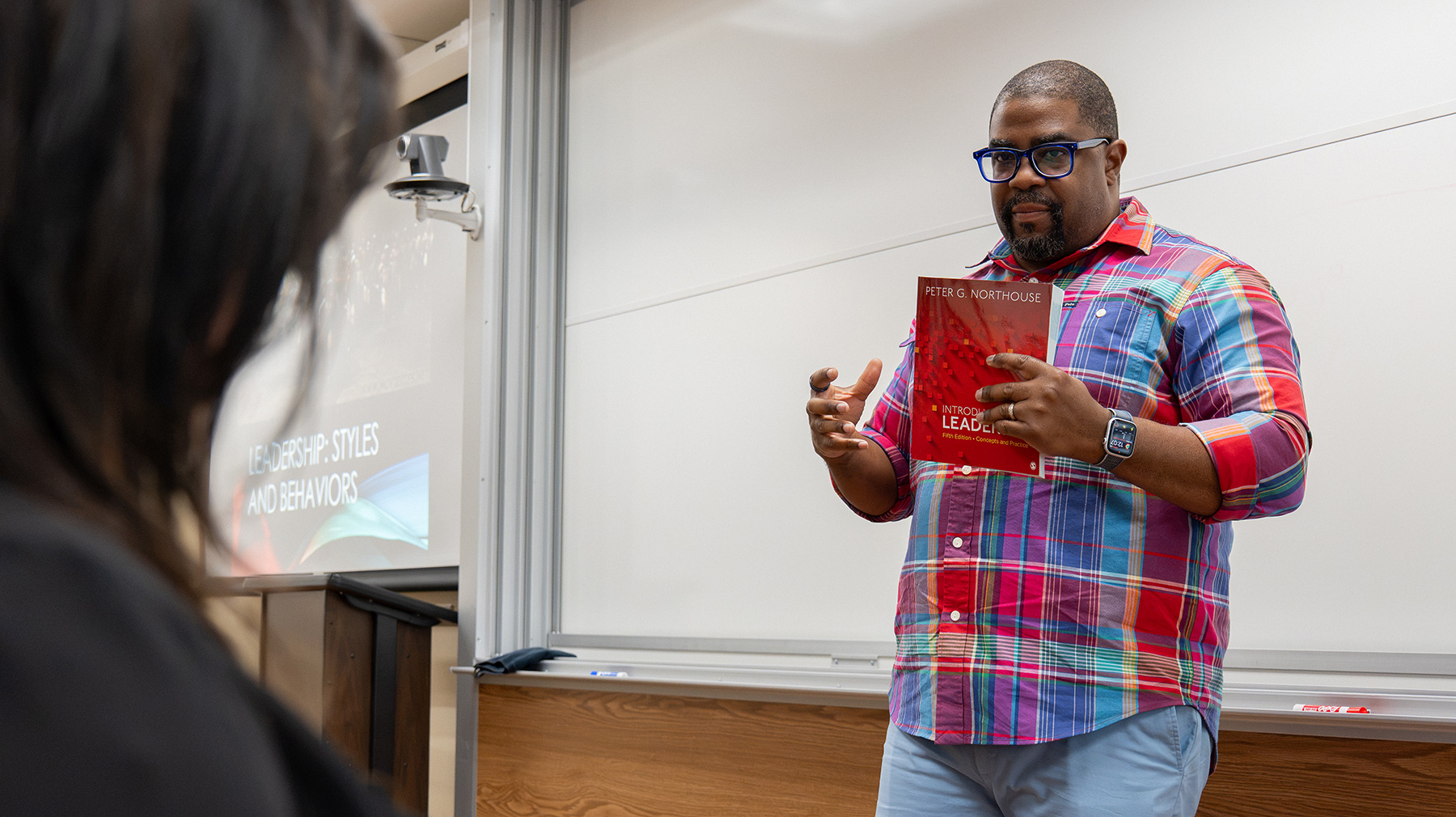
“They’re not questions someone’s going to be able to breeze through — they require some thought,” said Randall Croom, PhD, an associate professor of Management and the program’s very first director. “And each of the questions gets at a different element of the character that I’m looking for in a Business Fellow. There’s imagination, there’s creativity, there’s, ‘Do you help other people?’ There’s initiative — what did you do without being told? There’s principle — what did you do even though it was hard, even though it cost you something or it might have been unpopular?”
Croom, who previously served as assistant director of Stetson’s Honors program, described his philosophy for the Business Fellows program as being threefold.
First, he wants to help students become self-directed and follow their own interests and passions, even if that means deviating from traditional structures and pathways. Second, he wants to push students to focus less on themselves and instead think more about their impact on others. Lastly, he wants the program to foster a sense of identity and connection with business as the common theme.
“If you sculpt clay, you need metal underneath it to make the clay hold together. This is called an armature. And what I thought was, we’d have an armature model,” Croom said. “We support a basic shape, but even though we have a basic shape, the artist has a lot of freedom in terms of what they get to put on the armature. And that’s how I look at the Business Fellows. We have a basic shape for you, but we’re trusting you as the student to do something cool.”
Students selected as Business Fellows receive targeted support for research, internships, study abroad or away experiences, and other approved academic or professional activities, including a $2,000 award per year after their first, sophomore and junior years. These funds can be used for rent or transportation for internships, professional licensing or certification, tools or software to build a prototype or website for an entrepreneurial project — the possibilities are endless, as long as students are accountable for the expenses.
The first piece of programming in the works for this academic year is a soft skills workshop, where students will learn business etiquette — such as how to write a professional email or give a proper handshake while maintaining good eye contact — that isn’t necessarily taught in the classroom but can be critical in day-to-day business operations. Croom also plans to organize networking events, community service opportunities as well as an end-of-year celebration where Fellows can share their wins and achievements.
Once the Business Fellows program is more established, Croom hopes to be able to host a Business Solutions Conference, an event that focuses on the power of businesses to solve problems in the world and ultimately improve it.
“Organizations are really powerful, and businesses are one of the most powerful kinds of organizations there are. While there are times when businesses have done harm to the planet, and to people, there are also times when businesses have done good. I think it’s important based on our values as a university, as an institution, that we prepare our students to use business for good,” he said.
The Student Perspective
After befriending a group of Presidential Fellows during his first year at Stetson and learning how impactful the program was for his peers, Robert Isaiah Roundtree secretly hoped he could turn back time and join a similar group. That’s why, when he saw the call for applications for Business Fellows, he knew he had to apply. He ended up finishing his application in one sitting and is now a proud member of the inaugural Business Fellows cohort.
A sophomore Finance major, Roundtree is interested in going into asset management and sees being a Business Fellow as an opportunity to break into leadership roles on campus.
A passion project he has been working on since high school is building a custom large language model, giving it a knowledge base on a niche topic, and developing it into a product he can sell to businesses. He believes he could use the $2,000 summer funding from the Business Fellows program as capital to refine his LLM into something more meaningful.

For Business major Claire Simmonds, another sophomore in the inaugural Business Fellows cohort, the opportunity to network and create relationships across campus was the program’s biggest selling point. Being an international student from Ontario, Canada, she wanted to be intentional about building connections with people from all over the world, especially because she doesn’t yet know where she wants to work after graduation.
Her experience as a student-athlete gave her ample material for the application questions for the Business Fellows program. By talking about mentoring younger athletes and navigating team dynamics, from communicating with teammates from different parts of the world to handling confrontation and criticism, she was able to convey a sense of who she was beyond what her resume and transcript could tell.
The Business Fellows program will allow Simmonds to explore as well.
Because she is not committed to a single career path at the moment, she thinks the $2,000 summer funding will open up internship opportunities for which she would otherwise have to pay for housing out of pocket. She is also considering using the funding for LSAT courses and testing fees, as pre-law is one of the career tracks she is interested in.
–Siyon Kim