Constitution Day at Stetson: Why the Constitution Still Matters in 2026
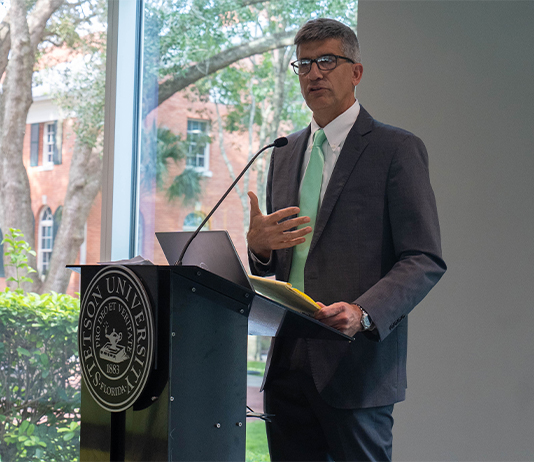
“Public buy-in for a constitution is the reason that it is successful,” said Louis Virelli, a professor at Stetson College of Law. “There is no manner of force that will allow a democracy like ours to function. If we don’t believe in it, and participate in it voluntarily, and trust its legitimacy inherently, it simply doesn’t work.”
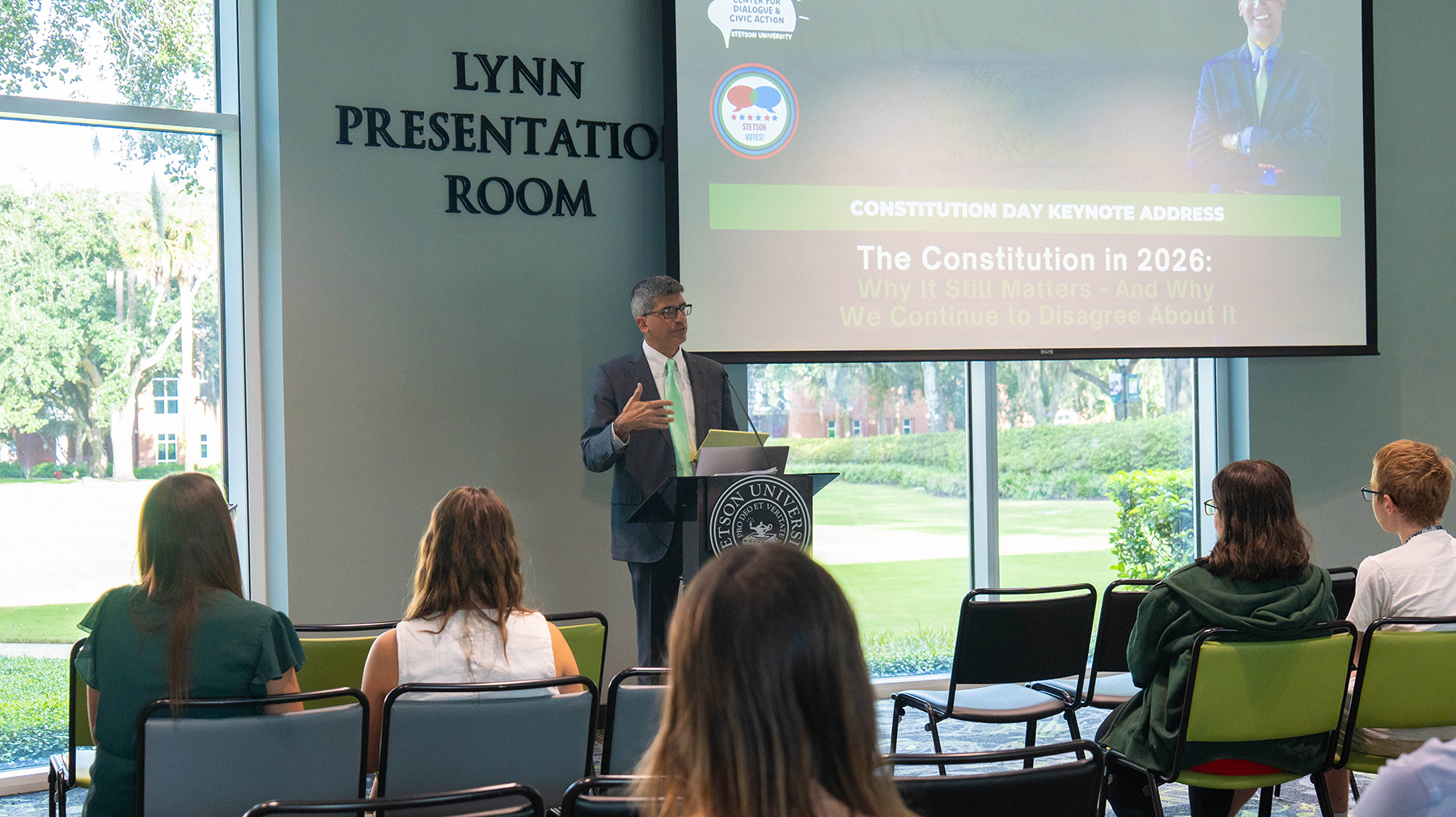
Virelli delivered the keynote speech, “The Constitution in 2026: Why It Still Matters and Why We Continue to Disagree About It,” at the celebration of Constitution Day organized by the Center for Cultural, Civic & Community Engagement on Stetson’s DeLand Campus on Thursday, Sept. 17.
Constitution Day in the United States celebrates the adoption of the U.S. Constitution in 1787 and honors new citizens. Observed on Sept. 17 annually, it encourages people to learn about their rights and responsibilities under this foundational document.
“A right is a thing that the government can’t do to you, a liberty the government can’t infringe upon,” Virelli said. “That’s what the Constitution provides. It’s called the ‘rule of law.’ Fundamentally, it’s the idea that we won’t tolerate acts of force or acts of privilege or concentrated power to govern. The law is the final word.”
Attendees had the opportunity to engage with the nation’s history and values. They gained a deeper appreciation for how the Constitution shapes everyday life. The celebration not only marked a historic event but also encouraged students to reflect on their obligations to participate in the democratic process.
“The Constitution is the supreme law of the land, the organizing principle of our society, and it applies to everybody equally,” Virelli explained. “That is what distinguishes us from other countries and other systems around the world. We revere our constitution and that reverence for the rule of law requires participation. We need to be voting and paying as much attention as our regular lives will allow us.”
Virelli teaches courses in administrative law, civil procedure, constitutional law and the separation of powers. He has received the Dickerson-Brown Award for Excellence in Faculty Scholarship and the Branton Excellence in Teaching Award. He regularly coaches one of Stetson’s moot court teams and is the faculty adviser to the Stetson chapter of the American Constitution Society, the Stetson Law Democrats and the Federal Bar Association.
He emphasized the significance of having our 4,500-word Constitution — equivalent to 18 double-spaced pages — in writing.
“It is the oldest, continually functioning written constitution in the world,” he says. “It’s also notably shorter than others. People are more likely to be faithful to a certain idea when they can see it written down and because it doesn’t change over time, but its brevity requires that we be diligent about how the text is interpreted.”
In the end, more than two centuries after its ratification, the Constitution remains a vital and living document, strengthened by amendments, serving as both guide and protector of U.S. citizens and their elected officials.
–Renee Garrison