
FACULTY FORWARD: Josh Rust, PhD


As a proud Double Hatter, I remain deeply grateful to the Stetson faculty who invested in me, challenged me, encouraged me and believed in my potential. I often reflect on the professors who took the time to pour into my dreams, helping me complete my education, become an attorney and ultimately serve my alma mater.
To recognize that lasting impact, I have launched Faculty Forward, a spotlight recognizing faculty members who continue this important work every day by preparing and inspiring the next generation of leaders.
–Lila Jaber ’88, JD ’90, Chair, Stetson University Board of Trustees

Q: As you support and teach law-related courses in Stetson’s Law Ready program, how do you help our students hone their analytical thinking skills?
I think the key to analytical thinking is historical thinking. Analytical thinking attempts to identify the component parts of a concept or definition as it exists today. At its best, a liberal arts education cultivates not only analytical thinking but historical thinking—or what political scientist Hugh Heclo calls “institutional thinking.” It involves seeing words as carrying the weight of history. Definitional shorthand is useful, but you cannot fully understand a word until you grasp the history it condenses. It is to see language in its historical and dynamic context.
The United States works within a common-law tradition, which takes history incredibly seriously. A legally recognized word such as “malice” is a kind of shorthand for a history of decisions that have progressively specified the concept. An older, moralistic sense of the word means wickedness; in the legal sense, however, the word has come to mean something more specific: harm caused either intentionally or recklessly. Over time, such legal definitions can come to depart from our ordinary understanding of the same terms.
Q: Some of your students are pursuing law school. What are the offerings and “bridge to law school” initiatives they’re able to take advantage of?
Stetson’s pre-law programming is experiencing something of a renaissance. It has long been Stetson’s mission to provide students with the core strengths of a liberal arts education: critical thinking, an awareness of the present’s placement in history, intellectual tenacity and a love of learning for its own sake. No matter their major, students who earn their degrees from Stetson University have long enjoyed distinct advantages in law school that peers from more narrowly vocational programs often lack.
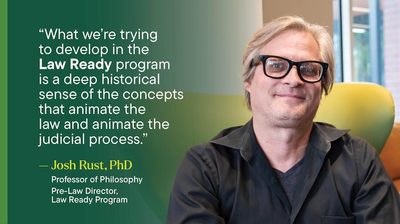
Through the faculty-driven Hatter Ready initiative, we took the excellent work already taking place across campus and integrated it into a cohesive framework—what we now call “Law Ready.” To this foundation, we have added several major initiatives, including a new Law, Society and Advocacy minor, which complements our long-standing Business Law minor.
Faculty and staff have also launched the Law Ready Living and Learning Community (LLC), allowing incoming students interested in legal careers to take foundational courses and live together. I am especially excited about the LLC’s immersive experiential component: students are working alongside local attorney and Double Hatter Brittany Gloersen, BA ’08, JD ’11 to help local seniors draft legally recognized advance directives.
Student-led organizations have expanded in parallel, including our chapters of the National Black Law Students Association (NBLSA) and the National Latinx Law Students Association (NLLSA). Notably, our undergraduate BLSA chapter was recognized as the national Chapter of the Year by its umbrella organization. Many students choose to join our long-established and influential Phi Alpha Delta (PAD) chapter.
I am proud that Stetson University has stepped up to give needed structure and support to what should be an institution-defining, mission-driven commitment. There is a way of conducting pre-professional preparation that remains deeply continuous with our identity as Florida’s first liberal arts university.
Q: Describe Stetson’s pre-law school Mock Trial and Moot Court programs and the recent successes.
Mock Trial and Moot Court are extraordinary examples of how Stetson, as an institution, has caught up with the talent and ambition our students brought with them.
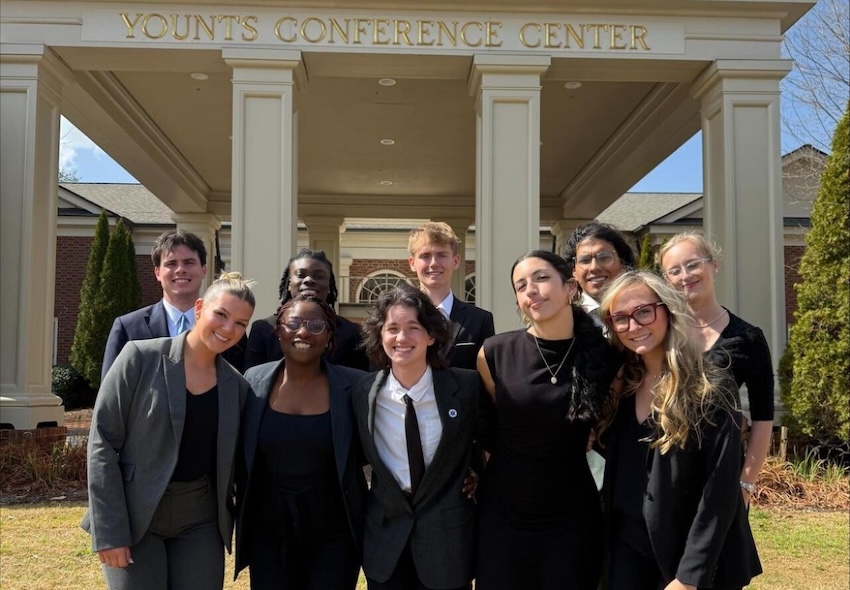
The Mock Trial team grew in fits and starts until, in the spring of 2025, one of our teams qualified for nationals—making Stetson the only university in Florida to reach that level of competition. Stetson Mock Trial did it again last spring, securing a strong national bid and sending a second team to ORCS (the Opening Round Championship Series). Additionally, Temi Adediji earned All-American honors for the second time.
Moot Court is a newer team that has nevertheless qualified for nationals twice in the past few years.
Both teams perfectly complement Stetson Law’s national reputation in trial advocacy. I remain deeply grateful to the sponsors and boosters who have made this growth possible and I am proud to share that Stetson University itself is now directly supporting both teams financially. I am also immensely thankful for Stetson Law’s ongoing financial and training support. The Law School’s Carson Sadro is one of the best Mock Trial coaches in the country and she has been unwavering in her commitment to our undergraduate advocacy teams.

Q: Your work has created meaningful opportunities for Stetson students to become career-ready. When you reflect on the impact you’ve had, what continues to motivate and inspire you to do this work?
I’ve long been impressed by Robert Paul Wolff’s The Ideal of the University (1969). Wolff describes the undergraduate as standing at the “threshold of adulthood.” For perhaps the first time, the student confronts the task of deciding not simply what occupation to pursue, but who one is—what values, commitments, style of life and conception of oneself one is going to adopt. I love being a university professor in part because I love working with students who are living in this liminal space, where they begin to take ownership of what may become deeply held projects and commitments.
In my own classes, I see myself as providing students with some of the materials through which this autonomy can be cultivated. What does it mean to give an argument that is genuinely one’s own, while framing it in such a way that it becomes intelligible to others? In this sense, self-making is grounded in critical thinking. But it is not simply a matter of critical thinking. Critical thinking presupposes a kind of intellectual tenacity: students must take the arguments and ideas of others seriously enough that their criticisms do not depend on caricaturing another person’s position. To develop one’s own view requires first learning how to encounter another person’s view on its own terms.
What especially intrigues me about Wolff is his suggestion that, because the university is a place where students may come to discover not merely a career but a value system, students (and faculty) should also participate in governing the institution itself. In our student-created and student-led organizations, students do not merely learn about autonomy or leadership in the abstract; they exercise those capacities by building, sustaining and governing institutions of their own. This is what has happened in student-led pre-law programming; and universities ought to give students meaningful opportunities to discover through that practice what kinds of people they want to become.