
Stetson Welcomes First Cohort of S-STEM Scholars
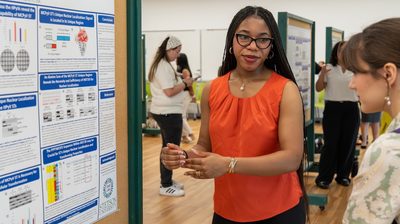
The new S-STEM Scholar program, funded by the National Science Foundation, is rolling out its first cohort of students this fall at Stetson due to a $2M grant announced last year.
The new grant provides double the funding of the first NSF grant awarded in 2021 and brings with it a more formal structure for retaining high-achieving students, supporting their graduation, and their ultimate success in launching a career within the scientific community or grad school.
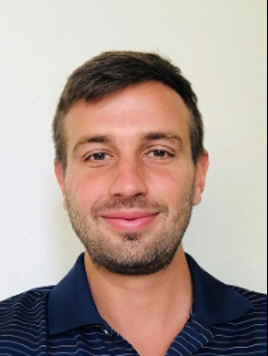
The S-STEM Scholar program is helping to make it possible for students like Courtney Ricks from Windemere, Florida to attend Stetson. She chose to come to Stetson because of the small class sizes and close mentoring opportunities from professors. She is excited to begin her academic journey at Stetson as a member of the class of 2030. Growing up, she was passionate about both dance and science, but her academic goal is to pursue a career in medicine as a doctor.
“Courtney was selected based on merit, as were all the other candidates,” said Matthew Shannon, PhD, an assistant professor of biochemistry at Stetson and the program’s principal investigator (PI). “We are so proud to welcome them to campus. This is a difference-maker for Stetson as a seminal program. The hard work that went into winning this grant will be worth it when we see these students cross the stage at graduation.”
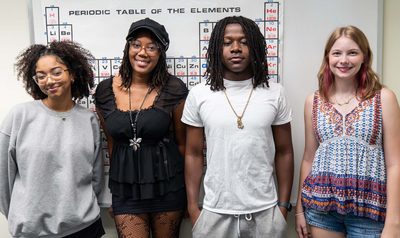
With the start of the fall 2026 semester, Stetson welcomes its inaugural cohort of nine S-STEM Scholars.
- Chloe Bygrave, a computer science major from Davenport, Florida
- Zion Jean, a biology major from Orlando, Florida
- Cheyenne Lewis, a computer science major from Bronx, New York
- Kendra Miles, a computer science major from Sanford, Florida
- Kiley Murphy, a biology major from Fairhope, Alabama
- Aaleeah Patterson, a computer science major from Groveland, Florida
- Courtney Ricks, a cellular and molecular biomedical sciences major from Windermere, Florida
- Jaden Sims, a cybersecurity and business administration double major from Hackettstown, New Jersey
- Saniyah Crosby, a biology major from Debary, Florida
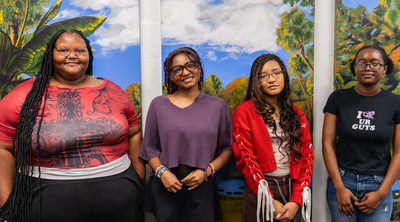
The S-STEM Scholars will be part of a collaborative community of blended academic and residential life alongside the HONORS Living and Learning Community in Chaudoin Hall. Stetson’s intentional approach of guided academic immersion aids development of the cohort’s sense of belonging and the easy formation of organic study groups.
The S-STEM Scholar cohort will move together through a premiere curriculum designed to rapidly orient them to physics, biology, chemistry, environmental science, computer science and math. The program is funding a customized focus that Stetson is already known for due to its low student to faculty ratio across all programs and commitment to experiential, contemporary learning through Hatter Ready. Winning a grant of this nature is clear evidence that Stetson’s immersive approach to higher education is rigorous enough to garner the substantial award and investment by NSF.
Stetson is fielding the following team of 11 faculty and staff to advise and support the scholars.
- Matthew Shannon, PhD – assistant professor of biochemistry; principal investigator (PI)
- Jason Evans, PhD – professor of environmental sciences and studies; co-PI
- Lynn Kee, PhD – associate professor of biology; assistant dean of advising for the College of Arts and Sciences; co-PI
- George Glander, PhD – professor of physics; senior associate dean of the College of Arts and Sciences
- Ben Tanner, PhD – professor of environmental sciences and studies
- Nathan Wolek, PhD – professor of digital arts; FSEM professor
- Mike Eskenazi, PhD – associate professor of psychology; faculty senate chair
- Michael Schroeder, PhD – associate professor of math
- Holley Lynch, PhD – associate professor of physics
- Kristine Dye, PhD – assistant professor of health sciences and biology
- Krista Hargis – administrator in the national sciences department
Stetson’s culture of support will also include evidence-based programming including tutoring, scholarships ranging from $10,000 to $15,000 annually, paid positions through the grant, as well as team-building and a speaker series.
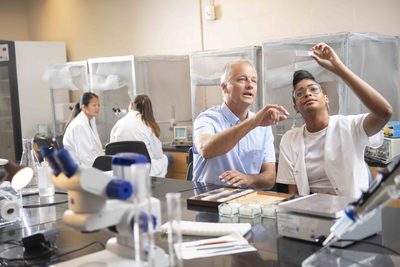
“Before school even started, the freshman cohort had already completed the inaugural S-STEM summer bridge program, one of many planned co-curriculars,” said Shannon. “Co-curriculars are designed to provide a rapid onramp so we got them into the lab for hands-on experience, we ate a lot of course and we brought in speakers who shared insights such as community projects they could get involved in, accessibility services on campus and how to get their resumes loaded onto LinkedIn to set them up for academic and career success.” The students also traveled together to visit the Institute for Water and Environmental Resilience with professors Jason Evans, PhD, and Ben Tanner, PhD.
In the spring, Shannon and the other professors mentoring the students will build on the cohort experience with a zero-credit colloquium. The colloquium with provide a low-stakes opportunity to explore STEM options and connect with faculty and other experts without the pressure of grades and performance.
Once the S-STEM Scholars have successfully completed their first year, they will move through a series of rapid fully embedded research cycles to develop the self-efficacy and confidence to collaborate with peers. Students will engage in four one-week research projects with a different faculty member for each cycle. The four-week program is designed to expose them to different areas they’ve possibly never heard of before. The research primer is a paid program that will also include housing. The goal is to enter sophomore year with the preparation and resume building experience that will result in readiness for meaningful internships or Research Experiences for Undergraduates, which is a competitive, paid summer program mostly funded by NSF.
Shannon is a biophysical chemist who specializes in using spectroscopic methods, primarily Nuclear Magnetic Resonance (NMR), to study macromolecules at atomic resolution. It doesn’t escape him that John York, PhD, professor of chemistry and department chair, wrote the NSF grant that made it possible for Stetson to purchase an NMR Spectrometer. “It was one of the biggest reasons I ended up at Stetson. They’re willing to invest in things that can change the world and I’m happy to pay it forward so see what paths may develop for these scholars.”
-Deb Lovett