Matt’s Point: A Loving Memorial and One of the First Freshwater Living Shorelines in Florida
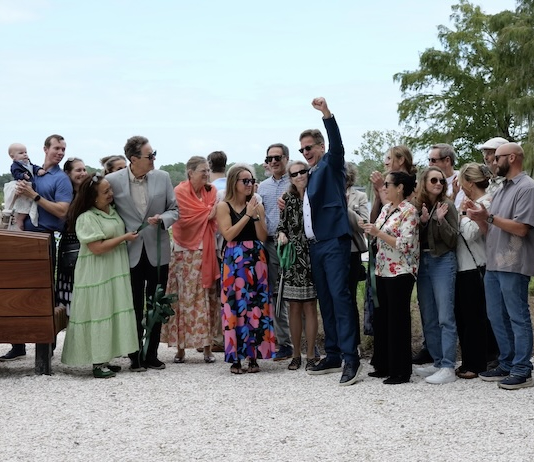
On the morning of Oct. 18, raw and real emotions were front and center while the backdrop was picture-perfect, seemingly heaven sent. Following six years of sitework and the heartbreak of 20 years earlier, Stetson celebrated the ribbon-cutting of Matt’s Point Living Shoreline at the Sandra Stetson Aquatic Center.
In 2006, Matthew Michael Oyler ’05 passed away after being hit while a pedestrian by a driver under the influence of alcohol. Oyler was the nephew of Stetson President Christopher F. Roellke, PhD. Shortly after Roellke took office in 2020, a tribute to Oyler began as a mere hope in the future. On this day, it became reality, as dozens of Roellke’s family and friends, along with a well-represented Stetson community, listened to podium messages of love, legacy and environmental stewardship.
In addition to honoring Oyler’s life and his passion for fishing and nature, Matt’s Point Living Shoreline was created to serve as a living laboratory where students and researchers can study freshwater ecosystems. Also, the project restores the lake’s natural edge and opens it to more of the local community, complete with an ADA-compliant boardwalk and public access trail for fishing, nature watching and outdoor education.

At the podium, Roellke remembered his nephew. “What makes Matt’s Point so meaningful is that it reflects who Matt Oyler was,” Roellke said. “He loved the water. He deeply valued nature. He found joy in fishing, learning, exploring, and spending meaningful time with family and with friends. He lived with the deepest appreciation for the natural world and for the people around him.”
Jason Evans, PhD, executive director of the university’s Institute for Water and Environmental Resilience, pointed to what can be called Stetson serendipity. At a time when Evans was contemplating how to resurrect the eroding shoreline, Rina Arroyo, then chief of staff to the president, called him about the idea of a memorial. Minds met with help coming from multiple corners — including a $600,000 Volusia County ECHO grant (Environmental, Cultural, Historical and Outdoor) plus a generous community of Stetson donors.
Still today, the stars remain aligned. “I don’t know if you guys have noticed,” Evans said. “But there is a bald eagle that’s flying around, which is just absolutely amazing.” Also, winds occasionally gusted. It was telling of the moment.
Other speakers included Bryan O’Neal ’05, Oyler’s first roommate and fast friend. “I was assigned a roommate and that turned out to be Matt Oyler,” O’Neal said. “And instantly any of the nerves or uncertainty about my living situation dissipated. … I didn’t know it at the time, but I was gaining a lifelong friend.”
Then Beth Oyler, mother and sister of the president, took the podium, with Roellke standing by her side. After thanking those in attendance and all involved, speaking softly, she captured the day: “To me, Matt’s Point is a masterpiece of love, science and education.”
‘Lots of Opportunities for Long-Term Research’
In addition to serving as the home waters for the Sandra Stetson Aquatic Center and Stetson Rowing — providing a quaint cove for boat launching and race viewing — the peninsula setting on Lake Beresford has the potential to be an environmental oasis for research. That’s how Jason Evans, PhD, also a professor of environmental science and studies, viewed it for years.
The site was created by a dredge-and-fill operation in the 1950s that created a horseshoe-shaped shoreline. Over the years, however, erosion continued to take its toll, made worse by hurricanes and severe thunderstorms. Then, a student who had been studying the erosion proposed an idea for a living shoreline, sending the eventual Matt’s Point into motion.
Living shorelines mimic natural systems to hold the shoreline in place, preventing erosion and improving water quality. The construction elements used on the project will also reduce wave-action and create habitat for wildlife. And, while living shorelines are commonly seen in coastal environments, Matt’s Point is a freshwater living shoreline, one of the first of its kind in Florida. In essence, Matt’s Point is a natural habitat of native plants to protect the lake, shelter wildlife and keep the waters healthy for generations.
With the project completed, Evans sees Matt’s Point Living Shoreline as an integral component of the university’s Institute for Water and Environmental Resilience. Further, he sees it as a big win for Stetson University with “lots of opportunities for long-term research,” adding that in decades to come students will still be using the site for research.
-Michael Candelaria