NIH Grant Funding Undergraduate Cancer Research
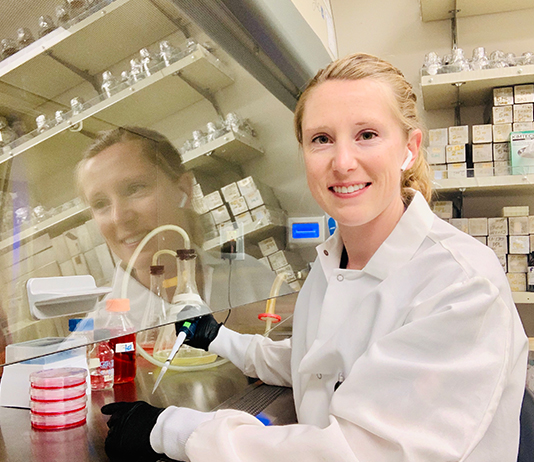
When Kristine Dye, PhD, assistant professor of health sciences and biology came to Stetson from the University of Washington – Seattle in 2020, she brought along her passion project in the molecular research of Merkel Cell Carcinoma. However, amid the excitement of receiving financial support from Stetson to continue her studies, she quickly realized these investigations were going to require far more funding.
At the time, COVID-19 was the virus of most concern and Dye, along with her research assistants, pivoted from protein to RNA research and what would be one of the most exacting ways to monitor the virus’ spread and evolution: wastewater surveillance. Stetson joined the elite list of universities making real-time scientific discoveries with multiple papers published by the Heliyon, A Cell Press Journal.
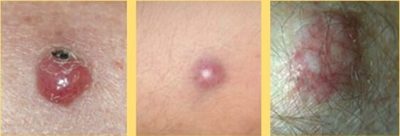
In 2024, Dye returned to the focus of her scientific passion: uncovering the mechanisms by which Merkel Cell Polyomavirus (MCPyV) leads to the development of Merkel Cell Carcinoma (MCC). Merkel Cell is a skin cancer three times more deadly than melanoma, which has been in the news lately for advances in treatment at pharmaceutical companies Moderna and Merck. At the cancerous stage, it is extremely rare, deadly, difficult to diagnose and was also the cause of death for Jimmy Buffett.
“Some smaller MCC projects, in addition to the COVID work and its resulting publications, made us more competitive for federal funding, which we needed to further our Merkel Cell research,” said Dye. The team anxiously awaited feedback as word spread that government funding of higher ed research began drying up.
The fact that Dye’s first application for an NIH grant was successful clearly indicates she is on to something. “For the COVID work, I published three papers — two of which I co-authored with eight of my research assistants,” said Dye. The team worked together for about two years thanks to funding by the university, getting a sample from the wastewater treatment plant every couple of weeks. “The students knew when that sample came in, they had to get to work and they had to be really good at what they were doing. They had to be quick, efficient and not make mistakes. It’s a super technical protocol that they had to do.”
The research was evidence of not only the real-world experience Stetson is known for, but also was a once-in-a-century, time sensitive, scientific exploration into the unknown.
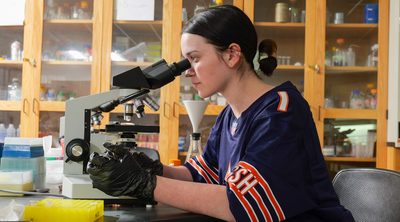
This year, the $547,875 NIH research grant is funding the return of four senior students and two sophomores as the Dye Lab’s first paid research assistants. “This is so incredibly impactful on so many levels, but critical for our students who have been volunteering over 20 hours a week, then heading to a job, juggling classes, athletics and homework,” Dye noted.
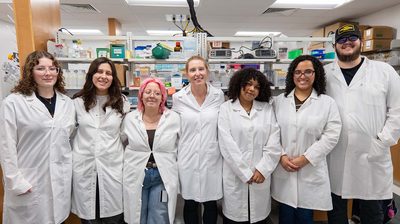
R15, by which the grant is known, will also enable Dye to purchase materials for the experiments that will be conducted by:
- Leah Seltzer, a sophomore biology major from Parkland, Florida
- Noelle Zinn, a senior biochemistry major from Orlando, Florida
- Raven Hufstetler, a senior chemistry and cellular and molecular biology major from Inverness, Florida
- Elle Rivera Diaz, a sophomore cellular and molecular biology sciences major from Ponce, Puerto Rico
- Raissa Borges de Oliveira Leal, a senior chemistry and economics major from São Paulo, São Paulo, Brazil
- Jake Catha, a senior cellular and molecular biology major from DeBary, Florida
The initial phase of the team’s Merkel Cell research is to determine how the virus causes cancer. About 15% of all cancers worldwide are caused by a virus. What allows Merkel Cell Polyomavirus to cause cancer?
The ultimate goal of the Dye Lab’s research is to contribute to the body of research that leads to the design of novel therapeutics to help treat Merkel Cell Carcinoma, much like the work that Moderna (a blend of the words modified and RNA) was doing on cancer prior to COVID, work that was initiated at the University of Pennsylvania in the lab led by Dr. Katalin Karikó and Dr. Drew Weissman. After 16 years working on unstable molecules and multiple barriers in the lab, they achieved a major foundational breakthrough in 2005. Their discovery was patented, with other scientists excited to conduct further research. Fifteen years later, Moderna and the German biotech firm, BioNTech, would have spent so much time perfecting a manufacturing platform that they were able to design a COVID vaccine in just 48 hours.
The groundbreaking work initiated in university labs is a bit of a long game but with huge payoffs for mankind. While today we marvel at a vaccine for Melanoma, the research breakthrough was made by Dr. Catherine Wu, professor of medicine, back in 2017 at Harvard Med School and its major teaching affiliate hospital, Dana-Farber Cancer Institute.
“It’s every research scientist’s wish for the time spent in the lab to someday pay off and lead to solving even one of mankind’s ills,” said Dye. “I find viruses so fascinating because they are very unique. In order to replicate, they need to get into and take over a cell. This can be very dangerous.”
To do that, the virus needs to outcompete the human body’s 20,000 genes. What are the odds? Plus, the cell’s nucleus, where DNA resides, is extremely well protected. For the virus to get into the nucleus it needs a unique password, also known as a nuclear localization signal (NLS).
“The first step was finding which part of the virus causes cancer,” says Dye. “The next step in our investigation was to figure out how it causes cancer, which was an exciting discovery. We found that it’s going into a host cell’s nucleus, which is very unusual, and it doesn’t even have a password. No other human polyomavirus behaves this way. We published those results in a 2024 paper co-authored with Stetson students.”
Unfortunately, most of us are already infected with the virus, although only a very small percentage actually develop the cancer. As people age, though, the incidence rate goes up and other factors come in to play such as not using sunscreen, not taking care of your skin, some combination of all three or a gene mutation. Many believe the higher incidence rate is also due to greater awareness and better diagnostics. It still remains the deadliest type of skin cancer due to its aggressive nature and that current therapies are ineffective for 50% of people diagnosed with Merkel Cell Carcinoma.
“We have made great strides on Merkel Cell research here at Stetson, and the consensus is that we’re on the verge of something really big,” concludes Dye.
It’s a challenge worthy of investment by Stetson and NIH.
-Deb Lovett