
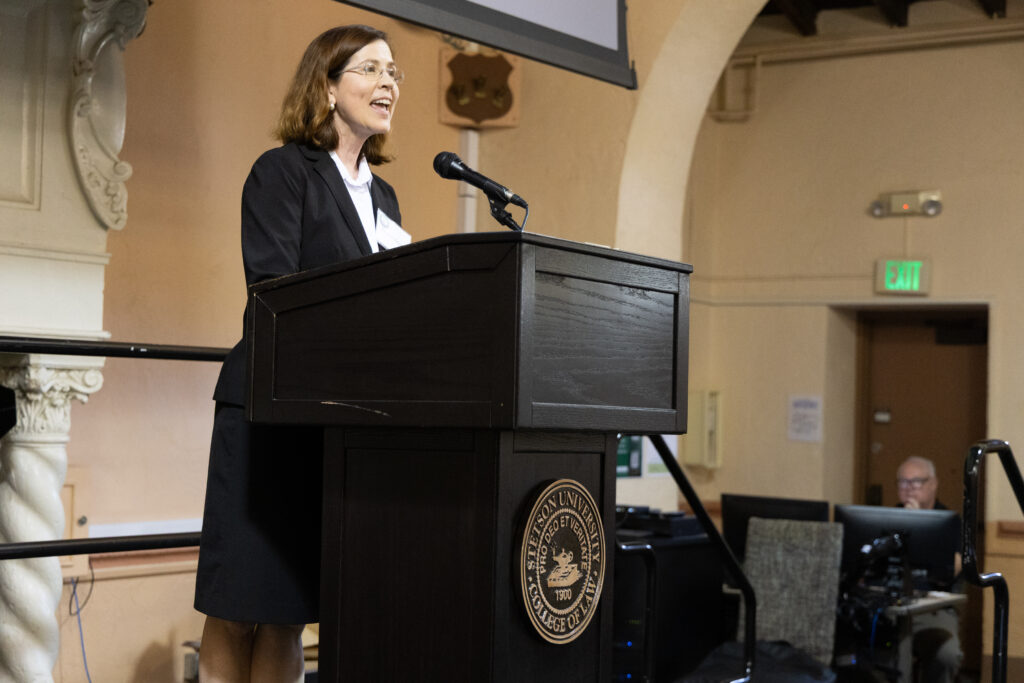
Working as a bank teller over several summers during her college days, Stetson Law Professor Kristen Adams developed a curiosity about cashless transactions and how they are regulated.
“I became completely fascinated with the laws of payment systems,” Adams said.
In the years since, the longtime Stetson Law professor has developed a subspecialty in payment systems and is now a recognized expert in the area, which encompasses checks, promissory notes, credit, and cryptocurrency. Recently, Adams was appointed to an influential position in which she will lend her expertise to a group studying legal and policy issues relating to payment fraud.
In the summer of 2026, she began serving as a Reporter for the Uniform Law Commission (ULC) and American Law Institute (ALI) Joint Study Committee on UCC Articles 3, 4, and 4A (Payment Fraud).
To Adams, the undertaking is the culmination of a nearly lifelong dream.
“This has been an enormous honor to receive,” Adams said. “It’s something that I’ve wanted to do for at least as long as I’ve been a professor.”
Shaping anti-fraud laws in the digital age
Working with the ALI, the ULC develops and updates the Uniform Commercial Code (UCC), a comprehensive set of model laws that states can adopt to modernize and standardize rules governing commercial transactions.
In the ULC and ALI process, a reporter is a nationally recognized scholar who conducts extensive legal research, drafts proposed statutory language and official comments, and helps guide the committee through the drafting process. It is a prestigious role for which the nation’s top legal scholars are chosen.
The joint study committee was created to address an alarming rise in fraudulent checks and wire transfers in recent years. As a reporter, Adams will evaluate how current laws support banks, businesses, and individuals when fraud occurs. Based on her analysis, she will recommend updates to modernize the current code so that it can more effectively address cyber threats and scams.
By investigating emerging trends, industry practices, and court decisions, drafting proposed UCC language and official comments, and providing objective legal guidance to committee members, Adams is engaging in the same type of work that she teaches her students to perform.
Addressing a new frontier
Reporters are generally highly respected law professors or legal experts selected for their deep, specialized knowledge of commercial law. The position is typically by invitation.
The scope of her work – amending the code to address checks and wire fraud – is narrow but extremely timely.
“There are forms of fraud that may not have existed when the code was written,” Adams said.
She has met with Federal Reserve officials, AARP representatives, consumer groups, banks, and other stakeholders with the goal of developing recommendations that could take the form of amendments to the UCC, official commentary, proposed federal legislation, or regulatory changes.
Adams said the committee is moving forward quickly on the project and could complete its study in as little as six months.