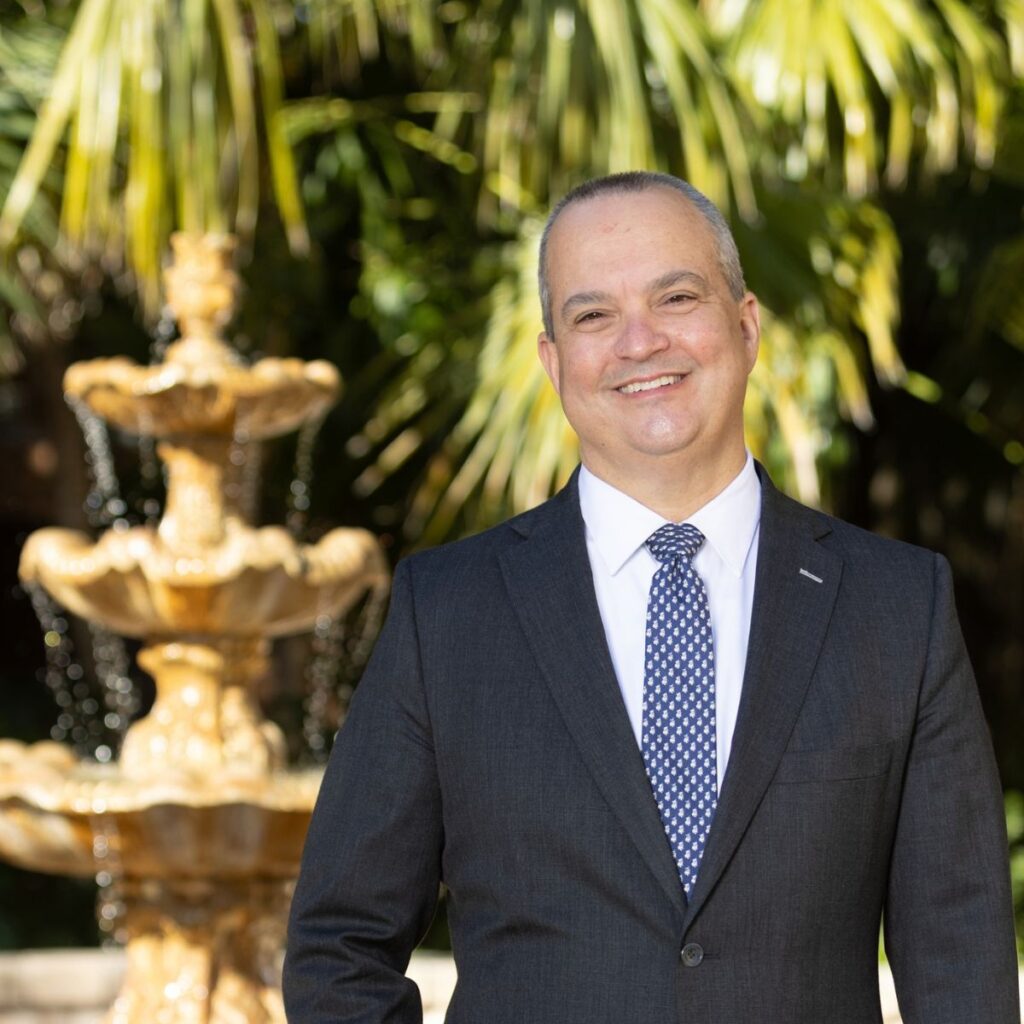
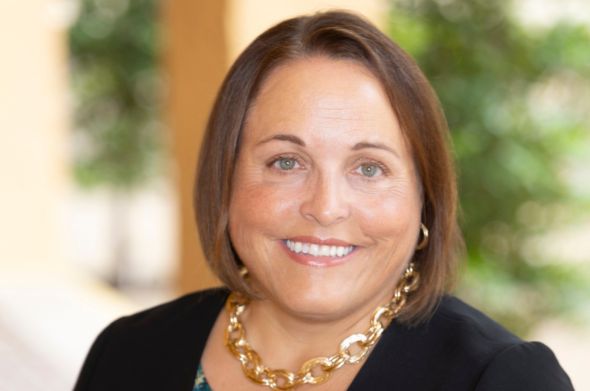
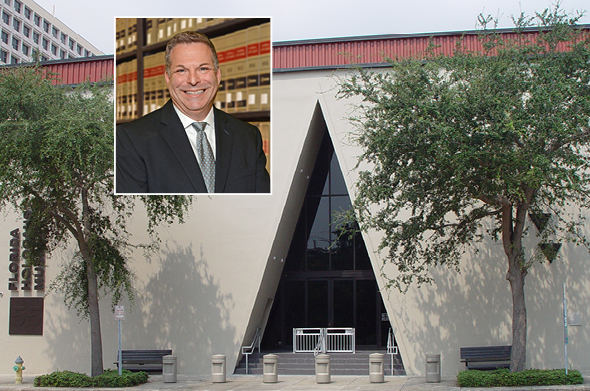
In your bid to purchase Blackacre, that fictional parcel of land familiar to generations of law students, you may be able to sign legal documents using your smartphone. But many of the legal concepts that still shape property ownership in the U.S. were already centuries old when the Mayflower set sail. Today, Stetson Law Dean D. Benjamin Barros is helping lead a national effort to determine whether those rules can be simplified and modernized for a new era.
A national nonpartisan organization, the ULC develops model legislation for state lawmakers to consider, often with the aim of clarifying and modernizing current laws without losing meaning or diminishing legal protections. The committee is examining whether the ULC should propose a uniform law that simplifies our property law by eliminating unneeded complexity that has accumulated over hundreds of years. This work can ultimately influence estate planning, family inheritance, and the transfer and development of property.
As reporter, Barros serves as the primary academic authority for the committee. His research and analysis will support its decision on whether to recommend that the ULC draft a uniform or model act. He will help provide the committee with research and analysis as it evaluates whether longstanding legal doctrines governing property ownership can be simplified and modernized.
“Many of the core principles in our property law are unnecessarily complex because they have their origins in feudal England. They often reflect issues that were present 500 years ago but aren’t present today,” Barros said. “I am excited to help with this project exploring ways to make our property law simpler and more clear. I’m grateful to the ULC for this opportunity.”
A nationally recognized property-law scholar, Barros has authored a highly regarded casebook on the topic and was founding editor of the Journal of Law, Property, and Society, a peer-reviewed publication by the Association of Property, Law, and Society. Notably, his 2008 paper, “Toward a Model Law of Estates and Future Interests,” anticipated many of the issues now under consideration by the committee and explored how these doctrines might be simplified through model legislation. His appointment reflects both his subject-matter expertise and his leadership within legal academia
The committee’s recommendations could ultimately influence future law-reform efforts and, if advanced into a drafting project, help shape model legislation designed to promote greater clarity, consistency, and predictability in state property laws.
If the committee recommends drafting model legislation, its work may help shape laws that state legislatures across the country will consider, potentially supporting more robust property rights for future generations.
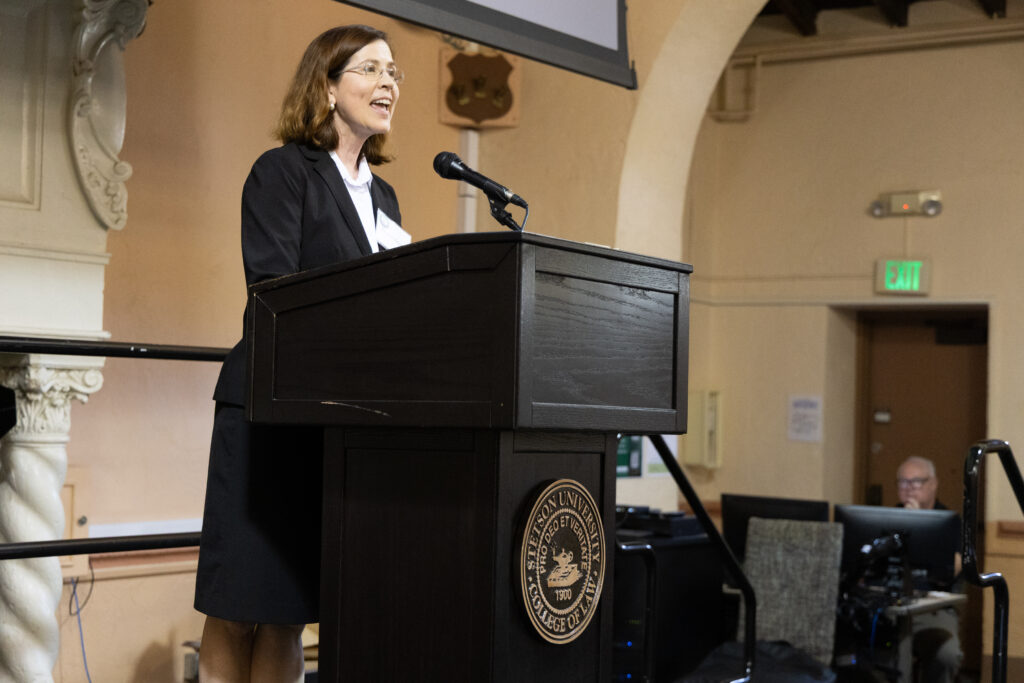
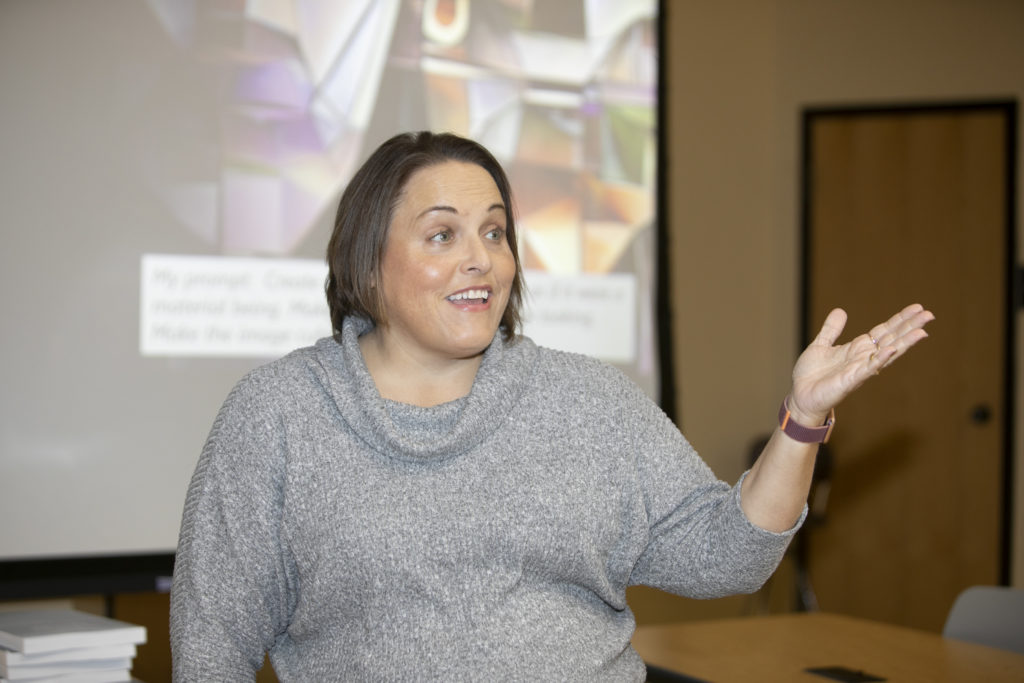
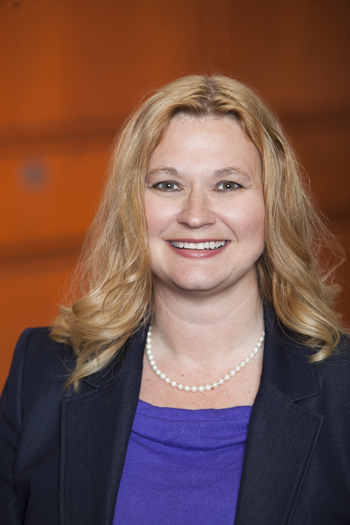
Law Professor Kristen Adams speaks at a Stetson Law event.
Working as a bank teller over several summers during her college days, Stetson Law Professor Kristen Adams developed a curiosity about cashless transactions and how they are regulated.
“I became completely fascinated with the laws of payment systems,” Adams said.
In the years since, the longtime Stetson Law professor has developed a subspecialty in payment systems and is now a recognized expert in the area, which encompasses checks, promissory notes, credit, and cryptocurrency. Recently, Adams was appointed to an influential position in which she will lend her expertise to a group studying legal and policy issues relating to payment fraud.
To Adams, the undertaking is the culmination of a nearly lifelong dream.
“This has been an enormous honor to receive,” Adams said. “It’s something that I’ve wanted to do for at least as long as I’ve been a professor.”
Shaping anti-fraud laws in the digital age
Working with the ALI, the ULC develops and updates the Uniform Commercial Code (UCC), a comprehensive set of model laws that states can adopt to modernize and standardize rules governing commercial transactions.
In the ULC and ALI process, a reporter is a nationally recognized scholar who conducts extensive legal research, drafts proposed statutory language and official comments, and helps guide the committee through the drafting process. It is a prestigious role for which the nation’s top legal scholars are chosen.
The joint study committee was created to address an alarming rise in fraudulent checks and wire transfers in recent years. As a reporter, Adams will evaluate how current laws support banks, businesses, and individuals when fraud occurs. Based on her analysis, she will recommend updates to modernize the current code so that it can more effectively address cyber threats and scams.
By investigating emerging trends, industry practices, and court decisions, drafting proposed UCC language and official comments, and providing objective legal guidance to committee members, Adams is engaging in the same type of work that she teaches her students to perform.
Addressing a new frontier
Reporters are generally highly respected law professors or legal experts selected for their deep, specialized knowledge of commercial law. The position is typically by invitation.
The scope of her work – amending the code to address checks and wire fraud – is narrow but extremely timely.
“There are forms of fraud that may not have existed when the code was written,” Adams said.
She has met with Federal Reserve officials, AARP representatives, consumer groups, banks, and other stakeholders with the goal of developing recommendations that could take the form of amendments to the UCC, official commentary, proposed federal legislation, or regulatory changes.
Adams said the committee is moving forward quickly on the project and could complete its study in as little as six months.
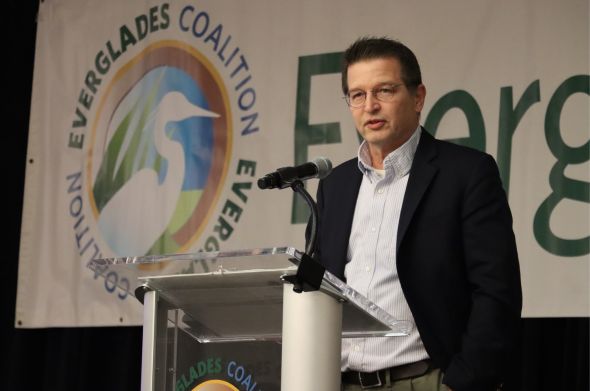
Law Professor Royal Gardner gave a keynote address at the 2026 Everglades Coalition conference.
Members of the Stetson Law faculty shared key legal insights – and a message of hope – on protecting the vast, beloved landscapes that constitute the Florida Everglades at the 41st Annual 2026 Everglades Coalition Conference in Naples, Florida.
The event is the largest gathering of environmental advocates, government officials, students, educators, and others that focuses on the future of Everglades restoration efforts. This year’s theme was “Everglades Strong: All in for Restoration.” At the heart of many conversations were state and federal cuts to regulations and funding, a recent U.S. Supreme Court decision redefining protected waterways, and other emerging factors that threaten biodiversity in the Everglades, including the construction and operation of “Alligator Alcatraz,” a migrant detention facility.
In his keynote address to attendees, Stetson Law Professor and Institute for Biodiversity Law and Policy Director Royal Gardner offered a perspective on a key moment for environmental advocates – and how it can illuminate a way forward in uncertain times.
“One of the lessons of history that gives us hope is that coalitions working together using a science-based approach communicated in language the public understands can be successful,” Gardner said.
When the proposed “Everglades Jetport” – which supposedly would have been the world’s largest – threatened to destroy a portion of the Everglades in the 1960s, public outcry led to the nation’s first Environmental Impact Statement, Congress passing the National Environmental Policy Act, or NEPA, and ultimately the project’s halting.
“The coalition was successful,” Gardner said. “It stopped the jetport and it led to the establishment of Big Cypress National Preserve.”
That landmark legislation went on to influence dozens of other nations’ environmental policies, he added.
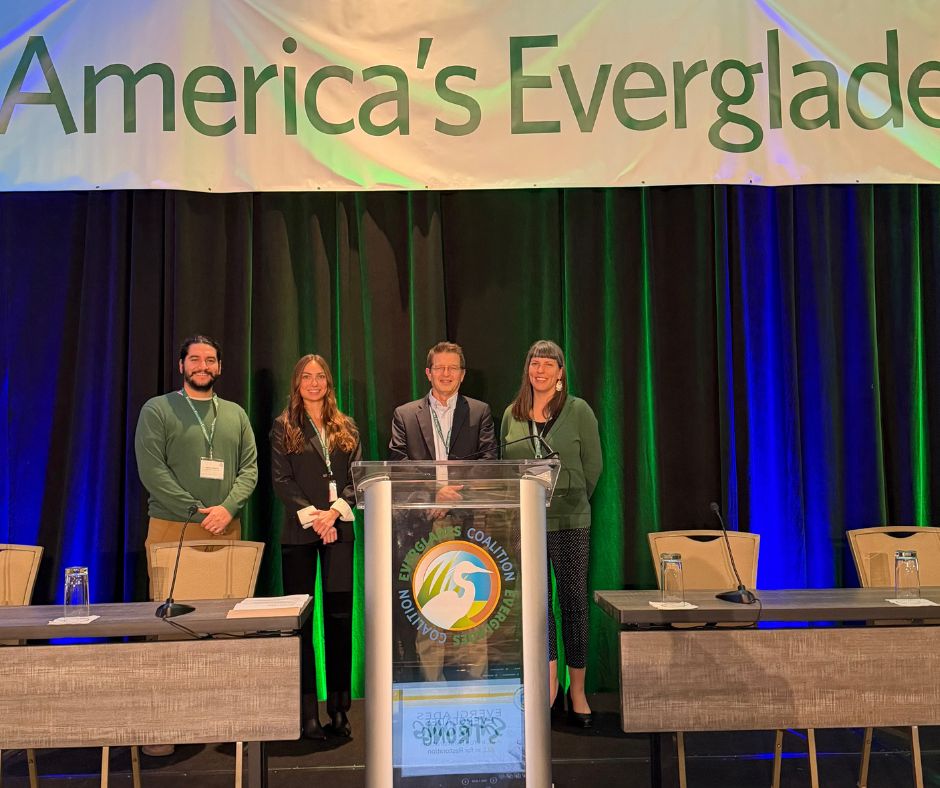
Left to right: Student Noah Peretz, Student Kylee Schaefer, Law Professor Royal Gardner, and Alumna Elise Bennett
“It’s appropriate that the Everglades serve as a model for the international community because the Everglades is internationally important in its own right,” Gardner said.
Not only is the vast, iconic wetland an international destination, but it is also designated under the Ramsar Convention and other international environmental regimes.
Facing the challenges ahead
Recent political shifts have led to uncertainty among environmental advocates on the future of wetlands protections. Among the most concerning to many is the U.S. Supreme Court decision in Sacket v. Environmental Protection Agency, the landmark case that recently led to a much narrower definition of wetlands subject to protection.
That same jetport parcel is in the spotlight again as the site of Alligator Alcatraz.
“Once more our nation’s commitment to conservation is being tested and at the exact same site, no less,” said Stetson Law Professor and Jacobs Public Interest Law Clinic for Democracy and the Environment Jaclyn Lopez, who spoke on the migrant detention center and represents amici-conservation groups in a lawsuit over Alligator Alcatraz.
Lopez moderated a panel of representatives from numerous groups who oppose the facility on environmental and cultural grounds, including indigenous tribes and environmental organizations.
“It is our hope with this panel we can learn from history and benefit from the struggles of those who came before us to do better, sooner,” Lopez said.
In his keynote address, Gardner encouraged his audience not to lose hope as policymakers threaten detrimental rollbacks of environmental protections, but to use the existing political system to challenge them.
“They’re people,” he said. “They’re people who run for office or put themselves up to be appointed to public office. So, what I want you to consider is running for office or encouraging good people to run for office. We need good people running the government.”
The Association of American Law Schools’ Section on Legal Writing, Reasoning, and Research is honoring Stetson Law Professor Kirsten K. Davis with its 2026 section award.
Recognizing an individual whose tireless work supports the advancement of the field, the award cites her extensive contributions to the legal writing community through scholarship, leadership, and transformative work, including her recent work on generative AI and legal communication.
When Davis was notified of the news during a surprise presentation arranged by Vice Dean Jason Palmer, three other luminaries from the discipline took part in the moment over Zoom and shared the reasons that Davis was the recipient of the award. She will receive the award during the AALS Annual Meeting Section Award Ceremony on Tuesday, January 8, 2026 in New Orleans.
An inspiration to colleagues
Over her 25-year teaching career, Davis has engaged her colleagues to help shape the way law schools – and, by extension, legal professionals – think about and approach legal writing. She founded the Stetson Institute for the Advancement of Legal Communication to further that mission, has produced sharp, insightful scholarship, and engaged her colleagues in forward-thinking conversations.
She has played a major role in Stetson Law’s status as a national leader in legal writing. The college is third in the nation in legal writing per US News & World Report’s 2025 rankings.
A significant aspect of Davis’s work has been shifting the discipline’s perspective on legal writing to a rhetorical one that recognizes law is appropriate for rigorous rhetorical critique, something that Stetson Law Associate Dean for Assessment and Professional Engagement Anne Mullins has found particularly influential in her own work.
“She is the person who taught me that legal writing was an inherently rhetorical exercise, and she showed me what rigorous rhetorical critique of legal texts looks like,” Mullins said. “The shift she got me to make was like going from seeing the world in black and white to technicolor.”
Davis has helped shape the future of legal education by serving in AALS leadership roles as well as on the boards of both the Association of Legal Writing Directors and Legal Writing Institute. Her body of scholarship explores the intersection of legal writing, rhetoric, and ethics, offering a rich interdisciplinary contribution. She also frequently presents at national conferences on these topics.
Leading the conversation on AI & legal communication
As generative AI began to emerge in late 2022, Davis saw the likely impact it was going to have on legal writing and higher education writ large. She founded a national conversation group on generative AI, has led workshops across the country for faculty, students, lawyers, and judges, and continues to generously share her expertise and time.
Her trailblazing work in educating the legal writing and higher education communities about the implications of generative AI is part of what led the AALS Section on Technology, Law, & Legal Education to give Davis its Technology Mentorship Award in January of 2024.
“I could not be happier to see Dr. Davis honored for her extraordinary contributions,” said University of North Dakota Assistant Professor of Law Carolyn Williams of Davis’s latest honor. “Her foresight to begin studying AI and bringing her knowledge into law schools via presentations all over the country and forming the Legal Writing and Generative AI Convo Group showcases that her work not only enriches our field—it defines it.”
Legal Research and Writing Clinical Professor Rebekah Hanley of University of Oregon School of Law said Davis has been critical to the legal writing discipline during the transition to the generative AI era.
“Her expertise, enthusiasm, and generosity are unmatched,” Hanley said. “She has led countless conversations about pedagogy, sharing key resources and facilitating productive collaboration. She has also published – and inspired – scholarship that supports both law faculty and practicing lawyers.”
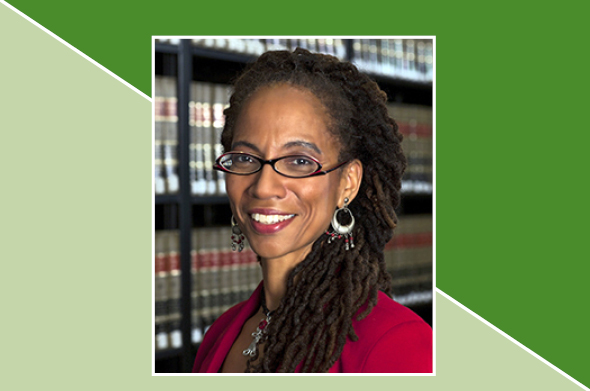
Left: Vice Dean Jason Palmer. Right: Associate Dean for Academic Affairs Stacey-Rae Simcox.
Building on Stetson Law’s commitment to supporting student success in law school and beyond, College of Law Dean D. Benjamin Barros has appointed Professor Jason Palmer as Vice Dean and Professor Stacey-Rae Simcox as Associate Dean for Academic Affairs.
Their insight and guidance in these roles will ensure that the College of Law will retain its academic rigor, grow in its capacity to support students, and engage alumni as well as the greater legal community.
Professor Jason Palmer becomes Vice Dean
Dean Barros has chosen Dean Palmer to be Vice Dean of the College of Law due to his exceptional work as associate dean for academic affairs, a role in which he served since summer of 2023.
In this new position, Dean Palmer leads strategic initiatives and oversees educational, administrative, and operational enhancements that advance the College’s priorities and institutional goals.
“Jason’s leadership and outstanding administrative abilities will be instrumental in helping us achieve our ambitious goals for the future,” said Barros. “He has done an exceptional job as associate dean for academic affairs, managing complex and difficult situations, and I look forward to working with him in this new capacity.”
Dean Palmer, who joined the Stetson Law faculty in 2008, teaches legal research and writing, civil procedure, complex litigation, international litigation and arbitration, law and sexuality, and other courses. He has written, published, and spoken extensively on domestic and international mass claims processes, and spent five years in Zurich, Switzerland, adjudicating claims of Holocaust victims who were attempting to recover assets from Swiss banks.
From 2019 to 2021, he served as chair of the Association of American Law Schools’ Professional Development (Arc of Career) Committee. Dean Palmer also served on the board of directors of the nonprofit Legal Writing Institute from 2016-2020 (including as treasurer from 2018 to 2020) and was chair of the AALS Section on Sexual Orientation and Gender Identity Issues.
On campus, he has supported students as an advisor on student legal publications and has helped facilitate workshops to train sign language interpreters how to navigate the complexities of conducting their work in a courtroom setting.
Professor Stacey-Rae Simcox named Associate Dean for Academic Affairs
Citing her leadership of Stetson Law’s Veterans Law Institute and Veterans Law Clinic, Dean Barros has also named Professor Stacey-Rae Simcox as Associate Dean for Academic Affairs.
Dean Simcox will continue her work as Director of the Veterans Law Institute throughout the 2025-2026 academic year. Her dedication to academic excellence and service to veterans reflects two key elements of Stetson Law’s mission.
Teaching veterans law, administrative law, and trusts and estates, Simcox joined the Stetson Law faculty in 2014. Her leadership of the Veterans Law Clinic has helped numerous veterans recover millions of dollars’ worth of previously denied benefits they earned through their service, all while giving clinic students meaningful real-world experience doing legal work.
“I have been impressed with Stacey-Rae’s leadership of the VLI and of some of our most important faculty committees,” said Dean Barros. “I am delighted that Stacey-Rae has agreed to take on this new role, and I look forward to working with her.”
As director of the VLI, she has also forged important partnerships, including a medical-legal partnership between Stetson Law and the University of South Florida’s Morsani College of Medicine that brings medical students and faculty and the Stetson Law community together to work for the benefit of disabled veterans.
In 2023, she co-published Veterans Benefits: Law, Theory, and Practice, a textbook for students working at veterans law clinics across the country.
She is a founding member of the National Law School Veterans Clinic Consortium and served as its president and on its board for six years.
Clockwise from top left: Law Professor and Director of Clinical and Experiential Education Christine Cerniglia; 2024 alumna Mary Rose Maloney; Adjunct Law Professor Ari Weisberg; 2018 alumna Taylor Sartor
The award honors donors, pro bono lawyers, and legal aid programs that support legal services for children. FFLA recognized the clinic during the 2025 Florida Bar Convention in June, noting that not all legal aid organizations or law schools have programs designed specifically for children.
“Providing opportunities for our students to work on behalf of minors who are unable to advocate for themselves during the most critical moments of their young lives is challenging but rewarding,” said Law Professor and Director of Clinical and Experiential Education Christine Cerniglia. “We greatly appreciate the recognition and look forward to supporting the important work the Public Defender’s Office does on behalf of our most vulnerable.”
A voice for the voiceless
Launched in 2012 after having been cofounded by the College of Law and then-Public Defender Bob Dillinger ’76, the program offers Stetson Law students the opportunity to work on cases involving at-risk youth. Its initial director was Steve Nelson, followed by Laura Snell in 2014.
Clinic leadership says the program helps fill a gap in the juvenile justice system, and can have a transformative effect.
“Providing express interest and holistic legal representation to a child is extremely gratifying, as you can deliver them real change,” said Ari Weisberg, Juvenile Division Director of the Sixth Judicial Circuit Public Defender’s Office (PD6), who has been overseeing the clinic since 2017. “An attorney for a child gives a voice to the voiceless, upholds children’s autonomy and agency, and builds trusting adult relationships. It is deeply fulfilling to know that your work supports the dignity of a child that may have no other champion.”
Igniting powerful career trajectories
Of the roughly three dozen students who have enrolled in the clinic, many have gone on to pursue careers in juvenile law, and now work at local legal aid organizations representing children in the child welfare system, the Department of Children and Families, the Statewide Guardian ad Litem Office, and Public Defender and State Attorney Offices across Florida.
The Florida Bar has recognized some alumni for their contribution to juvenile law. Some serve on the Legal Needs of Children Committee. One, 2018 alumna Taylor Sartor, has even created and published a handbook and related app called FosterPower to ensure that children in Florida’s foster care system know their rights.
Now an attorney at Bay Area Legal Services, Sartor said the Child Advocacy Clinic gave her invaluable experience that helped shape her career path, and that Weisberg remains an important mentor to her and fellow alumni who now help children in their daily work.
“This program gives law students the unique opportunity to not just learn how to be an effective advocate but also be able to put those skills into practice by representing clients,” Sartor said. “This recognition is very well deserved, and I highly recommend this clinic to anyone interested in becoming a children’s attorney.”
Real-world experience for aspiring advocates
While a student, 2024 alumna Mary Rose Maloney was interested in juvenile defense and dependency and was excited that the clinic offered crossover between the two. Sartor also suggested she apply for the clinic to prepare her for her current role as an attorney ad litem at Bay Area Legal Services.
Her work involved helping new clients understand how the delinquency court system works and representing them under the supervision of the attorneys in the office, which included preparing for trials.
One of her most impactful moments with the clinic was helping prevent a child from being “direct filed” (charged as an adult), which she said was particularly meaningful to her.
“The Child Advocacy Clinic was by far my favorite experience in law school,” Maloney said. “There is nothing more rewarding than protecting children’s rights as they navigate the system. Participating in the clinic helped me find where I belong in the legal field. I will forever be grateful for everything I learned at PD6.”
From standing up to violent drug cartels in Medellin, Colombia to spending nights and weekends tailoring lesson plans to meet the evolving needs of students, Law Professor Luz Nagle has spent decades in selfless pursuit of a more just world.
After 25 years of tirelessly leading Stetson’s international law courses and programs, Nagle has retired from her full-time faculty role.
Stetson Law Professor Luz Nagle
A passionate human rights advocate, she was Stetson Law’s first Hispanic tenured faculty member. Her deep commitment to her students – and, off campus, to fighting human trafficking and other international crimes – has helped earn her the honor of Professor Emerita. Nagle’s time at Stetson Law follows a long, varied career that began in her native Colombia, where she served as a young judge during serious sociopolitical violence in the 1980s.
Asked what she will miss the most about life at Stetson Law, Nagle said she’ll miss her students and watching them evolve into legal professionals.
“It’s so great to see the transformation of the students, from the first two weeks of class until the end,” she said. “The students taught me a lot, and that is what I treasure the most and what I miss the most.”
Tireless commitment, innovative approach
Colleagues say Nagle’s passion for teaching international law was contagious – and that she had a unique ability to engage students on the subject.
“While she continued to pile up awards and accolades throughout her career and was highly sought as a speaker around the world, Luz’s real passion was teaching and she excelled at it,” said Stetson Law Professor Mark Bauer. “Students were excited and inspired by Luz’s classes.”
He added that Nagle modeled exemplary professionalism and achievement for students, faculty, staff, and alumni of the College of Law.
Law Professor Linda Anderson said Professor Nagle is a beacon of knowledge in the realm of international law whose unwavering commitment to her students and passionate advocacy against human trafficking have left an indelible mark that will persist long after her retirement.
“Her profound dedication to shaping the next generation of legal minds and her tireless efforts in addressing global issues showcase a legacy that extends far beyond the classroom,” Anderson said. “Luz exemplifies the intersection of expertise and empathy, leaving an inspiring imprint on the lives she has touched.”
In photos: Professor Luz Nagle Abroad
LuzNagleBogotaOmbudsmanoffice1August2022
LuzNaglefaith-basedorgvisit1August2022
LuzNaglefaith-basedorgvisit2August2022
LuzNagleLGBTQorgvisit1August2022
LuzNagleBogotaAGofficeAugust2022
LuzNagleMayorsofficeCartagenaforum2022
LuzNagleFundacionDignitasAugust2022
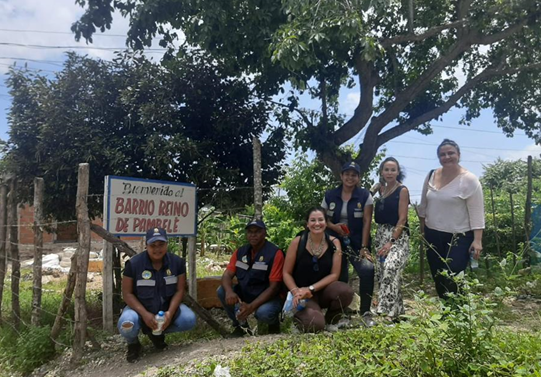
LuzNagleBarriodePalambe3August2022
LuzNagleBarriodePalambe4August2022
LuzNagleBarriodePalambe5August2022
NigeriaVisitNagle1
premioIBA
NigeriaVisit22
NaglewIraqidelegation2009
NaglespeakingwithEcuadorNationalPolice
Nagle’s approach to teaching was unconventional. Every semester, for every course she taught, she would tailor the coursework to the unique needs of her students.
“My first two weeks of class were always a thermometer for me,” Nagle said. “I would try to learn who my students were to see what method I was going to use for them to better understand and absorb the material.”
Nagle also went to great lengths to ensure her coursework was informed by current events, such as the war in Ukraine.
“In international law, events change every single semester and year,” she said. “I would grab events to create simulations for the students to be able to apply the cases and what we were covering.”
One year, as wildfires impeded California winemakers’ ability to grow grapes, she learned about the domestic and European wine industries and the laws governing them to develop a fact pattern that reflected the real-world complexities of international business.
Deep-seated passion for justice
Nagle’s commitment to student success seems to run in the family. The dean of a chemical engineering department at a university in Colombia, her father would invite struggling students to their home for tutoring sessions to help them grasp the material. His practices provided an early foundation for her own teaching techniques when she became a law professor.
The eighth of nine siblings, she grew up keenly aware of the poverty others were experiencing, and of her own privilege.
“I grew up in a country where the gaps between the haves and have-nots were huge,” Nagle said. “I remember being a little girl and my mom would always tell my younger brother and me to serve a plate equal to the ones we were serving ourselves and put it to the side because little kids would be knocking at the door asking for food. I saw a lot of kids going through trashcans looking for food.”
As a teenager, she was debating whether to study chemistry or law. She chose the latter after witnessing the way the justice system treated children living at local orphanages, whose legal troubles snowballed as the root cause of their behavior went unaddressed.
“I always thought that the children were not to blame for a lot per se; that there were issues in society that needed to be fixed,” Nagle said.
Seeking justice at all costs
Nagle’s early career was often harrowing.
She worked as a judge in a time and an area of Colombia where drug cartels paid off public officials – and targeted those who wouldn’t take a bribe. Unlike the justice system in the U.S., Colombia’s is inquisitorial, which means members of the judiciary conduct investigations. Nagle took her role seriously, regularly standing up to violent criminals and corrupt officials.
She faced death threats and multiple attempts on her life. Her car was tampered with. She was followed while driving to work by men on motorcycles who shot out her windshield.
One day, a drug cartel member came to Nagle’s office and tried to shoot her – but his gun got stuck in its holster. Nagle managed to draw a revolver she had been given for protection and shot him in the leg.
“When you’re young, you think you’re invulnerable,” Nagle said. “You think that you can change the world alone.”
The final straw was a warning from a concerned family friend, who asked her if she could stomach her family members being killed, one by one, if she persisted.
“And that’s when I said ‘Shoot. This is for real,’” Nagle said.
A new beginning
Nagle’s now-husband, Jerry, who she met years earlier while studying English in Santa Barbara, was planning to join her in Colombia as the threats reached a crescendo. Instead, they married and returned to California, where she had to build her career from scratch.
“I was a house painter,” she said. “I cleaned offices at night. I cleaned toilets. I had told my husband I didn’t want to be a lawyer because I didn’t believe in law. I didn’t believe in lawyers – because I thought they were corrupt.”
Her husband kept encouraging her to pursue law. She was moved to do so when, visiting a local Latin market, she heard stories about people having been brought to the U.S., kept as prisoners, and forced to work with no pay.
“Maybe learning a different system will allow me to be a bridge between countries in Latin America that are so corrupt,” she said. “And maybe the U.S. legal system will have more answers. Maybe the process will be fairer. And that’s how I decided to go back to school.”
In photos: Professor Nagle at Stetson Law
(L-R): Natalia C. Reyna Forero with Professor Luz Nagle.
Professor Luz Nagle presented in Canada.
Panelists (L-R): Professor Royal Gardner, Professor Luz Nagle, Professor Jason Palmer and alumnus Ahmad Yakzan.
(L-R): Professor Luz Nagle, Ahmad Yakzan, Franziska Kues and Gregory W. Kehoe.
(L-R): Stetson Law pioneering educators Professor Dorothea Beane, Ruth Thurman, and Luz Nagle.
HBAPres-DEArep-Nagle2000
Nagle2003Commencement
NagleAlumniOpenHouse2003
LuzNagle2003HonorsandAwards
NagleHonorsandAwards2004
NagleandChildren2004
She earned an M.A. in Latin American studies and an LL.M. in international law at UCLA, then went to the College of William & Mary for her J.D. She clerked for the Supreme Court of Virginia and worked for Microsoft Corporation’s Latin America Copyright Enforcement Practice.
Nagle was looking to transition into a teaching role that would allow her to spend more time with family. She wasn’t pleased with her options – until Dean Gary Vause called. The College of Law was developing an International Law LL.M. and he wanted to see if she was interested in leading the program.
She started in 1998, when Liz Moody was dean – the same year the Dolly & Homer Hand Library opened its doors. The International Law LL.M. launched that year. Over 25 years, her scholarly accomplishments were myriad. She has written extensively on human trafficking, lectured at universities across the world, advised governments, and served as a Fulbright Senior Scholar and Lecturer in the Canary Islands, Spain in 2019. (See Nagle’s full bio.)
No slowing down
Nights and weekends spent tailoring her lesson plans to the ever-evolving needs of her students may be over, but Nagle said she is not done working.
She is wrapping up a project on the link between human trafficking and public corruption for the United Nations Office on Drugs and Crime, working with George Mason University’s Terrorism, Transnational Crime and Corruption Center, and is chair of American Bar Association Rule of Law Initiative for Latin America and the Caribbean.
“I hate the word retirement. If you retire, it’s like you just do nothing. No. I’m just changing,” Nagle said. “I’m going to be busy.”
Dr. Kirsten Davis, Professor of Law and Faculty Director of Online Legal Education Strategies at Stetson.
From embracing virtual learning during the pandemic to inspiring colleagues to reimagine legal education in the age of artificial intelligence, Dr. Kirsten Davis is leading important conversations about the ways tech transforms how we teach law.
Earlier this month, Davis, a Professor of Law at Stetson and the college’s Faculty Director of Online Legal Education Strategies, was an inaugural recipient of the Association of American Law Schools Section on Technology, Law, & Legal Education Technology Mentorship Award.
The Section’s award announcement to its members described Davis a “a respected authority in legal ethics and communication” who “has made significant strides in integrating technology into legal education,” particularly with regard to the effects A.I. is having on the field.
“Through her impactful pedagogy, scholarly work, and direct mentorship, she has been a catalyst in helping students and peers understand and adapt to the rapidly evolving landscape in practice,” the Section announcement said. “Her initiatives have set a benchmark for technology mentorship within legal academia.”
Advancing the conversation
To be eligible for the award, nominees are required to have made notable efforts to help colleagues navigate the changing technology landscape, such as workshops, scholarship, or events aiming to share insights about emerging tech and offer mentees hands-on opportunities to apply what they’ve learned.
Law Professor Ashley Krenelka-Chase nominated Davis for the AALS award. She said she was motivated to do so because Davis works tirelessly to share her knowledge and understanding of emerging technologies – specifically the proliferation of Generative A.I. programs like Chat GPT.
“Her mentorship has helped people feel more comfortable with what they do and don’t know about using this technology in their classrooms and has allowed all of us to think about the use of generative A.I. and other technologies beyond the black and white in which it is often portrayed,” Krenelka-Chase said.
How it started: Adapting to The New Normal
In 2020, as education institutions everywhere grappled with how to ensure learning continued amid a global pandemic, Davis sprang into action.
She developed tutorials for colleagues who were new to virtual platforms like Zoom, created Amazon shopping lists to help them outfit their home offices with lighting and audio equipment, and more.
“From Zoom to working with Canvas to helping teaching assistants get up to speed on how to support online teaching, we were really just in survival mode in that first bit,” she said.
For that work, the university gave Davis an award for Covid-era innovation.
As the campus transitioned to the learning management software Canvas, Davis worked with Academic Technology Manager Julie Kitzmiller and faculty members Elizabeth Berenguer and Ashley Krenelka Chase on a program to train faculty and staff on the platform.
Sparking New Conversations about A.I.
As ChatGPT and other generative artificial intelligence began to grab headlines in late 2022, Davis – on sabbatical at the time – jumped at the chance to explore its implications for law schools.
“This was the moment I’ve been waiting on my whole career: the opportunity to study technology that might represent a paradigmatic shift for writing and researching the law,” Davis said.
Realizing the likely impact generative A.I. was about to have on legal education – especially legal writing – Davis reached out to colleagues on a listserv read by legal-writing experts across the country and invited them to join a national online conversation, the Generative A.I. and Legal Writing Convo Group.
Dr. Kirsten Davis, a Professor of Law at Stetson, presented on artificial intelligence’s impact on law careers at Campus to Career 2024.
“I sent out an invitation and faculty started joining on Zoom. We talked about our concerns: Would legal writing classes need new outcomes?” Davis said. “Would faculty need new writing assessment practices? What kind of academic integrity policies should we have with generative AI in the mix? Do we need new curriculum, exercises, and assignments, and what would they look like?”
The group has grown from under 30 members in May 2023 to nearly 300 as of January 2024. Davis has since spoken on generative A.I. and legal writing at law schools at Georgetown, Rutgers, Temple, and Southwestern and will speak at the University of Baltimore in April.
Assessing A.I.’s new role in the classroom & beyond
Those conversations encouraged others to ask questions about how generative A.I. is changing legal education. Davis said developing new approaches to student assessment will be particularly important. Evaluating legal writing assignments has long been seen as a way to evaluate not only the skill of communication but also underlying lawyering skills like legal reasoning. Students’ use of generative A.I. to write papers may change that assumption, which could mean that new ways of assessing skills need to develop.
“I think from a legal education perspective, faculty have to ask, what does the world of lawyering look like for our students three, five, ten years from now?” Davis said. “How are we going to prepare them to navigate a practice world with unprecedented writing technology? Our responses to these questions are going be important.”
The future ubiquity of generative A.I. means law schools need to consider right now whether to teach students prompt engineering skills – and how to evaluate and refine the text A.I. generates, she said. The legal profession will also likely see significant impacts, such as changes to staffing models and billing practices in an environment where legal documents can be generated and refined in a fraction of the time it has historically taken, Davis said.
One question Davis is frequently asked is whether artificial intelligence will eliminate the need for lawyers.
“The discussion of the end of lawyering has been going on for decades, Davis said. “So this question is not something entirely new. Generative A.I. changes the calculus, but I think clients and the legal system will always need careful, smart, lawyers with good judgment and even better ideas who can make good use of technology.”
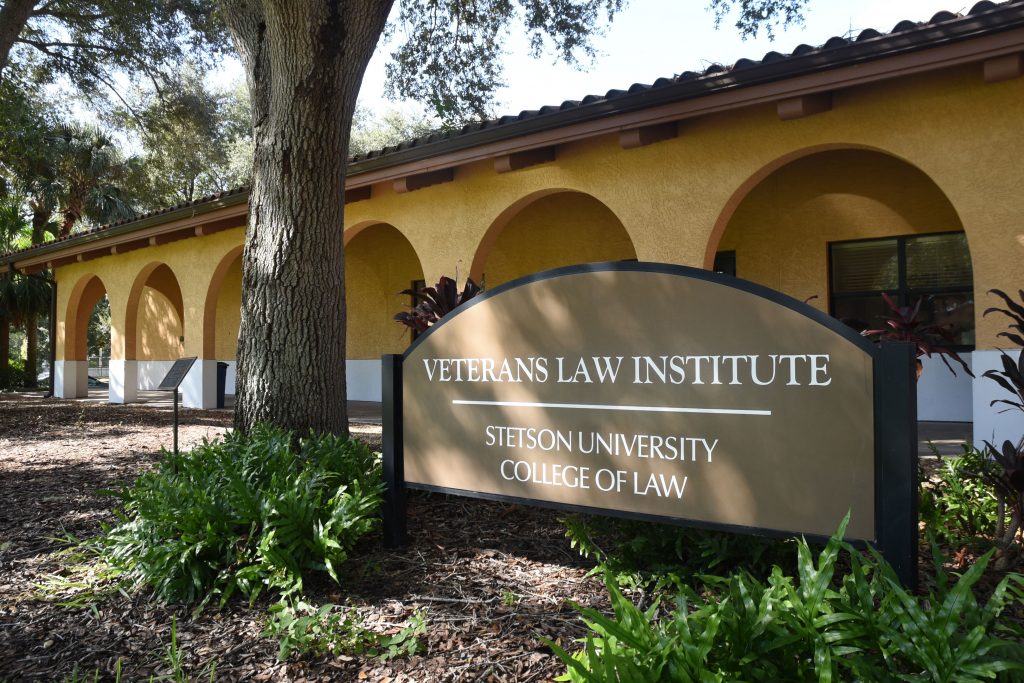
The Veterans Law Institute is on the Stetson University College of Law campus in Gulfport, Florida.
In recognition of its extensive work on behalf of veterans, The Veterans Consortium (TVC) has named Stetson’s Veterans Law Institute among seven recipients of its 2023 TVC Pro Bono Mission Partner Awards.
The awards honor active members of TVC’s National Volunteer Corps for committing their time and expertise to help further TVC’s mission of providing quality legal services to veterans in need at no charge. Award recipients will be honored Wednesday, November 15at the TVC Pro Bono Mission Partner Awards Reception, in Washington, DC.
The VLI won the consortium’s inaugural Legal Scholars Award for its extensive work on behalf of veterans. Law Professor and Veterans Law Institute Director Stacey-Rae Simcox and Adjunct Professor and VLI Associate Director Morgan MacIsaac-Bykowski will travel to Washington to accept the award.
“It is an honor to be recognized by The Veterans Consortium for the work we do on behalf of veterans,” Simcox said. “And it only inspires us to build on our successful record of advocating for veterans while giving our students a chance to do meaningful work on behalf of those who have served our nation.”
Tireless work on behalf of veterans
A founding member of the National Law School Veterans Clinic Consortium (NLSVCC), the VLI has been involved with numerous efforts to secure benefits for veterans whose claims for benefits from the U.S. Department of Veterans Affairs had been denied or inadequately compensated. These cases can take years.
In one case, a Navy veteran was hit by a car during service and suffered numerous injuries. They worsened over time; eventually requiring him to use a wheelchair. VLI students and staff took his case to court four times. After eight years, their work led to the client’s payment going from 30 percent to 100 percent due to unemployability and allowed him to receive over $70,000 in back benefits owed to him.
In another, a Navy corpsman experienced neurological damage after being tasked with spraying a pesticide to kill the fruit flies that invaded the Naval facility where he worked. He was eventually diagnosed with multiple sclerosis (MS). Receiving no benefits, he sought help from the VLI.
Professor Stacey-Rae Simcox meets with students working with the Veterans Advocacy Clinic.
Over four years, they were able to prove the connection between the pesticides he used and his MS – and the veteran received 100 percent of his claim along with Dependent and Indemnity compensation, which means his spouse would be paid monthly after he passed away. In addition, the VLI helped secure over $1 million in back pay for the client since his wife had been paying out of pocket for nursing home care, prescriptions, and medical appointments that should have been covered by the U.S. Department of Veterans Affairs.
Gaining experience, changing lives
In addition to helping veterans, the VLI gives students the opportunity to gain critical hands-on experience on U.S. Court of Appeals for Veterans Claims (CAVC) cases with potentially transformative outcomes.
For alumnus Christopher Gieger ’21, the first case he worked on was an introduction to appellate advocacy in administrative law, which became a critical first step toward his current career.
“I loved the challenges of the case and figuring out the best way to present our arguments in a brief,” he said. “The case also gave me the honor of representing a United States Veteran. We wanted to provide the best advocacy possible, and that pressure was a privilege.”
Alumnus Max Yarus ’19 said he wanted to gain experience serving vulnerable populations through public interest litigation – adding that working on veterans’ behalf was a chance to feel close to his grandfather, a World War II veteran.
“I remember writing my first memos and briefs and conducting negotiations with opposing counsel at the VLI; they were truly the foundations of my legal career and gave me the confidence to continue representing veterans in appeals to the CAVC after graduation,” he said. “I am currently clerking for Judge [Michael] Allen on the CAVC, and I’m eternally grateful for the VLI starting me down this career path.”
A former U.S. Army Airborne Infantryman who deployed as part of Operation Enduring Freedom, Vasilios Zimarakos ‘20 said many of his friends, family members, peers, and leaders who have experienced disabilities caused by and obtained during their time in service.
He said his most memorable appellate case while working in the VLI involved the widow of a veteran who had died from a disability obtained during his service in the Vietnam War. Zimarakos and his colleagues were able to secure benefits for the widow as well as back pay.
“The feeling of being able to tell ‘my’ first client about the outcome is something I’ll never forget, and my experiences at the VLI shaped my professional career in ways I still attribute to my time spent working on cases for our nation’s veterans,” Zimarakos said.
The Elizabeth Hurlock Beckman Award Trust has chosen Law Professor Judith Scully as one of eight recipients of its prestigious Elizabeth Hurlock Beckman Award.
Each year, the award aims to honor a teacher or professor who has inspired former students to “create an organization which has demonstrably conferred a benefit on the community at large” or established “on a lasting basis a concept, procedure or movement of comparable benefit to the community at large.”
As founder and co-director of Stetson Law’s Social Justice Advocacy Concentration and a champion of Stetson Law’s robust, pioneering pro bono program, Scully works tirelessly to help turn students’ passion into actionable initiatives capable of creating transformative outcomes. This includes having led the Stetson Law Innocence Initiative and co-chairing the St. Petersburg Higher Education for Racial Equality (SPHERE) Consortium.
Mentee honors mentor
Educators who are honored with this award must be nominated by a former student whose work they inspired.
In Scully’s case, Alumna Taylor Sartor, a graduate of Stetson Law’s Social Justice Advocacy Concentration, nominated her. It was Scully’s guidance in helping her develop and establish what ultimately became FosterPower, a digital platform that empowers youth in the foster care system to advocate for themselves, that compelled Sartor to nominate her.
The platform, which launched in June of 2023, grew out of a know-your-rights guide offering information and resources to youth in the foster system, which Sartor worked on under Scully’s mentorship.
“Professor Scully has inspired so many students to go on and do impactful work with our law degrees, and I am grateful she gave me the tools to be the social justice attorney I am today,” Sartor said. “Professor Scully planted the seed during my time in law school, and in years to come my vision of kids knowing their rights bloomed into a movement that has given youth across the state of Florida access to vital information on their rights.”
FosterPower was designed to be an easy-to-access resource for youth in the foster care system.
To the Elizabeth Hurlock Beckman Award Advisory Committee, Scully’s guidance on the project reflects the purpose of the award.
In addition to being honored at an October 14, 2023 ceremony in Atlanta, Scully will receive a $25,000 award.
Spotlighting transformative work
Scully said she is profoundly thankful to Sartor for taking the time to nominate her, and that she hopes it will help spread awareness of the Social Justice Advocacy program and the important work of program graduates like Sartor.
“I am deeply honored to be named as an awardee particularly because of the spotlight we can place on both our SJA program and the work that Taylor began several years ago as a student in our program,” Scully said.
The Elizabeth Hurlock Beckman Award honors Hurlock Beckman’s contributions to the field of psychology. It was established by her daughter, Gail McKnight Beckman in 2008. Though the committee has given the award to more than 20 educators in some years, in 2023, just eight educators received the award, Scully among them.
Stetson Law Professor Jason Palmer spoke at The Florida Holocaust Museum as part of the museum’s Lawyers of Conscience series.
Before a packed room at The Florida Holocaust Museum, Stetson Law Professor Jason Palmer gave a compelling talk on the process of helping families of Holocaust victims reclaim assets from Swiss banks.
Palmer, who teaches international litigation and arbitration, legal writing, civil procedure, and law and sexuality – among other courses – wove together strands of history, collaboration, and heart-wrenching stories of families seeking justice in the wake of unprecedented atrocity as part of the museum’s Lawyers of Conscience lecture series.
“Not only did I spend five years of my life in Zurich, Switzerland, working on these matters and working on international mass claims processes, but I also have a personal connection, with a family member who was a Holocaust survivor and very close friends whose parents were Holocaust survivors,” Palmer said. “So the work that the museum does is very important and the topic is personal.”
An international collaboration
As a claims judge for the Claims Resolution Tribunal (CRT) for Dormant Accounts in Switzerland, Palmer adjudicated claims for dormant Swiss bank accounts of victims of Nazi persecution. The process was the result of legal challenges to Swiss banks that had accumulated great wealth in part from assets deposited there by individuals who later became victims of the Holocaust or were separated from their wealth when the Iron Curtain was established.
Relatives of Holocaust victims were asked to submit claims if they believed a loved one had deposited assets in a Swiss bank prior to the war. If they could prove their relation to the person who established a now-dormant account, tribunal officials awarded them with an amount of money comparable to the original deposit, with appropriate interest and fees added as of the date of the award.
Thousands of people from around the world had legitimate claims – all of which were investigated by a team of about 100 young legal professionals – lawyers, paralegals, translators – committed to doling out justice.
“Over the course of both CRTs, over $720 million was distributed to victims of the Holocaust,” Palmer said. “It was really an amazing enterprise made up of people basically in their late twenties to late thirties.”
A challenging legal landscape
Determining whether a claim should be paid required claimants to provide documentation to justify their claims – but since adjudicators could not rely on documents like death certificates (given there often wasn’t one), they had to get creative.
In one case, a claimant whose grandparents had made a deposit had only one way to demonstrate the validity of her claim: describing the place her grandparents lived, from her memories of visiting them as a little girl. The adjudicators used old maps to determine that her description of the town – the church down the street, a nearby playground – matched the layout of the town listed in the address used to open the account.
There were also challenges with multiple account holders sharing a name, and with determining which nation’s laws applied at a time when shifting borders kept an account holder’s citizenship in flux.
In some cases, the process helped reunite families whose connections had been lost to the war.
When an account was awarded that was determined to be owned by a victim of Nazi persecution, a computer model subsequently helped Palmer and his team to determine an equitable adjustment to the account amount which was also awarded to the claimant. While they couldn’t guarantee the claimants were being given the exact amount that was deposited, the CRT did its best. “It wasn’t perfect justice,” Palmer said. “It wasn’t the exact amount, but it was to right a historical wrong.”
An enduring Stetson Law connection
The event was not just the first edition of Lawyers of Conscience since before the start of the COVID-19 pandemic; it also marks the tenth anniversary of the series. Museum board member Rachael Worthington noted that the inaugural speaker of the series in 2013 was former Stetson Law Dean Bruce Jacob.
Jacob, who spent 13 years as Stetson Law dean (1981-1994), focused on the Nuremberg medical trials, which prosecuted Nazi doctors who carried out cruel experiments on Holocaust victims.
Palmer’s evening lecture was open to the general public, but the professor also led a CLE seminar on the same topic for legal professionals earlier in the day.
After roughly five years of intensive research and writing, Law Professor Stacey-Rae Simcox has published a unique book that could benefit countless veterans.
A collaboration with William & Mary Law School Professor Emeritus David E. Boelzner, the book is called Veterans Benefits: Law, Theory, and Practice. Published through Carolina Academic Press, it aims to serve as “a useful and complete resource for teachers of veterans law, particularly in the practical context of preparing student advocates in law clinics to assist veterans with their claims for benefits.”
It concisely maps out the incredibly complex VA claims system and shows students how to navigate it.
A practical focus
What makes the book particularly useful to students working in veterans law clinics at law schools across the country is that it gives them concrete examples that invite students to apply what they are learning to real-world client situations.
“A clinical course requires practical application of statute, regulation, case law, and analysis to a real-life client’s legal issues,” Simcox, who is director of Stetson Law’s Veterans Law Institute, said. “This book is unique because it provides students with a number of client vignettes to allow the student to apply what they are learning to a practical client scenario, just as they would in practice.”
Another useful attribute for their intended audience: the most important cases in this area of law are summarized so students spend less time dissecting and analyzing each case and more time working on behalf of their clients.
“That allows students and instructors to move more quickly through understanding complicated material toward applying what they have learned,” Simcox said.
An ever-changing landscape
Law Professor Stacey-Rae Simcox and her co-collaborators spent nearly five years working on this clinics-focused textbook.
One of the biggest challenges Simcox and Boelzner had was making sure the text reflected the major congressional changes to veteran benefits and the way the U.S. Department of Veterans Affairs administers them.
One example: In 2019, VA implemented a statute passed in 2017 that overhauled the appeals process for VA decisions, which meant they had to significantly alter the book. Another happened just as they went to press, when Congress passed the PACT Act, which added a number of presumptive conditions for veterans who served in the Middle East, Camp Lejeune, and Vietnam.
“Every time these changes happened, they had to be accounted for in the book to make sure it had the most up-to-date material for students,” Simcox said. “That slowed the process down dramatically.”
Bridging a legal gap
Part of what makes veterans law clinics at law schools such a critical resource for veterans going through the VA claims process is a federal policy barring them from hiring an attorney until the agency has examined evidence and issued a decision affirming or denying the claim. This often leaves veterans without an advocate during a critical part of the disability claims process.
Since their work is unpaid, students working through veterans law clinics at their law schools are uniquely positioned to assist – provided they have a solid grasp of the system’s nuances.
“Our hope is that this book will help law students and other advocates gain a deeper understanding of veterans law and help achieve better results for our veterans and their families,” Simcox said. “And on a personal note, as a veteran myself, I consider it a great privilege to give back to my fellow veterans in this small way.”
Both authors thank Judge Michael Allen, a former Stetson Law professor was also director of the college’s Veterans Law Institute, in their acknowledgements. An early collaborator on the book, Allen was appointed a judge of the U.S. Court of Appeals for Veterans Claims in August of 2017. His appointment to the bench was an important development for veterans, given his extensive knowledge of federal courts as well as constitutional and administrative law, Simcox said.