
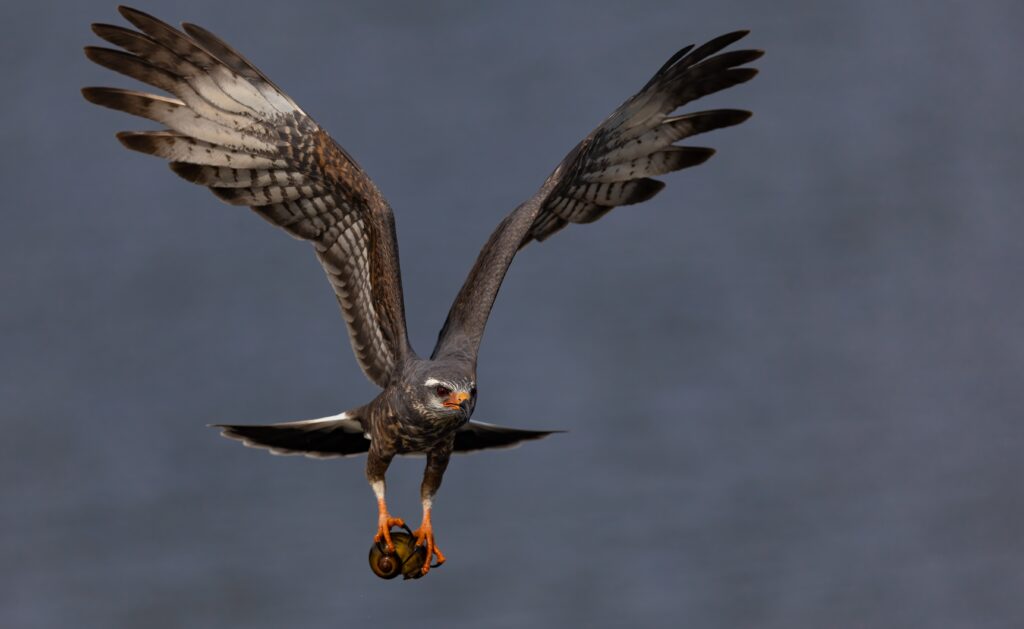
From shifting weather patterns to widespread development of wetlands that are home to its favorite food, the endangered Everglade snail kite has faced myriad threats to its existence. Despite the seemingly insurmountable threat of extinction, the bird of prey figured out how to survive.
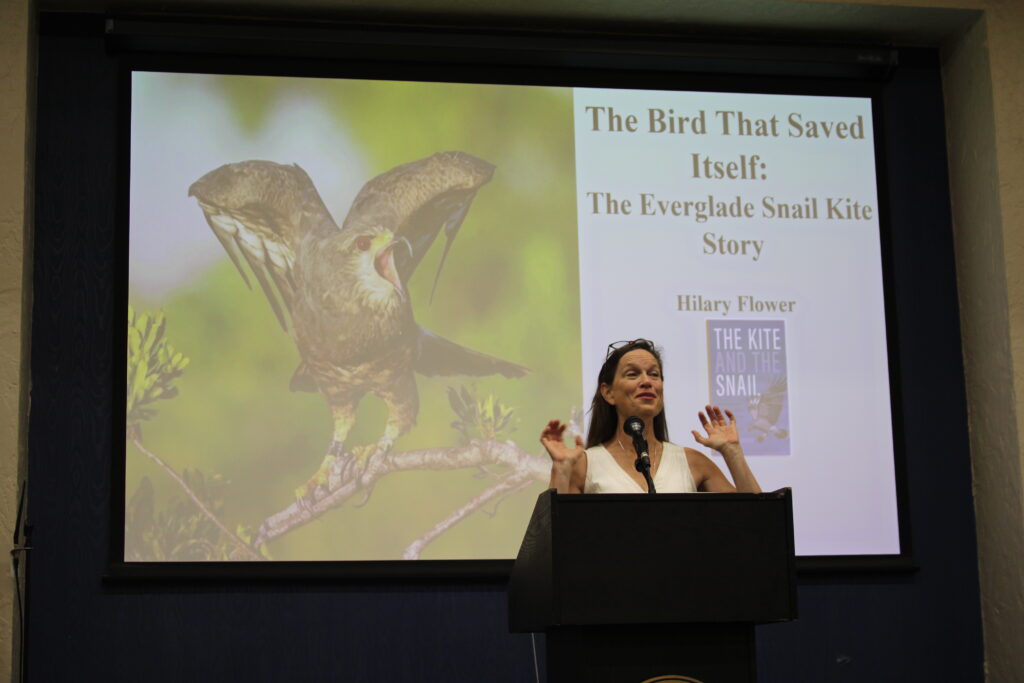
In a recent Foreman Biodiversity Lecture, author, geologist, and ecohydrologist Hilary Flower shared the story of how the South Florida species beat the odds. Flower’s recent book, The Kite and the Snail, examines the Everglade snail kite’s survival in depth and explores what might be learned from it.
“I’m calling this talk The Bird That Saved Itself because it’s an endangered species that keeps saving its own butt,” Flower told attendees.
Highly adapted but picky
A medium-sized raptor found only in Florida, the Everglade snail kite is, as Sir David Attenborough might put it, one of nature’s ultimate specialists. The bird feeds exclusively on apple snails and has evolved a uniquely curved bill for removing them from their shells. But the picky diet comes with a major downside.
“If the snail’s gone, [the Everglade snail kite is] gone,” Flower said.
Historically, they ranged throughout Florida’s wetlands, particularly south of Lake Okeechobee. But as with so many South Florida species, drainage of the Everglades, development, and changes to water management dramatically reduced their habitat. By the mid-20th century, surveys estimated that only 25 to 100 birds remained.
Taking refuge in unlikely places
As conservation efforts ramped up under the Endangered Species Act, federal officials designated critical habitat for the species. Yet the areas officially protected on paper were not always the places that ultimately saved the birds.
During a severe drought in the early 1980s, wildlife biologist Jean Takekawa launched a statewide “snail kite hotline” to locate missing birds after traditional habitat dried out. Reports revealed that the kites had dispersed across Florida, seeking food in unexpected places.
“She called them nomads,” Flower said.
Rather than surviving in pristine wetlands, many birds were found in canals, retention ponds, roadside ditches, and other altered landscapes Flower referred to as “emergency wetlands.”
One site proved especially important: an abandoned mining pit in Palm Beach County slated for landfill development. After receiving a tip that one had been spotted at the site, Takekawa paddled out in a canoe to scope it out. There were too many to count. In 1985, researchers counted 372 snail kites roosting there, even though only about 400 birds remained statewide at the end of that year.
“This wetland, this crazy about-to-be-a-landfill wetland saved the snail kites,” Flower said.
The story illustrates both the resilience of the species and the challenges facing conservation efforts, she said.
Adapting & surviving
For decades, scientists viewed the bird as an indicator of Everglades health because its survival depends on clean, shallow wetlands that also support countless other species.
“When it was thriving, the larger ecosystem was thriving,” Flower said.
Today, however, many snail kites have shifted north of Lake Okeechobee and increasingly rely on an invasive apple snail rather than the native species that once sustained them. Their continued survival reflects an ability to adapt to changing conditions, but it also raises concerns about the state of the ecosystem they once symbolized.
“Think about its name, Everglade snail kite,” Flower said. “It’s no longer in the Everglades.”
Even so, she remains impressed by the bird’s persistence.
“It’s so adaptive,” she said. “It is doing everything it can to save itself.”