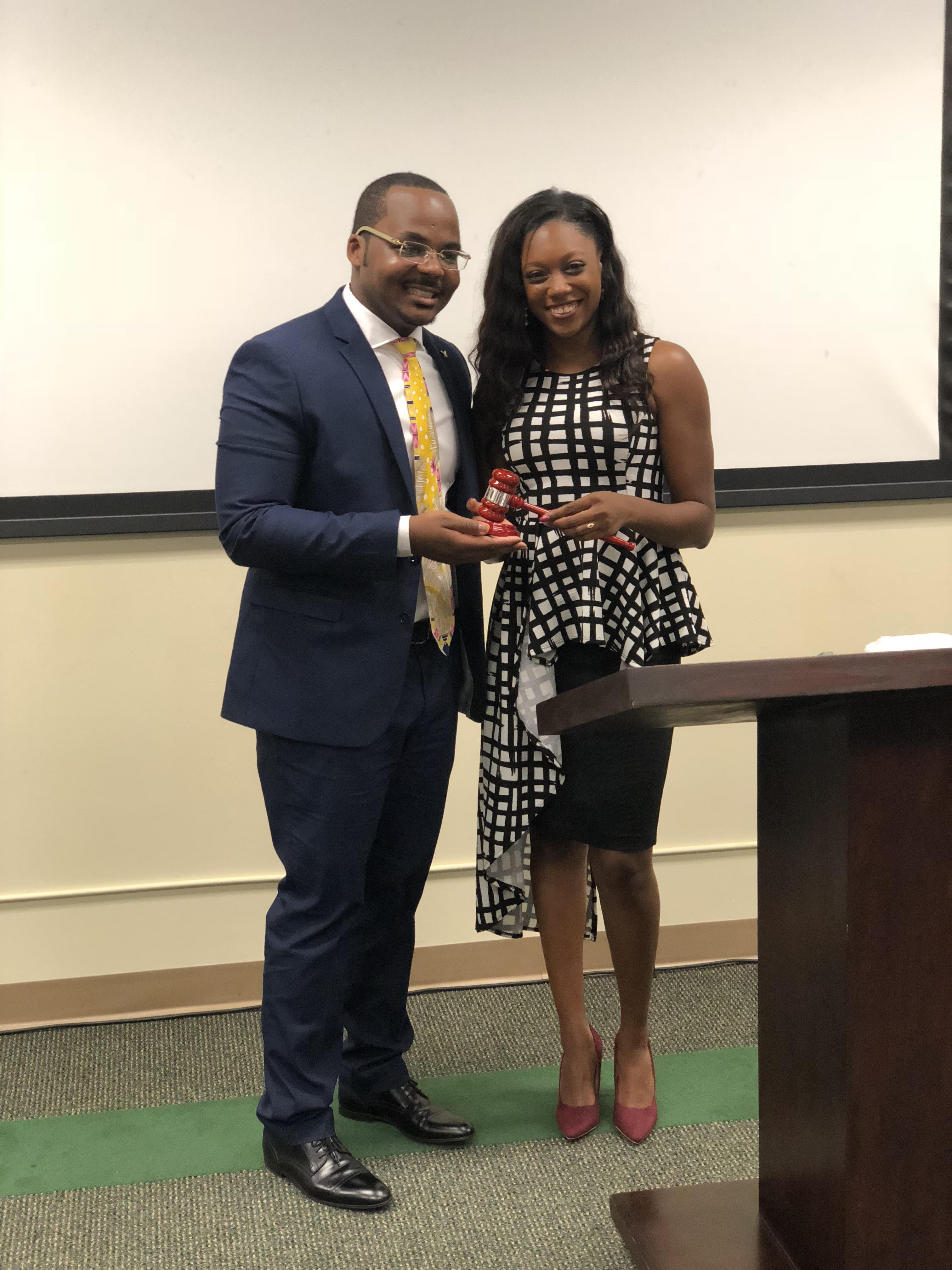
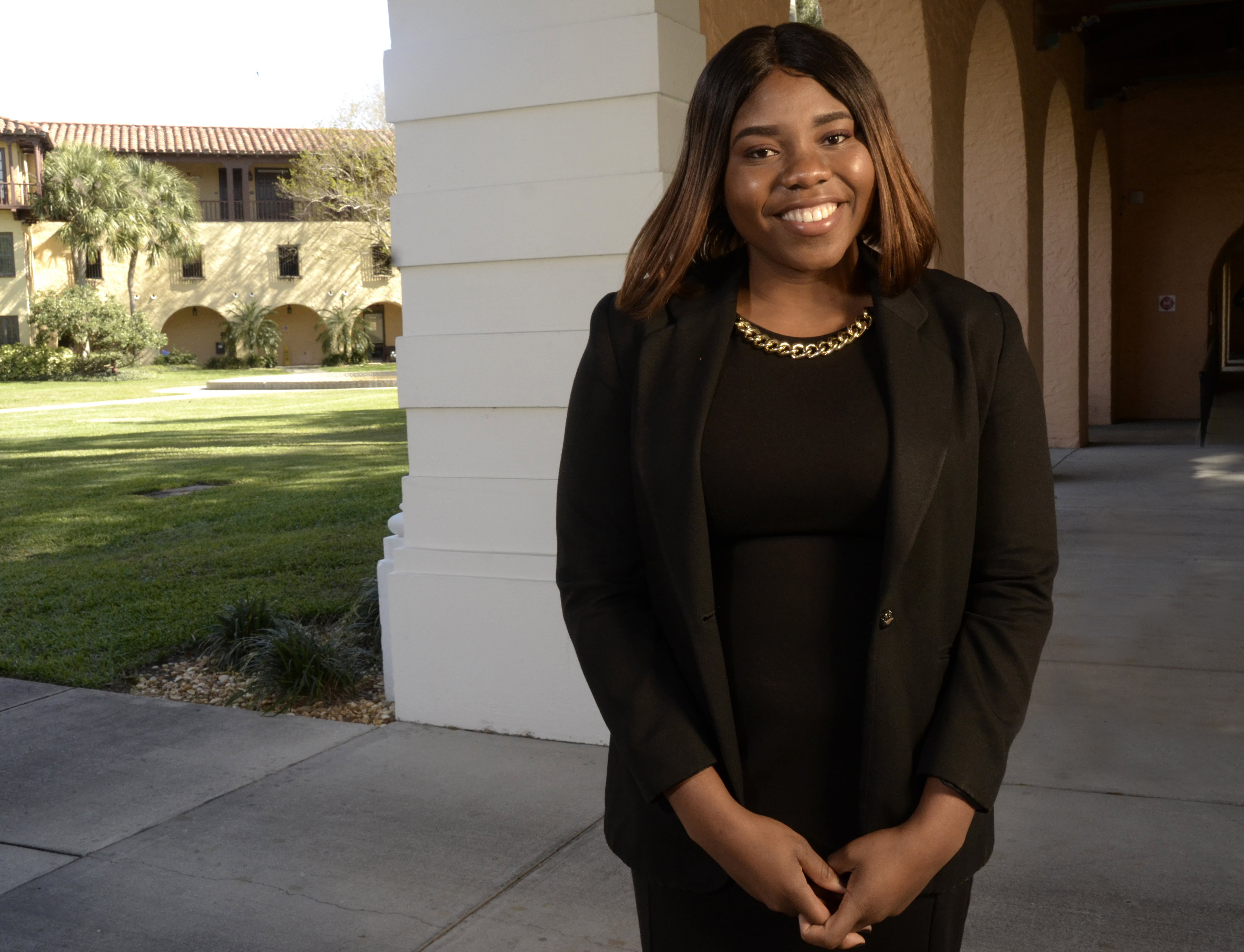
Professor of Law Kristen D. Adams has been selected as the interim dean of Stetson University College of Law in Gulfport, Florida, effective June 1.
Current Stetson Law Dean Christopher M. Pietruszkiewicz, dean at the College of Law since 2012, has been appointed president of the University of Evansville in Evansville, Indiana, effective July 1, 2018.
Professor Adams is the faculty advisor for the nationally acclaimed Dispute Resolution Board, one of the faculty coordinators of the Social Justice Advocacy Concentration program, and one of the faculty pro bono coordinators at Stetson, where she has taught for more than 17 years. Adams also serves as a mentor for Stetson’s LL.M. students focusing on international business and supervises the Homeless Advocacy Externship.
Adams is the author or co-author of six books and 17 scholarly articles. She is currently the chair of the American Bar Association Business Law Section’s Uniform Commercial Code Committee, editor-in-chief of the Uniform Commercial Code Law Journal, a member of the Board of Regents for the American College of Commercial Finance Lawyers, an elected member of the American Law Institute, and on the Executive Committee of the Board of Directors for Gulfcoast Legal Services.
Adams graduated from Emory Law School with honors in 1995 and received her LL.M. degree from Yale Law School in 2000. Before joining academia, Adams served in private practice in Atlanta, Georgia, as a commercial litigator.
A national search for the next dean of Stetson Law will begin in the fall.
Editor’s Note: Joseph Sise is the recipient of Stetson University College of Law’s prestigious Foreman Award, announced on May 18.
Joseph Sise, a third-year law student at Stetson graduating in May, is a member of Stetson’s Trial Team. He spends an average of 20 hours on weekends preparing for competitions scattered across the country from Kansas City to Miami, participating in four competitions as a 2L and five as a 3L. He is a state, regional and national champion on Trial Team, taking home first place at the National Civil Trial Competition in Los Angeles in 2016. Sise was also part of the team that won the Chester Bedell Trial Competition last year.
In his spare time, between classes and Trial Team practice, and serving as an associate editor on the Stetson Law Review, Sise has managed to write the draft of a novel.
“Law school teaches you to look beneath what seems obvious on the surface for the true underlying facts of a case,” said Sise. “You have to have the willingness to learn, and that means that you also have to have the willingness to be wrong in order to learn.”
Sise said that the practically oriented advocacy focus at Stetson drew him to the law school. He knew that he wanted to be an advocate when he came to Stetson, where he had an opportunity to join the Trial Team.
“Trial Team teaches you to have a confidence in the process and an awareness of how others perceive you, to learn how to talk with judges, appeal to other people, and leave your ego at the door,” he said. In preparing for every competition, Sise shared that researching the preferred presentation style involves thinking about the best way to connect with people and paying attention to different perspectives. During his last competition, Sise had the opportunity to present for both the prosecution and defense.
“I’ve built good relationships with people,” said Sise.
At Stetson, Sise is a teaching assistant for Professor Erika McArdle, a one-time Stetson Trial Team champion herself.
His grandfather, John Lynch of Naples, Florida, inspired him to go to law school. Sise’s dad Joe is a judge with the Supreme Court of New York and his mom Robin is a lawyer who worked on the model for Child Health Plus, a New York State program that provides health coverage to uninsured children, before taking a leave to raise four kids.
“My parents taught me the importance of different perspectives, about paying attention to someone who doesn’t agree with you, and about being empathetic,” said Sise.
After he graduates in May, he and his girlfriend Selena Lorry, who’s been accepted into a Ph.D. program doing research in cancer immunology at Duke University, will be moving to North Carolina in the summer.
“I’m open to a lot of things in the future,” said Sise, who has his sights on working as a plaintiff’s attorney. “Whatever you do, it gives you experience.”
(L-R): Brittany Showalter, Kate Konecny, FAWLS incoming president Kimberly Lopater, Casey Burns, Julia Alley, Michelle Moretz, FAWLS advisor Joann Grages Burnett.
Stetson’s chapter of the Florida Association of Women Lawyers was again honored by FAWL, receiving the 2018 Outstanding Student Chapter Award for the fourth year.
FAWLS, which recently hosted the second annual Women’s Week at Stetson this year, with programming to help support and advance women, was also named Student Organization of the Year. Kimberly Lopater, FAWLS incoming president, was named Rising Star during Stetson’s student organization award on April 23.
Stetson’s chapter will receive its award during the summer FAWL Annual Gala during the Florida Bar’s annual convention on June 13 in Orlando.
“FAWLS has a history of strong and passionate leadership and this year is certainly no exception,” said Joann Grages Burnett, Associate Director of Career and Professional Development. “FAWLS continues to provide creative, timely, and thoughtful programming to the Stetson Law community. I am thrilled that their hard work and dedication to FAWL’s mission continues to be recognized.”
Established in 2014, the award is presented annually to the FAWL student chapter that has most effectively created new programs, events, or services and/or expanded on traditional programs, events or services that further FAWL’s mission; provided programs, events or services that encourage and assist members to become leaders in the law school and in the community; sought and gained exposure and recognition in both the law school community and the community as a whole; promoted diversity in law school and/or in the community; successfully recruited new members; and consistently participated in the state FAWL organization by paying dues in a timely manner, having an active chapter representative, attending meetings and functions, encouraging volunteers for committees and offices, working well with other local chapters, and assisting with FAWL projects.
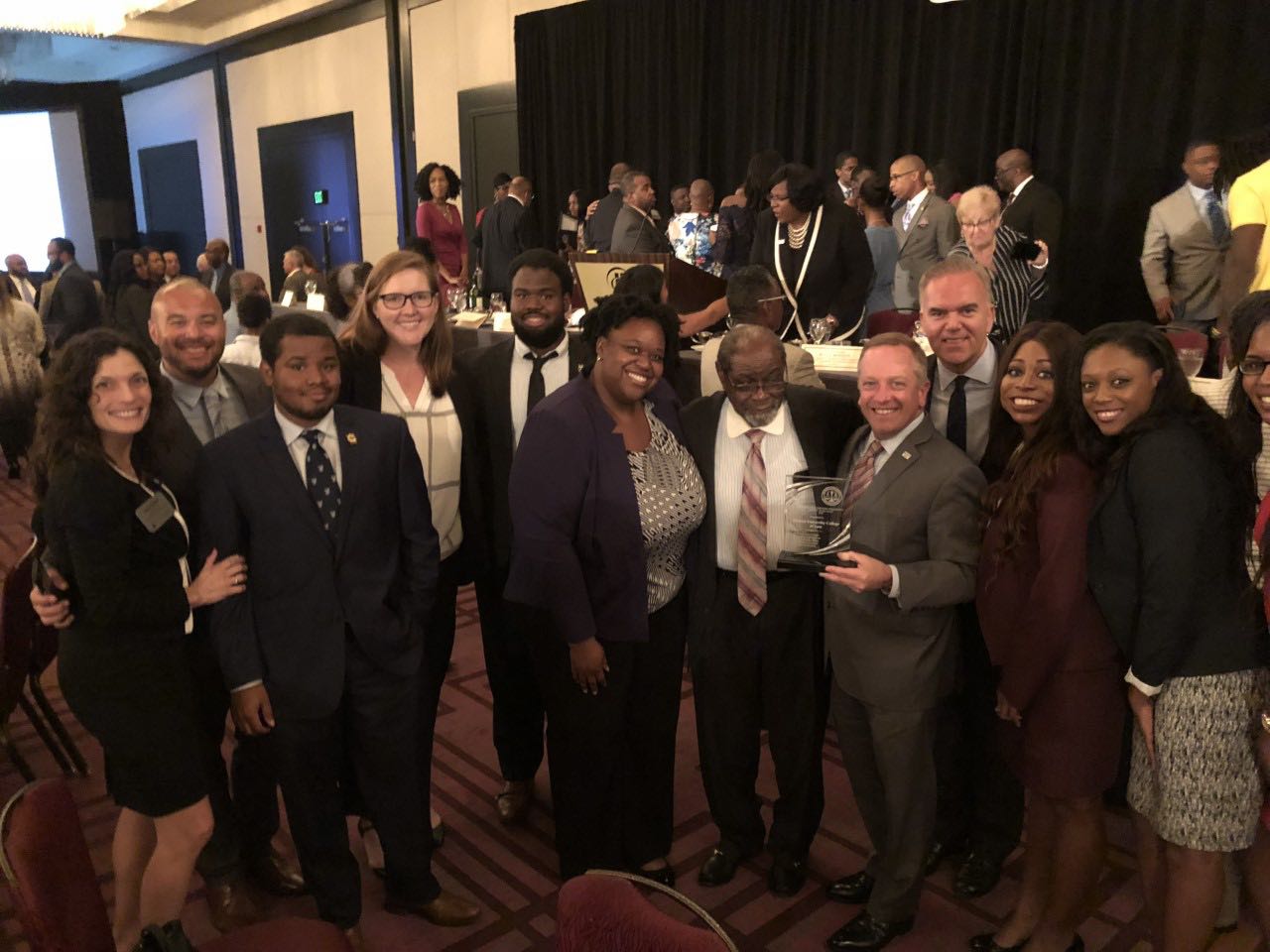
(L to R): Assistant Dean of Strategic Enrollment Management Laura Zuppo, Assistant Dean of International and Graduate Programs JR Swanegan, student Jonathan Blair, Associate Director of Career and Professional Development Joann Grages Burnett, student GEBA 2018 scholarship recipient Reed Blair, Associate Director for Admissions and Diversity Initiatives Carmen Johnson, Delano Stewart (award’s namesake), Law Dean Christopher Pietruszkiewicz, Director of Admissions Darren Kettles, student Brandy Orth-Becker, student Keongela Norton, and student Assita Toure. Photo courtesy Dean Pietruszkiewicz.
Stetson University College of Law was honored on Monday night, April 23, with the Delano S. Stewart Diversity Award, in recognition of outstanding contributions to improving the status of African-Americans in the community during the George Edgecomb Bar Association scholarship banquet. Third-year Stetson Law student Reed Blair received the GEBA Bar Prep Scholarship and was recognized during the banquet. The keynote speaker was Dick Vitale, famed sports analyst and cancer research philanthropist.
“The honor is a significant milestone in Stetson’s longstanding partnership with GEBA, and our continued efforts to recruit diverse law students and promote greater inclusion in the legal field,” said Carmen Johnson, Stetson’s associate director for Admissions and Diversity Initiatives. “Delano Stewart’s pioneering example serves as a welcomed reminder to the Stetson community, including our law students, to not settle for the status quo as we advocate for more equality throughout our communities.”
As Florida’s first law school, Stetson University College of Law has educated outstanding lawyers, judges and community leaders for more than a century. Stetson Law plays a dynamic role in the Tampa Bay metro area, with its main campus in Gulfport and a satellite center in Tampa. Stetson University is also home to a College of Arts and Sciences, School of Business Administration, and School of Music in DeLand, with a university satellite center in Celebration. Stetson Law is ranked no. 1 in trial advocacy and no. 2 in legal writing by U.S. News & World Report. Stetson has also been recognized as one of the Top 20 most diverse law schools in the nation by preLaw magazine and was honored as a National Diversity Outreach Champion by the National Black Pre-Law Conference.
Dean Christopher Pietruszkiewicz leads a diverse team of faculty and staff according to Stetson’s mission and values. Through initiatives and forums organized by Stetson’s Committee on Diversity and Inclusiveness and multiple student organizations, Stetson works proactively to address current events relating to diversity and inclusion and to foster an open community dialogue. Stetson Law trains students to serve as engaged advocates in the journey towards an inclusive and just society. Popular courses include a Race and Law Seminar, Diverse Issues in Advocacy course, and a nationally-recognized Constitutional Law and the Civil Rights Movement lecture and travel course, pioneered to educate law students about the impact of the law on racial equality and human rights by engaging directly with veterans of the Movement.
The GEBA annual scholarship banquet, now in its 35th year, also highlighted the Moffitt Cancer Center and its newly launched George Edgecomb Society to raise research funds to address the cancer health disparities in the black/African-American community.
The Student Leadership Development Committee hosted its final luncheon of the semester on April 18 with Ella Shenhav, a partner at the Tampa office of Shutts & Bowen LLP, presenting.
Ella Shenhav.
Shenhav received her B.A. from the University of South Florida and later earned a J.D. from Harvard Law School in 2009.
During the luncheon, she engaged with students and spoke about the importance of helping others through pro bono service.
“Leadership in the service context means developing the kind of relationships with people that convinces them you’re not going to throw them in the water without a flotation device,” Shenhav said.
Shenhav serves as the executive director of the Tampa branch of Project H.E.L.P., Homeless Experience Legal Protection, which brings attorneys, law students and legal staff together to provide legal assistance to the Bay area homeless population.
“Sometimes I feel like a personal trainer,” she explained. “I tell everyone, ‘You should really do some pro bono. All the paperwork’s there. You’ll feel great afterwards.’”
In her first job at a large law firm, Shenhav explained that she wanted to effectively contribute to her team, so she completed more than 400 hours of pro bono service to gain experience in her field and learn more about the real-world practice of law. She encouraged students to do the same and get involved with pro bono sooner rather than later.
“You can coach people and help them to a point where they feel so comfortable with pro bono that they almost become addicted to it,” Shenhav concluded.
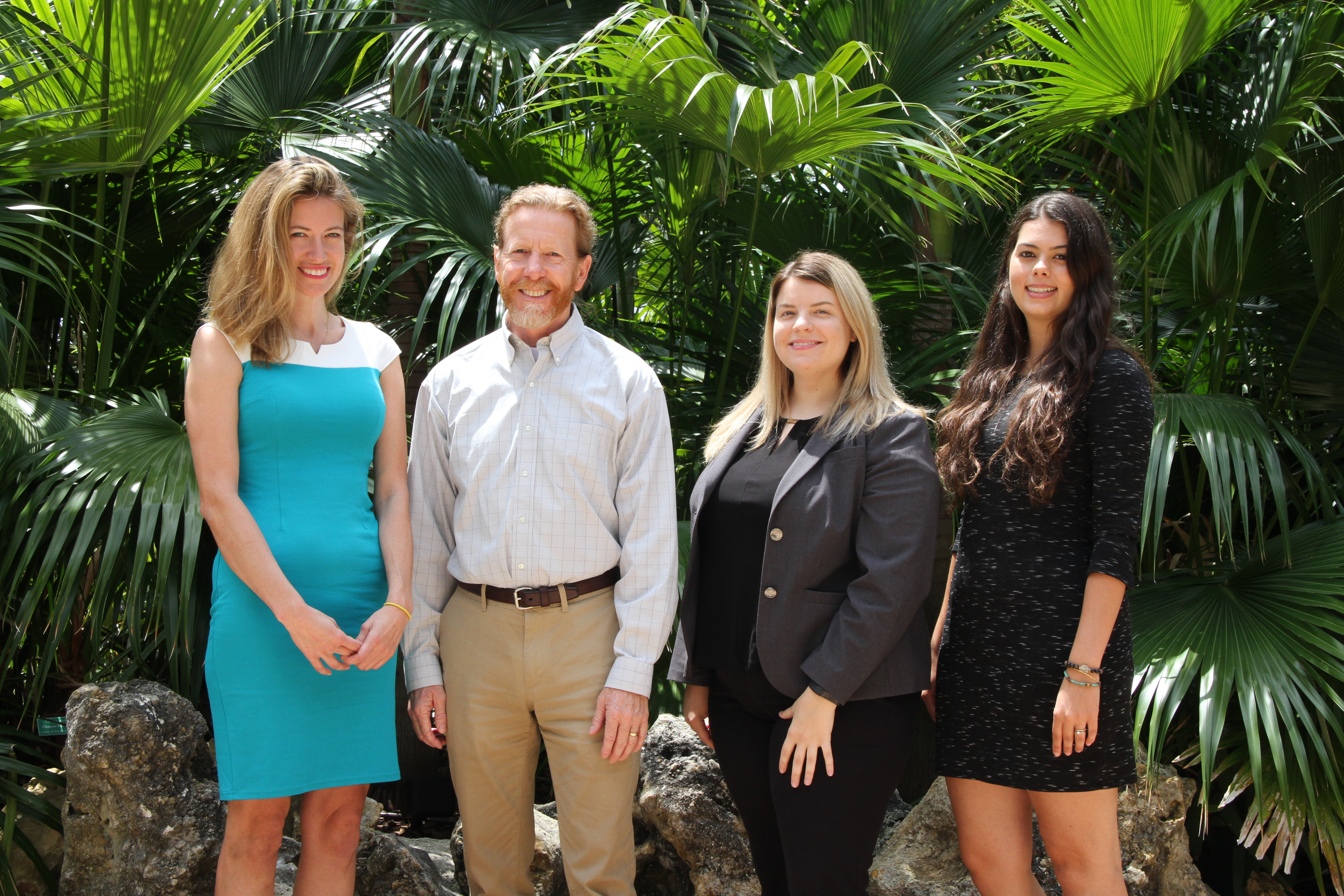
(L-R): Rachael Curran, Professor Long, Brittany Atwell and Katie Bright.
Two Stetson University College of Law alumni, Katie Cleveland Bright J.D. ’15 and Rachael Curran J.D. ’17, and third-year law student Brittany Atwell worked with Professor of Law Lance Long to provide research and assist in drafting a complaint on behalf of eight Florida youth, climate activists Delaney Reynolds and Levi Draheim, against the state of Florida, Governor Rick Scott, and several agencies in Leon County Court.
The lawsuit alleges that Florida government has statutory, public trust, and constitutional obligations to protect essential natural resources, including the atmosphere, for present and future generations. The nonprofit organization Our Children’s Trust supports the youth in filing the case, Reynolds v. State of Florida.
“This complaint is important because it is one of the first times that Florida citizens have sought relief in the courts based on the public trust provisions of the Florida Constitution,” said Professor Long. “Florida’s executive and legislative branches have failed to fulfill their Constitutional obligations to hold Florida’s natural resources in trust for the benefit of current and future generations; this failure is properly redressed through the courts.”
The plaintiffs argue that the defendants have violated and continue to violate the Florida Constitution by breaching duties to protect Public Trust Resources and by denying the youth their fundamental rights to liberty, pursuit of happiness, and property, including human habitation and personal and economic health, safety and wellbeing.
Professor Long teaches a course on Environmental Advocacy at Stetson. Bright most recently worked as staff attorney with the Ocean Conservancy in Portland, Oregon. Curran is a staff attorney for the Center for Biological Diversity.
To read more about the lawsuit, please visit the Miami Herald.
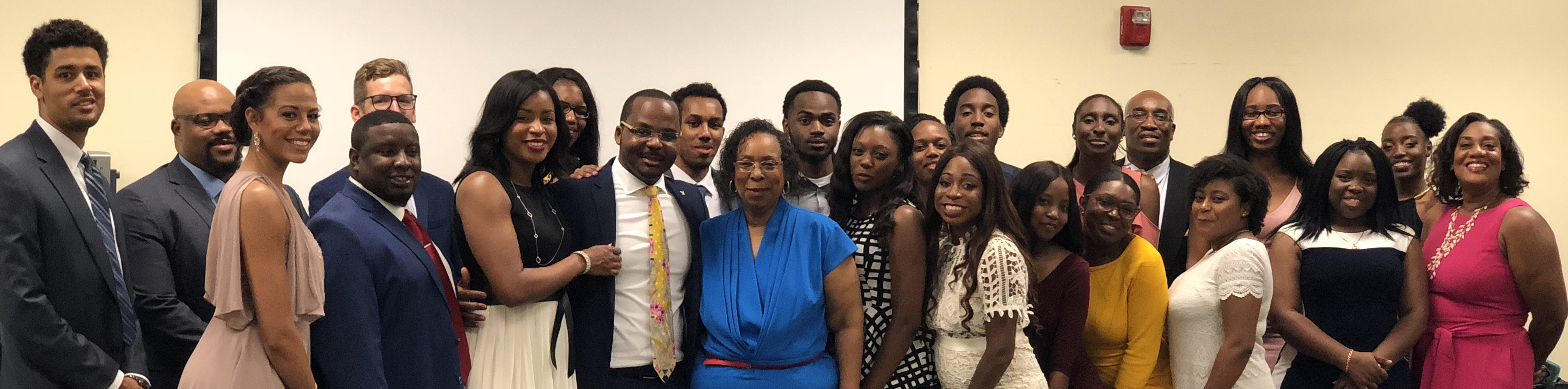
Back Row (L-R): Greg Payton, Tyrell Daniel, Jake Black, Assita Toure, Forest Sutton, Justin Bell, Andrea Snipes-Booker, Mark Joseph, Danielle Martin J.D. ‘13, Associate Dean Darryl Wilson, Kassi Toure and Jamie Haskins. Front Row (L-R): Cymoril White, Micheal Jenkins, Kimberly Watson, Aaron Watson J.D. ‘09, Professor Dorothea Beane, BLSA student president Keongela Norton, Brandy Orth Becker, Brielle Tucker, Alexis Turner-Garris, Ja’Keria McCowan, Sade Christie, Assistant Director for Career and Professional Development Kamilah Clark. Photo courtesy Kimberly Watson.
Stetson University College of Law’s Black Law Students Association coordinated the annual Alumni Banquet at the Tampa Law Center on April 14 to honor alumni and celebrate graduating third-year BLSA members and BLSA accomplishments.
Aaron Watson J.D. ’09 with BLSA student president Keongela Norton. Photo courtesy Kimberly Watson.
Aaron Watson J.D. ’09 presented remarks at the event.
Watson, founder of the Watson Firm PLLC, was a national champion in trial advocacy while he was a student at Stetson, winning the American Association of Justice student trial competition. At Stetson, Watson also served as president for the Black Law Students Association, interned with the U.S. Department of Justice, and volunteered with the Florida Attorney General’s office. He was selected for the Stallworth Trial Team Award by faculty at Stetson for his achievement of excellence in trial advocacy, and he was inducted into The National Order of Barristers for attaining high honor in the art of courtroom advocacy. Watson currently serves on the Board of Governors for the American Association for Justice and the Florida Justice Association, and has recently been named one of the National Black Lawyers Top 100.
When Taofikat Ninalowo came to the U.S. from Nigeria, she was determined to have an impact on poverty in the world. She moved to Peoria, Illinois, from Nigeria, Africa, at age 17. In Illinois, she enrolled at Illinois Central College, then moved to a larger school, Illinois State University. In Illinois, she launched a UNICEF program to bring awareness to the plight of poverty. Being from Nigeria, Ninalowo said she had not known the extent of the problem of poverty in the U.S. As an undergraduate student studying business administration, she began to see a career in law as a way to have an impact on people’s lives, and decided to pursue law school.
“I chose Stetson because of its reputation for advocacy and legal writing, skills that translate into a good lawyer,” said Ninalowo.
One of 10 siblings scattered across the U.S., Ninalowo is unique in her pursuit of law. Her brothers and sisters work in varied fields: in medicine, engineering, acting, filmmaking, and information technology. Ninalowo’s parents worked hard to send their children from Nigeria to the U.S. to complete their college educations.
At Stetson, Ninalowo is pursuing both a J.D. and M.B.A. degree. She is a member of the Dispute Resolution Board, a research assistant for professor Ellen Podgor, and a teaching assistant for professor Joseph Morrissey. She traveled this spring to the Willem C. Vis International Commercial Arbitration Moot in Austria, Vienna, as a student coach with the Vis team, and said she wants to come back to help the team as a coach or a judge after graduating in May.
Ninalowo said she spent her time at law school exploring all the options, working in a public interest law firm, with Burr & Forman, in-house at Overseas Shipholding Group Inc., and with U.S. Magistrate Judge Julie Sneed. She discovered that the emotional toll of working on eviction cases was not a good match.
“I came to law school focused on public interest work, but developed into an advocacy board member,” said Ninalowo.
She joined the Dispute Resolution Board to develop as an advocate. Writing briefs for competitions helpedto improve her writing skills along with participating in Stetson Law’s Honors Program. As a first-year student, Ninalowo was a Student Bar Association representative and vice president of the Public Service Fellows, and in her second year, became a Stetson Student Ambassador. She tutored first-year law students in contracts, property and constitutional law, joined the Inclusive Implementation Strategy Group, and was selected as one of three student representatives for the Diversity and Inclusion Committee at Stetson.
“If you throw yourself out there, you might realize that’s what you want to be in life,” said Ninalowo. “At the same time, you can’t do it all, so be selective and don’t just jump into an organization before you know what it’s all about,” she said.
Her business background and experiences inspired her to focus on corporate litigation and transactional work.
“I enjoyed working with a bankruptcy practice group during my externship,” said Ninalowo. “Consumer litigation really interests me—bringing cases for consumer plaintiffs.”
In May, Ninalowo’s parents Raolat and Jamiu will visit Stetson’s Gulfport campus for the first time during commencement.
“I found myself here,” Ninalowo said, looking back on her Stetson experience. “I want to give back.”
When third-year law student Viviana Vasiu B.A. ’15 talks about becoming a legal fiction writer on par with John Grisham, she’s not joking. Vasiu is determined to write iconic popular legal fiction, but in a way that accurately represents the roles of women in the legal field.
“For the most part, the novels either had no female heroines, or they were set up to fail somehow,” Vasiu said of Grisham’s novels. “Women still face issues in the legal profession. Even fiction authors make an impression, especially when they are cited in the courts. We have a responsibility ethically to think about how stereotyping impacts us.”
The editor-in-chief of the Stetson Law Review came to the U.S. a little more than seven years ago from Romania to study case law and has been fascinated by the law and writing from a young age. Her goal was to become a lawyer and her focus was always on writing.
“I knew I loved public speaking and being in a courtroom, but I also loved writing,” said Vasiu. “Law school teaches you to think about audience first.”
As a child, she said she pored over the comparative law books in her lawyer parents’ library in Romania that explored the differences between the civil and case law systems. It was Oliver Wendell Holmes Jr. and the emphasis on legal history and storytelling in the judiciary system that drew Vasiu to study law in the U.S. She is fascinated by criminal law, constitutional law, and the intersection of the law with other disciplines, particularly literature and sociology.
As a paralegal studies major in San Diego, California, several universities recruited Vasiu directly because she was president of the Phi Theta Kappa Honor society at the college. She ultimately chose Stetson due to the tight knit community, strong academics and warm weather. At Stetson, Vasiu said she connected with professors who became like family. As an undergraduate student at Stetson, she wrote news features as student editor of both Visual and Stetson magazines.
At Stetson Law, Vasiu has learned what to look for in the best law review articles. The competition for page space in legal journals is highly coveted among law students around the nation, and Vasiu has perfected the science of law review writing. She has had five scholarly articles accepted for publication in legal journals and in an international conference book. Vasiu’s articles include a placement in a peer-reviewed journal nationally ranked second in criminal law and procedure, as well as a highly-ranked law review placement.
“The rejection taught me what was possible and how to push for it,” said Vasiu. “All you need is one yes.”
She has written on issues ranging from criminal law (cybercrime, white collar crime, juvenile, and constitutional issues) to the intersection of law with other disciplines (nonfiction, fiction and poetry). She was inspired to pursue the intersection between law and poetry through professor Kristen Adams’ class: Law Through the Lens of Poetry. As she approaches commencement in May, Vasiu is co-authoring a book review on white collar crime and a criminology book with Professor of Law Ellen S. Podgor that will be published in the fall. After commencement, Vasiu, who also worked in a big law firm as a student, will start a federal clerkship with Judge Anthony E. Porcelli B.A. ’93/J.D. ’98 in Tampa, then look for a position as a prosecutor, as well as an LL.M., Ph.D., or S.J.D. program at a top university.
She also plans to keep writing and said she will draw from all of these experiences in defining the female heroine in her upcoming novel.
“I want to challenge myself and break down barriers for myself, for other women, and for anyone who needs inspiration,” said Vasiu. “Stetson taught me what’s possible, and how to push for what you want when it gets hard. You have to show that you believe in yourself and show others why they should believe in you.”
Kevin Reali, an upcoming graduate, set sail for law school after five years of serving in the Navy. However, the part-time student didn’t trade his sea legs for casebooks; he balances his studies with working full-time at Eckerd College, coaching the sailing team.
Following his undergraduate career at the University of South Florida – where Reali studied engineering and competed on the sailing team, he served in the Navy and worked as a Nuclear Surface Warfare Officer. He worked in the private sector after the Navy, but knew he wanted to further his education.
Reali reasoned that, given his engineering background, he could find success in intellectual property law. However, he soon realized that the analytical skills he acquired through engineering apply to every aspect and form of law.
“I came to law school and thought I knew exactly what I was going to do, but I didn’t know anything about law,” Reali said. “It wasn’t like I’d been waiting my whole life to do law, it just ended up being the right thing and, in hindsight, it was a lucky choice because I really have enjoyed it.”
Reali’s full-time job, coaching a team of 32 college students, is seven days a week when the team is in season. His work begins in the afternoon on weekdays and the sailing team has competitions on the weekends. Because of this schedule, Reali typically prepares for class on weekday mornings.
“[My job] is uniquely set up very well for going to school part-time because I can devote part of my day in the office to doing some reading or preparation,” Reali said. “I’d rather have more work with flexibility than a set number of hours with no flexibility.”
Along with his full-time job and part-time studies, Reali also balances his memberships in both Law Review and Moot Court.
“[Being a part-time student] is hard, but it’s a conscious decision to balance school and work or take on debt,” said Reali.
With Moot Court and Law Review, Reali said he has developed a stronger peer network than through classes alone.
“When I started law school, I didn’t think I was going to be involved in any organizations,” Reali said. “I just thought, ‘I’m a part-time student, I’m going to do my work and I’m going to disappear and that’s all I’m going to do.’ The Moot Court competition schedule can be challenging with my work schedule, but Professor Bowman has been really good to me and I still got to participate, still got to do competitions, but she was also understanding when it wouldn’t work. Moot Court is really rewarding; you get to write, you get to work with professors, you get to network with coaches that come in and volunteer their time.”
Reali looks forward to his legal career and hopes to one day work in litigation, using his engineering background to break down technical cases.
“I appreciate the flexibility [at Stetson]. Not all schools have a part-time program and even if they have a part-time program, I wouldn’t expect that a professor would appreciate the conflicting time demands of a part-time student,” Reali said. “I never felt singled out or like it was hurting me to be a part-time student.”
This semester, Reali’s 10th and final semester at Stetson, has been a long time coming. Though it’s been a challenge, he’s literally sailed through law school.
(L-R): Taylor Greenberg and Anne (“Annie”) Kanzow. Photo by Merve Ozcan.
By Bianca Lopez
Two Stetson Law students, Taylor Greenberg and Anne (“Annie”) Kanzow, have been selected as Equal Justice Works fellows and will be pursuing projects helping adolescents.
The Equal Justice Works Fellowship is committed to encouraging law students to pursue careers in the field of public interest after graduation. Equal Justice Works invites upcoming legal graduates nationwide to propose projects designed to assist communities that have an unmet need for legal services.
Applicants must first find an organization that will agree to host them and allow them to implement their proposed projects post-graduation. Select finalists present their projects to a panel of potential sponsors. The sponsors then choose projects that they wish to support. The fellow’s salary during the course of the project is covered by their sponsor, while all other employment benefits come from their host organization.
Some other benefits of the Equal Justice Works Fellowship include loan repayment during the two-year fellowship period and a summit in Washington D.C. where fellows can meet all of the other fellows from across the country.
Greenberg learned about the Equal Justice Works Fellowship from Stetson’s career services office while she was touring law schools.
“I thought, ‘Oh, that sounds like something I want to do, that’s what I’m going to do,’” Greenberg said. “I planned it very far in advance.”
Greenberg partnered with the L. David Shear Children’s Law Center at Bay Area Legal Services – where she has previously volunteered and completed an externship for school credit – for her fellowship project proposal. Greenberg Traurig and the Florida Bar Foundation chose to sponsor Greenberg’s project.
Greenberg decided at a young age that she wanted to go to law school and be the voice for others who needed it most.
“I always knew I wanted to go to law school but I didn’t know what I wanted to do – I just knew I wanted to help people,” Greenberg said.
Now, as the founder of Child Advocates of Stetson Law (CASL) and in her sixth year as a Guardian ad Litem, Greenberg knows exactly which group of people she wants to advocate for: teenagers living in group homes.
After college, she joined AmeriCorps and worked in an English classroom of a Title I high school. There, she met a 16-year-old student who was living in a group home and would frequently run away. Greenberg took his case as a Guardian ad Litem and assisted in finding him a foster home. More than three years later, the two are still very close, as evidenced by his school photo that Greenberg carries with her daily in her phone case.
Taking out the picture she says, “He’s the reason that I want to fix the foster care system.”
Greenberg’s project involves educating attorneys through a three-pronged model she designed based on her experiences with teenagers in foster care.
“What I’ve seen, working with teenagers who have very high needs and very little support systems living in group home care, is that when their legal rights are enforced in three key areas, their outcomes can improve vastly,” Greenberg said. “Those areas are: making sure that their basic needs are met, that they’re receiving quality services, and that they have a developed support system.”
Kanzow, on the other hand, had not heard of the Equal Justice Works Fellowship until far into her law school career. However, she determined her legal career path in high school.
Like Greenberg, Kanzow’s project involves work with adolescents and stems from personal experience. When Kanzow was in high school, someone close to her struggled with emotional behavioral issues.
Kanzow witnessed the power and influence of lawyers first-hand when her friend’s family hired a special education attorney. The attorney challenged the system and helped find placement in a private therapeutic boarding school.
“It changed her life completely,” Kanzow said. “When I saw the attorney work, I saw how much it helped her and her family. I knew I wanted to go to law school already, but I decided that was what I’m going to practice.”
Now, Kanzow’s friend has a successful personal life and career, free of any behavioral issues.
Kanzow structured all of her studies and personal time around special education. She studied sociology in college and tutored kids with emotional behavioral issues after school. After graduating from college, Kanzow tutored a child with severe ADHD and Dyslexia.
“I was able to see how if you just adjust your teaching just a little bit – teach it a different way – [special needs students] can get it,” Kanzow said.
The Children’s Rights Section of Community Legal Services of Mid-Florida, where Kanzow works as an intern, told her about the fellowship and encouraged her to apply with them as her host organization. Kanzow’s project involves the same topic as her internship: the school to prison pipeline, with emphasis on special education in rural areas and minorities. The Florida Bar Foundation chose to sponsor Kanzow’s project. In her application, she proposed creating educational materials for parents, students, attorneys, and advocates, in addition to her practicing special education law.
“A lot of students, based on race, are being excluded from the special education system,” Kanzow said. “Some students, if they’re doing something wrong, will be identified as in need of extra services because of an emotional or behavioral issue. Whereas, minority children, will often be identified as a bad kid.”
Kanzow and Greenberg have discussed ways of tying their two projects together in future collaborations, such as giving trainings on their respective subjects to one another’s teams. A unique aspect of the Equal Justice Works Fellowship is that the committee does not consider grades or request any transcripts, instead they want to see passion and commitment – both of which Kanzow and Greenberg have in excess.
“They just want to see you as a person and your project,” Greenberg said. “But, what I also like is that you have the ability to impact an underserved population through different avenues. Most fellows have a multi-faceted approach to tackling their issue. In order to make a real change, you can’t just do it in the courtroom. You have to educate the wider community. You really get to be creative in the ways that you’re trying to effectuate change.”
Members of Stetson’s FAWLS group: (L-R): Brittany Showalter, Kim Lopater, Kate Konecny, Julia Alley, Michelle Moretz spearheaded this year’s Women’s Week. Photo by Merve Ozcan.
By Bianca Lopez
(L-R): Joann Grages Burnett, Brittany Maxey, Bobbi-Sue Doyle Hazard, Erica Bartimmo and Professor Stacey-Rae Simcox. Photo by Merve Ozcan.
Small black buttons, reading: “The Future is Female,” circulated through campus during March, Women’s History Month. The buttons were being sold by FAWLS (Florida Association for Women Lawyers at Stetson) to benefit the Ovarian Cancer Fund Alliance, in conjunction with Women’s Week.
FAWLS founded Women’s Week at Stetson last year with four events centered on topics of concern to women. This year, FAWLS added a fifth event: The Superhero 1K. FAWLS collaborated with other school organizations such as NOW (National Organization of Women), LELA (Labor and Employment Law Association), Phi Delta Phi, and Public Service Fellows, as well as, community organizations including HAWL (Hillsborough Association for Women Lawyers), PFAWL (Pinellas County Chapter of the Florida Association for Women Lawyers), and Women Lawyers of Pasco.
Dr. Davis spoke in the Mann Lounge for Women’s Week.CASA representative and bureau volunteer Julie Cline. Photo by Merve Ozcan.Women’s Week kicked off with a Superhero 1K. Pictured is first-year student Rebecca Klonel. Photo courtesy Kate Konecny.
“It’s important to us as an organization to raise money for women’s issues and women’s organizations,” said Kate Konecny, student and FAWLS president. “I think it’s important for students to get involved with the community and advocating for issues that are important to them. Women’s Week is a whole week that we can reflect on these issues, and decide what we’re going to do about them. Whether it’s through advocacy, or having tools to face discrimination day to day, it’s a way to get conversation started.”
The week began with the Superhero 1k fun run on Sunday, March 25. Local sponsors donated prizes for best Superhero costumes and the participants who won the race. The event raised $250 for the Ovarian Cancer Fund Alliance. On Monday, March 26, a panel consisting of Stetson Professor Stacey-Rae Simcox, Attorney Erica Bartimmo, Attorney Bobbi-Sue Doyle Hazard, and Attorney Brittany Maxey-Fisher empowered students by inspiring them to be confident and giving advice on workplace scenarios at the event “What to Do When?”. On Tuesday, March 27, a performance of “The Vagina Monologues” was held in the Great Hall. A supply drive and pro-bono event to support CASA took place on Wednesday, March 28. Finally, on Thursday, March 29, FAWLS hosted a networking and impression management event with local attorneys, featuring a speech by Dr. Kirsten Davis, a Stetson Law professor.
“In my opinion, our most successful event was the Superhero 1K,” Konecny said. “It was a fun weekend event that had great student turn out and also raised money for a great cause.”