Skip to content

Students host discussion on capital punishment in America

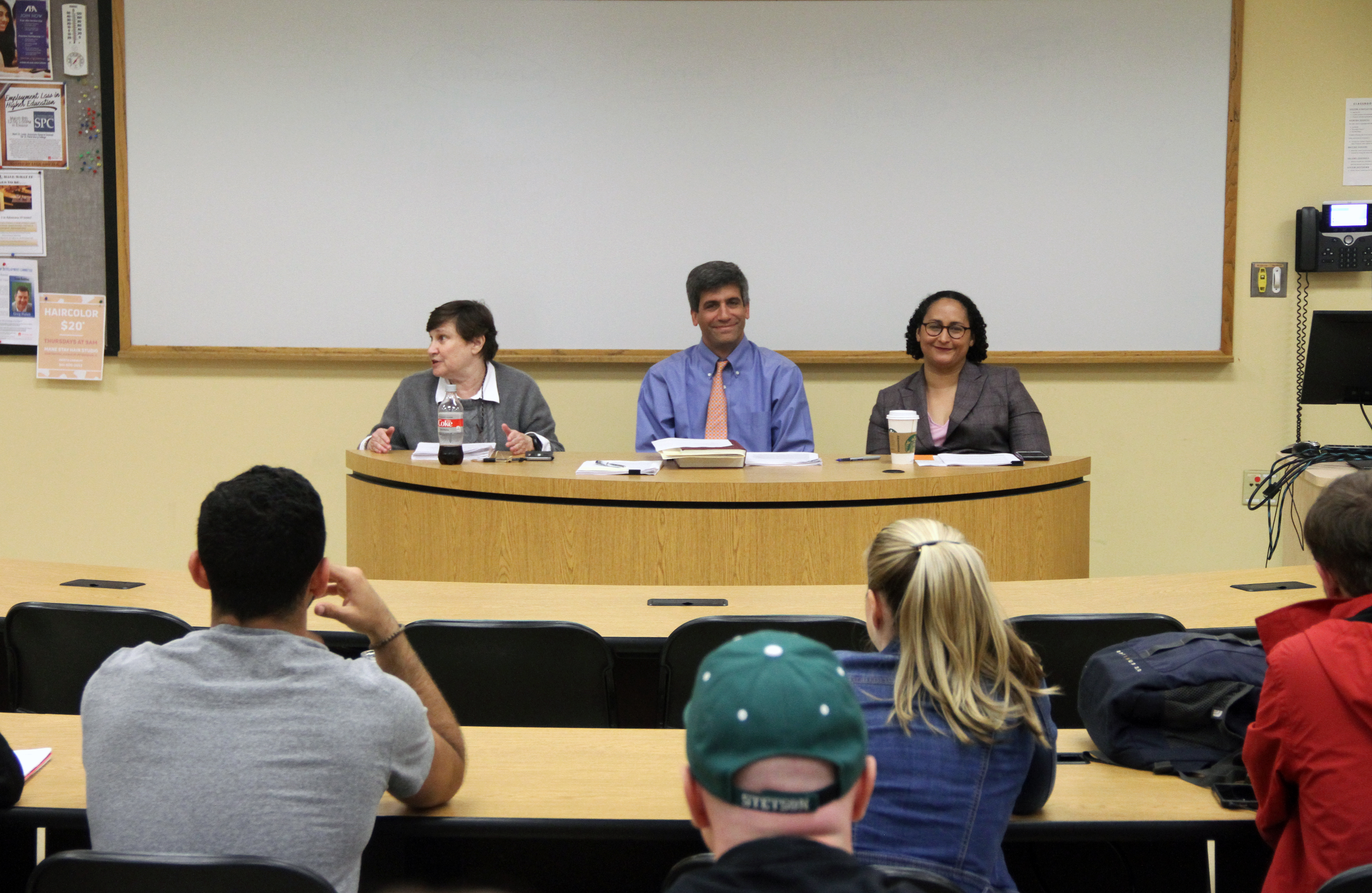
(L-R): Innocence Initiative President Christie Fekany, Dean Emeritus and Professor of Law Bruce Jacob, Professor Ellen Podgor, Roger L. Weeden and Teodoro Marrero. Photo by Merve Ozcan.

By Bianca Lopez

The Innocence Initiative, Federalist Society and the American Constitution Society held a panel to discuss the death penalty on March 30. Two professors from Stetson Law, Professor of Law Ellen Podgor and Dean Emeritus and Professor of Law Bruce Jacob, and two attorneys, Roger Weeden and Teodoro Marrero, answered questions about capital punishment in America.

Both Podgor and Jacob teach courses on criminal law and have worked as prosecutors during their careers. Professor Podgor, a member of the American Law Institute, took part in submitting a motion to remove the death penalty. While the motion was not accepted, the Model Penal Code no longer includes capital punishment. Weeden and Marrero are defense attorneys in Orlando and have worked together on death penalty cases.

“I believe we’re going to see the end of the death penalty in the United States, in my lifetime,” Marrero said.

Marrero and Weeden discussed the death penalty from the viewpoint of the defense: trying to keep their clients alive. Marrero explained to the audience how he manages to put all of his effort into defending clients, even when he has seen the acts that they have been convicted of prior to the penalty determination.

“We try to find the good in the person; there’s almost always something good in them,” Marrero said. “We try to show that they have worth as a person.”

In death penalty cases, the determination of death must be voted on unanimously by the jury. The panel touched on the topic of jury selection, saying that anyone with extreme opinions for or against the death penalty cannot serve.

“We have a fighting chance if we have the right jurors,” Marrero said. “In a death penalty case, life [in prison] is a win.”

Dean Emeritus Jacob, who also teaches constitutional law, spoke on the constitutional rights of defendants in a death penalty case and case law concerning the constitutionality of the death penalty.

After the panel answered prepared questions posed by the Innocence Initiative, Mary Gantert, a student and vice president of the Innocence Initiative, presented a PowerPoint and speech after being inspired by what she learned about the death penalty while interning under the Honorable Barbara J. Pariente of the Florida Supreme Court. Gantert had just begun her internship when the first execution following SCOTUS deeming Florida’s death penalty unconstitutional was about to occur. Gantert focused on learning more about Florida’s death penalty, which she then chose as the topic for her seminar paper.

“As attorney Morrero said [during the panel], working with the death penalty changes you,” Gantert said. “Imagine working with someone’s case for weeks or months, getting to know so much about not only their crime, but their entire life, and then hearing: ‘The sentence of the State of Florida vs. [inmate name] has been carried out at [time of day].’ After that, the phone call ends, and you know that a human being has been executed and you have been a part of it.”

Stetson presents annual continuing legal education program for lawyers on “Analytics-The Tech Driving Legal Decisions” on April 27

Stetson University College of Law presents its annual Legal Tech CLE for lawyers on “Analytics-The Tech Driving Legal Decisions” from 8:30 a.m.-4 p.m. on April 27 on the Gulfport campus, 1401 61st St. S.

Topics include:

  • Using Big Data to Predict Outcomes
  • What is Your Ethical Obligation When
  • Algorithms Control Your Research?
  • Judicial Opinions and Analytics
  • Analytics Applied in Practice
  • How the Florida Bar is Analyzing Analytics

Speakers include Carebridge CEO, Deborah Watkins, University of Colorado Law School law Library Director and Associate Professor, Susan Nevelow Mart, FASTCASE representative, David Nayer, Akerman LLP library services representatives Diana Witt and Courtney Salmons, and Florida Bar president-elect John M. Stewart.

Florida CLE credits are pending.

For more information and to register, visit http://bit.ly/LegalTechCLE.

Can governments engage in unconstitutional discrimination? Stetson presents symposium on animus and bias in the law on April 20

Stetson University College of Law presents a symposium on the concept of the Supreme Court’s emerging animus doctrine and bias in the law from 8:30 a.m.-4 p.m. on April 20 on the Gulfport campus, 1401 61st St. S.

The symposium is complimentary and open to the public with registration. The program will also be available via webcast, for those who cannot attend.

Panels include:

  • 9:15-10:45 a.m.: Animus and Its Discontents
  • 11 a.m.-12:45 p.m.: Animus and the Religion Clauses
  • 1:15-1:45 p.m.: Lunch Keynote with Brooklyn Law School professor William D. Araiza
  • 2-3:45 p.m.: Animus in Various Contexts
  • 3:45-4 p.m.: Concluding Thoughts

The symposium begins with breakfast at 8:30 a.m., followed by a welcome at 9 a.m.

For more information and to register, visit http://bit.ly/StetsonSymposium.

Stetson launches webinar on “Promoting Realistic Expectations for Suicide Prevention on Campus”

Stetson University College of Law launches webinar on April 10 from 3-4 p.m. on “Promoting Realistic Expectations for Suicide Prevention on Campus.”

The webinar addresses tools college administrators may use to prevent suicides and work with suicidal students on campus. Participants will learn about how the law and good healthcare practices work together to reduce suicides on campus and improve students’ mental health.

The webinar features Stetson’s Center for Excellence in Higher Education Law and Policy director Peter Lake and University of Central Missouri Assistant Director of University Health Services for Counseling & Psychological Services Paul Polychronis.

To learn more, and to register, visit stetson.edu/law/conferences/homepages/ or contact Stetson’s Office of Professional Education at 727-562-7898 or [email protected].

Growing in the field: Third-year law student Vanessa Moore to join Environment and Natural Resources Division at DOJ

Vanessa Moore. Photo by Brian Vandervliet.
Vanessa Moore, May 2018 Valedictorian. Photo by Brian Vandervliet.

By Bianca Lopez

Vanessa Moore, a third-year student at Stetson Law, plans to launch her legal career after graduating in May in Washington, D.C., where she will join the Attorney General’s Honors Program, working in the Environment and Natural Resources Division of the U.S. Department of Justice. Moore was named Valedictorian of the May 2018 class.

“That’s what I came here to do, to pursue environmental law,” said Moore, a student in Stetson’s environmental law concentration program. “I thought it was such an important area.”

Moore said she hasn’t always been interested in environmental issues or conservation. Growing up in Mobile, Alabama, she said she took having a clean environment for granted, and did not start to question her attitudes until her freshman year of college when her roommate chastised her for throwing recyclable items into the trash in their dorm room.

Moore’s interest in environmental work began to flourish after college. While working in corporate communications and marketing at Raymond James, Moore immersed herself in books, news articles, and documentaries covering ecological concerns and realized the importance of environmental conservation.

“We need smart people working on these issues and I would like to be one of them,” Moore said.

Seven years after graduating from college, Moore decided that it was time to go back to school, and headed to law school at Stetson.

“I wanted a new challenge from a professional standpoint, and to work on issues that are meaningful and important,” Moore said. “I’ve loved learning new things on a daily basis since I’ve been in law school. That was one of the things that drove me to a new career path, because I felt there were so many more opportunities for me to learn and grow.”

During her time at Stetson Law, Moore has served on Stetson’s national environmental law moot court competition team, as the vice president for the Environmental Law Society, as an articles and symposia editor on the Stetson Law Review, as a teaching assistant for three research and writing courses, and as a fellow with the Institute for Biodiversity Law and Policy.

Moore has also done externships with the U.S. Attorney’s Office in Tampa; Judge Bucklew, Senior U.S. District Judge for the Middle District of Florida; and the Center for Biological Diversity. She also completed a clinic with the St. Petersburg City Attorney’s Office and a summer internship with a private law firm.

“I got a really great experience here with the clinical education department,” Moore said. “Those were some of my favorite experiences during law school because I got to see so many different forms of practice.”

Moore said graduating from Stetson will be bittersweet.

“I am looking forward to moving ahead and starting to practice, since that’s obviously what I came here to do,” said Moore. “However, I’m also really going to miss law school. I’ll miss the campus, the students and the professors at Stetson. Everyone here is so nice. It’ll be sad but also exciting.”

Dr. Ruth Cromie presents on Avian Influenza: a One Health issue of threats and opportunities

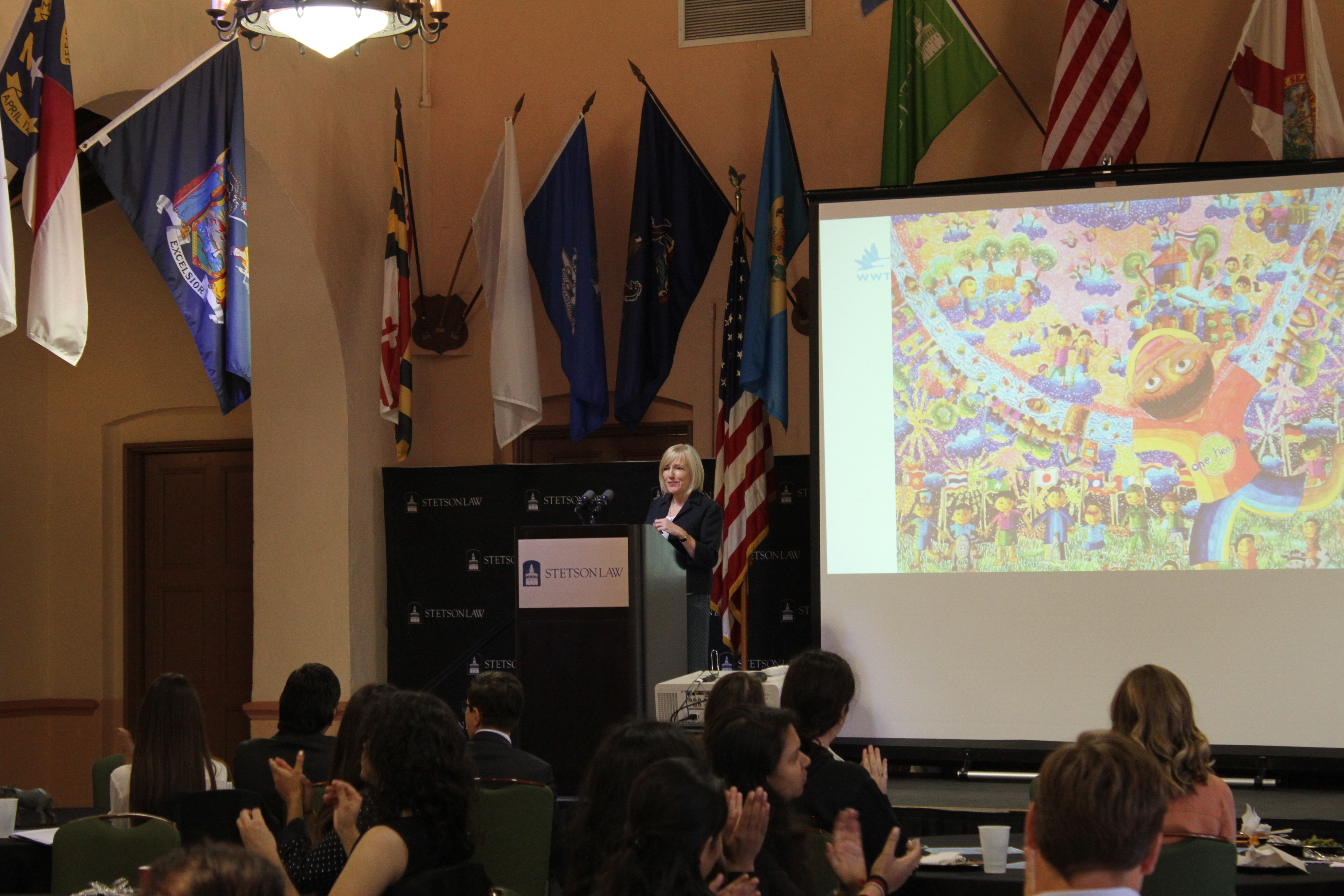
Dr. Ruth Cromie presented at Stetson.

Dr. Ruth Cromie presented the Foreman Biodiversity Lecture at Stetson on March 22 on “Avian Influenza: a One Health issue of threats and opportunities.”

The lecture was held in conjunction with the final rounds of the 22nd International Environmental Moot Court Competition held March 22-24 on Stetson’s Gulfport campus. The competition brings teams of students together from all over the world.

Cromie discussed increases in emerging infectious diseases in humans and wildlife and pointed to causes ranging from habitat destruction and climate change to food production systems.

She explained how avian flu virus can spread among poultry kept in close quarters and how a virus outbreak in bird populations in one part of the world may spread by migratory birds across the globe.

“Making the right decisions about how we produce our food, how we manage our environment, it’s those kinds of things which would produce a healthier outcome,” said Cromie.

Dr. Cromie served as a final round judge in the International Environmental Moot Court Competition this year at Stetson. The competition focused on “Responses to Highly Pathogenic Avian Influenza and Transboundary Wetlands” this year.

Federalist Society and Stetson Democrats host debate on Masterpiece Cakeshop v. Colorado Civil Rights Commission

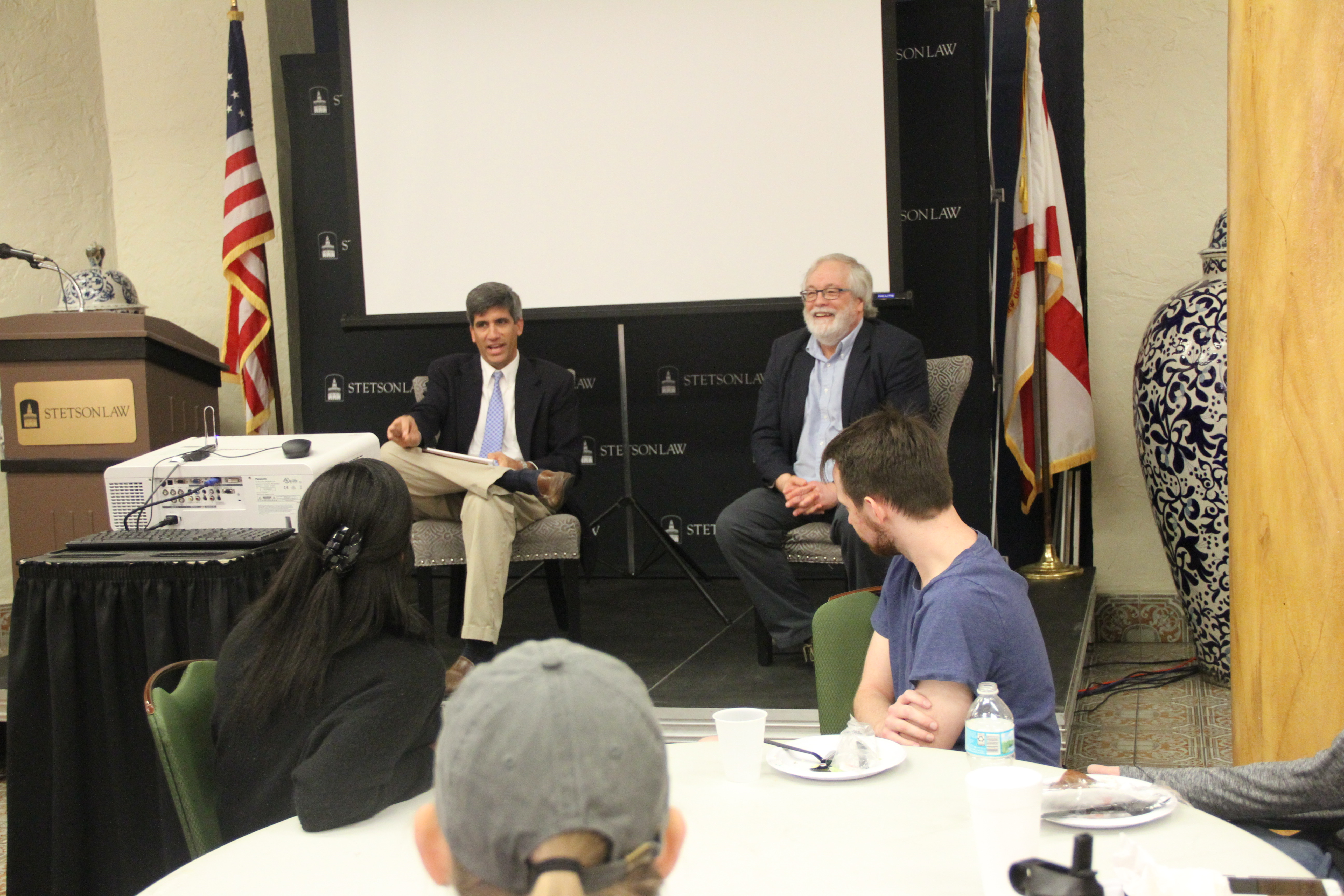
(L-R): Professor Louis Virelli took and Professor Richard Duncan. Photo by Merve Ozcan.

By Bianca Lopez

The Federalist Society and Stetson Democrats hosted a debate on Monday, March 19 deliberating the Masterpiece Cakeshop v. Colorado Civil Rights Commission case from this year’s Supreme Court docket.

The case involves a same-sex couple, Charlie Craig and David Mullins, who attempted to order a custom wedding cake from baker Jack Phillips. Phillips declined the order, claiming it was due to his religious beliefs. The question before the Supreme Court is whether Colorado’s public accommodations law violates Phillips’ First Amendment rights.

Professor Louis Virelli took the position of the Colorado Civil Rights Commission and Professor Richard Duncan, a visitor from the University of Nebraska, spoke on the side of the Masterpiece Cakeshop.

Stetson student and president of the Federalist Society, Max Yarus, introduced the debaters. Duncan opened the debate, arguing that Phillips’ cake decorating is art and art, as an expression under the First Amendment, cannot be compelled. Virelli argued that there must be a line for what may be considered expression, and food does not apply because no one would look at the cake and connect it to Phillips or any support of same-sex marriage.

The event ended with a question and answer portion – in the theme of a “fireside chat” – with both debaters seated in large chairs and speaking directly with the audience.

“I am always encouraged when important and current legal issues are the subject of open discussion on campus,” Professor Virelli said. “I hope students felt like they learned something about the constitutional questions surrounding the Masterpiece Cakeshop case and that they felt that both sides of this highly controversial issue were presented competently and respectfully.”

Team from the University of the Philippines College of Law wins the 22nd International Environmental Moot Court Competition at Stetson

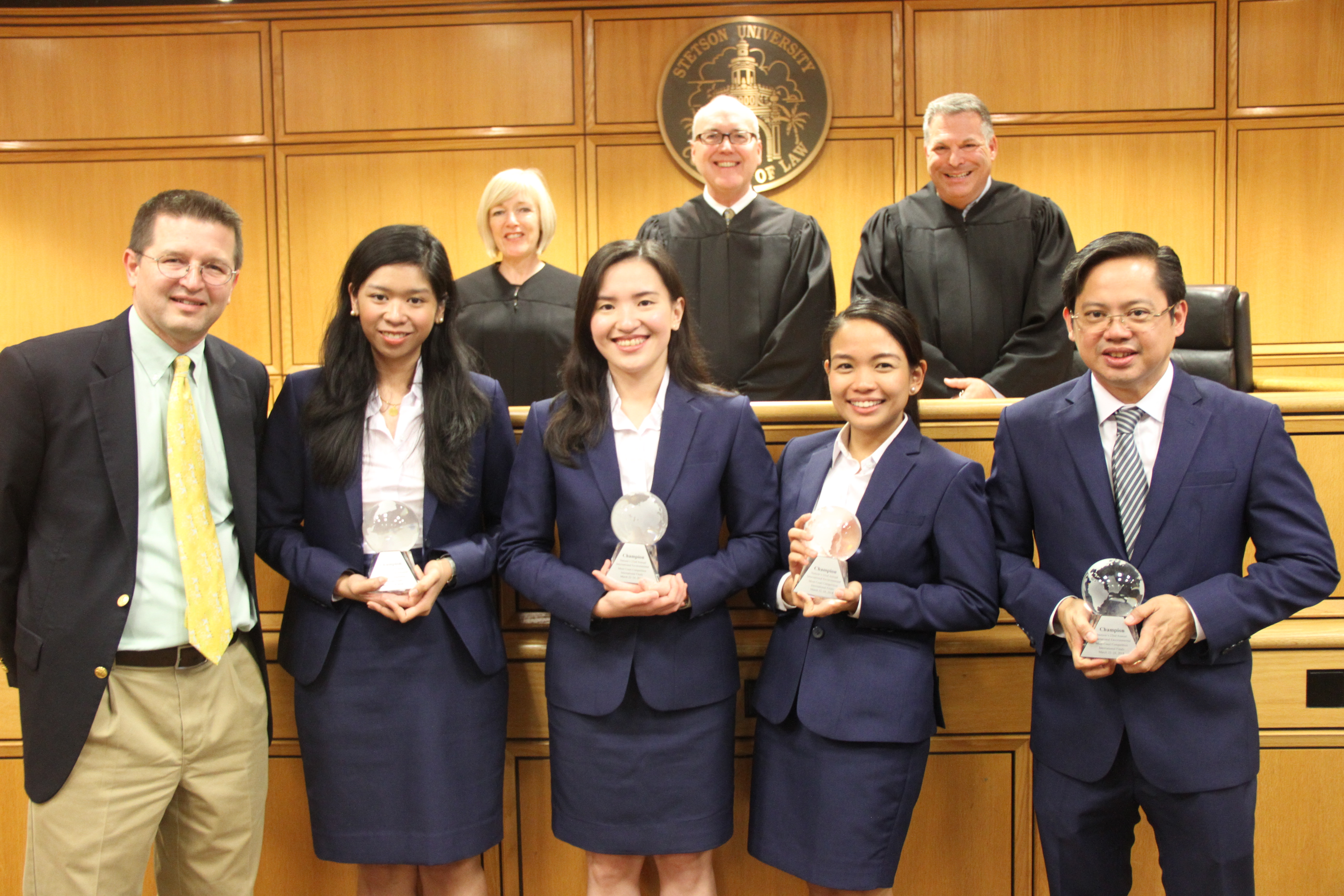
A team from the Philippines won the IEMCC at Stetson. Photo by Brielle Tucker.

The University of the Philippines College of Law won the 22nd International Environmental Moot Court Competition held March 22-24 on Stetson’s Gulfport, Florida, campus.

The competition brings teams of students together from all over the world to Stetson.This year’s teams traveled from Brazil, China, Colombia, India, Ireland, Kenya, Nepal, the Philippines, Republic of Korea, Singapore, the U.K. and Ukraine.

This year’s competition focused on “Responses to Highly Pathogenic Avian Influenza and Transboundary Wetlands.”

The award for Best Memorial was presented to Soongsil University College of Law, Republic of Korea. Two teams won this year’s Spirit of Stetson Award:  the University of Nairobi, Kenya, and Catholic University of Eastern Africa, Kenya.

The award for Best Oralist in the Final Round was presented to Marianne Crielle Vitug, University of the Philippines College of Law.

The award for Best Oralist in the Preliminary Rounds was presented to Anusha Udayakumar Rao, of Symbiosis Law School in Pune, India.

The event was supported by the Joy McCann Foundation and the Environmental and Land Use Law Section of the Florida Bar.

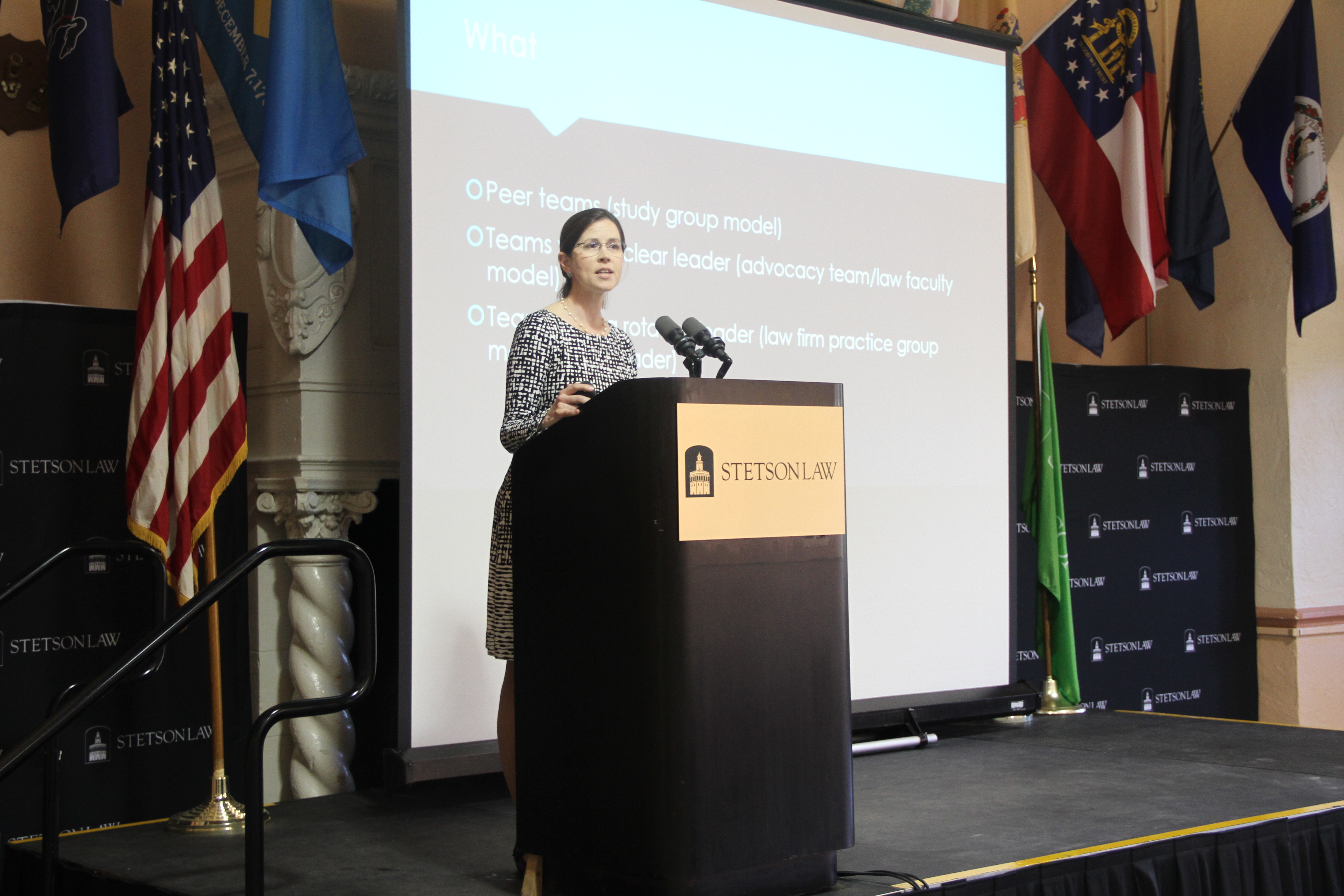
Professor Kristen Adams presents on the importance on team-building

Professor Kristen Adams spoke on the resource of teams at the SLDC luncheon. Photo by Merve Ozcan.

By Rachel Wise

The Student Leadership Development Committee hosted its second luncheon of the semester on March 21 with Professor of Law Kristen Adams.

During the luncheon, Professor Adams discussed the importance of teamwork with a presentation entitled: “The What/Why/When/Hows, and a Few Secrets of Great Teams.”

“The law, as practiced, is very much a team sport,” Professor Adams said. “The more different skills that you are able to bring into a team, the more you can do as a group.”

She explained that it is never too early nor too late to start teambuilding with others. “It starts with something as simple as making sure you know each other by name,” she said.

As an advisor to the Stetson Dispute Resolution Board, she often uses teambuilding to help the competitors come together as a unit and thrive outside of their comfort zones, such as improv exercises, varying practice locations, and even telling the team to ‘go have fun together’ outside of classes.

Professor Adams received her B.A. from Rice University, a J.D. from Emory Law School, and a LL.M. from Yale Law.

At Stetson, she teaches Commercial Transactions, International Sales Law & Arbitration, Property, and various other topics. In 2016, she published her fifth book: CISG Basics: A Guide to International Sales Law, a collaborative project with Professor Candace Zierdt.

“Great teams do not develop by accident. When you put amazing individuals in a room together, they are not automatically a great team,” Professor Adams concluded. “They happen because someone puts effort into team-building.”

Panel discusses Mueller Investigation

(L-R:) Professor Ellen Podgor, Professor Louis Virelli and Professor Ciara Torres-Spelliscy led a panel on the Mueller investigation. Photo by Merve Ozcan.

By Bianca Lopez

On March 20, a panel of three Stetson Law professors – Professor Ellen Podgor, Professor Louis Virelli, and Professor Ciara Torres-Spelliscy – spoke to students about Robert Mueller’s investigation into Russian influence of the 2016 election of President Donald Trump. The event was hosted by the American Constitution Society, the Federalist Society, and Stetson Democrats.

Professor Podgor, due to her background teaching white collar crime, discussed the criminal procedure followed in this investigation. Professor Virelli, a constitutional law professor, covered Paul Manafort’s lawsuit against Mueller and examined the constitutional questions brought up by the investigation. Professor Torres-Spelliscy, who teaches election law, spoke on the illegality of Russia’s connection to the 2016 election.

“Since Special Counsel Mueller’s investigation is about an election, discussing possible election law violations makes sense,” Professor Torres-Spelliscy said. “Interestingly, while the current Supreme Court has largely been hostile to campaign finance regulations, what is fully intact are the laws that bar foreign individuals from spending money in American elections. The Court agrees that keeping foreigners out of U.S. elections is constitutional.”

After each professor delved into their respective topics, the event hosts opened the floor to questions from the student audience.

“I have had several people come up to me since telling me it was an awesome event and they learned a lot, which is great,” said Kate Welch, student secretary of the American Constitution Society. “I think it was important for students to understand that this special investigation is a big deal, backed up by black letter law giving Mueller subpoena power and the right to look further into anything that he feels is relevant to the issue.”

Stetson hosts the 16th Annual Diversity and Inclusion Youth Pre-Law Conference

Stetson’s Gulfport campus hosted the 16th Annual Diversity and Inclusion Youth Pre-Law Conference on March 9, with students from Tyrone Middle School. This year’s theme was “The Great Debate.”

The daylong conference, held every year in partnership with the Law School Admission Counsel’s DiscoverLaw.org, featured alumni volunteers mentoring middle school students along with Stetson Law students, faculty and administrators. Stetson also partnered this year with the Fred G. Minnis, Sr. Bar Association of Pinellas County. With the assistance of the Minnis Bar, the middle students drafted mock written and oral arguments and had an opportunity to advocate in the Eleazer Courtroom on topics ranging from policing in schools to arming teachers.

The conference, coordinated by Associate Director for Admissions and Diversity Initiatives Carmen Johnson in conjunction with the Minnis Bar, promotes opportunities for legal education and careers among local middle school, high school and community college students from a range of diverse backgrounds.

“Our alumni, working together with these students, feeds the pipeline of excellence and helps grow future advocates,” said Professor Judith Scully.

Alumni volunteers included Johnson, Charis Campbell, Shaquana Harper, Angelica Jones, Cassandra Kline and Danielle Martin.

Stetson hosts “Essentials of Trial Interpreting: A Mock Trial Experience”

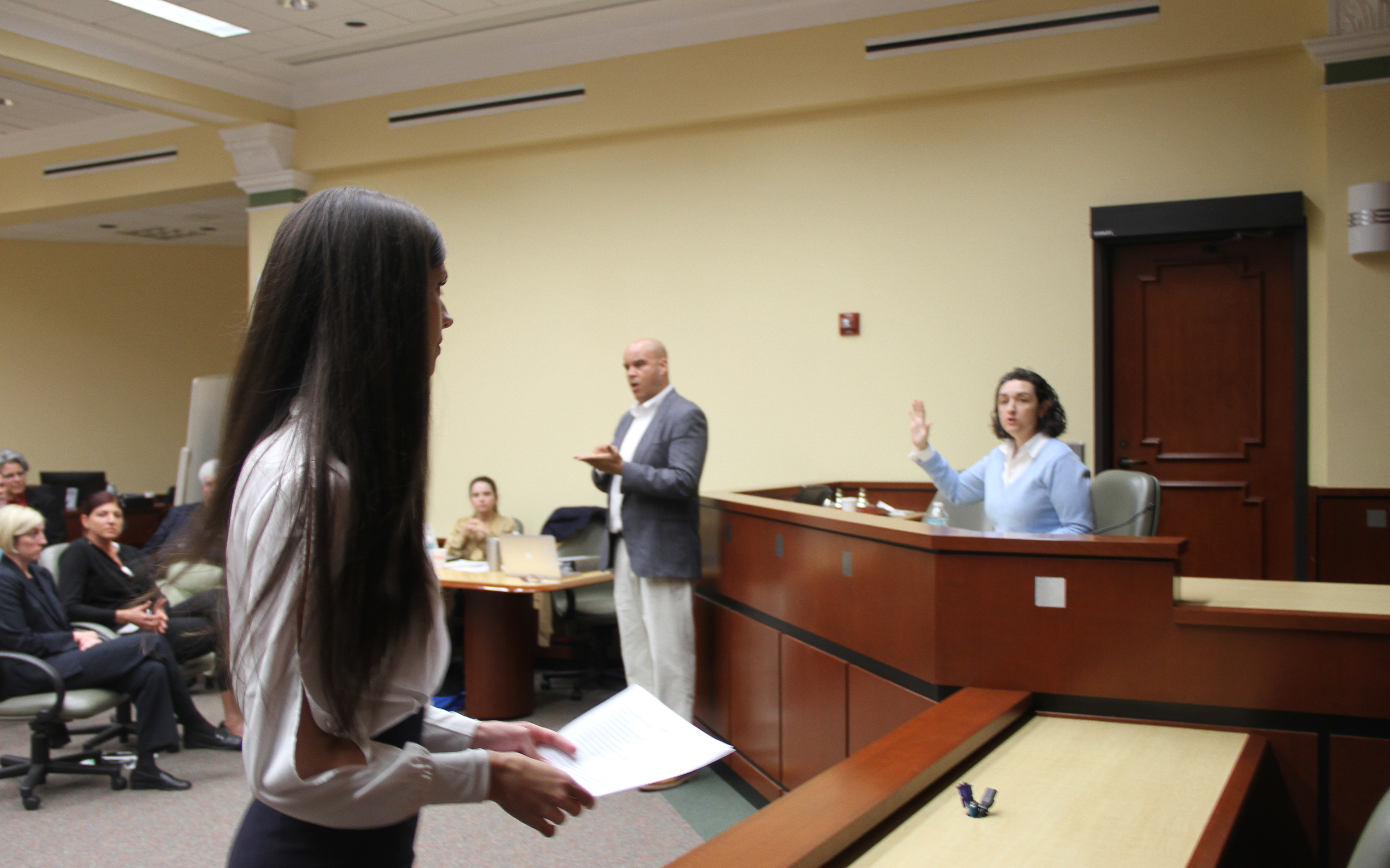
Stetson presented a mock trial for interpreters on March 4 in the Eleazer Courtroom, with Trial Team Director and Professor Julia Metts acting as judge. Photo by Merve Ozcan.
Stetson presented a mock trial that was used to train sign language interpreters on March 4 in the Eleazer Courtroom, with Director of Trial Teams and Professor Julia Metts acting as judge. Photo by Merve Ozcan.
Stetson University College of Law’s Center for Excellence in Elder Law co-sponsored with Absolute Quality Interpreting Services (AQI) a weekend workshop on “Essentials of Trial Interpreting: A Mock Trial Experience,” March 3-4 on Stetson’s Gulfport campus.

SC:L certified sign language interpreters Ben Hall and Linda Ross presented at the two-day session, covering the essential elements of trial interpreting for the deaf and featuring a mock trial experience conducted by Stetson Law.

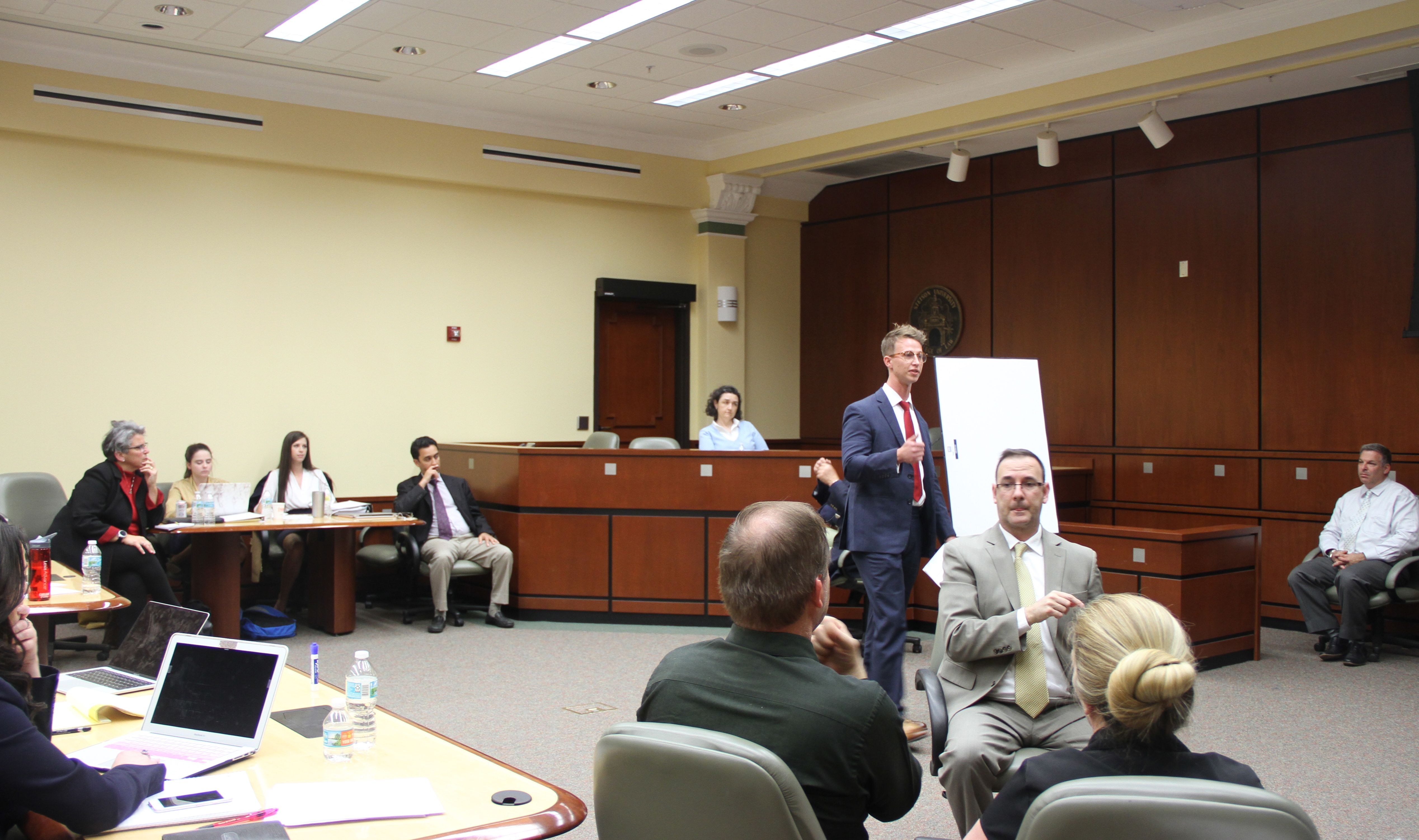
Stetson hosted "Essentials of Trial Interpreting: A Mock Trial Experience" on March 4 in Gulfport. Photo by Merve Ozcan.
Stetson hosted “Essentials of Trial Interpreting: A Mock Trial Experience” on March 4 in Gulfport. Photo by Merve Ozcan.

Sign language interpreters for the deaf were invited to interpret a mock courtroom trial in Stetson’s Eleazer Courtroom, a teaching courtroom on Stetson’s Gulfport campus designed as a model for accessibility.

“The Workshop was designed to be a collaborative learning experience for both sign language interpreters and Stetson law students,” explained Professor Jason Palmer, one of the organizers of the workshop.  “Providing this mock trial training in an actual courtroom to sign language interpreters, the only one of its kind, reinforces Stetson’s commitment to community outreach, as well as providing access to justice through unique educational opportunities.”

Hallenross and Associates, LLC, provided 1.6 CEU credits for interpreters.