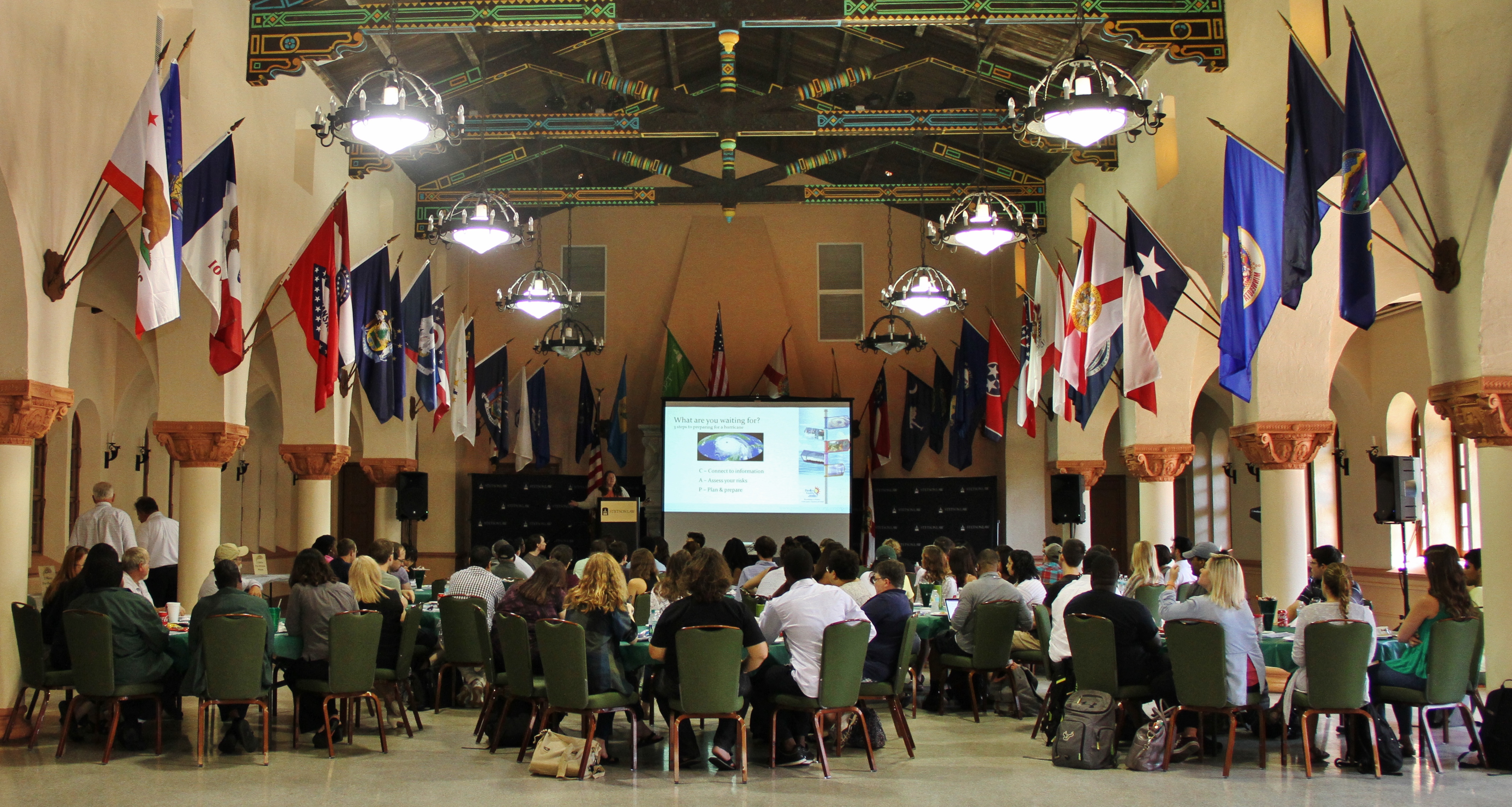
Students gathered in the Great Hall on Aug. 30. Photo by Merve Ozcan.
Human Resources, Residential Life and the Student Affairs Office facilitated a lunchtime program for Stetson University College of Law on how to prepare for and recover from a serious weather situation. Sandra Pittman, a volunteer for Pinellas County Emergency Management, presented in the Great Hall on the Gulfport campus on Aug. 30.
More information about preparing for serious weather events is available on the Emergency Preparedness Page.
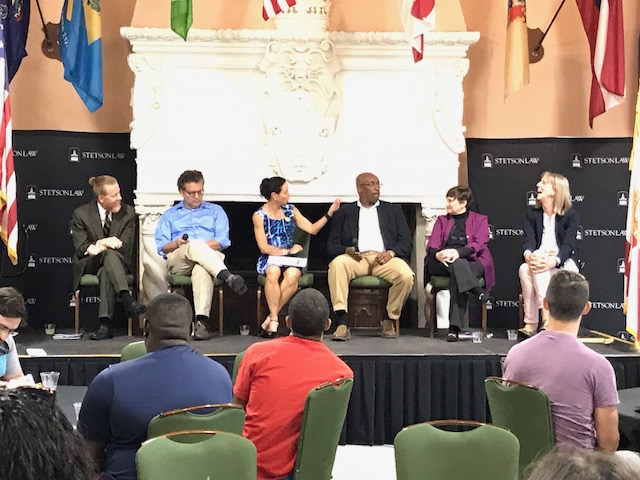
(L-R): Professor Lance Long, Professor James Fox, Professor Luz Nagle, Associate Dean Darryl Wilson, Professor Ellen Podgor, and Professor Ann Piccard.
Stetson University College of Law hosted a panel on “Diversity and Inclusion in the U.S.: A Discussion Post-Charlottesville,” on Aug. 24.
“The goal was to begin a campus-wide discussion as the year begins and join in community to support one another,” said Assistant Dean for Student Affairs Tammy Briant, who moderated the panel.
Dozens of campus community members attended the discussion, with panelists Associate Dean Darryl Wilson, professors James Fox, Lance Long, Luz Nagle, Ann Piccard and Ellen Podgor fielding questions from the audience.
The discussion was hosted by Stetson’s Inclusive Implementation Strategy Group, along with the co-chairs of the College of Law’s Diversity and Inclusiveness Committee.
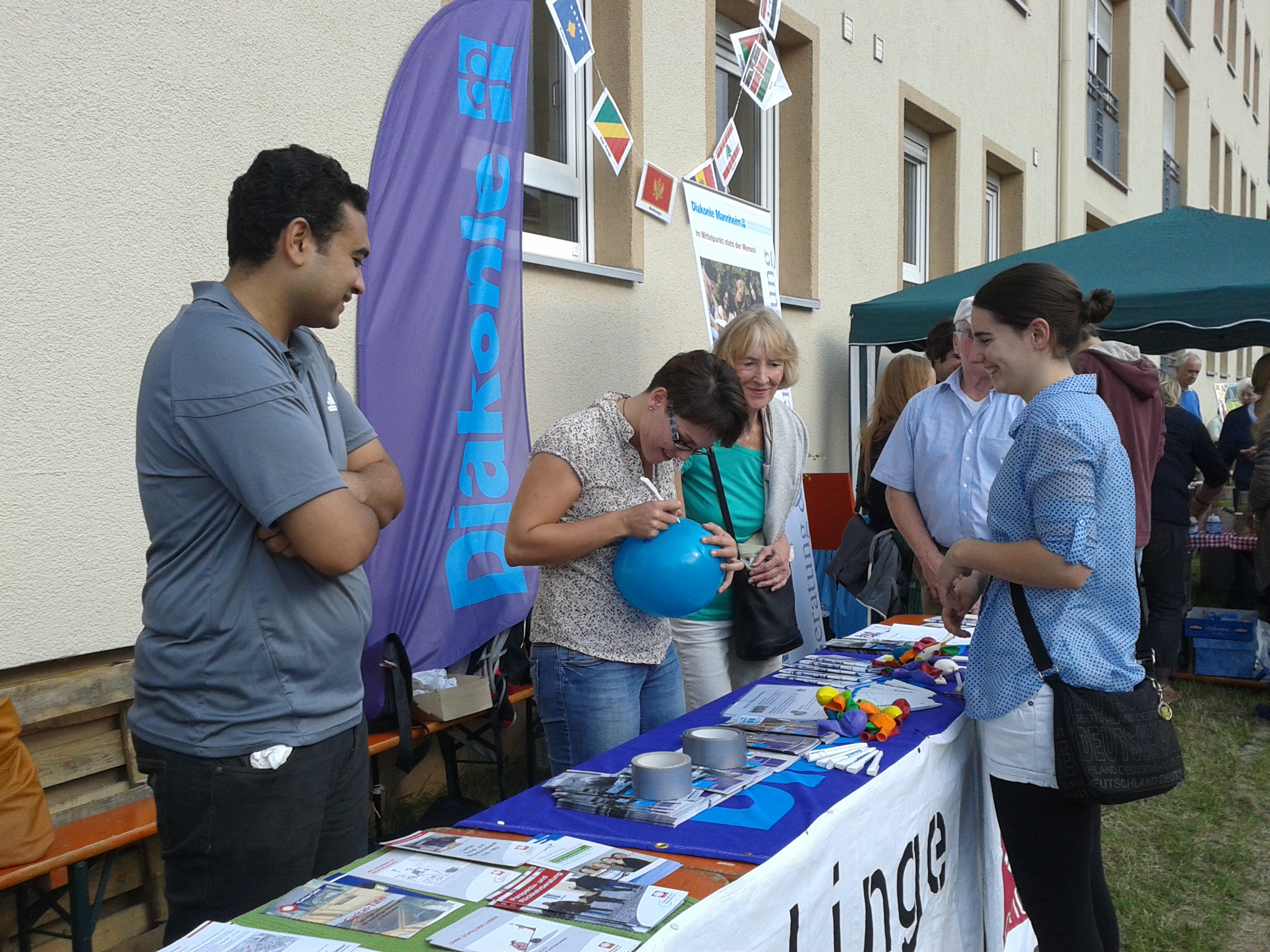
Mohamed Mohamed (left) at a welcome event for refugees with Diakonie in Germany. Photo Courtesy Mohamed.
By Kai Su
Mohamed Mohamed became involved with humanitarian causes from a young age. In 2008, while in high school and living in North Sinai near the Gaza Strip, he helped the Red Crescent provide relief to people injured during the war in Gaza. He continued to be involved with humanitarian action in Egypt, which shaped his career path.
Mohamed, a Fulbright Scholar, is now at Stetson University College of Law working on his LL.M. in International Law. He graduated from Al-Azhar University’s law school in Cairo in 2014. While there, Mohamed formed a relationship with an international law professor named Ahmed Tawfik who does work with the United Nations and UNICEF.
“I just thought that I want to be like him,” Mohamed said. “He is my role model in law school.”
After graduating law school, Mohamed completed an internship at a Christian social welfare organization called Diakonie in Mannheim, Germany. He was assigned to work with Arabic-speaking refugees, providing legal aid on during their process of seeking asylum in Germany.
“Some people just stay for six months, and then others stay years just to get their status,” Mohamed said about the refugees he worked with from Syria, Iraq, Somalia and other countries.
Mohamed worked with refugees during the middle phase of their transition from entering Germany and obtaining asylum. During this middle stage, refugees live at a camp before moving to a permanent camp or apartment. Mohamed said the German government and organizations like Diakonie provide services, such as German language classes, to help refugees integrate into society after they obtain asylum in the country.
“They make them very welcome there,” he said.
After the internship, Mohamed learned that he received a prestigious job in the Egyptian government working at Al-Azhar — the largest Sunni Muslim institution in the world. He handled legal affairs for Imam Ahmed El Tayyeb, the Grand Imam of Al-Azhar.
“He is a man who really loves peace,” Mohamed said. “He does a great job spreading the culture of peace.”
The legal consultant office where Mohamed worked was responsible for ensuring compliance with international protocols, investigating complaints, and working with other religious leaders and institutions. While working in Cairo, the Grand Imam sent Mohamed to South Africa for a work mission as a member of peace convoy, and he lectured in mosques, churches, schools, and at a radio station.
Mohamed said he learned about Stetson through the Fulbright Program. Through his own research, he learned about the advocacy program and read about other students’ positive experiences at Stetson. Mohamed said the small class sizes and openness of the administration appealed to him. While here, he hopes to develop his advocacy and negotiation and mediation skills.
“My main concern was dealing with administration and making sure I got the best education opportunity I could because it happens only once in my lifetime,” Mohamed said. “So I wanted to make sure I chose correctly.”
Mohamed said he is very happy with his choice.
“I just feel that I am in my home country,” Mohamed said. “Not only my home country, but my home, from the first day here at Stetson.”
After completing his LL.M., Mohamed has a few options in mind for his next move. He said his top option is returning to humanitarian work. He would also like to return to Al-Azhar to develop global interfaith projects, such as with the Vatican or the Council of Churches, or other projects that promote peace.
“Especially because there is tension in the Middle East,” he said.
Mohamed said he believes lawyers have a responsibility to help people who may need legal aid, no matter what circumstances people are in.
“Of course they have a moral responsibility toward people,” Mohamed said. “Not only for people who have a crisis, but for people who are in need.”
Nathan Bruemmer spent 20 years advocating for equality and social justice before coming to law school. After graduating from Stetson University College of Law in May, he is preparing for his next role as an advocate.
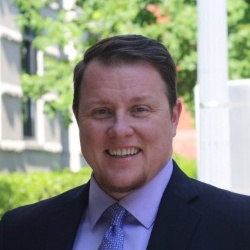
Nathan Bruemmer.
On Aug. 7, Bruemmer will begin his position as executive director of the local nonprofit Advocacy Leadership Support and Outreach Youth. ALSO Youth is an LGBT organization based in Sarasota. Bruemmer was recently selected among “Most Remarkable People 2017” by Watermark magazine.
“If you had asked me my dream job five or 10 years ago, I probably would’ve described this,” Bruemmer said. “A job that combines my passion for working with children, advocacy, and LGBT equality.”
Bruemmer recently received an award from the Tampa Bay Business Journal for being a community voice. He was also featured in the Tampa Bay Times for his work beginning a tradition of kicking off the St Pete Pride Parade with a transgender march. He said there are needs everywhere for advocacy work.
“The last three years, the law has progressed in ways—the country has progressed in ways—politically, socially, and culturally that create a lot of interesting opportunities to do social justice work,” he said. “And as quickly as it’s expanded, things have started taking steps backward in I think potentially dangerous ways.”
Bruemmer said that during his 1L year at Stetson, Caitlyn Jenner’s story broke and the riots following police shootings in Ferguson and Baltimore occurred. During the summer before his 2L year, the marriage equality decision in Obergefell v. Hodges was announced and a transgender woman, India Clarke, was murdered in Tampa. Around that time, Bruemmer got involved in more projects and his advocacy work took off.
Bruemmer said law school has taught him how to be a better listener, which is the most important skill an effective advocate can have. He said it is important to be persuasive and passionate, but you must take the time to understand the people you are working with when advocating for different needs in different circles.
“And you can’t do that if you lead with your opening statement right out of the gate,” Bruemmer said. “The most persuasive thing—the thing that wins cases—you set up with an opening statement, but your closing argument is crucial. And the only way you win a closing argument is if you were really listening.”
Bruemmer said, as Professor Charles Rose teaches in Trial Advocacy, “situational awareness” is key.
“It’s about being in the moment and being aware and not being too prideful that your argument is the best…” Bruemmer said. “Finding the common ground to move the needle absolutely requires listening.”
Bruemmer, who has taught in six different schools in Hillsborough County, said the political climate was different when he started teaching in 1999.
“It was kind of a big deal to be LGBT and teaching 10 years ago,” he said. “People could lose their jobs.”
Bruemmer said bullying and mental health statistics were frightening. He never discussed his personal life as a teacher, but students would find their way into his classroom at lunch or after school because they needed a place to be. By working with a coalition of nonprofits, Bruemmer fought to convince school districts to implement changes as part of the Safe Schools Initiative, and the climate improved by the time he left teaching in 2009.
In addition to equality and education work, Bruemmer has advocated for the homeless, affordable housing, and veterans. He said his current advocacy work is mostly intersection-based, so he appreciates when people approach an issue from different perspectives.
“I don’t pretend that I know exactly all perspectives. I can’t know that.” Bruemmer said. “But when I do work for children or for the trans community in Tampa Bay, I can lead that conversation more eloquently and passionately.”
Bruemmer recalls passing through St. Louis, Missouri, on his drive to law school, right after the Ferguson shooting. His truck broke down, and the people who stopped to help Bruemmer talked to him about what had happened.
“I’m literally on my drive to law school, coming to law school to become a better advocate,” Bruemmer said, “and my first experience as I’m coming in is a social justice, eye-opening experience. So it just took off from there. I thought, ‘This is where I need to be at this point in history.’”
Bruemmer draws parallels between courtroom advocacy and advocating outside the courtroom for equal rights, but he said they are also quite different. There are rules in the courtroom, such as rules of civil procedure and evidence. There are also traditions and nuances—even expected dress and mannerisms. Advocacy work outside the courtroom is a lot more fluid, but there are still nuances and customs in the way things are done, he explains.
“I hope that more people are inspired to be advocates. It isn’t a zero-sum game where you have to be a traditional lawyer or an advocate,” Bruemmer said. “You can be some combination of all those things.”
Bruemmer said the best advice he got coming into law school was to stay grounded and to be open to new experiences. He said that having a plan and direction is helpful, but you have to keep enough room open to not limit yourself.
“If we’re drawn to law school, there’s a reason,” Bruemmer said. “We’re fighters. We’re all advocates for something.”
Lisa Diliberto joins Stetson University College of Law in Gulfport, Florida, as director of communications and marketing.
For the past 25 years, Diliberto has held senior leadership roles in global brand marketing for two Fortune 500 companies including Hertz Corporation and Sony Electronics where she led strategic planning, brand communications and creative development.
While at Hertz, Diliberto was responsible for enhancing existing brands and launching new brands using both traditional and digital vehicles. She was also responsible for corporate sponsorships and appointed partners including Wimbledon, Disney and AAA. During her tenure, Diliberto earned Woman of the Year from Travel Agent Magazine’s annual 100 list of the most influential women in the travel industry.
Diliberto earned her Bachelor of Science in marketing from St. Thomas Aquinas College in New York. Originally from Bergen County, New Jersey, she has spent three years in Florida and now calls it home.
Professor Dmitriy Kamensky from Ukraine has returned to Stetson University College of Law as a visiting professor this summer to teach a course on the Introduction to Comparative Criminal Law. The one-credit course, which runs for two weeks, compares the criminal law frameworks of America to the codified criminal law systems of Europe—mainly Ukraine and Germany.
Kamensky, who teaches at Berdyansk State University Law School in Ukraine, first came to Stetson as a Fulbright Visiting Student Researcher in 2015. He did comparative research on white collar crime under the mentorship of Professor Ellen Podgor, publishing two articles in the Stetson Law Review and the Mississippi College Law Journal. Kamensky said he had read numerous academic works by Podgor while in Ukraine, which is why he asked to be placed at Stetson.
“I think she’s one of the best experts in the field, so I asked if it might be possible for the Fulbright Program to place me here to work with her, and my request was granted.” Kamensky said. “So I was really excited about the amazing opportunity to work together.”
Kamensky is currently writing a treatise in which he compares the white collar crime framework in Ukraine and the United States. In Ukraine he teaches criminal law, criminal procedure, and criminology. However, he said teaching in America is much different than in Europe, where the Socratic method is uncommon.
“Here you have to have this legal communication with students going back and forth all the time. So that was a little bit of a challenge for me,” Kamensky said, “but I think so far so good—I am teaching and learning how to teach better at the same time.”
Kamensky said he learns a lot from his ten J.D. and LL.M. students, who he admits do an amazing job briefing him on the international news every day. He thinks it is great his students take an interest in international issues because it keeps their personal and professional horizons open.
“They might end up in a big law firm that has offices in Hong Kong or Moscow or Kiev,” Kamensky said. “They can travel all over the world, and that’s where these comparative international law skills become handy.”
The main white collar crimes in Ukraine are those associated with oligarchs and corruption within the government, which arise in a continuing attempt to control national welfare and the economy. Other areas of similar criminality include money laundering, tax evasion, and antitrust violations.
Kamensky explained that there has been major organized crime in Ukraine in the 1990s, which evolved into organized economic criminality in the 21st century.
“You no longer see gangsters with guns or blackmail or kidnapping, but instead the monetary schemes have taken place in organized crime,” Kamensky said, “and today millions of dollars are involved in corruption, connecting big businessmen to dishonest politicians.”
Kamensky said he believes this is the biggest threat for Ukraine right now.
“The question of the day is how we can get rid of such illegal practices and create a model for a fair distribution of welfare among our citizens—just like you see in this country and Australia, throughout Western Europe and other civilized countries,” Kamensky said. “We would like to see our own middle class growing, but until we destroy this oligarchy and its political ties, our successes here will remain very limited.”
Kamensky says many statutory crimes in America look similar to those in Ukraine. However, there are differences in the level of economic development, the role that law enforcement agencies play, and interpretation of criminal statutes by the judiciaries.
Kamensky has traveled extensively for the last several years, doing comparative research projects in Europe. This is his fourth professional visit to America, and he hopes not his last. He said there is currently a growing trend in Ukraine called international academic mobility, of which he is a big proponent.
“This is both international law and comparative law in action,” Kamensky said, “when there are amazing opportunities for academics, practitioners, and students to travel abroad with the goal of learning and sharing.”
Stetson University College of Law, ranked the best law school in the nation in trial advocacy, will host two open house and information sessions in July and August about the admissions process for part-time law school applicants.
Future law students interested in attending Stetson should RSVP for one of the afternoon or evening sessions:
Wednesday, July 26, General Session from 12:15-1 p.m., One-on-one Session from 1:30-5 p.m., or Evening General Session from 6-7 p.m. at the Tampa Law Center, 1700 N. Tampa St.
Thursday, Aug. 24, General Session from 12:15-1 p.m., One-on-one Session from 1:30-5 p.m., or Evening General Session from 6-7 p.m. in the Mann Lounge at the Gulfport campus, 1401 61st St. S.
Stetson enrolls new law students every fall. Students interested in the full-time program are also invited to attend.
Retired Army Lieutenant General Ronald L. Burgess Jr. is Stetson University College of Law’s spring commencement speaker. Lieutenant General Burgess is presently serving as the senior counsel for national security programs, cyber programs and military affairs at Auburn University.
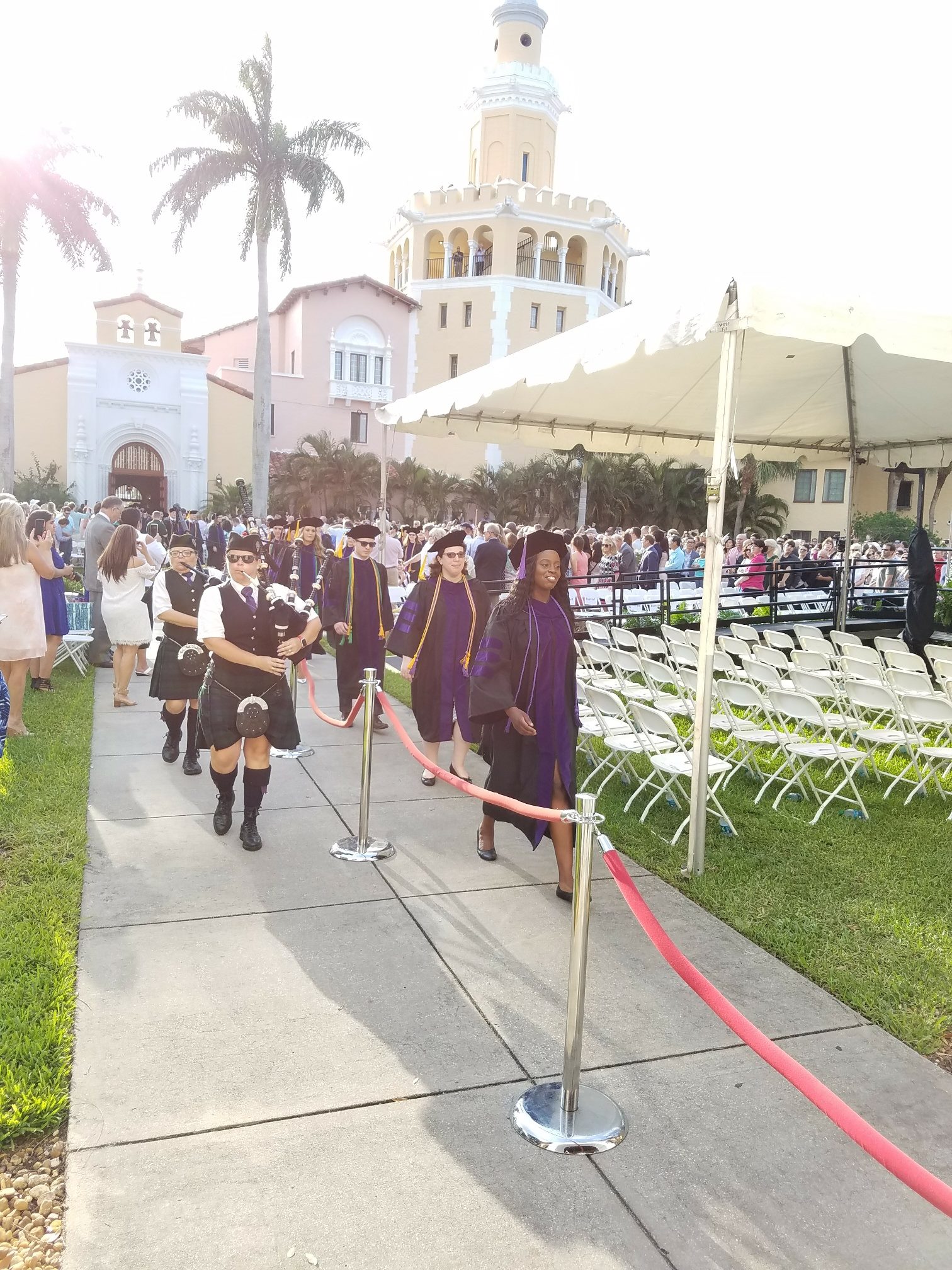
Burgess addressed more than 200 students during Stetson law school’s commencement on Saturday, May 13, in the Plaza Mayor courtyard on the Gulfport campus.
He described his life in public service, and evolving global challenges.
“You are entering an era of global interdependence that is full of promise and opportunity,” Burgess told the graduates gathered to hear him speak.
“I believe you should seize this moment.”
Starcee Brown, foreground, walks at the May 2017 commencement.
At Auburn University, Burgess coordinates with the university’s Office of the Vice President for Research to guide, direct and support interdisciplinary research as part of the Auburn University Cyber Initiative. Burgess directed the Defense Intelligence Agency from March 2009 until July 2012, where he received the Defense Distinguished Service Medal for his service. He was awarded the National Intelligence Distinguished Service Medal from Director of National Intelligence James R. Clapper, Jr.
A total of 254 Stetson law school students celebrated commencement, among them 28 part-time J.D. students, 12 J.D./M.B.A. students, two J.D./MINTEC students, one J.D./LL.M. student, two J.D./Grado students, eight LL.M. in Advocacy, two joint J.D./LL.M. in Advocacy, seven LL.M. in Elder Law and 12 LL.M. in International Law students.
This year’s outstanding graduating class includes:
Nathan Bruemmer, member of the Trial Team and Dispute Resolution Board, American Bar Association representative who served in leadership roles in three student organizations, served as liaison to the ABA’s SOGI Commission, between the American Bar Association and the National LGBT Bar Association, and served on the boards of St. Pete Pride, the LGBT Bar Association of Tampa Bay, and TransAction Florida;
Colby Connell, Trial Team member who was named best overall advocate in the National Civil Trial Competition and the Florida Justice Association Mock Trial Competition, won the Chester Bedell Trial Competition, ran a school-wide mock trial competition for first-year law students, served as a class representative for the Student Bar Association, and was quoted in the article, “Master Trial Advocacy Skills During Law School,” in U.S. News & World Report;
Evan Dix, editor-in-chief of the Stetson Law Review and selected for publication in the Stetson Law Review, Moot Court Board member, Student Ambassador, and research assistant in the field of antitrust, who was on the team that won best brief in the Andrews Kurth Moot Court National Championship;
Lieutenant Kasey Feltner, chief justice of the Moot Court Board, Stetson Law Review senior associate, editor-in-chief of the Stetson Journal of Advocacy and the Law whose honors paper on “Swipe Right for ISIS: Social Media and Material Support to Foreign Terrorist Organizations”was recently published in the Boston University Public Interest Law Journal, who tied for Best Oralist at the
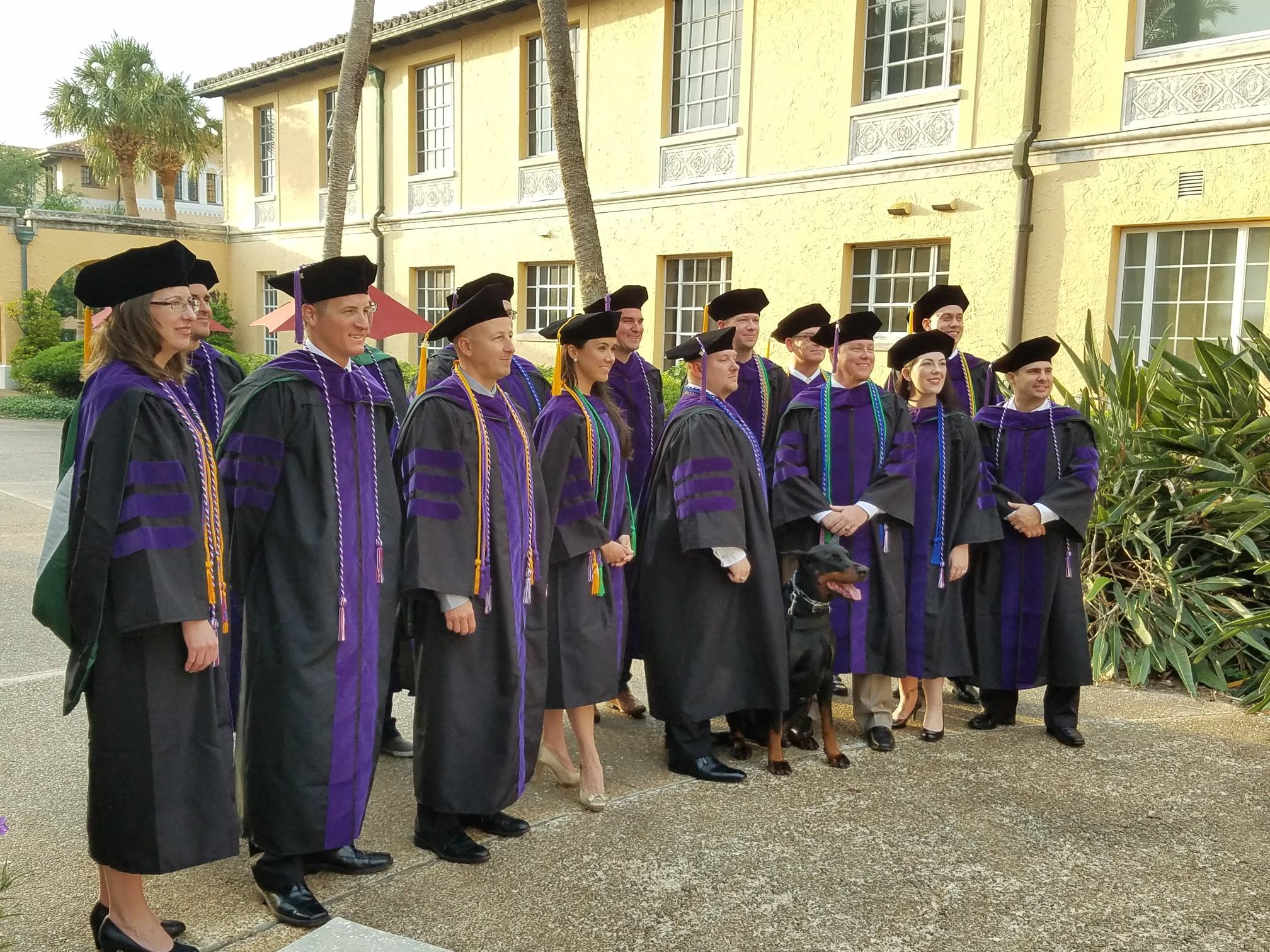
Stetson Law veterans, students honored for their work with the Veterans Advocacy Clinic, gather for a photo at spring commencement.
Andrews Kurth Moot Court National Championship;
Adriana Foreman, Honors Program student and Impact Award recipient who served as managing editor of the Stetson Law Review, Labor and Employment Law Association president, Hispanic Bar Association vice president, and student Moot Court Board member;
Diriki T. Geuka, former high school teacher who served as president of the Calvin A. Kuenzel Student Bar Association, member of the Journal of International Wildlife Law and Policy, the Black Law Students Association, The Pillars mentoring group, and the Second Amendment Society at Stetson;
Courtney Olivier, Trial Team member, Center for Excellence in Advocacy fellow, Student Leadership Development Committee member, Student Bar Association representative and Study Abroad Diplomat;
Chloe Wells, member of the Moot Court Board who was named second best oralist at the 2017 Phillip C. Jessup International Moot Court Competition, Southern Regionals, served as president of Florida Association for Women Lawyers at Stetson, and as a Mark Orr Foreign Affairs Fellow with the Tampa Bay Foreign Relations Committee;
Jami Worley, research fellow in Stetson’s Veterans Law Institute, fellow in the Institute for the Advancement of Legal Communication, and graduate teaching assistant and Equal Justice Works Summer Corps Member who completed more than 600 pro bono service hours;
Natalie Yello, associate justice of the Moot Court Board, president of the Stetson Chapter of the Florida Bar Young Lawyers Division Law Student Division, editor-in-chief of the Journal of International Aging Law and Policy and Stetson University’s first Ms. J.D. Fellow, who was named Governor of the Year of the Stetson Chapter of the Florida Bar Young Lawyers Division Law Student Division last summer.
Stetson Law celebrated commencement on May 13 in Gulfport.
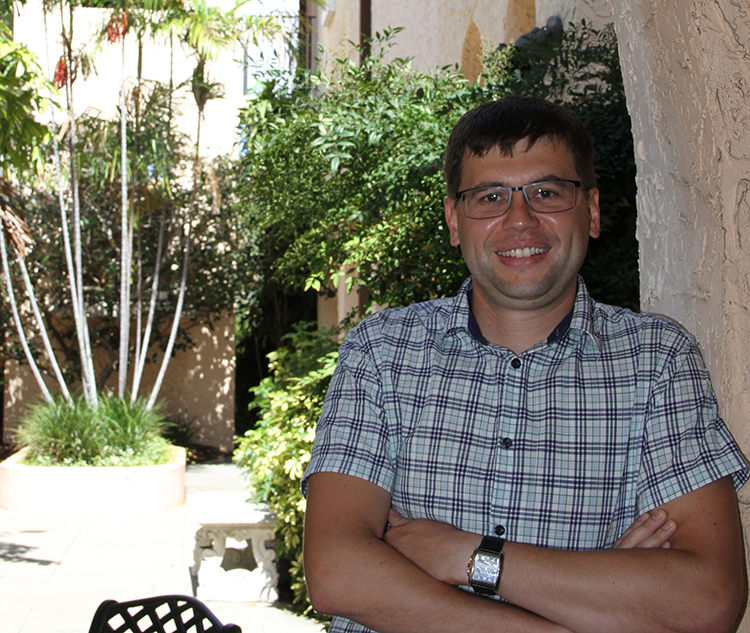
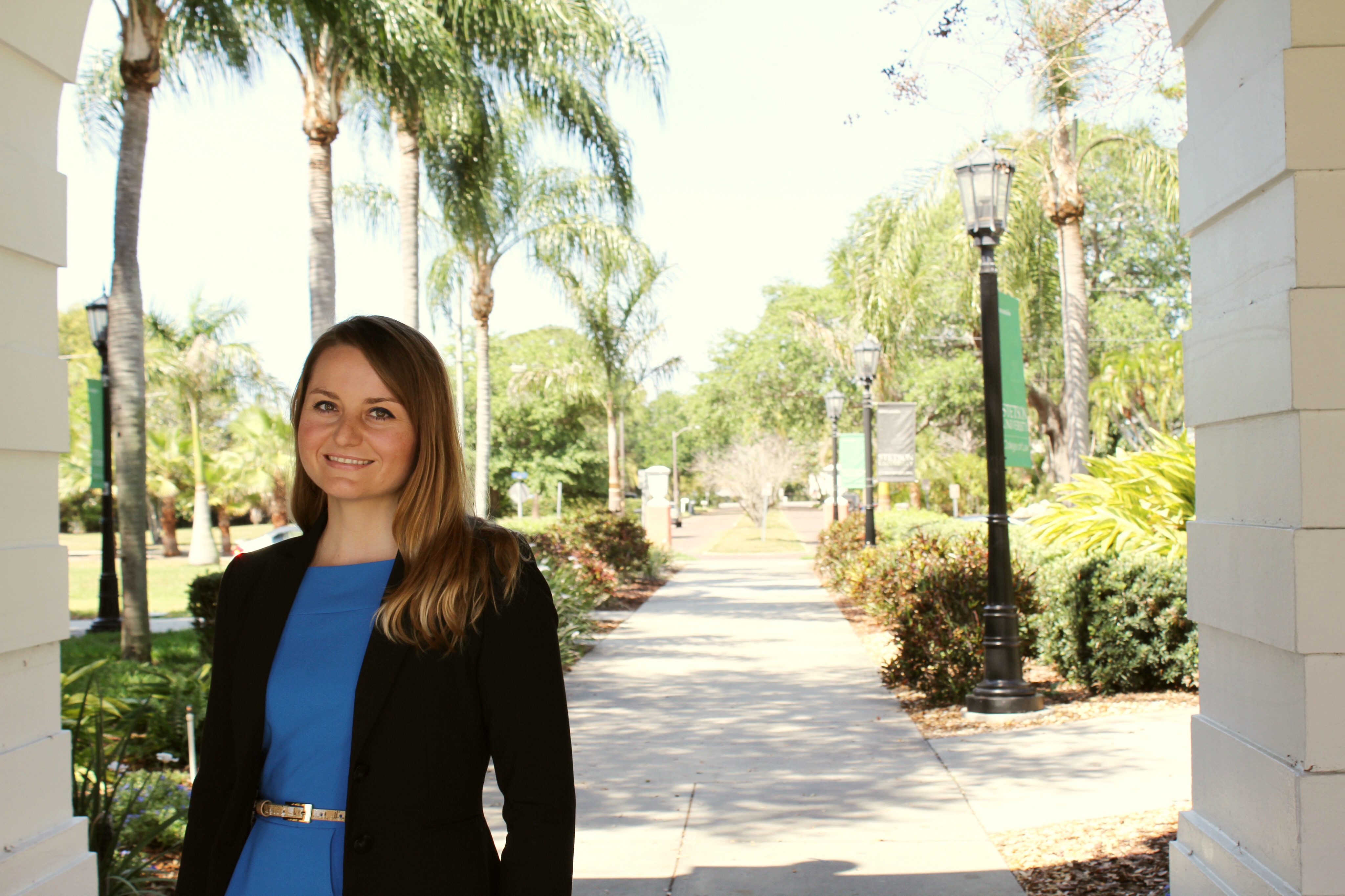
Agata Kuzniar is a student in Stetson’s part-time program and editor with the Stetson Law Review.
In 2003, Agata “Aggie” Kuzniar moved across the world from Poland to the U.S. to pursue an education in the American legal system.
“In Poland, civil law is very different from the legal system in the U.S.,” said Kuzniar, who said she found learning about the law in the U.S. fascinating.
Her family in Poland was supportive, and Kuzniar moved to the U.S. as a student, focused on meeting new people in her new home in the U.S. and immersing herself in the culture.
She worked her way through her undergraduate years as a political science major at the University of Connecticut, visiting Florida for the first time during vacation as a student and falling in love with the warm climate. She decided to make the move again, this time to Florida, and found a job in the legal field within two weeks of moving.
Today, the second-year student in Stetson’s part-time law program balances working full time at the Banker Lopez Gassler law firm with serving as articles and symposia editor for the Stetson Law Review and attending law school. At Stetson, Kuzniar said she found mentors through the Stetson Law Review program and professors willing to lend advice on achieving success in law school.
“If you are a person who wants to achieve your dreams and meet your goals, it’s a lot of work and you must sacrifice your social life, but it’s doable,” said Kuzniar.
Kuzniar’s article on her journey from Poland to study law in America was recently published in theFederal Bar Associationmagazine. Her essay on the importance of the jury in American jurisprudence has been selected for publication in the fall issue of the Hillsborough County Bar Association’s Lawyer magazine. She recently won the Hillsborough County Bar Association Trial and Litigation Section Scholarship Essay Contest. Another article on data protection is forthcoming later this year.
After graduating from Stetson law school’s part-time program, Kuzniar plans to stay in the area and aspires to work in business law.
“Living in the Tampa Bay area is like living in a place where other people come for vacation,” said Kuzniar.
Chase is the associate director of Stetson University College of Law’s Dolly & Homer Hand Law Library, coordinator of legal practice technology, and an adjunct law professor. She holds both a J.D. degree from the University of Dayton School of Law and a master’s degree in library and information science from the University of South Florida. Chase also attended the Leadership Institute for Academic Librarians at the Harvard University Graduate School of Education.
The Emerging Leader Award recognizes newer members who have already made significant contributions to the AALL and/or to the profession and have demonstrated the potential for leadership and continuing service. Chase has made her mark on the field of law librarianship during her short time in the profession, presenting at national and international conferences and publishing book chapters and articles in publications related to both law librarianship and librarianship, generally. In addition, Chase is the editor of the forthcoming book Millennial Leadership in Libraries, which will be published by the William S. Hein company later this year.
“I am extremely honored and humbled to be one of this year’s recipients of the AALL Emerging Leader Award. I look forward to many years of service with my colleagues in librarianship and know that our libraries and institutions will be better because of the continued engagement and leadership of the library profession.”
Fifteen years ago, a Dean’s job at the College of Law was very different than it is today. In the past, we made tweaks to the curriculum to help students get better prepared for practice. Today it is so much broader. It is understanding our community, connecting with students, and telling the story about their successes. It is trying to find ways – big and small – to help to make the law school experience for students better and finding ways to value our faculty and staff who are the foundations of what we do to make Stetson a special place.
As a private law school in a state with 11 other law schools, we have identified the ways that we add value for students as they decide on where they’re going to spend three years or four years as part of their law school career and where they will identify as alumni forever. A significant part of the role is external, connecting with the 9,000 Stetson Law alums and telling the story about what Stetson is doing and what it wants to do in the future.
I also serve on a number of national boards – the Law School Admission Council and the American Bar Association’s Standards Review Committee. Serving in a national capacity provides a unique opportunity to understand some of the trends before they happen. As Wayne Gretzky used to say, you don’t want to skate where the puck has been. You want to skate where the puck is going. And a big part of that service in national organizations is to help us figure out where the puck is going.
How long have you worked at Stetson?
I have been here almost five years and started in July 2012. Earlier in my career, I spent five years at the U.S. Department of Education and four years at the U.S. Department of Justice in Washington, D.C, as a trial attorney flying around the country and trying cases on behalf of the United States. While I was trying to figure out how to get to Louisiana and Florida and Alabama and Mississippi to take depositions and try cases, I taught as an adjunct at George Mason University’s law school, teaching corporate tax classes on Tuesday and Thursday evenings.
After successfully accomplishing that for a semester, I thought about doing it full-time and I was very fortunate that Louisiana State University in Baton Rouge asked me to interview. It all happened pretty quickly and about three months after the process began, my family and I moved from Washington, D.C., to Baton Rouge, where I spent 12 years on the faculty of LSU’s Law Center – the last five years as Vice Chancellor for Business and Financial Affairs.
In recent years, many law schools have gone through a period of change. How has that impacted Stetson’s College of Law?
In 2012, when I started here, legal education was changing. The largest class in the history of legal education enrolled in 2010, and because of various factors, the number of people applying to law schools has decreased pretty substantially — 40 percent since 2010.
The legal profession began asking law schools to do things differently and to be more transformational in student learning. As I thought about becoming the Dean at Stetson, one of the things that struck me was that Stetson already was doing many of the things that I thought legal education was going to have to do in the future. It had already blended much of its skills and doctrine together. Stetson created the first trial advocacy program in 1902, and the first clinic in the state of Florida in the 1960s. So while I thought many law schools had to make dramatic change, I thought Stetson was well-positioned to help its students be better prepared for what the profession is asking them to do immediately after graduation. Fortunately, for me, over the last five years, I have found exactly that – Stetson was far ahead of the curve.
When people ask why should they attend Stetson Law School, what do you say?
Stetson has a distinct value that makes it unique among many other law schools. Our advocacy program has been ranked No. 1 in the country by U.S. News & World Report for 19 of the last 23 years and this ranking is voted on by faculty members at other law schools that teach advocacy. We hear from many judges and lawyers that they can tell a Stetson student in the courtroom because of the training they received at Stetson. Our legal writing program has never been ranked outside of the top six… so the two things that Stetson does best are the two things that lawyers are asked to do on a daily basis in practice: advocate for clients orally and in writing.
Our veterans’ programs have been innovative, creating the first legal-medical partnership in the country in which law students, medical students, residents and law professors work together to help veterans obtain benefits from the Department of Veterans Affairs based on their service to our country. The VA Medical Center, just about 15 minutes from campus, is one of the largest medical facilities outside of Washington, D.C., and we were the first academic institution to help coordinate with legal-aid organizations to locate a legal clinic inside the VA hospital to help veterans with non-criminal matters.
Importantly, our students engage in over 30,000 hours of pro bono service every year. And that means we help fill some of the justice gap that exists in the United States, volunteering to work with legal aid organizations in our communities to give Floridians access to legal services that they otherwise wouldn’t have.
What trends do you see happening in legal education in the next five to 10 years?
At Stetson, our employment statistics for students graduating from law school have been excellent, for working at traditional places like law firms, the State Attorney’s Office and the Public Defender’s Office, and more and more, law schools are being looked at by business and industry for people to hire in what they call J.D.-Advantage jobs. These are jobs for which passing the Bar exam is not required, but a legal education is helpful in developing their critical-thinking skills.
No longer are business and industry simply looking to lawyers when a problem arises. Business and industry are looking for people with a legal education to help them run businesses and be part of their management structure. As more and more areas of compliance arise, law students are being sought after by compliance departments and, in particular, in the healthcare field. While these jobs have not been traditionally held by lawyers, there are increasing opportunities for law students.
So where do I think legal education is going in the future? I think more and more people will go to law school for non-traditional legal jobs because the education, training and skills that that you develop in law school are transferable across a broad spectrum of jobs.
What do you enjoy doing in your free time?
I have a wonderful family with two relatively small children, ages 11 and 7. They love athletics and I spend my free time watching baseball, basketball, and taekwondo — and playing some golf with them.
For the last 20 years, up until the time I became dean at Stetson, I was a high school and NCAA college basketball official. And when I became dean, I retired. My wife is also a high school and NCAA basketball official, and earlier this year she asked me to do a charity basketball game together. We had so much fun that she convinced me that I could do a couple of games a year, and so she and I officiated a few high school basketball game together this year – the boys joined us and finished each night with pizza and ice cream. It turned out to be a wonderful time together.
I work out early in the morning and I am still an avid runner – just a little slower.
Bio Education: Bachelor of Science from the University of Scranton, Pennsylvania; a Juris Doctor degree from Loyola University in New Orleans; and a Master of Laws degree from Georgetown University. Hometown: Scranton, Pennsylvania Family: He and his wife Siobhan have two sons, Ryan, 11, and John, 7.
Fast Facts Stetson University College of Law Where: Gulfport/St. Petersburg with a satellite center near downtown Tampa Founded: in 1900, Florida’s first law school Enrollment: 759 students (647 full-time; 112 part-time) Faculty: 54 full-time faculty members, 159 part-time
Stetson University College of Law hosts the Educating Advocates Teaching Advocacy Skills Conference on the Gulfport, Florida, campus on May 22-25.
The annual Educating Advocates conference invites professors, lawyers and legal practitioners from across the U.S. to spend two and one-half intensive days learning the Stetson method of advocacy, developing their teaching skills, and networking with renowned advocacy instructors.
The theme of this year’s conference is “We Are What We Teach: Modeling Appropriate Behaviors Across Teaching Modalities,” and includes an optional, full-day Teacher Advocacy Training session on May 25.
Stetson will present the Lifetime Achievement Award for Excellence in Teaching Advocacy to Syracuse University Professor of Law Emeritus Travis H.D. Lewin, longtime trial competition advisor and coach.
The inaugural Cornerstone Award, which recognizes exceptional members of the advocacy teaching community, will be presented in memoriam this fall to Lawrence Sutter’s surviving family at a ceremony in Ohio.
The Edward D. Ohlbaum Professionalism Award will be presented at the regional EATS conference in December of 2017 at Drexel University.