Stetson University College of Law students won the 2016 Law Student Professionalism YouTube Contest for their training and educational video depicting professional conduct for lawyers. It is the second year in a row that Stetson students have won the Florida Bar contest.
The video, “Legal Ethics Play of the Day,” features Stetson law students Dan Kavanaugh and Shaheen Nouri as television sportscasters reviewing a play-by-play of ethics scenarios acted by students Colby Connell, Patrick Iyampillai and Natalie Yello.
The Florida Bar’s Henry Latimer Center for Professionalism and Standing Committee on Professionalism selected the winners, who will receive their award on June 16 during the Stetson University College of Law Alumni Reception at the Florida Bar’s Annual Convention in Orlando.
The contest was designed to promote professionalism among law students as an integral part of a legal career.
Naomi L.P. Ardjomand-Kermani of WellFlorida Council Inc., St. Petersburg City Council member Steve Kornell, and Kristen Whitesell of Metro Wellness and Community Centers presented at Stetson law school on March 31 on the need for a law and policy response to rising cases of HIV infection in Florida.
(L-R): Bruemmer, Whitesell, Ardjomand-Kermani and Kornell.
Stetson’s Lambda Legal Society, Black Law Students Association, Health Care Law Association and Law Students for Reproductive Justice co-sponsored the program for students on HIV/AIDS and the Law.
“The impetus for this program was the release of some startling statistics in 2015 specific to Florida,” student Nathan Bruemmer explained during the introduction to the program.
Thirty-five years after the first AIDS diagnosis in the U.S., “Florida now has the highest number of new HIV diagnoses in the nation, with Hillsborough County demonstrating the largest increase — 63 percent from 2012 to 2014. Pinellas County diagnoses increased 32 percent, according to recent Florida Department of Health numbers,” said Bruemmer. Bruemmer shared that according to a 2014 Florida Dept. of Health Report, Florida is ranked third nationwide for HIV cases among pre-teen children.
While medical interventions and social services programs are available to help people with HIV/AIDS , stigma and discrimination create obstacles to people securing treatment, Bruemmer explained.
The panel discussed the implications of rising HIV cases in Florida, as well as how the law, lawyers and policymakers can help remove hurdles to HIV education and treatment.
“We need to have real conversations,” said Kornell. “When people feel more respected, they’re more likely not to engage in risky behavior.”
“Florida policies surrounding access to care and impoverished communities are driving this statistic forward,” said Whitesell, who pointed to the lack of sexual education in Florida as a problem. “Policy changes will effect this statistic.”
“The linkage to care component is the most important component to HIV care,” said Ardjomand-Kermani.
“We should not let anyone die or suffer because of lack of sexual education,” said Kornell. “We should really hold someone accountable for those statistics.”
In a course launched this semester by Professor of Law Joseph Morrissey, students are studying more than case law from text books, and alumni are sharing their tools of the trade.
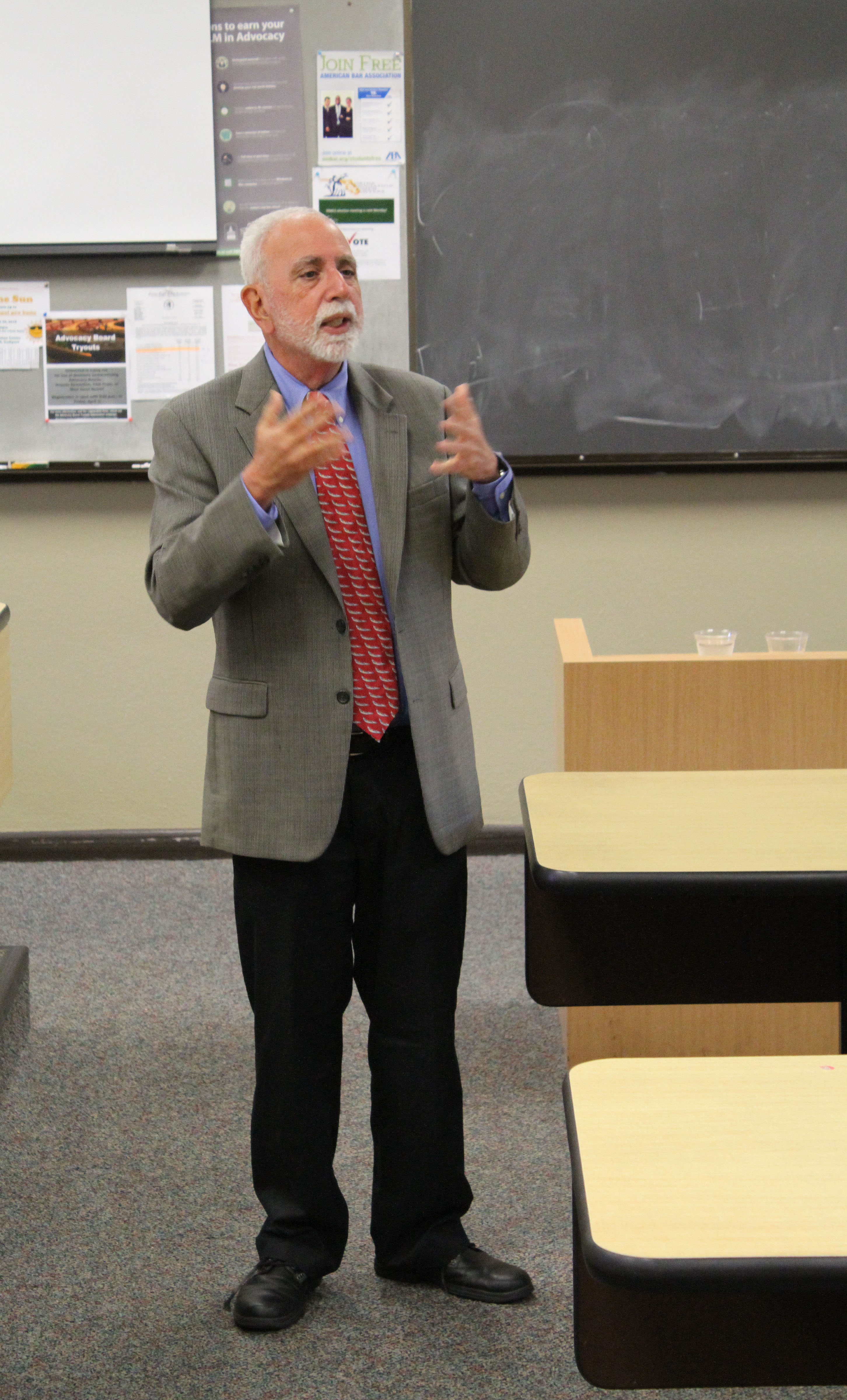
Professor Joseph Morrissey teaches, among other classes, Business Entities, Constitutional Law, Contracts, Corporations, and International Sales & Arbitration at Stetson.
Professor Morrissey’s new course, “Documents of the Deal,” is a business law boot camp designed to provide students with skills training to enter a sophisticated transactional practice. Students complete negotiating and drafting exercises and learn from top business lawyers who join the class weekly to discuss their areas of expertise. Those experts also present and discuss the complex contracts they use in their day-to-day practice. The topics presented span the life and death of a corporation: from business formation, through lending, mergers & acquisitions, securities transactions, all the way to bankruptcy.
“For several years now nationally there has been an increased discussion about providing law students with more practical training and exposure to the skills of practicing attorneys,” said Professor Morrissey, who teaches, among other classes, Business Entities, Constitutional Law, Contracts, Corporations, and International Sales & Arbitration at Stetson. “The goal of this movement is to get law students ready to successfully practice law when they graduate. Stetson has done this routinely for decades with incredible training in the advocacy area through curricular offerings and extracurricular team-based competitions. But this skills training has not been as thoroughly developed in our business offerings. The Documents of the Deal class is designed to provide just that skills training for students interested in business law.”
The class also provides students with an opportunity to network and explore career opportunities, Morrissey explained. “We have been very lucky to have had a wide range of really successful and dynamic attorneys present to the class. Many have been Stetson alumni. Each of the presenters has been incredibly generous with their time. Not only have they shared their expertise with our students in the class, they each expressly encouraged our students to follow up in personal e-mails with any further questions they have or advice they may seek. Our students in the class have remarked that they are genuinely inspired and encouraged by the successes of these alumni.”
Mark Haranzo JD ’85 practices with Withersworldwide in New York City. He traveled back to his alma mater in Gulfport, Florida, to present on various transactional documents used in estate planning for corporate clients. Haranzo shared that his Trusts and Estates professor at Stetson law school, E. McGruder “Mack” Faris, inspired his interest in estate planning and every area of law that encompasses, from tax to litigation to contracts. “There’s a lot more to life than cases and codes,” said Haranzo, who spends a sizable percentage of his time training young lawyers.
He said that while hitting the law books is important, lawyers need to interact. He was happily surprised to find that Morrissey’s classroom was set up like a corporate board room, with students sitting around a U-shaped table facing each other to improve engagement.
Today, working in Manhattan, Haranzo said that he is surrounded by Columbia and Harvard Law graduates and feels that his Stetson law school degree prepared him to go toe to toe with any of them.
Third-year Stetson Law student Aaron Reichelson said he was impressed that guest lecturers in the class were industry leaders. Many were involved in drafting current legislation or mentioned participated in cases the students read about in class.
“Unlike other courses that demonstrate the history and the evolution of the law from an academic perspective, the subject matter in this course is up-to-the-minute current, coming directly from attorneys who practice it every day,” said Reichelson, who suggested that the course should be considered a mandatory choice for any student wishing to practice corporate law.
Student Giovanni Giarratana said that he plans to work with Burr & Forman in Tampa, likely in commercial litigation.
“I have really enjoyed getting to hear from top business law practitioners in the Tampa area, many of whom are Stetson alums,” said Giarratana.
Michael Marder JD ’77 is managing partner at GreenspoonMarder Law who presented on securitization transactions for the class.
“I was pleased to be given an opportunity to impart real-world financial scenarios to the students and engage in discussions,” said Marder. In his day-to-day practice, Marder said the reality is an absence of routine.
“Each day brings new challenges,” said Marder. “My clients come from all industries and I handle myriad issues. This week it may be a trial over a business dispute, and next week a multi-million dollar financing transaction, with contract reviews, condominium development documents or litigation in between. Big or small, all matters can be broken down to the people involved, and my pleasure is taking care of people.”
Brittany Maxey JD ’07 of Maxey Law in St. Petersburg is an intellectual property attorney who went to law school solely to prepare for a practice in IP. In her own firm, she says she needs to be able to spot potential issues that face her clients in the business world. A course like the Documents of the Deal was not offered when she was in law school.
“This is a very unique course as it is rare that students have the opportunity to see so many of the actual transactional pieces that take place between the life and death of a corporation,” said Maxey, who covered intellectual property in the course.
David M. Doney JD ’91 is managing partner at Akerman LLP in Tampa where he focuses on mergers and acquisitions and capital markets transactions. He said that teaching a topic in the course appealed to him because the course was uniquely designed to teach students business-related topics from a practical and transactional perspective.
“Much of law school is centered around litigation,” said Doney. “Even subjects that are fundamentally transactional, such as business associations and securities regulation, are taught primarily from casebooks.”
Third-year student Lara McGuire is a member of the Moot Court Board and the Stetson Law Review. She said that she signed up for the class because she wants to be a litigator focused in commercial litigation with a working knowledge of the transactional stages that lead to disputes.
“This class has provided me with a significant foundation on a broad range of business law topics, and more importantly, exposure to the actual documents involved in these transactions,” said McGuire. “I no longer fear walking into a firm and being blindsided by documents or concepts that are entirely foreign to me.”
“The practice of law is so closely intertwined with business, and it’s important for all attorneys to have at least a minimal knowledge of those concepts,” said McGuire.
In addition to Documents of the Deal, Stetson offers courses in law and accounting, law practice management, contract drafting, a capstone course for business entities, international business transactions, interviewing and counseling and other courses for students interested in business and the law. Stetson also offers a joint JD/MBA degree.
“It is challenging for a young lawyer,” said Haranzo, who encouraged students to follow work they feel passionate about. “Early on, it’s important to expose lawyers to different opportunities in law, not as an afterthought.”
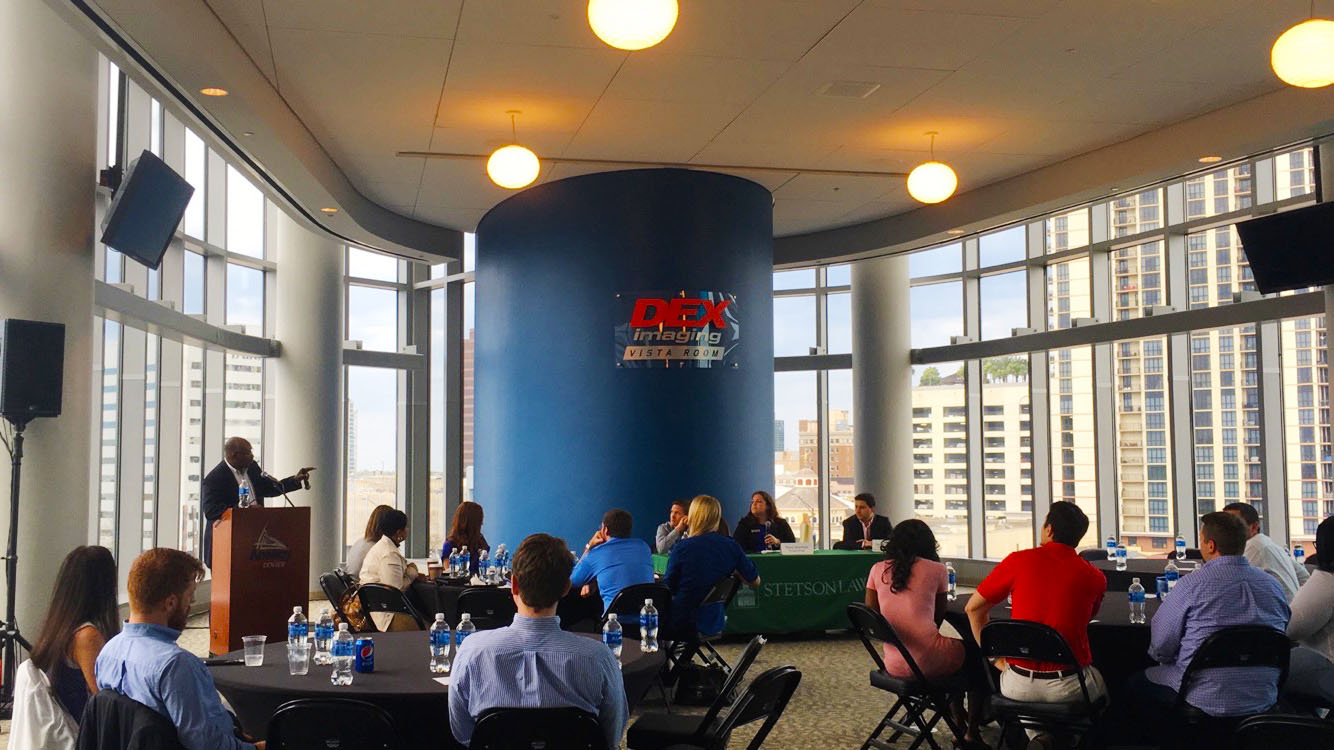
On March 18, Stetson Law’s Entertainment and Sports Law Society and Intellectual Property Law Society co-hosted “A Magical Night” in Orlando before the Cleveland Cavaliers and Orlando Magic game at the Amway Center in Orlando. The special event for law students included a three-person panel discussion with leading attorneys in the sports, entertainment and intellectual property fields followed by a back-and-forth basketball game between the Orlando Magic and the Cleveland Cavaliers, led by LeBron James. Law students from Stetson, Barry, Cooley and FAMU attended the event.
The three-person panel featured General Counsel for the Orlando Magic Nyea Sturman, Associate Counsel for Minor League Baseball Robert Fountain J.D. ’12, and Senior Vice President of Player Representation and General Counsel for Life Sports Management Jaafar Choufani. Stetson property and sports law professor and Associate Dean for Faculty and Strategic Initiatives Darryl C. Wilson moderated the event.
Area law students gathered for “A Magical Night” at the Amway Center in Orlando. Photo courtesy Alexandra Murdocca.
“EASL and IPLS strive to provide students with the opportunity to attend events that are educational, career-driven, and fun. Because many of our students are from Orlando and return to Orlando after graduation and because we have never held an event in the Orlando area, ‘A Magical Night’ enabled students to meet with attorneys in a new geographical area who practice sports, entertainment and IP law,” said Stetson’s EASL and IPLS student president, Alexandra Murdocca.
“The event was also open to other area law students, which allowed our students to meet their future colleagues in the sports and entertainment industries. With the Cavaliers vs. Magic basketball game following the pre-game networking hour and panel discussion, students and attorneys were able to continue to get to know one another in a laid-back, relaxed environment while enjoying a basketball game,” Murdocca said.
Associate Dean Darryl C. Wilson moderated the panel discussion for “A Magical Night.” Photo courtesy Alexandra Murdocca.
Sturman described her position as her “dream job” and spoke of her experience with corporate sponsors as the Magic built their new home in the Amway Center.
Fountain spoke of his experience spinning what began as an externship as a second-year law student at Stetson into his position today. Fountain brought a unique angle to the discussion as a representative for a professional sports league. He also discussed the intellectual property issues within Minor League Baseball regarding team logos, names and re-branding.
Choufani, also a practicing intellectual property attorney with Allen, Dyer, Doppelt, Milbrath & Gilchrist, P.A., spoke of his experiences representing players when negotiating with teams and about the structuring of contracts after a player is drafted.
After the panel discussion, students networked with Orlando area sports, entertainment, and IP law attorneys and participated in EASL’s silent auction during the pre-game reception.
EASL held a silent auction to raise money for its new philanthropic effort to raise money for the Boys and Girls Club of the Suncoast and the Sports Business & Leadership Association, two local non-profit organizations that support underprivileged youth in the community. EASL’s auction items featured an opportunity to present the game ball to both team captains at the Cleveland Cavaliers vs. Orlando Magic basketball game, Tampa Bay Rays baseball game tickets, and O’Maddy’s Bar & Grille merchandise.
“I had a great time, the panelists were very informative and I would love to do this again” said second-year Stetson law student Jaime Reitz.
Student Viktoryia Johnson introduced speakers Gil Singer and Jim Mallue. Photo by Marissa Marchena.
On March 24, Stetson’s student Labor & Employment Law Association hosted a presentation on employment discrimination, titled “Florida Commission on Human Relations’ Take on Employment Discrimination in Florida.” The speakers, Jim Mallue and Gil Singer, discussed the Florida Commission on Human Relations’ operation and the administrative process available to Floridians who have experienced discrimination in the workforce.
“The primary functions of the FCHR are to investigate and resolve employment discrimination cases and public accommodation discrimination cases brought under the Florida Civil Rights Act of 1992, and housing discrimination cases . . . brought under the Fair Housing Act,” said Mallue.
During his presentation, Mallue discussed the FCHR’s organization and functions and the complaint, mediation, and investigation processes established by the agency. He explained the anti-discrimination protections Floridians enjoy under the Florida Civil Rights Act of 1992 and the two avenues—judicial and administrative—Floridians can employ to pursue their causes of action under the Florida’s civil rights statute. Singer explained the FCHR’s appellate review process and his duties as a commissioner.
A crowd listened to speaker Jim Mallue. Photo by Marissa Marchena.
Mallue is a senior attorney with the FCHR. Prior to joining the FCHR in 1994, Mallue was active in civil rights enforcement on a volunteer basis, serving for a number of years on the St. Petersburg Human Relations Review Board as both board member and board chairperson, as well as serving as a commissioner of the FCHR. Singer is a Florida debt collection attorney and partner in Marcadis Singer, PA. In 2002, Singer was appointed to the FCHR, where he served a four-year term as commissioner. In 2007 and again in 2011, Florida governors reappointed Singer to the same post for two more four-year terms.
Stetson’s Labor & Employment Law Association is planning a similar event next year.
Students interested in learning more or becoming members of LELA should visit the Stetson Labor and Employment Law Association on Facebook. To join LELA’s listserv to receive notifications of future events, and labor and employment law writing competitions and scholarship opportunities, email Viktoryia Johnson, LELA president, at [email protected].
Michael Perlin spoke at Stetson law school on March 23. Photo by Marissa Marchena.
“We have to be vigilant to make sure the miscarriages of justice that have been all too prevalent over the last 40 years must end,” New York Law School Professor Emeritus Michael Perlin told an audience of Stetson law school students and faculty gathered on March 23 on the Gulfport campus to hear him talk.
Professor Perlin spoke on “Power and Greed and the Corruptible Seed” Mental Disability, Prosecutorial Misconduct, and the Death Penalty.
Perlin has devoted his career to ensuring that people with mental disabilities have legal rights. The author of 27 books and 300 scholarly articles on mental disability law, Perlin is an internationally recognized expert in mental health law and the co-founder of Mental Disability Law and Policy Associates.
“It’s important for law students interested in criminal law to understand how much we need to learn about mental health because so many convicted defendants are suffering from mental illness and different mental challenges,” said Professor Judith Scully, co-director of the Social Justice Advocacy program at Stetson. “Our prisons should not be housing people with mental health issues.”
As a professor, lawyer and advocate, Perlin advises mental health professionals, hospitals, advocates, activists, lawyers and governments. Perlin has worked as a deputy public defender, director of the Division of Mental Health Advocacy in New Jersey, and at all levels of the judicial system.
“We are truly fortunate to have a person of Professor Perlin’s skills to come speak to our community,” said Associate Dean Susan Rozelle. “He is a treasure.”
Perlin was originally scheduled to deliver the Wm. Reece Smith Jr. Distinguished Lecture at Stetson’s annual Inns of Court Banquet in January but winter travel delays prevented him from lecturing in person.
Stetson’s Gulfport campus hosted a series of events during diversity week, Feb. 29-March 4, to raise awareness about discrimination.
Professor Rebecca Morgan, co-director of the Center for Excellence in Elder Law, led a discussion with students on ageism. Photo by Karun Rivero, 2L.
An evening film and discussion on Feb. 25, “Cracking the Codes: The System of Racial Inequality,” hosted by the Social Justice Advocacy Concentration at Stetson, kicked off the series.
Events for faculty, staff and students included a program on poverty, homelessness and social justice on Feb. 29; a program on being black in America on March 1; a diversity banquet on March 2; lunchtime talk with Professor Rebecca Morgan on the topic of ageism as part of the “Pizza with Professors” series on March 3; and an evening presentation on diversity in the U.S. military on March 3 (read more in this Weekly Challenger feature).
Stetson University College of Law in Gulfport, Florida, is hosting speakers from Curacao, Puerto Rico, the Virgin Islands, and the east and west coasts of the U.S. on March 18 for a lively discussion and debate surrounding the issues of territorial status and self-determination, voting rights, and effective advocacy in the Virgin Islands.
Stetson law school’s Gulfport, Florida, campus.
WHAT: The symposium sponsored by the Stetson Law Review is free and open to the public. Continuing Legal Education credits are available.
WHEN: 9 a.m.- 5 p.m.
WHERE: Great Hall at Stetson Law, 1401 61st St. S., Gulfport.
To register for the symposium, “Effective Advocacy in a Territorial Jurisdiction: The Repudiation of the Restatements in the Virgin Islands and Emerging Issues of Political Status in the Territorial and Insular Jurisdictions of the United States,” visit https://stetsonuniversitycollegeo.regfox.com/test.
For more information, please contact Stetson’s Office of Professional Education at 727-562-7898.
“Florida is a very special place for sea turtles and Floridians play an important role as stewards,” Dr. Anne Meylan, senior research scientist with the Florida Fish and Wildlife Conservation Commission, told students, faculty, and members of the public gathered on March 1 on Stetson law school’s Gulfport campus to hear her talk.
She described the five endangered species of sea turtles nesting on Florida’s shores and the state’s important role. She illustrated how Florida hosts 90 percent of all loggerhead sea turtle nests in the U.S.
“Florida’s beaches are threatened in a way they never have been before,” said Dr. Meylan, who explained that Florida has more than 800 miles of nesting beaches.
Dr. Meylan said that factors including coastal development, sea level rise and erosion all threaten successful sea turtle nesting in Florida.
She said that enforcement of existing and new coastal management regulations, habitat design and conservation, land acquisition, conservation easements and a retreat from the shoreline could all help preserve Florida’s beaches as nesting sites for the endangered sea turtles.
The final presentation in Stetson’s spring biodiversity lecture series is scheduled for 5 p.m. on April 13 in the Great Hall. The lecture will feature Elizabeth Gitari, advocate of the High Court of Kenya and legal affairs manager of WildlifeDirect, speaking on the prosecution of the illegal wildlife trade.
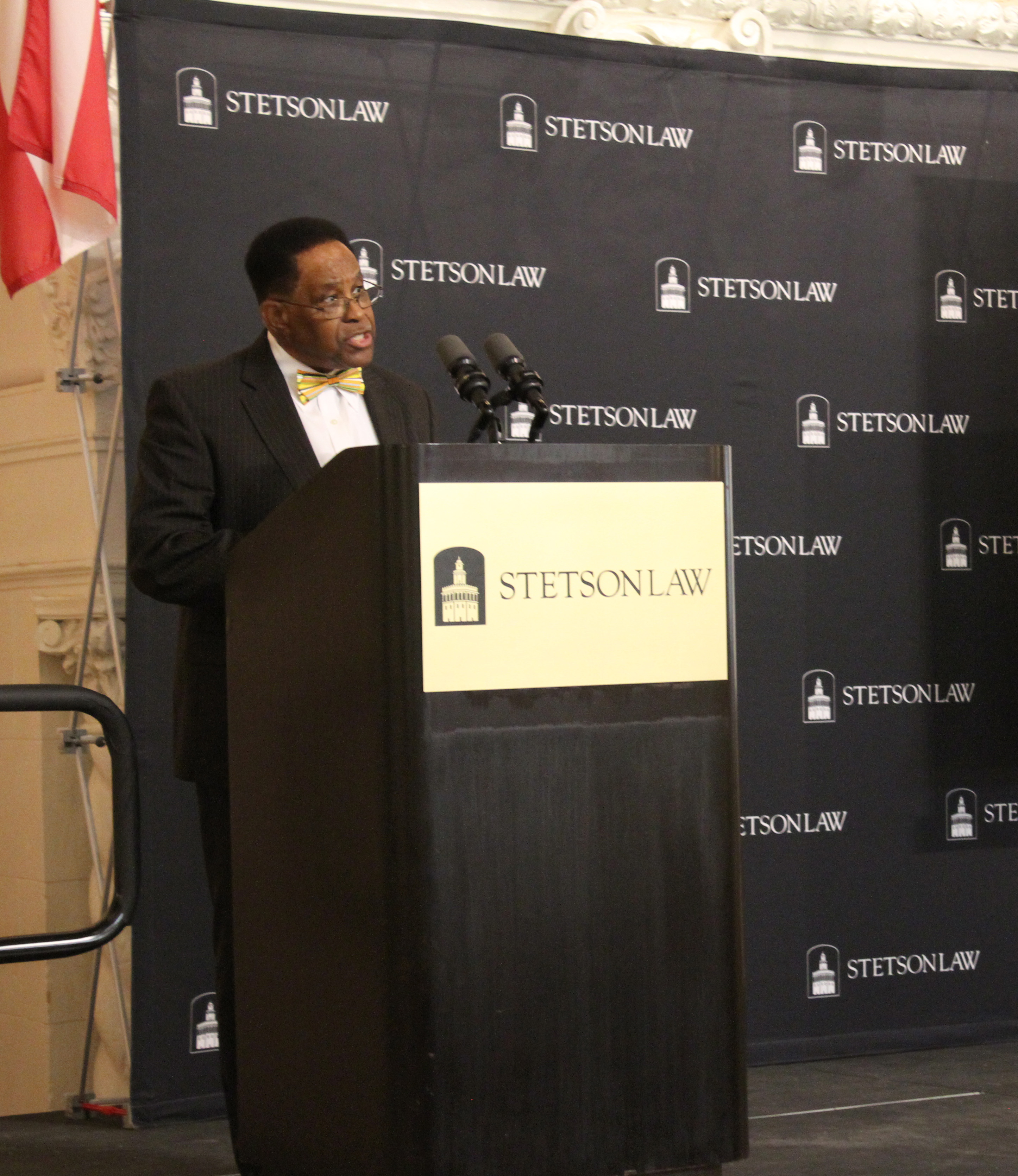
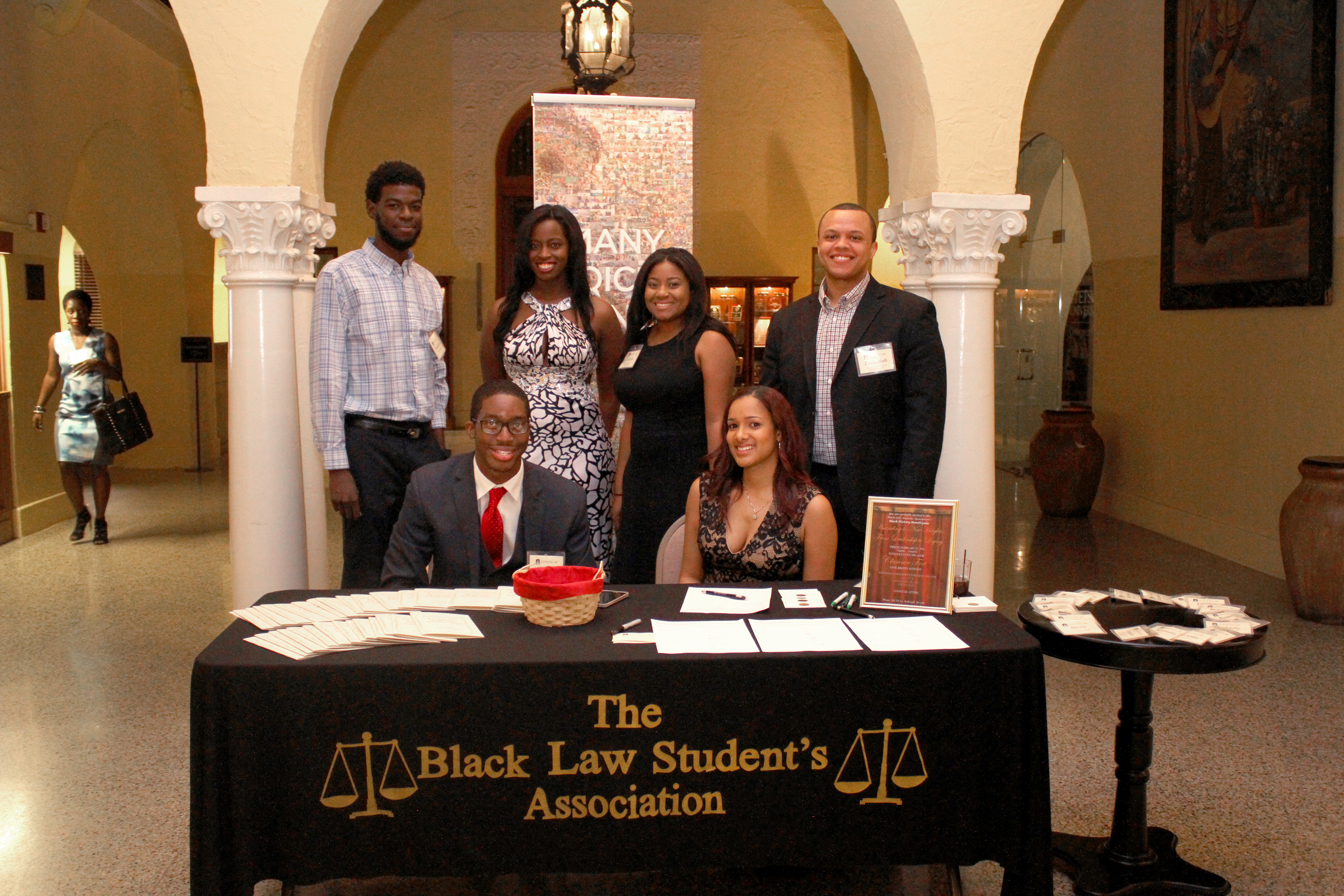
Tampa civil rights movement leader Clarence Fort provided the keynote address at the Black History Month Gala on Feb. 19 at Stetson University College of Law in Gulfport. The program on “Ascending to New Heights: From Leadership to Legacy” also recognized influential faculty members. Fort’s grandson, Kaarl E. Brandon, is a second-year law student at Stetson. He introduced Clarence Fort.
Black History Gala keynote Clarence Fort. Photo by Karun Rivero.
“It’s imperative to hear the experiences of local civil rights activists, and to learn about civil rights movements that have taken place right here in Tampa Bay, especially being future practitioners of law,” said Brandon. “As we enter positions of influence, the stories of prior generations are powerful tools of uplift, indicia of the fortitude and attitude required to overcome, and prophesy of successful but little known strategies and solutions to similar issues we face today.”
According to the Tampa Bay Times, in 1960, Fort helped lead a student sit-in at F.W. Woolworth’s lunch counter in Tampa. He also worked on integrating Tampa’s theaters and the the city bus service workforce. Fort was one of the first African-American Trailways bus line drivers in Florida.
Fort told the audience at Stetson that while on a scheduled trip from Albany, Georgia, to Tallahassee, Florida, he was stopped by an elderly African-American couple. The female passenger wept during the entire trip, and said that she never dreamed she would live long enough to ride a bus driven by an African-American Trailways bus driver. Fort said it was during this trip that he realized the true meaning of Dr. King’s “I Have A Dream” speech.
Fort served for decades as a Hillsborough County sheriff’s deputy. He coordinated the local Dr. Martin Luther King Jr. parade, founded the Progress Village Foundation and has led a “Saving Our Children” program for more than 20 years at New Mount Zion Baptist Church.
(L-R): Fred Randall (campus public safety personnel), Chizom Okebugwo (2L), Starcee Brown (3L), Keria McCowen (1L), Annette Collins (3L) and Zachariah Wade (3L). Photo by Karun Rivero.
In 2014, an East Tampa park was named the Clarence Fort Freedom Trail after Fort.
Stetson’s Black Law Students Association and George Edgecomb Bar Association co-sponsored the event.
Stetson University College of Law hosted a public town hall forum on Feb. 25 with Gulfport’s mayoral candidates to discuss environmental issues in the city. Stetson’s Environmental Law Society, Stetson’s Maritime Law Society and Long’s Environmental Advocacy class co-sponsored the event.
(L-R): Mayor Sam Henderson, Lauren Eliopoulos and Barbara Banno. Photo by Marissa Marchena.
Gulfport mayoral candidates Barbara Banno and Gulfport Mayor Sam Henderson presented, followed by a Q&A with moderator and Stetson Law professor Lance Long.
Student Lauren Eliopoulos introduced Banno and Mayor Henderson. During the Q&A, Professor Long asked Banno and Henderson how they would address sewage contamination in Clam Bayou.
Mayor Henderson described his goal to implement mitigation strategies to improve the water.
Banno said that the contamination is as an environmental disaster.
Eliopoulos said that she and fellow student Emily Carter worked to create the forum as a way that individuals can hear concerns.
“We have a great group of students working to make a difference in the world,” said Professor Long.
Rev. John C. Williams spoke with Stetson law students via Skype on Feb. 23. Photo by SeanCarlo Lopez.
The son of civil rights era activist Robert F. Williams, the Rev. John C. Williams, spoke with Stetson law students on the Gulfport campus on Feb. 23.
After sharing a first-hand account of what the struggle for basic human rights was like for African-Americans during the American civil rights movement in the 1950s and 1960s, Rev. Williams described how the Second Amendment can be used to preserve the First Amendment.
“When there is no legal recourse, when the courts turn you away, when people are oppressed, people have the right to secure basic human rights by any means necessary,” said Rev. Williams.
The Rev. Williams’ father, Robert F. Williams, led the Monroe, North Carolina, chapter of the National Association for the Advancement of Colored People during an era when white supremacists regularly targeted African-Americans. Robert F. Williams is the author of Negroes with Guns.
“Despite the nonviolent teaching of the NAACP, life lessons taught Mr. Williams that it was necessary to advocate for armed resistance and self-defense against the Ku Klux Klan,” said Diriki Geuka, a second-year student at Stetson law school who helped coordinate the event.
During the civil rights era, Robert F. Williams petitioned the National Rifle Association for a charter, which was subsequently granted, and formed an armed band known as the Black Guard to defend the Monroe, North Carolina, community from terrorism by white supremacists. The NAACP suspended Williams for advocating violence. Facing arrest for fabricated kidnapping charges, Williams fled to Cuba with his family where he and his wife started the radio program, “Radio Free Dixie.” He later moved to China before being cleared of all charges and returning to the U.S. in 1969 and joining the Institute for Chinese Studies at University of Michigan as a research associate.
“Hearing the history of how Robert F. Williams challenged not only white supremacists but also Martin Luther King Jr. and the entire civil rights establishment was inspiring,” said Professor Judith Scully, co-director of Stetson’s Social Justice Advocacy program. “His story tied the freedom struggle in the rural black South to politics, black cultural pride and armed self-reliance, a history that is often ignored.”
“Black History Month is often a time when routine lessons are taught about a select few civil rights heroes,” said Geuka. “Because of the emphasis on nonviolence that is often associated with the civil rights movement, the contributions of men like Robert F. Williams are often overlooked.”
Dozens of Stetson law students attended Williams’ talk on Feb. 23 in Classroom A. Photo by SeanCarlo Lopez.
“The event made me realize how the system of law we have here in America is not perfect,” said third-year student Patrick Iyampillai, president of the Jewish Law Students Association. “Just 50 years ago, equal citizens under the law of the Constitution were under fire for the color of their skin.”
“It was both humbling and motivating to see such a diverse crowd appreciating the gravity of what Rev. Williams had to say concerning his father’s approach to the civil rights struggle,” said student Zachariah Wade, founder of The Pillars.
“This was one of the best events I’ve been to since I started at Stetson Law,” said second-year Stetson Law student and Federalist Society president Christian Romaguera, who attended the event. “It was incredible to hear Mr. Williams speak about his experiences and those of his father’s. His father’s goals, actions, and accomplishments were nothing short of heroic.”
“Today, I walked away with a deeper respect for the Second Amendment and for African-American history,” said first-year student Alexis Turner-Garris. “Any diversity initiative at Stetson should aim to give students these kinds of experiences, experiences that challenge our beliefs and broaden our understandings.”
The Second Amendment Society, The Pillars and the Federalist Society co-sponsored the event. The Second Amendment Society was launched in the fall of 2015 by Geuka, society president Eric Reuter and Kenneth C. Smith. Reuter discovered the story of Robert F. Williams while researching a seminar paper on the Second Amendment and reading about the McDonald v. Chicago case and widespread efforts to disarm African-Americans after the Civil War.
“To my surprise, I realized that the civil rights movement has a hidden history, one where some of its champions took up arms and courageously fought back against their oppressors,” said Reuter. “Robert F. Williams was at the epicenter of that movement in the 1950s and 1960s.”
Reuter said that a GoFundMe page has been created to assist Rev. Williams in covering medical expenses.