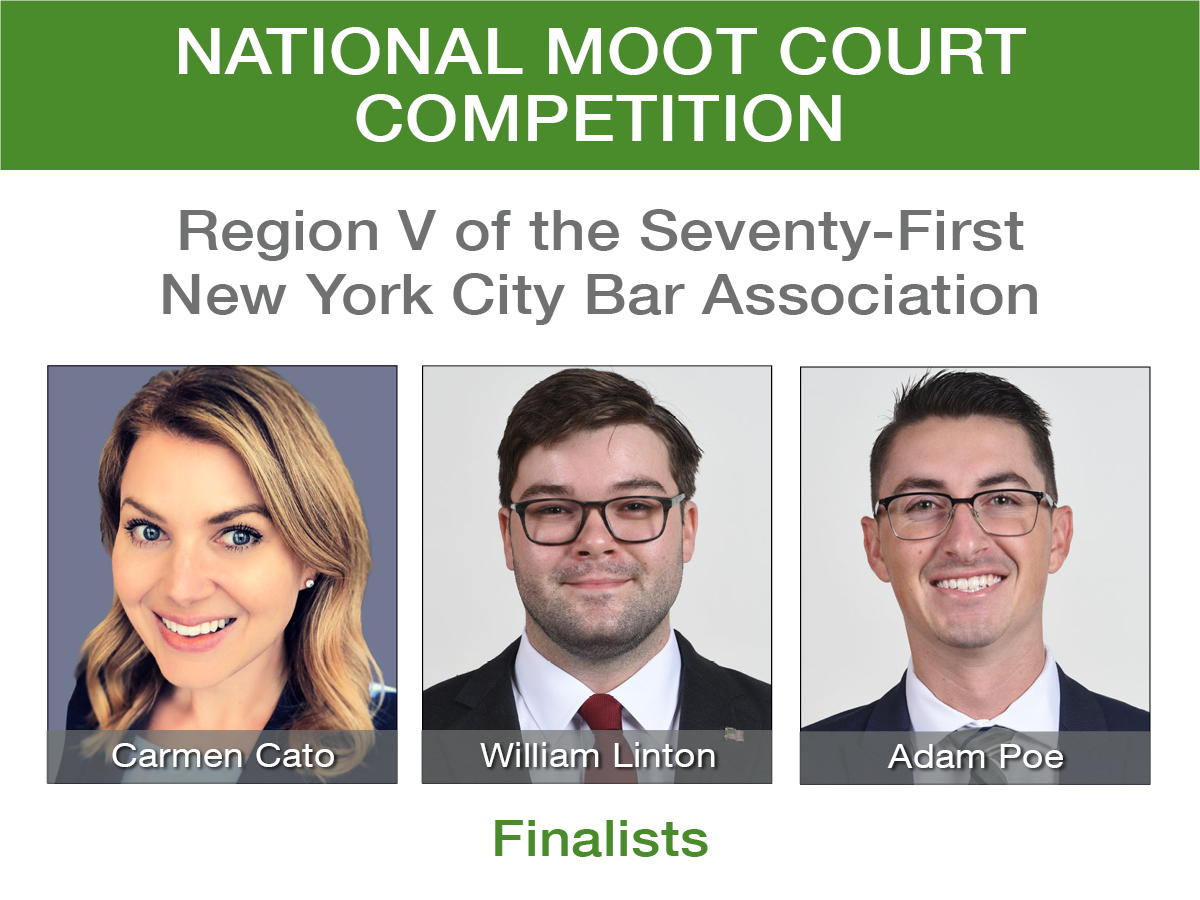
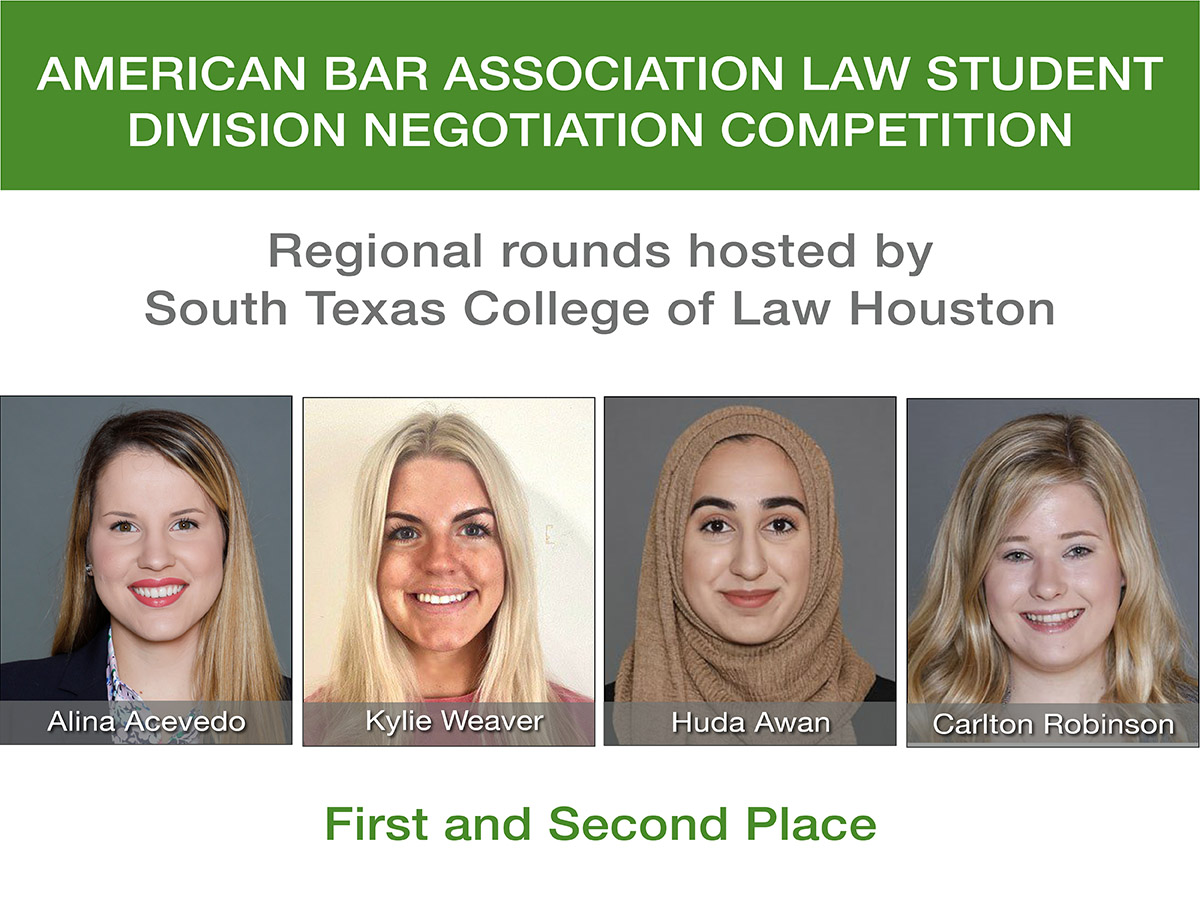
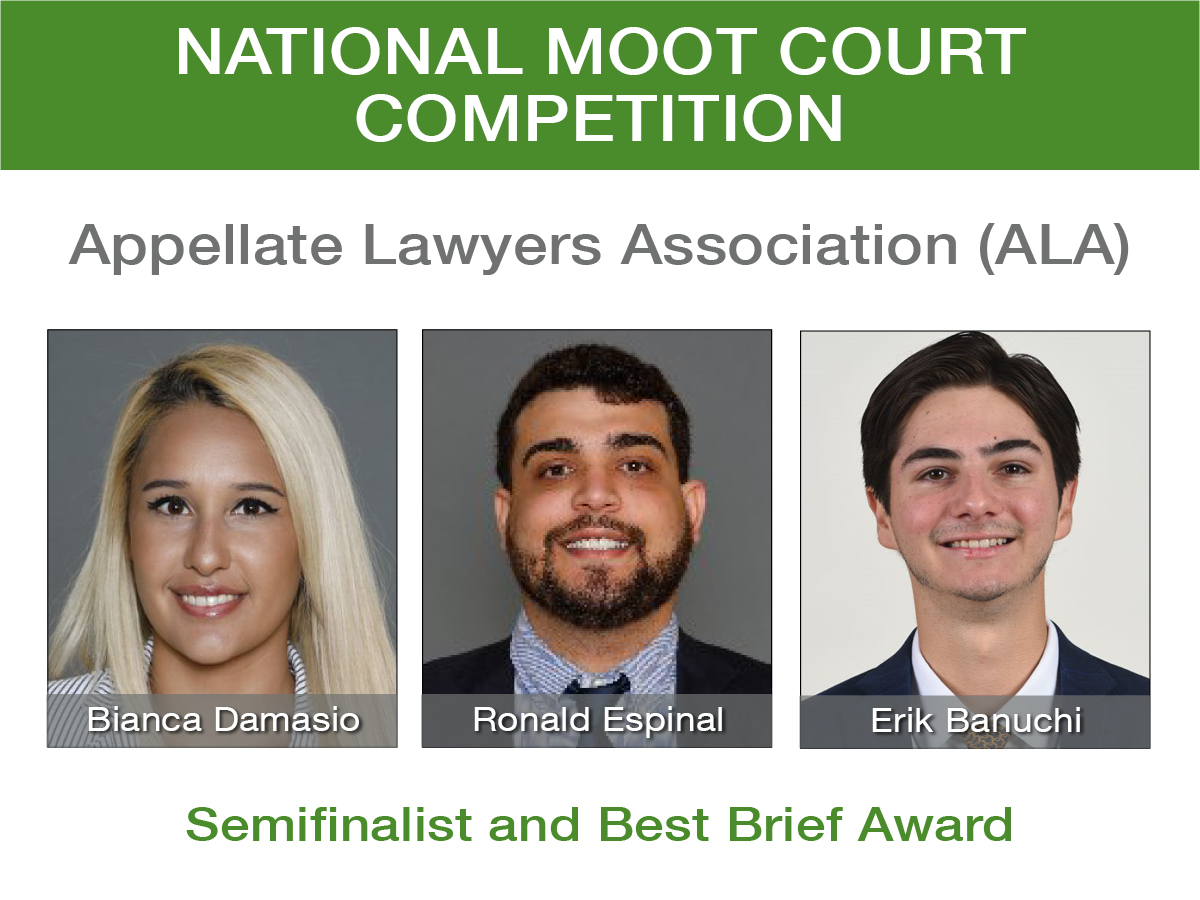
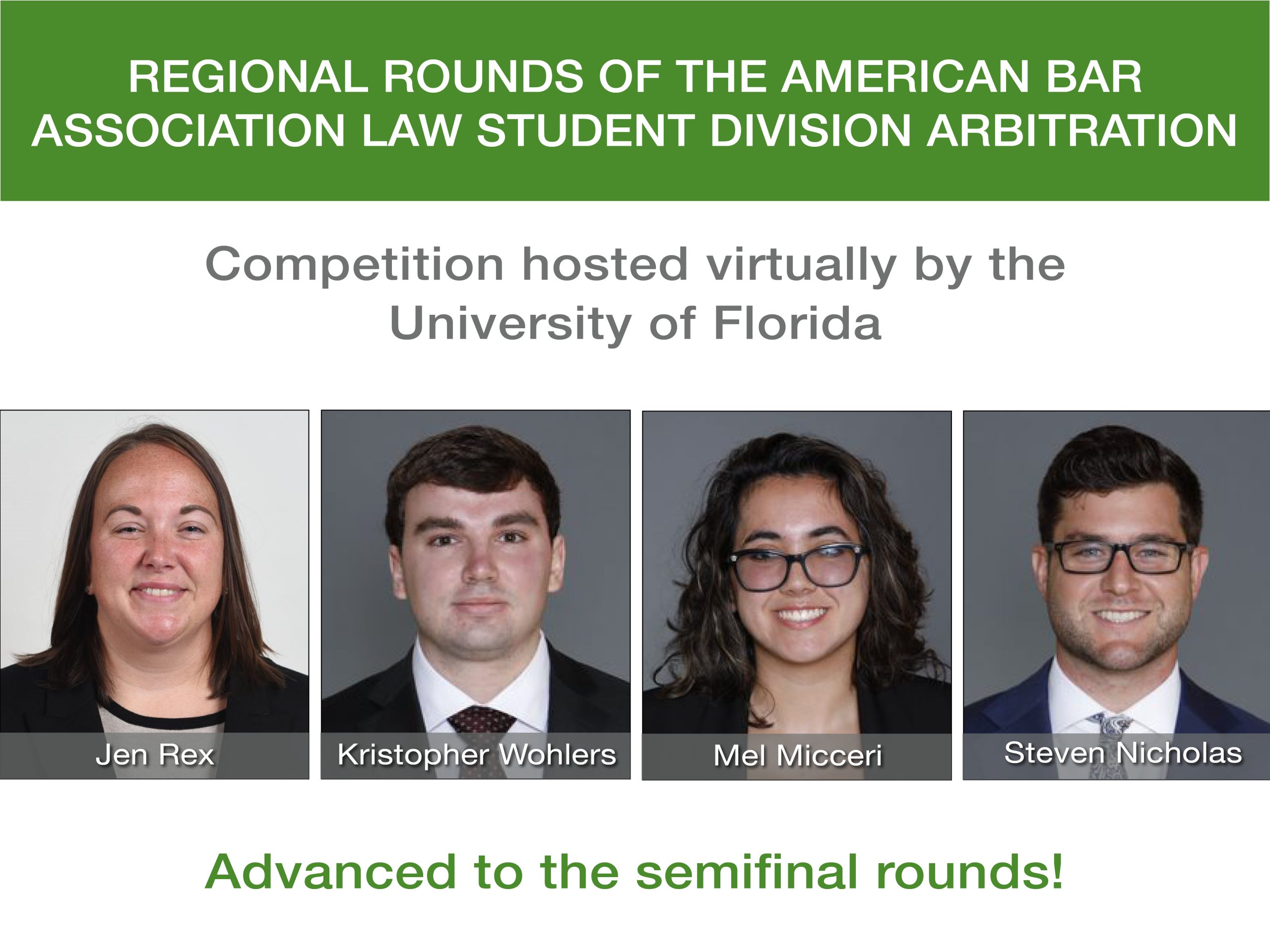
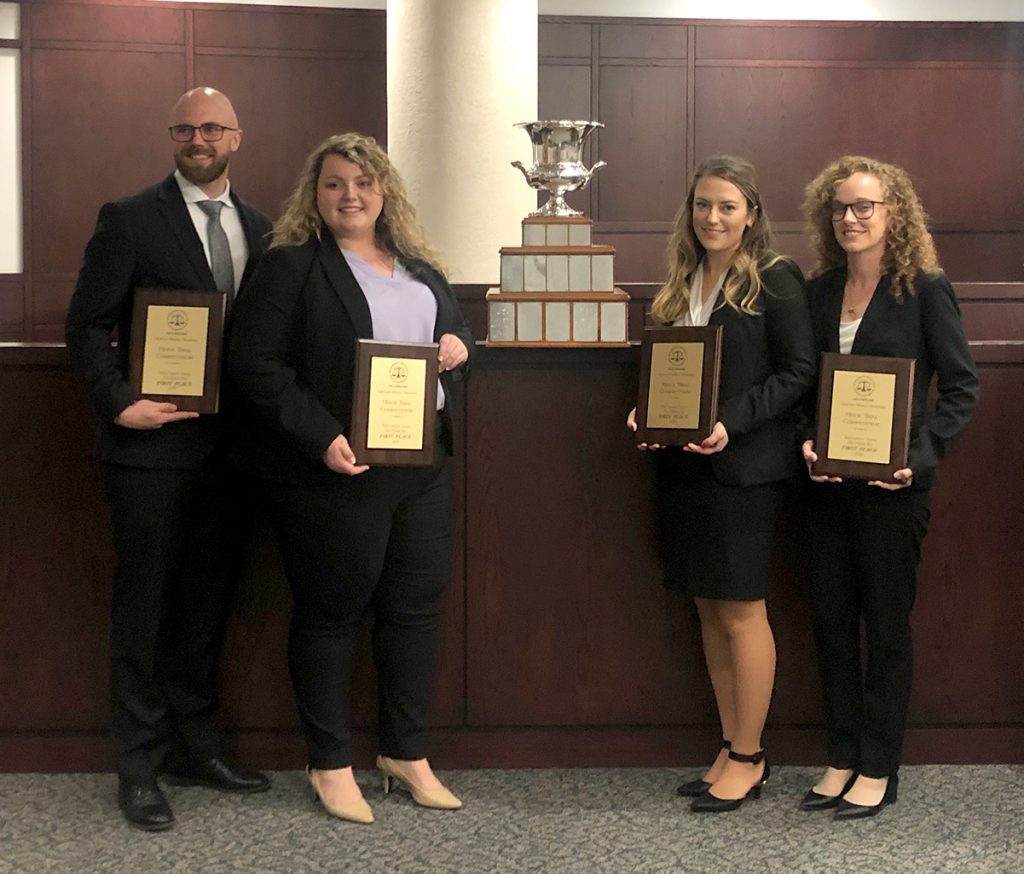
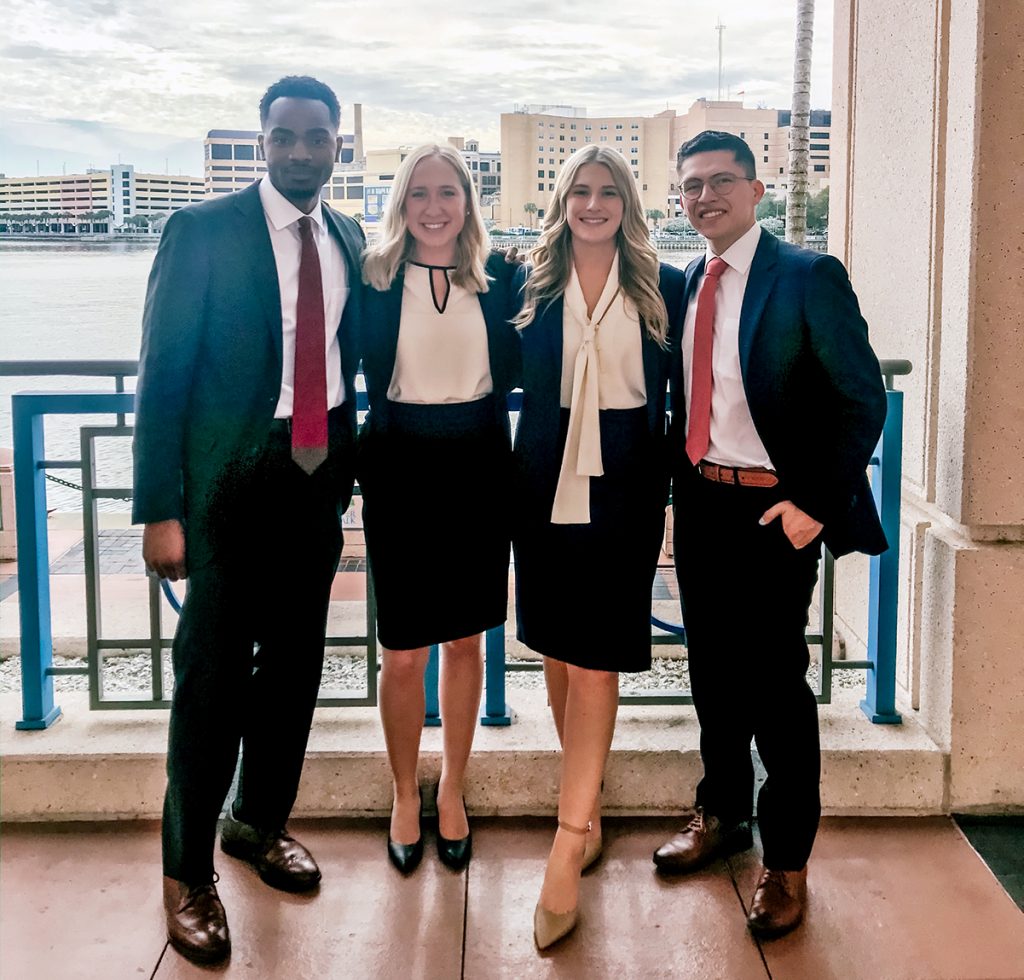
In true Stetson Law fashion, our advocacy teams have been bringing home awards and advancements this fall!
First, congratulations to Moot Court Board members Carmen Cato, William Linton, and Adam Poe for being named finalists in the regional round of the National Moot Court Competition! They will compete in the national rounds in February.
Second, kudos to duos Alina Acevedo and Kylie Weaver and Huda Awan and Carlton Robinson for their first and second place finishes, respectively, in the American Bar Association Law Student Division Negotiation Competition regional rounds hosted by South Texas College of Law Houston! They will advance to the finals in February.
Third, shoutout to Bianca Damasio, Ronald Espinal, and Erik Banuchi for their semifinalist finish and Best Brief Award in the Appellate Lawyers Association (ALA) Moot Court Competition!
Fourth, high-fives to Jen Rex, Kristopher Wohlers, Mel Micceri, and Steven Nicholas for their advancement to the semifinal rounds of the American Bar Association Law Student Division Arbitration Competition hosted virtually by the University of Florida!
This is tremendous work so far from our teams, and we look forward to what they achieve in the New Year!
Current and prospective students, alumni, and legal professionals including judges and various types of attorneys, participated in the annual Survival of the Fittest event hosted by Stetson BLSA. The event was held virtually this year.
On Saturday, Oct. 24, 2020, Stetson’s BLSA hosted Survival of the Fittest, an annual event for the Black Law Students Association aimed at teaching practical tools to navigate the legal profession.
The online conference gave students a unique opportunity to network and learn from a large group of legal professionals across a broad spectrum of disciplines. This year’s panels included Judges, Solo Practitioners, Government Attorneys, Criminal Law Attorneys, and even a JD Career panel. In addition to gaining practical tools, organizers hoped students would have a chance to consider how the practice of law and identity intersect.
This year BLSA focused on providing students and perspective students with the opportunity to hear directly from distinguished attorneys what it takes to successfully complete law school and thrive in their professional career. The topics of career development, networking, etiquette, maintaining relationships in the legal profession and navigating through adversity were highlighted throughout the event.
“There was an amazing turnout this year with fantastic and insightful speakers,” said Jasmine Mattear, Stetson BLSA president. “Stetson’s Black Law Student Association’s alumni network continues to be dedicated to pouring back into the Stetson community and for that BLSA is extremely grateful. Additionally, some Stetson Law prospective students attended the event! It was exciting to have the opportunity to interact with potential future Hatters!”
A special thanks to the Office of Career Development for always supporting Survival of the Fittest, BLSA and most importantly students in preparing for and securing internships and jobs. This event would not be possible if not for the help from Media Services, The Office of Career Development, and Stetson Alumni.
“The 2020-2021 BLSA Executive Board encourages all students to hold their passions close, work hard, dream big, and to never give up,” Mattear said. “Always remember what drives you!”
Jon Paul Brooker examines Ocean Conservancy in Florida in latest Foreman Biodiversity Lecture at Stetson Law.
By Taylor Allyn, 3L Stetson Law
On Oct. 6, 2020, the Stetson Law community welcomed alumnus Jon Paul Brooker as part of the Edward and Bonnie Foreman Biodiversity Lecture Series. His talk, “Currents and Crossroads: A Vision for Florida’s Oceans and Coasts” expounded on his lifelong passion and work in protecting Florida’s oceans.
Jon Paul Brooker
Brooker is the Director of Florida Conservation at the Ocean Conservancy in St. Petersburg and works every day to protect the unique and wild Florida he grew up knowing. The ocean is more than a beautiful place to relax and play. It also functions as our life support system, providing oxygen, jobs, and food for 3 billion people, which is why it is imperative to protect “our biggest public playground,” he said.
Ocean Conservancy was founded in 1972 as an organization of scientists and lawyers working to effect meaningful environmental policy change to help protect oceans. The organization has coordinated the International Coastal Cleanup for decades and is focused on several other concerns, including Arctic conservation in the face of rapid industrialization, ocean acidification and its impacts on aquaculture, Gulf restoration after the 2010 BP oil spill, fish conservation and regeneration of fish stocks, and striving to keep the oceans trash free.
Additionally, the organization has a renewed focus on protecting Florida and tackling its unique environmental problems concerning oil and gas, algal blooms, ocean acidification, and water cleanliness. Brooker said climate change and ocean temperature increases have already begun to damage our environment both above and under the water. We can expect more frequent and severe storms—in 2020, there were more than four named storms at one time in the Atlantic Ocean, for example. Warming water temperatures and ocean acidification can also cause coral bleaching, loss of habitats for marine life, and stony coral tissue disease.
Because Florida is a swing state, Brooker said he spends much of his time convincing conservative politicians to include conservation in their policy goals. He described the current need for ocean conservation as an “all hands on deck moment” and emphasized the goal of making healthy oceans and coasts in Florida the equivalent of supporting farmers in Iowa – a political no-brainer for candidates, no matter their party affiliation.
Among Ocean Conservancy’s other priorities are climate change and intersectional environmentalism, targeting injustice impacting marginalized communities, and addressing climate gentrification. The group also fosters partnerships with local governments for issues with water quality, marine wildlife, education, ocean trash, and carbon pollution. They push statewide water quality reforms to close regulatory gaps and conduct education and outreach through ocean classroom curriculums. Brooker underscored the importance of ensuring Florida children are properly educated about their home, so that they may usher in a new generation of environmental advocates.
His advice to law students wanting to get involved with conservation: follow your passions. Conservation may not be the work that makes you rich, but the ultimate reward is the knowledge that you are advancing the protection of a beautiful and unique environment.
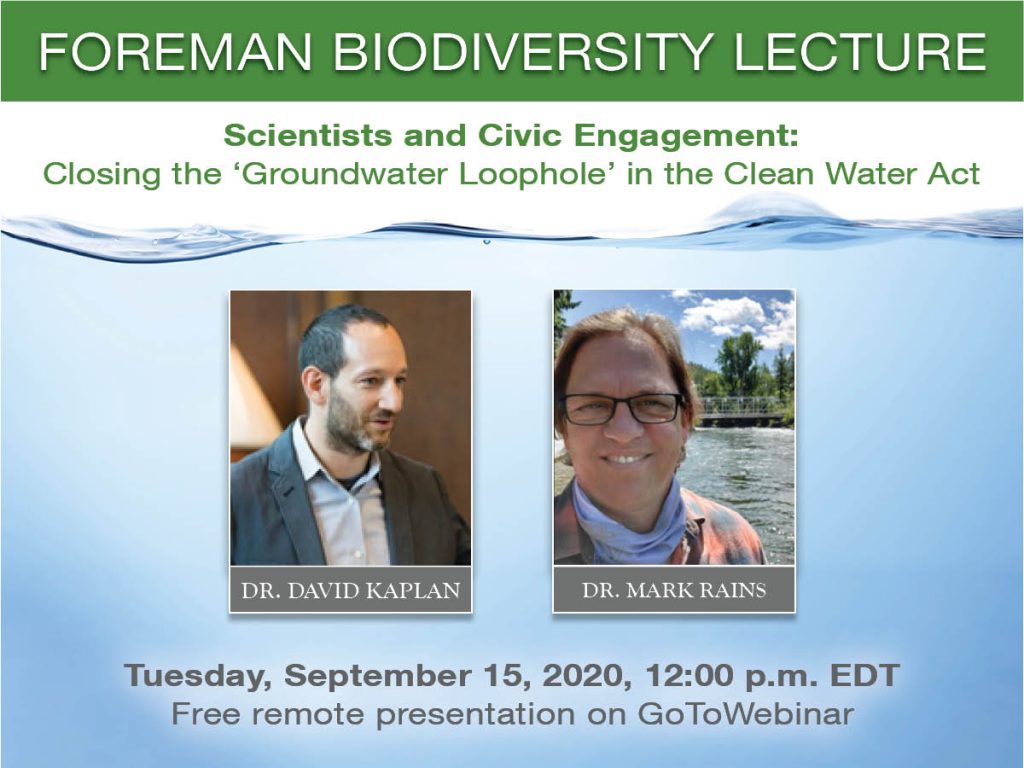
The inaugural Edward and Bonnie Foreman Biodiversity Lecture of the academic year is titled “Scientists and Civic Engagement: Closing the ‘Groundwater Loophole’ in the Clean Water Act” and will hosted online on Tuesday, Sept. 15 from 12-1 p.m.
The speakers will be Dr. David Kaplan and Dr. Mark Rains, both of whom were instrumental in working with Stetson Law’s Institute for Biodiversity Law and Policy on an amici curiae (“friend of the court”) brief in the U.S. Supreme Court in County of Maui v. Hawaii Wildlife Fund.
Academic scientists are often disengaged from civil discourse, especially in the legal domain. Most notably, academic institutions are not structured for civil discourse, and academic scientists themselves are often unfamiliar and perhaps uncomfortable with the nature of civil discourse itself. However, a group of academic scientists, including Kaplan and Rains, overcame these barriers, engaging as friends of the court in County of Maui v. Hawaii Wildlife Fund (2020). The brief informed the Supreme Court of the United States, resulting in a science-based ruling that has closed a massive loophole and strengthened the Clean Water Act.
Kaplan is an Associate Professor in the Department of Environmental Engineering Sciences within the Engineering School of Sustainable Infrastructure and Environment at the University of Florida and Director of the H.T. Odum Center for Wetlands. Rains is a Professor of Geology and the Director of the School of Geosciences at the University of South Florida.
The Stetson BLSA Trial Team and Dispute Resolution Team members with their coaches. From left: Whitany Lewis, Abigail Dean, Emeraude Lerebours, Professor James Sheehan, Coach Justin Scott, Noel Gonzalez, Jasmine Mattear, and Conklin Howard.
Stetson Law’s BLSA Trial Team and Dispute Resolution Team extended the long green line of Stetson success with second and third places, respectively, in competitions at the 52ndNational Black Law Student Association (NBLSA) Convention in Cincinnati, Ohio, March 6-8, 2020.
The Trial Team placed second overall out of 17 teams in the Constance Baker Motley (CBM) Mock Trial Competition, missing the title by a single point. The Dispute Resolution placed third out of 12 teams in the Nelson Mandela International (NMI) Negotiation Competition. The NBLSA hosts three competitions during the convention, and Stetson was the only school to place in the top 3 in more than one contest.
Noel Gonzalez, Emeraude Lerebours, Coach and alumnus Justin Scott, Jasmine Mattear, and Conklin Howard placed second in the trial team competition.
The students
had to overcome some distinct hurdles: All of the team members were competition
rookies; though Stetson BLSA teams have attended the CBM Trial Competition in
the past, they made never made it to Nationals; and this was the first time
Stetson BLSA competed in the NMI Negotiation Competition.
Trial Team
members were Noel Gonzalez, Emeraude Lerebours, Jasmine Mattear, and Conklin
Howard. Dispute Resolution Team members were Abigail Dean and Whitany Lewis.
Stetson Alumnus Justin Scott and Professor James Sheehan served as coaches.
“I am
grateful for the opportunity to coach this talented group of advocates – it
makes coaching easy! None of this would have been possible without the vision
and dedication of BLSA President Forest Sutton and the unrelenting support and
dedication of Professor Julia Metts and the Advocacy Center,” Scott said.
Stetson BLSA Dispute Resolution team Whitany Lewis and Abigail Dean took third at nationals.
It was
Sutton, a veteran of Stetson’s Trial and Dispute Resolution teams, who sought
to revive a Stetson BLSA contingent of competition teams, said Julia Metts,
director of trial programs.
“I
couldn’t have been more excited to help,” Metts said. “I knew we could do great
things, but I had no idea that the team would make it to Nationals in their
first competition. And then be a finalist at Nationals!”
“Great things are possible when we give students, who have the courage to dream, the support to accomplish those dreams,” she continued. “Forest and the BLSA board organized tryouts, found a coach, supported the team during practices, and helped make this moment possible.”
Sutton, for his part, was just as pleased with the teams’ results this year and believes future students can build on the momentum.
“I couldn’t be more proud of each competitor who dedicated so much time and effort into developing their advocacy skills, but also representing BLSA at a national competition,” Sutton said. “To have gone out and made Stetson’s name known in a brand new setting is simply remarkable. Additionally, the support BLSA received from other students, faculty members, and alumna Brielle Tucker makes me optimistic about the success BLSA can build upon in the coming years.”
EDITOR’S NOTE: This event was postponed due to COVID-19 and rescheduled to Nov. 13, 2020. Read about the new event here.
GULFPORT, Fla. – The Tax Law Society at Stetson University College of Law will present the Stetson Tax Innovators Exchange (S.T.I.X.) on March 31, 2020, featuring IRS Deputy Director Sunita Lough and renowned tax attorney Marc Simonetti.
S.T.I.X. is a new and forward-thinking tax law
collaboration event focused almost exclusively on tax practitioners – those
working in the trenches every day. The nation’s top tax attorneys will
dive into bleeding edge approaches to the practice of tax law and lead group
discussions
where practitioners can
share challenges they face…and have a room full of the greatest tax minds in
the country grab a white board and work the problem out with them.
This
interactive seminar will feature topics that run the gamut, but the overall
goal is to ensure attendees leave armed with useful new techniques to advance not
only their practice, but the field itself.
The
first event in this innovative annual series will feature presentations by:
Sunita
Lough, the new IRS Deputy Commissioner of Enforcement and
Services – A graduate of George Mason
University Law School with an LLM in Taxation from Georgetown University School
of Law, Lough has filled a variety of roles in her 25 years with the IRS.
Marc
Simonetti, partner with Pillsbury Winthrop Shaw Pittman LLP – Recognized by Chambers USA: Guide
to Leading Business Lawyers in the area of tax, Simonetti is well known for
his expertise in state and local taxation.
This event is sponsored by the Tax Section of The
Florida Bar. Cost is $40 and includes two CLE credits and refreshments,
followed by a networking opportunity with open bar.
Stetson Law’s Vis International Arbitration Moot team won the Richard DeWitt Memorial Vis Pre-Moot competition in Miami on Feb. 29, 2020. From left: Huda Awan, Audrey Gangloff, Melissa Micceri, Prof. Stephanie Vaughan (coach), Joe Cuffel, Devin Dudley, Pedro Aranguez Diaz, Clare McQueen (student coach) and Prof. Joseph Morrissey (coach).
Stetson University College of Law’s Vis International Arbitration Moot team won the Richard DeWitt Memorial Vis Pre-Moot on Saturday, Feb. 29, 2020, in Miami. The victory prepares the team to advance to the Willem C. Vis International Commercial Arbitration Moot competition in Vienna in early April.
Team members are Huda Awan, Melissa Micceri, Devin Dudley, Audrey Gangloff, Pedro Aranguez Diaz, and Joe Cuffel. This was the first competition for Awan, Diaz, Dudley, and Micceri, and the first dispute resolution competition for Gangloff, who is also a member of the Moot Court Board. Cuffel was the lone veteran on the team.
Professor Joseph Morrissey, Professor Stephanie Vaughan, and student Clare McQueen coached the team. McQueen was part of last year’s team that advanced to the Elite 8 in Vienna. They said the competition was especially fierce this year, with international (Finnish Lapland University) and out-of-state (American University Washington College of Law and Tulane Law School) teams joining the usual Florida schools.
The Florida Bar International Law Section hosts the Richard DeWitt Memorial Vis Pre-Moot for teams competing in the Willem C. Vis International Commercial Arbitration Moot competition in Vienna and Hong Kong. The day-long event includes four rounds between the competing law schools with seasoned practitioners serving as arbitrators. The event gives students an opportunity to practice and sharpen their skills by presenting and defending their legal arguments and receiving feedback from some of the best practitioners in international law.
Students must argue the jurisdictional, procedural and substantive issues raised by the case before a panel composed of practitioners, under the applicable international treaties and rules. The subject matter of the competition is typically a controversy that arises out of a dispute governed by the United Nation’ Convention on Contracts for the International Sale of Goods.
Culverhouse Chair and UCLA Law Professor Devon Carbado lectures on critical race judgements in a special class for students on Saturday, Feb. 8, 2020.
By Brittany Given Stetson Law 3L Feb. 14, 2020
Devon Carbado, distinguished UCLA law professor and author, returned to Stetson Law on Feb. 8, 2020, as the new Culverhouse Chair to teach “Critical Race Judgments: Critical Race Theory and Supreme Court Decision making.”
Carbado launched the Saturday morning class with a racial determination exercise where he first described one parent as black and another parent as white. He then asked students to classify the child as black, white, biracial, multiracial, or other. He repeated this exercise multiple times with different combinations of the child’s parents including white, black, Latino, and Asian. The takeaway from this exercise was to see that society does not take into account how a person identifies himself or herself. Rather, society primarily views people based on their physical features.
At the end of the exercise, Carbado posed the question: Should people have the right to choose their own race? It was a topic he would circle back to at the end of the class.
This icebreaker segued into a discussion on the landmark 1954 U.S. Supreme Court decision in Brown v. Board of Education, which declared that racial segregation in public school was unconstitutional. It was a decision that went against the will of the majority Americans and an achievement that was not without controversy. Carbado explained that progress has not been linear, but rather can be described as ebb and flow. When slavery was abolished, there was a backlash and Jim Crow laws were enacted. After the victory in Brown v. Board of Education, more lynchings started to occur. When the Civil Rights Act was passed, many people and businesses resisted integration.
Students participated in a special Culverhouse Chair lecture.
The class discussion about the ebb and flow of progress led Carbado to explain the concept of “racial math.” Slavery produced racial inequality. Then there was some civil rights intervention during the period of Reconstruction. If you take the racial inequality and subtract the civil rights intervention during Reconstruction, Carbado explains that you can only get two possible answers: The first answer is that there is zero racial inequality. The second answer is that there is still some racial inequality. After Reconstruction, most everyone agrees there was still some racial inequality, and Jim Crow laws increased the divide, but Brown v. Board of Education helped offset some of the inequality. Still, society was left with some racial inequality rather than zero racial inequality.
Carbado continued in this vein, going through much of the history of the United States and giving examples of when more racial inequality was added and when some racial inequality was subtracted. His point was that there has never been a moment in our history when the intervention has been enough to completely clear the slate or to have zero racial inequality. The accumulation of racial inequality has been a problem over hundreds of years.
After providing students this historical context, Carbado then broached how race is a social construction. He broke it down into five parts: The first part is the moment when people say that race matters now. People agree that race is a thing that is recognized. The second part is when people decide the relevant categories of race, such as black, white, or yellow. He encouraged students to look at the U.S. census over the years because there have been different racial categories over time. The third part is to determine what criteria to employ to stick people in the categories. Phenotype hasn’t been the only criteria used. Language, accent, and demeanor also are used to place people into racial categories. The fourth part is to map some experience such as slavery, freedom, or internment. The final part is to assign meanings to the different groups, such as those enslaved are inferior. Race, he said, is bound up with questions of social meaning.
Sara Papantonio (left) and Raelyn Watson (center) won the regional National Trial Competition in Alabama and will head to the national finals in Texas in April. The winners are pictured here with their coach, Professor Julia Metts.
Stetson Law’s Trial Team won the regional National Trial Competition hosted by Cumberland School of Law in Birmingham, Ala., Feb. 7-9, 2020, and will head to the national finals in Fort Worth, Texas, in April!
NTC is one of the oldest and most prestigious trial competitions in the country, and two Stetson teams consisting of five advocates participated in the regional contest. The advocates were Sara Papantonio, Raelyn Watson, Matt Keen, Francesca Naumann, and Alicia Roddenberg. Both teams made it to the final round – making it the first time in eight years that two Stetson teams made it to the regional finals.
Sara Papantonio and Raelyn Watson were undefeated throughout the competition, winning all six rounds. This is the second year in a row that Sara Papantonio was on the regional winning team.
“There is no way we could accomplish these milestones if not for the sacrifices of our students,” said Julia Metts, Stetson’s director of Trial Programs and Professor of Practice who coached the teams. “They gave up almost their entire winter break to practice for this competition. We can’t thank them enough for all they sacrifice to help maintain our mission of Excellence in Advocacy.”
Matt Keen, Francesca Naumann (center), and Alicia Roddenberg were finalists at the regional competition. This was the first time in eight years that two Stetson teams made the finals.
Four student witnesses traveled with the trial teams and were praised for their professionalism throughout the process, Metts said. The students are Anna Zangari, Taylor Watson, Andie Larson, and Allen Wallace.
Dispute Resolution Board members competed in the regional client counseling competition in Louisville, Ky., last weekend. From left, Alina Acevedo (2L), Forest Sutton (3L), Gabriele Bodanza (2L), Bailey Peterson (2L), Jacqueline Phillips (2L), and Andrea Snipes-Booker (3L).
With a win Feb. 7-8, 2020, at the ABA Client Counseling regional competition at the University of Louisville- Louis D. Brandeis School of Law in Louisville, Ky., Stetson Law’s Dispute Resolution Board is now “three for three,” having advanced to national rounds in all three areas in which the ABA Law Student Division hosts competitions: negotiation, arbitration, and client counseling.
DR/Trial Team veteran Forest Sutton and rookie Gabriele Bodanza (who
was competing for the very first time this past weekend) won their regional
competition in Louisville and will advance to national rounds in mid-March.
Other Stetson students who participated in the competition
included:
Andrea Snipes-Booker and Bailey
Peterson made it to the finals and placed third overall; and
Alina Acevedo and Jacqueline Phillips,
both second-year students who performed expertly in their first-ever
competition on behalf of Stetson.
Kaile Bennett and Jerry Funt won the ABA Negotiation regional competition in November in Utah and advanced to the national competition at the ABA headquarters in Chicago in early February.
Ryan Dwyer, Grace Kobitter, and Kyle McCabe, together with 2L
DR/Moot Court member Mia Tolliver (who was competing for the first time for
Stetson) won the regional competition in November and were one of only 10 teams
to advance to the national competition in Chicago in January.
Negotiation and client counseling coaches were Professor Jim Sheehan
and Stetson alumna Emily VanOosting J.D. ‘12.
The Stetson University College of Law Trial Team of, from left, Drew Trautman, Rachel Wise, Megan Tiralosi and Amy Trentalange won the 2020 Chester Bedell Mock Trial Competition.
Jan. 24, 2020 — The Stetson University College of Law Trial Team of Drew Trautman, Amy Trentalange, Megan Tiralosi, and Rachel Wise won the Chester Bedell Mock Trial Competition Jan. 22-24 in Tampa, Florida.
Megan Tiralosi also won the best advocate award. A second
Stetson team of Olivia Bergert, Justin Bell, Magner Tiuso, Molly Goodwill made
it to the quarterfinal round.
This marks the 24th time in 38 years a Stetson team has won
the competition. Hatters claimed the inaugural trophy as well in 1983. The
Trial Lawyers Section of the Florida Bar conducts the prestigious competition
for mock trial teams from across the state annually, and distinguished members
of the judiciary preside over the final round.
A Stetson University College of Law Trial Team of, from left, Justin Bell, Molly Goodwill, Olivia Bergert, and Magner Tiuso made the quarterfinal round of the competition.
All eight students sacrificed their winter break to prepare for the competition, and the winning team was ultimately made better by having practiced against their schoolmates, said Julia A. Metts, director of Trial Programs and professor of practice.
“Iron sharpens iron, and that is how Stetson stays consistent,” she said. “Together we make each other better. Together we push towards a goal of personal and professional growth. Together we advocate with a purpose!”
Stetson’s program in trial advocacy is nationally ranked No.
1 by U.S. News & World Report. To learn more about the advocacy program,
visit stetson.edu/law/advocacy.
The late Wm. Reece Smith Jr. at Stetson University College of Law
Dec. 2, 2019 – Stetson University College of Law is currently accepting nominations for the prestigious William Reece Smith Jr. Public Service Award, which recognizes individuals who have provided outstanding service to the legal profession and community. This year’s award will be presented at the Annual Inns of Court Banquet in the Great Hall on February 5, 2020.
Nominations must be received by close of business on Monday, Dec. 17, 2019. Completed nominations may be emailed to [email protected].
Wm. Reece Smith Jr. served as a distinguished professorial lecturer at Stetson Law
The annual award is named in honor of legendary Florida lawyer William Reece Smith Jr. who served for decades as a distinguished professional lecturer at Stetson Law. Smith, who passed away in 2013, dedicated more than 60 years of service to the legal profession. He worked tirelessly to provide legal services to the poor. Smith founded and served as the first president of Florida Legal Services, served as a city attorney for Tampa, chair and trustee of numerous colleges and universities, interim president of the University of South Florida, and as board member of countless religious, charitable, civic and professional organizations.
Stetson established the William Reece Smith Jr. Award in 1990 to honor outstanding contributions to public service, the justice system and the community.