Skip to content

Stetson Law hosted international meeting on sea turtle conservation

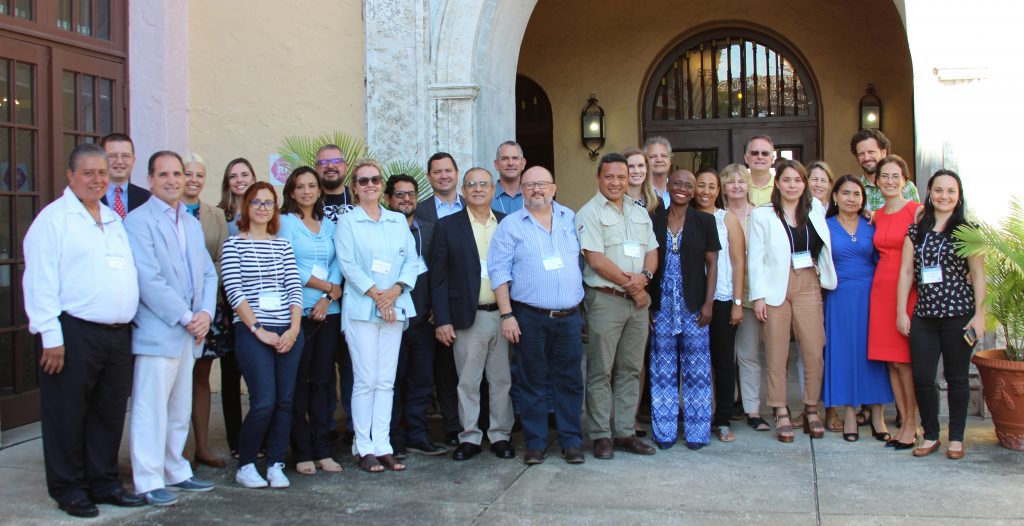
picture of Inter-American Convention for the Protection and Conservation of Sea Turtles attendees
Stetson University College of Law hosted the Inter-American Convention for the Protection and Conservation of Sea Turtles meeting of the Scientific Committee in September.

By Molly Kaelin

Stetson College of Law had the honor of hosting the most recent meeting of the Scientific Committee of the Inter-American Convention for the Protection and Conservation of Sea Turtles (IAC) in September.

The IAC is an international treaty that seeks to create balance between national interests, regional customs, and international sea turtle conservation efforts. It was created in 1994 by a group of coastal nations from North, Central, and South America to reduce regional sea turtle threats. Under the treaty, member states have a legal framework within which to act on behalf of sea turtle populations. Today the IAC has 16 member states comprising Argentina, Belize, Brazil, Chile, Costa Rica, The Dominican Republic, Ecuador, Guatemala, Honduras, Mexico, The Netherlands, Panama, Peru, the United States, Uruguay, and Venezuela.

The IAC uses data and education – while being mindful of each member state’s environmental, socioeconomic and cultural characteristics – to protect sea turtles and their habitats, as well as help recover turtle populations.

IAC efforts are focused on the entire life cycle of sea turtles. The Treaty forbids the capture of sea turtles, their shells, or their eggs. Restrictions are also placed on human activities that may adversely affect sea turtles during their reproduction, incubation and migration stages.
IAC secretary veronica caceres
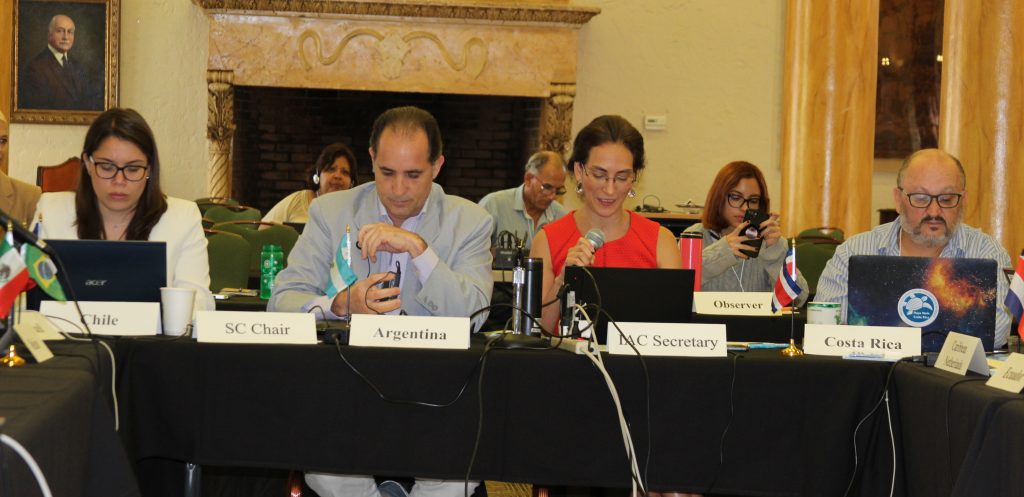
IAC Secretary Veronica Caceres speaks at the event.

“Nesting beaches are much easier to protect than open oceans,” said Veronica Caceres, IAC’s secretariat.

A Nicaraguan native, Caceres holds a master’s in fishery and began working with sea turtle conservation in Central America early in her career. One of the conservation techniques she focuses on is the Turtle Exclusion Device, or TED. She explained that the TED is put inside of shrimping nets and prevents accidental sea turtle capture, leading to a reduction in turtle deaths.

Other conservation efforts include restoring and conserving habitats, designating protected areas, supporting research aimed at reproduction, breeding and re-introduction, fostering relationships with governmental institutions, NGOs and the public at large, and reducing the impact of fishing on sea turtle populations.

Film examines tension between humans and wildlife

As part of the three-day meeting, IAC played the film, “Cacu: Un Cambio por la Vida” (Cacu: A Change for Life) by Director/Journalist Marvin Del Cid and Marine Biologist Omar Shamir Reynoso. The film explores the tension between the human need to make a living and the value of protecting the environment. The documentary follows Reynoso as he works with five Santo Domingo fishermen to protect sea turtle nests in Santo Domingo.

Caceres said this tension is one of the key challenges they face in getting communities to participate in conservation efforts. They often get pushback from locals.

“It’s often their livelihood,” she said, referring to egg poaching, “so you have to approach it with the right attitude.”

Caceres makes it a priority to understand community needs and the reasons why sea turtle eggs are poached.

“Only after we understand why, can we think about how to educate and encourage them to change. It is important the community is recognized for their efforts.”

sea turtle art

One way to encourage local populations is through finding other avenues of income that depend on a flourishing environment, such as tourism. Sometimes communities can be incentivized for undertaking and closely monitoring conservation efforts. For example, a community may receive funding for new schools or even stipends in exchange for monitoring the sea turtle populations and preventing egg poaching.

IAC members aim to improve turtle mortality rate by increasing the number of communities who monitor sea turtle population trends. They also are focused on mitigating the impact of plastic pollution and climate change on sea turtles. 

“As climate change worsens, beach sand becomes hotter. This means the incubation temperature becomes greater and, since incubation temperature determines the sex of the turtles, more female turtles will be born,” Caceres explained, “without males, sea turtle species will not survive.”

The organization also wants to add more signatories to the treaty, including El Salvador, Columbia, and Canada.

Stetson’s role creates opportunity for students

Stetson College of Law is an Accredited Observer of the IAC, meaning Stetson representatives have the privilege of observing and hosting IAC meetings. Other accredited observers include NGOs and scientific institutions.
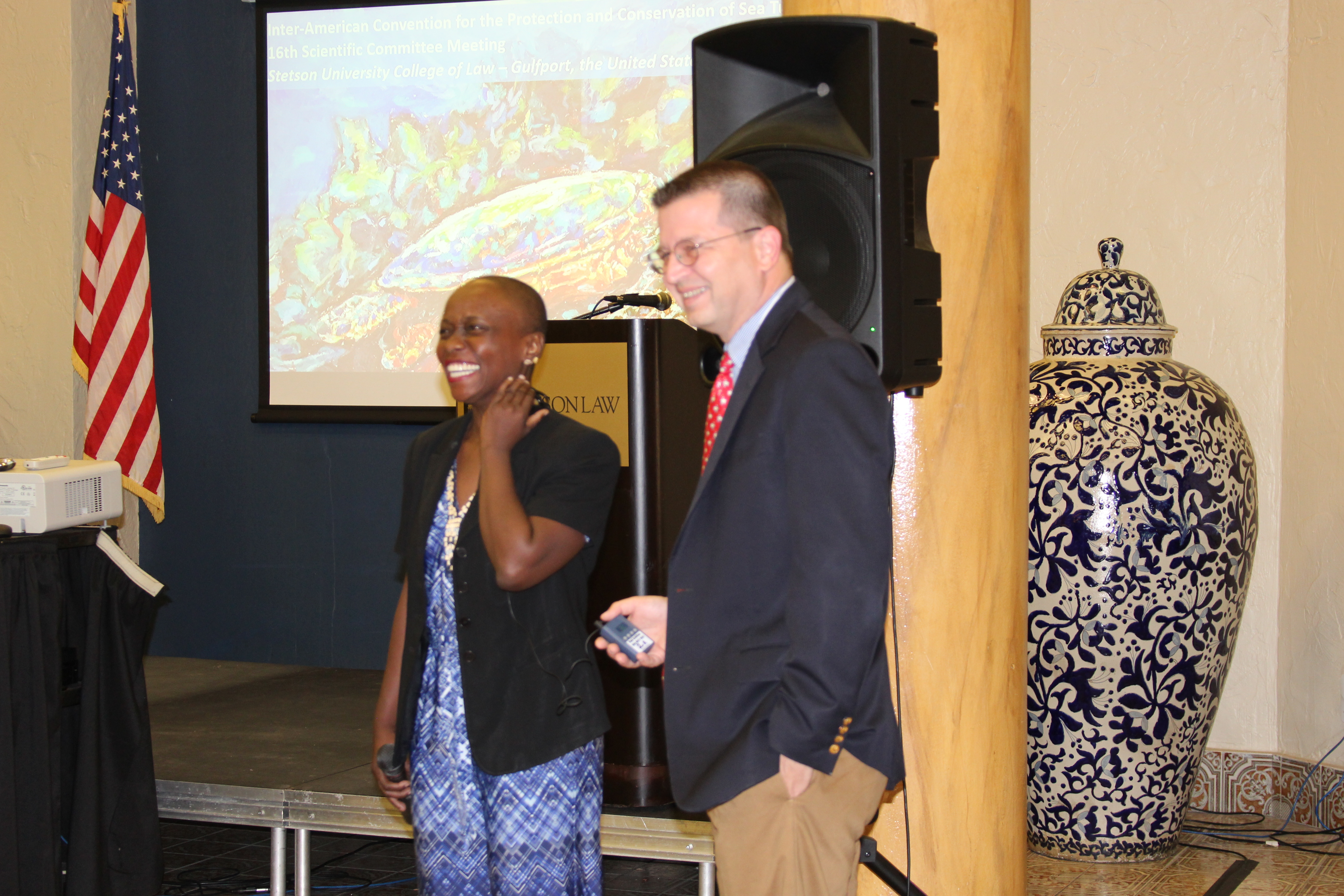
Stetson Law Dean Michèle Alexandre and Professor Royal Gardner welcomed attendees.

(more…)

Moot Court Board members claim top honors at contest

Moot Court Board members participated in the National Veterans Law Moot Court Competition. From left: Christopher Gieger, Sean Mullen, Judge Michael Allen, Christopher Odgers, and Vasilios Zimarakos.

Moot Court Board members took Best Team and Best Oralist in the National Veterans Law Moot Court Competition at George Washington University Law School, in Washington, D.C., Nov. 1-3, 2019.

Not only did Stetson win, but two Stetson teams faced off against each other in the semifinal round! The participants were Sean Mullen, Christopher Odgers, Vasilios Zimarakos, and Christopher Gieger.

Vasilios Zimarakos won Best Oralist, and Sean Mullen and Christopher Odgers were named Best Team.

Twenty-one teams from around the nation—including strong advocacy schools and those with veterans projects or clinics, such as Baylor, Brooklyn, George Mason, University of Denver, and Widener—participated in the competition. 

Timely topics

The topics were cutting edge. In fact, the second issue, which Sean Mullen and Christopher Gieger argued, was whether there a constitutional due process violation when one Veterans Law Judge presided over the veteran’s hearing and found him credible and a different Veterans Law Judge adjudicated his appeal and denied the claim based on a lack of credibility. This question was argued at the Court of Appeals for Veterans Claims (CAVC) in just the last two months. 

Stetson teams argued in front of attorneys and judges, including Stetson’s very own, Judge Michael Allen, who all had expertise in veterans law. The victories add to a trove of Stetson trophies outside the CAVC, giving the school five Best Team plaques, eight Best Brief awards, and five Best Oralist wins.

Professor Stacey-Rae Simcox, director of the Veterans Law Institute and Veterans Advocacy Clinic, and Professor Brooke J. Bowman, director of Moot Court Board and interim Law Library director, coached this year’s winning teams.

About Veterans Law Institute

Stetson has a dedicated Veterans Law Institute that serves as a center for student veterans and pro bono service for members of the military and veterans. To date, the Veterans Law Clinic has helped clients receive over $1.7 million in back benefits the VA owed them, and their future benefits total more than $19 million. Each year, Stetson Law students contribute over 3,500 pro bono hours helping veterans with their legal needs.

Stetson students win regional negotiation competition, advance to nationals

aba dispute resolution team winners
Members of the Stetson Law Dispute Resolution Board are, from left, Kaile Bennett, Coach Bill Greiner, Erica Eddy, Corey Roberts, Brittany Kovalskaya, Professor and Coach James Sheehan, Julia Knoll, and Jeremy Funt.

Two Stetson students won a regional negotiation competition and will advance to the nationals in Chicago in February.

Stetson Law Dispute Resolution Board members Brittany Kovalskaya, Corey Roberts, Erica Eddy, Jeremy Funt, Julia Knoll, and Kaile Bennett competed Nov. 1-2, 2019, at the regional rounds of the American Bar Association Law Student Division Negotiation Competition hosted by Brigham Young University’s J.R. Clark Law School.

Stetson Law alumnus Bill Greiner J.D. ‘07 and Professor Jim Sheehan J.D. ’77 coached the teams. In a field of 24 teams, duo Jeremy Funt and Kaile Bennett placed second in preliminary rounds and advanced to the final round, which they won. Funt and Bennett will represent Stetson at the national competition, which will take place in Chicago in February at the headquarters of the American Bar Association.

“Not only am I very proud of all six of these students, but I am deeply grateful to coaches Sheehan and Greiner, who invested countless hours in mentoring and preparing our teams,” said Professor Kristen David Adams, Faculty Director for the Dispute Resolution Board. “Our stalwart coaches are the bedrock of Stetson advocacy.”

30 in 30: ABA experts share top tips for summer associates

Members of the American Bar Association shared 30 tips for success for students who have summer associate or clerkship positions. From left: Erica Bartimmo, Logan Murphy, Brian Koji, and Katie McCray. Photo by Marie-Salome Desbats

By Brittany Given

On Oct. 21, 2019, the Office of Career and Professional Development hosted a panel to help students with summer associate or law clerk positions by shining a light on what they can expect and how to make the most of their time in the law firm.

A panel of local attorneys and members of the American Bar Association (ABA) shared their top tips in a special ABA 30 in 30 session with students. Panel members included Logan Murphy,  shareholder with Hill Ward Henderson in Tampa; Katie McCray, senior counsel at Wilson Turner Kosmo LLP in San Diego; Erica Bartimmo, corporate counsel for Jabil Inc. in Tampa; and Brian Koji, shareholder with Allen Norton & Blue, P.A. in Tampa.

Top Tips

  1. Find a Mentor: This is easy to say but hard to do because everyone is likely very busy. Make yourself visible and valuable. Go into attorneys’ offices and ask what they are working on and if you can help. Seek out more than one mentor if you can.  
  2. Receive Software Training: If the firm offers training, make sure you sign up. Get to know the IT person or team.
  3. Learn the Law: Learn as much as you can. Even in firms that specialize, there are different subtopics.
  4. Understand Research Economics: Ask if you should research on Google or other free search engine before heading to Lexis Nexis or Westlaw.
  5. Accept Assignments: Volunteer to do research or extra assignments if the opportunity arises.
  6. Know Who Does What: Remember there are other team members who make up a successful law firm besides the attorneys. Get to know the paralegals and administrative staff, too. Sometimes it is better to ask a paralegal a question before going straight to the attorney.
  7. Get Time Estimates: Some assignments should only take an hour while other assignments will take all week. If you feel like you are spending too much time on a project, let your supervising attorney know.
  8. Know Your Firm: Research the firm online before you start working there.
  9. Look the Part: If you look like a lawyer, you’ll be treated like a lawyer.
  10. Incorporate Assigning Attorney’s Styles: Write how the assigning attorney wants you to write rather than how your Research & Writing professor wanted you to write.
  11. Be Respectful: Always err on side of being respectful. Don’t forget to be respectful to assistants.
  12. Solicit Feedback: Ask what the attorney thought of your work if feedback is not provided. Feedback is the most valuable part of a clerkship. Don’t be defensive when you receive criticism.
  13. Learn from Mistakes: Attorneys expect that you will make mistakes. You are evaluated on how you learn from your mistakes.
  14. Socialize with Caution: You need to go to firm social events. It’s part of the job and part of your evaluation. Do not overindulge.
  15. Report All Time: Write down everything you do.
  16. Utilize a Calendar System: This is very important because often malpractice is a result of missing a deadline.
  17. Read Time Reports: Make sure clients’ names are spelled correctly. If you think you spent too much time on a project, talk to the assigning attorney about it.
  18. Organize Work: Learn it and do it in a way that makes sense to you.
  19. Do Your Best Work: You can use briefs or other assignments you create as future writing samples as long as you get permission.
  20. Proofread and Double Check All Written Materials: When you think you are done editing, edit it one more time, have someone else edit it, and then edit one last time.
  21. Keep a List of Major Projects You Completed: This will help you reflect on all you’ve learned over the course of the summer.
  22. Indicate Satisfaction: When you’ve enjoyed working on an assignment, let the assigning attorney know.
  23. Recognize Your Internal Clients: Your primary clients are the partners and more senior attorneys.
  24. Create an Action Plan: Think about what your summer goals are and what you’d like to learn while at the firm.
  25. Join Bar Associations: Membership is a wise investment in your knowledge base and professional network.
  26. Get Active in the Community: These activities will give you exposure and offer you opportunities to begin building a network of contacts.
  27. Network Inside the Firm: Learn who is who in the firm. Socialize with everyone in the firm.
  28. Be the First One in the Office: Lawyers will be impressed to see you have arrived early and are already hard at work.
  29. Be on Time for Meetings: Be sure to arrive promptly even if others do not.
  30. Master Time Management: Devise a daily routine and stick to it.

Students interested in landing a summer associate position should talk to the Office of Career and Professional Development, participate in on campus interviews, and reach out to firms that specialize in the type of law students are interested in practicing with a targeted cover letter. Joining the ABA is a great way for students to network and meet other lawyers and judges, as well as find mentors and learn about the practice of law.

The ABA Section of Litigation Judicial Intern Opportunity Program will begin accepting applications for second-year students on November 4and for first-year students on December 1. Applications must be submitted by January 10, 2020.

Stetson celebrates 4 decades of ‘Chester Champions’

Four decades worth of Stetson College of Law Chester Champions gathered at the school in September for a reunion and to celebrate this year’s win. Back row from left: Chinwe Okpechi, Rachel Wood, Claudette Fornuto, Fred Schaub, Grace Samarkos, George Root, Jason Recksiedler, Charles Samarkos, Diego Novales, Kristin Gonzalez, Brandon Blake, Art Rios, Grady Irvin, Lara Breslow, and the Hon. Jessica Recksiedler. Center row from left: Megan Tiralosi, Elise Engle, Judge David Demers, Kristin Demers-Crowell, Professor Lee Coppock, Mariela Llanes, Dan Green, Randy Brennan, Jaime Eagan, and Jennifer Fernandez. Front row from left: John Grant, Jamie Grant, LaMark McGreen, and Brandon Breslow. Photo by Mark Wemple.

The Stetson University College of Law team won the Chester Bedell Mock Trial Competition in January of this year, making it the 23rd time in 37 years a Stetson team claimed the award.

It’s a fitting continuation of the legacy, given that a Stetson team won the inaugural Chester Bedell competition in 1983.

To celebrate the trophy’s return to campus, Stetson invited winning team members and coaches from the last four decades back for a Chester Champs Reunion on Sept. 14.

“We want to remind the world of our continued dominance in the advocacy world—a dominance that started in 1983 and has continued without any signs of stopping,” said Professor Roberta Flowers, interim director of the Center for Excellence in Advocacy.

The Trial Lawyers Section of the Florida Bar conducts the prestigious competition for mock trial teams from across the state annually, and distinguished members of the judiciary preside over the final round.

This year’s winning team comprised Elise Engle, LaMark McGreen, Grace Samarkos and Megan Tiralosi. A second Stetson team made it to the semi-final round. That group included JD Arnett, Olivia Bergert, Blake Fromang and Justine Roof.

Samarkos is the daughter of Charles Samarkos J.D. ’89, who won the Chester Bedell competition when he was a student at Stetson. Fromang is the son of Stetson Law alumna Jennifer Eden J.D. ’90, who won Chester Bedell several times when she was a student.  

Stetson Law 2016 alumni Brandon and Lara Breslow co-coached this year’s team.

Stetson’s program in trial advocacy is nationally ranked no. 1 by U.S. News & World Report. To learn more about the advocacy program, visit stetson.edu/law/advocacy.

Protecting Florida’s Wildlife Corridor is key to preserving state’s natural beauty and diversity

dean michele alexandre speaking with jason lauritsen and professors
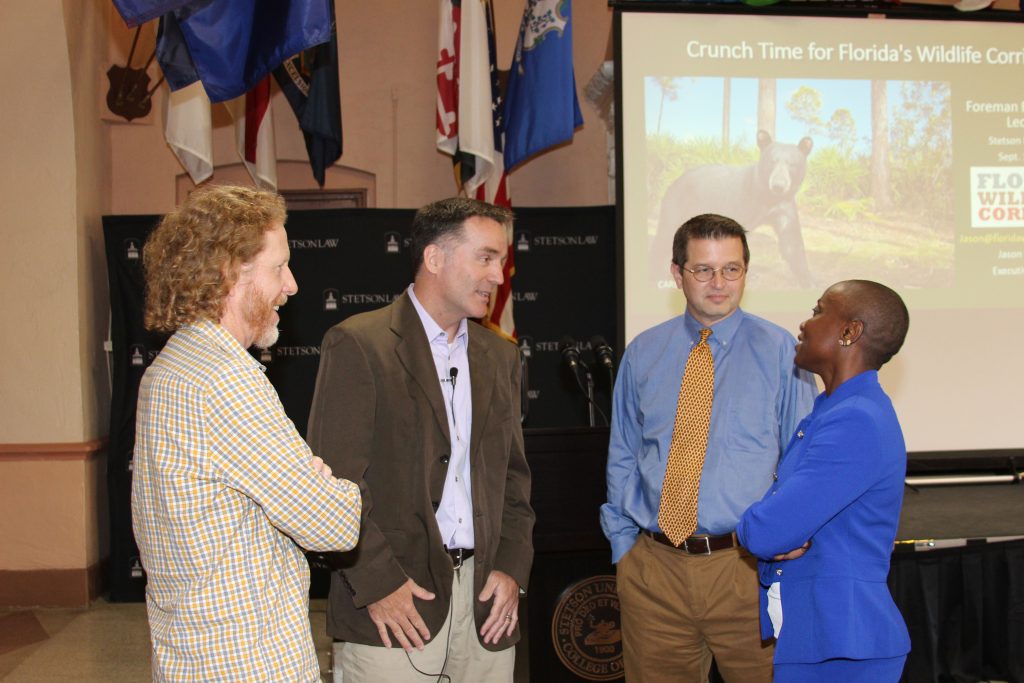
Stetson College of Law Dean Michèle Alexandre talks with Jason Lauritsen, executive director of the Florida Wildlife Corridor after the first Foreman Biodiversity Lecture of the school year. From left: Professor Lance N. Long, Lauritsen, Professor Royal C. Gardner, and Dean Alexandre.

By Taylor Allyn

On Sept. 12, the Stetson Law community welcomed Jason Lauritsen, the Executive Director of the Florida Wildlife Corridor, to speak as a part of the Foreman Biodiversity lectures. The Florida Wildlife Corridor is a non-profit organization seeking to protect and educate the public about the corridor, which is a path through the state connecting land and waters that are integral for native habitats.

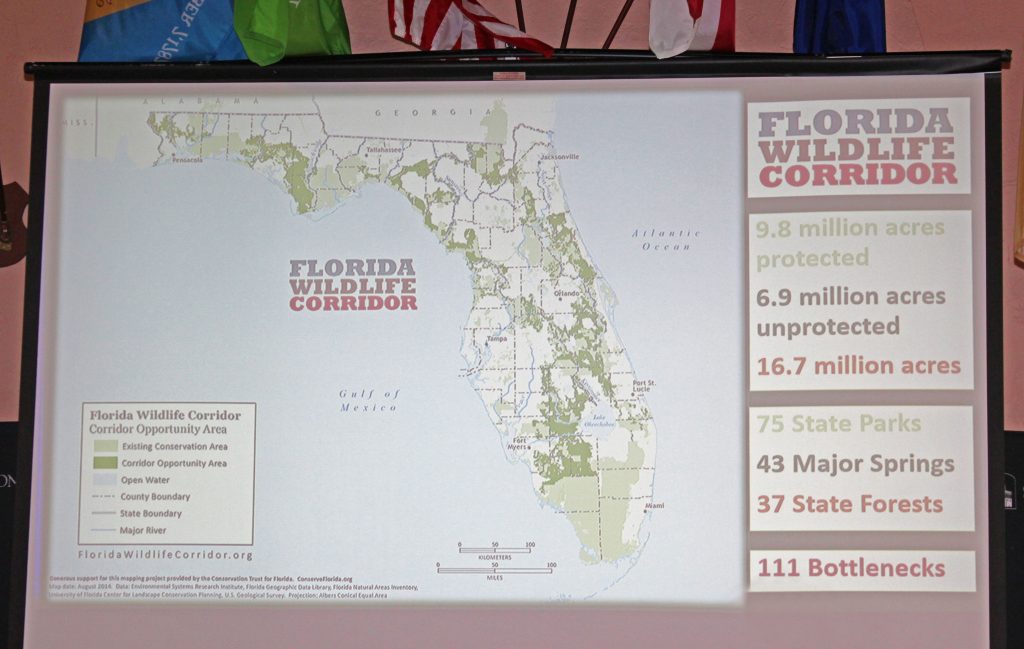
A map depicting the Florida Wildlife Corridor protected areas.

Lauritsen began his talk by impressing upon the audience the importance of preserving this undeveloped land in Florida. He explained that 1,000 people move to Florida every day—by 2070, there will be 11 million more people in the state. There is a race against time to accommodate that influx of people while maintaining the beauty and health of the natural environment. According to Lauritsen, the wildlife corridor is a solution to this problem. Right now, almost 10 million acres of the wildlife corridor are protected in the form of state parks, forests, and springs, but almost 7 million acres remain unprotected. He stressed that Florida’s natural beauty and biodiversity is not guaranteed for the future if there is not a movement to protect it.

Lauritsen’s goal is to educate the public and decisionmakers on the importance of preserving and protecting the corridor. The Florida Wildlife Corridor works with state agencies, regional conservation programs, legislators, and task forces to identify ways to maintain and protect Florida wildlife. They also work with local farmers and ranchers to establish conservation easements and create alternate solutions to protect large swaths of land.

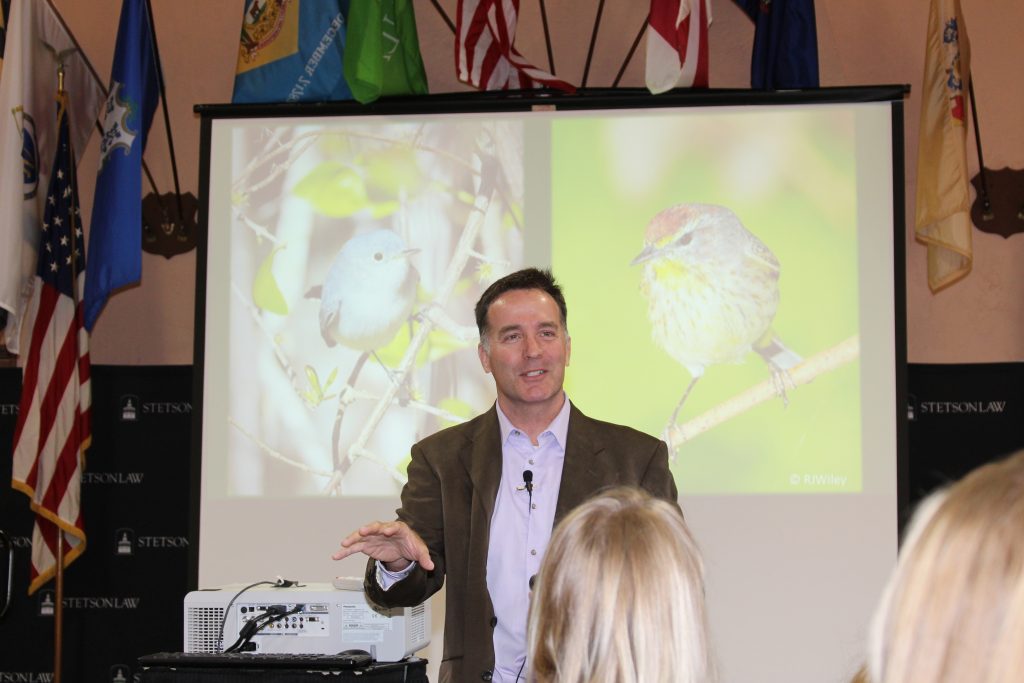
Jason Lauritsen speaking to students.
Jason Lauritsen explains the importance of the Wildlife Corridor for creatures across the ecosystem.

Negative impacts in the natural world are not always easily apparent, Lauritsen said. He cited an example of a type of caterpillar that feeds on cypress trees. These caterpillars are food for many kinds of songbirds, and are also hosts to parasitic wasp larvae, which are important native pollinators. Hurricane Irma wiped out the foliage of these cypress trees in many places, leaving caterpillars without food and causing a chain reaction that affected birds, wasps, and plant life.

“If all we appreciate is the beauty and we don’t understand how it works, we are going to make the wrong decisions,” he said. “I like to think of this as taking advantage of the long lens of history and the fine focus of science as we progress to try to find solutions.”

He went on to address the problem of isolation in native habitats. The more isolated a species is, the less genetic diversity they have. Connecting habitats through the wildlife corridor is especially important for black bears and Florida panthers, who need access to different habitats at different times.

Lauritsen ended the talk by discussing multiple pieces of legislation that have been created to improve wildlife conservation, including a bill that would create a wildlife crossing pilot program to reduce the incidences of vehicle and wildlife collisions. Lauritsen urged the audience to get in touch with legislators and let them know these bills are important.

Florida is currently collecting public input and recommendations for a toll road bill that was signed into law earlier this year, and Lauritsen sees this as a chance to make a difference in the future of Florida’s infrastructure.

“Our hope is that through this planning process, [we can] push our leadership to recognize and instill ecological values for future generations.”

For 10 ways you can help connect with the Florida Wildlife Corridor, check out their website, floridawildlifecorridor.org.  You can also watch the entire lecture online at Stetson Law’s YouTube channel.

Moot Court Board brings home another championship

Photo of Stetson Moot Court Board members
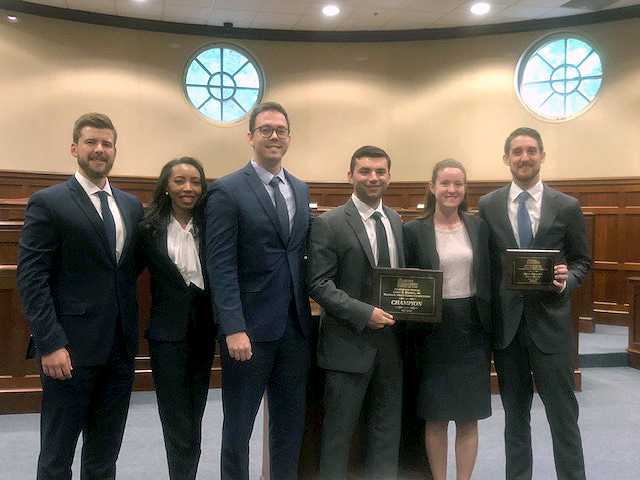
Stetson Moot Court Board team members who participated in the Annual Leroy R. Hassell Sr. National Constitutional Law Moot Court Competition are, from left: Tyler Vaughn, Tiffani Thornton, Chris Lawson, Evan Dahdah, Audrey Gangloff, and James Nealon

Members of Stetson’s Moot Court Board added another plaque to the case after winning the 19th Annual Leroy R. Hassell, Sr. National Constitutional Law Moot Court Competition at Regent University School of Law in Virginia Beach, Virginia, on Oct. 4-5, 2019.

Twenty-six teams from around the nation participated in the competition, including advocacy powerhouses Baylor, Liberty, St. Mary’s, and South Texas. The issues were cutting edge and timely: one topic – whether the abolition of the insanity defense and substitution of a mens rea approach to evidence of mental impairment violates the Eighth and Fourteenth Amendment – was argued in the United States Supreme Court in Kahler v. Kansas the Monday after the competition!

Stetson fielded two teams for the competition. A team comprising Chris Lawson, Tiffani Thornton, and Tyler Vaughn had the second-best brief in the competition, but fell to South Texas in a close quarterfinal round. The team with Evan Dahdah, Audrey Gangloff, and returning champion James Nealon defeated teams that won the best petitioner’s brief and best preliminary round oralist before moving through two more rounds to go head-to-head with South Texas in the finals.  

Team perseveres despite grueling questioning

The team faced a panel of nine justices from federal appellate courts, including the Fifth, Sixth, and Ninth Circuits, as well as state supreme court justices. The justices showed no mercy, hammering the oralists with questions as soon as they started to speak. The trio persevered and brought home the championship. To top it off, James won the award for the best oralist in the final round! 

The Annual Leroy R. Hassell, Sr. National Constitutional Law Moot Court Competition is named in honor of the late former Chief Justice of the Supreme Court of Virginia who dedicated his life to the fight for justice for the Commonwealth’s citizens. He championed constitutional rights and was the first African American Chief Justice of the Virginia Supreme Court.

James Nealon was on the 2018 winning team with alumni Madison Wahler and Deanna Cipriano. A photograph of him arguing last year before the panel of justices still graces the competition homepage

Professor of Law Brooke J. Bowman and the Rev. Bill Wildhack, Esq. (class of 2005) coached Stetson’s teams at this year’s competition.

For those keeping count, Stetson’s current stats for championships are:

  • 5 World (International);
  • 75 National Championships;
  • 88 Regional Championships;
  • 48 State Championships;
  • 56 Brief Awards;
  • 169 Best Oralist/Best Advocate Awards; 
  • 6 Professionalism Awards;
  • 1 National Competition Award.

Stetson students get a crack at criminal law reform in FL

picture of Senator Darryl Rouson, Stetson Professor Judith Scully, Senator Jeff Brandes, and Stetson student Matt Keen
State Sens. Darryl Rouson (D-St. Petersburg) and Jeff Brandes (R-St. Petersburg) spoke to Stetson College of Law students about the Florida Legislature’s Criminal Punishment Code Task Force on Sept. 24. Pictured from left: Sen. Darryl Rouson, Stetson Professor Judith Scully, Sen. Jeff Brandes, and Stetson student Matt Keen. Photo by Daniela Gomez.

By George Thurlow

State Sens. Darryl Rouson (D-St. Petersburg) and Jeff Brandes (R-St. Petersburg) spoke to Stetson College of Law students about the Florida Legislature’s Criminal Punishment Code Task Force during a campus visit on Sept. 24.

The Florida Legislature created the Task Force last spring to take a fine-toothed comb to the state’s Criminal Punishment code. The group is studying how to rethink non-criminal sanctions, sentencing enhancements, and sentencing guideline calculations. 

As part of that effort, Sen. Rouson contacted Stetson Law Professor Judith Scully with a proposal to create a student-equivalent of the Task Force at Stetson. The goal is for the students to conduct extensive research of their own and to draft legislation to be presented at the Spring 2020 Session of the Florida Legislature, which runs from January to March 2020.

Matt Keen, a 3L at Stetson, will oversee the creation of the Law Student Criminal Punishment Code Task Force and its work as part of his directed research project for his Social Justice Advocacy concentration.

“The process, although only recently started, has already been incredibly rewarding,” Keen said. “I feel extremely grateful to both Professor Scully and to Stetson Law as a whole for preparing me to undertake this experience.”

State of criminal reform in Florida

Sen. Rouson, whose district includes the College of Law, explained that Florida’s current criminal justice system is based mainly on 1997 and 1998 revisions to the Criminal Punishment code that introduced things such as the elimination of discretionary sentencing by judges, mandatory minimum sentences for both non-violent and violent crimes, “three strikes” laws, and the requirement that inmates serve 85 percent of their sentences. The result of these changes is that, as Sen. Rouson put it, “rehabilitation [became] subordinate to punishment.”

Sen. Brandes explained that most prisons have 20-40 percent staff vacancy rates, and the statewide average two-year staff retention rate is 46 percent. The average pay of a corrections officer is less than $35,000 per year, and given that few auxiliary staff positions are filled, corrections officers are responsible for many things beyond their job responsibilities.

Prisons face more than just staffing challenges. Fewer than five percent of inmates have educational opportunities, resulting in little opportunity for rehabilitation and making prison violence and crime more common, Brandes said. Officer-inmate violence and inmate-inmate violence is up nearly 50 percent over the past 10 years, and there’s been nearly a 500 percent increase in contraband. Inmates who have completed their sentence receive little re-entry assistance (only $50 and a bus pass), so that, coupled with the lack of rehabilitation, leads to increased recidivism and penalties.

picture of student in audience asking question
Students ask questions during the Sept. 24 meeting. Those interested in participating in the project should contact Matt Keen at [email protected].

Sen. Brandes estimates the cost adequately staffing prisons and making them a rehabilitative atmosphere to be nearly $200 to $300 million a year. To make that realistic, he has a number of proposals to limit the prison population, including diversionary programs such as drug courts and veterans court, as well as facilitating earlier releases and re-entry programs.

Sens. Rouson and Brandes were optimistic about the prospects of achieving such reforms in the future, although they identified potential hurdles, including lack of support from law enforcement and the fact that prison reform is a hard issue to excite people about. The two said they are eager for the opportunity to work with students for fresh ideas and perspectives.

Students who are interested in helping with the Law Student Criminal Punishment Code Task Force should contact Matt Keen at [email protected] or speak with Professor Judith Scully.

Study abroad advocacy program in England marks successful 5th year, begins plans for 2020

Group of students in Oxford, England.
Stetson University College of Law students traveled to Oxford, England, for the Comparative Advocacy Program study abroad program.

Stetson University College of Law wrapped up its fifth Comparative Advocacy Program in Oxford, England, from July 22 through Aug. 2, 2019. This year’s study abroad trip was a hit with students and faculty alike for its mix of demanding legal training with Oxford’s intellectual and fascinating history.

The program is an intensive experience where students are exposed to the fundamental tenets of rhetoric, psychology, and storytelling while learning about a new culture. Local techniques and practices form an integral part of the course, and guest speakers from England, Scotland, and Ireland help expand students’ understanding of the differences and similarities between our legal system and Great Britain’s.

Stetson Professor Stephanie Vaughan is the Resident Director for the program, and new Stetson College of Law Dean Michèle Alexandre joined the group this year. Other faculty leaders included:

  • Lou Fasulo, Director of Advocacy at Pace University College of Law;
  • Rafe Foreman, former professor at University of Missouri-Kansas City School of Law; and
  • Gillian Moore, former Assistant Attorney General in Scotland.

Together, the leaders provided students with hands-on training on all aspects of U.S. trial advocacy, as well as an introduction to procedural differences in Scotland and England.  The students were inspired by lectures and discussions that highlighted the value of litigation in protecting the foundations of our legal systems, effectuating social change, and giving a voice to the voiceless.

“The Oxford program was designed to provide a unique international immersion learning experience,” said Professor Lou Fasulo, director of the program.  “It creates a rich learning environment to teach advocacy skills and comparative international litigation.  The program empowers students by teaching them the power of courtroom advocacy, the responsibilities of representing clients, and the love for global awareness.”

Cultural immersion is key

The students went on a cultural city tour, watched a criminal trial, and participated in a question and answer session with English judges.  They also traveled to Cambridge, where they learned the history and legal significance of the town. For fun, the students enjoyed a punting tour – a Cambridge and Oxford staple form of transportation via a narrow, flat-bottomed boat akin to a Venetian gondola – and visited local music spots and Shakespeare in the park. 

For a number of participants, the Oxford trip was their first time traveling to Europe. That was true for Tina Budzisz, a student in Stetson’s part-time program, but she said support from staff and faculty helped calm her nerves about it. Afterward, she declared the study abroad a “must do.”

“As a part time student with a full-time job and other responsibilities, it can be difficult to gain the required experiential credits needed for graduation,” she said. “It can also be intimidating when first looking at the budget for this trip.  With all that being said, if I had one piece of advice to give a law student, especially a part-time law student like myself, it would be to take this course!  This a ‘don’t miss’ moment in your life, education and career. You will make friends you otherwise would not; be taught by some of the best litigators in the world; realize skills that you did not know you had; and if you are lucky, you will be invited to punt with the uncrowned Queen of Scotland.”

“This a ‘don’t miss’ moment in your life, education and career. You will make friends you otherwise would not; be taught by some of the best litigators in the world; realize skills that you did not know you had; and if you are lucky, you will be invited to punt with the uncrowned Queen of Scotland.”

Tina Budzisz

Frank Cusumano, a second-year student in the full-time program, said spending nearly two weeks in Oxford allowed him to connect with locals, which he found rewarding. Popular sites and the city’s rich history were enticing, too.

“I enjoyed going to the famous local spots, including CS Lewis’ office and the pub that the Inklings hung out in,” he said. “We went on a walking tour of Oxford, and I was amazed to know that the school is old enough that the reason that walls were built around the colleges was that highway robbers were running amuck in the streets at night.”

Oxford University is the oldest university in the English-speaking world, with teaching existing in some form since 1096. The city of Oxford, located in central England, has been home to royalty and scholars for more than 800 years.

Plan your 2020 trip!

Each year, Stetson College of Law works to expand and innovate the program in Oxford, and 2020 will be no exception. The program will continue to focus on combining trial advocacy and other litigation skills with a recognition and understanding of global legal processes.  At Stetson, the goal is always to make lawyers who make a difference.  Next year’s program will run from July 26 through August 7, 2020.  Learn more about the program here: https://www.stetson.edu/law/studyabroad/oxford/.   

We need you! Now accepting program proposals for next Campus to Career conference

Campus to Career personal development conference

The 2020 Professional Development Conference: Campus to Career will take place on Friday, Jan. 31, 2020, and the Conference Planning Committee is now accepting program proposals.

Campus to Career is an award-winning professional development conference that is primarily for first-year law students but is open to all students. It meets students where they are, professionally and personally, and is timed to occur at the beginning of a full-time student’s second semester when they have finished the difficult business of academically transitioning to law school are now at a place where they can transition professionally to the law school experience.

The Planning Committee is seeking proposals for 60 or 70-minute Competency-Centered Break-Out Sessions from Stetson University College of Law full-time faculty, adjunct faculty, staff, alumni, and members of our legal community. Up to 15 concurrent sessions will be selected.

The 2020 Campus to Career Conference will focus on the following competencies

  1. Resilience
  2. Time Management
  3. Professional Identity Development
  4. Decision-making
  5. Planning
  6. Civility
  7. Self-assessment
  8. Mentoring
  9. Wellness
  10. Cultural Proficiency

The Committee welcomes proposals that focus on each of the above competencies but has identified several focused topics that reflect specific needs on our campus at this time. We encourage proposals that would address the below themes, all of which align with the framework of the above competencies:

  • Using social media in a professional manner
  • Helping students who “fell into law school” identify their professional goals
  • Providing students with perspective on their first semester (it doesn’t define them or their future)
  • Forming an authentic professional identity

The priority deadline for proposal submission is Friday, September 27, 2019.   Additional information, including the proposal portal can be found at www.stetson.edu/law/pdcrfp. If you have any questions, please contact [email protected] or call 727-562-7303.

Stetson to host free Consumer Protection Fair

Stetson University College of Law, in partnership with AARP Tampa Bay, will host a Consumer Protection Fair on Wednesday, Sept. 11, 2019, as part of AARP’s National Day of Service.

Attendees will have the opportunity to shred sensitive documents and consult expert speakers on consumer protection issues, as well as probate, power of attorney and other important topics.  AARP employees will help attendees sign up for the National Do Not Call Registry and various ways to opt out of junk mail.

Stetson alumna Stephanie Edwards, of Edwards Elder Law in St. Petersburg, and alumnus Will Lucius, director of Special Needs Trust at Raymond James, will speak at the event. Law students will assist with legal tech training, including how to spot dangerous email attachments and suspicious web links. Members of the school’s prestigious Trial Team will conduct a mock trial for the audience.

All services are free, and the event includes free food and parking.

The event will be held on Stetson’s campus, 1401 61st St. South in Gulfport, in the Mann Lounge from 10 a.m. to 1 p.m. Registration is encouraged by calling 1-877-926-8300 or going online to https://aarp.cvent.com/STPDayofService091119.

Student Bianca Lopez chosen as Next Generation Leader

Bianca Lopez.

By Taylor Allyn

Every year, the American Constitution Society (ACS) selects a small and elite group of Next Generation Leaders who have demonstrated special leadership in their communities. ACS is a non-profit progressive legal organization founded as a response to the Supreme Court’s Bush v. Gore decision, with chapters in law schools nationwide. This year, student Bianca Lopez was chosen as a Next Generation Leader for her work with the Stetson Law chapter of ACS. 

Lopez was vice president of the Stetson Law ACS during her first year, moving up to president for her second year. She created and spearheaded a mentorship program on the Gulfport campus, pairing up students and local attorneys based on common interests. As president, Lopez arranged for speakers from Spread the Vote Florida to address students during the 2018 election season. She also oversaw a Constitution in the Classroom program, where ACS members traveled to a local elementary school to talk to students about the Constitution and the separation of powers.

To Lopez, her selection by ACS solidifies her lifelong commitment to the organization. Next Generation Leaders remain members after they graduate law school and move on in their careers. Lopez said she hopes to one day get involved with business policy, and to make positive changes wherever she can.