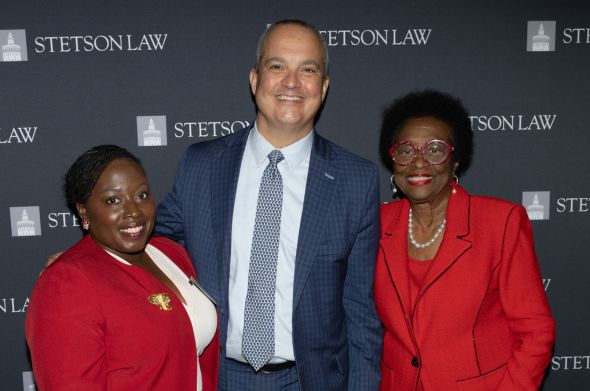
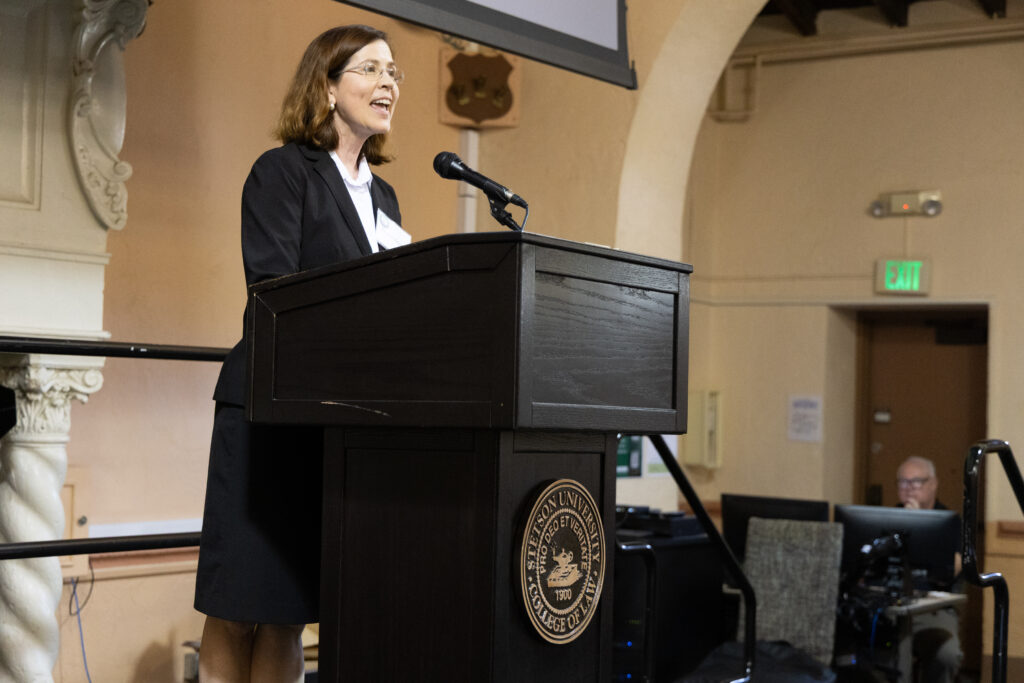
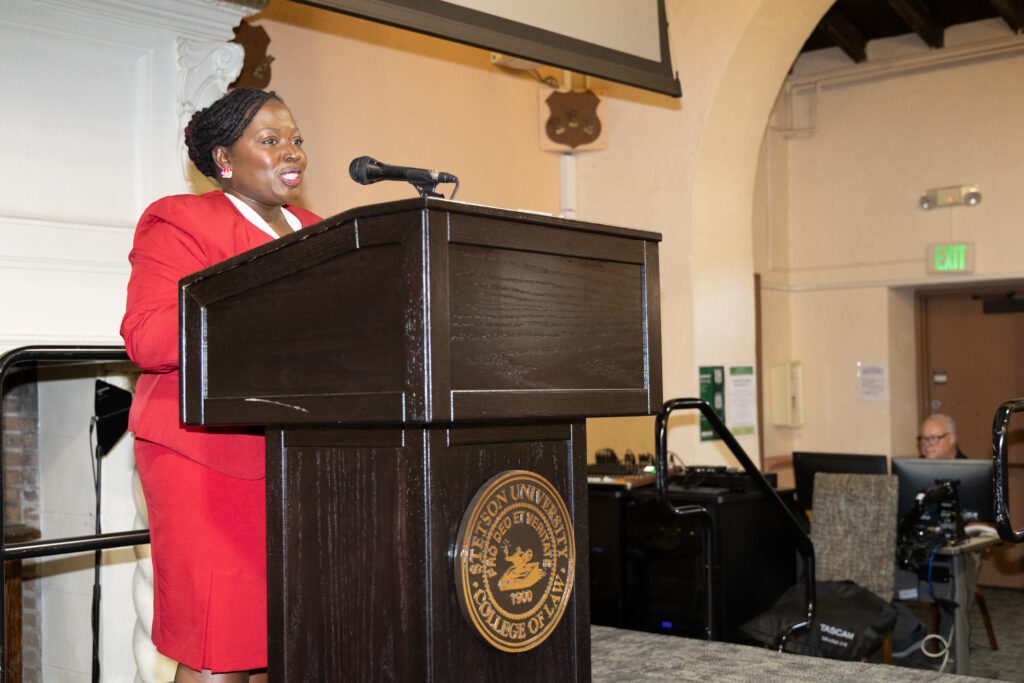
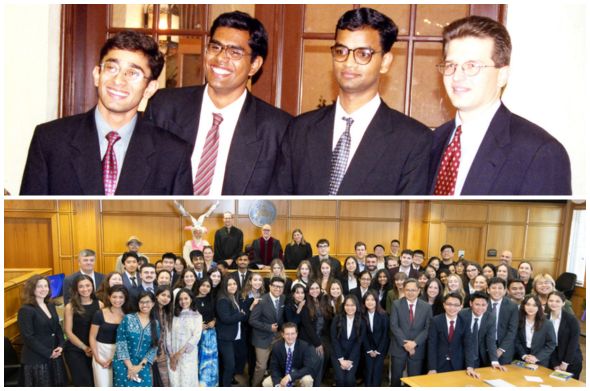
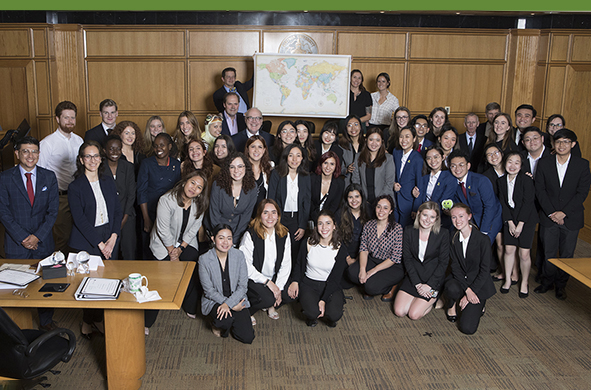
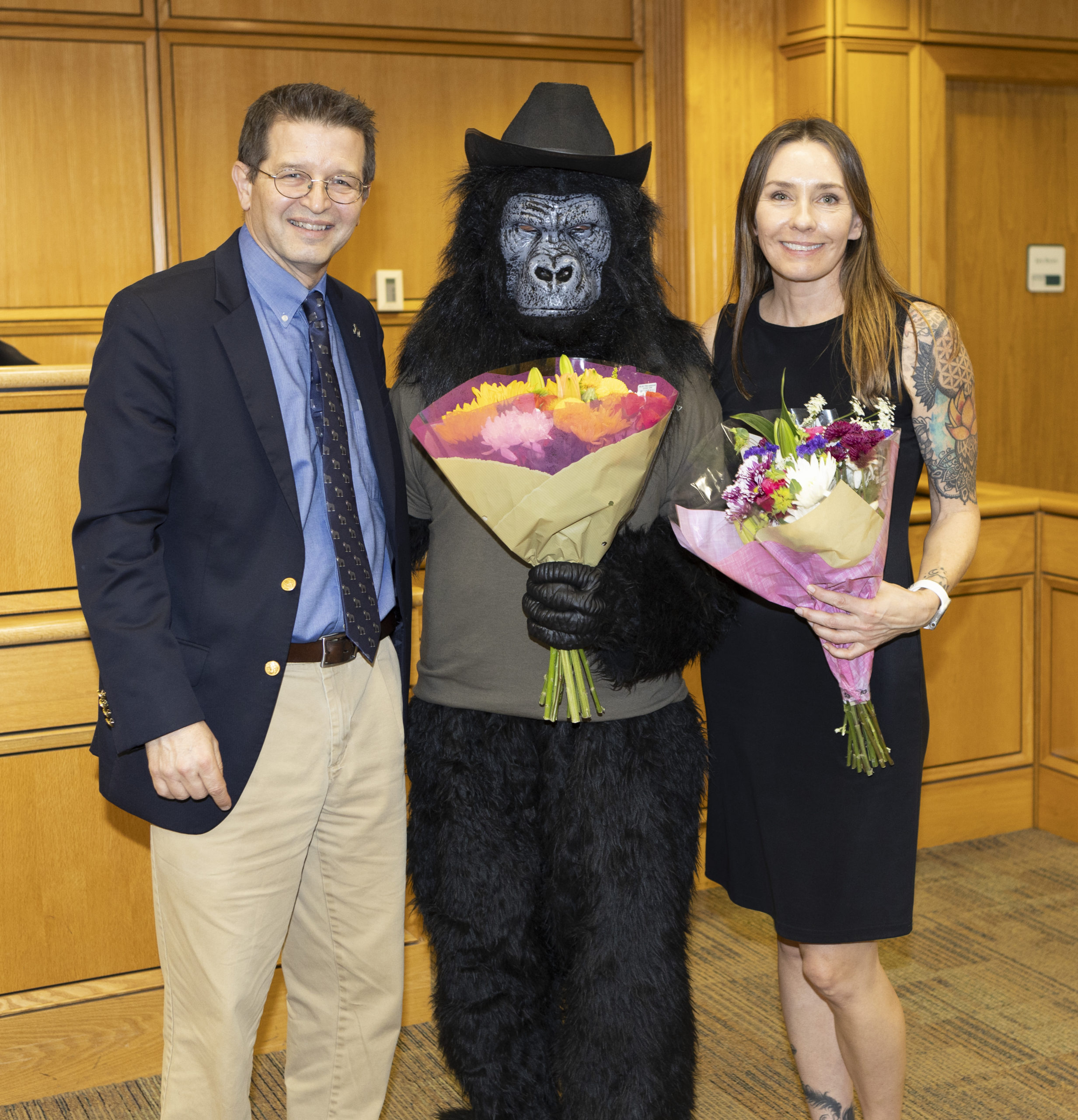
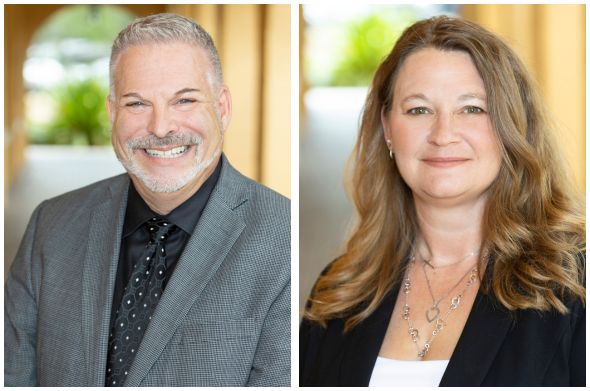
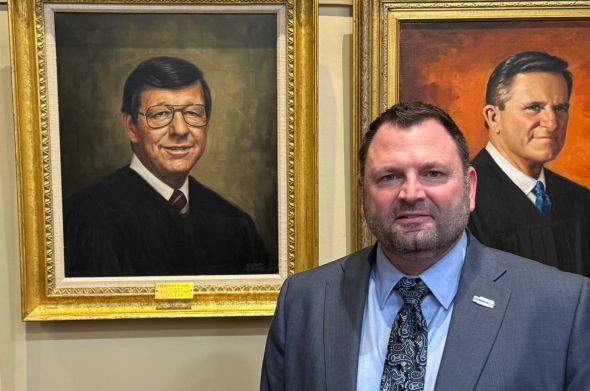
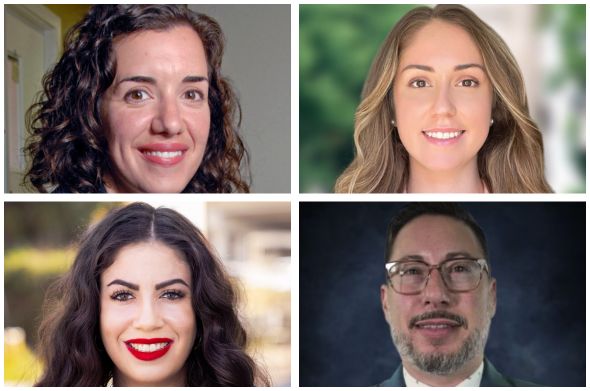
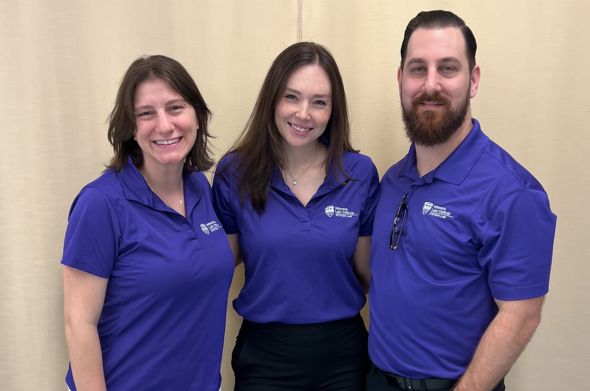
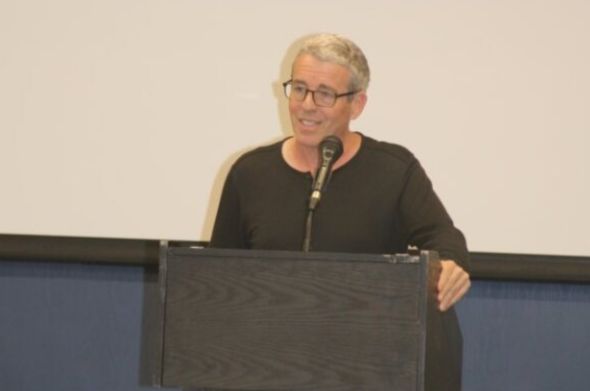
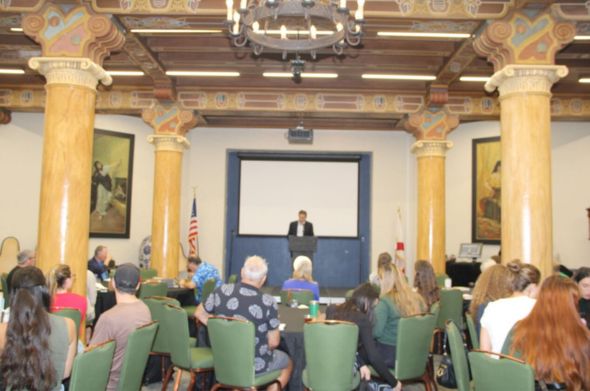
Left to right: Pye Young ’05, Stetson Law Sean D. Benjamin Barros, former Florida State Sen. Arthenia Joyner.
From bold acts of civil disobedience to innovative strategies for addressing the current justice gap, the 2026 William Reece Smith, Jr. Banquet was a moving exploration of how the law can transform lives.
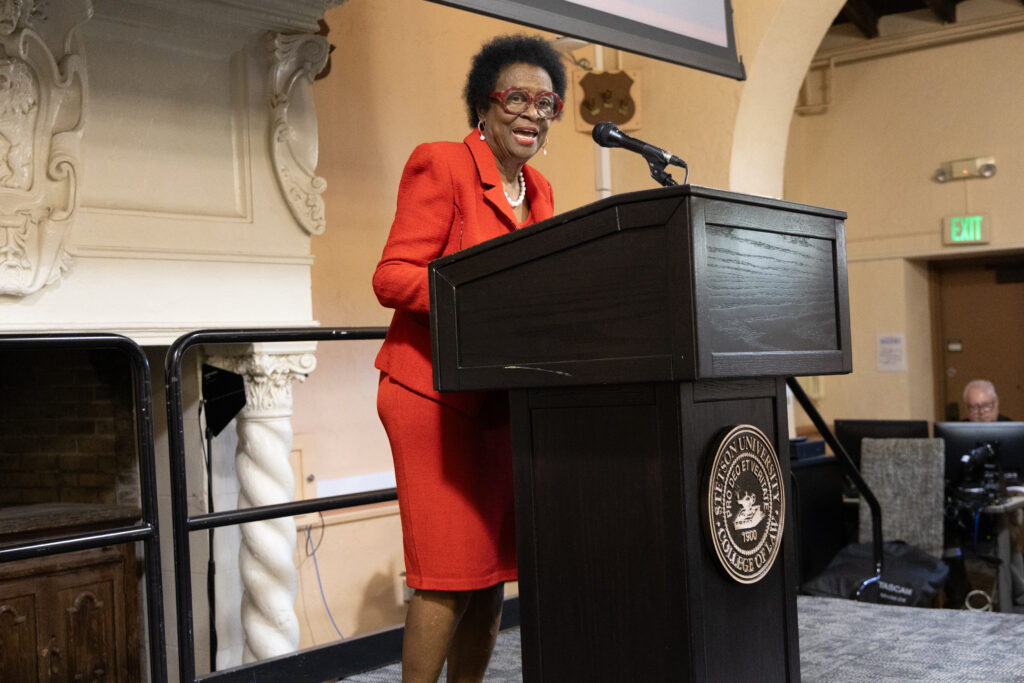
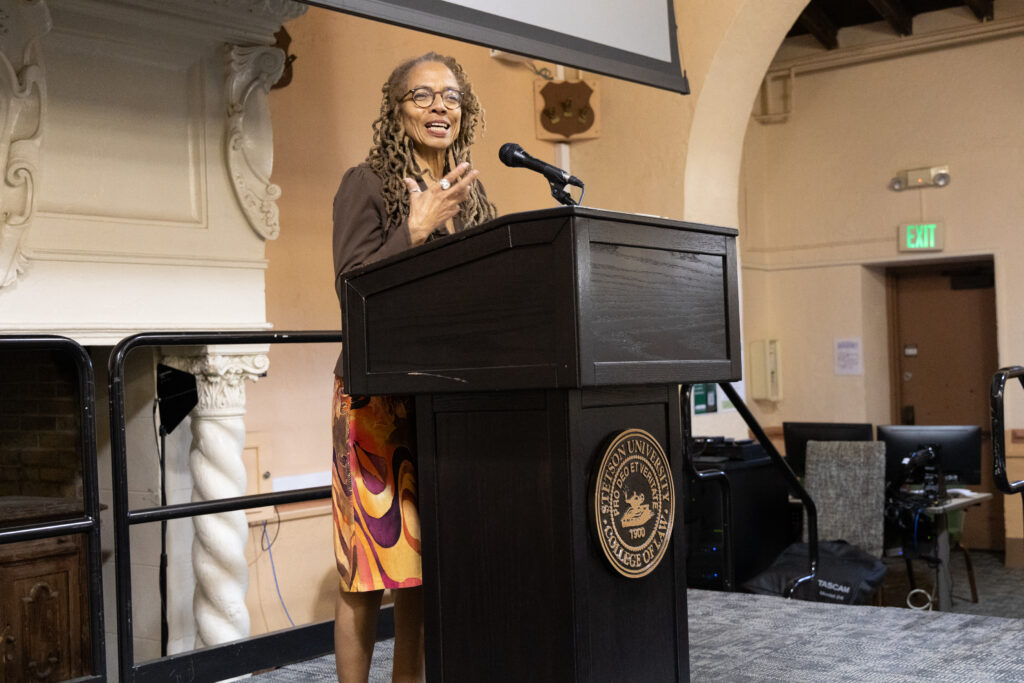
Each year, the event honors two individuals who embody the values promoted by legendary lawyer Wm. Reece Smith, Jr. In his leadership of organizations from Florida Legal Services Inc. to the American Bar and International Bar Associations, Smith fought to expand legal services to those who cannot afford them. He was also a distinguished professorial lecturer at Stetson Law. This year’s banquet featured former Florida State Senator Arthenia Joyner, who is best known for her pioneering legal career rooted in Civil Rights Era activism, as the keynote speaker. Pye Young, a 2005 alumna and managing attorney in Bay Area Legal Services’ St. Petersburg office, was honored with the 2026 Wm. Reece Smith Public Service Award.
Recognizing fearless leadership
Law Professor Kristen Adams
Introducing Joyner, Law Professor Kristen Adams referred to her as “a trailblazer, a lawyer, a legislator, and a lifelong advocate for justice” and noted the former Florida Senate Minority Leader has practiced law longer than any other Black woman in Florida history.
“Where others might have been silenced, Senator Joyner was strengthened,” Adams said. “Some call her an activist. Others call her a pragmatist. All know that she is firm in her resolve to reflect positive change in our society.”
A return to campus
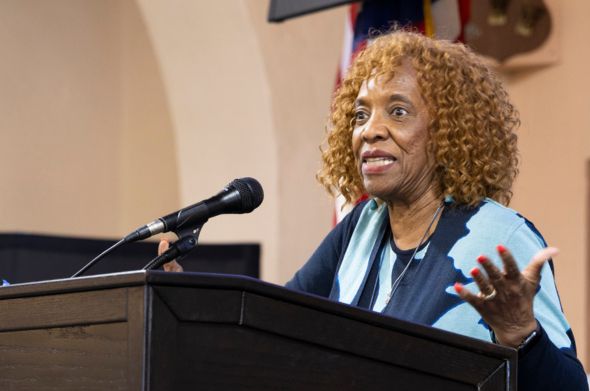
At the podium, Joyner said this was not her first time speaking at Stetson Law. In 1990, she was the first Black person to serve as the College’s commencement speaker. Thirty-six years later, she returned to honor the legacy of Smith, whom she knew through their shared profession and passion for equal justice.
“So, I’m home now,” she joked.
She recalled growing up in Tampa at a time when the Ku Klux Klan was a constant threat and her activism against segregation and other injustices, which included acts of civil disobedience that led to three arrests.
“That’s not a criminal record for me. It’s a freedom record,” Joyner said. “When your government is wrong, you have not just the right but the obligation to say so.”
Civil rights activist and former Florida State Senator Arthenia Joyner.
The Florida A&M University alumna became the first Black lawyer to practice in both Polk and Hillsborough Counties in Florida. Elected to serve in the Florida House of Representatives and Florida Senate, including as Senate Minority Leader, Joyner championed civil rights, equitable justice, and opportunities for marginalized communities. She said the fight for progress never ends.
“I have lived 83 years on this earth; more than 50 years at the Bar,” she said. “And if there’s one thing I know, it is this: progress is never permanent. Every generation must fight for it. Over and over and over again.”
As she closed her lecture, she urged the law students and young lawyers in attendance to persevere against efforts to subvert the justice system.
“If you remember nothing else from what I’ve said this evening, remember this: the law is a living thing,” Joyner said. “It breathes through the people who practice it. It grows when we feed it courage and compassion. And it dies when we allow it to be captured by those who seek power over justice.”
Bridging the justice gap in Tampa Bay
The second honoree of the evening, Young was honored for her leadership and innovative approach to expanding legal services in Tampa Bay.
Law Professor Judith Scully
In her introduction, Law Professor Judith Scully said that while those accused of a crime are legally entitled to representation, people with other legal issues face fees ranging from $250 to $1,000 an hour. With a growing wealth gap in the US, more individuals lack access the legal support that would truly create equal justice under the law – which results in further injustice.
“Unfortunately, when people’s lives are not protected, inequality becomes entrenched and trust in the legal system begins to erode rapidly,” Scully said. “Consequently, addressing this justice gap should be of deep concern to all of us in the legal profession.”
Young’s work establishing legal clinics and medical partnerships at Bay Area Legal Services, Scully said, embodies the spirit of public service.
Pye Young, a 2005 Stetson Law alumna, has championed legal services.
In her remarks, Young urged students in attendance to harness their legal expertise to help others, and to embrace pro bono opportunities the way they would billable hours.
“Some people feel that pro bono is free legal work,” she said. “But I submit to you that offering pro bono services and public service is much greater than a requirement of our profession. It is the very manifestation of why we seek to become attorneys in the first place.”
Invoking the namesake of the evening, Young said dedicating time and expertise to an important cause is one of the most fulfilling things a lawyer can do.
“I challenge each of you to find your inner William Reece Smith,” Young said. “Find your passion. Donate your time to a worthy cause and make a meaningful impact on the lives of those who may not be able to afford legal assistance and legal representation. This is the call of our great profession.”
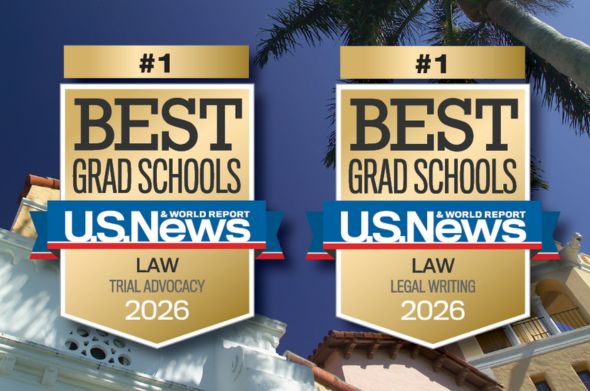
Stetson Law has been U.S. News and World Report’s #1 law school for trial advocacy more than 20 time since 1995. In 2026, it ranked Stetson Law #1 in legal writing for the first time.
In its newest graduate school rankings, U.S. News & World Report has elevated Stetson University College of Law’s legal writing program to the #1 spot in that category for the first time. The College had also retained its status as the #1 destination for trial advocacy.
This is the fourth year in a row Stetson has ranked #1 in trial advocacy, an honor the College has received 26 of the 31 years it has been given. Stetson Law earned its #1 law school ranking for legal writing after three consecutive years as the #3 school in this area. The College ranked 91st overall, an eight-point jump from 99th in 2025.
It is no coincidence that Stetson Law is the top school for advocacy and legal writing. Rather, it reflects a sharp focus on ensuring students are ready to practice when they graduate and pass the bar.
In other words, Stetson Law is the best at teaching what lawyers do every day.
“Our #1 rankings in both advocacy and legal writing reflect our values as an institution,” said Stetson Law Dean D.Benjamin Barros. “No matter their practice, all lawyers advocate and write. We are proud to be focused on training our students to be truly excellent lawyers.”
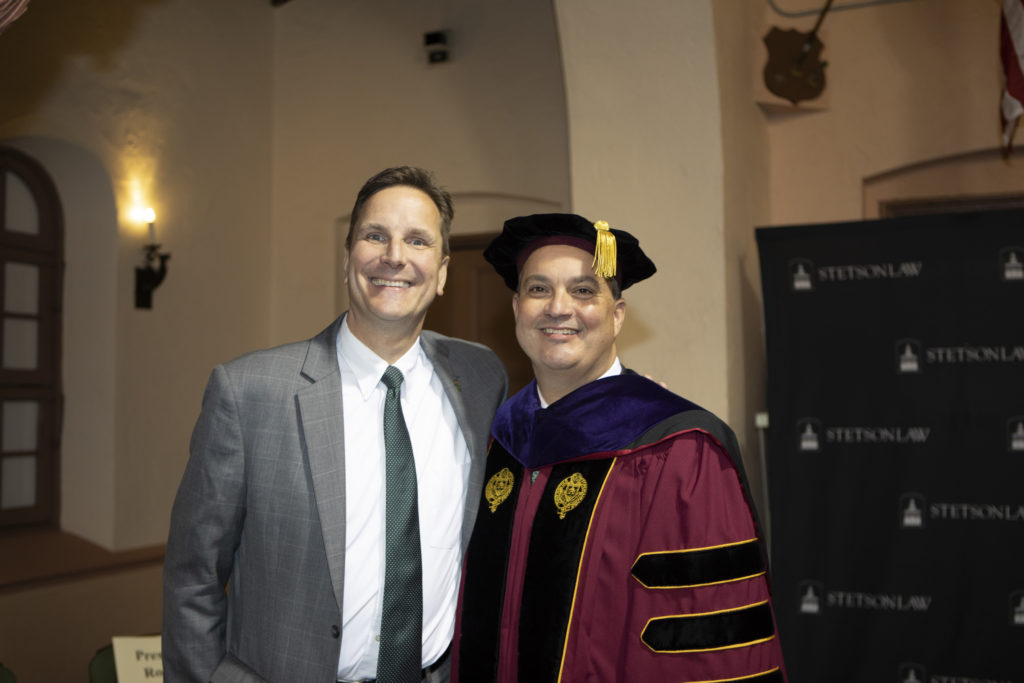
Stetson University President Christopher F. Roellke (left); Stetson Law Dean D. Benjamin Barros.
Currently celebrating its 125th anniversary, Stetson Law sits on a historic campus in Gulfport, Florida. It is Florida’s first law school and part of Stetson University, which has a main campus in DeLand, Florida. To university leadership, these latest honors are emblematic of Stetson’s university-wide culture of career preparedness, which includes Hatter Ready, an undergraduate initiative that emphasizes experiential and immersive learning.
“Yet again, our incredible College of Law community has earned its place as a top destination for students who seek the skills and knowledge to not only practice law, but to do so with heart,” said Stetson University President Christopher F. Roellke, PhD. “We are grateful to U.S. News & World Report for this recognition, which is the direct result of Stetson’s steadfast commitment to our students.”
Legal writing: well-rounded, forward-thinking
Through its Institute for the Advancement of Legal Communication, the College inspires passion for exploring legal writing’s many aspects, including the ways in which technological factors like generative artificial intelligence are shaping the teaching and practice of legal writing. For institute faculty and leadership, their work has implications that go well beyond legal academia and practice.
“Our work sets high standards for excellence within the legal profession,” said Elizabeth Berenguer, who directs The Institute. “We are honored that our colleagues and U.S. News & World Report have recognized Stetson as one of the top legal writing programs in the nation.”
Stetson Law Professor Elizabeth Berenguer
The institute provides robust support for its legal writing faculty while maintaining a strong institutional commitment to research and innovation.
Twelve full-time tenured and tenure-track faculty members, all leading scholars in the field, teach in the College’s legal writing program. Each year, Stetson Law hosts a distinguished visitor to teach legal research and writing and lead special events related to their scholarship at the law school. Recent visitors include professors Brian Larson, Shailini George, and Mary Adkins.
In spring of 2025, the Institute launched The Hive, a scholarship incubator for legal writing scholars across the nation who are seeking mentorship as they develop their work. Multiple participants have already placed their articles for publication.
For 25 years, Stetson Law’s Center for Advocacy Education (formerly known as the Center for Excellence in Advocacy) has helped Stetson Law remain a passionate, deeply supportive community for anyone eager to strengthen their advocacy skills. This is evident in a campus culture that encourages students to speak up for themselves and others as well as the College’s hosting premier events like the Educating Advocacy Teachers (EATS) conference and the National Pretrial Competition.
Its nationally and internationally recognized trial, dispute resolution, and moot court teams have earned more than 110 national titles, a testament to the center’s enduring impact.
Stetson Law Professor Elizabeth Boals
“We take a forward-looking, holistic approach to advocacy education that integrates emerging technologies, including artificial intelligence, to ensure our students are prepared to thrive in a rapidly evolving legal profession,” said Elizabeth Boals, Director of the Center for Advocacy Education. “We are committed to equipping students with the practical skills and adaptability they need to be practice-ready from day one. We are once again honored by U.S. News’ recognition and inspired to continue innovating and building an environment where our students will develop to their full potential.”
In fall 2023, the 16,000-square-foot Advocacy Institute opened its doors. With more practice spaces than any other law school, the impressive facility reflects Stetson’s deep advocacy roots while offering expansive opportunities for scholarship, collaboration, and hands-on training. As home to the Center for Advocacy Education, the Center for Elder Justice, and the Jacobs Law Clinic for Democracy and the Environment, it is a vibrant hub where advocacy can thrive in all its forms.
Stetson’s International Environmental Moot Court Competition turned 30 during the 2025-2026 academic year.
For three decades, the world’s top student advocates have come to Stetson Law to determine the outcome of fictional disputes between fictional nations – and the (also fictional) creatures that dwell within them.
As Stetson’s International Environmental Moot Court Competition turns 30, the event continues to build on its legacy of collaboration, cross-cultural celebration, and inspiring passion for the art of environmental advocacy.
The 26th Annual International Environmental Moot Court Competition, which took place Apr. 7-9, 2022
The final rounds of this year’s competition take place April 16 through April 18 on Stetson Law’s historic Gulfport campus. Once again, it will bring together student teams from around the globe for what will likely be a transformative experience.
“Over the last three decades, we have educated young advocates and leaders about environmental challenges. It’s been incredibly rewarding to meet alumni of the moot whose careers have been influenced by ‘The Stetson,’ as the event is referred to in many countries,” said Law Professor Royal Gardner, director of Stetson’s Institute for Biodiversity Law & Policy. “The competition has only endured because of the support of the Stetson community—faculty, staff, students, administration, alumni, and friends of Stetson.”
How it all began
Gardner and former Stetson Law Dean and Professor Darby Dickerson – both new professors at the time – realized that while there were moot court events covering numerous areas of law, none were dedicated solely to international environmental law. With the support of then-Dean Lizabeth Moody, the professors went to work organizing the event, which took place in November of 1996.
(L-R): Professor Royal Gardner in background, University of Maryland Law students William Tilburg, April Morton, Best Oralist Molly Knoll, and Stetson Law Dean Darby Dickerson. Click for high-resolution image.
A total of 12 teams – 11 from the U.S. and one from the University of Málaga in Spain – argued on both sides of a problem loosely based on the turbot dispute between Canada and Spain. Over the years, students from nearly fifty countries, from Australia to Zimbabwe, have competed.
For the 30th edition, national and regional rounds were conducted in Bangladesh, Brazil, Colombia, Ghana, Kenya, India, Ireland, Pakistan, the Philippines, Republic of Korea, and the United States. Thirty teams from five continents have been invited to campus for the finals, although new visa requirements and rising travel costs have created significant challenges.
Gardner reports that he regularly receives compliments on how smoothly the moot is organized, which he credits to his colleagues on the competition committee, Professor Erin Okuno, a 2013 alumna, and Foreman Biodiversity Professor Katherine Pratt, a 2019 alumna.
Fostering global connections
With its globe-spanning reach and global themes, the competition has also attracted legal professionals working on international issues to volunteer as judges, including:
Judge Christopher Weeramantry (International Court of Justice), Judges Kathy-Ann Brown and Anthony Lucky (International Tribunal for the Law of the Sea), Secretary General Peter Bridgewater and Deputy Secretary General Nick Davidson (Ramsar Convention), Executive Director Bradnee Chambers and Executive Director Amy Fraenkel (Convention on Migratory Species), and Secretary Veronica Caceres (Convention for the Protection and Conservation of Sea Turtles).
A message from AstridSchomaker, Executive Secretary, Convention on Biological Diversity
The cases, the critters
The competition always requires students to grapple with important legal questions such as: how should one balance the needs of the current generation with those of future generations? What does consensus mean in the context of multilateral environmental agreements? How does one resolve conflicts between different treaties?
Gardner said the case is the result of a brainstorming session that takes place over dinner immediately following the prior year’s IEMCC finals.
Although hypothetical, the facts used in the competition often reflect current events. The basis of the 1999 problem was the export of toxic waste from Taiwan to Cambodia, which sparked riots. Two years later, it was Japan’s whaling program. Coinciding with Russia’s invasion of Ukraine, the 2022 problem – which was created more than six months before the invasion – dealt with the environmental fallout of conflict in the region.
In 2024, the problem examined whether the discovery of a shark species long thought extinct should halt rare-minerals mining in its habitat.
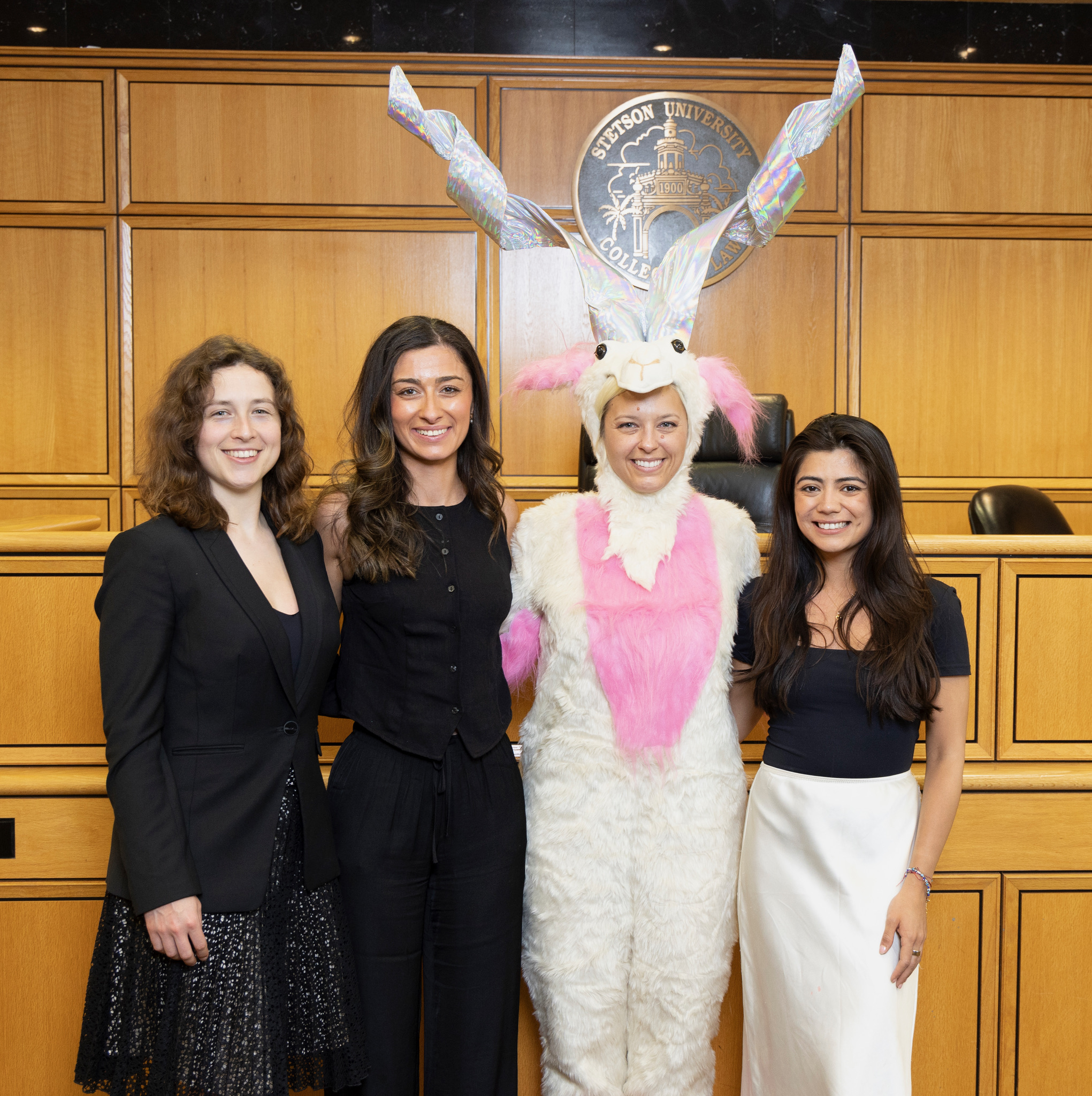
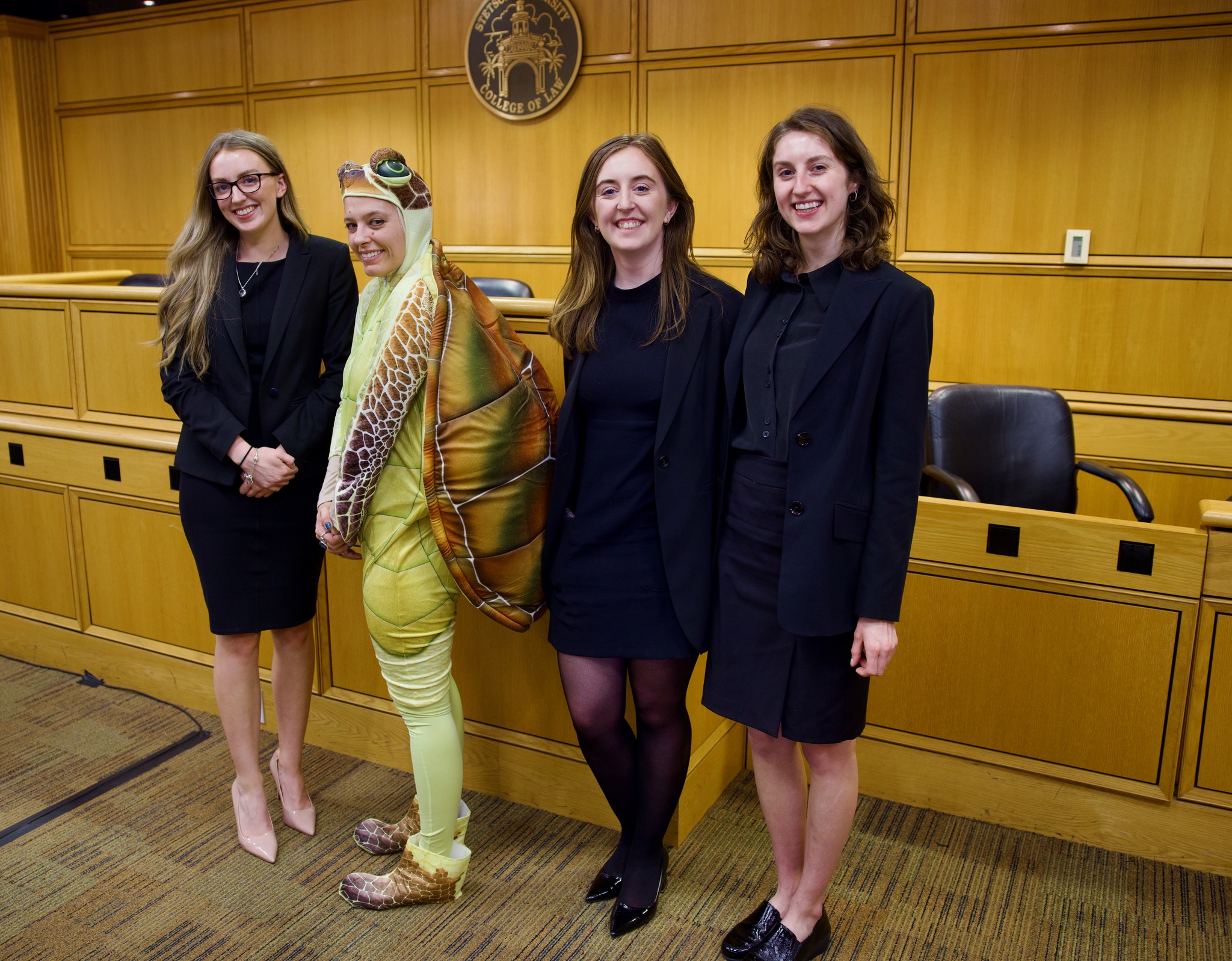
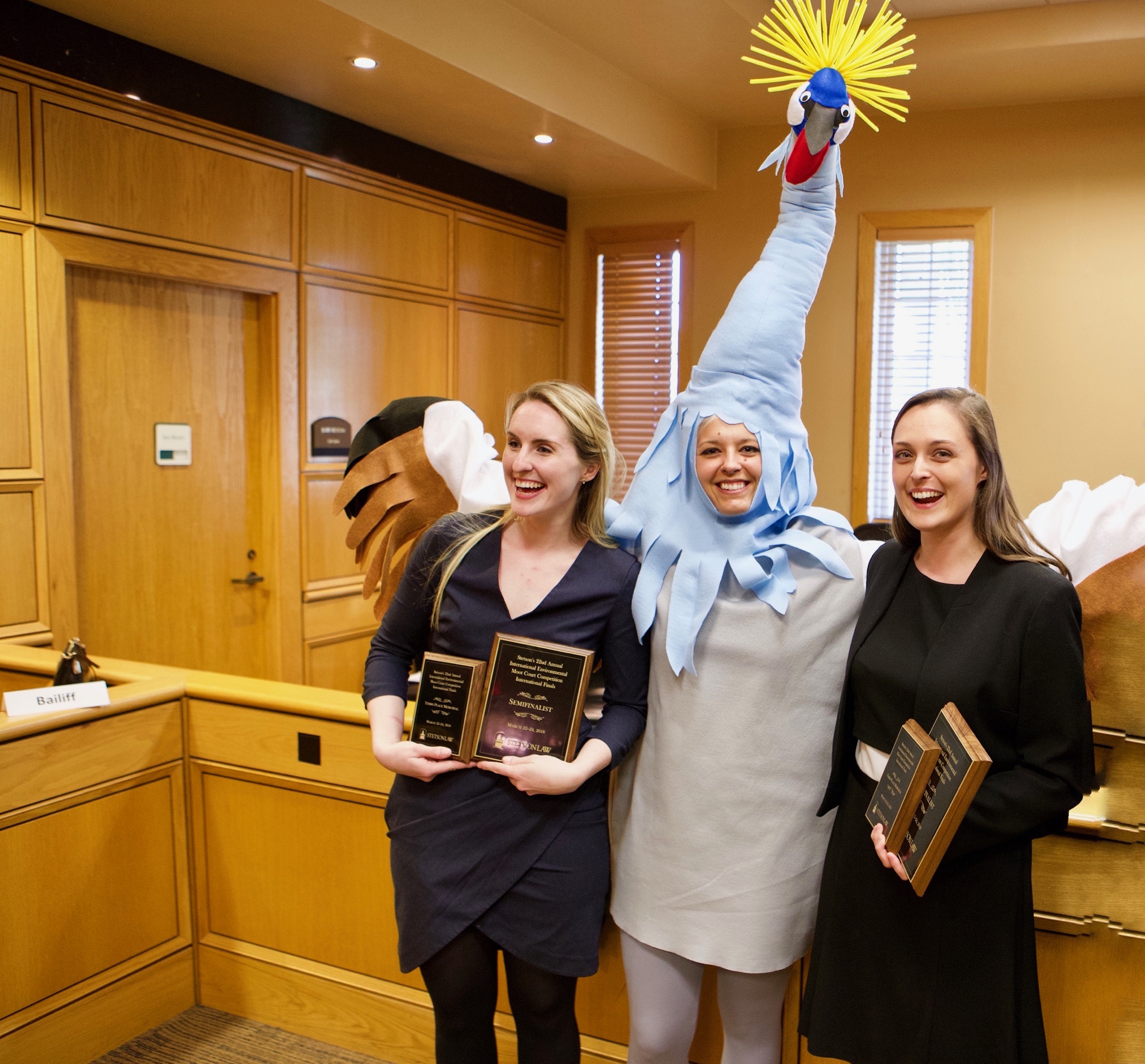
Since she has been involved, Okuno has endeavored to create or purchase a costume she dons to serve as the competition mascot at the event’s culmination – including the shark. She said the most challenging one to create (as well as her favorite) was the “blue-crowned crane.”
Another favorite: 2025’s “Royal markhor,” a goat-like species with long, spiraling horns protruding from its head and splashes of pink fur.
“I had to get creative with that one,” Okuno said.
SLIDESHOW: ERIN OKUNO’S COSTUMES
IEMCCTurns307
IEMCCTurns305
IEMCC Turns 30 8
IEMCC 2024 Gorilla 2
The 2026 problem deals with legal questions about de-extinction efforts related to the (fictional) Royal panther.
“Everyone waits for the charismatic species to emerge when the judges are debating the final rounds,” Gardner said.
The impact of global events
Whether it’s the global Covid-19 pandemic or the aftermath of the September 11 attacks in 2001, major events have created uncertainty in some years. In 2022, Russia’s invasion in Ukraine kept a team from the latter country from participating in the finals. They did, however, produce a video that was shown during the event’s opening reception.
Shortly after Russia invaded Ukraine in 2022, a team of Ukrainian students created a video message to IEMCC teams, coaches, judges, and support staff.
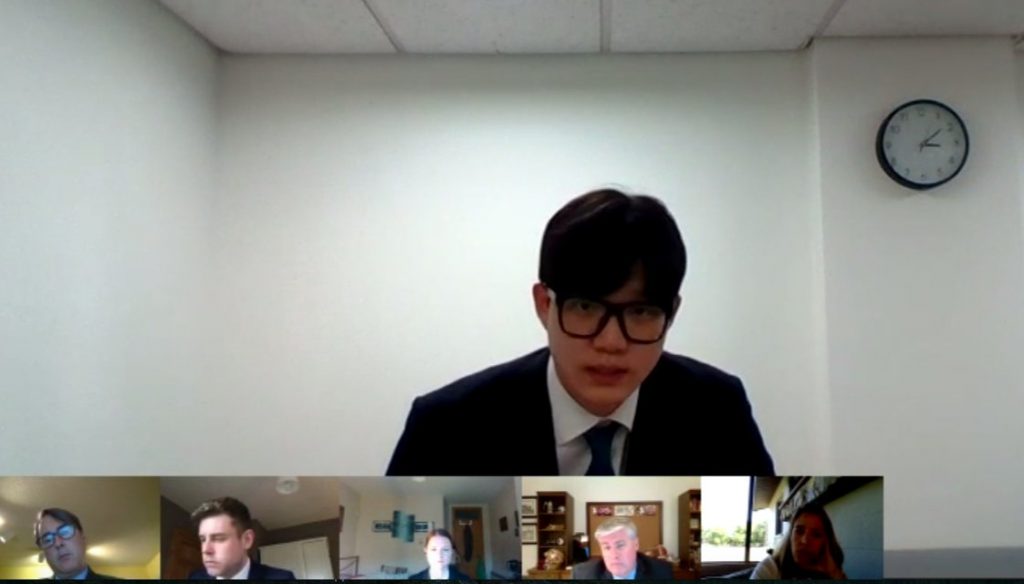
The IEMCC was one of the first moot court competitions to go online in 2020 and 2021 during the global pandemic. Gardner recalls a student competitor from South Korea presenting virtually from his campus (which officials opened just for him) at 3:00 A.M. local time.
Stetson’s International Environmental Moot Court Conference was one of the first College events to go virtual in 2020.
One year, the competition’s Central Asian rounds were held in Nagorno-Karabakh, a breakaway region of Azerbaijan. The rounds went forward despite objections by Azerbaijani officials, with Gardner explaining it would proceed in the spirit of the right to education contained in the Universal Declaration of Human Rights, which promotes “the maintenance of peace.”
What sets IEMCC apart
Moot court competitions are often intense, high-pressure affairs. Even though the teams are there to compete, they help create a friendly, positive environment on campus.
“The best part is how enthusiastic and happy to be here everyone is,” said Pratt.
Okuno agrees. “Everyone exudes collegiality and joy,” she said.
T P Kennedy, Director of Education at the Law Society of Ireland, said his students often come away from the event with lifelong connections within the team as well as other competitors.
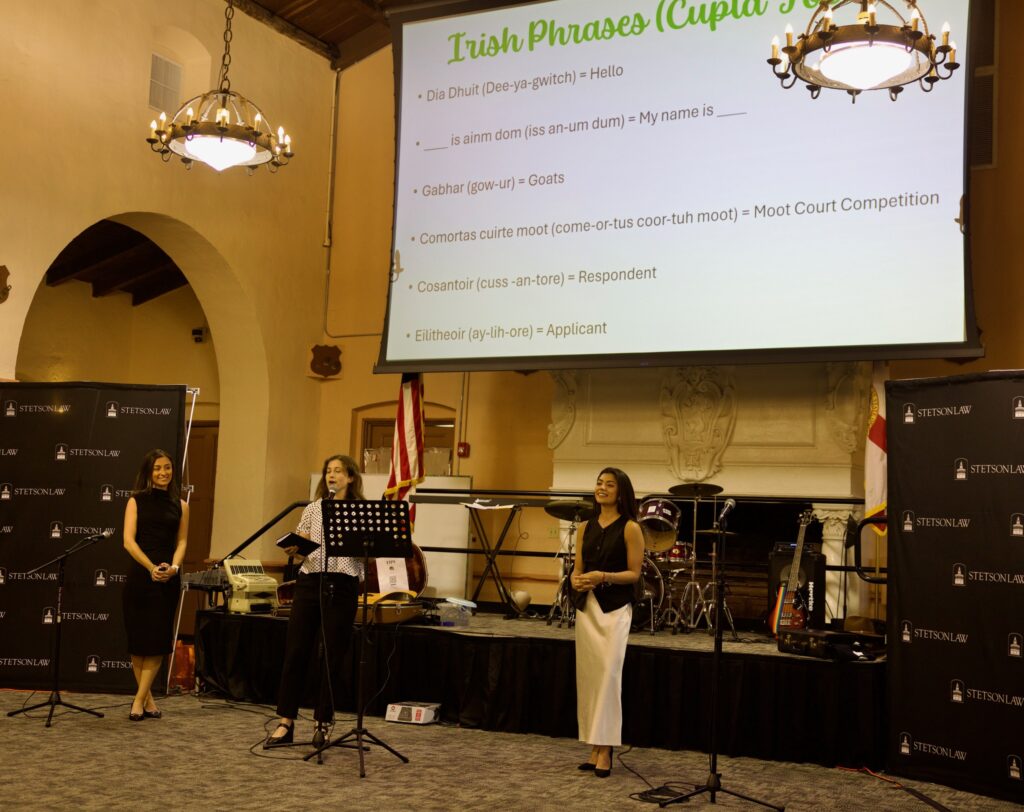
The opening reception of Stetson’s IEMCC final round includes an exchange of cultural traditions.
“What’s been notable for us is how civil and transparent the competition is,” Kennedy said. “Judges engage in conversation with the student advocate and there’s no sense of point scoring or entrapment.”
Such a cheerful environment has fostered the development of many traditions over the years, including a multicultural talent showcase during the welcome reception.
Members of Stetson Law faculty and staff sometimes even open their homes to visiting teams and judges. And the event now typically kicks off immediately on the heels of Stetson Law’s International Wildlife Conference, which often has a theme that dovetails with that of the IEMCC record.
Many national and regional rounds hold similar side events. Indeed, the organizers of the Bangladesh National Rounds use the Stetson moot as a mechanism to help build environmental civil society.
Gardner recently has had the opportunity to judge rounds in Brazil, Colombia, India, the Philippines, and Tanzania.
“It was an honor to participate, and it was inspirational to witness the energy, enthusiasm, and advocacy skills of the students,” Gardner said.
In partnership with the American Arbitration Association (AAA), the global leader in alternative dispute resolution (ADR), Stetson Law is introducing an innovative way for new attorneys to sharpen their knowledge of the arbitration process.
The Fundamentals of Arbitration Advocacy is a new online certificate program designed to equip new attorneys as well as those with limited arbitration experience with a practical understanding of the arbitration process.
Participants will gain sharp insights from Stetson Law advocacy faculty and experienced AAA arbitrators through virtual lectures, interactive exercises focusing on major steps of the arbitration process, and live Zoom office hours. They will sharpen their understanding of filing procedures, arbitrator selection, and preliminary hearings. The program is structured on flexible weekly modules students can work on at their convenience and submit assignments by the designated deadlines.
“Through this partnership with Stetson University, we are expanding access to high-quality training that equips attorneys to address both current practice and emerging challenges in arbitration,” said Christine Newhall, senior vice president of AAA Education.
For Stetson Law leadership, this course reflects College’s commitment to expanding the opportunities it offers to the greater legal community.
“We are incredibly proud to partner with the AAA on this project, which combines the AAA’s expertise in dispute resolution with Stetson Law’s nationally renowned expertise in advocacy education,” said Stetson Law Dean D. Benjamin Barros.
The inaugural round of the course begins on May 4, 2026. Upon successful completion, participants will receive a certificate and a digital badge.
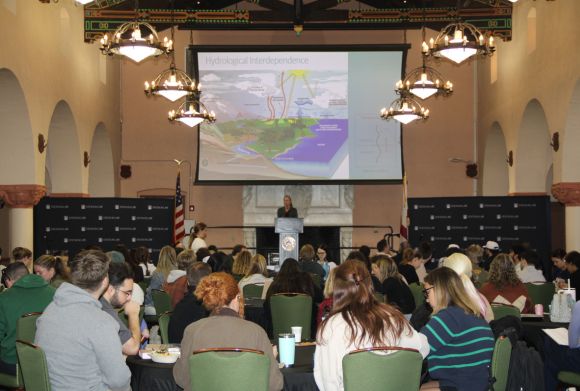
The World Bank’s Christina Leb spoke about her institution’s role in the development of sustainable water policies across borders.
As she began her lecture in Stetson Law’s Great Hall, Christina Leb noted the opulence of the venue.
“This is probably the most fantabulous hall I’ve ever spoken in,” said Leb, who is senior counsel at the World Bank’s Environmental and International Law Department (LEGEN).
She was there to talk about the key role organizations like hers play in the development of sustainable water governance, especially in places where bodies of water cross international boundaries. Her talk, which drew a sizeable audience of students, was the February 2026 installment of Stetson’s Foreman Biodiversity Lecture Series.
Demystifying a complex topic
Leb detailed her experience working at a multilateral development bank supporting the creation and implementation of international water laws and sustainable water resources management – and how the very nature of water presents a challenge to doing so.
“We need to remember that water is in constant flux,” she said. “The hydrological cycle determines the availability of water over land. Water evaporates over land, over the ocean, rains down through the mountains, across landscapes, and percolates into the soil.”
Comparing the principles of international water law to the principles of international environmental law and international law in general, Leb said there is a general duty among participating nations to cooperate, prevent significant harm, and settle disputes.
There are more than 300 transboundary river basins in the world, and even more transboundary aquifers that provide freshwater to multiple countries. There are delicate wetlands and watersheds connected to the water supply upon which millions depend. Pollution in one country can contaminate another’s drinking water.
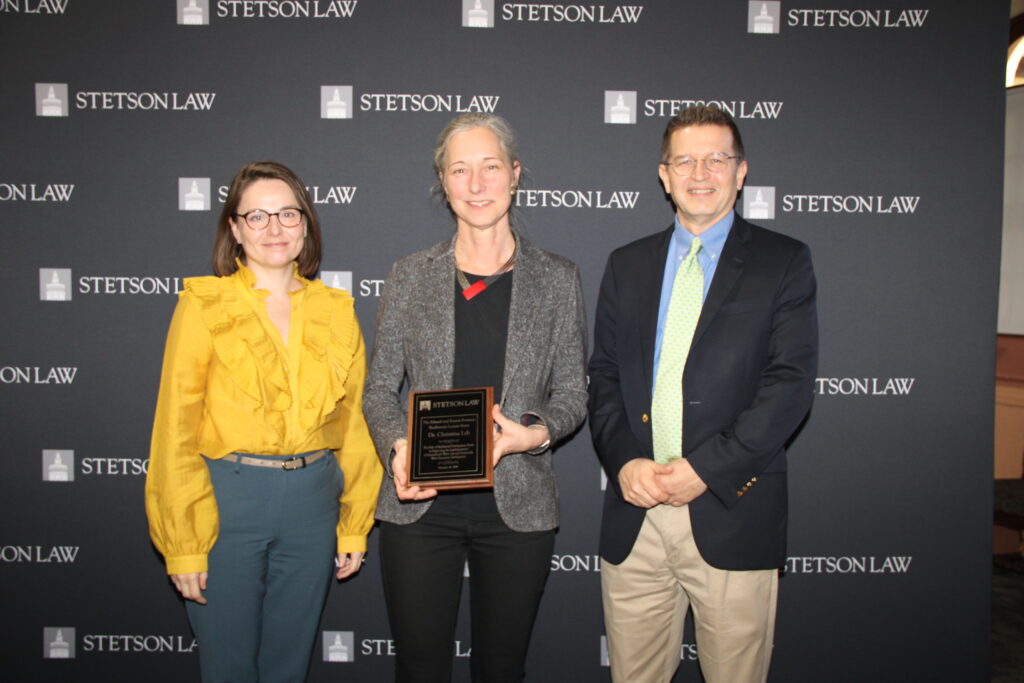
Left to right: Associate Professor Klara Van der Ploeg, World Bank Senior Counsel Christina Leb, and Law Professor Royal Gardner. Van der Ploeg helped bring Leb to campus to deliver a Foreman Biodiversity Lecture.
Organizations like the World Bank, which seek to lift populations out of poverty around the globe, can help motivate nations to protect the water resources they share with other nations by requiring sustainability practices as a condition of funding. Yet shifting political, economic, and environmental circumstances can present a challenge when it comes to creating a lasting agreement.
An example she cited was the Indus Basin Treaty, which was developed in 1960 when India and Pakistan were divided into two separate countries. The World Bank brokered this water-sharing agreement. Following a 2025 attack in India’s Kashmir region, India suspended the treaty.
“International treaties are a product of their times, and when negotiating a treaty, it’s very important as a lawyer to make them flexible in the long term,” she said. “To build in clauses that allow negotiation, because in most cases, the relationships between countries and their water needs evolve over time – and the treaties will become outdated one way or another.”
Advice to aspiring international law practitioners
Asked how a law student can best position him or herself for work within such initiatives, Leb said it is best to seek out professional experience through internships as well as attending relevant conferences where they can meet and interact with leading professionals in the field.
“Ultimately what helped me was having a network of people,” Leb said.
As they prepare to join a competitive profession that places profound value on relationships, law students must cultivate the ability to hold meaningful conversations despite differences.
To support students in developing this skill, Stetson University College of Law has launched a bold new initiative designed to prepare future lawyers to lead difficult conversations with clarity, empathy, and professionalism.
Championed by Dean D. Benjamin Barros, the Dean’s Fellows for Civil Discourse program empowers students to build a concrete, sustainable culture of respectful dialogue on campus and beyond.
The student-led program is part of a comprehensive effort to ensure that civil discourse remains a defining feature of the Stetson Law experience. For Barros, this initiative is a critical step toward a major goal he has had since he joined Stetson: creating an actionable policy that supports Stetson Law’s already robust culture of civility.
“One of my biggest priorities as dean of the College of Law has always been civil discourse,” he said. “We need to remain a place where people from very different backgrounds can come together and learn from each other.”
A three-part model
The initiative involves three key players: College leadership, student fellows, and an external expert partner.
Leadership sets the tone before classes begin. During orientation, students hear directly from Barros or Associate Dean for Assessment and Professional Engagement Anne Mullins about the centrality of civil discourse in their professional development.
“That early signal matters,” Mullins said. “It establishes that this work is not extracurricular or optional; it is part of professional formation.”
Students begin to learn about civil discourse as an aspect of professional development as part of their 1L orientation.
The nine inaugural fellows, all 2Ls, represent a wide cross-section of student organizations, ideological perspectives, and lived experiences. They volunteer their time to advise the College on how to best support students when challenging conversations arise. Their work will continue into their 3L year, providing continuity and building a peer-led infrastructure that can grow over time.
The third pillar of the program is the Constructive Dialogue Institute (CDI), a national leader in helping students engage productively across differences. Founded by Jonathan Haidt and Caroline Mehl, CDI works with institutions across higher education. Stetson is the first law school to partner with the organization directly, which allows CDI to tailor its approach to the unique demands of professional education and development.
Key questions guide the process
The program kicked off in the fall 2025 semester with a full-day training led by CDI for the fellows and selected student organization leaders. The trainer, who herself is a JD, brought immediate credibility and grounded the work in the realities of legal education.
The fellows are now tasked with developing core principles based on key questions:
How should we treat one another when we disagree?
How should we handle controversial outside speakers?
How do we create a community that is engaged and civil rather than avoidant or conflict-free?
Stetson also supported CDI in the development of a skills-based training program tailored to issues of professional identity, power, and responsibility. The program will roll out to the Fellows and three of the Stetson Inns, supplemented by interpersonal dialogues the Fellows will facilitate.
Planning for real-life situations
When the guiding principles are in place, the fellows will turn to one of the biggest challenges campuses nationwide face: how to handle controversial speakers who come to campus.
Their task is to translate the principles they developed into universally applicable guidelines that reflect Stetson’s values, educational mission, and responsibility to students. The goal is neither censorship nor uncritical openness, but a thoughtful framework that supports learning and engagement.
“This is not about avoiding disagreement,” Mullins said. “It’s about ensuring our students graduate ready to lead difficult, high-stakes conversations in courtrooms, boardrooms, communities, and civic life.”
Leading the way on civil discourse
The fellowship reflects Stetson Law’s shared values and commitment to preparing students not just to think critically, but to lead responsibly in challenging moments.
“Our approach to this program is student-driven, skill-based, nonpartisan, and consistent with academic freedom,” Barros said. “We are training leaders, so we want our students to themselves set our community’s expectation for civil discourse.”
As the fellows continue their work, Stetson Law is positioning itself as a national leader in cultivating the next generation of lawyers who can navigate and elevate the conversations that shape communities and democracy itself.
Meet the inaugural fellows
The 2025-2026 fellows bring a remarkable range of experiences to the table.
Mark Boyle is an active member of the Federalist Society. Last summer, he served as a judicial intern for the Honorable Geoffrey H. Gentile, where he gained exposure to federal court practice and judicial decision-making, experience that informs his commitment to principled, respectful dialogue in the legal profession.
Caitlyn Green is a member of the Student Leadership Development Committee and a 2L Representative for Stetson Law Republicans, in addition to her membership in the Federalist Society. She externed last summer at the U.S. District Court for the Middle District of Florida, gaining experience with federal litigation and judicial process that reinforces the importance of civility and professionalism in legal advocacy.
Spencer Greenwood is a member of Stetson’s Trial Team with a strong interest in litigation and advocacy. Last summer, he worked at Banker Lopez Gassler in St. Petersburg, where he deepened his appreciation for clarity and respectful engagement in adversarial settings.
Sassy Hill is a member of the Dispute Resolution Board and serves as Lambda Legal Society’s 2L representative and the Anti-Trafficking Coalition’s vice president. A Stetson Law Ambassador, Hill is also an entrepreneur and two-time business founder who brings a collaborative, solutions-oriented approach to civil discourse informed by leadership, advocacy, and real-world problem solving.
Sean Patterson is an active member of the Black Law Students Association, the Student Bar Association, and the Student Veterans Association at Stetson Law. He works full time as the Senior Signals Intelligence Chief for Special Operations at U.S. Central Command on MacDill Air Force Base and mentors local youth through the RISE Program. His experiences underscore the value of trust, perspective, and disciplined communication in civil dialogue.
Patterson said he chose to participate in the Civil Discourse Fellowship because he believes meaningful dialogue begins with perspective.
“As a Black and disabled combat veteran (of a certain age), my lived experience has shaped how I see justice, disagreement, and community,” Patterson said. “Too often, I think we intend to engage in discourse to change minds (we are aspiring to be attorneys); I hope to instead help open hearts so we can foster a campus culture where students feel safe sharing their thoughts without judgment or fear.”
Sierra Shellabarger currently serves as secretary of both the American Constitution Society and the Legal Advocates for Reproductive Autonomy at Stetson. She also volunteers as a Guardian ad Litem for the Sixth Circuit, where she advocates children within the state welfare system. Last summer, as a law clerk at Coats Schmidt, P.A. in St. Petersburg, Florida, she gained experience in civil litigation and real estate law. This summer, she will join Moyer Law Group as summer associate, where she will focus on defense-side construction litigation.
Tika Singh is a member of the Stetson Law Review and is active in the Entertainment and Sports Law Society, Stetson Law Republicans, and the Federalist Society. She is currently externing with the Honorable Amy Williams of Florida’s Sixth Judicial Circuit and previously worked as a corporate paralegal at Rio Tinto in Washington, D.C. Her experiences shape her commitment to thoughtful dialogue and fairness across institutional and ideological differences.
“I chose to participate in the Civil Discourse Fellowship because I believe the legal profession demands not just strong advocacy, but the ability to engage thoughtfully with perspectives different from our own,” Singh said. “I hope to help foster a campus culture where disagreement is productive, respectful, and grounded in a shared commitment to understanding and growth.”
Joey Taylor serves as Secretary of the Entertainment and Sports Law Society and is pursuing a concentration in Social Justice Advocacy. His work with the NHL, IRONMAN, USF Men’s Hockey, and his community service reflect a commitment to teamwork, empathy, and constructive communication.
Taylor said he has been pleasantly surprised with how his fellow students come from such diverse backgrounds, from younger students fresh from undergraduate life to those who have already chosen to re-enter the classroom after years of professional experience.
“There’s no other environment where you’re surrounded by bright students learning from an expert on a subject, so I’m hoping we can lead the student body towards taking advantage of the opportunity to learn from each other by promoting constructive discourse both inside and outside of the classroom,” Taylor said.
Janet Worthman serves as vice president of the Stetson Law Democrats and is active in the Criminal Law Society and the Florida Association for Women Lawyers. Last summer, she worked at the State Attorney’s Office in Sarasota, where she gained practical experience in criminal prosecution and public service that informed her dedication to respectful engagement on complex and contested issues.
“I chose to participate in the Civil Discourse Fellowship because I want to become more intentional and effective in how I engage across differing perspectives,” Worthman said. “My hope is to build on that growth by continuing to develop spaces at Stetson Law where civil discourse thrives among peers and across the broader campus community.”
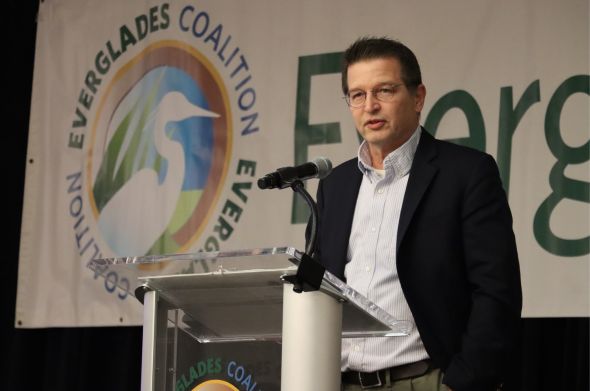
Law Professor Royal Gardner gave a keynote address at the 2026 Everglades Coalition conference.
Members of the Stetson Law faculty shared key legal insights – and a message of hope – on protecting the vast, beloved landscapes that constitute the Florida Everglades at the 41st Annual 2026 Everglades Coalition Conference in Naples, Florida.
The event is the largest gathering of environmental advocates, government officials, students, educators, and others that focuses on the future of Everglades restoration efforts. This year’s theme was “Everglades Strong: All in for Restoration.” At the heart of many conversations were state and federal cuts to regulations and funding, a recent U.S. Supreme Court decision redefining protected waterways, and other emerging factors that threaten biodiversity in the Everglades, including the construction and operation of “Alligator Alcatraz,” a migrant detention facility.
In his keynote address to attendees, Stetson Law Professor and Institute for Biodiversity Law and Policy Director Royal Gardner offered a perspective on a key moment for environmental advocates – and how it can illuminate a way forward in uncertain times.
“One of the lessons of history that gives us hope is that coalitions working together using a science-based approach communicated in language the public understands can be successful,” Gardner said.
When the proposed “Everglades Jetport” – which supposedly would have been the world’s largest – threatened to destroy a portion of the Everglades in the 1960s, public outcry led to the nation’s first Environmental Impact Statement, Congress passing the National Environmental Policy Act, or NEPA, and ultimately the project’s halting.
“The coalition was successful,” Gardner said. “It stopped the jetport and it led to the establishment of Big Cypress National Preserve.”
That landmark legislation went on to influence dozens of other nations’ environmental policies, he added.
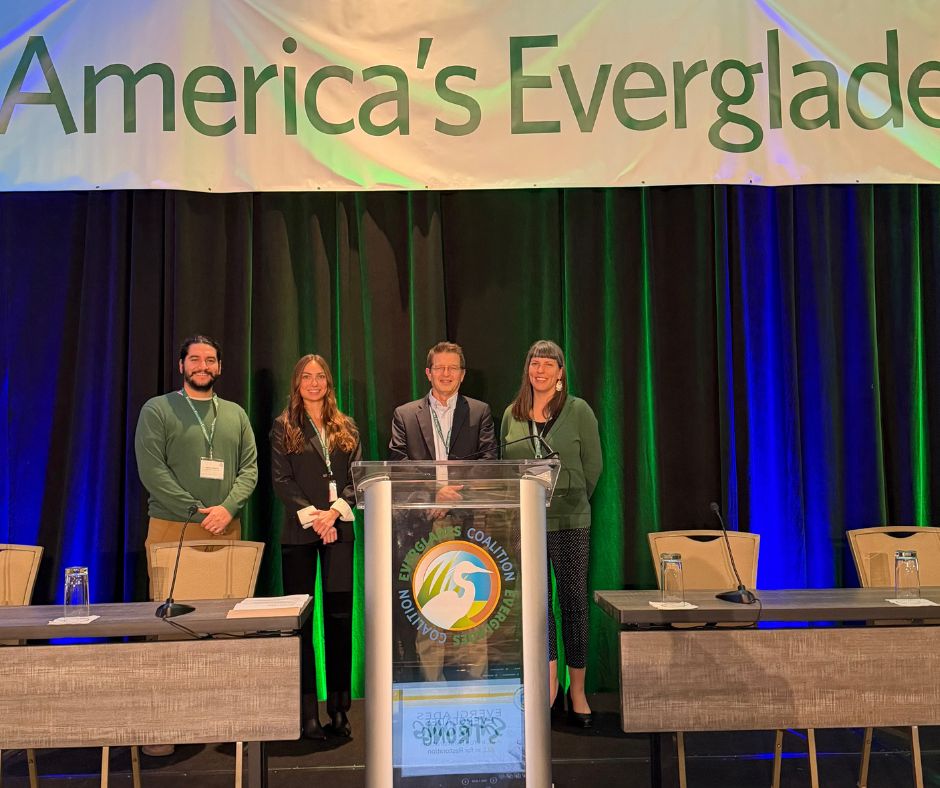
Left to right: Student Noah Peretz, Student Kylee Schaefer, Law Professor Royal Gardner, and Alumna Elise Bennett
“It’s appropriate that the Everglades serve as a model for the international community because the Everglades is internationally important in its own right,” Gardner said.
Not only is the vast, iconic wetland an international destination, but it is also designated under the Ramsar Convention and other international environmental regimes.
Facing the challenges ahead
Recent political shifts have led to uncertainty among environmental advocates on the future of wetlands protections. Among the most concerning to many is the U.S. Supreme Court decision in Sacket v. Environmental Protection Agency, the landmark case that recently led to a much narrower definition of wetlands subject to protection.
That same jetport parcel is in the spotlight again as the site of Alligator Alcatraz.
“Once more our nation’s commitment to conservation is being tested and at the exact same site, no less,” said Stetson Law Professor and Jacobs Public Interest Law Clinic for Democracy and the Environment Jaclyn Lopez, who spoke on the migrant detention center and represents amici-conservation groups in a lawsuit over Alligator Alcatraz.
Lopez moderated a panel of representatives from numerous groups who oppose the facility on environmental and cultural grounds, including indigenous tribes and environmental organizations.
“It is our hope with this panel we can learn from history and benefit from the struggles of those who came before us to do better, sooner,” Lopez said.
In his keynote address, Gardner encouraged his audience not to lose hope as policymakers threaten detrimental rollbacks of environmental protections, but to use the existing political system to challenge them.
“They’re people,” he said. “They’re people who run for office or put themselves up to be appointed to public office. So, what I want you to consider is running for office or encouraging good people to run for office. We need good people running the government.”
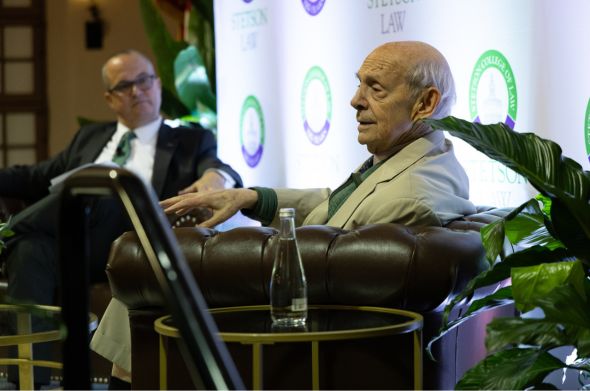
Dean D. Benjamin Barros (left) looks on as Retired U.S. Supreme Court Justice Stephen Breyer speaks at Stetson Law on February 1, 2026.
On February 1, the Stetson Law community gave a warm welcome to Retired U.S. Supreme Court Justice Stephen Breyer, who visited campus to share insights about the legal profession with College of Law students.
The Sunday evening event, which filled the Great Hall with hundreds of students, faculty and staff members, was one of several events commemorating Stetson Law’s 125th anniversary. It comprised an hour of insight, reflection, advice, and, often, humor as the retired justice conversed with Stetson Law Dean D. Benjamin Barros. The two also discussed Breyer’s recent book, Reading the Constitution: Why I Chose Pragmatism, Not Textualism.
Offering students an inside look at how the U.S. Supreme Court works day to day, the types of cases the Court hears, and how justices conduct conversations on divisive issues, Breyer stressed civility, respect, and listening to those with whom one disagrees.
“The thing that I found works the best: Listen to what the people say and where they’re coming from,” Breyer said. “Listen. And then you build on what they say.”
The Stetson Connections
Breyer was introduced by 1986 Stetson Law Alumnus David Bronstein, who met Breyer due to his friendship with Breyer’s son Michael.
Bronstein joked that he met the elder Breyer because he “was a C student.” He had meant to ask his friend how people get to the Supreme Court but worded his question in a way that made it seem like he was asking to visit – so the younger Breyer called his father and arranged one.
“Because I didn’t know how to properly ask a question, I got invited to the Supreme Court,” joked Bronstein, who is a founding partner with Bronstein & Carmon, a prominent insurance defense firm in South Florida.
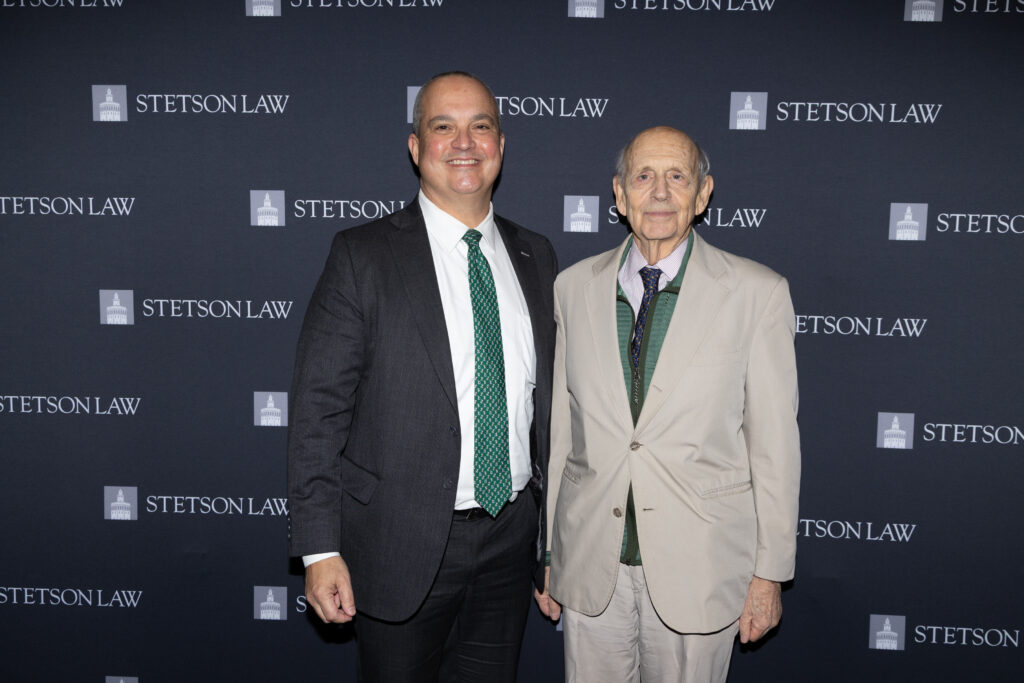
Left: Stetson Law Dean D. Benjamin Barros. Right: Retired U.S. Supreme Court Justice Stephen Breyer.
Bronstein also pointed out that former Dean Bruce Jacob, a 1959 alumnus and a transformative figure in Stetson Law history, was a special guest that evening. Jacob is known for arguing before the U.S. Supreme Court in the landmark 1963 case Gideon v. Wainwright.
“It’s such a delight for me to see him here today,” he said of Jacob, who was dean when Bronstein attended Stetson Law.
Thoughts on the Legal Profession & Civic Engagement
Breyer, who retired from the Court in 2022, is a graduate of Stanford, Oxford, and Harvard Law School. He has taught law at Harvard Law School and at the Kennedy School of Government for years. He worked as a Supreme Court law clerk for Justice Arthur Goldberg, served as a Justice Department lawyer in the Antitrust Division, was an Assistant Special Prosecutor during Watergate, and served as Chief Counsel of the Senate Judiciary Committee.
He was appointed to the U.S. Court of Appeals for the First Circuit by President Carter in 1980 and became Chief Judge a decade later. President Bill Clinton appointed him to the Supreme Court in 1994. He has authored books and articles on a broad range of legal topics.
As the conversation drew to a close, Breyer urged the students in attendance to remain active participants in democracy – and reflected on the unique and fundamental role the law and legal professionals play in promoting a just society in the U.S.
“Law is an institution that in general should help people live together peacefully,” Breyer said. “A rule of law is what we depend upon to keep those 340 million people together.”
WATCH: Full full video of Justice Breyer’s visit to Stetson Law
When the chance arose to make their law school campus greener, Peretz jumped at the opportunity.
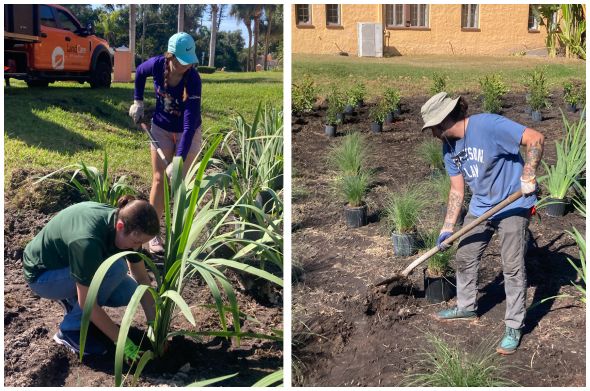
With encouragement from Jacobs Clinic Director Jaclyn Lopez and with the enthusiastic support of campus officials and landscaping contractors, Peretz spearheaded a successful Tampa Bay Environmental Restoration Fund grant application to fund a multi-year effort to install native plants in four areas on campus. Peretz had never done anything like it before.
“It became clear that transforming our grass-lined stormwater retention swales into native, plant-based bioswales was a natural fit,” Peretz said. “From there, I began drafting the grant proposal. This was the first grant proposal I had ever written, and it would not have been possible without the support of my mentors.”
From green to greener
For natural environments and the wildlife that dwells within them, the grass isn’t always as green as it seems. St. Augustine and other lawn grasses require fertilizers, the excess of which get carried off by rainwaters into nearby waterways, where they feed harmful algae blooms. When it floods, they tend to retain less flood water than natural landscaping.
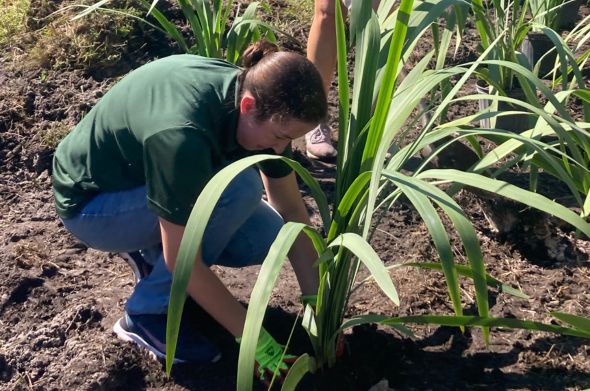
The bioswale project, which began fall of 2025, is replacing expansive patches of St. Augustine grass that line campus stormwater retention areas with vibrant and less water-intensive native plants. The Florida-friendly plants absorb more stormwater while reducing the amount of fertilizer that drains into our local waterways Bear Creek, Boca Ciega Bay, and Tampa Bay.
Replacing turf grass with water-loving native plants will help reduce flooding and pollution on campus.
They will enhance filtration, improve groundwater recharge and water quality, and help filter pollutants originating from vehicles, roofing materials, landscaping, pet waste, and other sources. Since they require significantly less care, they’ll also be cheaper to maintain.
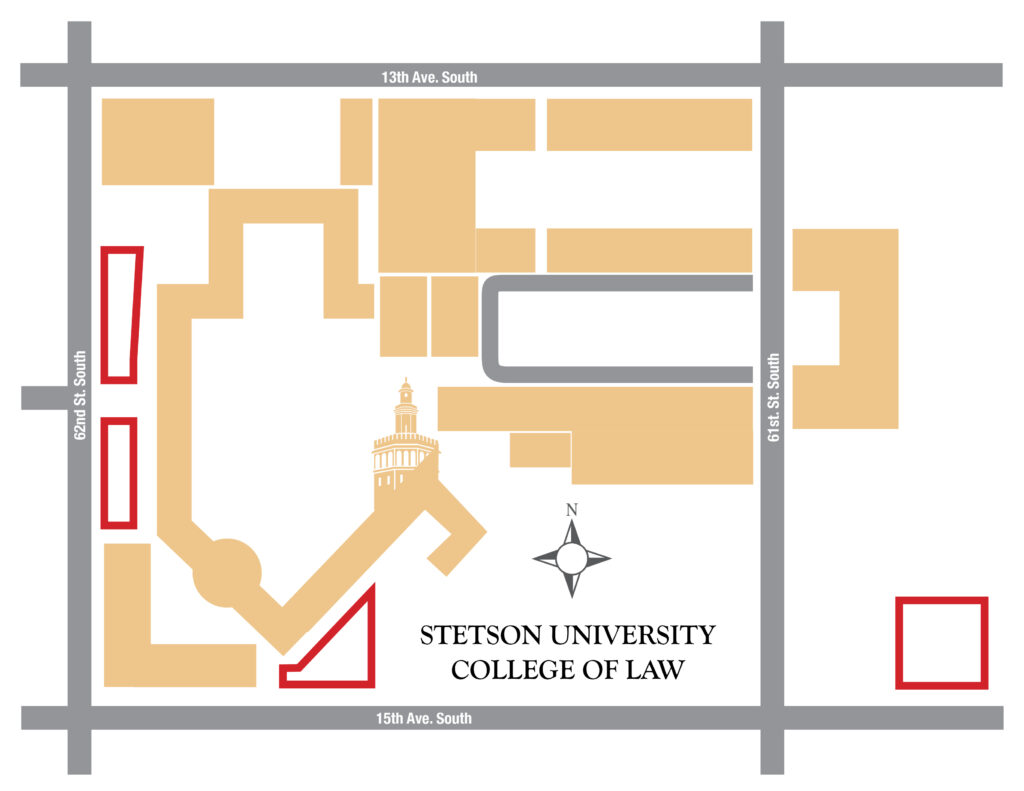
The first phase of the project is located on the south side of campus, across the street from the basketball courts and directly to the east of the walkway leading to the campus pool. Here, tufts of blue iris, muhly grass, cocoplum, and beautyberry dot the soil.
The second phase will overhaul the stormwater retention area south of the Hand Law Library. The third and fourth phases will replace turf grass on the edge of campus east of Plaza Mayor.
When the project is complete, educational signs explaining the benefits of bioswales will be placed near them and continuous monitoring of area water quality will ensue.
The project reflects the College of Law’s commitment to sustainability as well as engaging the community in meaningful dialogue on important issues.
“The campus bioswale project is just one example of how education and community advocacy can work together for a better future,” Lopez said. “In bringing this project about, Noah demonstrated an awe-inspiring amount of attention to detail, work ethic, follow-through and, perhaps most importantly, passion. We’re thrilled to have Noah as part of our team.”
A public education opportunity
Environmental advocates see the project as a way to expose students, faculty, staff, friends, and neighbors to environmentally beneficial ways of maintaining urban green spaces and inspire them to think beyond the way we’ve always done things.
The swales are being installed in four key areas on campus (highlighted above in red).
“We’re excited to support Stetson’s vision to excel beyond the status quo of turf grass on their College of Law campus,” said Jessica Lewis, community projects manager with the Tampa Bay Estuary Program. “Once established, these bioswales will not only prevent nutrient pollution and water waste, they’ll also create a positive impact by restoring native urban habitat and showing students, faculty, and campus neighbors what’s possible in their own backyards.”
Peretz is now planting the seeds to ensure continued student involvement in administering the project after they graduate in May.
“My hope is that, as an alum, I will be able to return to campus and see the long-term fruits of this work, and that over time more of Stetson’s landscape design reflects a little more of that wild Florida beauty,” they said.
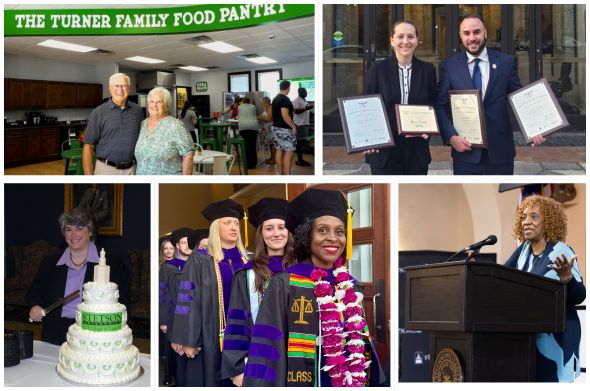
Highlights from 2025 include the dedication of the Turner Food Pantry, student championship wins, amazing speakers, an incredible graduating class, and celebration of the latest inductees to Stetson Law’s prestigious Hall of Fame.
In 2025, the Stetson Law community worked hard, supported one another, earned national recognition, and achieved great milestones. From celebrating the College’s 125 years of exceptional legal scholarship to continuing our forward-thinking approach to the role of artificial intelligence in education and the law, here are 25 major Stetson Law highlights of 2025.
Student grad 2025 4
Hall of Fame 2025 inductees
Palmer Simcox News Preview
Jeff Harvey Fred Karl portrait
Janice Kelsey 2025 News (1)
Morgan Wm Reece Smith 2025
Wildlife Conference 2025 Panel 2
IMG_2060
Padilla Conference Vastine
Immersive Learning Oct 2025 News Preview
Child Advocacy Clinic July 2025 News Preview
Seashells Biodiversity Barnett
Stetson Law celebrated its 125th anniversary. Hundreds came to campus to mark the occasion for the opulent Eras Gala. Festivities will continue throughout the remainder of the 2025-2026 academic year.
Stetson Law welcomed five exceptional individuals into its prestigious Hall of Fame: Dean Darby Dickerson, Professor Peter Lake, Michael Marder ’77, Jeffery Smith ’73, and Ying White ’97.
Alumnus Jeffrey Harvey ’12 helped reinforce the tremendous sense of community Stetson Law enjoys. Harvey honored his mentor, Alumnus and Former Florida Supreme Court Justice Fred Karl ’49 by donating a copy of Karl’s book Python Tales to the Florida Supreme Court Archives and contributing to a scholarship fund designated for veterans attending Stetson Law.
Stetson Law’s signature professional development event, Campus to Career, featured insightful panel discussions, incredible keynotes, and impactful networking sessions. Bonus: during the event, Jonah Perlin recorded a live episode of the How I Lawyer podcast that featured Howard Williams ’12, who talked about his career path. Williams is now president of the Stetson Lawyers Alumni Association. Listen here.
The International Wildlife Conference brought together top animal advocates from around the globe in April. The 29th edition of the International Environmental Moot Court Competition followed immediately on its heels. See full recap.
Faculty, staff and leadership continued to lead the charge on generative artificial intelligence in higher education and within the legal profession and in higher education. The Association of American Law Schools’ Section on Legal Writing, Reasoning, and Research honored Law Professor Kirsten Davis with its 2026 section award for her leadership in this and other areas.
Stetson’s criminal law team stepped up its offerings with a new criminal law concentration, which invites students to sharpen their understanding of the area of practice while still in law school.
Two students dedicated their win at the National Veterans Law Mootto the memory of a dear friend and colleague, Logan T. West, who passed away unexpectedly in 2024 shortly before he was expected to compete in that year’s edition of the competition.
Left to right: Mary Samarkos ’20 and Morgan Zimarakos ’20 of Stetson’s Veterans Law Institute; Vasilios “Billy” Zimarakos ’20
Staff and students with Stetson’s Veterans Law Institute (VLI) and Veterans Advocacy Clinic (VAC) recently ventured to the nearby St. Petersburg College (SPC) Gibbs Campus to help student veterans file disability claims with the U.S. Department of Veterans Affairs. The event was coordinated by SPC’s Institute for Strategic Policy Solutions (ISPS).
The day started with two VAC teaching assistants, Valeriya Gilmutdinova and Dietta Hahn, presenting on the basics of a VA disability claim and how to support a claim for service connection.
Stetson VAC students and volunteer attorneys (all VAC alumni) then met with student veterans from SPC and provided direct legal advice on how to secure VA disability benefits for physical and mental-health injuries or conditions incurred in or otherwise caused by their time in service.
Stetson Law has conducted similar events at the primary Stetson University in DeLand, but this event was the first to take place at SPC. ISPS Executive Director Kimberly Jackson, a 2002 Stetson Law alumna, had asked VLI leadership to partner with the nonprofit on a campus event that supports students who are veterans. VLI staff and leadership were happy to oblige.
“Outreach events are exciting because our students have the opportunity to give back to their community by working one on one with local veterans,” said Veterans Advocacy Clinic Interim Director Morgan Zimarakos. “Many veterans do not require full legal representation but still need to be pointed in the right direction. Outreach events allow us to explain how to file claims, what types of evidence to submit, and how to prepare an appeal so that the veterans we work with are empowered to continue the process on their own. Thanks to Kimberly and ISPS for hosting this important event.”
The Stetson team told each of the veterans with whom they met that they could apply for further Veterans Advocacy Clinic services if they wanted continued assistance with their benefits claims.
Bestselling author Michael Grunwald spoke at Stetson Law in November 2025.
What does the food on your plate have to do with rising sea levels?
As it turns out, says best-selling author Michael Grunwald, quite a bit.
Grunwald, who spoke on the Stetson Law campus November 18 as part of the Edward and Bonnie Foreman Biodiversity Lecture Series, covers environmental policy and politics for The New York Times and other outlets. His most recent book, We Are Eating the Earth: The Race to Fix Our Food System and Save Our Climate, delves into the massive yet untold impacts industrial agriculture is having on the planet – and what we can do about it as individuals and societies.
“It’s a great read – a thought-provoking book about the connections between our food system and climate change,” said Law Professor Royal Gardner, director of Stetson’s Institute for Biodiversity Law & Policy, in his introductory remarks.
Grunwald said that while urban and suburban development cover just one percent of the planet, farmland covers a staggering 40 percent – and consumes more land every day.
“We’re losing a soccer field of forest to agriculture every six seconds,” he said. “Our natural planet is becoming an agricultural planet.”
A compounding problem
When it comes to offsetting the excess carbon emissions that are associated with rising global temperatures, trees are a critical resource for pulling carbon from the atmosphere. The loss of forests, prairies, and other natural landscapes means less carbon dioxide is being pulled from the atmosphere.
Grunwald said trying to decarbonize the planet through renewable energy and other solutions while cutting down trees is like trying to clean your house while smashing the vacuum cleaner to bits.
Much of the land now being used for agriculture grows food for the animals many humans eat. Those animals are also emitting large amounts of greenhouse gases like methane into the air.
Yet a growing human population requires a reliable, productive food system. To achieve sustainable food production for generations to come, Grunwald said, we need to take a hard but honest look at what’s on our plates.
“We’re going to need to make more food with less land and less mess,” he said.
Hard choices, sustainable solutions
The problem appears daunting, but Grunwald sees two obvious starting points: eating less meat and wasting less food.
Meat from mass-scale agricultural operations requires extensive land – including land for growing the animals’ food – and directly produces greenhouse gases like methane. Meat from cows and lambs is particularly taxing on the environment, he said.
Professor Royal Gardner introduced speaker Michael Grunwald.
Meanwhile, we are wasting more than 25 percent of the food we buy, which forces the food system to produce much more than is needed. The average U.S. household wastes more than $2,000 a year on food that will end up in a landfill, where it will emit methane – another powerful greenhouse gas.
“It is insane that we waste at least a quarter of our food,” Grunwald said. “That means we waste a quarter of the land and water and fertilizer that we use to grow it. We use a landmass the size of China to grow garbage.”
At the industrial level, he said, innovators are exploring ways to produce more food with less land. Food companies like Beyond and Impossible have developed meat alternatives from plants that will allow individuals to eat burgers and other foods they love without sacrificing palatability. Composting has become easier and more widespread, which helps reduce the amount of wasted food being shipped off to landfills.
As for individuals, their impact comes from the choices they make at each meal. While everyone going vegan would have a transformative impact on the planet, Grunwald – who said he is not vegan – recognizes the widespread resistance to this lifestyle, given the emotional and cultural associations made with certain foods.
“We all find a level of hypocrisy that we’re comfortable with,” he said. “Perfect isn’t usually on the menu. But better is better than worse.”