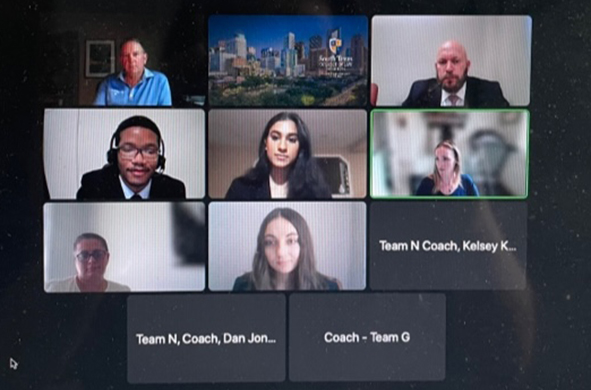
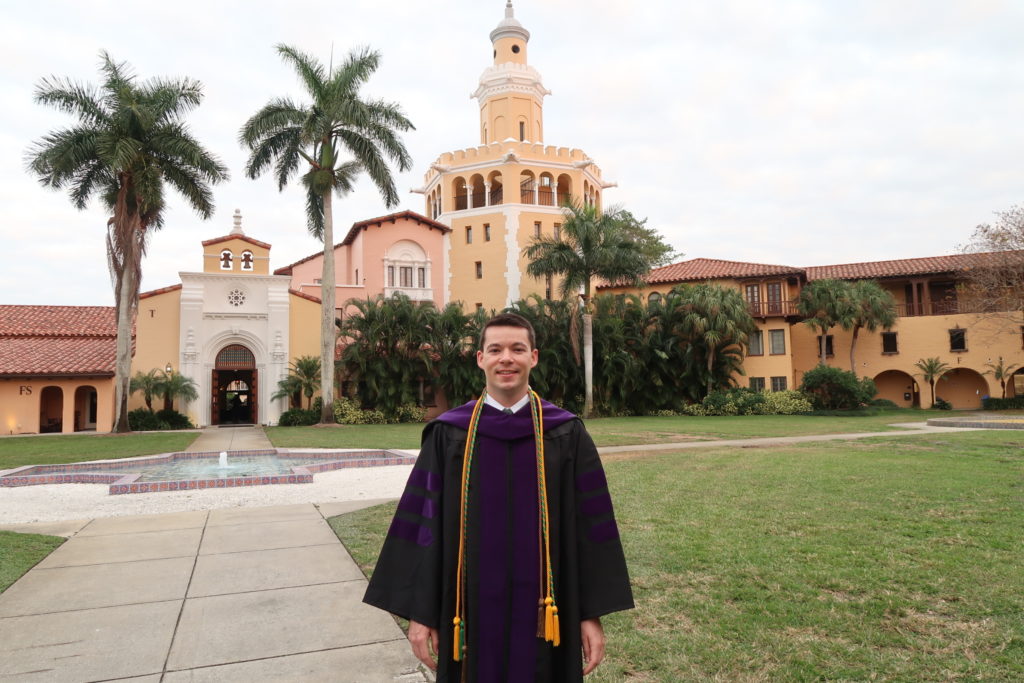
For the first time ever, Stetson Law’s Dispute Resolution Board won South Texas University’s Energy Law Negotiation Competition. The virtual event took place March 25-26 and featured teams from 18 law schools, including University of Texas, University of North Carolina, and Emory University.
Prior to this year’s win, Stetson Law had never before advanced in this competition – let alone won it outright.
Making this victory even more remarkable was the fact that the two competitors from Stetson Law, Andrew Zacherl (3L) and Selina Nadeau (2L), were up against teams from schools that have concentrations in energy law. Nadeau, who has a concentration in environmental law, was competing for the first time.
They went into the final rounds seeded third, having won five of six ballots in the preliminary rounds, and emerged from finals as champions.
Now in its seventh year, the annual Energy Law Negotiation Competition gives participants the opportunity to practice their negotiation skills in a hypothetical setting in Houston, which is often referred to as the energy capital of the United States. The event is judged by oil and gas industry professionals from major law firms and energy companies. In recent years, many of the competition’s top-four spots went to schools from Texas, a state known for its oil and gas industry. In 2019, all four schools that placed were in Texas.
Negotiation facts were given to the 18 teams on February 25, which gave them a month to prepare.
Professor Kristen Adams, who is faculty director of Stetson Law’s Dispute Resolution Board, said the team’s success was “truly historic.”
“This was the culmination of Andrew’s distinguished work on the DR board, and a truly auspicious beginning for Selina, who was competing for Stetson for the first time,” Adams said. “Congratulations, and a special thanks to Coach Bill Greiner.”
From an engineer-turned-real-estate rockstar to a barrier-breaking mayor of a major Florida city, Campus to Career’s first week was packed with compelling insights from Stetson Law alumni. The sessions showcased how these high-profile grads navigated their early careers after graduation – and demonstrated that professional pathways don’t always go in a straight line.
“You don’t really choose…your profession. Sometimes it chooses you.”
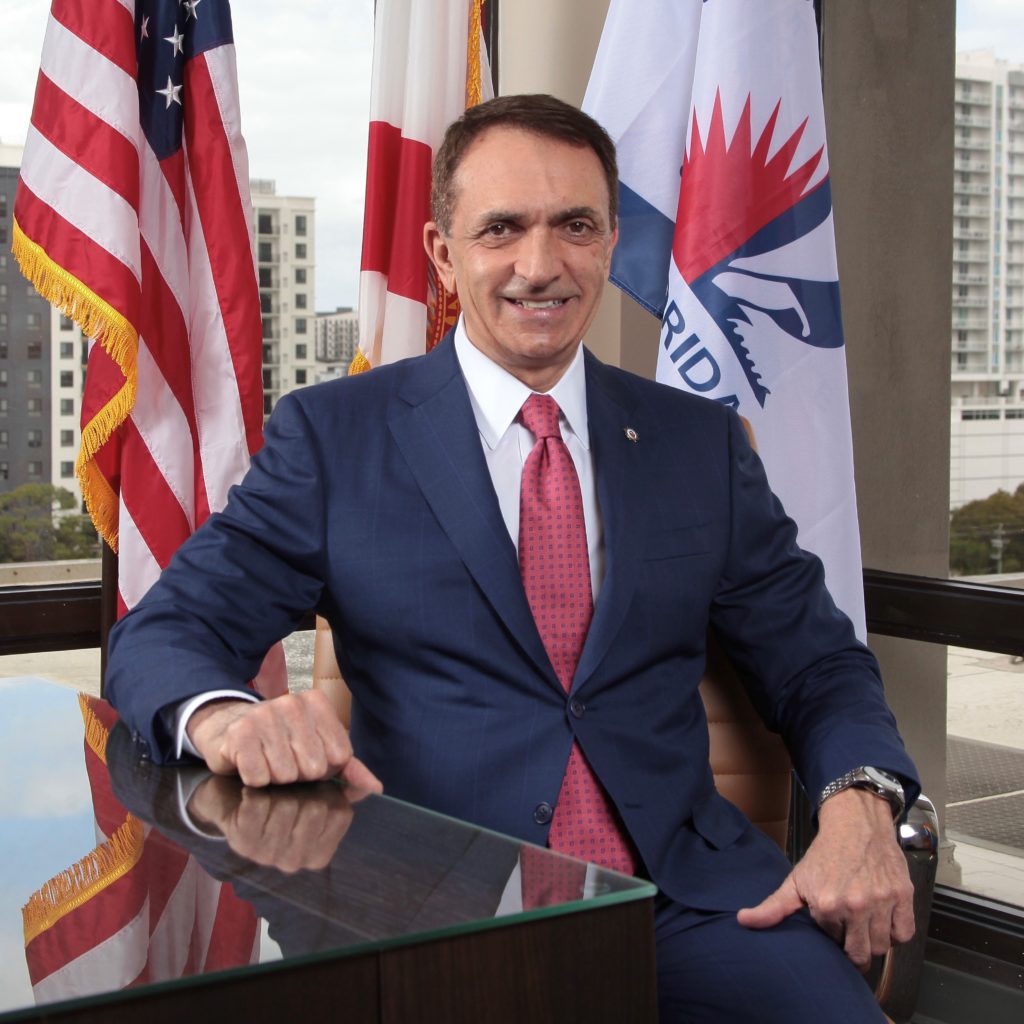
Fort Lauderdale Mayor Dean Trantalis
Here are some highlights from the week’s keynote events.
Fort Lauderdale Mayor Dean Trantalis on Service & Community Involvement
Fort Lauderdale Mayor and Stetson Alumnus Dean Trantalis
Well before fighting homophobia in Broward County in the nineties or being elected Mayor of Fort Lauderdale in 2018, Dean Trantalis was a Boston University student inspired to major in political science by the Vietnam War and Watergate. While he didn’t go to law school right away, advocacy always called to him.
“You don’t really choose…your profession. Sometimes it chooses you,” he said. “And I guess I kind of always knew that I was going to be a lawyer.”
In his Tuesday keynote, the ’79 Stetson Law alumnus talked about fighting for LGBTQ protections in Broward County at a time when even like-minded politicians were afraid to publicly support it – and why, whether you’re advocating in a courtroom or knocking on doors, you need to put the work in.
“The first thing to do when advocating something is to know your subject matter,” he said. “Because if you don’t know your subject matter, people are going to see right through you. Make sure you know your subject matter, and make sure that you own it…And be honest in your advocacy.”
Selling Tampa’s Rena Upshaw-Frazier on Career Pathways
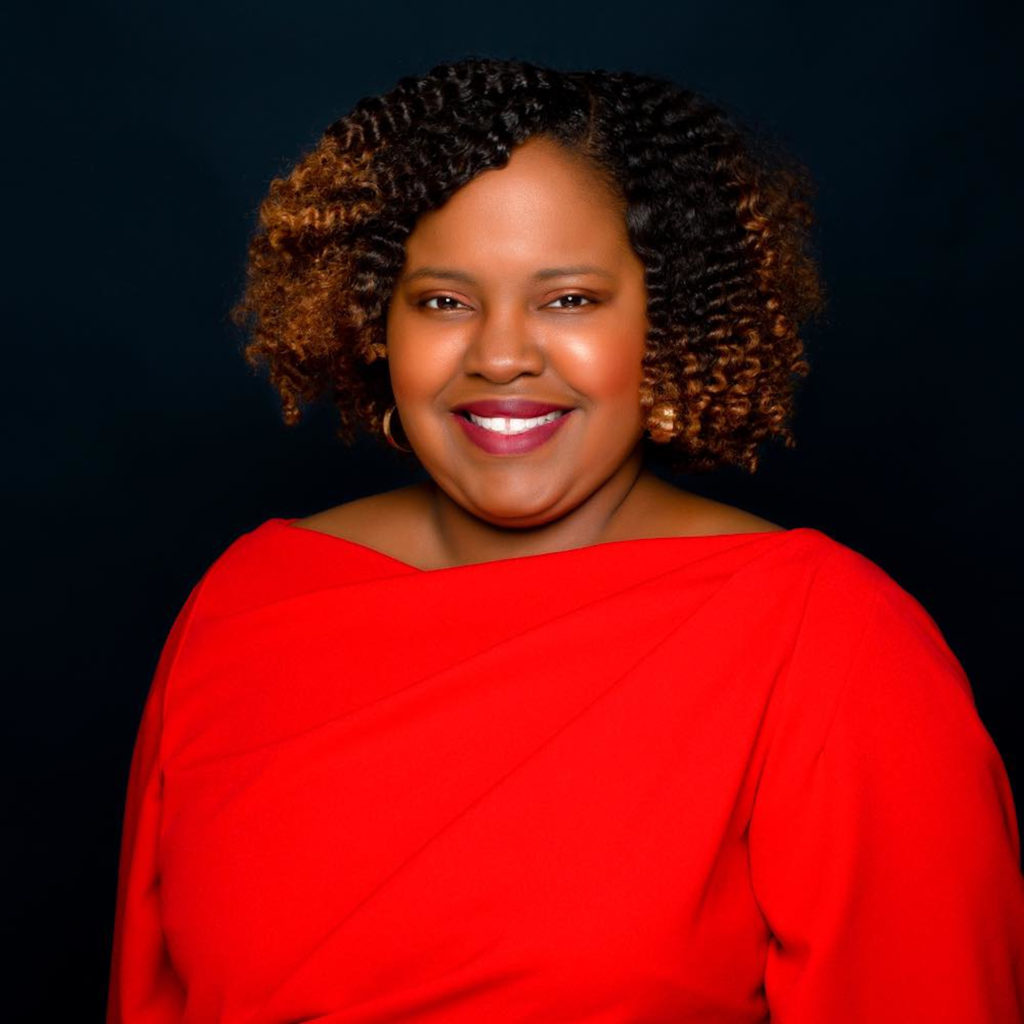
While her career path wasn’t one of absolute certainty, Rena Upshaw-Frazier knew one thing.
“I wanted to do something that was going to make an impact,” she said Wednesday afternoon.
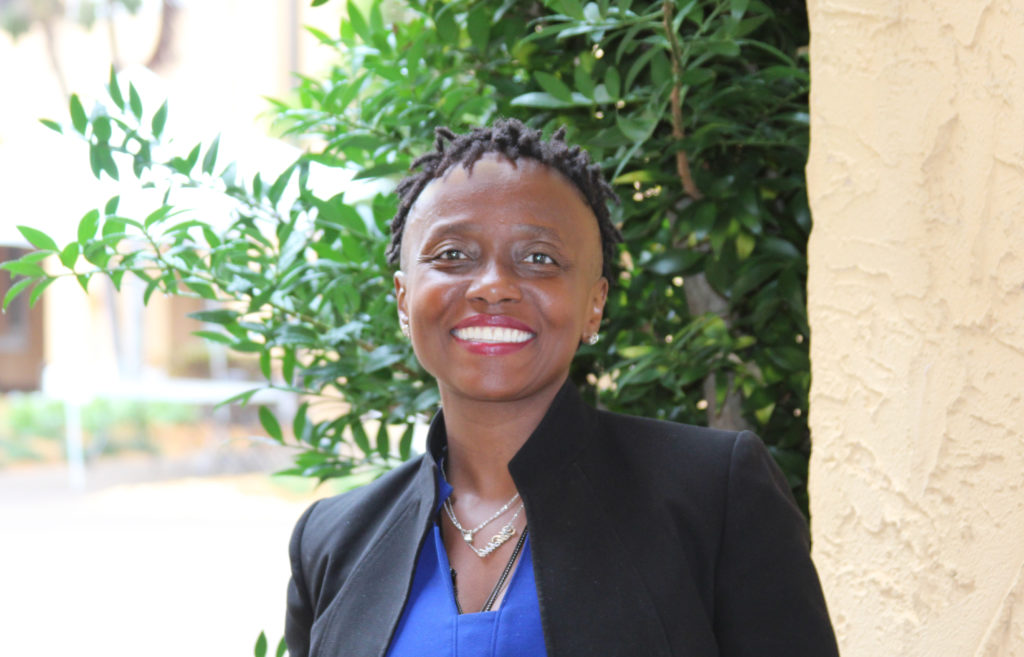
Stetson Law Alumna and Selling Tampa Star Rena Upshaw Frazier
She had wanted to go into environmental science, but her father advised her against it because it wouldn’t be lucrative – so she pursued environmental engineering at University of South Florida. The Tampa native was drawn to the legal work she was exposed to – so she applied to Stetson Law and got in.
“I had a lot of people tell me engineers won’t make good lawyers,” she said. “It actually ended up being the opposite.”
She ended up at a large firm, where she fell in love with real estate while helping a colleague with extra work. It felt like a calling – so much so that she eventually got her real estate license and joined Allure, an all-female Tampa brokerage. A producer from the reality show Selling Sunset reached out to Allure about filming a similar reality show in Tampa. Upshaw-Frazier auditioned for a role and got it – but like leaving law, it was a tough decision.
“You’re just really putting yourself out there and you don’t really have a lot of control over the end product,” she said. “You film the scenes, and it gets chopped up how it gets chopped up.”
Ultimately, she “decided to just go for it and see what happened,” and became a key person on Netflix’s Selling Tampa.
If she could say anything to her law-school self, she would tell herself to take it easy.
“I’d say ‘girl, relax,’” Upshaw-Frazier said. “I would enjoy the journey a lot more.”
When moving into private practice after working with the Hillsborough County Public Defender’s office, Stetson Law alumna Theresa Jean-Pierre Coy said she didn’t realize that having your own practice means that you take on all support roles, from IT person to administrative assistant. She realized this when her cell phone rang, and it was an angry judge on the other end asking why she had missed a hearing.
Coy is now Conviction Unit Supervisor with the Hillsborough County State Attorney’s Office.
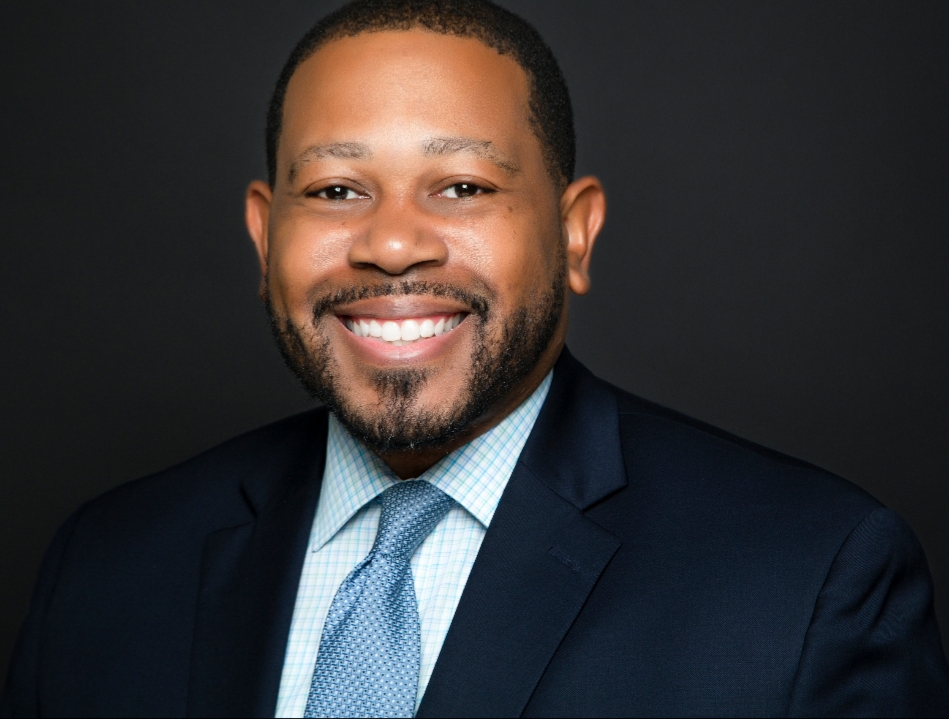
The former George Edgecomb Bar Association President fielded questions Thursday evening alongside her husband, Hillsborough County State Attorney’s Office Juvenile Division Chief Travis Coy, who is also a Stetson Law alum.
The two met at Stetson Law, and throughout their keynote address joked about what it’s like to have a romantic partner who’s also a colleague.
Stetson Law Alumnus Travis Coy
The Coys stressed relationship-building and hard work as keys to success. For example, when studying for the bar exam, Theresa Jean-Pierre Coy said she treated it like a nine-to-five job. Yet while the work is important, she also thinks it’s important to give oneself some breathing room.
“I would tell myself relax a little,” she said when asked what she would tell her younger self.
You’re going to be okay, in fact, you’re going to do better than you ever imagined.”
Travis Coy urged the students who were participating to enjoy life.
“Being a lawyer does not define who you are. First and foremost, you’re a human being,” he said. “Make sure you embrace life and that you cherish the moment and that you’re living in the moment.”
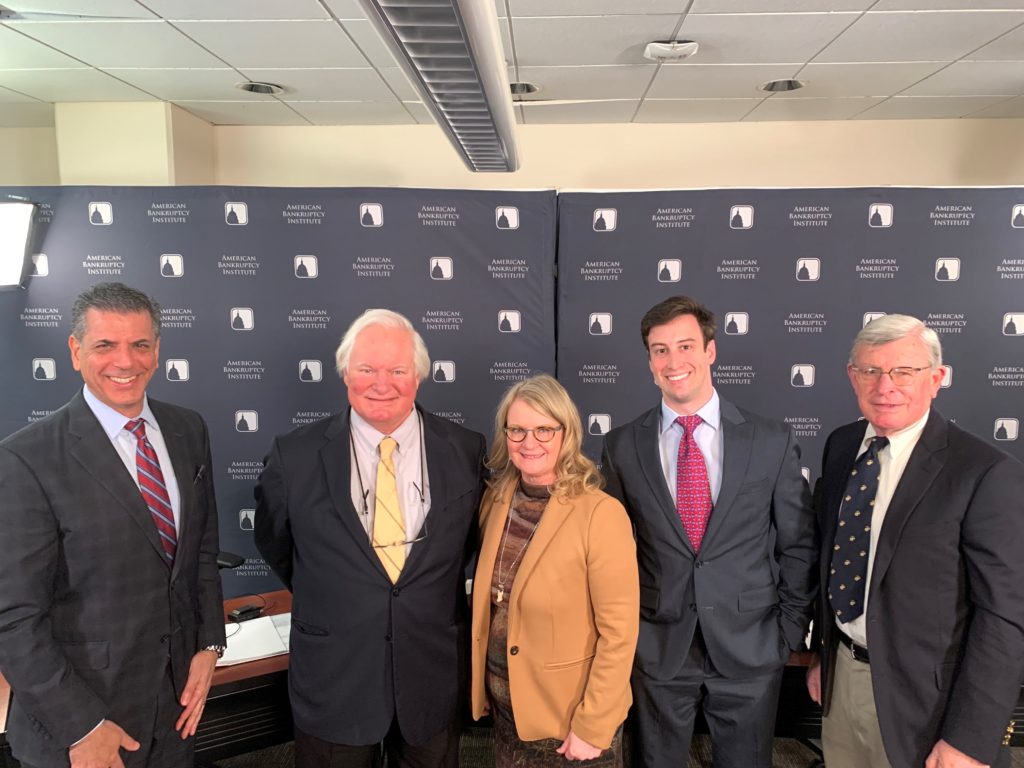
Left to right: Attorney Steven Berman, Judge Michael Williamson, Judge Mary Heston, 3L Cooper “Cade” Zimmerman, and Judge Christopher Klein.
For veterans dealing with serious money woes, it can feel like there’s no way out – especially in the wake of a challenging life event such as divorce.
Financial insolvency has even been identified as a leading cause of veteran suicides. That’s why two Stetson Law students are harnessing what they’ve learned to help members of the military take control of their finances.
The 3L students, Cooper “Cade” Zimmerman and Jade Yeban, worked with Steven Berman, a partner in the Tampa office of Shumaker Law who specializes in bankruptcy law, on an in-depth presentation to train Navy Judge Advocate General (JAG) officers on bankruptcy so they can better advise service members who are facing insolvency and other serious financial problems.
Giving back to those who have served
To the students, it was an invaluable hands-on experience doing work on behalf of those who have served.
Zimmerman said a thorough bankruptcy law course he took at Stetson Law gave him a solid foundation for this project, which he said was one of the best experiences he has had at Stetson.
“I have always held our military in the highest regard – both of my grandfathers were Marines,” he said. “To have a positive impact on anyone’s life is special, but to help those who have the job of protecting the United States and our values is an extraordinary experience.”
How the program got started
While JAG officers have extensive legal training, there are no required curricula related to financial literacy. With the number of veterans experiencing insolvency and its effects on everything from everyday work to obtaining security clearances, Berman saw an opportunity to educate military legal officers on laws relating to consumer finance, bankruptcy, and potential avenues for relief.
“There are lots of options and we wanted legal officers to understand and be able to identify the issues attendant to financial distress and have the tools to refer active duty and veterans in need to competent insolvency professionals,” Berman said.
Appointed to the American Bankruptcy Institute’s Veterans Task Force in December 2020, Berman has worked to establish a pipeline of volunteers with expertise to combat bankruptcy and the far-reaching consequences it can have.
“Financial distress can be emotionally debilitating and also can affect an individual service member’s day-to-day work, especially if someone doesn’t know how to get out of a bad situation,” Berman said. “We saw the need and believe it will be impactful on a likely large unaddressed need in the legal support for our military members.”
A “fantastic” hands-on experience
Recently, Zimmerman and Berman traveled to Washington, DC to support a panel presentation by United States Bankruptcy Judges Mary Heston, Christopher Klein, and Michael Williamson. The discussion was recorded and will be available to Navy JAG officers, as will the supporting written materials. The Army and Navy have also requested the presentation, Berman said.
Zimmerman said the experience left quite an impression on him, and that he hopes to use the knowledge and skills he learned at Stetson Law to help veterans after he graduates.
“During my trip to DC for the live panel, I was able to develop relationships and have in-depth conversations with each about the ins and outs of bankruptcy law and the legal field in general,” he said. “It was truly one of the best experiences I have had at Stetson Law.”
A win-win for students and veterans
Though it’s a complicated area of the law, one that’s not particularly intuitive, Berman said the students worked to create enough written materials to support three to four hours’ worth of programming.
“The students were fantastic,” he said. “They understood the need for the project right away, and were eager to help.”
To Law Professor Theresa Radwan, who coordinates the Business Law Concentration program, the project was an absolute win-win.
“For the students, it helped them deepen their own understanding of the law while knowing that they were helping attorneys help others,” Radwan said. “In addition, they received mentoring from practitioners and judges associated with the project.”
Learn more about the work Stetson Law does for veterans through its Veterans Law Institute.
Stetson University College of Law is thrilled to announce that Chase Wilsey is valedictorian of the Fall 2021 graduating class.
The news comes as his family’s St. Petersburg firm, Fisher & Wilsey, P.A., celebrates its 60th year in operation. While studying at Stetson law, Chase worked at the family firm to gain valuable hands-on experience in real estate transactions, estate-planning, probate, and business law.
In pursuit of his law degree, Chase became one of Stetson law’s first students to complete the new business law concentration program. In addition, Chase earned his MBA degree by participating in Stetson’s dual degree J.D./M.B.A. program offered through Stetson University’s main campus in DeLand, Florida. Prior to law school, he received a B.S. in Business Administration from University of Florida with a major in information systems.
As a 3L at Stetson Law, Chase clerked for the Honorable Edward C. LaRose of the Second District Court of Appeals. Serving nearly six million people in west-central and southwest Florida, the 2nd DCA is one of the busiest courts in the United States. The experience was an opportunity to see judges write and issue opinions in real time – rather than interpreting them in the classroom well after they’re written. Chase even had the opportunity to write the first draft of a now-published opinion.
“Participating in Stetson’s judicial externship program was the perfect way to culminate my law school experience. I would highly recommend it to current and future law students,” he said.
As a 2L, Chase was a Senior Associate on the Stetson Law Review, where he wrote a paper on sovereign immunity, which he said he’d like to turn into a book someday.
As for the classroom experience at Stetson Law, he said Law Professor Dr. Timothy Kaye is among key faculty standouts for him.
“Kaye’s remedies course was the best class I took in law school,” Wilsey said. “Professor Kaye is absolutely brilliant. Stetson is lucky to have him, and I feel extremely privileged to have taken three of his classes.”
Chase continues to work at Fisher & Wilsey, which was cofounded by his grandfather, George Wilsey, in 1962. His father, David Wilsey, is a Stetson Law alum (J.D. ’86), as is his sister, Abby Wilsey (J.D. ’20). Chase’s father and his uncle, Steven Wilsey, are the firm’s principals. His grandfather, George, is retired but remains in an advisory role even at 92 years of age!
With a competitive spirit and a knack for understanding what it takes to do well in law school, Chase likens his approach to success at Stetson Law to running an ultramarathon.
“Law school is a massive challenge and super long grind. I wasn’t going to leave anything on the table,” he said. “You only go to law school once, and I made a pact with myself to make the absolute most of the opportunity.”
When learning how to navigate the transition between law school and professional life, the best teachers are those who transformed their Stetson Law education into exciting careers.
That’s why Campus to Career 2022, also known as Stetson Law’s Professional Development Conference, should pique the interest of any 1L, 2L or 3L. Spanning from March 22 through April 14, it features virtual workshops, breakout sessions, networking opportunities, and more. The event kicks off with keynote addresses from some of Stetson Law’s most high-profile alumni, including Fort Lauderdale Mayor Dean Trantalis and Rena Upshaw-Frazier, star of the Netflix series Selling Tampa.
Organizers and speakers alike say they look forward to showing students what it looks like to successfully go from life as a law student to the day-to-day rigors (and, frankly, challenges) of a career that will likely look a lot different from days spent immersed in learning.
“I’m excited to return (virtually) to Stetson Law to participate in this year’s Campus to Career Conference,” said Mayor Trantalis, who is also Fort Lauderdale’s first openly gay mayor.
What to expect
Trantalis’s hour-long keynote launches the event Tuesday, March 22 at 11:45 a.m. Service will be the theme of his speech.
Fort Lauderdale Mayor and Stetson Law alum Dean Trantalis
“During my time at Stetson, I became equipped with many of the necessary skills needed to successfully achieve a career in law,” Trantalis said. “Today, as the founder of my own firm and the two-term mayor of the city of Fort Lauderdale, there’s much more that I’ve learned since my graduation that I look forward to sharing with my fellow soon-to-be alumni.”
Over the course of the event, students can gain insights from Stetson Law faculty, staff, alumni, and other community members on how to cultivate a host of competencies that will help them build and sustain their careers – whether or not they choose to become legal practitioners. This includes demonstrating resilience (handling setbacks), cultural humility (understanding the value of diversity, equity, and inclusion), time management (how not to over-extend), professional identity (social media dos and don’ts), and wellness (managing stress).
A series of career community panels will also give students critical insights into what it is like to practice criminal, elder, and other types of law from professionals who operate in those spaces every day.
A ”springboard” to success
In past years, the Campus to Career has been so meaningful, it has inspired students to help organize it.
“Looking back, Campus to Career was the 1L springboard that has led me into my final semester,” said 3L Joseph Kim, co-chair of the 2022 Campus to Career Conference. “As someone who continues to incorporate the knowledge they gained attending as a 1L and serving as a 2L Student Fellow, I highly encourage you to attend this year’s conference.”
Attendees who meet certain criteria will be eligible for a host of fun door prizes, from Target gift cards to a reserved parking spot for the 2022 Fall semester.
For more information, including schedules, speaker bios, and door prize eligibility, See the Campus to Career program guide.
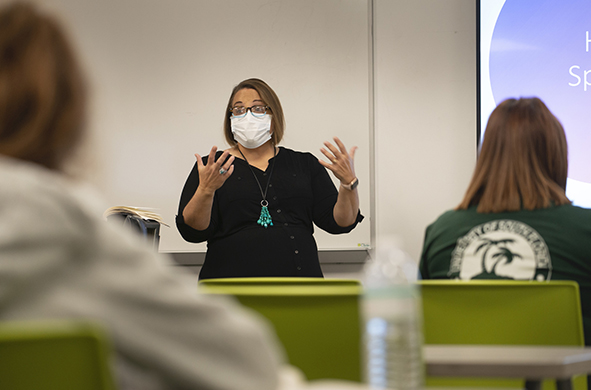
Professor Kirsten Davis speaks to USF St. Pete undergraduate students.
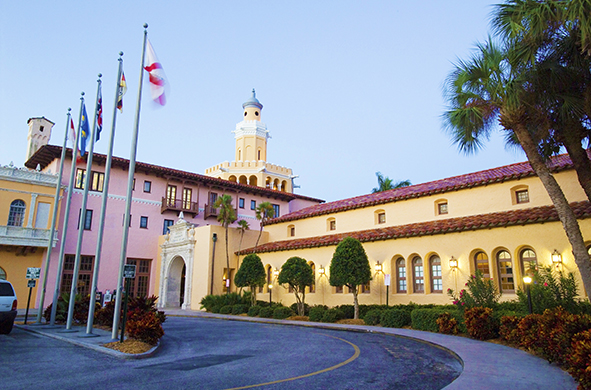
Stetson Law and University of South Florida St. Petersburg have some things in common: revered faculty, beautiful grounds, and a vibrant learning environment. Now, something else connects the two: a new partnership that has brought Stetson Law faculty to the USF St. Pete campus to teach law.
At the helm of the inaugural course is Stetson Law Professor Dr.Kirsten Davis, who was selected for the role by Stetson Law Dean Michèle Alexandre. The course, “Text, Tweet, Take to the Street: Dissent and the First Amendment,” aims to explore dissent and how it relates to free speech. Students learn about landmark cases involving the First Amendment, what types of speech are protected and what are not, and how decades-old precedents still apply in the digital age.
“In all areas of life, we are dealing with what dissent looks like. We see it on television, in our neighborhoods, on Twitter and Facebook,” said Davis, the inaugural Judy Genshaft Honors College Visiting Professor of Law. “For any citizen, understanding how the First Amendment fits with that discourse is really important.”
Creatively adapted for undergraduates
Davis, who is Director of Stetson Law’s Institute for the Advancement of Legal Communication, finds creative ways to teach First Amendment law to a lay audience. The class incorporates puzzles and art sessions that help non-law students more easily grasp often-complex legal language and processes.
“I’ve taken what I know about teaching law school and adapted it for what I hope is a fun and interesting course for outstanding undergraduate students, no matter their major,” she said. “I think our favorite in-class activity has been making art as a way to review key concepts of the course.”
She is planning to bring her colleague, William Reece Smith, Jr. Distinguished Professor of Law Kristen Adams, to the classroom for a session that connects law and poetry.
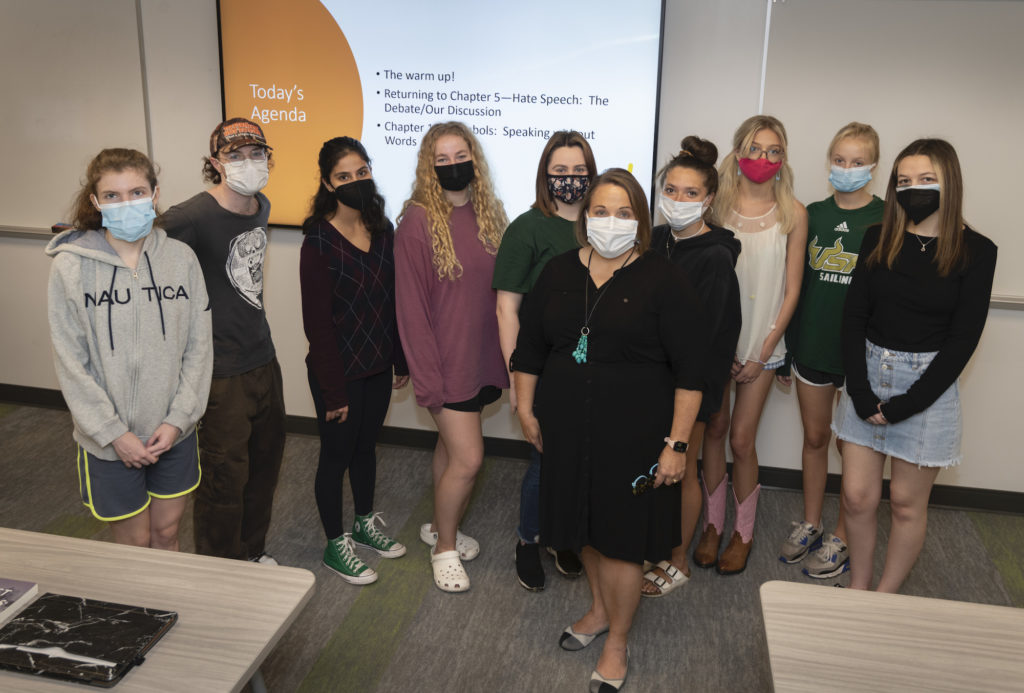
Stetson Law Professor Kirsten Davis is surrounded by undergraduate students from the course she teaches at USF St. Pete.
In addition to bringing together students from all majors, from biology to political science, the course can help them decide if law school is right for them.
“The class will help students decide whether or not they want to attend law school. Even if it’s not for them, now they’ll know,” said Thomas Smith, USF’s associate dean of the Judy Genshaft Honors College and a professor of political science.
The experience has strengthened USF St. Pete junior Alivia Kelly’s resolve to attend law school – at Stetson, in particular. The psychology major has enjoyed studying psychological concepts’ role in shaping First Amendment law.
“I am definitely looking at Stetson for law school,” she said. “I have experienced firsthand being a disabled woman in the U.S., and my identity motivates my interests. I would love to explore the complexities of law across cultures and mediums that have never been fully integrated into the legal sphere before.”
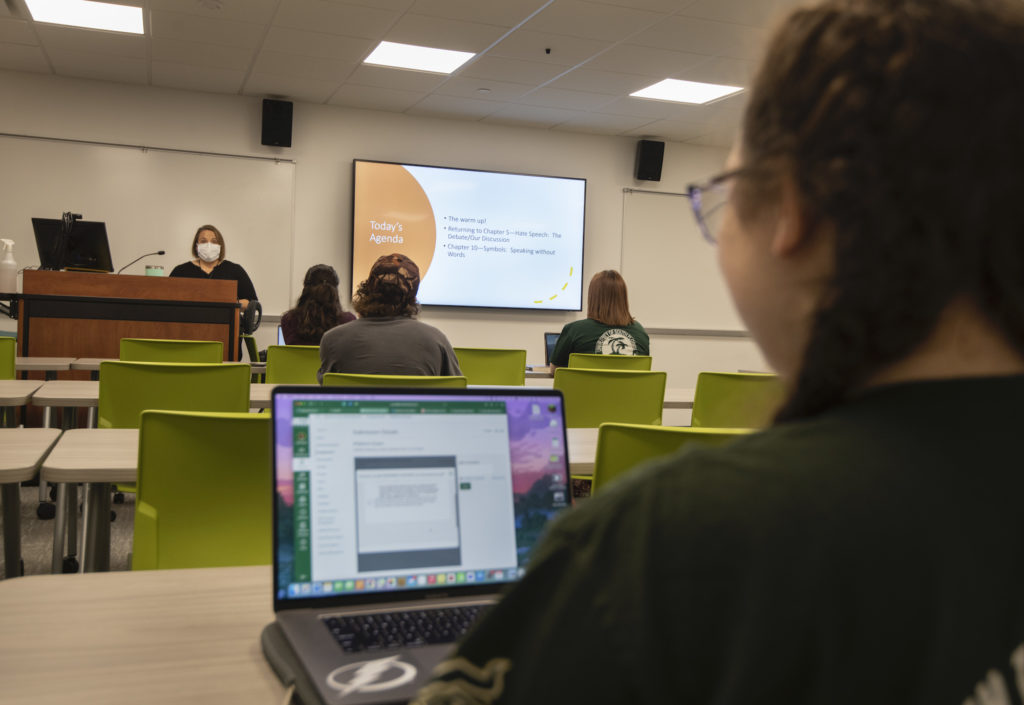
Stetson Law Professor Kirsten Davis speaks to a classroom at USF St. Pete.
A multifaceted partnership
The USF-Stetson Law partnership also includes a course taught to environmental science majors by Stetson Law Foreman Biodiversity Fellow Katherine Platt and Stetson Law 3L Lauren Beames.
The program allows environmental law students to earn credit through teaching such courses at USF St. Pete. Law students and fellows like Pratt collaborate on curriculum suited to their classes.
“This is really a great immersion experience,” Pratt said. “There really is no better way to understand a concept than to teach it to someone else.”
As part of the Stetson Law-USF St. Pete agreement, undergraduate honors students can start their first year of law school while enrolled in their final undergraduate year. There is also a direct-admission program for students whose GPA and LSAT scores meet a certain standard, which guarantees admission to Stetson Law as well as access to scholarship funds.
Even in her earliest memories, Hannah Raissa Ibañez, J.D. ’16, was always passionate about standing up for others.
It is what drove her to pursue legal education, work in the Pinellas County Public Defender’s Office, advocate for the homeless in Los Angeles and, recently, join the White House’s Architectural and Transportation Barriers Compliance Board thanks to a presidential nomination.
“I remember always being really fired up,” she said. “I could always sense when there was a power dynamic that was unfair. I think I always felt like a fighter, and I’ve always identified as a defender.”
Born in Belfast, Northern Ireland, Hannah Ibañez moved to Miami with her family as a young child and attended Simmons University in Boston, where, as an undergraduate, she majored in philosophy and political science with a minor in women’s and gender studies.
“There was just something about knowing how to run a courtroom and operating in that space that called to me.”
“The sharp edge of litigation”
Upon graduating, she said, law school was calling. As she toured campuses, including Harvard, Duke, and Brooklyn Law School, it was Stetson Law that really stood out to her.
Why?
She saw the Trial Team in action, and the confidence the fledgling lawyers exuded as they argued their cases to the real-world courtroom experience it gave students, what she witnessed thoroughly impressed her.
“I was absolutely sold,” she said. “There was just something about knowing how to run a courtroom and operating in that space that called to me.”
An experiential learner, she said she knew she wanted to be at the “sharp end of litigation.”
“It felt more real; it felt like an education that would stick with me and mold me,” she added.
The experience remains valuable to her to this day, whether it is instinctively standing the instant the judge walks into the courtroom or understanding the subtle cues that can influence the outcome of a day in court.
Active from the outset
Once she enrolled in Stetson Law’s J.D. program with a Social Justice Advocacy Concentration, faculty members who interacted with her recognized her passion and her drive from her early days on campus forward.
“Ms. Ibañez was in Stetson’s Honors Program, a program that allows top students to engage in individualized scholarship that will be helpful to them in later years,” said Professor Ellen Podgor. “From her initial classroom comments in criminal law to this later class it was clear she would excel in social justice advocacy.”
She held leadership positions in the National Organization for Women, in which she helped to organize a performance of The Vagina Monologues and was also active in the Lambda Legal Society. She completed two directed research projects as a student in the Social Justice Advocacy Concentration. One, which was centered on homelessness, included an innovative combination of a survey instrument and traditional scholarship that culminated in a thoughtful multi-media presentation. The other focused on motions and other materials attorneys could use to represent transgender clients in criminal cases. Through her participation in the Homeless Advocacy Externship, she demonstrated a deep commitment to advocacy on behalf of persons experiencing homelessness.
“Hannah brought such joy and power to all of her work and was a valuable mentor to her peers – something we witnessed more than once,” said Professor Ann Piccard.
Advocating for the underserved
She brought that joy and power to the pro bono clinic she enrolled in with the Pinellas County Public Defender’s Office, where she was offered a job upon graduation. The work was as heartbreaking as it was rewarding.
“It was absolutely amazing and horrifying at the same time,” she said. “There’s never a dull day.”
While working in the public defender’s office, she noticed how students participating in its clinic wanted to stay on after it ended, so she established an additional pro bono program that allows them to do so.
Clients the office took on were often homeless, mentally ill, or some combination thereof, which really hit home for Ibañez the need to focus on the root causes that can lead to a lifetime of legal challenges for so many. The lack of stable, affordable housing is a key factor, she said, which is why her current role as senior staff attorney on the Tenant Defense Project for Inner City LawCenter, a Los Angeles-based nonprofit providing legal services to the city’s most vulnerable residents at no charge. Here, she defends low-income tenants and families, people with disabilities, veterans facing homelessness, people living with HIV/AIDS, immigrants, and others.
An “unbelievable” opportunity
The organization does plenty of policy work as well, which is how she got connected to the U.S. Access Board; a colleague had forwarded her information to a member of U.S. Congress who was tasked with providing recommendations to fill federal vacancies. After an 18-month process involving interviews and other steps, she was on the shortlist – and elated to be there.
“I find it unbelievable,” she said.
The board aims to ensure all federal facilities comply with the Americans with Disabilities Act, such as buildings, vehicles, and telecommunications equipment. Currently, they meet several times a year for three-day sessions.
Ibañez said she hopes her story conveys to students aspiring to fight on behalf of the most vulnerable among us that they can find a pathway to effectively doing so at Stetson Law, where the community will welcome their passion for making a difference through advocacy.
Many Stetson Law alumni probably remember Professor Peter Lake as their torts teacher. Over the decades, though, his expertise in higher education law has put him at the helm of one of the most important conferences for professionals working at colleges and universities.
In March of 2022, the 43rd Annual National Conference on Law & Higher Education very much felt like a homecoming. The event took place at the Wyndham Grand Clearwater Beach. The weather was glorious, and attendees were reconnecting with one another after years of not being able to meet in person due to the pandemic. The event’s 2020 edition, in fact, was held just days before travel was shut down worldwide in efforts to stop the spread of Covid-19. Nearly 200 people, including students and speakers, attended.
“I believe that the people in this room are the people that are going to be the change agents.”
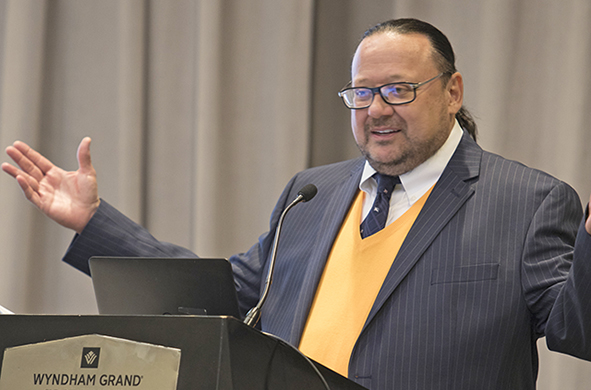
Stetson Law Professor Peter Lake
“To me this is a huge family reunion,” Lake, who is the Charles A. Dana Chair and Director of the Center for Excellence in Higher Education Law & Policy at Stetson Law, said in his opening remarks. “I can’t tell you how thrilled my staff and I are to come back and host you.”
Preparing for the “edupocalypse”
Naturally, the pandemic and other current events that directly affect higher education were at the center of conversation at the event, which ran from March 2-March 7, from campus safety and student mental health to diversity, equity, and inclusion efforts.
In talking about the higher education’s economic, political, and cultural challenges, Lake referred to the current state of affairs as the “edupocalypse,” telling those gathered that this is a unique, transformative point in time for higher ed. It’s a time when educators’ role as “keepers of the flame of truth” is being challenged thanks to the media climate, he said, when litigation has arisen in the wake of Covid-19 mitigation policies, and higher education is being criticized for everything from diversity efforts to rising tuition costs. In the face of these challenges, Lake said he is optimistic that higher education leaders like those in the room will succeed in overcoming them.
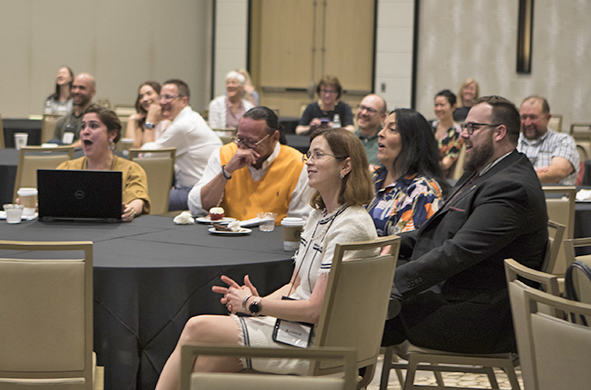
Law Professors Peter Lake and Kristen Adams were among the amused audience members during a Saturday Keynote at the 43rd Annual Law & Higher Ed Conference.
“I believe in this industry and I believe that we will meet whatever challenges come ahead,” he said. “I believe that the people in this room are the people that are going to be the change agents.”
A gathering of thought leaders
Attendees comprised a mix of industry professionals from a broad range of university departments, including public safety, Title IX, student affairs, university leadership, and, of course, legal professionals. Among keynote speakers were author Jules Coleman, whose talk was titled “The Uncertain Future of Higher Education is Here Now” (Coleman was also the 2022 William Reece Smith Distinguished Lecturer at Stetson Law’s Annual Inns of Court Event in February) and John Dunkle, senior advisor at the Jed Foundation, whose presentation was titled “College Student Mental Health: The Need for Bold Action to Unravel a ‘Gordian Knot’ for Higher Education.”
As in previous years, the gathering aimed to bring together thought leaders with the aim of developing policies to ensure success for colleges and universities. Sometimes, conversations that have taken place at the event have led directly to federal law reform. The theme in 2022 was “The Great Strategic Reclamation of Higher Education.”
“It is our mission to enhance higher education, to make our institutions stronger and most importantly, to make sure that we’re educating students in as powerful a way as possible,” said Stetson University Provost Noel Painter, whose remarks kicked off the event. “This conference and Peter’s leadership of this conference is exactly aligned with the mission of this institution.”
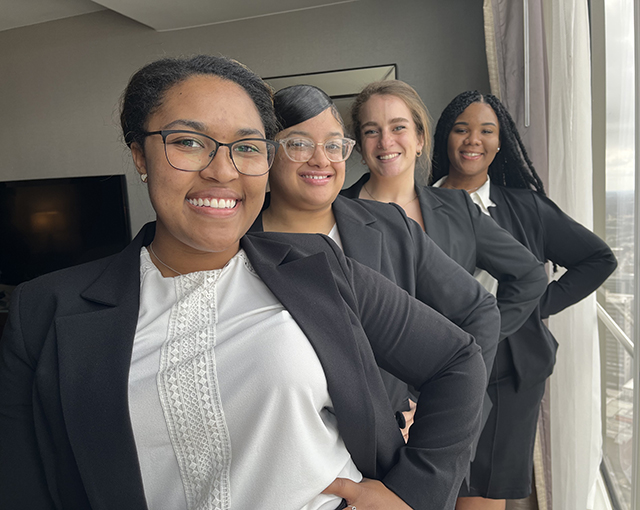
Members of Stetson’s Black Law Students Association, from left to right: Andrea Waters, Alyssa Fleming, Tala El-Ghali and Logan Jackson
Late February brought yet another successful competition to Stetson Law’s talented roster of student advocates.
The Stetson Black Law Students Association Trial Team made it all the way to the quarterfinals at the Constance Baker Motley Trial Team Competition. The competition took place at the Southern Regional Black Law Students Association (SRBLSA) Convention in Atlanta, GA, from February 24-27, 2022.
The team consisted of four Stetson BLSA members: Logan Jackson (2L), Andrea Waters (2L), Alyssa Flemming (3L), and Tala El-Ghali (3L). The BLSA team was put together by BLSA President Deja Gordon and coached by Stetson BLSA alumni Willengy Ramos (’14) and Forest Sutton (’20).
“Being President of Stetson’s BLSA at the first in-person SRBLSA convention in two years was monumental,” Gordon said.
Gordon added that it was an honor to assemble the team of advocates, who worked diligently ahead of the event.
Stetson BALSA’s visibility and involvement went beyond going far in this important competition.
At the conclusion of the competition and accompanying convention, Gordon was able to nominate two BLSA students to the Southern Regional BLSA Board: Logan Jackson as secretary and Blake Radford as treasurer.
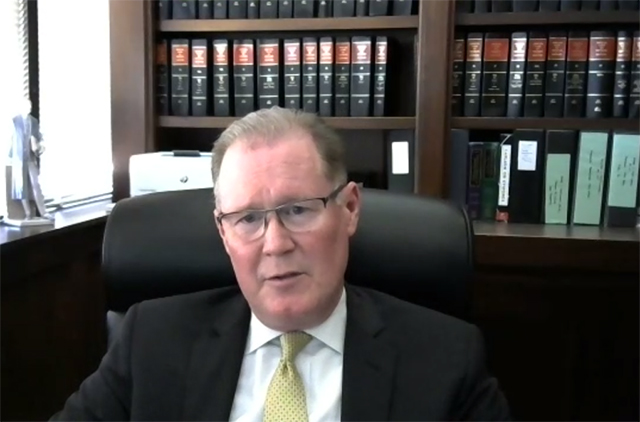
In a reflective keynote address he delivered as part of the Stetson Law Student Bar Association’s Diversity Week events, Judge Timothy Walmsley spoke about diversity’s transformative role in the criminal justice system – and what it means to be a neighbor in 2022.
Walmsley serves as a Superior Court Judge in Chatham County, Georgia, where, in the Savannah community, he “is regarded as a thoughtful and caring leader and friend,” said Stetson Law Professor Elizabeth Berenguer, who introduced him to the virtual audience.
Stetson Law Professor Elizabeth Berenguer
Beyond his community, he is best known for presiding over the murder trial of the men who killed Ahmaud Arbery in 2020. In keeping with this year’s Diversity Week theme, “This is U.S.,” Walmsley spoke about diversity within the legal profession and how social justice informs his reasoning in cases like that of Arbery’s killers.
In preparing to speak Wednesday, he said he reviewed numbers featured in a 2020 American Bar Association model diversity study that examined legal entities’ diversity initiatives, hiring practices, attrition, promotions, and more. While the statistics showed notable growth in the diversity within the Bar’s makeup over time, the diversity tends to bottleneck as one looks further up the chain of command at legal practices.
“Why that is occurring is a difficult question to answer,” Walmsley said.
“Conversations that need to continue”
Though he did not speak directly on his verdict in the Arbery case, he reflected on what it was like to preside over a high-profile case involving racial justice during a global pandemic. The case was outside his district, but he was appointed to it when all the judges in Glenn County, where the crime took place, had to recuse. One of the defendants, Gregory McMichael, was chief investigator with the District Attorney’s Office there, and was well known among the judges.
“It was a high-profile case at a time when there had been a number of other high-profile cases that had been in the American conscience.”
Judge Timothy Walmsley
The case moved slowly, he said, because of Covid-19-related restrictions as well as the fact that he took it on while maintaining a full schedule in his own courtroom. He called for the courtroom to be open to the media. There were days when protesters demonstrated outside the courthouse and days when the likes of Reverend Jesse Jackson and Reverend Al Sharpton sat in on the proceedings.
Ultimately, he said he thinks it contributed to a bigger conversation about American justice.
“We learned a lot out of the Arbery case,” Walmsley said. “It was a high-profile case at a time when there had been a number of other high-profile cases that had been in the American conscience: George Floyd, Breonna Taylor, even the Rittenhouse case. All of those cases…along with the Arbery case, I think have opened up very positive discussions about the justice system, about how it operates, who’s operating it, and I think those are conversations that need to continue.”
What it means to be a neighbor
At the sentencing hearing for the defendants, Walmsley made headlines for remarking that the case “should force us to consider expanding our definition of what a neighbor may be and how we treat them.” His comments were based on comments of another Southern judge, and that he knew that during the hearing, his time to speak would be limited.
“I spent a great deal of time thinking through the sentence, and more importantly…because of the nature of the case itself, I really wanted to make sure that the public and the litigants understood my sentence. Judges don’t really have many opportunities to really speak their mind on certain subjects,” he said. “I stand by those comments.”
On the broader subject of fairness in the criminal justice system, Walmsley said there is a lot of work that needs to be done.
“A topic that we need to address policing and profiling. There’s been a great deal of discussion on policing in particular, and I think that discussion needs to continue,” he said. “We need to understand that there are real issues in policing, but there are also individuals out there that are working hard within the police departments to do things right.”
“You may feel like you’re not getting traction, but you are.”
Judge Timothy Walmsley
As a judge, he added, his ability to issue sentences he views as fair is limited by factors such as the Drug War, mandatory minimums, and the jury selection process.
“We are challenged with a lot of problems when it comes to misdemeanors and petty crimes and how the accumulation of misdemeanor arrests and enforcement ultimately leads into my court, which is the Superior Court, where we deal with felonies,” he said.
Imparting optimism about the future
During the question-and answer session that followed, the judge was asked about what can appear to be slow progress when it comes to diversity and inclusion within the legal system. Walmsley assured his audience that the answer is never to give up.
“Nothing happens in the legal profession quickly,” he said. “You may feel like you’re not getting traction, but you are.”
Dean Michèle Alexandre
The broad-ranging conversation took place during a week full of discussions about bias, discrimination, and other barriers to diversity in the legal system and society. Now more than ever, organizers say, transcending differences is critical.
“In order to do business, in order to do anything in our society, we need to at the very least attempt to understand one another,” said Stetson College of Law Dean Michèle Alexandre, whose remarks kicked off the event. “The pursuit of knowledge, including our timely conversation today, is key not only for individual growth, but as professionals. It is essential for our ability to serve each other.”
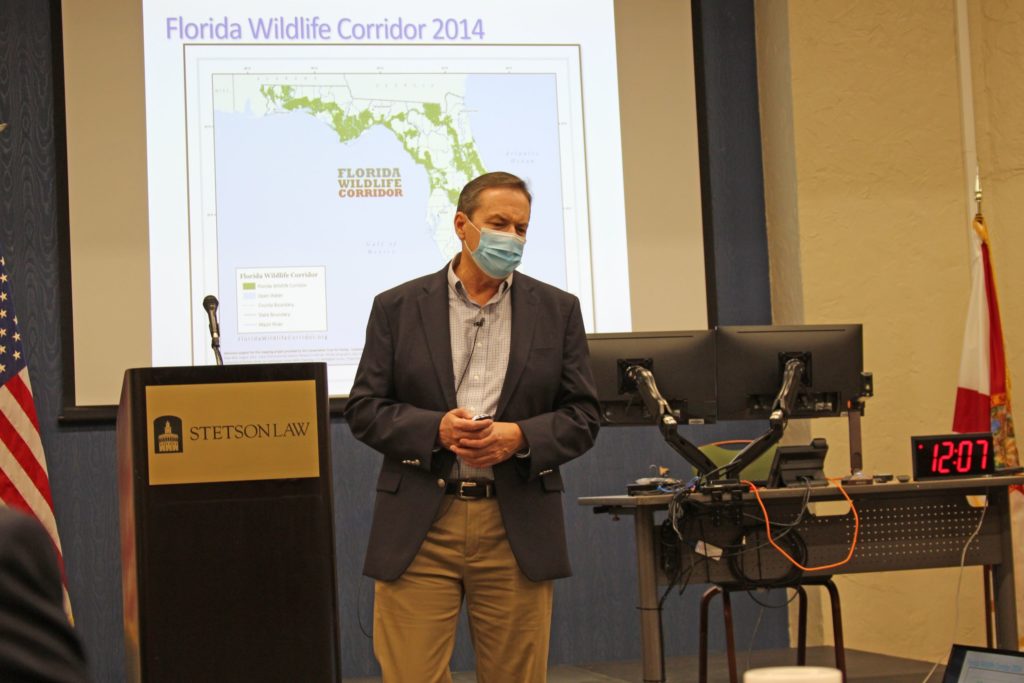
Keith Fountain, a premier expert in Florida conservation easements.
With urban sprawl covering so much of Florida’s landscape, it can be easy to forget that farming and ranching were once the state’s biggest industries. Yet even with widespread building on open land, there’s still quite a lot of undeveloped land dedicated to farming, ranching and timber in the Sunshine State.
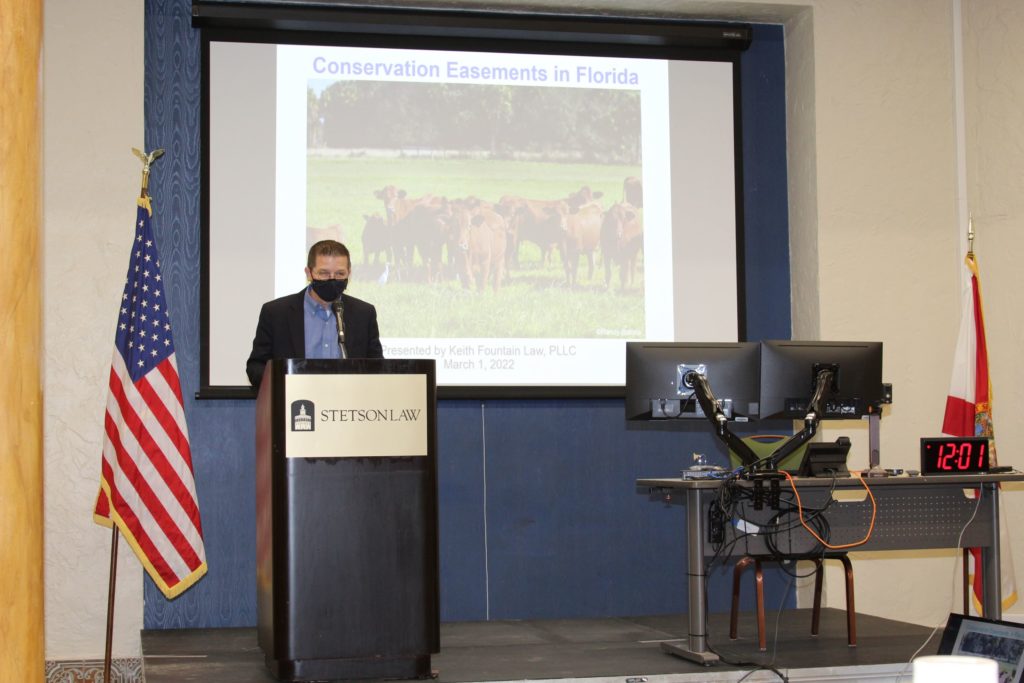
Attorney Keith Fountain, who spoke as part of Stetson Law’s Edward and Bonnie Foreman Biodiversity Lecture Series on March 1, has been helping protect what remains of these lands through transactions called conservation easements for nearly 30 years.
Professor Royal Gardner
Professor Royal Gardner, director of Stetson Law’s Institute for Biodiversity Law and Policy, said Fountain is “the expert” in conservation easements in Florida. Fountain also helped facilitate discussions that ultimately resulted in the establishment of the Everglades Headwaters National Wildlife Refuge and led preservation and restoration efforts at the site.
Preserving land through easements
So far, Fountain has worked on 4,300 transactions related to such deals, totaling over $800 million.
That may be a lot of money, but the land’s actual value can be substantially greater, he said, given how they can be the key to ensuring Florida’s most important watersheds and other open lands remain as contiguous and intact as possible.
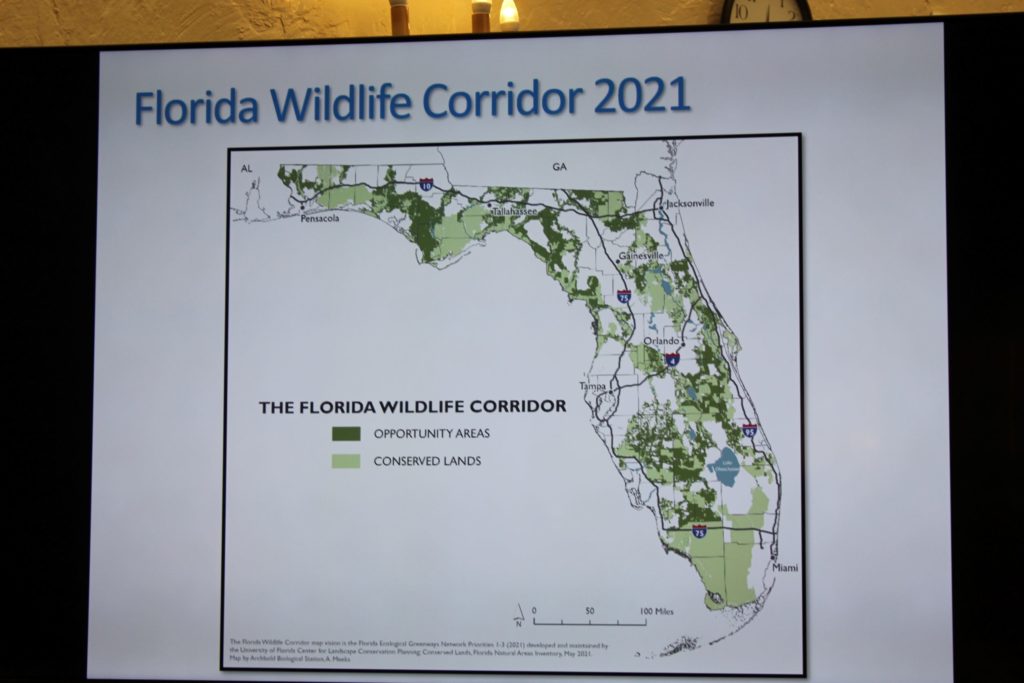
It’s important to protect critical watersheds in areas like those that make up the Florida Wildlife Corridor – for wildlife conservation as well as protecting the water resources Floridians rely on.
“Many of those lands contain very important environmental attributes,” Fountain said.
A small piece of the puzzle
While conservation lands managed by federal, state, and local authorities cover nearly 11 million acres in Florida, easements are a lot less common. Of Florida’s 34.7 million acres, just 915,000 of them are protected via conservation easements, which are set up through the Rural and Family Lands Protection Program and other methods.
Much of this land is concentrated in Central Florida, where cattle ranchlands still cover the landscape, and the Panhandle, an area where timber is a historically important industry.
Fountain gave a detailed overview of the types of easements available, how their terms can be enforced through courts, some of their limitations, and their place within the context of broader land conservation programs such as Florida Forever and Amendment 1, a land-buying measure on Florida’s ballot in 2014 approved by 75 percent of Florida voters. Funds like those offered through the two latter programs have been subject to the will of lawmakers potentially at odds with their cost to taxpayers or the limits they may place on certain industries.
A map of the Florida Wildlife Corridor
Conservation easements, on the other hand, aren’t as directly affected by politics. Instead, they’re an agreement between a property owner and the organization that is procuring the easement, which is typically an environmental nonprofit or a government agency.
While every conservation easement is different, they all aim to protect land by barring future development on a property while, in many cases, letting the landowners continue to use the land for their business as long as it does little or no harm to the ecology there. Plus, they can offer generous tax incentives for preserving the land.
“There’s a lot of income tax benefit here available to people,” Fountain said. “Sometimes these are large pieces of property.”
Those properties may be the key to protecting Florida’s natural resources for future generations, Fountain said. That is, if residential development, mining and other demands of an ever-growing population don’t get there first.
“I don’t know how long we’re going to be able to do this stuff at scale in Florida,” said Fountain. “We’re running out of time.”
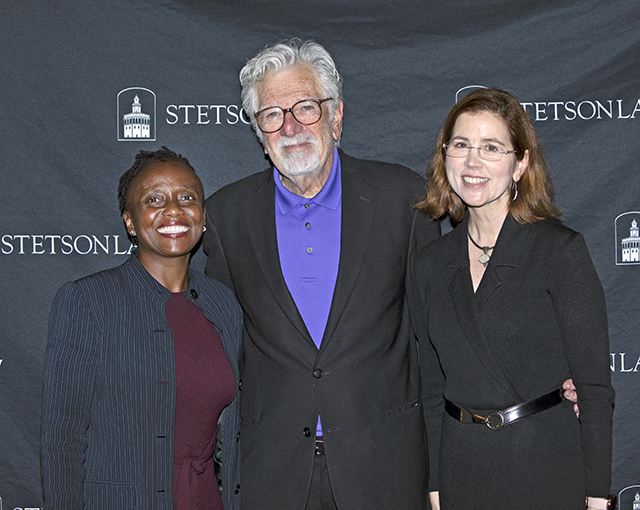
Dean Michèle Alexandre, Dr. Jules Coleman, and Professor Kristen Adams
The Annual Inns of Court event looked a little different in 2022 than most years, but the spirited hybrid event offered the Stetson Law community compelling conversation, fresh insights, and a few laughs along the way.
The yearly event invites students, faculty, and local Inns of Court chapter members to dine, network, and hear remarks from an esteemed speaker. The evening’s lecture component is named for William Reece Smith, Jr., who was a distinguished professor of law at Stetson.
Introducing the event’s namesake
Professor Kristen Adams
Event organizer and Professor Kristen Adams, whose full title is William Reece Smith, Jr. Distinguished Professor of Law, opened the event, which was headlined by esteemed law and philosophy scholar, Dr. Jules Coleman, who was her professor at Yale Law School.
She opened the event with a video highlighting Smith’s career, and referred to him as “a legal icon, mentor, advisor, teacher, a champion of civil rights and a consummate professional, who upheld the highest of standards.”
“He was also passionate about educating young lawyers,” Adams added of the former Stetson Law adjunct professor, who was inducted into the college’s Hall of Fame in 2004.
Dean Michèle Alexandre then introduced Coleman, with an overview of his storied career, from his extensive work in academia to his current activities as a thought-leader in education.
No stranger to Stetson Law
Dean Michèle Alexandre
Before diving into his keynote, Coleman said he’s been to campus before – and joked that he might have enjoyed his being in the room more than others present.
“It is not the first time I have been here…But every time I have spoken is a great pleasure to me,” Coleman said. “I can’t swear whether it is a pleasure for anybody else. I hope to make it interesting and enjoyable and that the hour goes reasonably quickly.”
During his 90-minute discussion, which included a question-and-answer session, Coleman spoke off the cuff and his remarks were full of humorous asides – and wisdom for the students and young lawyers in the room.
“I always enjoy being here, and, this time is no exception,” Coleman said. “I think you are all very fortunate to have a wonderful faculty guiding you. And I hope all of you, as you seek a career in law, appreciate that it is a noble profession and that its nobility depends, in part, of your capacity to always be responsive and ensure that it meets its promises to those who are under its authority.”
Comparing law & philosophy
Dr. Jules Coleman
An accomplished scholar in both philosophy and the law, Coleman spent much of his lecture, titled “What Can Be Learned From Thoroughbred Horses and Trolley Cars,” exploring the differences between philosophy and the law, and how theoretical underpinnings of the former can inform practice of the latter.
The two have one key thing in common, though, he said.
“I realized that one of the problems of both law and philosophy was that it was in a language that ordinary people typically have less access to and less comfort with, and that it involved concepts that were not easily accessible to them,” Coleman said. “But that didn’t mean that the problems that ordinary people faced and that ordinary communities faced were not problems that showed up time and time again, both in moral philosophy and moral theory and in legal practice.”
The first portion of his lecture – concerning the thoroughbreds – explored a complex scenario that occurred during the 2019 Kentucky Derby, when the winning horse was disqualified – to the benefit of the runner up – after injuring a horse that was well behind in the running. The case raised questions applicable in the courtroom.
“There is a general question about whether anybody in a case like this has standing or whether you have to be the wronged party to have standing,” Coleman said. “That is, of course, a central question in the law.”
Law & the “trolley problem”
The lecture also explored the trolley problem, its multiple variations, and their applications within the law, such as whether a party should be held liable for actions they take when their life is being threatened. The famous philosophical thought experiment explores ethics via a hypothetical – but utterly unrealistic – scenario, which Coleman joked was a sign that those who study philosophy might want to get out more.
“It just shows how outdated philosophers are, that they talk about trolleys rather than trains,” he said. “Maybe that was the last time anybody rode public transportation who is a philosopher.”
The point of exploring the law through lenses like these, he said, is to understand that legal practice is invariably tied to the real-life situations that are governed by laws, and that the law shouldn’t be studied in a vacuum.
“The law is not isolated…not like Kafka’s picture of it,” Coleman said. “In many ways it is, of course. It is incredibly bureaucratic and mysterious. That is done on purpose so you guys can make money, right? But it is not really. It is designed to help us find ways of living with one another.”