Skip to content

Father & Son Duo Earn J.D.s, Pass Bar Together

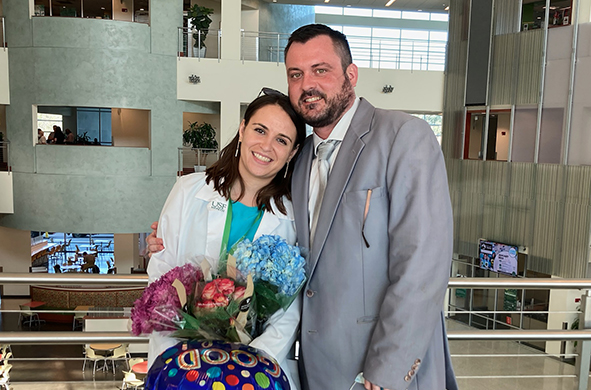
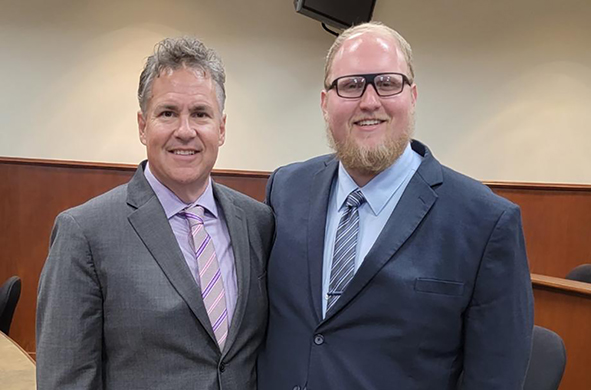
Father-and-son duo Rick and Key Morrow both received their J.D.s in December 2021 and subsequently passed the February 2022 Florida Bar exam.

Rick Morrow was at the gym, trying to distract himself from the pending Florida Bar exam results that were supposed to drop in several hours, when his son, Key, called. The results came down earlier than expected; Key had passed.

Rick rushed to see if he passed. After weeks of fretting over the February exam, Rick learned he had also passed. It was an unusual feeling, the culmination of years of study and lessons gained along an unconventional path for the father and son.

“Surreal, I would say,” Rick said. “It was an eight-year journey.”

Key and Rick Morrow received their J.D.s from Stetson Law in December 2021 through the college’s part-time program. They took most of their classes together, carpooled to class prior to the pandemic, studied together, and took the bar together.

“I think we benefitted from each other’s presence there,” Key said.

How they got here

The father and son duo’s journey was far from conventional.

Rick had been an entrepreneur who invested in apartment buildings, laundromats, and eventually an auto dealership, but had never earned a college degree.

As a freshman in high school, Key suffered from cancer – and missed a lot of school as a result. The illness coincided with financial stresses that he was working overtime to overcome. The ordeal affected his morale, and he eventually dropped out.

“High school kind of fizzled out after my junior year,” he said.

Over the course of Key’s illness, he and his father had grown close – “more like best friends than father and son,” as Rick put it. Key became a certified nursing assistant, but it didn’t take long for higher education to call.  So the two took on postsecondary education side-by-side, first earning associate’s degrees from St. Petersburg College, bachelor’s degrees from University of South Florida St. Petersburg (Key majored in psychology; Rick majored in political science), and, J.D.s from Stetson Law.

Because St. Petersburg was home for them – they are originally from New Hampshire, but moved there when Key was young enough to have taken some of his first steps on St. Pete Beach – they were set on Stetson Law.

“We didn’t apply anywhere else,” Rick said. The two enrolled in Stetson Law’s part-time program because the full-time program was full. They sold the auto dealership they ran together to they could focus on their studies. Both spent countless hours in the library.

Persevering through a pandemic

The two got involved with student organizations and held leadership positions within the Student Bar Association’s part-time-students’ division. When COVID-19 hit, they had to take their studies online.

“We lost our library,” Key said. “We started doing a lot of Zoom meetings.”

Much of their preparation for the Florida Bar exam was also virtual, the Morrows said. Yet they prevailed, as did many of their classmates, despite the challenging circumstances.

Key and Rick were part of the group of Stetson Law bar takers that had a notably high passage rate of 77.8 percent – the second-highest in the state for the February 2022 round. Many were classmates-turned-friends.

“Most of us were cohorts, and we killed it,” Rick said.

In the short time since the results came down, both secured full-time employment at Florida firms: Rick was hired at Orlando-based firm Killgore, Pearlman, Semanie & Squires PA, where he’ll be doing transactional work. Key will be handling cases involving labor, employment, and general liability at Cole, Scott & Kissane, P.A.
International Environmental Moot Court Competition (IEMCC) 2022: A Recap

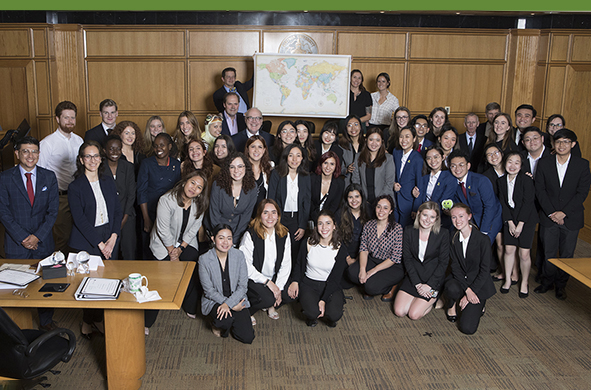
Attendees and organizers of the 26th annual IEMCC gather for a large group photo
The 26th Annual International Environmental Moot Court Competition took place Apr. 7-9, 2022.

For the first time since 2019, the International Environmental Moot Court Competition brought teams from around the world to Stetson Law to compete in the international finals. The event’s 26th edition brought 12 teams from 11 countries and five continents together for a spirited event April 7-9.

Teams argued a fictional case involving armed conflict, protected wetlands, and vulnerable sea turtle nesting areas.

Current events inspired the premise, and current events affected the event itself. A team from Ukraine had to cancel plans to attend as a result of Russia’s invasion of the country; they sent a moving video message to those in attendance. Teams from Bangladesh and India were unable to attend due to COVID-19-related visa issues. A team from Nairobi, Kenya was able to attend – but only because their visas got approved just a day before their scheduled departure.

“Despite travel-related challenges, the event went smoothly. I was impressed and inspired by the students’ advocacy skills, as well as their resilience and good cheer,” said Professor Royal Gardner, the competition’s founder and main organizer. “It was such a joy to host the teams in person after being virtual for two years.”

From bumpy travels to brilliant triumphs

Micah Cheyenne Ecarma of the University of the Philippines College of Law said her team had students from every level, which, due to time constraints, meant they could only practice once a week. Despite this, they made it to the final round.

“In the end, we saw our efforts bear fruit and witness each other’s improvements. Instead of dreading our preparations, we started looking forward to them,” Ecarma, who won Best Oralist for the preliminary rounds, said.

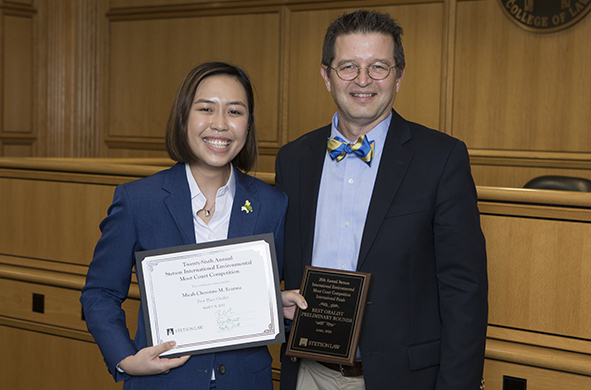
Micah Cheyenne Ecarma of the University of the Philippines College of Law holds two award plaques next to Professor Royal Gardner.
Micah Cheyenne Ecarma of the University of the Philippines College of Law, whose team was an IEMCC finalist, and Professor Royal Gardner. Ecarma also one Best Oralist for the preliminary rounds.

The trip from Manila to Gulfport wasn’t easy. A connecting flight was delayed, and the team even got separated. They arrived safely, albeit more than a half-day later than planned. Ecarma said ultimately, competing in person – especially on such a beautiful campus as Stetson Law’s – made the trip worth it. 

“We were blown away when we first set foot in the halls of Stetson. Being in such a lovely campus really inspired us and kept us calm and focused during our rounds,” Ecarma said. “We also really loved competing in the rooms themselves, as they really gave us the full experience of doing oral arguments in a courtroom in front of a panel of judges.”

Rising to the occasion

Participants commended the event’s organizers for a well-executed event.

“The organizers rose to the occasion given the challenges that we are facing to facilitate travel, accommodation, and paperwork. They kept us well fed, coordinated volunteers and judges, and gave comfortable space to work on campus to 12 teams from five continents,” said Verónica Cáceres Chamorro, who served as a championship round judge for the event.

Cáceres Chamorro, who is the secretary general of the Inter-American Convention for the Protection and Conservation of Sea Turtles, said she was impressed with the competitor’s command of her organization’s policies and their intensive research skills.

“I was delighted to see how knowledgeable the students participating in the Moot Court were of the entire IAC text, resolutions, and the research they did outside legal documents…addressing sea turtle threats – not only lighting, but climate change, dangers in the marine habitat with a marina and boat strikes, damage to nests from people walking on the beach, to the socioeconomic aspects,” she said.

IEMCC 2022: Results and recognition

The final round was between two teams from the Philippines: University of the Philippines College of Law and University of Cebu School of Law, Philippines. The latter was ultimately the winner. A University of Cebu School of Law competitor, Golda Marie Lim, won Best Oralist in the final round.

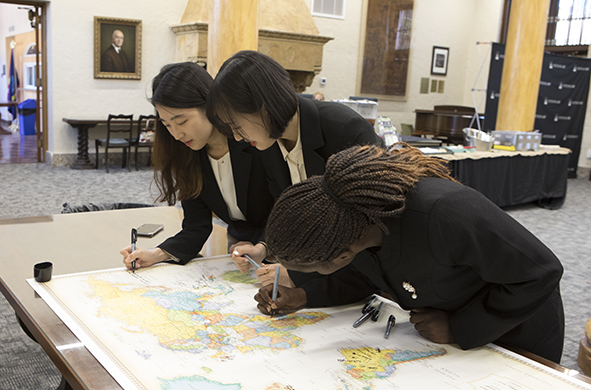
Three women sign a map of the world using Sharpie markers.
Team members from Kenya and Korea sign a world map that will be presented to the Ukrainian team, who were the 2022 recipients of the Spirit of Stetson Award.

Semifinalists were Singapore Management University and Law Society of Ireland.

Best Memorial went to University of Nairobi, Kenya.

Though they could not be present to compete, National University of Kyiv-Mohyla, Ukraine was given the Spirit of Stetson Award.

See the full 26th IEMCC results.

Stetson Law Grad Craig Zyburo Gets Top FL Bar Exam Score

Craig Zyburo, right, with his wife, Viviana

A Stetson Law graduate is among the top-scoring test-takers who took the Florida Bar exam in February 2022. Craig Zyburo, who graduated with his J.D. in December 2021, did so well on the test, he has been invited to speak at the Second District Court of Appeals swearing-in ceremony on May 2 – an honor reserved only for the highest-achieving test-takers.

In all, 443 February 2022 exam-takers were admitted to the Florida Bar. While he worked hard to prepare for the exam, Zyburo said he did not go into it with the expectation that his score would ultimately be among the highest statewide.

​“I just wanted to pass!” he said. “I had no idea what I would score or if I would even pass on my first try.”

With a 77.8 percent pass rate, Stetson Law ranked second in the state for February 2022 Florida Bar exam passage, and was about a percentage point away from the top spot. It is the first time since 2014 Stetson Law has had a top statewide pass rate.

Diligent study and preparation were key to Zyburo’s success, he said. He employed multiple prep methods, including several resources offered through Stetson Law’s Academic Success & Bar Preparation Services office.

“​I definitely put in a ton of work and a lot of hours for bar prep,” Zyburo said. “I usually studied eight hours a day, six days a week for about nine weeks.”

Born in New York City and raised in Naples, Florida, Zyburo holds a B.A. in Psychology, Cum Laude, from Boston College.

Prior to attending Stetson Law’s part-time J.D. program, he spent a decade teaching special education at local public schools. He lives in Dunedin with his wife, Viviana, and their two children.

Now that he has been admitted to the Florida Bar, Zyburo said he will be practicing insurance defense with the firm Andrews Biernacki Davis, where he previously held a summer clerk position. That clerkship, along with an externship with The World Triathlon Corporation (the company that produces IRONMAN events), “really gave me some solid legal experience,” he said.

He graduated from Stetson Law December 9, 2021, the same day his wife graduated from nursing school.

Scholar Catherine Smith on Brown vs. Board & Children’s Rights

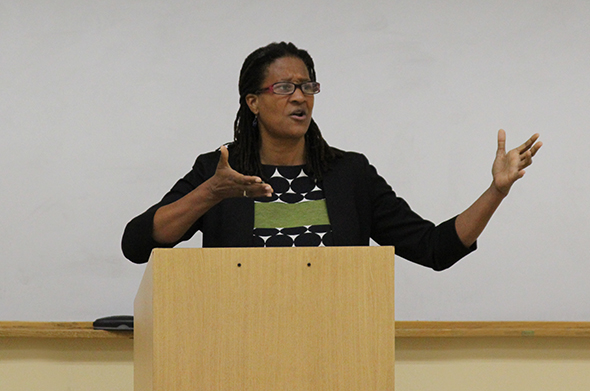
Professor Catherin Smith speaks at Stetson Law in April, 2022

The landmark U.S. Supreme Court decision handed down in Brown vs. Board of Education is a lauded as pivotal moment for civil rights.

Originally filed by the Brown family and a dozen other Black families against a Topeka, Kansas school district, it contested the constitutionality of forcing Black students to bus to segregated schools and challenged the “separate but equal” doctrine put forth by Plessy v. Ferguson decades earlier.

Earlier this month, University of Denver Sturm College of Law Professor Catherine Smith visited the Stetson Law Campus to assert that the case’s legacy may go beyond its groundbreaking impact on civil rights and education law in the U.S.

“I’m asking you to think of it as a landmark children’s rights case,” she told the audience gathered in the Great Hall and watching virtually over Zoom.

How “separate but equal” reinforced inequality

In Brown, she said, the plaintiffs contended that Black children being required to attend segregated schools in Kansa, South Carolina, Virginia, Delaware, and DC could never be considered equal to schools barring non-white students. The psychological impact of school segregation on Black children, the court recognized, “affected Black children’s hearts and minds in a way unlikely to ever be undone.” Segregation permanently locked children in racial castes, she said, thereby reinforcing racial inequalities.

“So, this lost children’s equality jurisprudence serves as a constitutional check on caste creation by ensuring young people’s advancement on individual merit and preventing state practices that lock classes of children and the groups to which they belong into an underclass, or into a caste – into some sort of group hierarchy,” Smith said.

An unexplored legal realm

Despite what she sees as an obvious avenue for exploring and developing a children’s rights-centered approach that could be applied cases involving juveniles, courts currently apply precedents and tests that stem from adult cases. Smith believes looking at Brown through a children’s rights lens could change that.

“It’s time for us to recognize this nascent children’s equality law and build on it,” she said. “It’s wide-open, I promise you. You will look and not be able to find a doctrine that talks about it in this way that I’ve been able to see.”

Fostering “constructive and healthy discourse” about law

In her remarks ahead of Smith’s lecture, Stetson Law Dean Michèle Alexandre said such discussions are critical.

“National and global events continue to highlight the importance of constructive and healthy discourse about our legal systems, including those that impact our children and other vulnerable populations,” she said. “As legal scholars tasked with training new generations of lawyers and advocates, we are honored to have such a distinguished scholar join us today as part of our charge to facilitate such discourse.”

See a video of Smith’s lecture in its entirety.

Professor Theresa Radwan Named Interim Dean

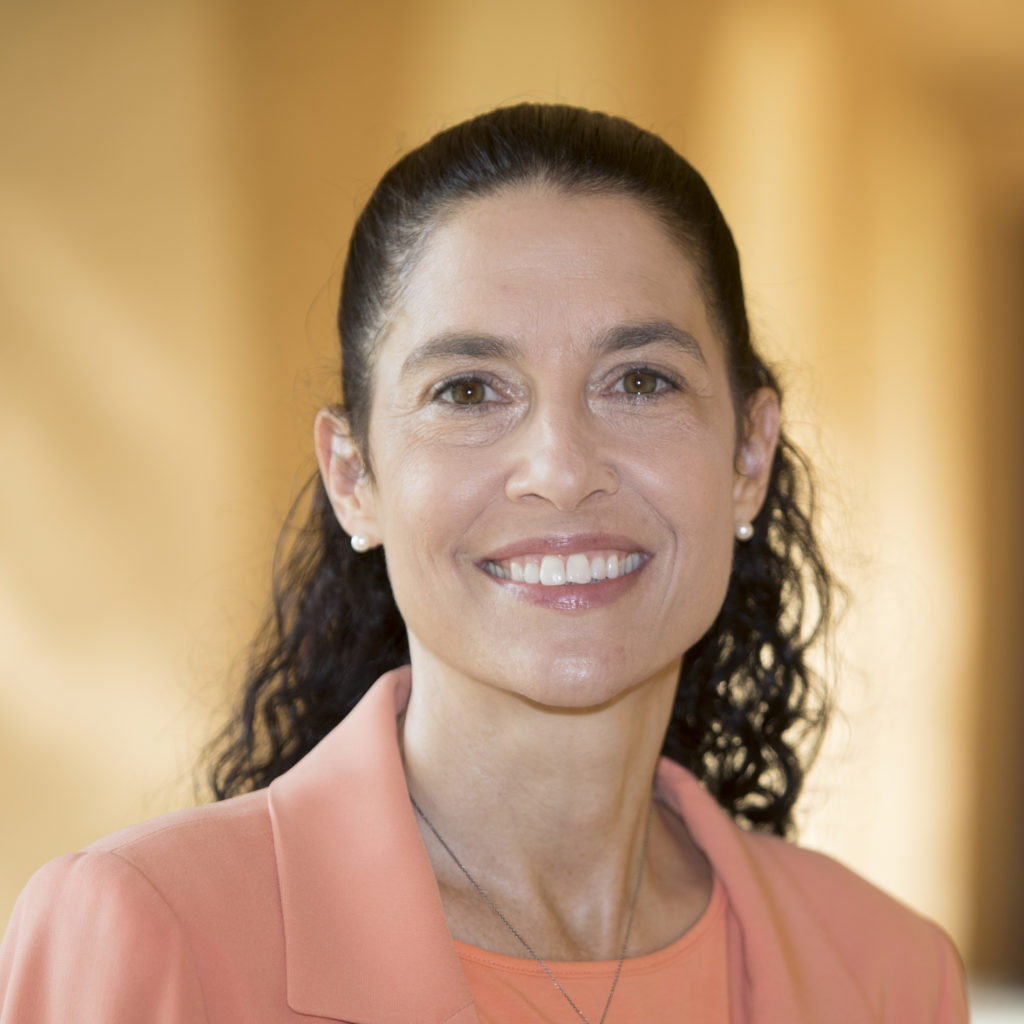
Stetson Law Professor Theresa Radwan

Stetson Law Professor Theresa Pulley Radwan has been chosen to lead the campus as its interim dean of the College of Law. Her term will begin June 24, 2022 and she will serve in that capacity until the position of dean is filled.

Specializing in business law, Professor Radwan joined the Stetson Law faculty in 2001. During her time at Stetson, she has served as Associate Dean for Academics, Senior Associate Dean for Academics, Associate Dean for Administration and Business Affairs, and Transitional Business Administrator. 

Her recent work as co-chair of the university-wide Safer Campus task force led the ACE Women’s Network to recognize her with the “She Stepped Up Award,” which is reserved for women who played a pivotal role in leading an institution throughout the pandemic. Radwan has routinely been recognized by the university for her teaching and scholarship, including the College of Law award for Excellence in Teaching (2004), and twice received the Homer and Dolly Hand Award for Excellence in Faculty Scholarship (2007 and 2017). 

Radwan attended the Marshall-Wythe School of Law at the College of William & Mary, where she served as an articles editor of the Bill of Rights Journal and a research editor of the Moot Court Board. Prior to joining Stetson, Professor Radwan practiced in the areas of bankruptcy and commercial law in Cleveland, taught as an adjunct faculty member at Case Western Reserve University, and served as a full-time faculty member at the University of Cincinnati.

To university leadership, Radwan was an obvious choice for the role.

“For quite some time, I have been aware of Terri Radwan’s strong contributions to the College of Law as an excellent educator, dedicated student mentor, exceptional scholar, and advocate for legal education,” said Dr. Noel Painter, executive vice president and provost at Stetson University. “I am confident that, through Interim Dean Radwan’s leadership and with the support of talented staff and faculty, the College of Law will continue to advance a strong record of student enrollment, reputational advancement, curricular innovation, and university initiatives including our commitment to diversity and inclusion.”  

Professor Radwan will serve in the role of interim dean while the University seeks a permanent dean to fill the role after Dean Michèle Alexandre’s departure. Radwan and Alexandre have worked together closely over the last three years and are well-positioned to have productive engagements between now and June 24 to facilitate a smooth decanal transition.

Stetson Law Fla. Bar Exam Pass Rates Among Top in State

Students takes the test or exam in class.

The Florida Board of Bar Examiners’ February 2022 Bar Examination results are in – and Stetson Law’s passage rate is one of the best in the state.

Of the 27 Stetson Law first-time bar takers who sat for the exam, 21 passed, meaning Stetson’s pass rate for first time-takers is 77.8 percent. The statewide average is 61.6 percent. Stetson Law’s passage rate was the second-highest in the state for the February 2022 bar results, following Florida State University College of Law by about a percentage point.

This was the first in-person bar exam since February 2020, and it included Part A, the Florida-prepared portion of the examination, and Part B, the Multistate Bar Examination (MBE). 

Stetson Law Dean Michèle Alexandre congratulated the bar takers and thanked the greater Stetson Law community for fostering student success.

“We know the duress that all bar takers are under, given the pandemic and other external stressors, and affirm every Stetson graduate who sat for the February 2022 bar exam,” Alexandre said. “We thank the entire Stetson Law community for continuing to support our graduates in a collaborative, student-centered fashion.”

The encouraging results are a reflection of Stetson Law’s dedication to equipping students with critical skills they need for success in their profession, which starts with passing the bar.

“Our commitment, as an institution, is to be certain that every Stetson Law student has a strong foundation upon which to prepare for and pass the bar, with a rigorous curriculum, comprehensive academic support, and specific bar-related programming that empower them to be successful in law school and in the practice of law,” Alexandre said.

Diversity Week Tabling Inspires Connection

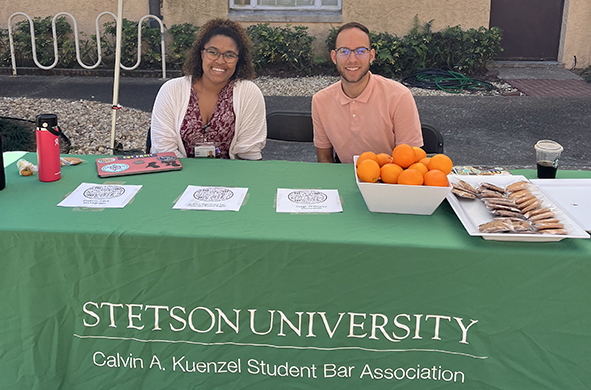
Two students sit at a table featuring promotional materials for the Calvin A. Kuenzel Student Bar Association, a bowl of oranges, and a plate of cookies.
Andrea Waters (left) and Edson Abadia (right) at a Diversity Week 2022 tabling event.

As Ketanji Brown Jackson’s recent confirmation to the U.S. Supreme Court demonstrates, diversity can be transformative when the legal community embraces it. Events like the tabling that took place during Diversity Week at Stetson Law celebrated diversity through connection and conversation.

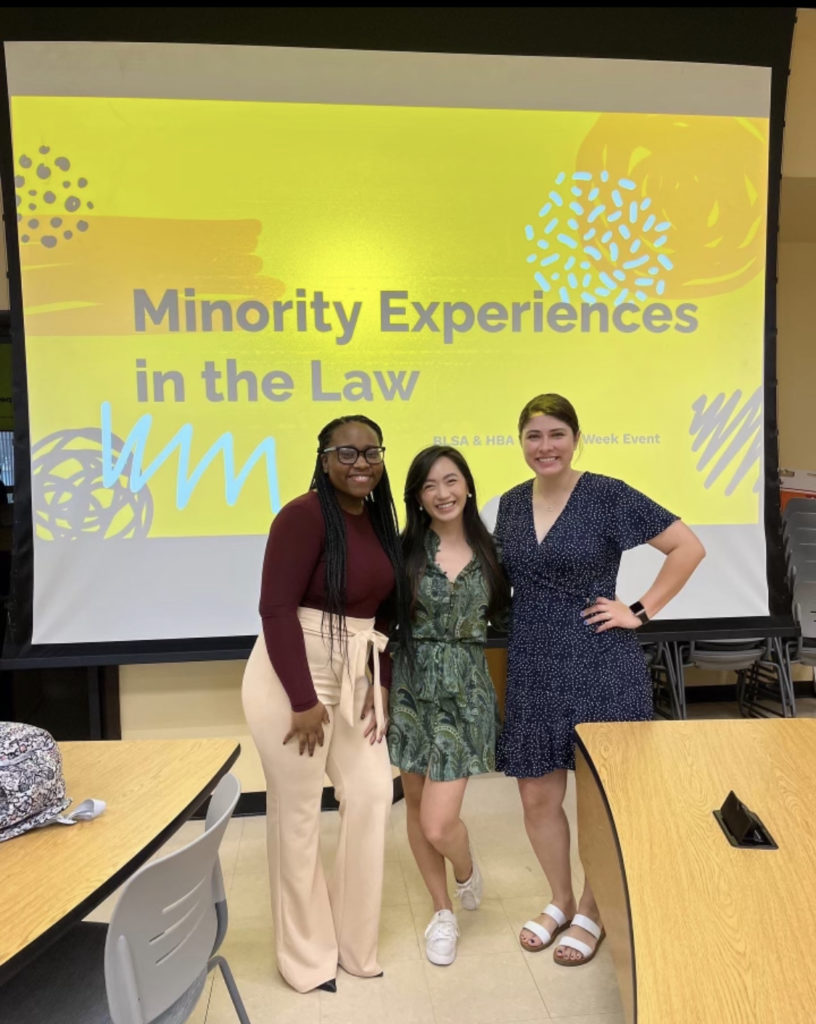
Three young women stand in front of a presentation slide that reads "Minority Experiences in the Law"
Law students Deja Gordon, Kelley Truong, and Melany Hernandez participate in Diversity Week 2022 events.

An annual event hosted on campus by the Student Bar Association’s Diversity Committee, Diversity Week features a different theme each year, depending on the campus climate and current legal issues being discussed in the public sphere, organizers say. This year, that theme was “This is U.S.”

“Our committee chose this theme because of the recent use of the American flag to promote partisanship and political messages,” said Edson Abadia, Jr., Co-Chair of the Stetson Law Student Bar Association’s Diversity Committee. “No matter your background, the American Flag is a symbol of strength, unity, and justice.”

Diversity Week focused on topics such as what it means to be a citizen of the United States, different civil rights movements in the U.S., and minority experiences in law school. It featured panel discussions and other related events – including a virtual keynote from Georgia Judge Timothy Walmsley, who is best known for presiding over the murder case against the men who killed Ahmaud Arbery in 2020.

The tabling that took place over the course of the week offered members of the Stetson Law community the chance to engage with one another on a variety of topics in a non-classroom setting, Crummer Courtyard. They created space for students to interact with faculty, staff, and classmates in a manner less formal than they typically do over the course of the semester – all while learning about opportunities they might not have known about.

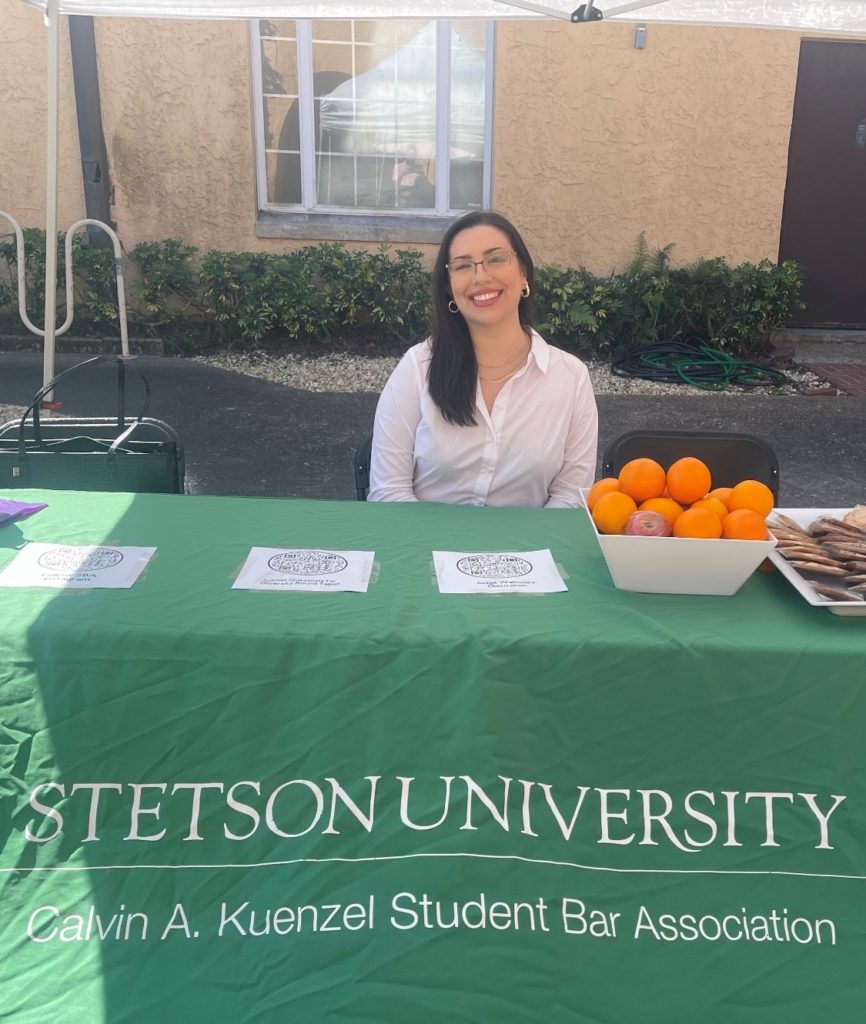
A law student sits at a table with a bowl of oranges and a plate of cookies. A tablecloth reads "Stetson University Calvin A. Kuenzel Student Bar Association."
Law student Diana Estrada during a Diversity Week 2022 tabling event.

“The tabling event created an opportunity for less formal conversations with students that allowed me to learn more about their priorities and interests and to share some information about how the Social Justice Advocacy concentration might help them to achieve their goals,” said Professor Kristen Adams, who is director of Stetson Law’s Dispute Resolution program.

Laura Tankel, Deputy Director of the Office of Career and Professional Development at Stetson Law, said her team enjoyed being able to meet new students and boost the department’s visibility on campus.

“Being visible to the students allowed us to share our department’s goals and programs,” Tankel said.

She added that the tabling helped introduce students to the resources her team provides, set up coaching appointments, and promote upcoming job fairs and other events.

Students who strolled through Crummer Courtyard during tabling events found a more relaxed, open setting in which to discuss the common factor that brings everyone to campus: interest in law.

“People seemed more introspective about how the law services us all and likewise how it is failing many of us,” said Lei-Lani Rogers, a board member of the Lambda Legal Society. “The ability to convey these realizations in eloquence, absent of academic demand, was empowering.”

Stetson Law Student Paper Honored at GRAMMY Week Event

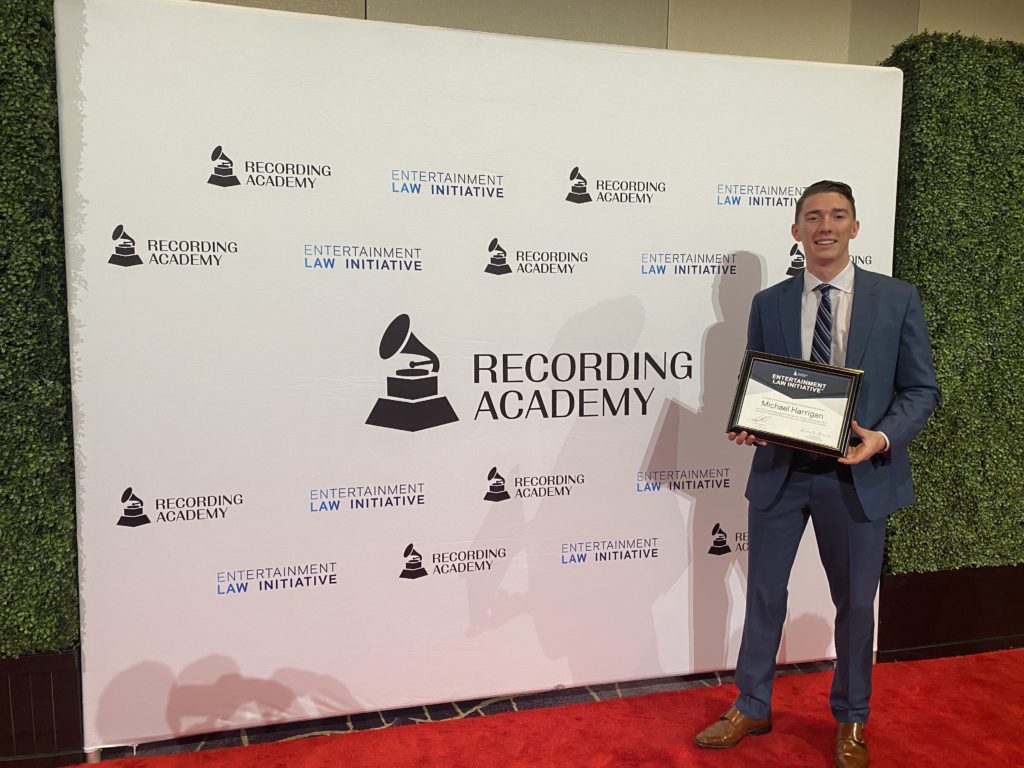
Stetson Law student Michael Harrigan wrote a winning paper about blockchain’s potential impact on copyright law.

As the Recording Academy showcased recording-industry standouts over GRAMMY Week, a first-year Stetson Law student saw some recognition of his own.

Michael F. Harrigan, ’24, was one of two runners-up for a paper he submitted to the American Bar Association’s Entertainment Law Initiative Writing Contest, a competition held in the lead-up to the week’s events and sponsored by The Recording Academy. Over the weekend, Harrigan flew to Las Vegas to attend the Entertainment Law Initiative (ELI) event during which he was recognized.

As part of the GRAMMY Week festivities, an event was held Saturday night honoring the contest’s winners. What makes Harrigan’s win particularly notable is that winning essays are typically written by 2Ls, 3Ls, or LL.M. students. As a first-year student, he said he did not set his expectations for winning very high.

As it turns out, he identified a compelling topic around which he crafted a well-researched and written paper.

The topic? The impact that NFTs (non-fungible tokens) and related technology may have on copyright law. Harrigan’s paper is titled “Beyond a Reasonable Doubt: How Blockchain Technology Can Shift the DMCA’s Burden of Notification Away From Copyright Owners.”

“When I began looking for a topic, it became clear that there was a growing buzz around artists experimenting with NFTs, cryptocurrency, and similar technology,” Harrigan said.
“The common theme among these artists was that they were all looking to gain more control over the rights and royalties associated with their work. So, this inspired me to write about just one way the current law could adapt to these emerging technologies.”

Open to J.D. and LL.M. candidates in the U.S., the contest was judged by a national panel of music lawyers. The timely subject matter combines multiple interests for Harrigan, who is co-founder and vice president of the Stetson Blockchain & Law Society.

“I have always been passionate about Music and Entertainment,” he said. “Over the past year, I have slowly realized the implications modern technology is going to have on artists and their rights. I think a lot of law students and lawyers alike will be surprised how emerging technologies, like blockchain and NFTs, will have an impact on their area of practice in the future.”

Now in its 24th year, the competition invites students to identify a pressing challenge within the realm of entertainment law and outline a solution in a 3,000-word essay. Prizes ranged from scholarships ($10,000 for the grand prize winner; $2,500 for the runners up), event invitations and mentorship opportunities.

See Team Ukraine’s Message to International Environmental Moot Competition

Anastasiia Kryshtanovych and her team were slated to come to Stetson Law from Ukraine to compete at IEMCC.

Prior to February of 2022, five Ukrainian women planned to attend Stetson Law’s International Environmental Moot Court Competition (IEMCC) finals on behalf of National University Kyiv-Mohyla Academy. The team was planning to join others from Mexico, Northern Ireland, Korea, Singapore, and beyond for the event’s 26th edition.

That changed when Russian forces invaded Ukraine.

Ahead of the event, which takes place April 7-9, the team sent a powerful message to participants via a video posted on YouTube. They said that prior to late February, they had been looking forward to competing.

“Unfortunately, it’s no longer possible due to the aggression of the Russian Federation against our country, Ukraine,” said Maria Stolbova, the team’s coach.

The team members said they are all safe, but deeply concerned about their fellow Ukrainians.

This year’s theme, Protected Areas & Armed Conflict, was chosen months before Russian President Vladimir Putin began his most recent attack on Ukraine. Teams have been competing over a legal battle between two fictional countries with environmental implications since fall of 2021.

The would-be competitors from Ukraine said they know the environmental hazards of a large-scale attack. Donbas, a heavily industrialized coal-mining region on the country’s east end partly controlled by pro-Russian separatists, has been a site of conflict since 2014. As a result, the air and water there have degraded dramatically as abandoned industrial sites degrade and artillery causes critical damage to water infrastructure. The Chernobyl nuclear plant has also been the source of fears over the war’s potential environmental consequences.

“Russia’s attack on Ukraine is also an attack on the environment,” Strolbova said.

The team asked for this year’s IEMCC participants to do what they can to support Ukraine.

“These days, Ukraine employs all the methods possible to stop the war and protect its citizens,” team advisor Katryna Skichko said. “The support of the international community is especially important for us in this regard. We ask you, the students from all over the world, legal and environmental scholars and practitioners, to support Ukraine.”

They implored viewers to spread information about the war in Ukraine, participate in meetings, and support humanitarian and volunteer initiatives helping Ukrainian army, civilians, and asylum seekers.

“So, we want you to defend your position as Ukraine: courageously, clearly, and confidently,” team member Valentyna Danyliuk said.

The IEMCC kicks off Thursday, April 7 with this academic year’s final installment of the Edward and Bonnie Foreman Biodiversity Lecture Series during which Dr. Dave Pritchard will discuss the current state of the Ramsar Convention, one of the world’s oldest environmental treaties.

See the whole video below or on YouTube.

Stetson Law Experts Weigh in on Ukraine War

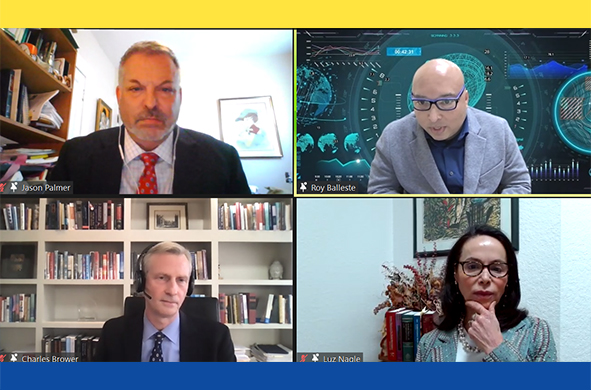
Four panelists participate in a virtual webinar about Russia's invasion of Ukraine.
Clockwise from top left: Stetson Law Professors Jason Palmer, Roy Balleste and Luz Nagle; Wayne State University Law School Professor Charles Brower

In a far-reaching conversation that took place Wednesday evening, international law experts did a deep dive on Russia’s invasion of Ukraine, from why it’s happening to its potential lasting impacts on global stability.

Stetson Law Professor Jason Palmer moderated the virtual panel. Stetson Law Professors Roy Balleste and Luz Nagle shared insights on the war’s cybersecurity and international human rights law aspects, respectively, while Wayne State University Law School Professor Charles Brower shared historical and overarching legal perspective on the conflict.

The panelists offered thoughts on the implications of Russia’s invasion of Ukraine, now nearing its sixth week, informed by their areas of expertise.

Why it’s happening and what it means

Among the international experts who spoke, there was no debate over why Russian President Vladimir Putin is attacking Ukraine.

“Putin truly believes that the breakup of the Soviet Union was the greatest catastrophe in the 20th century,” Brower said. “The invasion is nothing less than designed to reassert Russia’s status as a great power […]”

Nagle said she laments how the war is shaking the foundations of international law, but says such occurrences strengthen her resolve.

“The war is an absolute attack on the foundations and core values that underpin international law, the rules and institutions created to prevent another war,” she said. “Looking at the horrors of the invasion, many doubt the worth of international law, and the work of international lawyers. And I confess: I have. But I also remember why I went to law school and why I work in the international legal arena.”

An uncertain future for Ukraine & beyond

Nagle said the conflict has displaced nearly 6.5 million people internally within Ukraine alone. Many basic needs – like food, water, and clothing – aren’t being met, and there’s a huge need for psychological help and medicine for widespread conditions like hypertension, diabetes, cancer, respiratory disease, and covid-19.

“They need a lot of humanitarian assistance,” she said.

As for the many refugees displaced outside Ukraine, human rights abuses are rampant. And though there are laws against it, the system is overwhelmed.

“We have a protocol against human trafficking. And as we expect the United Nations is very involved, Interpol is involved in trying to determine who is engaged in human trafficking,” Nagle said. “Yes the system is overwhelmed, neighboring countries are overwhelmed, but the international community is doing their best.”

As for cybersecurity, Balleste said Putin’s notorious prowess for organizing cyberattacks and far-reaching misinformation campaigns in the digital space is being met with surprisingly adept opposition.

“In this situation, he miscalculated because what has happened is that pretty much every freelance hacker in the world has taken the umbrella of Anonymous and has directed their attention to Russia, and has disrupted satellite communications, banks,” Balleste said. “Pretty much everything he’s been doing to the world, Russia’s getting in return now through Anonymous. And so he’s bogged down in cyberspace.”

Balleste added that he hopes one outcome will be “more crystallization of international cyber law for the benefit of all nations,” he said, “because the alternative would be more disruption.”

For the rest of the world, the effects could be far-reaching if Putin’s attacks on longstanding global institutions and the West itself are successful.

Brower said he has no doubt that Putin is a war criminal, but the real challenge is holding him accountable, which requires investigating and documenting his crimes, effectively establishing him as a global pariah through indictment, and, eventually, prosecution. He said prosecution may seem unlikely, but so, too, did the prosecution of WWII’s worst actors – before it ultimately happened.

“If you don’t imagine it and if you don’t plan for it, it’s never going to happen,” he said.

Stetson Law students weigh in on the crisis

At the start of the panel, leaders from Stetson Law’s Republican and Democrat student organizations shared thoughts from discussions held within their respective communities on what the U.S. response should be and why.

“It is our belief that in the weeks and months moving forward, it’s important that the U.S. doesn’t aggravate this situation any more than it needs to,” said Emily Lehman, president of the Stetson Law Republicans. “And it is our hope that as the peace talks continue, the two countries can come to an agreement.”

Lehman and Stetson Law Democrats president Elizabeth Kellar said they and their respective peers support sanctions to varying extents and oppose U.S. military involvement in the conflict. And despite the divisive political climate, the students said the matter transcends politics.

“No matter what side of the aisle you fall on, when innocent civilians being targeted and people are starving and losing their homes and families, like in Ukraine, or in Yemen, or Syria, etc. then you should care about those lives being lost,” Kellar said.

View a full-length recording of the panel discussion on Ukraine.

U.S. News Ranks Stetson Law Near Top in Key Areas

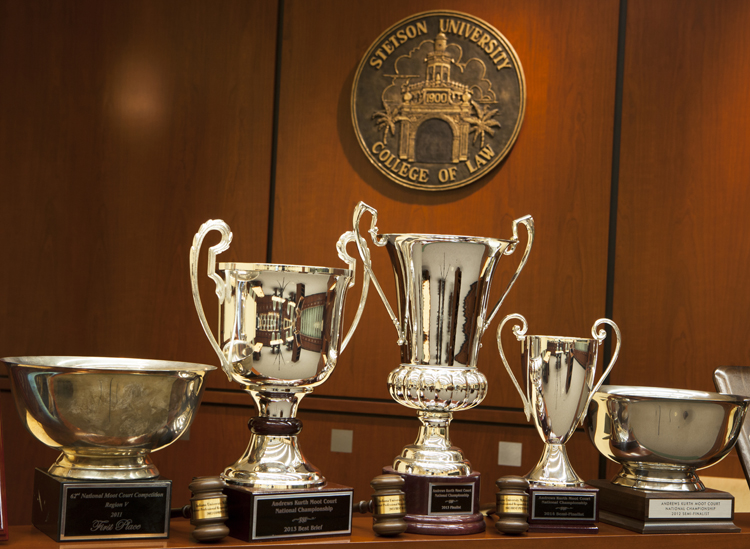
Stetson's advocacy teams bring home multiple accolades.
Stetson’s advocacy teams bring home multiple accolades.

The annual U.S. News & World Report results have been announced for 2023, and Stetson Law has once again placed at the top of its class in key areas. Yet again, the results reflect the College’s dedication to empowering its students with knowledge and skills essential for success as legal professionals.

The College remains a top destination for Trial Advocacy, tying for No. 3 with American University and South Texas College of Law and missing the No. 1 spot by a third of a point. Temple University claimed No. 1, followed by Baylor University.

Stetson Law’s perennial showing at the top of the list of the best law schools for Advocacy is a testament to the incredible dedication of our students, faculty, staff, and alumni in the classroom and on the global competition scene.

“As you can imagine, Advocacy is by nature one of the most competitive areas of the law, and we continuously assess and implement strategies to meet the challenges of this dynamic field,” said Professor Elizabeth Boals, Director of the Center for Excellence in Advocacy.

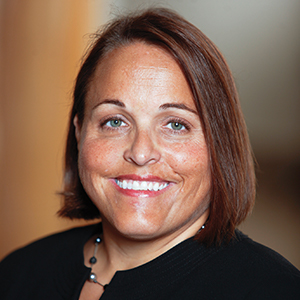
A headshot of Stetson Law Professor Kirsten Davis
Stetson Law Professor Kirsten Davis

Often ranked among the top in the nation, Stetson Law’s celebrated Legal Writing program climbed to No. 3. Neck-and-neck with the runner-up in its class, it was well within striking distance of the top ranking for legal writing with a 0.1 point margin.

“We are thrilled to have climbed to number three in the country and to be recognized for excellence by our peers,” said Professor Kirsten Davis, Director of the Institute for the Advancement of Legal Communication. “This ranking reflects the tireless efforts of our faculty to equip our students to be great legal writers.”

And, in just three years, Stetson Law’s Dispute Resolution rank has climbed from No. 72 in 2021 to No. 22 in 2023 – a truly meteoric rise in ranking.

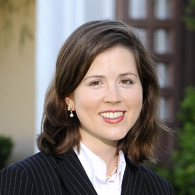
Professor Kristen Adams
Stetson Law Professor Kristen Adams.

“Climbing 50 spots in just two years is no small feat,” said Professor Kristen Adams, Director of Dispute Resolution. “It is clearly the product of years of hard work and commitment – and we are just getting started. We continue to put in the work that will pay dividends in future years’ rankings.”

Stetson University College of Law continues to make long-term investments to elevate its national reputation. This commitment, along with dedication to excellence in skills training, positions the school well for the future.

“As an institute widely recognized in areas critical to any successful legal career, the Stetson Law community is one that puts the work in – something evident in everything we do,” said Stetson University President Christopher F. Roellke, PhD. “I’m incredibly proud of the faculty, staff, and students, and alumni mentors and coaches whose contributions helped earn us recognition in key areas – and look forward to even more success in the future.”

Stetson Law’s Advocacy boards continue to thrive, from world-class competition teams’ performance in national and international competitions to the premier competitions the College hosts. The community looks forward to the 2023 academic year, when the new Advocacy Institute – outfitted with more practice courtrooms, collaboration space, and the latest technological capabilities – will open its doors.

“We are proud of our commitment to educating ethical professionals who will leave our campuses with the legal acumen, real-world skills, and compassion they need to succeed as Stetson Lawyers,” said Stetson College of Law Dean Michèle Alexandre. “It is a mission to which we remain steadfastly dedicated.”

Dispute Resolution Board Wins National Energy Law Competition

The final round of the competition

For the first time ever, Stetson Law’s Dispute Resolution Board won South Texas University’s Energy Law Negotiation Competition. The virtual event took place March 25-26 and featured teams from 18 law schools, including University of Texas, University of North Carolina, and Emory University.

Prior to this year’s win, Stetson Law had never before advanced in this competition – let alone won it outright.

Making this victory even more remarkable was the fact that the two competitors from Stetson Law, Andrew Zacherl (3L) and Selina Nadeau (2L), were up against teams from schools that have concentrations in energy law. Nadeau, who has a concentration in environmental law, was competing for the first time.

They went into the final rounds seeded third, having won five of six ballots in the preliminary rounds, and emerged from finals as champions. 

Now in its seventh year, the annual Energy Law Negotiation Competition gives participants the opportunity to practice their negotiation skills in a hypothetical setting in Houston, which is often referred to as the energy capital of the United States. The event is judged by oil and gas industry professionals from major law firms and energy companies. In recent years, many of the competition’s top-four spots went to schools from Texas, a state known for its oil and gas industry. In 2019, all four schools that placed were in Texas.

Negotiation facts were given to the 18 teams on February 25, which gave them a month to prepare.

Professor Kristen Adams, who is faculty director of Stetson Law’s Dispute Resolution Board, said the team’s success was “truly historic.”

“This was the culmination of Andrew’s distinguished work on the DR board, and a truly auspicious beginning for Selina, who was competing for Stetson for the first time,” Adams said. “Congratulations, and a special thanks to Coach Bill Greiner.”

Learn more about Stetson Law’s Dispute Resolution Board.