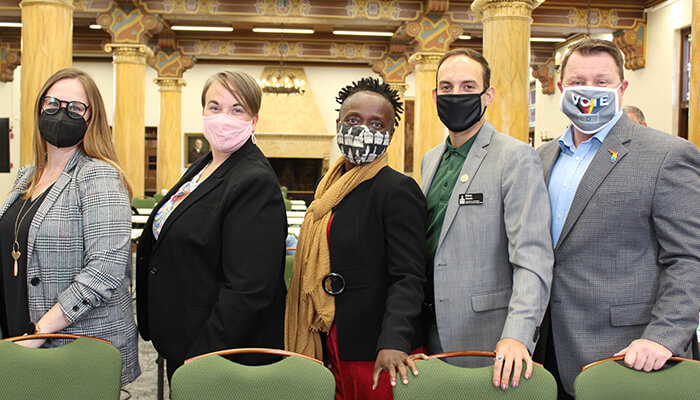
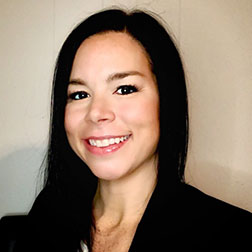
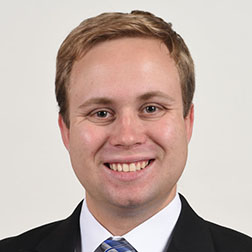
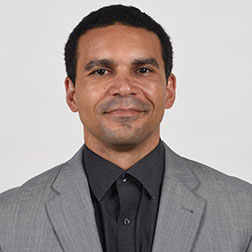
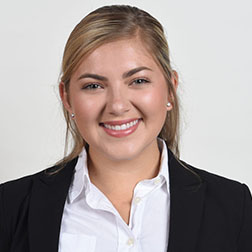
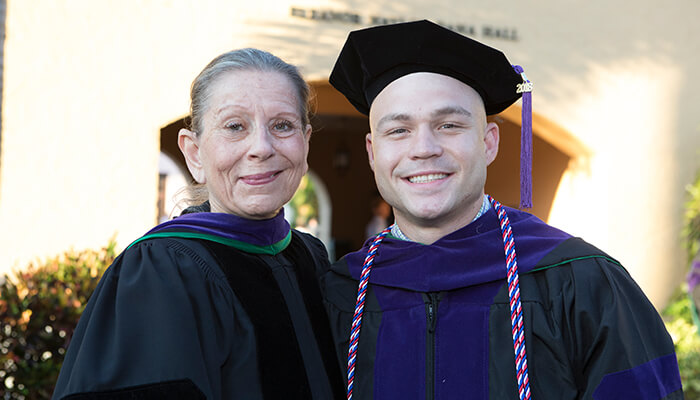
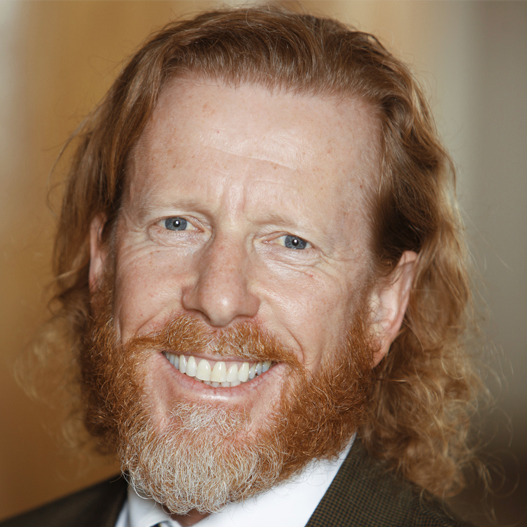
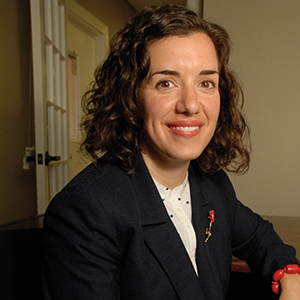
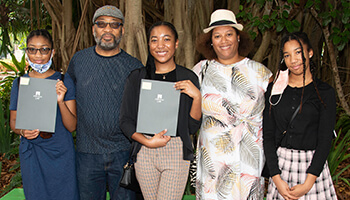
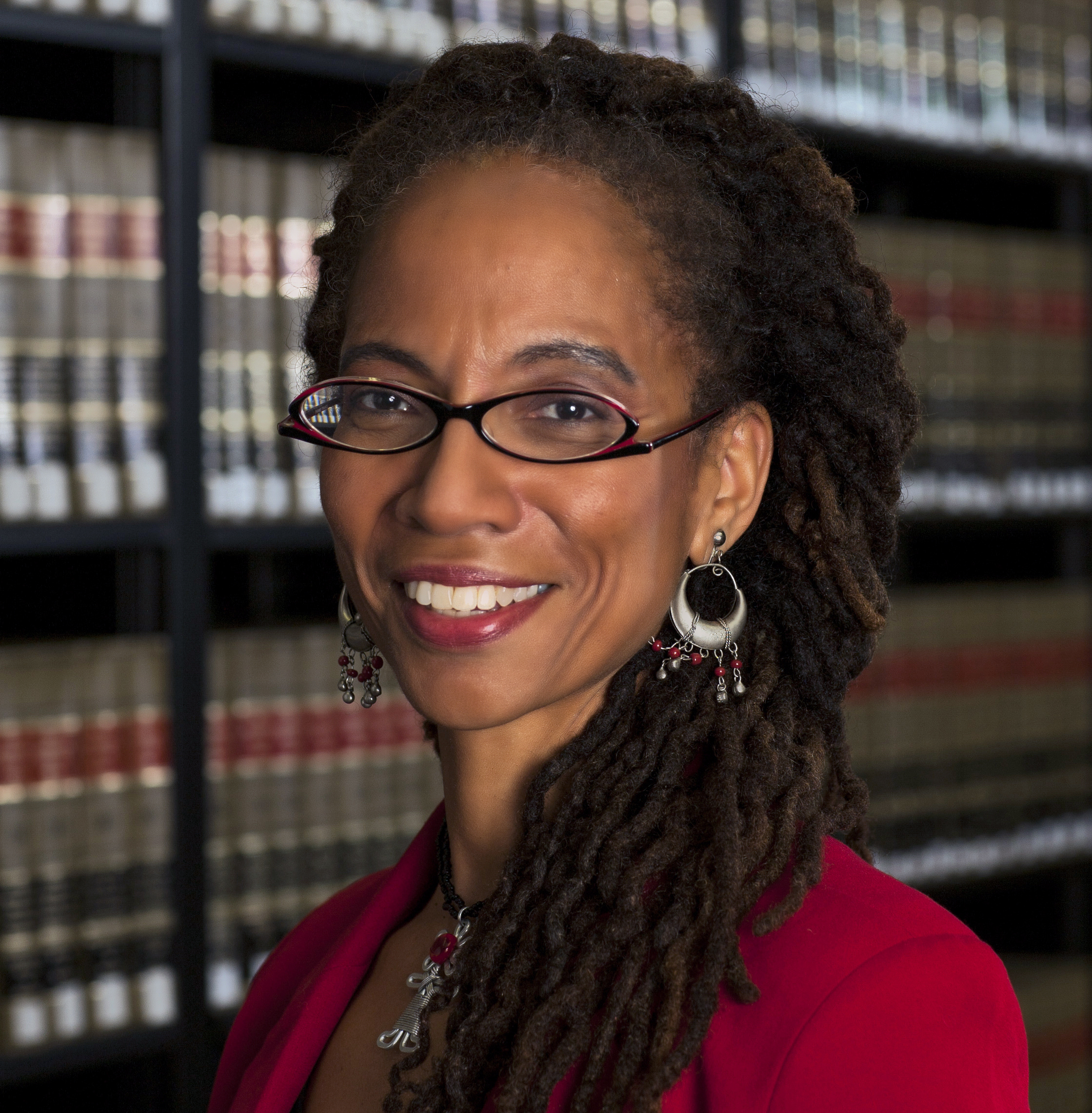
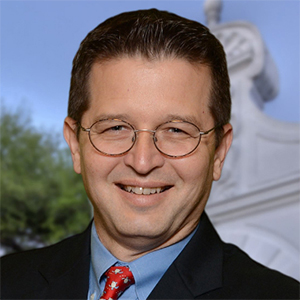
Lambda Legal Society members Jessica Merker and Jen Rex with Dean Michèle Alexandre, Lambda President Edson Abadia, and Stetson Law alumnus Nathan Bruemmer.
GULFPORT, Fla. – Stetson Law’s Lambda Legal Society has created a new endowed scholarship for dedicated members of Lambda who demonstrate a commitment to advocating for the LGBTQIA+ community in their studies, on campus, or in their work.
“We’re excited to have this new opportunity for LGBTQ+ and allied students on our campus,” said Edson Abadia, president of Lambda.
The organization hosted a special signing ceremony on Oct. 19, 2021, featuring the Lambda’s executive board, Stetson Law Dean Michèle Alexandre, and alumnus Nathan Bruemmer, J.D.’17., who serves as the LGBTQ Consumer Advocate for the Florida Department of Agriculture and Consumer Services.
“This scholarship means a lot for the Stetson community because it is providing opportunities and recognition of students who support the LGBTQ community and who are doing really great advocacy work, which is such an important part Stetson’s mission,” said Jen Rex, a 3L and vice president of Lambda. “So, we’re really glad to be able to support students who are doing great things.”
The scholarship will benefit a rising second or third-year law students in the full-time or part-time J.D. program in good academic standing. To be considered, students must list their studies, on-campus extracurricular activities, or work experience related to how they have advocated for the LGBTQIA+ community and how they plan to work in this regard in the future.
“I’m thrilled to see an investment in diversity and inclusion, specifically for LGBTQ students. Recruiting that kind of talent here for Stetson says so much,” Bruemmer said. “The law has changed; advocacy has changed as we see cases pending and decided every year while we’re in law school and the ability to invest in our future and the profession is an amazing thing.”
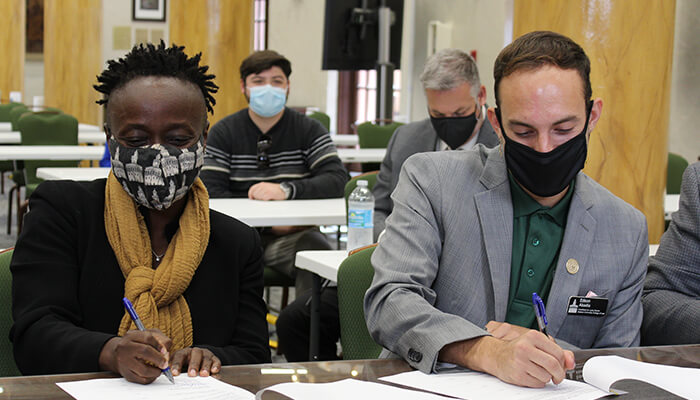
Dean Michèle Alexandre and Edson Abadia sign the new scholarship.
The Lambda Legal Society Pride Scholarship will be funded with a minimum gift of $25,000. In order to reach the goal, members of the Lambda Legal Society will work with local non-profit advocacy groups to develop a list of potential donors, as well as alumni, law professors, staff, and the community, corporations and foundations, to fund the endowment in two years. The scholarship will exist in perpetuity at Stetson University College of Law once the minimum of $25,000 is reached. Any individual, corporation, foundation, or group may make gifts to the principal of the Lambda Legal Society Pride Scholarship.
“Stetson Law is thrilled about continuing the legacy that has begun to open the doors to LGBTQIA members of the community,” Alexandre said. “The legal profession is a profession of access. This scholarship, and building on it, will make sure that students of all backgrounds – including those from all neglected areas who might also be LGBTQIA identifying will have the same opportunity to make a difference. I just could not be more excited because that is the work that we are here to do.”
The Lambda Legal Society provides a forum for exploring the legal issues faced by people in the LGBTQIA+ community. The goal of Lambda is to educate young attorneys about the unique issues that the community faces. Lambda also promotes international social justice and recognizes that the issues faced by people who identify as LGBTQIA+ are influenced by other parts of their identity. Students need not identify with any particular label to belong.
In February 2021, the Stetson University College of Law Lambda Legal Society became a part of the National LGBT Bar Association Law School Affiliate. In June 2021, it celebrated the inaugural raising of the Progress Pride Flag on campus.
The fellowship will put college students at the center of creating systemic change by providing opportunities to shape policy and systems through a racial justice lens.
A consortium of higher education institutions focused on racial justice in Pinellas County has selected its inaugural cohort of Racial Justice Student Fellows.
The St. Pete/Pinellas Higher Education for Race Equity (SPHERE) consortium chose eight students, two each from four Pinellas County universities and colleges, for the year-long fellowship.
“Through our consortium, we seek to acknowledge the unique responsibility of institutions of higher education in seeking systematic change,” said Michelle Madden, campus diversity officer at USF’s St. Petersburg campus, one of the partners of the consortium.
The fellowship will put college students at the center of creating systemic change by providing opportunities to shape policy and systems through a racial justice lens. Students will learn about mechanisms that enable racial healing and serve in summer internships to work on projects that support racial healing and transformation in the local community. Each student will receive up to $2,000 during the 2021-2022 academic year.
“With the fellowship, our hope is that students will gain the knowledge and tools to actively engage in equity, diversity, and inclusion (EDI) efforts and see themselves as a part of, and not apart from, the work that is needed to move EDI forward,” said Tashika Griffith, provost at St. Petersburg College, another partner of the consortium.
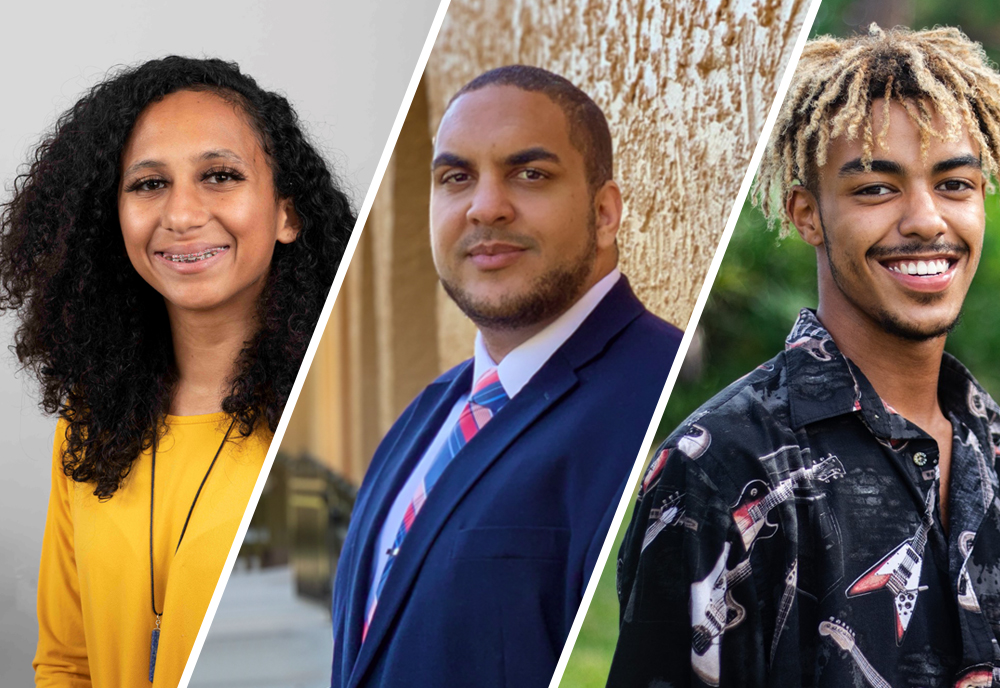
The eight fellows selected are: Trey Daniels and Kayla Rendon-Torres from Eckerd College; Audrie Brinegar and Na’Keidra Perez from St. Petersburg College; Blake Radford and Megan Holmes from Stetson University’s College of Law; and Aaron Rose and Destiny Gomez from the University of South Florida St. Petersburg campus.
“I want to be a public service lawyer who offers pro bono services to at risk communities,” Brinegar said, a History major at St. Petersburg College. “This fellowship position will help shape my career.”
Fellows will participate in biweekly planning meetings with consortium institution representatives to help shape the vision, goals and activities of a Truth, Racial Healing and Transformation Center for Pinellas County. This will include participating in other meetings at their home institutions as well as engaging with community members.
Over the course of the academic year, students will also be involved in at least seven approved activities, events or discussions related to race equity and racial justice. Students will complete a six-week internship in the summer of 2022 that focuses on deepening their understanding of systemic racism and developing opportunities to drive healing and transformation.
“As we build the work of the consortium, the student voice is critical,” said Judith Scully, a professor of law and director of the Social Justice Advocacy program at Stetson College of Law.
“We’re excited for this inaugural cohort and hope to grow the program in the future.”
SPHERE is a joint initiative among Eckerd College, St. Petersburg College, Stetson University College of Law, USF St. Petersburg campus and the Foundation for a Healthy St. Petersburg. The collaboration emerged out of a community task force that was convened to connect efforts in addressing inequalities that exist in the region. These institutions, which collectively serve more than 40,000 students, have been collaborating since the fall of 2020 to create a consortium working to dismantle racial hierarchies in the region.
Student testimonials for wanting to be a fellow
Trey Daniels – Eckerd College – Political Science Major
“As an aspiring civil rights defense attorney, I would like to do as much as I can to spark change while being a student. This opportunity will give me hope that I am being a strong advocate for the people in my community that I believe need me the most.”
Kayla Rendon-Torres – Eckerd College – Animal Studies and Environmental Studies Major
“By participating in this fellowship, my efforts to support each and every community will blend into the work I do today as a program manager of the Office of Diversity, Equity, Inclusion, and Belonging (DEIB) as well as my role as DEIB coordinator for the Eckerd College Search and Rescue (ECSAR) team.”
Audrie Brinegar – St. Petersburg College – History (Pre-law) Major
“This fellowship position will help shape my career. I want to be a public service lawyer who offers pro bono services to at risk communities.”
Na’Keidra Perez – St. Petersburg College – Paralegal Studies
“I believe this fellowship will shape my leadership journey and my career by not only giving me the tools and education necessary to set out to close the wealth gap racial divide but it will also allow for many networking opportunities to get my ideas in front of like-minded individuals who can further develop my talent and principles.”
Aaron Rose – USF St. Petersburg campus – Global Business
“I know that this fellowship will shape my journey and career because I am a global business major. I have to study abroad and meet people from all over due to my major and I feel that this will help me become more open to different perspectives and views in life.”
Destiny Gomez – USF St. Petersburg campus – Psychology Major
“I feel like through this amazing opportunity I would network with many individuals that would be assets to implementing my dreams for this nation. I am eager to correspond with like-minded individuals that share my same passions and have the same fire burning within them.”
Megan Holmes – Stetson University’s College of Law – Juris Doctor Candidate, B.A. in Political Science and Pre-law
“I came to law school interested in learning how to solve big, intractable problems, specifically those surrounding racial equity. I believe that this fellowship is the perfect next step in my career-long commitment to that cause. This fellowship will provide the opportunity to build a consortium that outlasts my time at Stetson.”
Blake Radford – Stetson University’s College of Law – Juris Doctor Candidate, B.A. in Political Science, Psychology
“If I want to help end racism and change the environment my cousins will have to grow up in, I need to learn from more enlightened and experienced minds on the tools they’ve used as well as what they have found in their experience to work and not work. I believe this fellowship will give me an opportunity to learn, experience, and discuss the situations we face and have a hand in trying to fix some of the issues. The potential to work with other fellows from various academic institutions and with more experienced individuals who can part their knowledge onto me will undoubtedly grant me a vast array of experience that I can learn from and implement into my leadership style and take forward with me on my journey.”
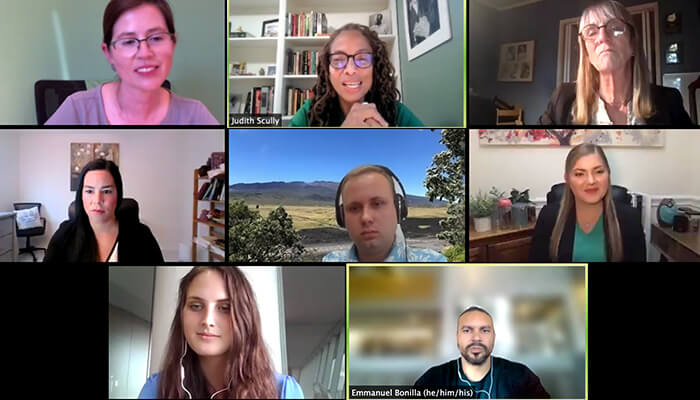
The annual William Reece Smith, Jr. Pro Bono Showcase features some of the best volunteer work of Stetson Law students. Pictured: Professor Kristen Adams, Professor Judith Scully, Professor Ann Piccard, Tiffany Hilton, Will Davis, Jessica Leabu, Hillary Hazeltine, and Emmanuel Bonilla.
As part of Stetson University College of Law’s deep commitment to providing quality pro bono service, the college hosts an annual William Reece Smith, Jr. Pro Bono Showcase to highlight some of the most impactful work of Stetson students.
“The five finalists, as well as all the other entrants, represent the very best of Stetson Law,” said Professor Ann Piccard. “We talk frequently about ‘Excellence in Advocacy,’ and the pro bono work we heard about is truly Excellence in Social Justice Advocacy. These students are the embodiment of everything that is good, hopeful, and inspiring about this law school community.”
This fall’s event was held on Sept. 30, and five student finalists shared their experiences. Professor Kristen Adams, Ann Piccard and Judith Scully, co-coordinators of the Social Justice Advocacy Program, evaluated the written submissions and oral presentations of the students and selected one to win a free parking space.
“This year’s applicants truly represented the principles and values of cultural diversity and passionate community advocacy,” Scully said.
The five finalists were Hillary Hazeltine, Emmanuel Bonilla, Will Davis, Tiffany Hilton and Jessica Leabu. Hilton was named winner of the Showcase. Read more about her project and all of the others below.
“Students are doing such extraordinary work in closing the justice gap,” Adams said. “We hope this will be a resource for students who have yet to complete their hours to find inspiration as to what they would like to do.”
8th Amendment Protection
Tiffany Hilton
Tiffany Hilton struggled with opioid substance abuse disorder and spent years in and out of the criminal justice system. She said she witnessed the justice gap firsthand. Her recovery gave her the opportunity to realize her lifelong dream of being a lawyer, and Stetson gave her the second chance she needed. Her singular goal as an attorney is to help others going through what she once did.
The Florida Bar regularly solicits volunteers from its membership to take on cases pro bono. In March 2021, Hilton learned of a special one where the judge would allow a law student to handle the case if supervised by a licensed attorney. It involved a transgender woman of color who was incarcerated and was being beaten by the other prisoners because of her status. Hilton contacted her former boss at a personal injury law firm, who agreed to supervisor her. They drove to the prison to meet the client and took the case.
Hilton successfully argued before Judge Robert Hinkle to reopen discovery in the case and then proceeded to devote every spare second from her law school studies on it. She deposed guards and other witnesses, discovered the Department of Corrections engaged in spoliation of evidence, filed a motion to compel, and ultimately settled the case at mediation. Her client received a substantial amount of money that will help her with living expenses once she is released from prison.
Hilton said she wanted her client to know she was not alone anymore and that there was someone fighting for her. So many people discard the rights of the accused and the incarcerated, framing them as criminals not worthy of dignity and respect.
“I know firsthand they are wrong,” she said.
“The only thing that separates me from my clients is where they are in their journeys.”
Voting Rights
Hillary Hazeltine
Hillary Hazeltine served as an extern with the Wisconsin Department of Justice where she worked on a large project for the 2020 election. She devoted hours to reviewing state statutes and voter information materials to ensure everything was updated and accurate. The goal was to make sure voters knew their rights, how to vote, when to vote, etc.
“Knowing your rights to vote is just a huge part of advocacy,” she said.
Conservation and Sovereignty
Will Davis
Will Davis vacationed in Hawaii and fell in love with the island. When he began searching for internship opportunities, he tapped Professor Royal Gardner, director of the Institute for Biodiversity Law and Policy, for connections that might get him back to the Aloha State. It worked, and he spent his summer serving in the Office of Hawaiian Affairs (OHA), a semi-autonomous state agency responsible for improving the wellbeing of all Native Hawaiians.
Davis was assigned to work on a series of legislative bills dealing with managing resources for land and water conservation. As a student in the Environmental Law Concentration, he was ready for the challenge, and ultimately saw one of the bills he worked on signed into law in June.
The overall experience taught him much about Hawaiian history, inspired him to write a law journal article on Hawaiian land use law, and solidified his desire to continue working to help native Hawaiians protect their sovereignty and natural resources.
Veterans Services
Emmanuel Bonilla
Emmanuel Bonilla served in Stetson Law’s Veterans Advocacy Clinic during the summer of his 1L year helping veterans file disability claims. The work required a deep dive into administrative law and medical record reviews, but as a veteran himself, Bonilla benefitted from seeing the process from both sides. He called the clinic a safe space where he was able handle real-life cases under the supervision of licensed attorneys who ensured he couldn’t make a mistake that would hurt the client’s case. Bonilla is now a 3L looking forward to graduation, but his Veterans Advocacy Clinic experience motivated him to apply for an Equal Justice Works Fellowship where he can extend his commitment to public service.
Guardian ad Litem
Jessica Leabu
Jessica Leabu served as a volunteer guardian in the Florida Guardian ad Litem program, which works with children and families in dependency cases where children are removed from the parents’ homes. Guardians are appointed to help design case plans for families to work toward reunification. The role is equal parts investigator, mediator, counselor and friend. Children in these cases face more change and confusion than most people realize; the guardian provides a sense of consistency and gives them a voice, Leabu said.
She began training in January 2020 and was appointed her first case the following month. It involved three brothers: two had been in foster care for more than a year, and the youngest was born into the system. The oldest had been separated from his siblings, and one of the first things Leabu determined was that the three should be placed in a foster home together. The oldest was non-verbal initially but started talking a month after being reunited with his siblings.
She developed a great relationship with the children through monthly visits with them to play and discuss their needs. She talked with their teachers and therapists, collected medical records, and wrote a report every six months for judicial review to make recommendations. She attended hearings and made oral testimony if necessary. She played mediator when a dispute erupted between caregivers to help them work out their differences in benefit of the children. When she realized the oldest child needed an official mental health diagnosis to get the services he needed, she worked with officials to get him an appointment with a pediatric neuropsychologist. He is now speaking in full sentences and able to articulate his needs and wants.
“I feel incredibly blessed to make a difference in the lives of these children,” Leabu said.
Professor Rebecca C. Morgan with one of her students at the 2019 Commencement ceremony.
Professor Rebecca C. Morgan, who created the Center for Excellence in Elder Law at Stetson, received a lifetime achievement award from the Florida Bar Elder Law Section this summer.
“There’s no more deserving person in the elder law world that I’m aware of,” said Steve Hitchcock, the immediate past chair of the Elder Law Section.
The Elder Law Section cultivates and promotes expertise and professionalism in the practice of law affecting people as they age and individuals with special needs. The Section offers multiple awards to members that demonstrate a willingness to serve in the field, and the Section chair for the respective year selects recipients who have made exceptional contributions.
The Elder Law Section Lifetime Achievement Award is not bestowed every year, but rather reserved for an attorney who has dedicated his or her life to the practice. The award is meant to recognize attorneys of great standing and reputation who exemplify what elder law attorneys do.
Hitchcock, a 2005 Stetson alumnus who completed the Elder Law Certificate of Concentration, said he has Morgan to thank for his current vocation. A second-career law student, when he left pharmacy he wasn’t sure what area of law he planned to direct his practice after graduation. A speaker during his practice management course mentioned elder law, and when he asked what that was, she directed him to Professor Morgan. The rest is history.
Morgan served as his mentor and helped him land his first job. He now has a firm with five attorneys.
Hitchcock said he was “astonished” to learn that Professor Morgan was not already a Lifetime Achievement Award honoree, adding that to him, she epitomizes an elder law attorney. She stands among some of the select few who have made an indelible impact on the practice of Elder Law from its very beginnings and has helped guide the careers of a great many Elder Law attorneys as a Section member, educator and resource, he explained.
“It was the obvious choice for me.”
Morgan was once called “the godmother of Elder Law” by former VA Secretary Max Cleland. For more than 30 years, Morgan has been the driving force behind essentially all of Stetson Law’s Elder Law programming, including creating the Center for Excellence in Elder Law, creating both the LL.M. in Elder Law and Master of Jurisprudence in Health Care Compliance, launching the National Conference on Special Needs Planning and Special Needs Trusts, and partnering with Professor Roberta Flowers to oversee the construction of the Eleazer Courtroom – the first courtroom in the nation designed specifically with the needs of elderly people in mind.
Her list of memberships, leadership positions, publications, accomplishments and accolades is long and includes being inducted into the Stetson University College of Law Hall of Fame in 2018. Through it all she has remained a dedicated advocate for the elderly and steadfast guide for generations of Stetson Law students.
“I am humbled and honored to receive such a significant recognition from the Elder Law Section,” Morgan said. “It has been my privilege to teach and work with so many fine attorneys in the field of elder law.”
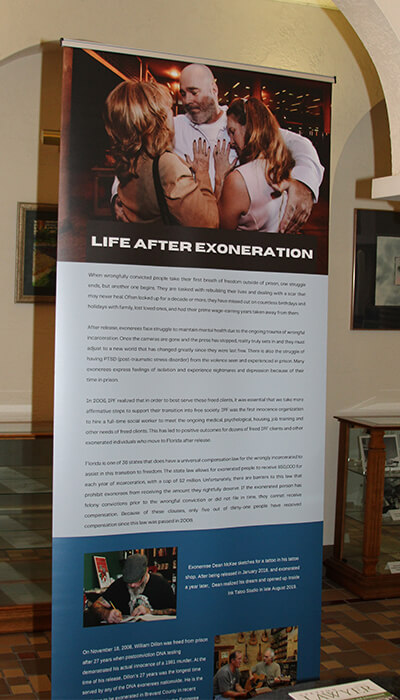
Stetson University College of Law’s Dolly & Homer Hand Law Library is hosting an exhibit from the Innocence Project of Florida now through the end of the month.
The exhibit is an opportunity to learn more about the work of the Innocence Project of Florida (IPF) and the Innocence movement as a whole, said Professor Ellen Podgor, who serves on the Board of Directors of the IPF. It describes the most common factors in wrongful convictions and their prevalence in known wrongful convictions, including eyewitness misidentification, official misconduct, and invalid forensic evidence.
The exhibit runs through the end of October.
Featured in the display are four IPF clients who were freed after having spent years in prison for crimes they did not commit: Orlando Boquete, Amanda Brumfield, and Nathan Myers and Clifford Williams (Myers and Williams were jointly convicted and exonerated). The exhibit also describes what life after exoneration is like for those who were wrongfully convicted.
“It was so nice getting to take time to read the stories of those wrongfully incarcerated,” said Alexis Ercia, a 3L and president of the Stetson’s Innocence Initiative. “The event is a real-life example of what we learned in Criminal Law.”
This exhibit was created in conjunction with “The Freedom Bowl: Tackling Wrongful Convictions One Turf at a Time,” a joint event hosted by the IPF and the Georgia Innocence Project in honor of International Wrongful Conviction Day, which is recognized on October 2, said Emily Thourson, finance and human resources manager for IPF. A video replay of that event is available on Crowdcast and includes a segment with Nathan Myers. The video requires email registration but is free to view.
“We hope the Stetson Law community enjoys learning about our work,” she said.
Current Library hours are Monday – Friday: 7 a.m. – 10 p.m., Saturdays: 10 a.m. – 6 p.m., and Sundays: 11 a.m. – 6 p.m. Because of the pandemic, The Dolly & Homer Hand Library is open only to faculty, staff, and students; there will be no access to the public until further notice.
FOR IMMEDIATE RELEASE Contact: Ashley McKnight-Taylor 727-562-7381
GULFPORT, Fla. — Stetson University College of Law received the 2021 Higher Education Excellence in Diversity (HEED) Award from INSIGHT Into Diversity magazine, the oldest and largest diversity-focused publication in higher education.
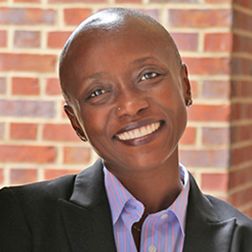
Dean Michèle Alexandre
The magazine selected Stetson Law for its inclusive curriculum initiatives, including in Criminal Law and Research and Writing courses; Americans with Disabilities Act initiatives, such as the creation of the Disability Allied Law Student Association; and development efforts focused on diversity scholarship fundraising and alumni engagement.
“We are thrilled to be recognized for the second year in a row for our ongoing efforts to foster an inclusive community where everyone is expected to lead with respect, compassion and professionalism,” said Dean Michèle Alexandre. “We are committed to the university-wide work of meaningful inclusionary practices among students, faculty, and staff regardless of the national recognition, but the HEED Award offers encouragement for continuing to lead by example in this important area.”
As a recipient of the annual HEED Award — a national honor recognizing U.S. colleges, universities and professional schools that demonstrate an outstanding commitment to diversity and inclusion — Stetson Law will be featured in the November 2021 issue of INSIGHT Into Diversity magazine.
Lance Long
“The HEED Award process consists of a comprehensive and rigorous application that includes questions relating to the recruitment and retention of students and employees — and best practices for both — continued leadership support for diversity, and other aspects of campus diversity and inclusion,” said Lenore Pearlstein, publisher of INSIGHT Into Diversity magazine. “We take a detailed approach to reviewing each application in deciding who will be named a HEED Award recipient. Our standards are high, and we look for institutions where diversity and inclusion are woven into the work being done every day across their campus.”
Last year, Stetson Law was recognized for concentrated efforts, among others, to recruit and retain historically underrepresented and first-generation students through a pre-law pipeline program that included mentorship throughout their academic career and specialized fundraising to ensure they had the financial wherewithal to complete law school.
Stetson Law continued to build on those efforts, this year adding greater focus on diversity scholarship fundraising and alumni engagement. Additionally, College of Law faculty leaders thoughtfully updated specific portions of their curriculum to integrate race and the law in course materials for Criminal Law and Legal Writing & Research courses – classes that all first-year law students are required to take.
“I am thrilled for this recognition and lift up of our faculty colleagues who collaborated to integrate race and the law in the research and writing and criminal law curriculum,” said Professor Lance Long, co-chair of the Stetson University College of Law Diversity and Inclusion Committee.
Carmen Johnson
Orientation for all new students, including transfer and visiting students, features two separate training and community standards sessions on cultural competence. Last, but not least, the Accessibility Resource Office expanded its work to provide reasonable and effective accommodations or testing modifications, as well as monitored campus compliance with disability rights laws.
“We are so proud of this recognition, which comes just as we are putting the finishing touches on a two-year plan of action to tackle even greater initiatives at both Stetson University and the College of Law,” said Carmen Johnson, Stetson University’s Executive Officer for Diversity, Collaboration, and Inclusion. “This is a galvanizing reminder that we are headed in the right direction and gives us additional motivation for the collaborative work ahead.”
For more information about Stetson University College of Law, visit stetson.edu/law.
About Stetson University College of Law
Stetson University College of Law, Florida’s first law school, has prepared lawyers and leaders since 1900. Today, Stetson leads the nation in blending legal doctrine with practical training, evidenced by its top-ranked programs in advocacy and legal writing. Through its academically rigorous curriculum and commitment to social responsibility, Stetson produces lawyers who are ethical advocates ready to succeed in the legal profession.
About INSIGHT Into Diversity
INSIGHT Into Diversity magazine is the oldest and largest diversity publication in higher education today and is well-known for its annual Higher Education Excellence in Diversity (HEED) Award, the only award recognizing colleges and universities for outstanding diversity and inclusion efforts across their campuses. In addition to its online job board, INSIGHT Into Diversity presents timely, thought-provoking news and feature stories on matters of diversity and inclusion across higher education and beyond. Articles include interviews with innovators and experts, as well as profiles of best practices and exemplary programs. Readers will also discover career opportunities that connect job seekers with institutions and businesses that embrace a diverse and inclusive workforce. Current, archived, and digital issues of INSIGHT Into Diversity magazine are available online at insightintodiversity.com.
Stetson University College of Law’s first-time bar takers passed the July 2021 Florida Bar examination at the rate of 78.8 percent. The statewide average was 71.6 percent. This marked Stetson’s best pass rate for first-time takers since July 2016.
“We are thankful for the entire College of Law community who provided a myriad of support to our bar takers,” said Dean Michèle Alexandre.
Stetson Law placed fourth among Florida law schools for the percent of graduates passing the exam on their first try, according to the Florida Board of Bar Examiners. Bar takers were still riding the tumultuous waves of pandemic-induced changes with this summer’s test, which was held remotely instead of the traditional in-person event.
“We are committed to ensuring every Stetson Law student has a strong foundation upon which to prepare for and pass the bar,” Alexandre said.
Stetson Law Professor Lance Long helped create and now serves on the board of Conserve Utah Valley (CUV), a non-profit organization that works to protect unspoiled land and water in the region from development.
Bridal Veil Falls, Provo, Utah. (Image by Mike Scalora via Wikimedia Commons)
“CUV was formed in response to repeated attempts by developers in Utah Valley (which is the name people in Utah use to refer to the valley south of the Salt Lake Valley) to quietly have publicly owned, beautiful and pristine foothills, canyons, rivers, and water sold and developed for high-end users at the expense of existing residents and the citizens of Utah Valley,” Long explained.
The idea began when a group of concerned citizens learned a developer wanted to build a drug rehabilitation center and public tramway at Bridal Veil Falls, a scenic waterfall recreation area in Provo Canyon that is one of the most iconic and well-known landmarks in Utah Valley and attracts thousands of local visitors per year.
“A number of us got so shocked at the brazen commercialism,” said Craig Christensen, an entrepreneur and nature lover who was moved to speak up once the development plan was unveiled. He now serves as executive director of CUV.
A grassroots effort driven by local citizens such as Christensen and students from Brigham Young University emerged to protect the falls. They sought guidance from Long, who was already a director and executive board member of an existing land preservation organization, Rock Canyon Preservation Alliance (RCPA). That group had fought similar attempts to develop Rock Canyon in Utah Valley. It soon became clear an overarching organization was needed to help protect all of Utah Valley’s dwindling open spaces.
CUV was born, and one of its first victories was rallying citizens to oppose the sale of Bridal Veil Falls and convincing the Utah County Commission to unanimously approve a measure to block private development of the falls.
Lance Long
“We not only defeated the sale but have introduced legislation to have the falls become a state monument, preventing any attempted development of the area in perpetuity,” Long said. “Currently, we are working to ensure that the Bonneville Trail, a popular hiking trail that traverses the length of the Valley along the foothills of the Wasatch Range, formalizes and maintains its access easements and easements across private lands.”
Christensen said the early members of CUV had little knowledge of the conservation process and associated lingo, so having Long’s involvement was crucial to them understanding what could and should happen, as well as, frankly, to maintaining optimism.
“People like Lance give the rest of us hope,” Christensen said. “He has that calming influence of having been involved with these issues for so long.”
Long was asked to take a role as a director of CUV but declined because of his commitments to RCPA and the fact that he lives in Florida during the academic year, teaching environmental law courses at Stetson. However, he continues to meet monthly with the board as a board member and provide legal support to the group.
“It’s hard to calibrate the value of that kind of experience he brings to a small group like ours,” Christensen said.
While CUV won their first battle, the war is ongoing. Utah state legislators are now discussing turning Bridal Veil Falls into a state park, which CUV members fear could result in unintended consequences of entrance fees and overtourism. They are also working to identify other at-risk spaces, continuing outreach efforts to educate local citizens about important conservation initiatives, and fostering regular, transparent dialogue among city, county and Forestry Service officials.
Many of the student participants in Stetson Law’s new Youth Civic Engagement Program for teenagers between the ages of 15-17 attended a wrap-up ceremony and campus tour at the end of the week-long course.
Stetson Law’s July 2021 Pipeline Program
“I think that one of the ‘a-ha’ moments that I witnessed really had to do with civil dialogue. Students really believe that when they’re ‘right,’ quote unquote, that they need to get their point across. But when they learned that the point of advocacy and the point of activism is to get other people to understand their position – not to be right, not to win – but to actually help others understand the issues, I think that was a big ‘a-ha’ moment for many of them,” said Professor Judith Scully.
She was one of three Stetson Law professors who led the school’s new Youth Civic Engagement Program last month. The weeklong summer experience was designed for Pinellas County teenagers, between the ages of 15-17, considered underrepresented because of race, sexual orientation, gender identity, socio-economic status, or school performance. The goal was to train the teens how to advocate for themselves and others.
Christine Cerniglia
“I had no idea how engaged they would be, and they took off with it,” said Professor Christine Cerniglia. “It was awesome!”
“This young generation is fierce, so how to guide and lead them is a task for us to figure out and keep up with them just to be quite honest,” she added. “They’re inspiring.”
The courses included: Self and Society; Human Rights and Global Citizenship; Technology and Human Rights; Cyberlaw and Human Rights; Mindfulness, Listening and Civil Dialogue; Social Media and Human Rights; Advocacy, Community Building and Protest; 4th Amendment Rights in Public Schools; and Self-Optimization and Individual Goal Setting.
Katie Parish, 15, was excited to learn about deductive reasoning and syllogism, saying that she often used those tools in discourse with others without realizing “that it was an actual thing.” She found the program to be engaging and encouraging.
“It’s just a very interesting, like, in-depth version of civil rights law and advocacy,” Parish said. “It makes advocating seem so much easier than it really looks, right? Because it seems so hard for kids our age, but Professor Scully and Professor Cerniglia and all the different people who were in the program just made it seem so easy.”
Eriam and Erin Shepherd were two of the participants.
William and Erica Shepherd, whose two daughters participated in the course, said the girls gained confidence and learned that communication is key to understanding themselves and others so they can work together to solve problems.
“First of all, this program was wonderful,” William Shepherd said. “It really taught them a lot about the concept of human rights and civics and learning how to implement themselves into that program.”
Stetson Law officials recognized that, during the last 20 years, civics education and social action programming have decreased nationally. Students have little, if any, opportunity at the high school level to access the knowledge and tools they need to be advocates. Given Stetson Law’s longstanding expertise in teaching students to think critically and advocate for vulnerable groups, school officials believed creating a program like this would be a valuable contribution to the community.
Judith Scully
“I taught a course called Advocacy, activism and social change, and it really introduced students to the fact that young people have always been at the forefront of changing public policy, and that they, too – our 2021 students – can also engage in advocacy that really makes a difference not just locally, not on the state level, not just on the national level, but internationally as well,” Scully said.
“I think our students were really excited about learning about how to harness their power and really participate in our democracy,” she added.
The students learned how to present themselves and do research, as well as the importance of voting and participating in government. One of the key lessons that surprised and delighted participants was the fact that in Florida, at age 16, they can pre-register to vote and get involved.
“The most useful thing I learned this week was Ten Ways to be an Advocate,” said Eriam Shepherd, 16. “I learned I can educate myself and others and that I can possibly in future run for office. And I learned about human rights and how my rights as a human are valid, and I need to know about those things.”
Stetson partnered with Foundation for a Healthy St. Petersburg to create and launch the new program. More than 40 students applied for the 30 openings, and ultimately 31 students completed the course, which was held virtually this year because of the pandemic. Next year’s class is expected to be held on Stetson’s Gulfport campus.
Stetson Law Professor Louis J. Virelli III was tapped for membership in a group of leading administrative law scholars to provide a federal agency with academic research and expertise.
The Administrative Conference of the United States (ACUS) created a new Council on Federal Agency Adjudication in September 2020 to provide a forum for the heads of agency adjudication programs to exchange information about procedural innovations, best management practices, and more.
Virelli is one of group of law scholars recently announced as the Council’s academic consultative group. He first became involved with the ACUS in 2018 when he was selected to draft a report on recusal of agency adjudicators. Virelli has since authored Administrative Recusal Rules: A Taxonomy and Study of Existing Recusal Standards for Agency Adjudicators in 2020 and Recusal Rules for Administrative Adjudicators in 2018. That report led to the adoption of ACUS Recommendation 2018-4 – Recusal Rules for Administrative Adjudicators.
“I am honored to be included among this group of outstanding administrative law scholars and am looking forward to continuing my work with ACUS,” he said.
ACUS is an independent agency within the Executive Branch of the United States government. Its volunteer members are drawn from other federal agencies as well as from those in the private sector with expertise and experience in law and government. Its mission is to study administrative procedures in federal programs and recommend improvements. In other words, “a public-private partnership designed to make government work better,” as President Obama said in 2010.
It accomplishes this mission by conducting research, formulating recommendations, spreading agency best practices, promoting information exchange, and sponsoring events and publications. Over the first 30 years of its existence, the Conference issued approximately 200 recommendations, most of which were implemented in whole or in part.
In addition to Virelli, the other legal scholars in the new academic consultative group are:
Michael Asimow (Santa Clara University School of Law)
Kent Barnett (University of Georgia School of Law)
Jack Beermann (Boston University School of Law)
Emily Bremer (University of Notre Dame Law School)
Jill Family (Widener University Commonwealth Law School)
William Funk (Lewis & Clark Law School)
Robert Glicksman (The George Washington University Law School)
Daniel Ho (Stanford Law School)
Linda Jellum (Mercer University School of Law)
Renée Landers (Suffolk University Law School)
Jeffrey Lubbers (American University Washington College of Law)
Michael Sant’Ambrogio (Michigan State University College of Law)
Bijal Shah (Arizona State University Sandra Day O’Connor College of Law)
Anna Shavers (Nebraska College of Law)
Urska Velikonja (Georgetown University Law Center)
Christopher Walker (The Ohio State University Moritz College of Law)
Melissa Wasserman (University of Texas School of Law)
The Record and Rules for the 26th Annual Stetson International Environmental Moot Court Competition (IEMCC) have been released and are now available on the IEMCC website.
The theme for this year’s problem is “Protected Areas and Armed Conflict.”
The global, multi-part contest gives students around the world an opportunity to learn more about and advocate for environmental issues impacting the planet. Teams compete in national and regional rounds throughout the world, and the top teams are invited to participate in the International Finals.
The International Finals are planned for April 7-9, 2022, at Stetson University College of Law’s campus in Gulfport, Florida. Last year’s competition was held virtually because of the pandemic. Law Society of Ireland was named winner in that contest, and Symbiosis Law School, Pune, India, was runner-up.
Additional information about national and regional rounds will be posted on the IEMCC website as it becomes available. For updates, visit https://stetson.edu/iemcc and follow the IEMCC Facebook page @StetsonIEMCC and Professor and Director of the Institute for Biodiversity Law and Policy Royal C. Gardner on Twitter @swamp_prof.
Stetson Law’s Institute for Biodiversity Law and Policy released its 2020-2021 Annual Report this month, and the contents highlight how, despite the global pandemic, the Institute continued to provide environmental education, research, and service locally, nationally, and internationally this past year.
Led by Professor of Law and Director, Royal C. Gardner, the Institute for Biodiversity Law and Policy is Stetson Law’s interdisciplinary focal point for environmental law programs and initiatives. Some of the highlights from the report include:
Nationwide legal support
In April 2020, the U.S. Supreme Court decided County of Maui v. Hawaii Wildlife Fund, a critical Clean Water Act case. The majority opinion cited an amici curiae brief that Gardner, Erin Okuno (assistant director of the Biodiversity Institute) and a team of attorneys had filed on behalf of aquatic scientists and scientific societies. Gardner discussed the caseand how scientists can contribute to policymaking in a presentation for the Society for Freshwater Science’s Summer of Science, and the amici brief was featured in a PBS NOVA podcast on Science in the Courtroom.
The Institute has continued to file amici curiae briefs, including in California, Massachusetts and South Carolina, on behalf of aquatic scientific organizationsto explain the importance of considering science when making decisions under the Clean Water Act. The briefs are available on the Biodiversity Institute’s website.
International outreach
The Institute faculty and staff maintain ongoing relationships with the Inter-American Convention for the Protection and Conservation of Sea Turtles and Ramsar Convention on Wetlands, two international organizations. This year they also collaborated on projects with the University of Philippines Law Center’s Institute of International Legal Studies, Alberta Land Institute of the University of Alberta, and the University of Barcelona.
Student success
Keep Tampa Bay Beautiful (KTBB) selected Stetson Law student Nicholas Lewis as the recipient of the 2020 Environmental Education Program Award for a project he worked on in Professor Lance Long’s Environmental Advocacy course. Nicholas developed K–12 lesson plans for KTBB’s Environmental Education Center.
Recent Stetson Law graduates also are putting their environmental law education into practice. Brian Remler started at Morris, Manning & Martin, LLP’s Atlanta office working with their Environmental and Construction Practice Group, which specializes in brownfield redevelopment. Jess Beaulieu accepted a position as the program manager for Denver University Sturm College of Law’s Animal Law Program.
Read the full 2020-2021 Annual Report on the Institute for Biodiversity Law and Policy website.