Skip to content

Hall of Fame 2025: Ying White ’97

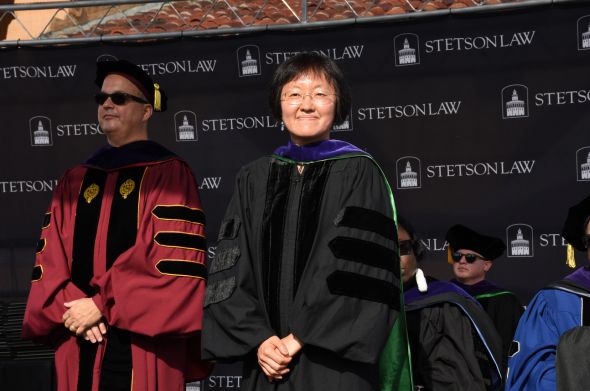
A woman with a dark bob and glasses smiles; she wears full ceremonial regalia. A man in red graduation regalia is in the background.
Ying White ’97 was the commencement speaker at the spring 2025 commencement. She was inducted into Stetson Law’s Hall of Fame in 2025.

When Ying White ’97 first became an attorney, her father-in-law gave her a picture of a young Abraham Lincoln, which she kept in her office. It was a reminder of what hard work and perseverance can accomplish.

“Here was a man aspiring to be an attorney with no formal legal education,” she said during her spring 2025 commencement address at Stetson Law. “Only through his own efforts, did he not only succeed in that task but as we all know, went on to become one of the great presidents of this country.”

A magna cum laude Stetson Law alumna, White has achieved much through her own hard work and perseverance. With a career defined by supporting major financial institutions amid a shifting global economy, a passion for giving back to her alma mater, and efforts to help Stetson grow its international reach, she is among the latest to join the Stetson Law Hall of Fame.

White was inducted at a November 1 ceremony at the Don CeSar on Florida’s St. Pete Beach.

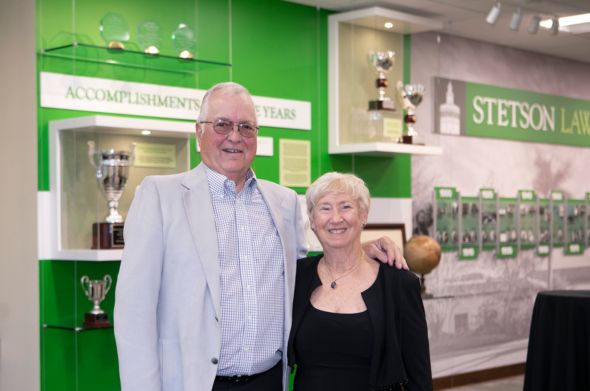
A woman with dark hair and a grey-striped suit and a man in a button-up shirt and jeans stand in front of a while featuring comemmorative plaques.
Ying White ’97 and former Dean Bruce Jacob ’59.

“The word that I would use to encapsulate Ying is driven,” said Dean D. Benjamin Barros. “She’s achieved so much in her career because she was willing to work so hard at it. She’s incredibly smart and incredibly talented. You see the drive in her. She’s really at the top of the game.”

Success on a global scale

White’s adaptability equipped her to thrive in a changing world. As partner at the global law firm Clifford Chance LLP, she has advised global fund managers like Citadel, BlackRock, and Vanguard on how to be profitable as they entered the China market.

She has advised sovereign wealth funds and Chinese businesses on their investments with major global funds. As chair of the American Bar Association’s China Law Committee, she conducted many US-China legal exchange programs. Throughout her career, she has sought to embody the values she says Stetson Law instilled in her and her classmates: compassion, ethics, courage, and boldness in the pursuit of justice.

Showing love for her alma mater

For years, White has mentored international students and alumni. She served on the Stetson Law Alumni Association Advisory Board Member from 2005-2008 and has personally supported Stetson Law Greatest Needs, the W. Gary Vause International LLM Scholarship, and Stetson Law Scholarships.

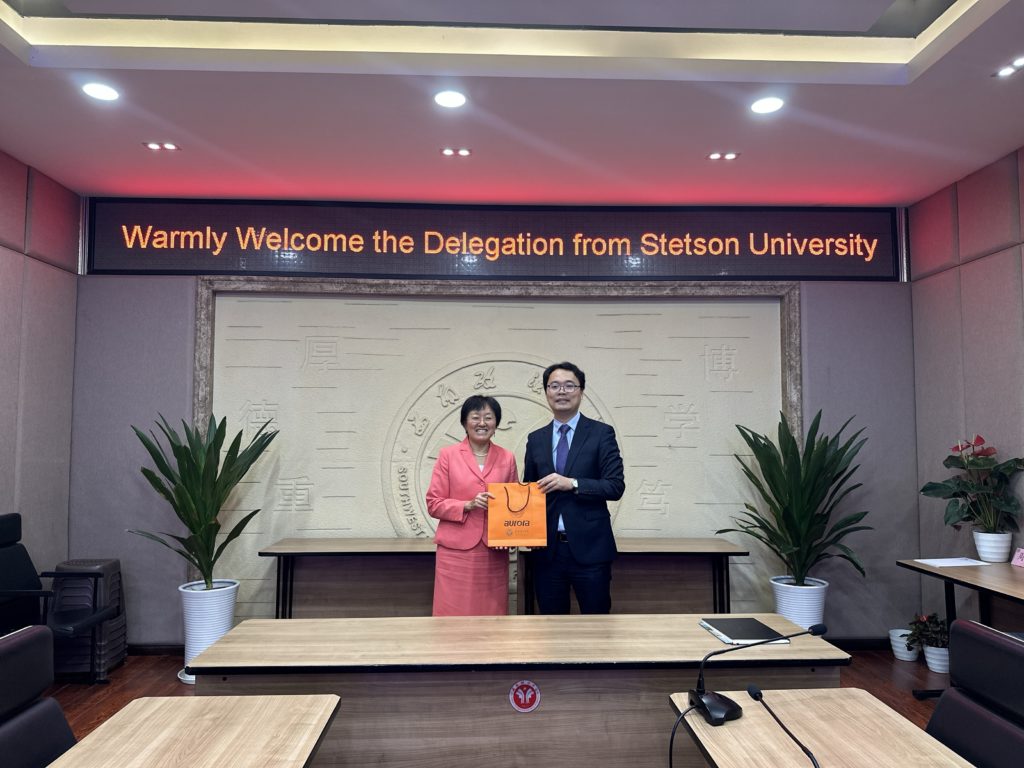
A woman wears a salmon-colored suit and a man wears a dark suit. Together, they hold an orange bag that says "aurora." There are Chinese characters on the wall behind them.

After Barros expressed a desire to have Stetson Law increase its international student enrollment, White offered to serve as a host, liaison, and translator on an October 2024 trip to China to explore academic partnership opportunities. The trip included a visit to Southwest University of Political Science and Law in Chongqing, China, which then sent a delegation for a productive visit to Stetson Law in March 2025.

Hall of Fame 2025: Michael Marder ’77

A man in a black suit and a woman in black formal dress
Michael Marder ’77 and his wife, Crisa Marder.

When he guest lectured for Professor Joseph Morrissey’s Documents of the Deal course, Michael Marder ’77 was thrilled to demystify securitization transactions for the students.

Marder, who is co-managing director and co-founder partner at prominent national firm GreenspoonMarder, sought to impart real-world financial scenarios while giving students a sense of the challenges a day can bring.

“My clients come from all industries and I handle myriad issues,” Marder said. “Big or small, all matters can be broken down to the people involved, and my pleasure is taking care of people.”

Whether it’s offering students insights from his own success story, contributing to student scholarships, or looking to his alma mater for firm’s next great hire, Marder’s extensive support of the College has earned him a place in the Stetson Law Hall of Fame. Marder was formally inducted into the Hall of Fame during a ceremony that took place November 1, 2025 at the Don CeSar on Florida’s St. Pete Beach.

“He’s an important supporter of the College of Law,” said Stetson Law Dean D. Benjamin Barros. “His firm hires our graduates. He’s what any law school dean would want an alum to be in terms of his engagement and support of the institution.”

The road to prominence

Since cofounding his firm with Gerald Greenspoon in 1981, Marder has focused on complex business litigation, transactional law, and real estate. He has sharp acumen in hospitality and vacation ownership law.

From a large timeshare and vacation ownership company to small hospitality businesses, his clients span the industry. Drawing on decades of experience, he works tirelessly to support them in their work, from project planning to administration of their properties. The firm now has grown to more than 225 attorneys and more than 20 office locations across the country. Yet he also remains committed to helping those in need. Marder chairs the Governing Board of Directors and the Advisory Board of the Victoria’s Voice Foundation, a nonprofit that supports initiatives to fight substance use disorder. He is also a member of the American Resort Development Association Chairman’s League.

Staying connected with Stetson

Despite a busy schedule, Marder remains a driving force at Stetson Law.

He generously supported construction of the Advocacy Institute, where the Michael Ellis Marder Courtroom was named in his honor. He and his firm have also contributed to the Center for Advocacy Education, Stetson Law Greatest Needs, Law General Scholarships, and the Honorable Thomas B. McCoun II Scholarship. He has hosted numerous alumni receptions and admitted student events at his home and in Greenspoon Marder locations including Boca Raton, Los Angeles, New York, and Orlando.

A member of Stetson Law’s Board of Overseers, he also has assisted the college in formulating plans for the future of the Tampa Law Center, thereby ensuring the College’s status as a regional leader for generations to come.

Hall of Fame 2025: Professor Peter Lake

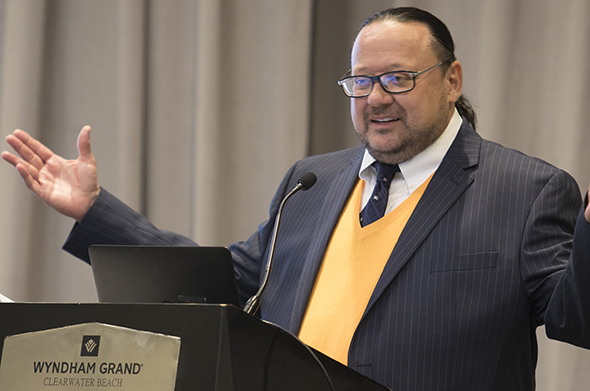
Law Professor Peter Lake speaks at a conference
Law Professor Peter Lake, Charles A. Dana Chair and Director, Center for Excellence in Higher Education Law and Policy

To alumni who took his torts class and top leaders in higher ed, Professor Peter F. Lake has achieved rockstar status. With more than 30 years in higher education, this professor of law, Charles A. Dana Chair, and director of Stetson’s Center for Excellence in Higher Education Law and Policy has shown an unparalleled commitment not just to the College, but to higher ed itself.

For these reasons and more, Professor Lake is now a member of the Stetson Law Hall of Fame. “Peter Lake is an absolutely remarkable person,” said Stetson Law Dean D. Benjamin Barros. “When I’m out meeting with alumni, we often ask ‘Who is your most memorable professor?’ Peter Lake comes up so often. His impact on his students is really tangible.”

Professor Lake was inducted into the Hall of Fame during November 1 ceremony at the Don CeSar on St. Pete Beach, Florida.

An enduring passion for higher ed

Lake is an internationally recognized expert on higher education law and policy and has been quoted or referred to in hundreds of newspapers and court opinions. He is an award-winning academic and has authored numerous law review articles, books, and other publications.

A young man in black and a man with white hair, a blue suit, and a red tie hold a plaque.
Law Professor Peter Lake and former Stetson Law Dean Gary Vause

With support from his team, the center hosts hundreds of college and university officials for the National Conference for Higher Education Law & Policy, held annually on Clearwater Beach. As the event’s tagline, “See you at the beach,” suggests, his rigorous work ethic is tempered by his easygoing demeanor. Since joining the College of Law faculty in 1990, the double-Harvard graduate has served in many administrative functions at Stetson, including honor code administrator, interim director of Title IX compliance, special assistant to the dean, and the faculty representative to the board of trustees. He also serves his profession through extensive consulting work.

Decades of impactful work

In the classroom, Professor Lake also stands out. When alumni are asked about their favorite professors, he is one of the most common responses. His torts class is a favorite among students and alumni. Professor Lake’s engaging style and ability to make complex topics easily digestible have endeared him to generations of alumni. By supporting the Professor Peter F. Lake “Spirit of the Law” Award Endowment and the College of Law Food Pantry, he is also helping ensure students are equipped to succeed in their law school journey and beyond.

Hall of Fame 2025: Dean Darby Dickerson

A man in a pale suit and a woman wearing a green velvet suit jacket hold a plaque.
Law Professor Robert Bickel and former Stetson Law Dean Darby Dickerson

Beloved former Dean Darby Dickerson’s impact is visible across campus and reflected in the College’s nation-leading programs.

From helping solidify the College’s status as a national leader in legal writing to fostering a relationship with Dolly and Homer Hand, namesakes of the Dolly and Homer Hand Library, her work was transformative during her time as dean from 2005 through 2011. She also hired celebrated faculty members who still teach today.

To say Dickerson was beloved by students is an understatement. She is regularly remembered fondly by those who shared time with her at Stetson and is celebrated by the greater legal education community.

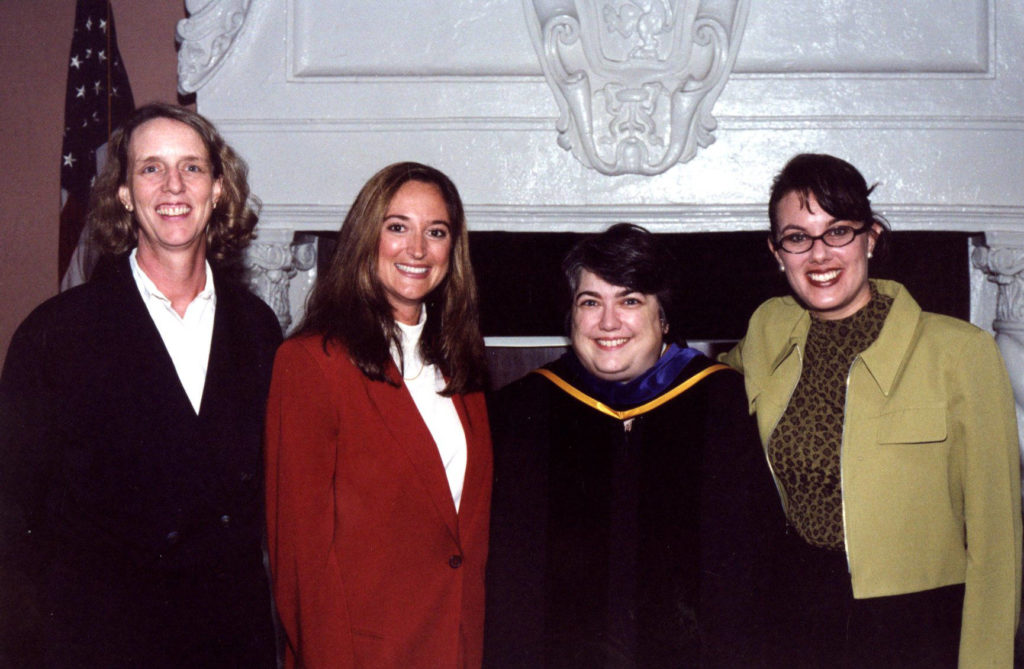
Four women in professional dress smile at the camera in front of a fireplace.
Left to right: Law Professor Emerita Ann Piccard, Law Professor Stephanie Vaughan, Dean Darby Dickerson, Law Professor Kelly Feeley.

For her profound impact on the College of Law and the legal profession itself, she is now a member of the Stetson Law Hall of Fame. She was officially inducted during a ceremony that took place November 1, 2025 at the Don CeSar on St. Pete Beach, Florida.

“When I talk with alumni about Darby, their eyes light up,” said Stetson Law Dean D. Benjamin Barros. “Her national reputation is stellar. She was president of the Association of American Law Schools. She is one of the best-known legal-writing scholars in the United States. She’s a rockstar in legal education.”

Dickerson is now a member of the Stetson Law Hall of Fame.

A prolific jurist and scholar

Dickerson joined the Stetson Law faculty in 1995 after practicing at Lock Liddell & Sapp, LLP and serving as a law clerk for the United States Court of Appeals for the Sixth Circuit.

At Stetson, she held many administrative roles, including vice dean, director of legal research & writing, moot court board director, and others. She has taught Legal Research and Writing, Contract Drafting and Review, Torts, ADR, Arbitration, and Election Law. She has supervised various externships, advised law reviews, and coached moot court boards and teams.

Following her time at Stetson, she served as dean at Texas Tech University School of Law, dean/CEO of The John Marshall Law (which she helped to merge into the University of Illinois Chicago), and dean at the University of Illinois Chicago School of Law. She is now dean and president at Southwestern Law School in Los Angeles, California.

A woman in a beige jacket sits next to a man in a black suit on a stage.
Former Stetson Law Dean Darby Dickerson talks with then-US Supreme Court Justice Stephen Breyer in 2019.

A lasting legacy

In addition to her many contributions as dean, Dickerson has also personally supported the college. She has made gifts to Stetson Law Greatest Needs, the Edward D. Foreman Most Distinguished Student Award, and the Priscilla and Lawrence Adams Scholarship.

Upon her departure from Stetson, the Stetson Lawyers Alumni Association established the Dean Darby Dickerson SLAAC Scholarship Endowment to honor her “devotion to leadership, writing, advocacy, love for higher education and pursuit of other scholarly endeavors.”

FL Supreme Court Chief Justice Speaks at Stetson

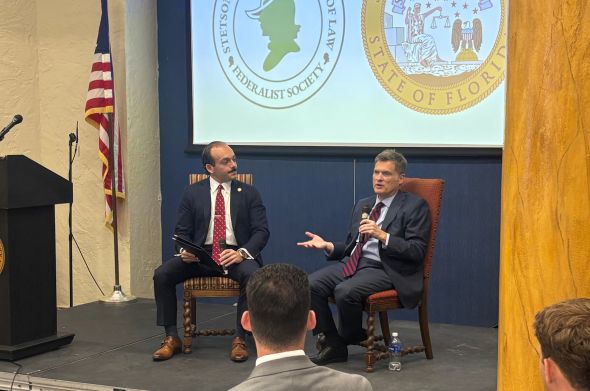
Two men wearing suits and ties sit and talk on a stage in front of a screen displaying the logos for the Stetson Federalist Society and the Florida Supreme Court.
Student Frank Giallourakis chats with Florida Supreme Court Chief Justice Carlos G. Muniz.

Members of the Stetson Law community packed the Mann Lounge on Thursday, October 23 to hear Florida Supreme Court Chief Justice Carlos G. Muniz’s thoughts on everything from judicial philosophy to how to succeed in the legal profession.

The fireside chat-style event was organized by the Stetson Law chapter of the Federalist Society and moderated by Frank Giallourakis, the organization’s president. “This afternoon was not just a tremendous honor for our Federalist Society chapter to host Chief Justice Muniz, but a historic day for our beloved Stetson law,” Giallourakis said following the event. “Chief Justice Muniz graciously took the time to speak to a crowd of over 100 students, faculty members, and administrators about judicial philosophy, the judiciary’s role under the Constitution, trends in Florida precedent concerning statutory interpretation, and how my Stetson law colleagues and I can best prepare ourselves to achieve great success.”

On building a meaningful career

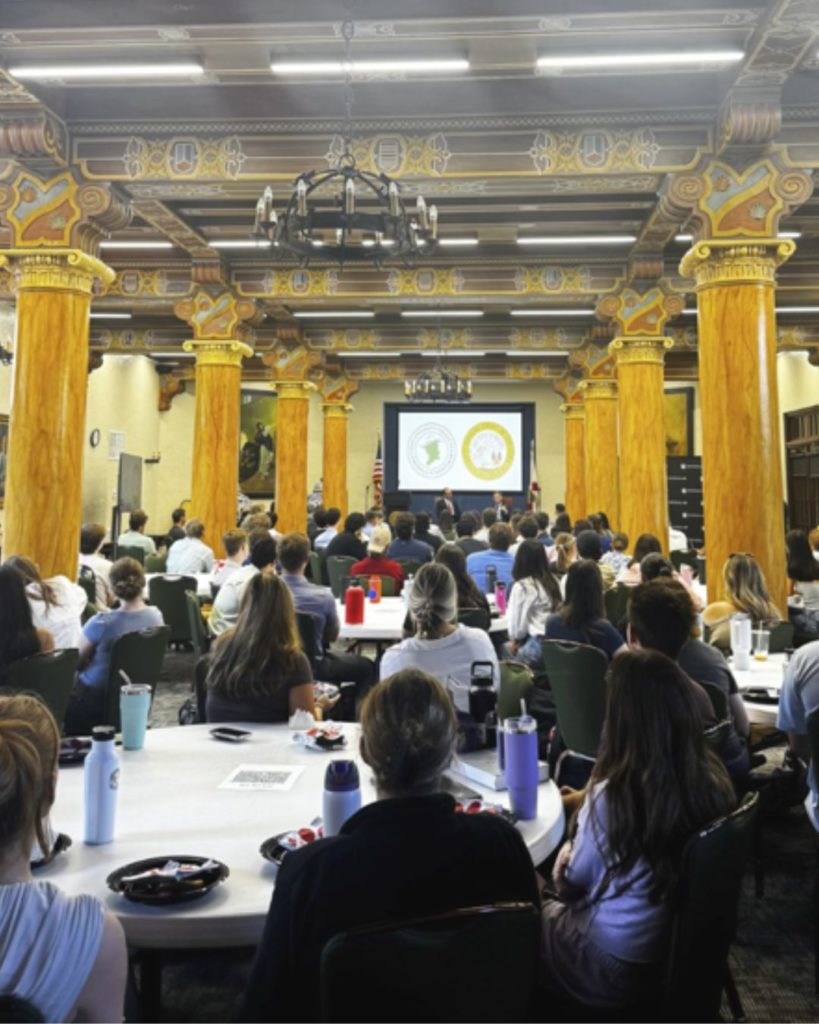
A photo of a room full of people from the back of the Mann Lounge
Florida Supreme Court Chief Justice Carlos G. Muniz spoke to a room full of students, faculty, and staff.

Chief Justice Muniz kicked off the conversation with his thoughts on how law students can realize their full professional potential.

One’s path is a combination of luck, merit, and relationships, he told the audience. Many opportunities happen because of positive impressions one gives his or her mentors and peers, and most people who find success want to pay it forward.

“Don’t be shy about asking people for help,” he said. “All of us have benefited from other people taking interest in us and helping us and my experience is that people want to be able to give back and help others who are coming along after them.”

Service & judicial philosophies

Muniz offered his thoughts on varying judicial philosophies such as originalism and textualism – and how judges’ relationship to the law differs from that of legal scholars.

He stressed that it is not the role of the judge to determine the outcome of a case based on their personal morals and opinions, but instead to subordinate one’s own views and will try to get the case right based on existing laws.

“There are lots of things judges don’t have control over. We don’t have control over what the law is. We don’t have control over the cases that come before us,” he said. “We do have control over how we treat people; whether we make sure that people have due process; whether they feel like judges came to the cases prepared and thoughtful. We really do try to promote that culture of service… The law is not just for judges. It’s for everybody.”

Organizers praised Chief Justice Muniz for his emphasis on shared values over the divisive rhetoric that can often dominate in conversations about law and policy.

“Chief Justice Muniz emphasized the importance of civility, careful study of the law, and a commitment to excellence in everything that we do not only as law students but practicing attorneys,” Giallourakis said. “We extend our sincerest gratitude to the administration for their steadfast support and look forward to carrying this momentum into our upcoming events.”

Learn more about Chief Justice Muniz.

Dr. Kirsten Davis Wins AALS Legal Writing Award

A closeup shot of Law Professor Kirsten K. Davis, who smiles at the camera.
Law Professor Kirsten K. Davis

The Association of American Law Schools’ Section on Legal Writing, Reasoning, and Research is honoring Stetson Law Professor Kirsten K. Davis with its 2026 section award.

Recognizing an individual whose tireless work supports the advancement of the field, the award cites her extensive contributions to the legal writing community through scholarship, leadership, and transformative work, including her recent work on generative AI and legal communication.

When Davis was notified of the news during a surprise presentation arranged by Vice Dean Jason Palmer, three other luminaries from the discipline took part in the moment over Zoom and shared the reasons that Davis was the recipient of the award. She will receive the award during the AALS Annual Meeting Section Award Ceremony on Tuesday, January 8, 2026 in New Orleans.

An inspiration to colleagues

Over her 25-year teaching career, Davis has engaged her colleagues to help shape the way law schools – and, by extension, legal professionals – think about and approach legal writing. She founded the Stetson Institute for the Advancement of Legal Communication to further that mission, has produced sharp, insightful scholarship, and engaged her colleagues in forward-thinking conversations.

She has played a major role in Stetson Law’s status as a national leader in legal writing. The college is third in the nation in legal writing per US News & World Report’s 2025 rankings.

A significant aspect of Davis’s work has been shifting the discipline’s perspective on legal writing to a rhetorical one that recognizes law is appropriate for rigorous rhetorical critique, something that Stetson Law Associate Dean for Assessment and Professional Engagement Anne Mullins has found particularly influential in her own work.

“She is the person who taught me that legal writing was an inherently rhetorical exercise, and she showed me what rigorous rhetorical critique of legal texts looks like,” Mullins said. “The shift she got me to make was like going from seeing the world in black and white to technicolor.”

Davis has helped shape the future of legal education by serving in AALS leadership roles as well as on the boards of both the Association of Legal Writing Directors and Legal Writing Institute. Her body of scholarship explores the intersection of legal writing, rhetoric, and ethics, offering a rich interdisciplinary contribution. She also frequently presents at national conferences on these topics.

Leading the conversation on AI & legal communication

As generative AI began to emerge in late 2022, Davis saw the likely impact it was going to have on legal writing and higher education writ large. She founded a national conversation group on generative AI, has led workshops across the country for faculty, students, lawyers, and judges, and continues to generously share her expertise and time.

Her trailblazing work in educating the legal writing and higher education communities about the implications of generative AI is part of what led the AALS Section on Technology, Law, & Legal Education to give Davis its Technology Mentorship Award in January of 2024.

“I could not be happier to see Dr. Davis honored for her extraordinary contributions,” said University of North Dakota Assistant Professor of Law Carolyn Williams of Davis’s latest honor. “Her foresight to begin studying AI and bringing her knowledge into law schools via presentations all over the country and forming the Legal Writing and Generative AI Convo Group showcases that her work not only enriches our field—it defines it.”

Legal Research and Writing Clinical Professor Rebekah Hanley of University of Oregon School of Law said Davis has been critical to the legal writing discipline during the transition to the generative AI era.

“Her expertise, enthusiasm, and generosity are unmatched,” Hanley said. “She has led countless conversations about pedagogy, sharing key resources and facilitating productive collaboration.  She has also published – and inspired – scholarship that supports both law faculty and practicing lawyers.”

See Dr. Davis’s full bio.

At Stetson Law, Immersive Courses Dive Deep

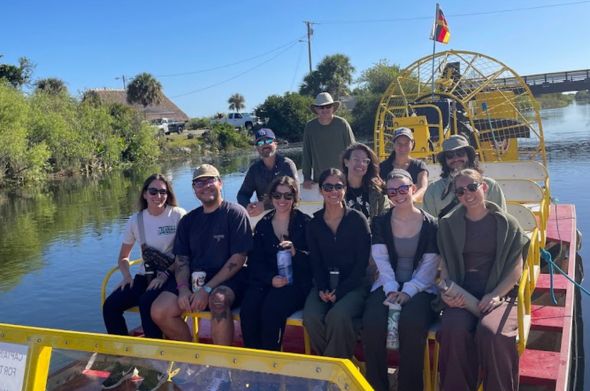
A group of students rides on an airboat in South Florida
Cases & Places brought students face-to-face with wild Florida and those who fight to preserve it.

Law courses don’t usually require a bottle of bug spray – let alone a tent. But for students who enroll in Cases and Places, a new course offered at Stetson Law, they are necessary.

One of the numerous outside-the-box courses the College offers, Cases and Places introduces students to Florida’s great outdoors, and the political, economic, and legal factors that influence how it functions today and the people leading on-the-ground efforts to protect it. In its inaugural offering, the course featured a four-day trip through the Greater Everglades, a large, biodiverse region, including its most remote environs – hence the tents.

“Getting our students out of the classroom and into the ecosystem is a powerful way to illuminate the legal documents and processes that shape our state,” said Law Professor Jaclyn Lopez, who teaches the course.

A new perspective on environmental law

Lifelong Floridian and Stetson Law student Warren Wood said the in-depth course was an enlightening experience even for someone who grew up in the Sunshine State.

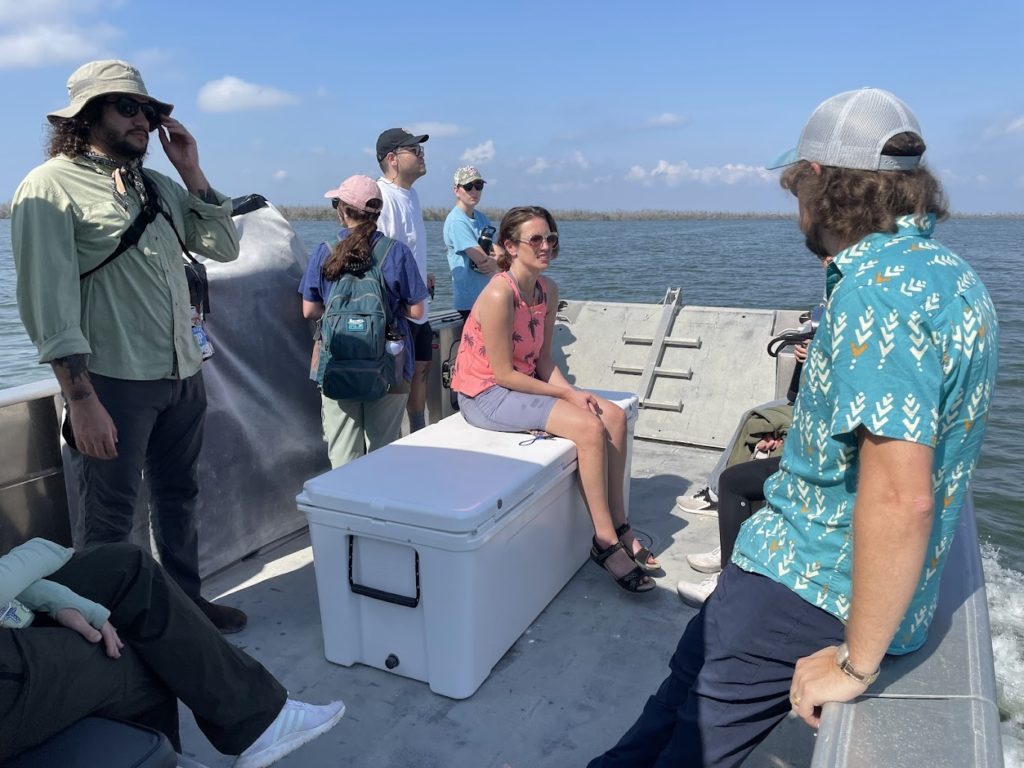
Several students and a boat captain sit on a boat in open water.
Cases & Places 2025.

“It is one thing to read about the cases that shaped our state,” he said. “But it brought things into a different perspective to go out and see the places that have been affected by the cases we studied, and meet the people who were not only involved in the past cases, but continue to fight to keep our state beautiful and clean for generations to come.”

The experience reflects the College of Law’s culture of fostering preparedness among its students through encouraging meaningful experiences and connections within the legal profession well before graduation. Travel courses offer many opportunities to do so, but some classroom-based syllabi feature immersive sessions with successful practitioners who share insights and offer practical lessons.

Cases & Places 2026 details

The second edition of the course invites students to explore Florida’s springs, live the cases, and meet the lawyers, scientists, and advocates who help shaped policy around Florida’s abundant springs.

The three-credit course involves camping trip with driving, hiking, and swimming and will be taught by Professors Lopez and Royal Gardner. It satisfies the upper-level writing requirement.

Students interested in applying can send a resume and letter of interest to Professor Lopez, [email protected], by October 24th.

A “life-changing” civil rights exploration

Every summer, Stetson’s Civil Rights Law Travel Course invites students to visit the historic sites and history-makers who shaped the Civil Rights Movement in the United States. The course launched in 2005 by then-Professor Robert Bickel and has continued with support from Wil Florin ’82 and Tommy Roebig ’86.

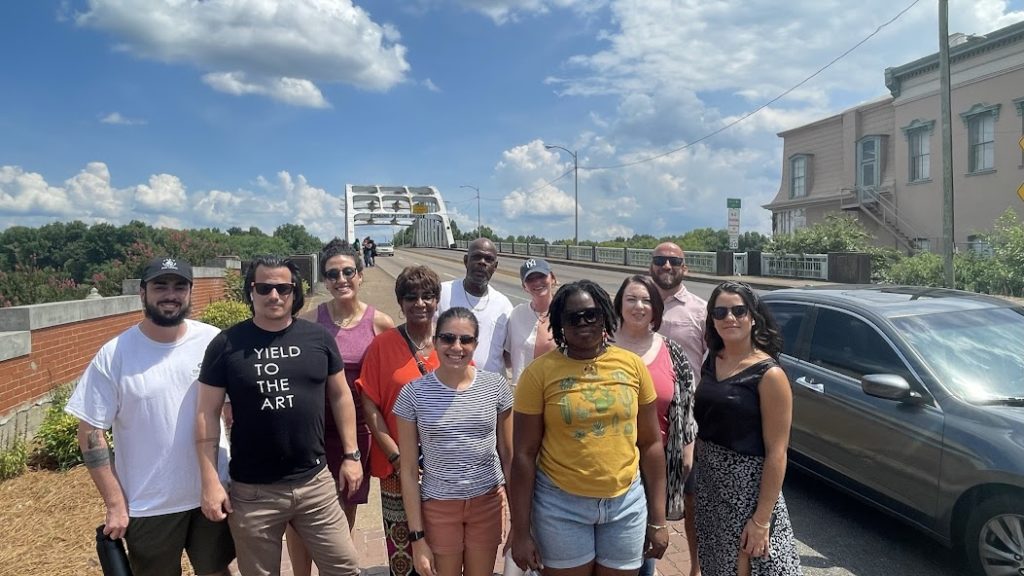
A group of students stands in front of a historic bridge on a sunny day.
A Civil Rights and the Constitution travel course is an immersive experience at Stetson Law.

The 2,000-mile journey takes them to Alabama, Georgia, and Tennessee to meet with still-living veterans of the Civil Rights Movement and explore places like the Edmund Pettus Bridge in Selma, Alabama.

Law Professor Judith Scully, who now teaches the course, said participating students describe the experience as life changing.

“As a professor who has been privileged to help lead this civil rights learning journey, I can say that my life has also been profoundly impacted and each year my commitment to teaching and learning in this program is exponentially multiplied,” Scully said. 

La’Tonya Lynn ’25 said the course gave her a “renewed call to action to make an impact” when she experienced it in 2022. 

“If I am resilient and persevere, I too can be victorious, even when faced with adversity,” she said.

Immersive learning in the classroom

While not all classes involve venturing out into the field, professors find unique ways to build real-world insights into their syllabi.

Law Professor Joseph Morrissey wears a salmon-colored shirt and sits at a seminar table.
Law Professor Joseph Morrissey leads a class discussion.

Through his compressed weekend course “Financial Advocacy,” Professor and Center for Elder Justice Director Mark Bauer covers legal financial literacy along with some cultural competence to help students understand the real-world questions they are going to face from clients and loved ones alike.

In his upper-level business course titled “Documents of the Deal,” Professor Joseph Morrissey brings accomplished practitioners, including alumni like Brittany Maxey-Fisher and Keven and Jenay Iurato, to the classroom for deep dives on a variety of corporate transaction types and the forms associated with them. From formation transactions to mergers and acquisitions and even bankruptcy, the course is meant to prepare students to launch a business law practice. 

“This course is a tremendous opportunity for law students to meet, learn from, and network with business law experts across a range of business fields,” Morrissey said. “It’s been awesome and students love it.”

Kaye Inns Speaker Offers Lessons in Values-Based Branding

A woman stands at a podium in front of a large screen featuring a slide about branding.
Branding expert Bailey Martindale spoke at Stetson Law in October of 2025.

What does branding have to do with fulfillment?

For legal professionals, more than one might expect.

Earlier this month, Law Professor Tim Kaye hosted a speaker who shared sharp insights about the important connection between personal values and professional identity.

The dinner event was part of the Stetson Inns program, the College’s fresh approach to helping law students develop confidence, understanding, and professional identity. The speaker was Bailey Martindale, founder of Branded Communication, who offered a thoughtful approach to brand-building tailored for legal professionals.

Introducing her, Kaye said the pressures of law school can be so overwhelming that success eclipses everything else.

“As a result, you forget about who you are and what your values were before you started,” Kaye said.

Building a professional identity early – one based on personal values – can help ensure a more fulfilling career in law, he said.

How values factor into brand

Through a series of examples and exercises, Martindale encouraged the students to think about what kind of lawyer they want to be – and how to express that to prospective clients. From aggressive litigators to passionate advocates for justice, there are plenty of options.

Those core characteristics, along with how one conducts him- or herself, form the roots of one’s brand – not, contrary to popular belief, a logo, billboard, or promo.

“Branding isn’t just visuals. Branding is reputation and behavior,” Martindale said. “The most important part of branding is really figuring out your values.”

Professional interactions, digital presence, aesthetic choices, and those with whom one associates send signals that help form a reputation, she added – so they ought to reflect the factors that motivated a lawyer to choose the legal profession in the first place.

Through an exercise she called a “Mini Brand Lab,” Martindale ask the students to choose words they would like to associate with their ethical core (integrity, justice, professionalism), the client experience they would like to create (transparency, compassion, speed), and personal drivers (excellence, legacy, community).

Having a clear personal values statement can help one maintain their professional ethical compass – and their brand – under pressure.

“Obviously, as you know, lawyers often find themselves in fairly stressful situations,” she said. “So how are you holding onto those values that are important to you in stressful situations?”

Aligning values with clientele

During a question-and-answer session that followed her presentation, a student asked what happens if justice is your core value, but a client is pushing you to win at all costs – ethically or otherwise.

“There are those lawyers who want to be known as ferocious lions who will do whatever it takes to win,” Martindale said. “There’s nothing wrong with that.”

If a client’s expectations go against your own ethos, however, it might be time for a difficult conversation.

“That is when I encourage you to fire that client,” Martindale said. “I know that is a scary decision.”

And if the message you’re sending seems to be bringing in clients whose goals do not align with your values, Martindale said, “that is probably telling you it’s time for a rebrand.”

Immersive learning in a relaxed setting

Stetson Law’s award-winning Inns program aims to create a low-pressure environment where first-year students are introduced to everything from essential legal knowledge to practical tools like marketing. The goal is to encourage them to begin to develop their authentic professional identity before the pressures of law school and the legal profession set in – and to make career choices accordingly.

The program consists of smaller groups of first-year law students led by a “Bencher,” or professor – in this case, Professor Kaye – and mentored by 2Ls and 3Ls. Within these smaller groups, Benchers aim to cultivate a sense of belonging and a support system among the students while giving them a chance to meet and hear real-world insights from working professionals in the legal world and beyond.

Learn more about the Stetson Inns.

How 2025 Valedictorian Shelby Ponton, Mother of 2, Made It Work

A woman with dark hair and a black dress stands before a plaque highlighting the Edward Foreman Award. She holds the award in a black case lined with purple velvet.
Stetson Law’s 2025 valedictorian is Shelby Ponton.

Upon starting law school, 2025 alumna Shelby Ponton realized she had something not all 1Ls possess: a curiosity about law that made studying a labor of love.

“I genuinely find it interesting,” she said.

The sense of fulfillment, combined with her desire to create a better future for her family, motivated the mother of two to work hard no matter what.

It paid off: Ponton is Stetson Law’s spring 2025 valedictorian. An animal cruelty investigator and rescue coordinator prior to law school, she was also the 2025 winner of the prestigious Edward D. Foreman Award, a member of Stetson’s Moot Court Board, and editor-in-chief of the Stetson Law Review.

She said learning of her valedictorian status was “redeeming.”

“All the long hours, deep thoughts, and sacrifices my loved ones made to help me get to the position I am lucky enough to be in felt worth it,” Ponton said. “More than anything, I feel excited to one day, when my kids are older, tell them how, with discipline and an extraordinary work ethic, they can accomplish anything.”

Balancing law school and family

When she started law school, Ponton and her husband, Zachary Ponton, had an infant in tow. Shortly before she started her second year, she gave birth to their second son. Whether she faced a tough assignment or a sleepless child, she would always focus on what was most important.

Zachary Ponton and 2025 Valedictorian Shelby Ponton with their two sons in May of 2025.

“When you have competing priorities in life that you really care about, you find a way to make it happen,” Ponton said. “I love my husband and two boys more than life itself and every time I faced a difficult assignment or long night, just thinking of their laughs was enough to get me through it.”

The opposite was also true.

“When the kids wouldn’t sleep or there was a blowout diaper, I’d joyfully think about citations and briefs,” she said.

The family would take their dog, Luna, on walks throughout campus. She said both of her children took their first steps and spoke their first words on the grounds of Stetson Law.

The support of loved ones & colleagues

She said her family was a critical source of support, namely her husband, “who made more sacrifices than I could possibly list to make this dream come true,” she said. She adds that her parents, in-laws, siblings, grandparents, mentors and coaches over the years, colleagues, and friends all factor into her success.

Also, while many Stetson professors positively impacted Shelby’s trajectory, there are a few who served as constant sources of mentorship: Professor Tomer Stein, Professor James Hart, Professor Erin Okuno, and Professor Ellen Podgor.

Serving as editor-in-chief of the Stetson Law Review was an unforgettable experience, she said, one that sparked lifelong friendships formed with members of the editorial board.

When she gave birth just before her 2L year, everyone on SLR united to support the family by providing meals to help offset the stress of sleepless nights. “That goes to show the kind heart of the people involved in this organization, and I am lucky they let me call them my friends,” she said.

On finding your passion

For students who aspire to achieve highly in law school and beyond, Ponton said everyone needs to create an approach to working hard that not only fits their personality and goals, but is sustainable over time – and to have a strong “why” for studying law upon which they can reflect when things get tough.

“Find, build, and lean on your support system,” Ponton said. “Don’t forget that you have control over your own life, your choices, and your future, so take ownership of it.”

Now a litigation associate at the Washington, D.C. office of Kirkland & Ellis, Ponton currently works on complex commercial litigation cases as well as some active pro bono matters.

Alumni, VLI Support Better Access to VA Claims Docs

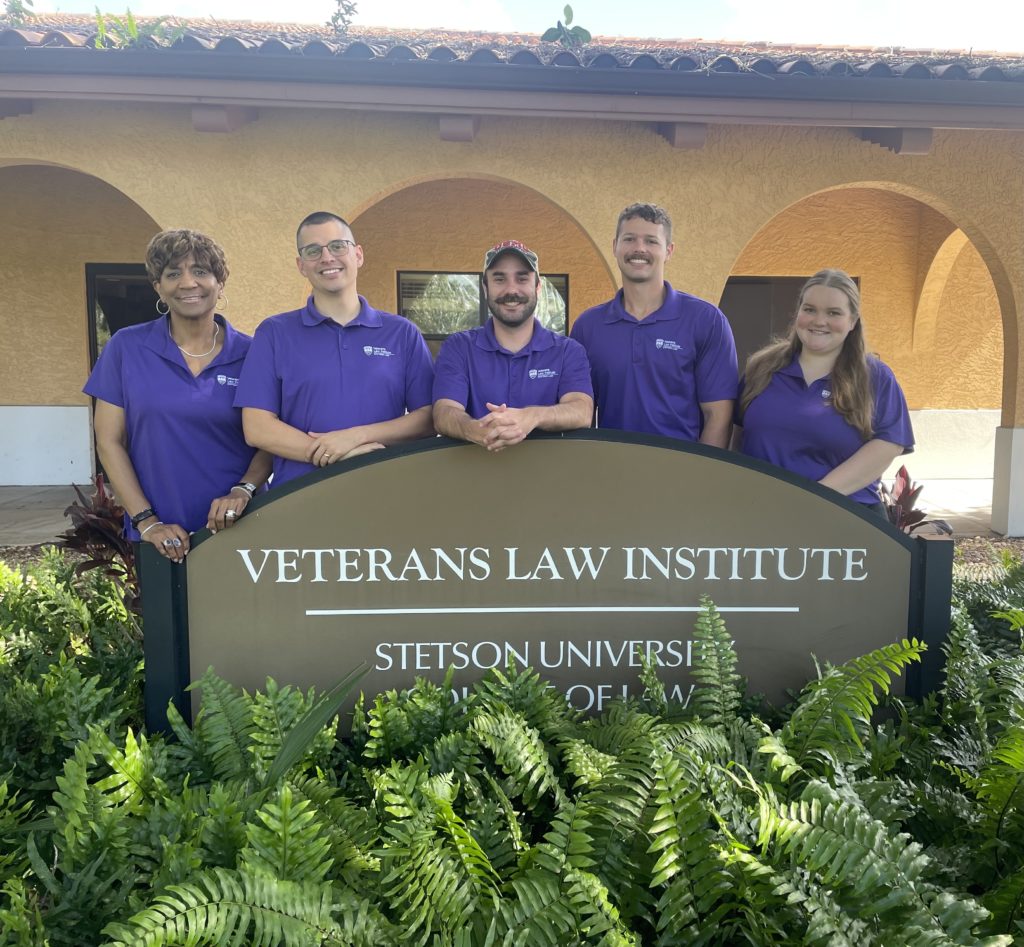
Three young alumni stand with purple shirts promoting Stetson's Veterans Law Institute.
Left to right: Mary Samarkos ’20 and Morgan Zimarakos ’20 of Stetson’s Veterans Law Institute; Vasilios “Billy” Zimarakos ’20

Members of the Stetson Law community are using their expertise to help make it easier for veterans to apply for benefits.

In an amicus brief filed on behalf of the National Law School Veterans Clinic Consortium, they are asking the U.S. Court of Appeals for the Federal Circuit to require the Department of Veterans Affairs to comply with a statute requiring it to provide benefits applications to veterans.

The brief, submitted October 1, supports the petitioner in a request for certification of a class action case   involving veterans who do not have access to technology or expertise that would give them a greater chance of securing the benefits they are due. Morgan Zimarakos ’20 and Mary Samarkos ’20 of Stetson’s Veterans Law Institute, along with Vasilios Zimarakos ’20 and Yelena Duterte (University of Illinois at Chicago Law) collaborated on the document.

 A potential undue burden

Veterans who submit an Intent to File for benefits receive letters in the mail that acknowledges that the VA has received their submission and refers them to a search engine containing nearly 1,000 forms.

Some may find it challenging to use, while others lack access to the tech that would allow them to access it entirely.

“If the search term used does not produce results, a link to a list of 992 separate entries populates. This list does not provide any information instructing claimants on what each form is used for, or which to submit in their situation,” the brief points out.

Meanwhile, the VA provides clear-cut instructions to staff, including a chart, to help them determine the right form a claimant should fill out based on the benefit sought, the brief notes, and thus can send claimants the correct paperwork.

Advocates for veterans say the current practice violates a law requiring “all instructions and forms” be furnished to veterans claiming benefits.

“Put simply, VA provides its adjudicators with more comprehensive guidance and information concerning these forms than it provides to the claimants required to complete them,” the brief argues.

Better access to support for veterans, families

Stetson Law’s Veterans Law Institute and Veterans Advocacy Clinic are driven to support those who have served in the U.S. Armed Forces as they pursue what is due to them, whether they are seeking pension or disability benefits. VLI and VAC faculty, staff, students, and supporters are thrilled to be part of a robust nationwide community of advocates who share this passion.

This case is a significant example of the challenges veterans face as they seek benefits.

“It is an absolute privilege to work on this case,” said Morgan Zimarakos, interim director of the Veterans Advocacy Clinic. “Although it seems clear-cut to us what the outcome ought to be, it is a clear example of how we can help identify opportunities to better serve veterans.”

Zimarakos said she is proud to be part of a team that includes her husband, Vasilios, as well as Samarkos, both of whom are veterans. All three graduated from Stetson Law in 2020.

She adds that she appreciates the diligence of Duterte, who put in extensive work on the process of filing the brief.

Learn more about Stetson’s Veterans Law Institute.

How Grassroots Advocacy Helped Stop Plan to Develop State Parks

A woman speaks at a podium in Stetson Law's Great Hall. Photos of Florida's State Parks are projected behind her.
Casey Darling Kniffin

As she began the first Foreman Biodiversity Lecture of the semester, speaker Casey Darling Kniffin asked the audience to picture their favorite Florida State Park.

Most Floridians, she said, have a favorite, where they go to experience open space and natural wonders. Kniffin’s is Jonathan Dickinson State Park just north of Jupiter on Florida’s Atlantic coast.

Florida’s 175 state parks are award-winning, critical wildlife habitat, and the product of decades of investment supported by Florida’s leadership and citizens alike.

“They’re also deeply personal,” Kniffin said. “These are the places that people go to swim, hike, paddle, fish.”

That’s why, when a plan to build golf courses, pickleball courts, lodging, and other facilities in nine state parks, Kniffin, who is conservation policy director for the nonprofit Florida Wildlife Foundation, had to act.

A threat to public lands

In August of 2024 rumors began to swirl about a plan to develop state parks. Kniffin knew her organization needed to take to social media to lead the fight against such a proposal but had difficulty tracking down hard proof. The idea of paving over Florida’s beloved natural lands seemed outlandish.

“I think that we all just assumed these places that had decades of investment going into them and knowing how cherished they are to the people of Florida, I really don’t think anyone thought they’d threaten them at this magnitude,” she said. “And then the Great Outdoors Initiative suggested otherwise.”

On August 24, a Department of Environmental Protection employee leaked a memo revealing details of the plan to the public. It summarized the changes to nine state parks: Anastasia, Topsail Hill, Camp Helen, Grayton Beach, Honeymoon Island, Hillsborough River, Dr. Von Mizzell, Oleta, and Kniffin’s beloved Jonathan Dickinson. It included proposed golf courses, pickleball courts, and non-rustic accommodations that would have involved destruction of native landscapes and critical wildlife habitats.

“That land belonged to the people of Florida, and suddenly it felt like what Floridians wanted was not even taken into consideration,” she said.

A rapid response

The state officially released details of the plan on August 19 – as well as meetings scheduled for the following week in which the public could voice their concerns, assuming their schedules allowed for it.

 Kniffin and her colleagues sprang into action. They took to social media to encourage Floridians to attend meetings, send emails, and speak at events.

“Our goal was to share information fast,” she said. “It was a full court press.”

The people really did respond. Social media posts reached over three million people. Hundreds of people showed up at rallies. The governor’s office received more than 250,000 emails and countless phone calls opposing the plan. People made art, encouraged others to speak out, and wrote letters. Media outlets, especially The Tampa Bay Times, covered it extensively.

“Finally, after eight days, it worked,” she said.

The state tabled the proposal on August 28, but another battle was just beginning.

Fighting for state protections

A coalition of groups then had to rally for a state law preventing a plan to develop state parks from ever seeing the light of day. Lawmakers in the state house and state senate eventually introduced such legislation.

“Legislators felt this groundswell, and they responded,” she said. “It was really proof that our elected officials do listen when enough people speak out together.”

But getting the bill passed in the State House and State Senate felt like an uphill battle. It was subject to weakening by lawmakers. It stalled in committee for weeks in the middle of the legislative session.

It finally passed and, after another wave of advocacy, signed into law by the governor in May of 2025.

A lesson for aspiring advocates

Kniffin told her audience, which consisted largely of Stetson Law students, that she hopes this success story inspires environmental advocates to continue the fight to protect Florida’s natural resources for generations to come.

“So how do we keep this going? I think it’s by remembering that each of us has a role to play,” Kniffin said. “It is important to remember that you’re part of something bigger and what you do really matters.”

Everyone has something to contribute to the cause, she added. Some are natural advocates; or apt to call, write, and meet with legislators; or artists and storytellers whose visuals, videos, art, podcasts, and other content will serve as an inspiring call to action for Floridians across all walks of life.

“The call to defend our state parks came from people of all backgrounds,” Kniffin said. “Students, scientists, business owners, lawyers, grandparents, artists, and what united us was a simple truth: that we love Florida State Parks; we love Florida’s wild lands writ large.”

Learn more about Florida Wildlife Federation’s campaign against proposed developments in Florida State Parks.

Students Attend Zimbabwe Wetlands Summit

Two students stand by a sign advertising COP 15 Zimbabwe.
Blair Carlyle and Erika Leeper served as Stetson Law’s delegation to COP15 in July of 2025.

For two Stetson Law students, attending the Ramsar Convention’s 15th Conference of the Contracting Parties (COP15) in summer of 2025 was more than an immersive learning experience; it was a once-in-a-lifetime opportunity.

Representing the next generation of environmental leaders, Blair Carlyle and Erika Leeper, who are now 3Ls, traveled to Victoria Falls, Zimbabwe with support from the Dick and Joan Jacobs’ Environmental Law Externship Fund to serve as Stetson Law’s delegation to COP15. The conference brought them face-to-face with environmental and political leaders from around the globe, including the President of Zimbabwe, Emmerson Mnangagwa.

“Witnessing the extraordinary work being done around the globe to protect and restore wetlands was both inspiring and motivating as I continue to pursue a career in environmental law,” Leeper said.

Stetson’s global leadership

Stetson Law is an observer to the Ramsar Convention on Wetlands, an international agreement on wetlands protection. Every three years, representatives from member nations meet to discuss the budget and develop priorities for the coming three years.

The COP15 agenda included review of an assessment on the environmental impacts of the Russian invasion in Ukraine and a proposal to delist Ramsar Sites (Wetlands of International Importance) in disputed territories.

A photo collage of two law students attending an environmental conference in Zimbabwe, including a session with Zimbabwe's president.
COP15: Scenes from the sessions, including a keynote from the president of Zimbabwe.

“Events like COP15 provide our students a unique opportunity to take part in substantive discussions on emerging challenges for wetlands stewardship on every continent,” said Professor Royal Gardner, director of Stetson’s Institute for Biodiversity Law and Policy and former Chair of Ramsar’s Scientific and Technical Review Panel. “We are thrilled that we can offer experiences to the next generation of environmental lawyers.”

For Carlyle, the presence of nearly hundreds of representatives made the conference feel like a microcosm of the world. “The conference itself was such an experience: 172 countries, all represented by delegates who were passionate and excited, not only about wetlands and conservation, but about the sharing of culture and the breaking down of barriers,” he said.

Surreal side trips

Within 15 minutes of arriving in Victoria Falls, Carlyle said he and his traveling companions were “awestruck” at the sight of baboons casually strolling by the hotel pool and a family of warthogs grazing in a patch of grass next to the road. A few nights later, he said, they walked out of a restaurant to see an enormous hippo sauntering down the sidewalk as people cautiously passed by it.

“Victoria Falls is one of the most breathtaking places I’ve ever been,” Carlyle said. “Dusty dirt roads that stretch for miles interconnect the towns that dotted the landscape. No fences, nothing to keep the lions out of town, but the people have learned to live side by side with the wildlife.”

A collage of photos from a wildlife-spotting trip in Zimbabwe in July of 2025.
The COP15 attendees had time to explore the surrounding natural wonders.

While the conference presented unique opportunities for global networking and learning, camping in Chobe National Park in Botswana proved to be the highlight of the trip. On safari, they encountered four of Africa’s “Big Five” (leopard, lions, elephants, and buffalo), as well as many other species. To the students, the surreal scenery was straight out of National Geographic.

“When I first saw a family of elephants heading to a watering hole, baby elephants leading the way, I sobbed,” Leeper said. “The safari experience was one that connected me so deeply with the environment, with gratitude and appreciation for the remarkable animals in Africa.”

A collage featuring a giraffe, an elephant, and an impala, all spotted during an adventure in Zimbabwe.
The Zimbabwe trip included unforgettable wildlife-spotting opportunities.

Other highlights: cruising on a river around Chobe’s Sedudu Island as crocodiles sunbathed on the dusty riverbanks, seeing giraffes towering against the African sky, and hearing the sounds of elephants and lions in the night.

“There were no fences, nothing between us and the animals, and each time I bolted awake in the night, I felt a connection to the previous generations of humans who had learned to live with being prey,” Carlyle said.