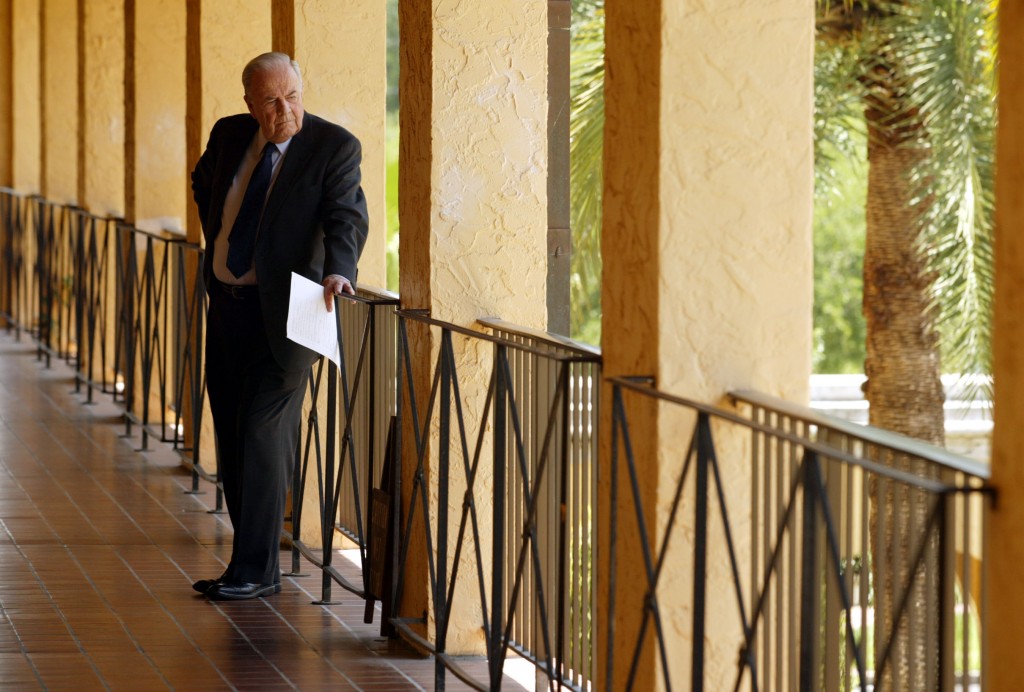
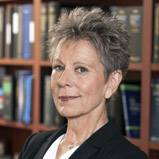
The late Wm. Reece Smith Jr. at Stetson University College of Law
Dec. 2, 2019 – Stetson University College of Law is currently accepting nominations for the prestigious William Reece Smith Jr. Public Service Award, which recognizes individuals who have provided outstanding service to the legal profession and community. This year’s award will be presented at the Annual Inns of Court Banquet in the Great Hall on February 5, 2020.
Nominations must be received by close of business on Monday, Dec. 17, 2019. Completed nominations may be emailed to [email protected].
Wm. Reece Smith Jr. served as a distinguished professorial lecturer at Stetson Law
The annual award is named in honor of legendary Florida lawyer William Reece Smith Jr. who served for decades as a distinguished professional lecturer at Stetson Law. Smith, who passed away in 2013, dedicated more than 60 years of service to the legal profession. He worked tirelessly to provide legal services to the poor. Smith founded and served as the first president of Florida Legal Services, served as a city attorney for Tampa, chair and trustee of numerous colleges and universities, interim president of the University of South Florida, and as board member of countless religious, charitable, civic and professional organizations.
Stetson established the William Reece Smith Jr. Award in 1990 to honor outstanding contributions to public service, the justice system and the community.
Dean Michèle Alexandre accepts the John Mercer Langston Legal Education Leadership Award at the 15th Annual National Black Pre-Law Conference and Law Fair in New York.
Dean Michèle Alexandre received the John Mercer Langston Legal Education Leadership Award at the 15th Annual National Black Pre-Law Conference and Law Fair at Columbia Law School in New York in early November.
The award is named for John Mercer Langston, the founding dean of the Law Department at Howard University and first black law school dean in 1869. Today, 150 years after Langston’s achievement, we have reached the largest number of black law school deans serving at American law schools in history.
Also during the conference, Stetson University College of Law was honored with a Diversity Outreach Champion Award. The award recognizes Stetson Law’s demonstrated commitment to recruiting black law students. The conference previously recognized Stetson Law as a Diversity Outreach Champion in 2014.
The National Black Pre-Law Conference and Law Fair aims to provide a powerful forum to help increase the numbers of excellent, strategic and competitive African American law school applicants, students and graduates nationwide.
Staff and students secure 100 percent disability for Marine with cancer; recognized for community service
Members of the Veterans Advocacy Clinic received community service awards at the Marine Corp Ball on Nov. 16, 2019. Veterans Law Institute Coordinator Shirley Booker, far left, Veterans Law Institute Director Stacey-Rae Simcox, second from right, and Stetson Law Student Mary Samarkos (2020), far right.
Stetson University College of Law Veterans Law Institute received the Distinguished Service Award from the Marine Corps League of Florida at Major B.F. Hickey – Detachment 57’s Marine Corps Birthday Ball celebration on Nov. 16, 2019.
The award recognized the work of the students, faculty and
staff in the Veterans
Advocacy Clinic to prove that a terminally ill Marine had been exposed to
toxic water at Camp Lejeune, North Carolina, in the 1980s and developed terminal
bile duct cancer. As a result of their efforts, the Marine won an appeal to the
Department of Veterans Affairs (VA) administrative board and secured benefits
to care for him and his family into the future.
Clinic law students, staff and faculty spent two years
working to find evidence to support that their Marine client had been in
contact with the water. They collaborated
with environmental science faculty and students on Stetson University’s main campus
in DeLand, environmental law faculty at the College of Law, and sifted through
thousands of pages of environmental records received under a Freedom of
Information Act (FOIA) request.
A little help from an alumnus
Professor Stacey-Rae Simcox.
Joshua Magidson, a shareholder at Macfarlane Ferguson &
McMullen, Stetson Law alumnus and a Marine himself, helped connect the Clinic staff
with Florida’s Marine Corps League. The League was able to spread the word and
track down other Marines who could corroborate that this Marine was exposed to
toxic water. After speaking to dozens of
Marines, law students found three witnesses who could prove the exposure.
At first the VA denied his claim, but the Veterans Clinic
appealed to the administrative board that oversees the VA. In the end, the Marine was awarded a 100
percent disability rating for his cancer.
“It’s an incredible example of the collaborative environment
we have across our campuses, and it’s a classic illustration of the impact our
law students can have on the world and the individual,” said Stacey-Rae Simcox,
director of the Veterans Law Institute and the Veterans Advocacy Clinic.
Major B.F. Hickey – Detachment 57 also presented law student
Mary Samarkos (2020), Veterans Law Institute Coordinator Shirley Booker, and
Professor Stacey-Rae Simcox with Community Service Awards for their work on the
case. The awards were presented by
Detachment 57 member and Stetson alumnus Brandon Robinson.
Case Background
The Veterans Advocacy Clinic had been working on this case
since the summer of 2017 and logged more than 400 hours of student legal work. The
veteran’s main goal was to have the VA recognize that his cancer was caused by his
military service so that his wife would be entitled to ongoing widow benefits
after his death.
Simcox said in her nearly 15 years of legal practice, this one was
case she feared was not winnable initially because they had no clear way to
prove the veteran’s cancer was caused by service in the Marine Corps. They
had to get creative and seek out further expertise.
They tapped faculty and students in Stetson’s Institute for Biodiversity
Law and Policy as well as biology and chemistry department faculty in
Deland for help deciphering the meaning of FOIA’d chemical records, aquifers,
ground water tables and myriad other environmental law terms that were foreign
to many of the staff in the Veterans Advocacy Clinic. Others involved
included: Law Professor Royal Gardner, Law Professor Paul Boudreaux, Dr.
Kirsten Work (professor of biology in Deland), Dr. Danielle Devoney (visiting assistant
professor of environmental toxicology in Deland), Christine Martin (a Stetson
DeLand employee and grad student in environmental studies), and law students Oscar
Sugranes (’18), Katherine Pratt (’19), Dane Petersen (’19), Brian Paul (’19),
John Pilz (’18), and Erica Eddy (3L).
The VA had already
recognized the water at Camp Lejeune was toxic and a contributor to bile
duct cancer, but the clinic staff had to factually prove that the veteran had
been physically exposed to the water there. While the veteran said his
job as a truck driver required him to drive back and forth to Camp Lejeune from
his actual duty station, the clinic had no proof he had ever actually been to
Camp Lejeune besides his word.
Students William Cocarro (’18) and Julie Munderback (’19) spent
hours poring through military historical records and trying to locate any
witnesses who might have been able to corroborate his travel between the two
installations. Finally, in the spring 2019 semester, the veteran remembered
that he had been sent to a small training facility called Bogue Field for
almost a month. Bogue is geographically in the middle of Camp Lejeune and
another Marine Corps installation. The students learned that Bogue had no
potable drinking water from the 1950s to the early 2000s and that water had to
be shipped in, but no one could verify where the water originated.
Based on that information, 3Ls Mary Samarkos and Chesley Roberts,
with the help of Phillip Saul (’19), hit the ground scouring for witnesses who
might be able to corroborate that the water at Bogue was being shipped in from
Camp Lejeune. With the help of Josh Magidson, the students contacted dozens
of veterans and identified three major witnesses who provided corroboration
that: 1). the water at Bogue Field was, in fact, shipped in from Camp Lejeune;
and 2). the veteran’s job did require him to drive to Camp Lejeune quite often.
Collaborative learning that made a difference
Veterans Clinic staff attorneys Rocky Roodhouse and Jami Worley,
along with Simcox worked hard to help the students think through the issues. Shirley
Booker, Veterans Clinic office manager, made sure that the veteran was taken
care of – even hand-carrying flowers to him on behalf of the clinic when he was
hospitalized.
The VA found that the brief submitted from Stetson, “relayed a
thorough, well documented, and scholarly discussion about the various exposures
while on active duty that may have contributed to his development of the
cholangiocarcinoma. Stated in their conclusion was that the veteran had
exposure to carcinogenic chemicals in the drinking water at Camp Lejeune,
exposure to contaminated water at Cherry Point, Agent Orange in Okinawa, Japan,
and liver flukes in Pohang, South Korea. There is ample evidence that the
veteran had contact with the drinking water from Camp Lejeune many times during
his service. Other exposures in terms of chemical or parasitic infections are
considerations for the veteran’s development of the cancer.”
A 100 percent disability rating means that not only will the
Veteran receive several tens of thousands of dollars in benefits that the VA
owed him on this claim, but he will get almost $4,000 a month into the future.
When he passes away, his wife will be taken care of as he had hoped with
widow’s benefits.
“The students who worked so hard on this case remind me constantly
why it is such a privilege to work with them,” Simcox said. “I hope it also
helps them remember that one lawyer can make a difference.”
Dean Michèle Alexandre received the John Mercer Langston Legal Education Leadership Award at the 15TH Annual National Black Pre-Law Conference and Law Fair at Columbia Law School in New York in early November.
The award is named for John Mercer Langston, the founding dean of the Law Department at Howard University and first black law school dean in 1869. Today, 150 years after Langston’s achievement, we have reached the largest number of black law school deans serving at American law schools in history.
Also during the conference, Stetson University College of Law was honored with a Diversity Outreach Champion Award. The award recognizes Stetson Law’s demonstrated commitment to recruiting black law students. The conference previously recognized Stetson Law as a Diversity Outreach Champion in 2014.
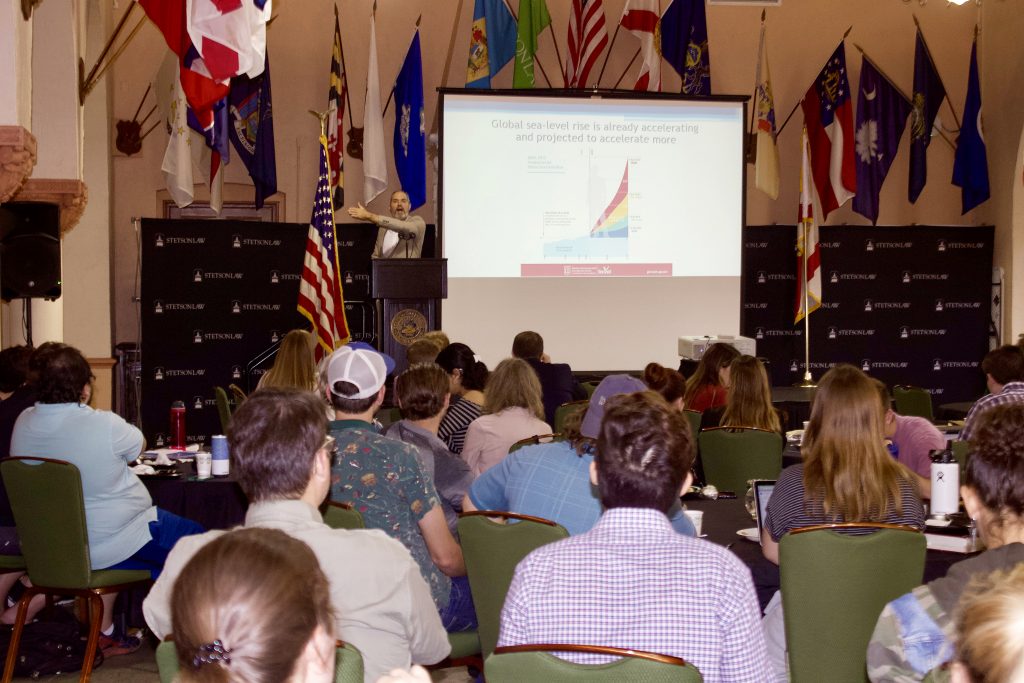
Dr. Jason Evans spoke on Nov. 5, 2019, as part of the Foreman
Biodiversity Lecture series. Evans is an associate professor of
Environmental Science and Studies and the interim director of the Institute for
Water and Environmental Resilience at Stetson University in Deland. His recent
research focuses on sea level rise vulnerability assessments and adaptation
planning for coastal communities throughout the Southeast.
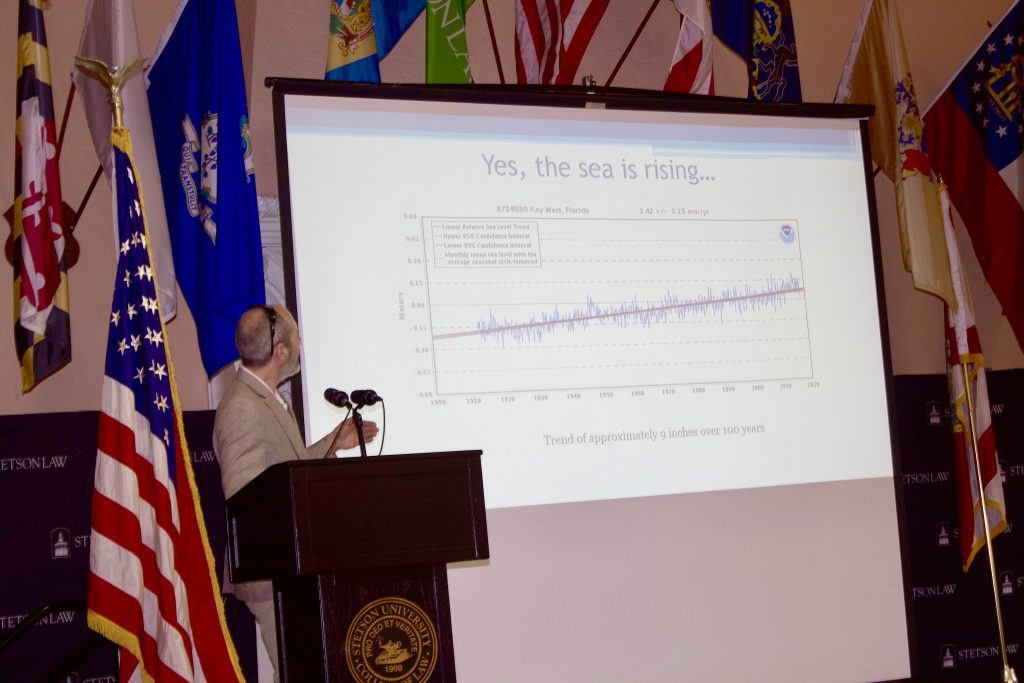
Evans kicked off his lecture with an explanation of some of the
data behind sea level rise. In Key West, the sea level has risen 9 inches in
the past 100 years. In Ft. Myers, it’s risen 12 inches in the past 100 years.
Sea levels rise as the climate warms, resulting in warmer water that expands in
volume. Melting ice also contributes, providing more water mass and volume.
However, the sea level is not rising equally everywhere: It’s rising in many
areas but falling in others because of rebounds from the weight of ice sheets
as they melt.
Dr. Jason Evans spoke on Nov. 5, 2019, as part of the Foreman Biodiversity Lecture series. Evans is an associate professor of Environmental Science and Studies and the interim director of the Institute for Water and Environmental Resilience at Stetson University in Deland.
Stark examples of saltwater flooding as a result of sea level
rise have occurred in the Southeast.
“This last
October there was flooding in certain areas [of the Florida Keys] for 45
straight days – where even at low tide there was still saltwater on the roads,”
Evans said.
In 2015,
Tybee Island, Georgia, had the fourth highest tide on record and the only road
on or off the island became completely impassable. Saltwater flooding is not
only harmful to vehicles and homes but presents a public safety issue when main
roads are obstructed. We have experienced the fastest rate of sea level rise in
8,000 years – 8 inches over the past 100 years, Evans said. Climate projections
predict a maximum of 10 feet of sea level rise by 2100. More conservative
predictions expect an average of 2-3 feet by 2100. According to Evans, because
the Earth has a naturally unstable climate, exact predictions are difficult.
“When it
starts flooding, there is water coming out of a storm drain [and] the streets
are flooding, who are you going to call? You are going to call the mayor, you
are going to call city council, and those people are going to have to deal with
it and figure out what to do.”
Dr. Jason Evans explains that climate projections predict a maximum of 10 feet of sea level rise by 2100. More conservative predictions expect an average of 2-3 feet by 2100.
Evans
stressed the role of local governments in sea level rise adaption and planning,
because there is no national or even statewide policy capable of addressing
this problem. He then introduced an analogy of a garden shed versus a nuclear
power plant. With a garden shed in your backyard, you don’t really need to plan
for sea level rise. A shed is cheap and will likely be gone by 2100. With a
nuclear power plant, the stakes are much higher. There is zero tolerance for a
plant failure, and it needs to be resilient to even the slightest risks. In
that case, you need to plan for the worst.
Sea level
impacts on the built environment start with stormwater drainage and wastewater
infiltration, Evans explained. When the sea level rises, saltwater enters
stormwater drainage systems and forms a plug. When it rains, fresh water cannot
drain and just comes back up. For this reason, stormwater mapping is immensely
important.
Evans
worked to map high tide and flooding scenarios for St. Marys, Georgia, and the
city later implemented green infrastructure stormwater improvements to address
potential issues. Evans calls improvements like these “duct tape adaptation.” They
are temporary fixes and won’t help much if the sea level rises 6 feet, but they
can help avoid flooding in the meantime.
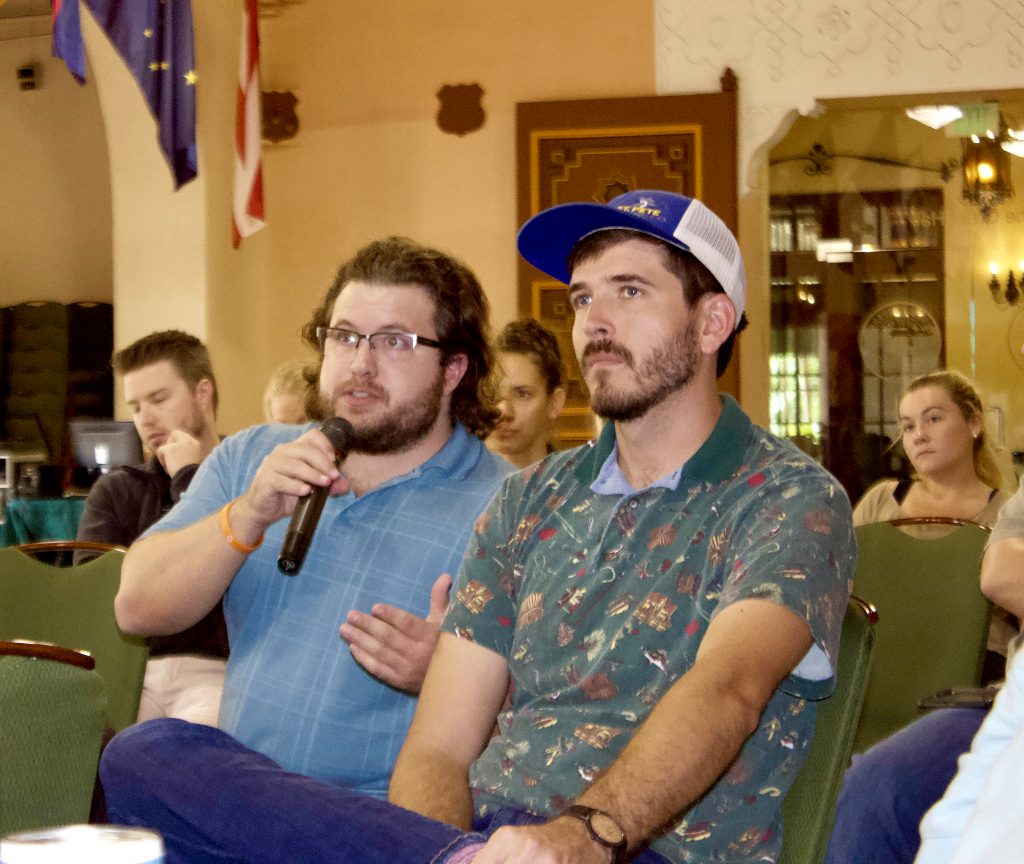
Students ask questions during the Foreman Biodiversity Lecture.
Evans wrapped up his lecture with a discussion of flood insurance and the Community Rating System (CRS), which is a voluntary incentive program for local governments to address climate change and sea level rise. By participating in the program and addressing sea level rise in their area, governments can receive a discount on flood insurance. Monroe County, Fla., was the first jurisdiction in the country to use sea level assessments to get a CRS discount. Programs like this can heighten the importance of sea level rise planning and risk assessment when larger policies are nonexistent or insufficient. Once the science behind sea level rise is accepted and governments start to address these risks, statewide and nationwide planning can begin.
About the Foreman Biodiversity Lecture Series
Stetson Law’s Institute for Biodiversity Law and Policy serves as an interdisciplinary focal point for education, research and service activities related to global, regional and local biodiversity issues. The Foreman Biodiversity Lecture Series brings to campus numerous experts in environmental law and environmental science. You can view Evans’s complete lecture on the Stetson Law YouTube channel.
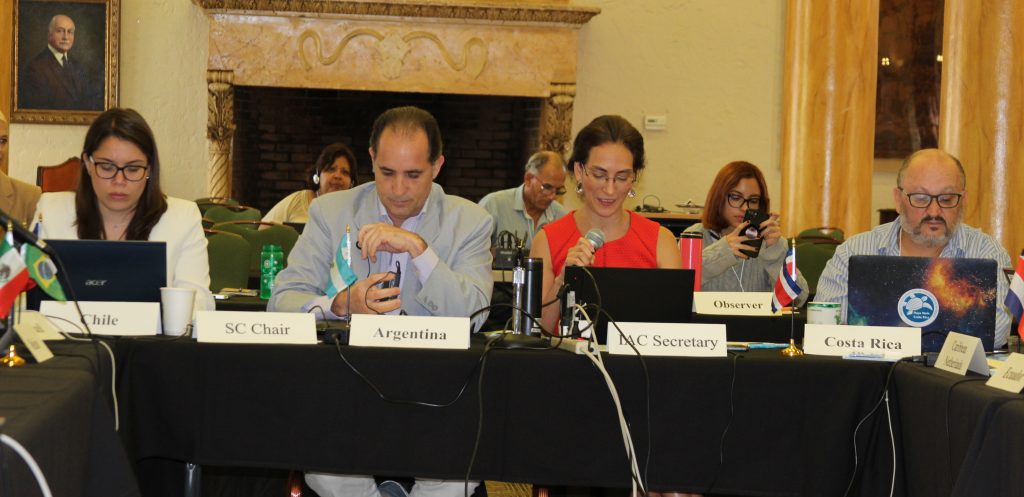
Stetson University College of Law hosted the Inter-American Convention for the Protection and Conservation of Sea Turtles meeting of the Scientific Committee in September.
The IAC is
an international treaty that seeks to create balance between national
interests, regional customs, and international sea turtle conservation efforts.
It was created in 1994 by a group of coastal nations from North, Central, and
South America to reduce regional sea turtle threats. Under the treaty, member
states have a legal framework within which to act on behalf of sea turtle
populations. Today the IAC has 16 member states comprising Argentina, Belize,
Brazil, Chile, Costa Rica, The Dominican Republic, Ecuador, Guatemala,
Honduras, Mexico, The Netherlands, Panama, Peru, the United States, Uruguay,
and Venezuela.
The IAC uses
data and education – while being mindful of each member state’s environmental,
socioeconomic and cultural characteristics – to protect sea turtles and their
habitats, as well as help recover turtle populations.
IAC efforts
are focused on the entire life cycle of sea turtles. The Treaty forbids the
capture of sea turtles, their shells, or their eggs. Restrictions are also placed
on human activities that may adversely affect sea turtles during their
reproduction, incubation and migration stages.
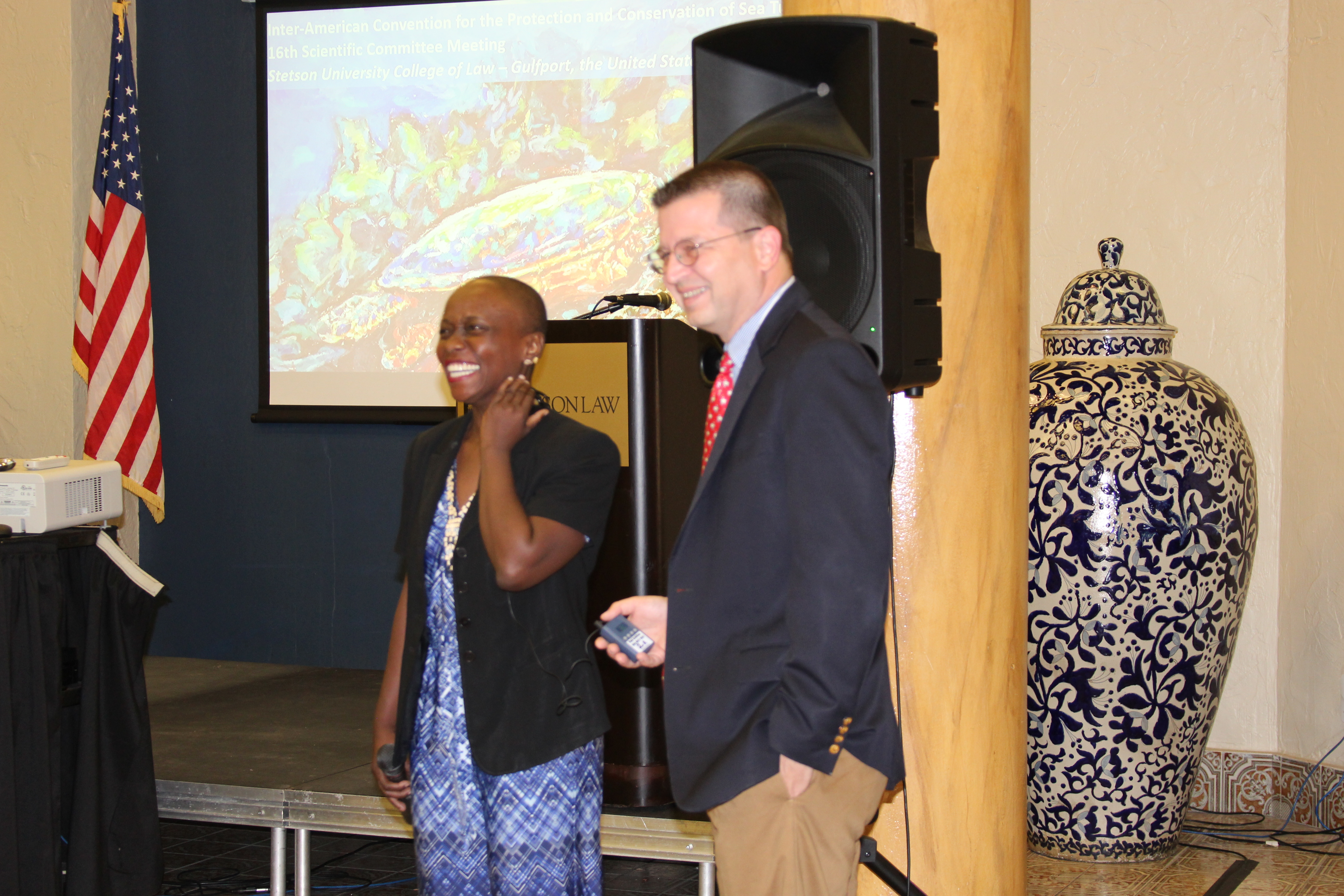
IAC Secretary Veronica Caceres speaks at the event.
“Nesting
beaches are much easier to protect than open oceans,” said Veronica Caceres,
IAC’s secretariat.
A Nicaraguan
native, Caceres holds a master’s in fishery and began working with sea turtle
conservation in Central America early in her career. One of the conservation
techniques she focuses on is the Turtle Exclusion Device, or TED. She explained
that the TED is put inside of shrimping nets and prevents accidental sea turtle
capture, leading to a reduction in turtle deaths.
Other
conservation efforts include restoring and conserving habitats, designating
protected areas, supporting research aimed at reproduction, breeding and re-introduction,
fostering relationships with governmental institutions, NGOs and the public at
large, and reducing the impact of fishing on sea turtle populations.
Film examines tension between humans and wildlife
As part of
the three-day meeting, IAC played the film, “Cacu: Un Cambio por la Vida”
(Cacu: A Change for Life) by Director/Journalist Marvin Del Cid and Marine
Biologist Omar Shamir Reynoso. The film explores the tension between the human
need to make a living and the value of protecting the environment. The
documentary follows Reynoso as he works with five Santo Domingo fishermen to
protect sea turtle nests in Santo Domingo.
Caceres said
this tension is one of the key challenges they face in getting communities to
participate in conservation efforts. They often get pushback from locals.
“It’s often
their livelihood,” she said, referring to egg poaching, “so you have to
approach it with the right attitude.”
Caceres
makes it a priority to understand community needs and the reasons why sea
turtle eggs are poached.
“Only
after we understand why, can we think about how to educate and encourage them
to change. It is important the community is recognized for their efforts.”
One way to
encourage local populations is through finding other avenues of income that
depend on a flourishing environment, such as tourism. Sometimes communities can
be incentivized for undertaking and closely monitoring conservation efforts.
For example, a community may receive funding for new schools or even stipends
in exchange for monitoring the sea turtle populations and preventing egg
poaching.
IAC members
aim to improve turtle mortality rate by increasing the number of communities
who monitor sea turtle population trends. They also are focused on mitigating
the impact of plastic pollution and climate change on sea turtles.
“As climate
change worsens, beach sand becomes hotter. This means the incubation
temperature becomes greater and, since incubation temperature determines the
sex of the turtles, more female turtles will be born,” Caceres explained,
“without males, sea turtle species will not survive.”
The
organization also wants to add more signatories to the treaty, including El
Salvador, Columbia, and Canada.
Stetson’s
role creates opportunity for students
Stetson
College of Law is an Accredited Observer of the IAC, meaning Stetson
representatives have the privilege of observing and hosting IAC meetings. Other
accredited observers include NGOs and scientific institutions.
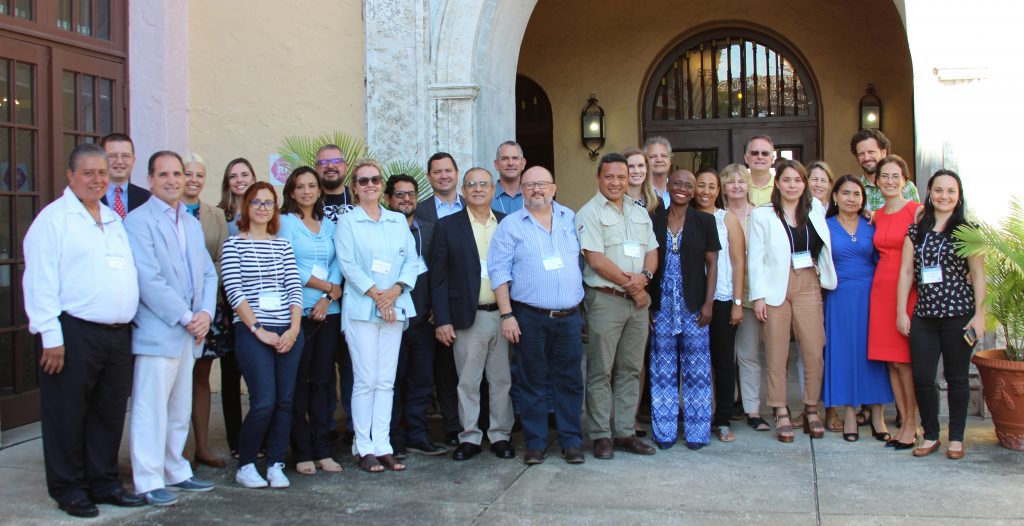
Stetson Law Dean Michèle Alexandre and Professor Royal Gardner welcomed attendees.
Exhibit portrays persecution of Jewish lawyers and judges during Nazi era
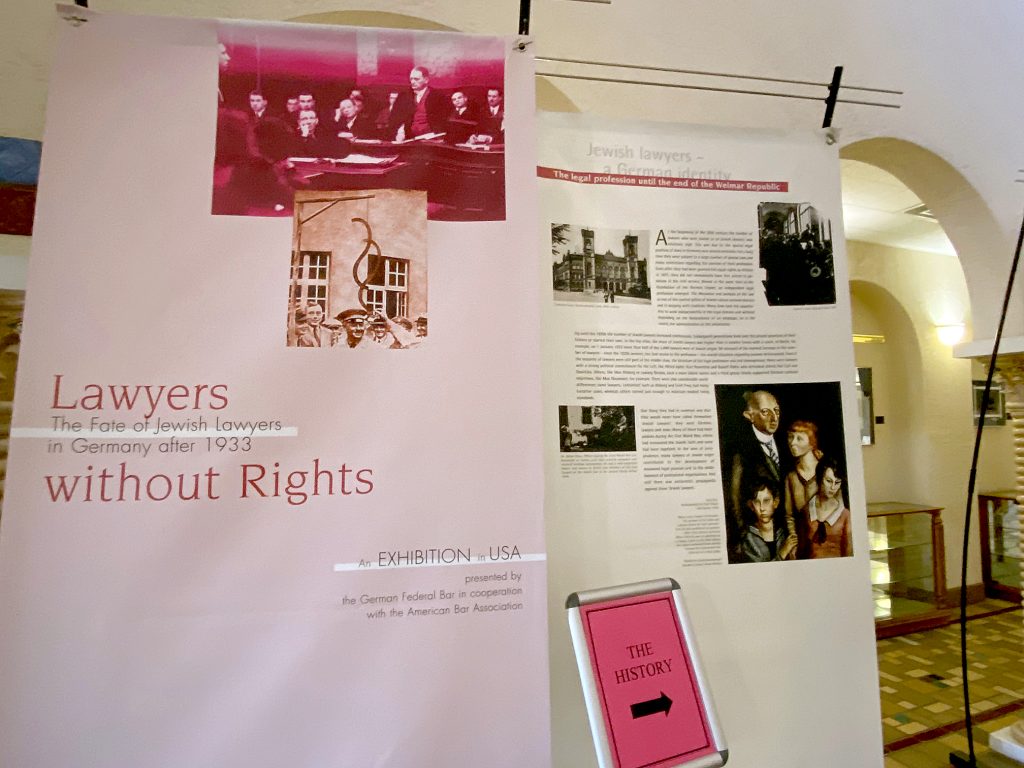
“Lawyers Without Rights: Jewish Lawyers in Germany under the Third Reich” exhibit is on display at the Dolly and Homer Hand Law Library.
The highly acclaimed international exhibit, “Lawyers Without Rights: Jewish Lawyers in Germany under the Third Reich,” will be available for viewing in the Dolly and Homer Hand Law Library at Stetson University College of Law throughout the month of November.
The exhibit is sponsored by Jewish Law Students Association (JLSA) at Stetson Law in conjunction with the American Bar Association and German Federal Bar. It has been shown in more than 100 cities in Germany, the United States, and other parts of the world.
The concept was conceived in
1998 when an Israeli lawyer asked the regional bar of Berlin for a list of Jewish
Lawyers whose licenses had been revoked by the Nazi regime.
“The regional bar decided not
only to research a list of names but also to try to find out more about the
fates behind all those names,” said Axel Filges, past president of the German
Federal Bar. “Some were able to leave the country after the Nazis came into
power, but very many of them were incarcerated or murdered. The non-Jewish
German lawyers of those days remained silent. They failed miserably, and so did
the lawyers’ organizations. We do not know why.”
After the Berlin bar
transformed its research into an exhibit, other regional bars began asking
whether they could show it and add their own research.
“So, like a puzzle, a portrait of the fate of Jewish lawyers in Germany has emerged step by step,” Filges said.
The exhibit is spread throughout the first, second and third floors of the library and is available to the public during regular library hours. However, members of the public should call ahead for times to view, as the library will be closed for Veterans Day and during the Thanksgiving holiday.
DELAND, Fla. — On Wednesday, Oct. 30, 2019, the Stetson University Board of Trustees announced it had elected Christopher F. Roellke, PhD, currently Dean of the College Emeritus and Professor of Education at Vassar College, to become the 10th president of Stetson University, effective July 1, 2020.
Roellke is widely regarded as an exceptionally effective and collaborative higher education leader who is past president for the Association of Education Finance and Policy, a 2014 Fulbright Scholar and the founder and fundraiser of Vassar College’s Urban Education Initiative.
Roellke will succeed Wendy B. Libby, PhD, who has served as Stetson University’s president since July 2009. Libby announced her retirement in February 2019 and will continue her position until June 30, 2020.
“The Board of Trustees has unanimously elected Dr. Roellke to lead Stetson into the future as our university’s 10th president,” said Joe Cooper, chair. “The board’s presidential search framework and process brought forth many highly qualified candidates, and we thank them all. Dr. Roellke is bringing an outstanding record of energetic leadership in higher education and a deep understanding of the challenges and opportunities Stetson University faces. The board is thrilled to welcome him as president-elect.”
“It is the greatest honor and privilege of my professional life to be selected as Stetson University’s 10th president,” said Roellke. “For nearly a century and a half, Stetson has been widely admired for its deep commitment to the traditions of liberal learning and globally engaged citizenship. My family and I are eager to immerse ourselves in this wonderful community of lifelong learners. Moving forward collaboratively with all of Stetson’s constituents, we are committed to preserving and enhancing this extraordinary form of education for generations to come.”
A graduate of Cornell University and Wesleyan University, Roellke has served three presidents at Vassar College. As Dean of the College, he was one of three tenured faculty members on the President’s Senior Leadership Team and oversaw the Dean of Studies, Dean of Students, Campus Life and Diversity, Career Development, portions of Equal Opportunity/Affirmative Action/Title IX, Accessibility and Educational Opportunity, Safety and Security, and Campus Activities.
He has worked with senior leadership and the Vassar community in the development of its strategic budgeting priorities and oversaw international partnerships and exchanges, including Vassar’s junior year abroad programs in Europe, Russia and Costa Rica. An American Council on Education Fellow, Roellke has also served as a visiting scholar at Yale Law School conducting research on school finance litigation. He has an upcoming book, the fourth in a co-edited series on research in education fiscal policy and practice with co-editor Jennifer King Rice, dean of the School of Education at the University of Maryland. The latest volume is focused on fiscal issues in American higher education and is due to be released in 2020.
“This is a wonderful appointment; Professor Roellke has tremendous skills and experience to take Stetson University to the next level, and we will miss him dearly here at Vassar. Our loss is Stetson’s gain,” said Elizabeth Howe Bradley, PhD, Vassar College President.
“Chris is an experienced educator who is ready to lead during these challenging times,” said Catherine Bond Hill, who was Vassar president, 2006-2017. “He is liked and respected, insightful and caring, and I really valued having him as part of my senior team. Chris has tremendous energy and great optimism for the future of American higher education. I am pleased for both Chris and for Stetson University.”
Roellke’s election by the Board of Trustees follows an extensive presidential search that drew a large and competitive group of candidates. The process began with community forums that allowed the committee to hear from students, faculty, staff, alumni, trustees and friends of the university about the qualities they were looking for in Stetson’s 10th president as well as the challenges and opportunities they see before Stetson in the coming years. The committee’s work, which included several exhaustive interviews with top candidates, spanned several months and, near the end of the process, various constituent groups met confidentially with final candidates on campus in formal and informal settings. Members of these broadly representative constituent groups then provided feedback to the search committee, which in turn fulfilled its charge to recommend the candidate best qualified to lead, inspire and shape the future of Stetson University.
“Chris is notable because of his passion and dedication to teaching and students,” said Maureen Breakiron-Evans, Board of Trustees chair-elect. “He is very student-oriented and authentic with a commitment to building and enhancing academic environments to foster deep faculty-student connections and community engagement. I look forward to working with him and the university during this transition.”
A dedicated fundraiser, Roellke has secured donations for major Vassar campus life and renovation projects, career development and local community outreach programs. He directly oversaw several major campus life construction and renovation projects including the $8 million renewal of the central dining facility to better serve the needs of students and faculty. He has successfully solicited grants from the Dyson Foundation, Mellon Foundation, Arthur Vining Davis Foundation, and Metropolitan Life and Economic Policy Institute, and helped to create outreach and support for alumni and parents.
Roellke’s wife, Kim, is a veterinarian and they have three daughters, Emma, Julia and Olivia. President-elect Roellke and his wife will be introduced to the Stetson communities during welcome ceremonies in both DeLand and Gulfport later next month.
For more information
For additional details about President-elect Roellke, the search process and other details, visit Stetson University’s website. Members of the media can find the official press kit in the online Newsroom or contact Janie Graziani, Assistant Vice President for Marketing Communications for Stetson University.
Stetson University College of Law inducted Susan S. Demers, the Honorable Michelle T. Morley, and Thomas “Tommy” D. Roebig Jr. into its prestigious Hall of Fame on Oct. 26, 2019.
Susan S. Demers
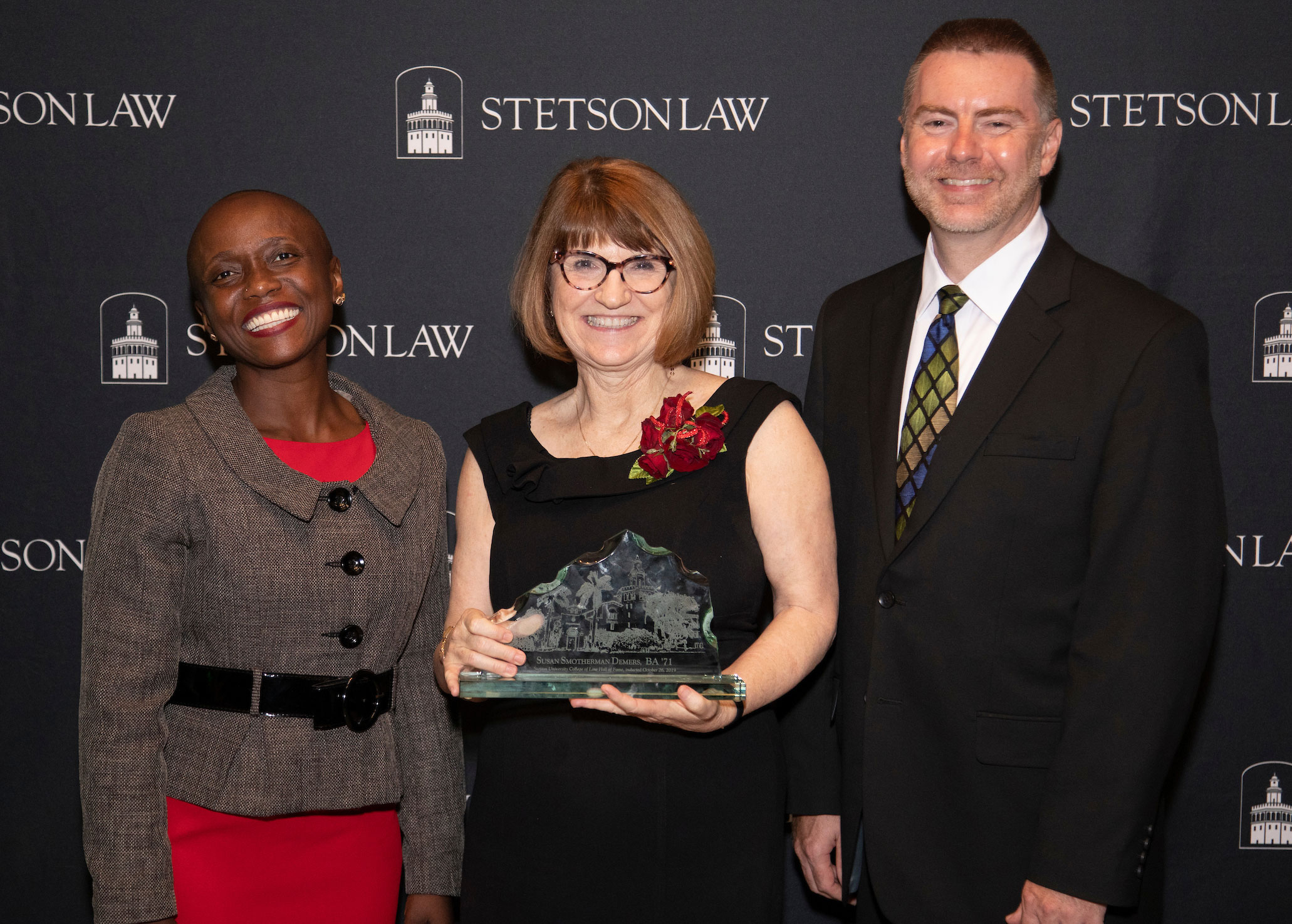
Stetson Law Dean Michèle Alexandre, Hall of Fame inductee Susan S. Demers, and Stetson University Executive Vice President and Provost Noel Painter.
Susan S. Demers is a 1971 graduate of Stetson University with a bachelor’s degree in Speech and Theatre and a Juris Doctor from the University of Florida College of Law. Since 1982, she has served as the Dean of St. Petersburg College’s ABA-approved Paralegal Studies Program and taught a variety of law-related classes. She is currently the Dean of the College of Policy Ethics and Legal Studies at SPC, and one of her most important endeavors is the Civic Engagement Project designed to develop more informed citizens. She also oversees the four-year program in Public Policy and Administration.
In addition to her work at SPC, Demers has served as an adjunct professor of Trial Advocacy and Technology at Stetson University College of Law. She devotes time as a consultant and coach for Stetson’s competitive trial teams. In 2009 she, along with husband David Demers and Professors Roberta Flowers and Lee Coppock, coached the trial team that won the prestigious American Association of Justice competition. They also coached three Chester Bedell Competition teams, two of which won the championship.
In 2008, Demers was honored with Stetson Law’s Distinguished Service Award, which was created for non-alumni who devote their time, integrity and scholarship to make Stetson Law the outstanding legal institution that it is today.
She is a past president of the Clearwater Bar Association and served on the board of directors of the Clearwater Bar Foundation. Three times she earned the CBA President’s Award, which honors exceptional service to the public and the legal profession. She is active with the People’s Law School, an 18-week program that teaches members of the public about different areas of the law.
Demers is on the board of the St. Petersburg City Theatre and helped spearhead the 2017 effort to save the company when it began to struggle financially. She and her two granddaughters continue to perform in Florida’s longest continually operating community theater.
The Hon. Michelle T. Morley
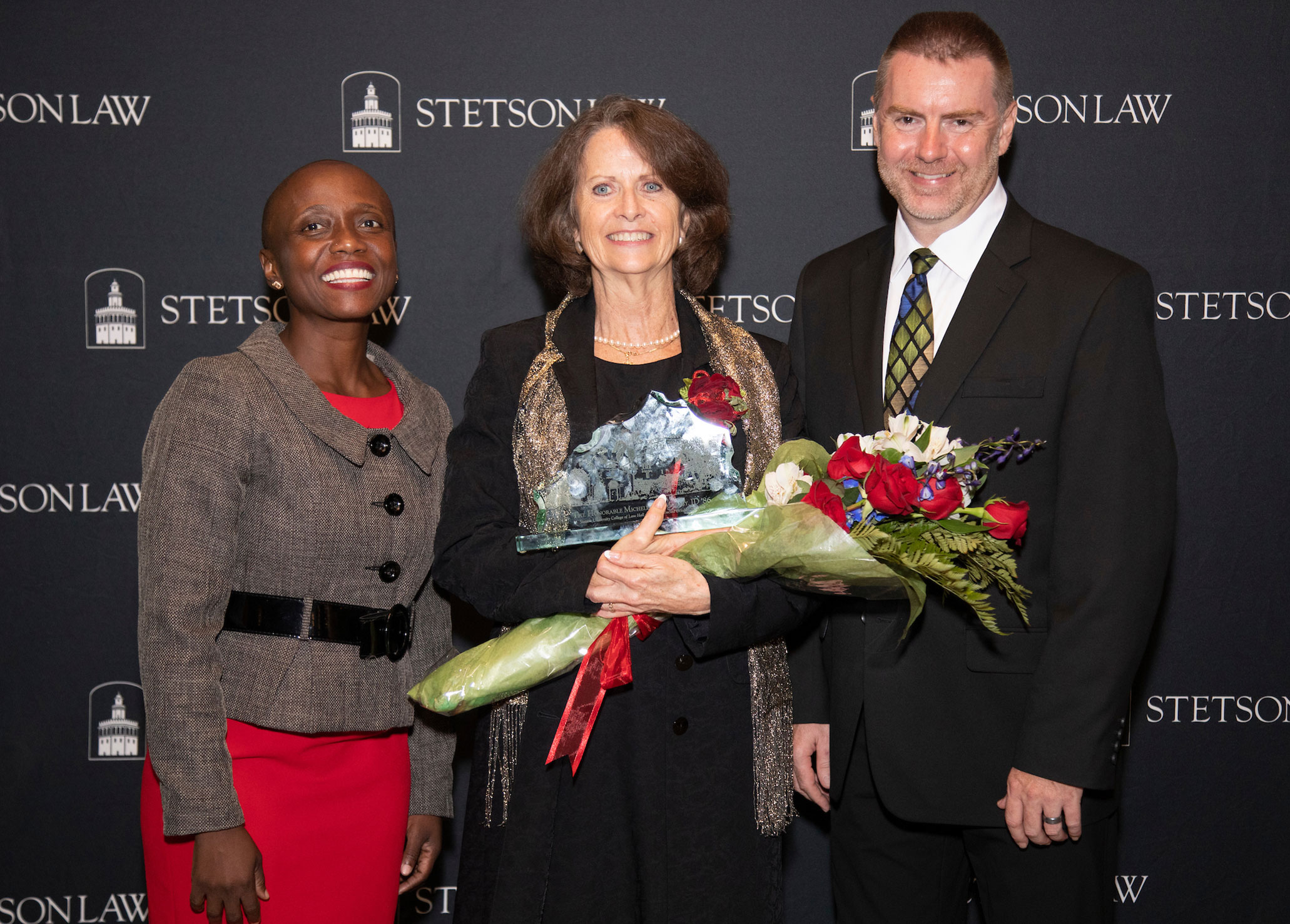
From left: Stetson Law Dean Michèle Alexandre, Hall of Fame inductee Michelle T. Morley, and Stetson University Executive Vice President and Provost Noel Painter.
Michelle T. Morley is a 1986 graduate of Stetson University College of Law. She spent several years in private practice before being elected to the 5th Judicial Circuit in Florida in 2006.
As a judge, Morley has distinguished herself in Family Law, Child Dependency and Dependency Mediation Training, Guardianship, Domestic Violence, Poverty Law and Economic Diversity Issues, Eldercare Issues, Judicial Ethics, and the future of Equal Justice. She became an Arbitrator for the Florida Attorney General’s Office, resolving “Lemon Law” complaints and joined the Florida Academy of Professional Mediators. She also serves on the Florida Judicial Qualifications Commission.
Morley has always been active in her community, including being a member of or volunteering with the Inverness Rotary Club, the Lake Sumter Community College Advisory Board, the Sumter County Sheriff’s sexual assault response team, The Refuge at Jumper Creek, and the Sumter County Adoption Support Focus Group, among other organizations. She also participated in Leadership Sumter County and was on the board of the Thomas E. Langley Medical Center.
Her biggest initiative has been the Eldercaring Coordination project. As a judge, she saw many cases where an elderly person was losing the capacity to care or make decisions for him or herself, and the person’s family began fighting about what to do. They would take their disputes to court, forcing judges to micromanage delicate situations best left to families.
In 2013, she and co-chair Linda Fieldstone brought together a taskforce of 20 state-wide agencies (including Stetson’s Center for Excellence in Elder Law) to create the Eldercaring Coordination project. The goal was to train eldercaring coordinators as an alternative dispute resolution option to help families care for their loved ones without the need for micromanagement from the courts. Since 2015, eldercaring coordination has successfully assisted 70 families.
Morley has also taken an active role in mentoring Stetson Law students through on-campus presentations and other teaching opportunities, including serving as a guest faculty member in the Constitutional Law and Civil Rights History travel course.
Thomas “Tommy” D. Roebig Jr.
From left: Stetson Law Dean Michèle Alexandre, Hall of Fame inductee Tommy Roebig, and Stetson University Executive Vice President and Provost Noel Painter.
Tommy Roebig is a 1986 graduate of Stetson University College of Law, where he was a member of the National Moot Court Team and a Dana Scholar. He now is partner in the civil litigation law firm Florin Roebig with fellow Stetson alumnus Wil Florin. In 2007, the Stetson Lawyers Association awarded Tommy and Wil its outstanding Alumni Award (Paul May Meritorious Service Award).
Roebig is Board Certified in Civil Trial Law by The Florida Bar and The National Board of Trial Advocacy, as well as Board Certified as a Civil Pretrial Practice Advocate by the National Board of Legal Specialty Certifications. He is a member of the Trial Lawyers for Public Justice Foundation and numerous other associations which promote civil justice.
During his more than 30 years in practice, Roebig has received many accolades, including those from Florida Trend™ Magazine, U.S. News and World Report Best Lawyers in America, Super Lawyers Magazine, and Martindale-Hubbell. In 2007, he was listed as one of “America’s Leading Plaintiff’s Lawyers” by the national legal organization, Lawdragon. Every year since 2009, Roebig was selected by the National Trial Lawyers Association as one of the Top 100 Trial Lawyers in the state of Florida.
Roebig has obtained jury awards of a million dollars or more in both federal and state court trials, including recoveries in the areas of medical malpractice, discrimination and civil rights, liquor liability, product liability, class action, and motor-vehicle negligence. In 2016, Roebig obtained a $42 million jury verdict against Applebee’s and others in a personal injury case that was the largest contested jury verdict in Hernando County history. His successes have led to induction into the “Million Dollar Advocates Forum,” a National organization that recognizes Trial Lawyers who have received jury awards in excess of a million dollars, and he has been named to the “Multi-Million Dollar Advocates Forum” for numerous jury verdicts of multiple millions.
Roebig is a frequently requested lecturer at Stetson University College of Law on the topics of negligence and wrongful death damages. He has often been a requested speaker on trial tactics to numerous legal associations and trial lawyer seminars, including the Florida Justice Association. He has served as an adjunct professor at St. Petersburg College teaching civil law courses.
Tommy Roebig delivers his Hall of Fame award accept speech during the event on Oct. 26.
View more photos and videos from the event
For the past 15 years, Stetson Law has honored distinguished luminaries in the legal and academic arenas at its annual Hall of Fame event. Previous Hall of Fame winners include Charles A. Dana, William R. Eleazer, and Dolly Hand.
Download high-resolution images from this photo gallery of the event on Zenfolio. Watch the individual inductee videos on the Hall of Fame page.
Stetson
University College of Law is pleased to announce that Devon Carbado, Professor
of Law at UCLA School of Law, will serve as Stetson’s 2019-2020 Culverhouse
Chair.
The
Culverhouse Chair is named for Hugh F. Culverhouse, a successful tax lawyer and
the original owner of the Tampa Bay Buccaneers. He established the chair with
the goal of attracting distinguished professors and judges from diverse areas
of law to visit Stetson. Professor Carbado joins a prestigious group of
previous Culverhouse Chairs that includes E. Allan Farnsworth, Edward D.
Ohlbaum, and Stetson’s own Ellen Podgor.
Professor
Carbado graduated from Harvard Law School in 1994 and joined the UCLA School of
Law faculty in 1997 where he is the Honorable Harry Pregerson Professor of Law.
He teaches Constitutional Criminal Procedure, Constitutional
Law, Critical Race Theory, and Criminal Adjudication.
“Devon
Carbado is an esteemed professor and distinguished author, and we are thrilled
to welcome him as Stetson’s newest Culverhouse Chair,” said Stetson University
College of Law Dean Michèle Alexandre. “His presence on campus this year will
offer enriching experiences for our students, faculty and staff.”
“Devon Carbado is an esteemed professor and distinguished author, and we are thrilled to welcome him as Stetson’s newest Culverhouse Chair,” said Stetson University College of Law Dean Michèle Alexandre. “His presence on campus this year will offer enriching experiences for our students, faculty and staff.”
Dean Michèle Alexandre
Carbado has
won numerous teaching awards, including being elected Professor of the Year by
the UCLA School of Law classes of 2000 and 2006. He was an inaugural recipient
of the Fletcher Foundation Fellowship, which is awarded to scholars whose work
furthers the goals of Brown v. Board of Education. In 2018, he was
named an inaugural recipient of the Atlantic Philanthropies Fellowship for
Racial Equity.
Carbado
has devoted much of his career to the examination of race, both in his
teachings and works. He writes in the areas of employment discrimination,
criminal procedure, implicit bias, constitutional law, and critical race
theory. He is the author of Acting White? Rethinking Race in
“Post-Racial” America (Oxford University Press) (with Mitu Gulati) and
the editor of several volumes, including RaceLaw Stories (Foundation
Press) (with Rachel Moran), among others.
Carbado on campus this November and in spring
During a
campus visit Nov. 11-17, 2019, Carbado will meet with Stetson’s Diversity
Committee on current and ongoing equality models; deliver an academic
presentation to faculty; hold class sessions with both the full-time and
part-time students; and deliver a presentation to students and the law school
community. In spring 2020, he will teach a two-credit course called, “Critical
Race Judgments: Critical Race Theory and Supreme Court Decision making.”
This marks
the second time Carbado will visit Stetson. He previously served as a Nicols
Lecturer for the College of Law and spoke on racial justice. The Nichols
Foundation Prominent Speakers Series was established at Stetson in 1995 in
honor of Perry Nichols, a successful national trial lawyer and past president
of both the American Trial Lawyers Association and the International Trial
Lawyers Association.
“I am excited
to return to Stetson. It is a wonderful school with an outstanding student body
and faculty, gifted and committed administrators, and an engaged alumni. I am looking forward to the opportunity both
to share my research on various dimensions of law and inequality with members
of the Stetson community and to learning from their insights and experiences,”
said Devon Carbado.
The Center for Excellence in Elder Law at Stetson University College of Law has adopted WINGS, a national guardianship program incubated by Florida’s courts and now transitioning to the state’s acknowledged experts and national leaders in this area of specialization.
WINGS, or Working Interdisciplinary
Network of Guardianship Stakeholders, began with a grant awarded to Florida’s
Office of the State Courts Administrator from the American Bar Association’s
Commission on Law and Aging. The transfer and evolution from startup to mature
program allows the continuation of WINGS following the successful completion of
the grant.
Stetson University College of Law, a stakeholder in WINGS from its inception in 2017, will coordinate meetings of WINGS, host its website, and manage the work of the program through the Center for Excellence in Elder Law and its faculty, including Professors Rebecca Morgan and Roberta Flowers.
Professor Roberta Flowers
Morgan and Flowers created a video series used to train and educate attorneys nationwide on the ethical dilemmas faced by elder law attorneys. They were awarded the Florida Supreme Court Professionalism Award for their video productions. In addition, they designed the nation’s first elder-friendly courtroom. Morgan and Flowers also developed, through WINGS, four e-learning modules to increase judges’ and attorneys’ professional competence and skills related to guardianship and less restrictive options.
There are 4.3 million Floridians aged 65
or older. A quarter of the state’s population is projected to be aged 65 or
older by 2030. Increasingly, Floridians seek help from the State Courts System
when they or loved ones need their interests protected. Guardianship cases for
adults have increased steadily, with more than 7,300 cases to establish
guardianship filed in the 2017-18 fiscal year, a 13 percent increase from five
years previous.
In its
startup phase directed by the courts, WINGS members recommended strategies for
boosting the number of physicians serving on examining committees, created an
informational guide and toolkit for decision-making options, and developed a
tool to help law enforcement officers and first responders identify abuse,
neglect, or exploitation.
WINGS stakeholders include representatives
from Florida courts, clerks of court, state executive agencies, private
organizations, and advocacy groups as well as family guardians and self-advocates.
More information about WINGS, the guardianship e-learning modules, and other
guardianship resources may be found on the Florida WINGS website, flwings.flcourts.org.
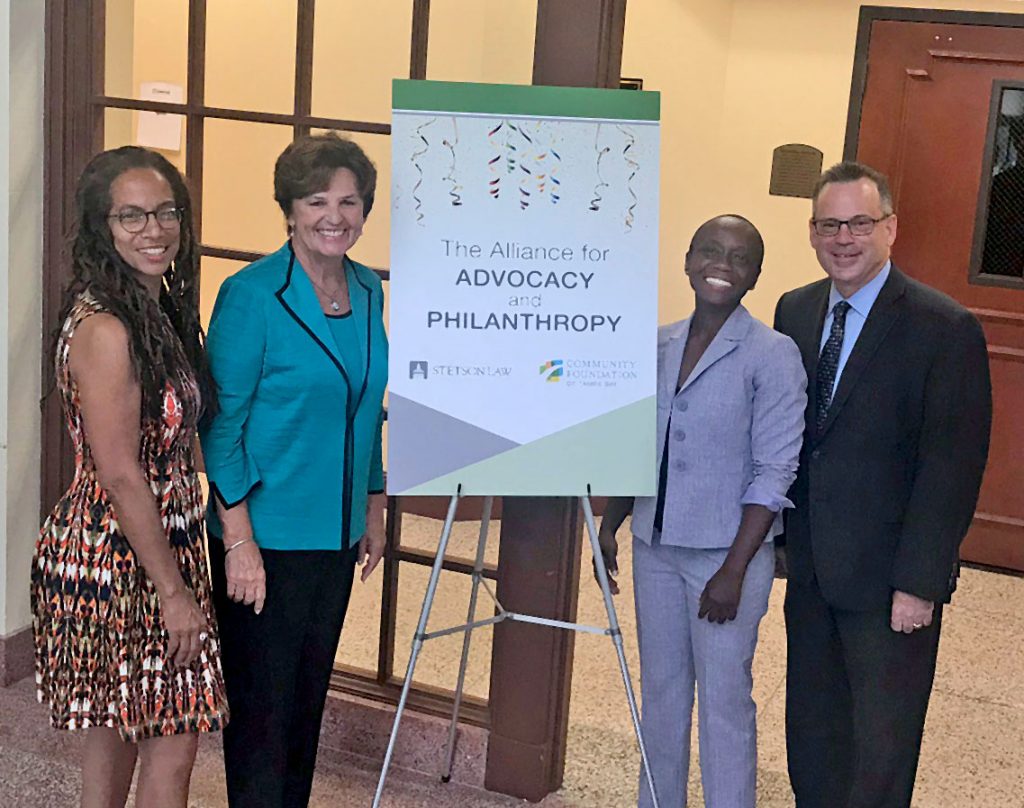
From left: Professor Judith Scully, Stetson University College of Law; Marlene Spalten, Community Foundation of Tampa Bay President and CEO; Michèle Alexandre, Dean, Stetson University College of Law; and Jesse Coraggio, VP, Community Foundation of Tampa Bay.
The
Community Foundation of Tampa Bay and Stetson University College of Law have
formed a new partnership to benefit the Tampa Bay area. The two organizations
have created the Alliance for Advocacy and Philanthropy, which will align the
power of advocacy with the heart of philanthropy. This new alliance reflects both
organizations’ longstanding commitment to addressing important issues for an
even more vibrant community.
The
Alliance for Advocacy and Philanthropy is a collaborative partnership, which
makes a strong case for creating positive change through the lens of activism
and the spirit of giving. The Alliance is a unique initiative to engage
the community and spark deep discussion through:
Connection, by
building partnerships and leveraging
resources to enhance the common good;
Education, by
developing self-advocacy and institutional capacity through access to
experts and educational opportunities; and
Collaboration,
by providing pathways for members of the community as well as students to
become actively involved.
“This
partnership is an incredible opportunity for our students and our community,”
said Michèle Alexandre, dean of Stetson University College of Law. “Working
together, we can empower the next generation of nonprofit and Tampa Bay leaders
to become effective
community advocates,
which will have a positive impact on our region.”
Fellowships and office space part of the deal
As part of the collaboration, the Community Foundation of Tampa Bay will offer two paid fellowships each semester for students attending Stetson University College of Law. The two fellowships will begin in spring 2020, and students will gain an in-depth understanding of community philanthropy and have hands-on experience in working with nonprofit organizations.
In
addition, Stetson University College of Law is providing office space at its
Gulfport campus for the Community Foundation of Tampa Bay. Stetson also will provide
meeting and conference space to the Community Foundation of Tampa Bay at its Gulfport
and downtown Tampa campuses.
The
general public, local nonprofits, and corporations will have opportunities to
take part in conversations sparked by the Alliance for Advocacy and
Philanthropy during events held at Stetson University College of Law.
Marlene
Spalten, president and CEO of the Community Foundation of Tampa Bay, said, “We look
forward to working with Florida’s first law school to create opportunities for our
region, to discuss communitywide challenges and possible solutions, and to promote
the economic health and vitality of Tampa Bay through an innovative program.”
“We look forward to working with Florida’s first law school to create opportunities for our region, to discuss community wide challenges and possible solutions, and to promote the economic health and vitality of Tampa Bay through an innovative program.”
Marlene Spalten, president and CEO of CFTB
About the organizations
The Alliance for
Advocacy and Philanthropy formalizes the organizations’ shared belief in
aligning resources and investing in advocacy, thought leadership, and programs
to solve community challenges. The partnership will include pro bono program opportunities
for students to support Tampa Bay area not-for-profits. Faculty and students at Stetson University
College of Law provide more than 30,000 hours of pro bono legal and advocacy
services through various institutes, programs and centers, including the Veterans
Law Institute, Center for Excellence in Advocacy,
the Social Justice Advocacy Program the Center for Excellence in Elder Law,
etc.
The Community Foundation
of Tampa Bay awards about $20 million each year to nonprofit organizations.
Since its inception nearly 30 years ago, the Community Foundation has granted
more than $230 million.