Skip to content

Stetson Law Welcomes 4 Visiting (and 1 Returning) Professors in 2025

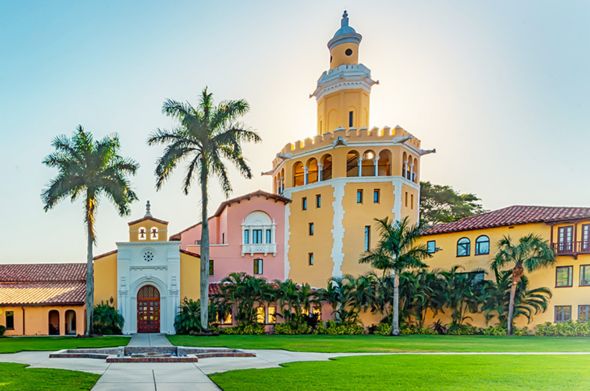
The Stetson Law tower from Plaza Mayor

As Stetson Law continues to maximize its offerings to students as well as magnify its scholarly contributions to legal education, the College is thrilled to welcome four visiting professors and one returning professor emerita to campus in fall of 2025.

Stetson Law is proud of its tradition of inviting visiting faculty to engage in projects that enrich students’ learning experiences while conducting important work that elevates Stetson’s regional, national, and international reputation.

These visiting faculty members represent a broad range of specialties.

Lucian Dervan

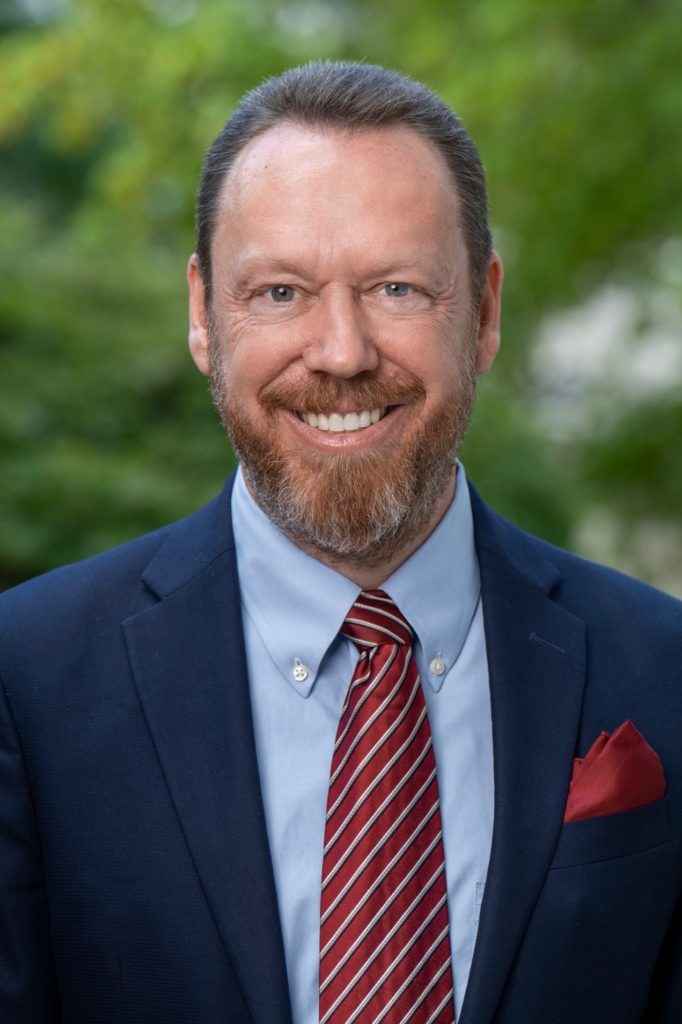
A mean with a beard smiles. He wears a suit and a red tie.
Professor Lucian Dervan

Joining Stetson from Belmont University College of Law, where he is Director of Criminal Justice Studies, Dervan focuses on domestic and international criminal law. The award-winning scholar is also Founding Director of the prestigious Plea Bargaining Institute.

Author of five books and dozens of book chapters and articles, Dervan is also the founder and author of The Plea Bargaining Blog and a contributing editor to the White Collar Crime Prof Blog (a member of the Law Professor Blogs Network), for which Stetson Law Professor Ellen Podgor serves as editor. He also regularly lectures regarding criminal law and has appeared before the United States House of Representatives’ Judiciary Committee. 

Dervan is founder and Chair of the ABA CJS’s Global White Collar Crime Institute, co-founder and co-chair of the ABA CJS’s Frankfurt International White Collar Crime Conference, and a member of the American Bar Foundation.

See Dervan’s full bio.

Sarah Gerwig

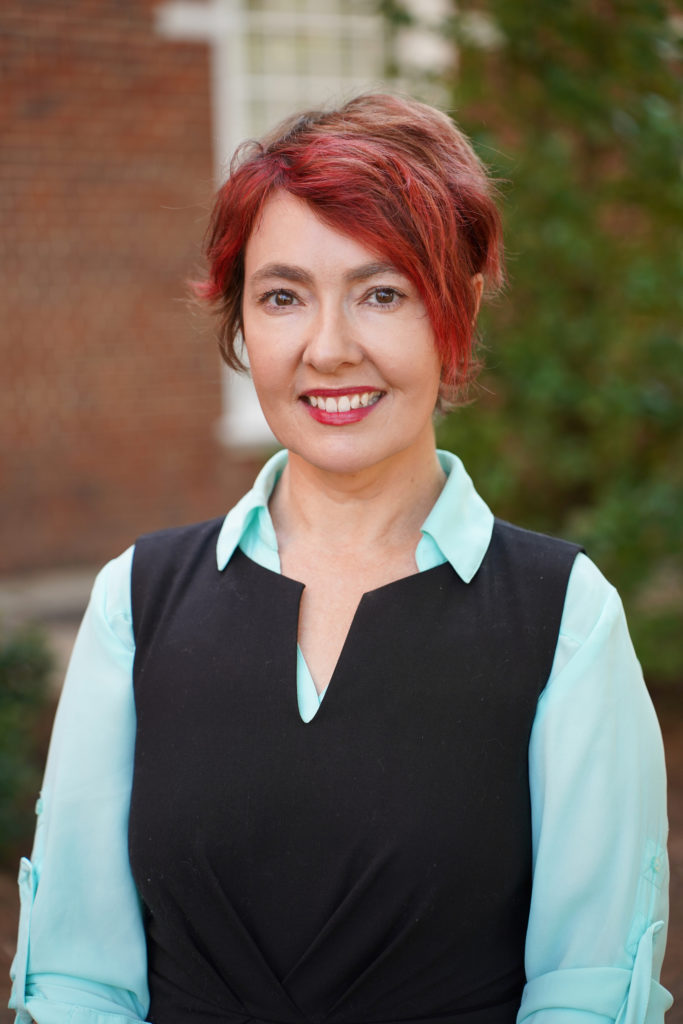
A woman with red hair wears a mint collared shirt and a vest.
Professor Sarah Gerwig

Joining Stetson Law from Mercer University, where she is a tenured Professor of Law, Gerwig will teach criminal law and feminist jurisprudence in the fall 2025 semester. 

At Mercer, she has served as Associate Dean for Academic Affairs and Director of Experiential Education. In 2006, she founded the nationally recognized Habeas Project, which provides pro bono representation in post-conviction cases across Georgia. She was awarded the 2013 Shanara Gilbert Emerging Clinician Award by the Clinical Legal Education Section of the American Association of Law Schools in recognition of her work with that clinic.

Gerwig directs Mercer’s unique Introduction to Client Counseling program, and her textbook, What Brings You Here Today? An Introduction to Client Counseling was published in 2021. Gerwig teaches and writes in the areas of criminal law, human rights, law & humanities, and professional responsibility.

See Gerwig’s full bio.

James Mastracchio

An accomplished tax litigator with clientele from around the globe, Mastracchio is a partner at Winston & Strawn LLP, where he has co-led the firm’s tax controversy practice in its Washington, DC office since 2021. He will teach federal income tax and tax practice and procedure as a visiting professor at Stetson Law.

With the distinction of having been lead counsel on international criminal cases in matters involving alleged tax violations, Mastracchio has represented clients before the U.S. Department of Justice and other regulatory bodies.

Mastracchio served as an Independent Examiner in Zurich, Switzerland and for the U.S. DOJ’s Swiss Bank Program and advised overseas financial institutions as well as government agencies on the implementation of the Foreign Account Tax Compliance Act. He was highly influential in the interpretation of inter-governmental agreements and treaty protocols as they relate to tax investigations.

Ira Nathenson

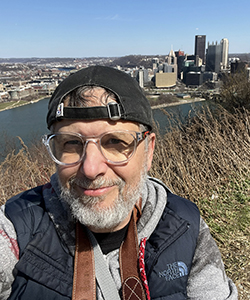
A man in glasses and a backwards hat takes a selfie against the backdrop of a city on a river surrounded by hills.
Professor Ira Nathenson

A passionate scholar in the area of intellectual property, Nathenson joins Stetson Law as a distinguished visiting professor after retiring from St. Thomas University Law School in Miami, where he founded the school’s intellectual property certificate program. While at Stetson, he will teach civil procedure and intellectual property.

Citing his eclectic interests, Nathenson looks for unexpected but compelling connections between seemingly disconnected areas like procedure, human rights, and popular culture.

Nathenson has written extensively on copyright law and other IP matters,  has served as Chair of the Section on Civil Procedure for the Association of American Law Schools, and runs a website featuring extensive civil procedure study resources as well as a companion YouTube channel.

See Nathenson’s full bio.

Professor Emerita Candace Zierdt

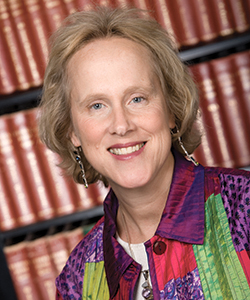
A blonde woman in a colorful shirt smiles in front of a stack of books.
Professor Candace Zierdt

Having recently retired from Stetson Law following nearly two decades on faculty, Law Professor Emerita Candace Zierdt returns to teach contracts in the fall 2025 semester.

Zierdt began teaching contracts and commercial law at Stetson in 2006. Prior to that, she taught at the University of North Dakota School of Law from 1990 to 2006. She has chaired the American Bar Association’s UCC committee, the Article 1 subcommittee, and the Article 2 subcommittee. She is also a member of the American Law Institute and the UCC committee for the Uniform Law Commission.

She was director of Stetson Law’s Bruce R. Jacob Visiting Professor Program from its founding in 2009 until 2019.

In January of 2025, she received the American Association of Law Schools’ (AALS) Section on Commercial and Consumer Law Mentorship Award at the AALS meeting in San Francisco.

See Zierdt’s full bio.

Other new faculty members include two new full-time professors as well as two Bruce R. Jacob Visiting Professors.

Meet the Newest Bruce R. Jacob Visiting Assistant Professors

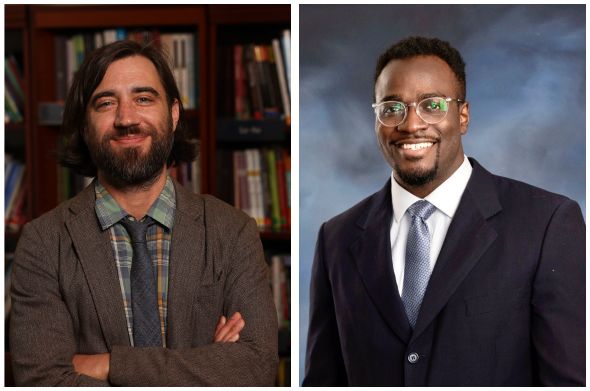
Headshots of two visiting professors in 2025

The Stetson Law community is excited to welcome two individuals to the faculty as part of its Bruce R. Jacob Visiting Assistant Professor (VAP) Program. Named for celebrated Dean Emeritus Bruce R. Jacob, this program invites aspiring academics to gain full-time teaching experience while benefiting from extensive mentorship and support from tenured faculty.

Over the program’s typically two-year period, these visiting professors are invited to produce meaningful scholarship while immersing themselves in Stetson Law’s vibrant campus community.

In fall of 2025, two scholars begin their time as Bruce R. Jacob Visiting Assistant Professors: Babafemi Fatade and Andrew Milne.

Babafemi Fatade

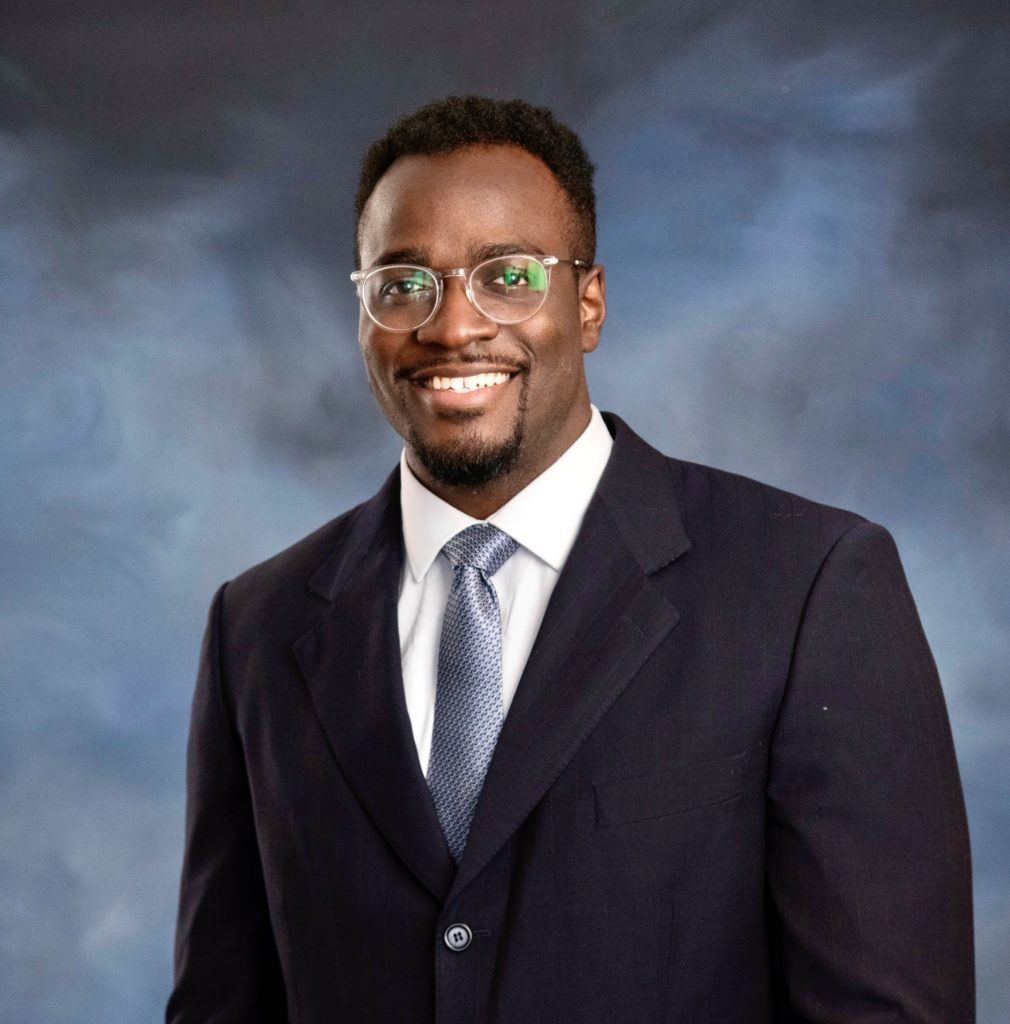
A man in a suit and tie
Professor Babafemi Fatade

Prior to joining Stetson Law, Fatade was an assistant professor of Lawyering at NYU School of Law. As a practitioner prior to entering academia, Fatade worked as a commercial attorney at Tennessee Valley Authority.

He received his JD from Georgetown University Law Center and his BA in philosophy from Georgia State University. He served as the administrative editor for the Georgetown Journal of Law and Modern Critical Race Perspectives while in law school and served as a student instructor for Georgetown’s Street Law practicum.

Fatade’s current research interest lies at the intersection of pre-contractual promissory reliance and the impracticability doctrine.

See Fatade’s full bio.

Andrew Milne

Prior to joining Stetson Law as a Bruce R. Jacob Visiting Assistant Professor, Professor Milne taught as a visiting assistant professor at Suffolk University and as a clinical teaching fellow in the Civil Practice Clinic at South Texas College of Law.  Following his graduation from New York University School of Law in 2012, he had over eleven years of practice, focusing on poverty law and disability rights. 

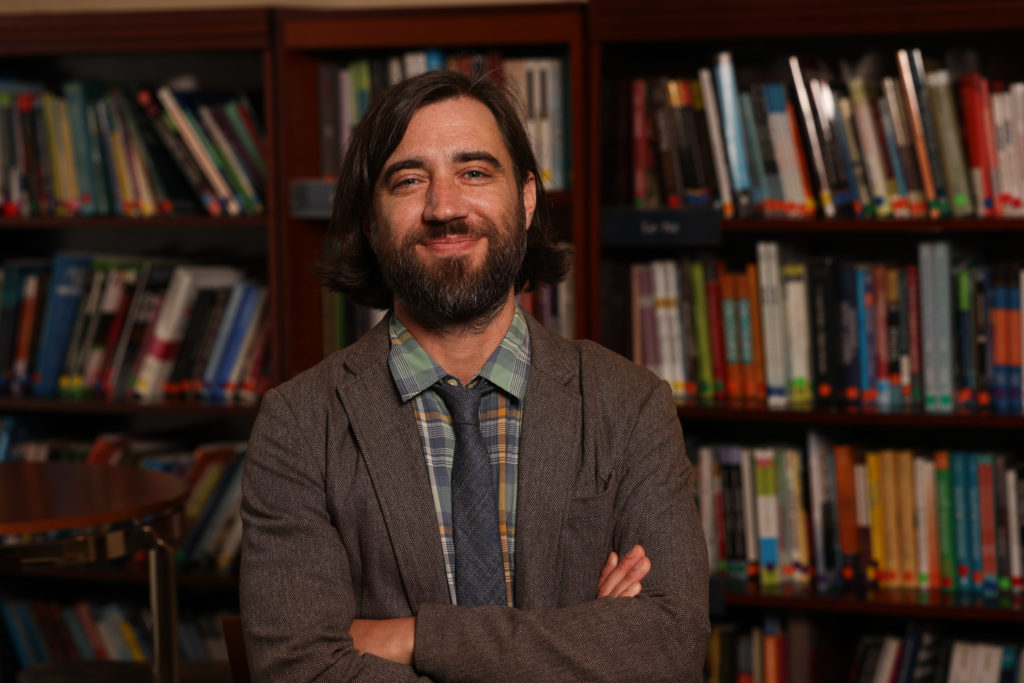
A man wearing a sweater folds his arms in front of shelves full of books
Professor Andrew Milne

As a staff attorney at Texas Rio Grande Legal Aid, he handled a wide variety of civil and criminal matters on behalf of vulnerable populations in rural counties. He also conducted statewide litigation to protect the rights of individuals in psychiatric, nursing, juvenile, and carceral facilities while working at Disability Rights Center – New Hampshire. 

See Milne’s full bio.

Other faculty members that have joined Stetson faculty this fall include two new full-time professors as well as four visiting professors and one returning professor emerita.

An International Focus for Newest Full-Time Faculty

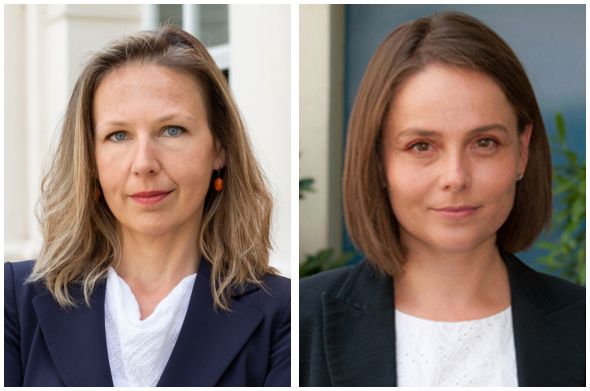
Headshots of two women wearing suits

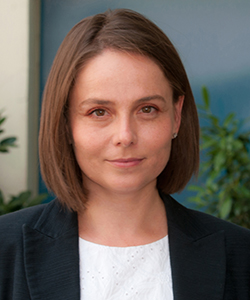
In the fall of 2025, two esteemed educators joined Stetson Law’s faculty as tenure-track professors. Both new hires demonstrate the College of Law’s commitment to growing its already robust offerings in the area of international law, as each brings a unique and impressive set of scholarship and experience to our law school.

Dagmar Rita Myslinska: Immigration Law

Stetson Law has hired noted immigration law scholar Dagmar Rita Myslinska as a tenure-track associate professor.

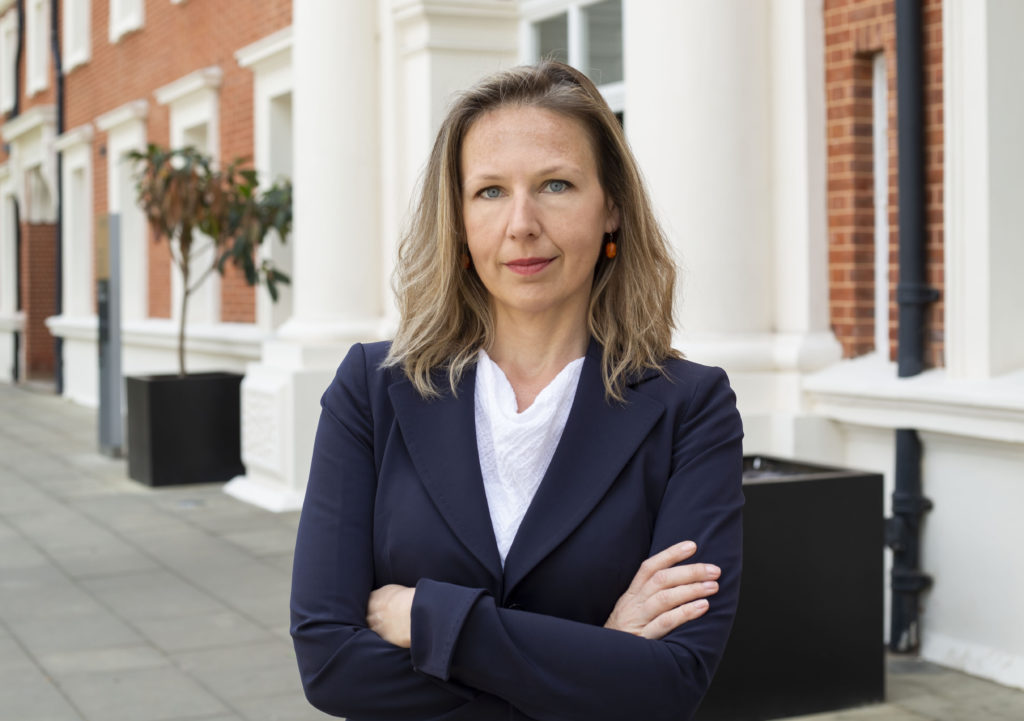
A woman with blonde, shoulder-length hair wears a blue suit jacket and white shirt. She crosses her arms as she stands in front of a red brick building with white columns.
Professor Dagmar Rita

She joins Stetson from Creighton University School of Law. Her extensive resume includes being the current chair-elect of the Association of American Law Schools’ European Law Section, a lecturer and director of teaching and learning at Goldsmiths, University of London, and a member of the board of trustees of the Migrants’ Rights Network.

Professor Myslinska’s research focuses on immigration and equality rights, using qualitative studies to analyze anti-discrimination and immigration policies in the US, UK, EU, and Japan.  She is currently working on a handbook of comparative international law.

See Myslinska’s full bio.

Klara Van der Ploeg: International Law & D.R.

Joining Stetson Law from the University of Nottingham School of Law, Associate Professor Klara Polackova Van der Ploeg specializes in international law and international trade regulation.

Professor Klara Van der Ploeg

Prior to joining Stetson, she led the Business, Trade and Human Rights Unit (Human Rights Law Centre) at the University of Nottingham, and she served as the Judicial Assistant to Judge Sir Christopher Greenwood at the International Court of Justice in The Hague. 

Her research explores structural questions surrounding international law and global governance, focusing on methods in which international law regulates non-state entities in addressing global problems.  Her monograph Regulating Collective Nonstate Entities in International Law: Rights and Obligations is forthcoming with Oxford University Press.

See Van Der Ploeg’s full bio.

Other faculty members that have joined the Stetson faculty this fall include two Bruce R. Jacob Visiting Assistant Professors as well as four visiting professors and one returning professor emerita.

Learn more about the international law concentration at Stetson.

Explore the College’s new International Law LLM offerings.

Palmer, Simcox Step Into New Deanship Roles

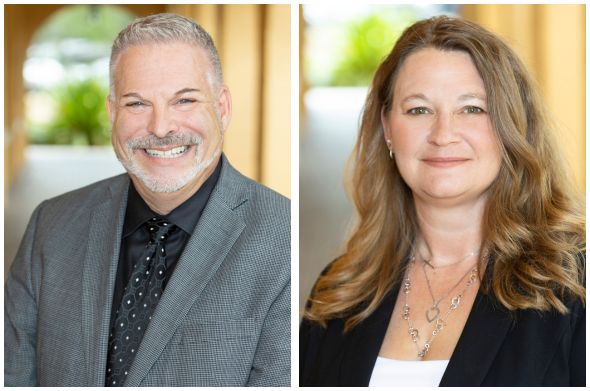
A split photo featuring two professor headshots. On the left is a man wearing a grey suit jacket; on the right is a woman wearing a black suit jacket.
Left: Vice Dean Jason Palmer. Right: Associate Dean for Academic Affairs Stacey-Rae Simcox.

Building on Stetson Law’s commitment to supporting student success in law school and beyond, College of Law Dean D. Benjamin Barros has appointed Professor Jason Palmer as Vice Dean and Professor Stacey-Rae Simcox as Associate Dean for Academic Affairs.

Their insight and guidance in these roles will ensure that the College of Law will retain its academic rigor, grow in its capacity to support students, and engage alumni as well as the greater legal community.

Professor Jason Palmer becomes Vice Dean

Dean Barros has chosen Dean Palmer to be Vice Dean of the College of Law due to his exceptional work as associate dean for academic affairs, a role in which he served since summer of 2023.

In this new position, Dean Palmer leads strategic initiatives and oversees educational, administrative, and operational enhancements that advance the College’s priorities and institutional goals.

“Jason’s leadership and outstanding administrative abilities will be instrumental in helping us achieve our ambitious goals for the future,” said Barros. “He has done an exceptional job as associate dean for academic affairs, managing complex and difficult situations, and I look forward to working with him in this new capacity.”

Dean Palmer, who joined the Stetson Law faculty in 2008, teaches legal research and writing, civil procedure, complex litigation, international litigation and arbitration, law and sexuality, and other courses. He has written, published, and spoken extensively on domestic and international mass claims processes, and spent five years in Zurich, Switzerland,  adjudicating claims of Holocaust victims who were attempting to recover assets from Swiss banks.

From 2019 to 2021, he served as chair of the Association of American Law Schools’ Professional Development (Arc of Career) Committee. Dean Palmer also served on the board of directors of the nonprofit Legal Writing Institute from 2016-2020 (including as treasurer from 2018 to 2020) and was chair of the AALS Section on Sexual Orientation and Gender Identity Issues.

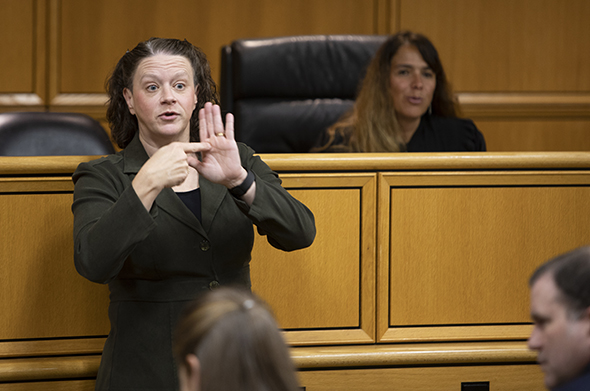
On campus, he has supported students as an advisor on student legal publications and has helped facilitate workshops to train sign language interpreters how to navigate the complexities of conducting their work in a courtroom setting.

See Dean Palmer’s full bio.

Professor Stacey-Rae Simcox named Associate Dean for Academic Affairs

Citing her leadership of Stetson Law’s Veterans Law Institute and Veterans Law Clinic, Dean Barros has also named Professor Stacey-Rae Simcox as Associate Dean for Academic Affairs.

Dean Simcox will continue her work as Director of the Veterans Law Institute throughout the 2025-2026 academic year. Her dedication to academic excellence and service to veterans reflects two key elements of Stetson Law’s mission. 

Teaching veterans law, administrative law, and trusts and estates, Simcox joined the Stetson Law faculty in 2014. Her leadership of the Veterans Law Clinic has helped numerous veterans recover millions of dollars’ worth of previously denied benefits they earned through their service, all while giving clinic students meaningful real-world experience doing legal work.

“I have been impressed with Stacey-Rae’s leadership of the VLI and of some of our most important faculty committees,” said Dean Barros. “I am delighted that Stacey-Rae has agreed to take on this new role, and I look forward to working with her.”

As director of the VLI, she has also forged important partnerships, including a medical-legal partnership between Stetson Law and the University of South Florida’s Morsani College of Medicine that brings medical students and faculty and the Stetson Law community together to work for the benefit of disabled veterans.

In 2023, she co-published Veterans Benefits: Law, Theory, and Practice, a textbook for students working at veterans law clinics across the country.

She is a founding member of the National Law School Veterans Clinic Consortium and served as its president and on its board for six years.

See Dean Simcox’s full bio.

Elder Justice Student Takes Passion to Another Level

With encouragement from Professor Rebecca Morgan, Lauren Lewchuk presented to DOJ officials in the summer of ’25.

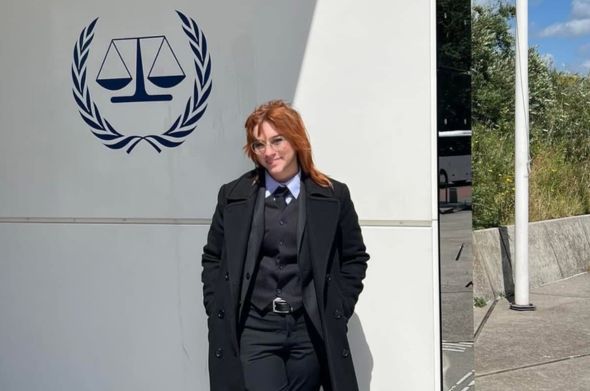
A person in a black suit and trench coat stands in front of a building featuring a picture of the scales of justice.
Lauren Lewchuk ’26 presented to the U.S. Department of Justice’s Elder Justice Initiative in summer of 2025.

It began with a paper Lauren Lewchuk ’26 wrote for their Elder Law Seminar class with Professor Rebecca Morgan ’80.

Titled “Barriers to Reintegration: The Socioeconomic Marginalization of Elderly Former Inmates,” it examines the socioeconomic barriers faced by elderly individuals reentering society after incarceration, with a focus on Florida’s aging prison population.

It concludes by proposing to establish of a Senior Reentry Assistance Program under the Older Americans Act to provide targeted support in housing, healthcare, legal services, and financial stability.

“This idea grew from my interest in criminal justice reform and my role as a mitigation interview specialist on death row cases on the defense side,” Lewchuk said.

With guidance from a private investigator, Lewchuk gathered detailed background information on clients facing capital punishment. They interacted with clients’ families and communities to better understand how the effects of incarceration go well beyond the incarcerated.

“These experiences were yet another reflection of how the criminal justice system consistently and disproportionately burdens and harms marginalized communities. They also shed light on the often-overlooked challenges that elderly individuals face when returning to society,” Lewchuk said.

From the classroom to the policymakers

Professor Morgan referred them to a member of the U.S. Department of Justice’s Elder Justice Initiative. Lewchuk planned to interview her for the paper, but she expressed interest in the concept and invited Lewchuk to present on it to members of her team. Lewchuk enthusiastically accepted.

Yet again, Morgan offered her support and encouragement.

“It is such a privilege to work with our students,” Morgan said. “Lauren’s enthusiasm, hard work, dedication show me that they will be an amazing attorney.”

To help Lewchuk prepare, she organized a mock presentation with several faculty members, including Professor Roberta Flowers, Vice Dean Jason Palmer, and Professor Theresa Radwan.

“Their thoughtful feedback and constructive critiques were invaluable, and I deeply appreciate their support,” Lewchuk said.

The experience bolstered Lewchuk’s resolve to advocate for the most vulnerable – and Morgan’s mentorship proved an invaluable part of this experience, as it always does for those who seek her help.

“Professor Morgan provided unwavering support and guidance throughout this process, for which I am truly grateful,” Lewchuk said.

125 Big Moments in Stetson Law History

Over the years, the Stetson Law community has had many has had many incredible milestones on campus and beyond. In honor of the College’s 125th anniversary, here’s a look at some of the biggest moments in its history.

A black-and-white image featuring four ornately dressed women posing on Stetson Law's "Wishing Well" fountain.
Wishing Well Fountain Ladies Posing Rolyat 1920s
previous arrow
next arrow
  1. 1900. Stetson University College of Law is founded with Albert J. Farrah as its initial dean. It was one of very few schools to require students to enroll in “practice court.” To be admitted in the first year, students had to be at least 18 years old and have a high school diploma or equivalent. Annual tuition was $66.
  2. 1900. Dr. Annie MacLean is the first female faculty member to teach at Stetson Law. She was an instructor in Constitutional Law.
  3. 1901. A.G. Hamlin, Stetson University trustee from 1888 to 1908 and attorney for the Florida East Coast Railway, raises $500 to start a new law library.
  4. 1902. Stetson Law graduates its first class of students.
  5. 1906. Mary Stewart Howarth-Hewitt becomes the first female law student to attend Stetson. After graduating, she would become the first woman admitted to practice in Florida. She graduates in 1908.
  6. 1913. Emmett Wilson (1904) is elected to the U.S. House of Representatives.
  7. 1922. Stetson Law becomes three-year law school.
  8. 1926. The College adopts a two-year undergrad requirement.
  9. 1926. Hotel Rolyat, Stetson Law’s future home, opens as an extravagant Spanish-themed hotel.
  10. 1927. William Hull Ellis (1889) begins his first term as Chief Justice of the Florida Supreme Court.
  11. 1930. Stetson Law gains American Bar Association approval.
  12. 1931. Stetson Law joins the American Association of Law Schools.
  13. 1932. Babe Ruth signs his 1932 contract with the Yankees at the Rolyat.
  14. 1932. Florida Military Academy opens at the former Hotel Rolyat.
  15. 1933. David Sholtz (1914) serves as 26th governor of Florida.
  16. 1935. Students begin to elect their own officers, planting the seeds for the Student Bar Association.
  17. 1937. Roy Harrison Chapman (1908) serves as a justice for the Floria Supreme Court until 1952.
  18. 1937. Joe Hendricks ’34 is elected to the U.S. House of Representatives.
  19. 1938. Students Ralph Odum and Thomas Cobb initiate Stetson’s first legal aid clinic.
  20. 1938. Elwyn Thomas (1915) becomes a justice of the Florida Supreme Court until 1969.
  21. 1942. Stetson Law closes until the end of World War II.
  22. 1946. The College reopens with 83 students. Enrollment balloons to 315 in 1948 thanks to the G.I. Bill.
  23. 1946. Miss Ray Jordan becomes the first law librarian.
  24. 1947. Stetson Law moves to naval base at DeLand Airport.
  25. 1948. Tolbert Frank Hobson (1924) serves as a justice on the Florida Supreme Court until 1962.
  26. 1952. Edwin Harris Drew ’52 served on Florida Supreme Court until 1971, including as chief justice.
  27. 1954. Stetson Law relocates to Gulfport, Florida, taking residence at the Rolyat Hotel.
  28. 1954. Celebrated trial attorney and personal injury law pioneer Perry Nichols ’37 helps found the International Academy of Trial Lawyers, later becoming president of the organization in 1965.
  29. 1955. Harold Sebring, who was a judge at the Nuremburg War Trials, resigns from the Florida Supreme Court to become the first dean of the Gulfport campus.
  30. 1955. Dean Harold Sebring implements President J. Ollie Edmunds’vision and plan for the Gulfport law center to be modeled after the English Inns of Court.
  31. 1955. A $250,000 pledge from Charles Dana enables the first law library to be built. It opens three years later.
  32. 1956. Hollywood at Stetson Law! The movie The Strange One is filmed on campus.
  33. 1957. At the recommendation of Stetson University Trustee Walter Mann, the College of Law Board of Overseers forms. Mann, for whom Mann Lounge is named, was its first president.
  34. 1962. A $250,000 bequest from Sarah E. Armstrong helps the law library grow its collection.
  35. 1963. At just 27, Bruce Jacob ’59 argues before the U.S. Supreme Court in the landmark case Gideon v. Wainwright. He would go on to champion pro bono service and become dean in 1981.
  36. 1963. Stetson becomes the first law school in Florida to establish a clinical program.
  37. 1964. State Attorney Dan Warren ’52 works with Dr. Martin Luther King, Jr. to crack down on the KKK and fight for civil rights in St. Augustine.
  38. 1966. Stetson replaces its LLB degree with a JD offering.
  39. 1968. Two new buildings open on campus: the H. Jackson Crummer Classroom building and Eleanor Naylor Dana Administrative Hall.
  40. 1969. Vassar Benjamin Carlton begins his term on the Florida Supreme Court, serving as Chief Justice in 1973.
  41. 1970. Thomas (Tom) James ’69 becomes Raymond James CEO at 27 years old. James served as CEO until 2010 and as chairman of the board until 2017.
  42. 1970. The College of Law receives another gift from the Dana Foundation to expand the law library and grow the collection.
  43. 1971. Hal Dekle ’40 is elected to the Florida Supreme Court.
  44. 1971. Dean Richard Dillon establishes the Stetson Intramural Law Review. Professor Elizabeth Leeman is the student publication’s first faculty advisor.
  45. 1971. Students begin a campus newspaper called The Prelude, which was published through the late 1980s.
  46. 1973. Thirteen years after the untimely death of his son Harvey Firestone III ’60, Harvey Firestone, Jr. helps fund the construction of recreation facilities including the pool, basketball courts, tennis courts, and a full gym.
  47. 1974. Thomas Stringer becomes the first Black College of Law graduate.
  48. 1974. Elizabeth Leeman becomes Stetson Law’s first female full-time professor.
  49. 1975. Ruth Fleet Thurman ’63 becomes first female tenured professor.
  50. 1976. The Harold L. Sebring Building opens.
  51. 1977. Fred Karl ’49 is elected to the Florida Supreme Court.
  52. 1978. The Intramural Review gains full law review status and has been published continuously thereafter as the Stetson Law Review.
  53. 1979. The first Higher Education Law and Policy Conference takes place.
  54. 1979. Dade County Circuit Court Judge Edward Cowart ’52 presides over the Ted Bundy trial.
  55. 1979. James Cloudis Smith ’67 serves as the 32nd Florida attorney general. He also served as Secretary of State of Florida from 1987-1995 and from 2002-2003.
  56. 1981. Double Hatter Jim Shore ’80 is the first Native American to graduate from the College of Law.
  57. 1980. Beloved law librarian Sally Ginsberg Waters joins Stetson.
  58. 1983. Supreme Court Justice John Paul Stevens speaks at the Inns of Court Banquet.
  59. 1983. The College of Law receives a rare book collection from Professor Alessandra Luini del Russo that had been in her family’s collection for over two centuries.
  60. 1986. Jane Geddes ’06 wins the LPGA Women’s Open.
  61. 1986. Joseph Reiter ’68 becomes president of the Florida Bar.
  62. 1986. Upon becoming president of the Stetson Lawyers Alumni Association, Paul May leads an effort to revitalize the organization from a somewhat dormant group to the robust organization it is today.
  63. 1989. Porkchop the Cat is photographed attending the 1989 graduation ceremony.
  64. 1990. Professor Dorothea Beane becomes the first Black professor on faculty and goes on to become the first Black professor to earn tenure.
  65. 1992. Stetson launches its groundbreaking legal pro bono service program for students and faculty.
  66. 1992. Manuel Ramos is the first Hispanic professor hired by the College of Law.
  67. 1992. Bernie McCabe ’72 is elected Pinellas-Pasco state attorney.
  68. 1994. Stetson wins all five National Trial Advocacy competitions.
  69. 1994. The Carey & Florin Courtroom is dedicated.
  70. 1994. William Blews ’66 becomes president of the Florida Bar.
  71. 1994. Lizabeth Moody becomes first female dean and first female vice president at the College of Law.
  72. 1995. U.S. News ranks Stetson Law No. 1 in trial skills advocacy for the first time.
  73. 1995. Stetson’s Center for Excellence in Elder Justice launches.
  74. 1995. Stetson’s International Environmental Moot Court Competition takes place for the first time.
  75. 1996. Stetson’s Institute for Biodiversity Law & Policy forms.
  76. 1996. Bob Dillinger ’76 is elected public defender for Florida’s Sixth Judicial Circuit, a role in which he would serve until 2020.
  77. 1997. As leader of a legal “dream team” Michael Mayer ’65 plays a key role in a lawsuit against the tobacco industry that resulted in an $11 billion settlement to Florida taxpayers.
  78. 1998. Stetson Law launches its LLM program in international law.
  79. 1998. A new building housing the Law Library opens with a large celebration. U.S. Supreme Court Justice Ruth Bader Ginsburg is the keynote speaker.
  80. 1998. Professor Luz Nagle is the first Hispanic female to join the Stetson Law faculty. She would become the first Hispanic female to earn tenure in 2004.
  81. 1998. The first study abroad program, a trip to Tallinn, Estonia, launches.
  82. 2000. Stetson’s Center for Excellence in Advocacy forms.
  83. 2002. The student center opens on campus.
  84. 2002. The part-time JD program, now known as Flex JD, launches.
  85. 2002. Richard E. Doran ’81 becomes the 34th attorney general of Florida.
  86. 2004. Stetson’s Tampa Law Center opens in downtown Tampa.
  87. 2004. The Wm. Reece Smith, Jr. Courtyard is dedicated.
  88. 2004. Stetson’s Center for Excellence in Higher Education Law & Policy forms.
  89. 2004. Stetson Law launches its Hall of Fame. Among the 17 initial honorees are former deans Lewis Tribble (1915), W. Gary Vause, and Judge Elizabeth Kovacevich (1961).
  90. 2004. Rich McKay ’84 becomes president and general manager of the Atlanta Falcons.
  91. 2004. Jerald Scott Paul is nominated by President George W. Bush and confirmed by the U.S. Senate to serve as Principal Deputy Administrator of the National Nuclear Security Administration at the U.S. Department of Energy.
  92. 2005. William Eleazer Courtroom, the nation’s first elder-friendly practice courtroom, is dedicated.
  93. 2005. Thanks to a $500,000 gift from the Joy McCann Foundation, the William Reece Smith, Jr. Distinguished Professorship launches. Named for celebrated professor and public interest law titan Wm. Reece Smith, Jr., the title was first bestowed on Professor Roberta Flowers.
  94. 2005. Stetson Law wins Willem C. Vis international championship over 150 law schools from 47 countries.
  95. 2005. The prestigious Edward D. Foreman Award is given to a student for the first time.
  96. 2006. Gus Bilirakis ’89 is elected to the U.S. House of Representatives.
  97. 2007. The Florin Roebig Courtroom is upgraded and rededicated.
  98. 2007. The Institute for Caribbean Law and Policy opens.
  99. 2007. U.S. Supreme Court Justice Antonin Scalia speaks on campus.
  100. 2008. Stetson Law hosts the National Pretrial Competition, developed by then-Dean Darby Dickerson, for the first time.
  101. 2010. The Dolly & Homer Hand Law Library is named in honor of the Hands’ philanthropic support of the library.
  102. 2010. Institute for the Advancement of Legal Communication forms.
  103. 2010. U.S. Supreme Court Justice Clarence Thomas speaks on campus as a Distinguished Jurist in Residence.
  104. 2011. Bob Gualtieri ’02 is appointed sheriff of Pinellas County and is elected to serve in the role in 2012 and reelected in 2016, 2020, and 2024.
  105. 2012. Christopher M. Pietruszkiewicz is named dean of the College of Law.
  106. 2012. The Veterans Law Institute opens.
  107. 2014. After serving in the Florida House of Representatives, Rick Kriseman ’87 is sworn in as mayor of St. Petersburg and serves in that role until 2022.
  108. 2014. Double Hatter and past Board of Overseers Chair Gregory Coleman ’85 ’89 becomes president of the Florida Bar.
  109. 2017. Fred Ridley ’77 is named chair of Augusta National Golf Club.
  110. 2018. The Veterans Law Institute opens in new state-of-the-art Judge Raphael Steinhardt building.
  111. 2018. James Byrne ’80 becomes United States Deputy Secretary of Veterans Affairs after serving as general counsel for the department.
  112. 2019. Leading civil rights scholar Michele Alexandre is appointed dean of the College of Law; the first Black individual to assume the role.
  113. 2020. The establishment of the Business Law Concentration creates an opportunity for students to sharpen their skills within corporate, tax, and other key areas of practice.
  114. 2020. Chris Sprowls ’09 becomes Florida House Speaker.
  115. 2020. With the world in the throes of the COVID-19 pandemic, Law Professor Kirsten Davis leads the effort to expand the College’s virtual education capabilities, an undertaking that earned national recognition.
  116. 2021. Stetson Dispute Resolution and Moot Court Boards win the second ABA Competitions Champion Award after earning the most points throughout the American Bar Association Law Student Division’s four competitions.
  117. 2022. Stetson Law’s Dispute Resolution Board wins South Texas University’s Energy Law Negotiation Competition despite the college having no energy law concentration.
  118. 2022. Kathleen Passidomo ’78 becomes Florida Senate President.
  119. 2023. Stetson Law welcomes D. Benjamin Barros as dean.
  120. 2023. Stetson Law’s former law library transforms into 16,000-square-foot Advocacy Institute, offering the most courtrooms of any law school in the country..
  121. 2023. Thanks to a generous gift from influential 1967 alumnus Dick Jacobs and his wife, Joan, the Jacobs Law Clinic for Democracy and the Environment launches under the leadership of Professor Jaclyn Lopez.
  122. 2024. Ashley Moody ’10 is appointed to a U.S. Senate seat representing Florida after serving as Florida Attorney General from 2019-2025..
  123. 2025. Pam Bondi ’90 is confirmed as Attorney General of the U.S. Bondi also served as Florida’s 37th Attorney General.
  124. 2025. Under the leadership of President and General Manager Christina Unkel ’12, the Tampa Bay Sun becomes the first team to win the United Soccer League (USL) Women’s Super League championship.
  125. 2025. Campus leadership adds generative artificial intelligence training to its 1L fall orientation programming.

Fall ’25 Orientation Features Session on AI

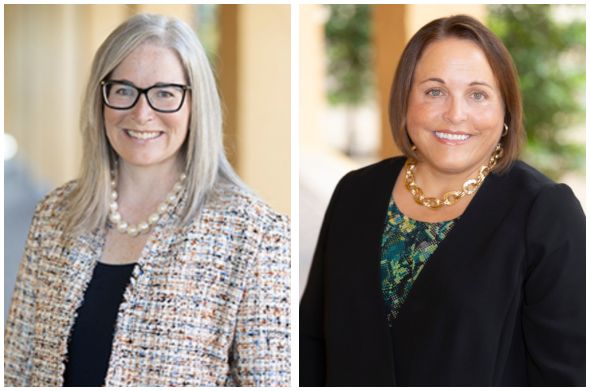
On the left is a headshot of Associate Dean Anne Mullins wearing a woven suit jacket and necklace with large pearl-like beads. On the right is a headshot of Professor Kirsten Davis wearing a black suit jacket and a gold-colored necklace.
Left: Associate Dean for Assessment and Professional Engagement and Professor of Law Anne Mullins; Right: Provost’s Faculty Fellow for Generative AI and Higher Education and Professor of Law Kirsten Davis.

For law students and legal professionals alike, generative artificial intelligence is a double-edged sword: a powerful tool that can enhance work and save time, but only if one knows how and why to use it.

Starting in fall of 2025, Stetson Law’s orientation will now include a training on best practices when using the paradigm-shifting tech in coursework and as legal professionals.

“Generative AI has touched nearly every aspect of our lives, especially in higher education,” said Associate Dean for Assessment and Professional Engagement Anne Mullins. “Orientation is the perfect opportunity to demonstrate how, if used correctly, these tools can support our students’ work as they develop important lawyering skills like attention to detail and critical thinking.”

Important lesson before class is in session

Generative AI is a powerful resource for law students. They can use it as a study aid, a brainstorming tool, and in some of the research they do as students and, eventually, as lawyers. Yet some might not be clear on how to reap the benefits of AI while avoiding poor information sourcing, plagiarism, or overreliance that can interfere with learning.

Designed and led by Dr. Kirsten Davis Professor of Law and Provost’s Faculty Fellow for Generative AI and Higher Education, the orientation course will introduce students using Generative AI ethically and effectively as students and as future legal professionals.

Since incoming students might have varying understandings of the tech and its uses, orientation is the perfect time to establish a baseline from which all students can work.

“I expect that students are wondering how generative AI is impacting law practice and law school and want to know how they should or should not use the tools,” Davis said. “There are many potential missteps with generative AI, and it’s our duty to start students off right.”

She hopes this will help them avoid pitfalls like relying on hallucinated information, examples of which have been seen in court cases where lawyers have included false case citations and fake quotations in court filings.

“Generative AI tools talk to us in our language, but they are not truth machines,” Davis said. “Law students need to understand this at the very start of law school.”

What’s on the agenda

Incoming 1Ls will learn about the technology behind generative AI, its strengths and weaknesses for advocacy and communication, and best practices for ethical use. 

“Importantly, students will get advice on appropriate uses for gen AI in their legal education. A significant goal of this training is to ensure that generative AI tools don’t interfere with their legal education,” Davis said.

In keeping with Stetson Law’s commitment to practice-readiness and professional identity formation, the training also promotes an approach to lawyering that emphasizes ethical advocacy, effective legal communication, preparedness, diligence, and inclusivity.   

“These values include a sense of responsibility to clients, the profession, the rule of law, and a commitment to actively developing the competencies needed for excellence as a lawyer,” Davis said. “The increasing use of generative AI by lawyers suggests that law students will need a framework for understanding how their character as lawyers intersect with the ability of generative AI tools to produce legal communication.”

The bigger picture

The session takes place amid an innovative orientation program that in 2023 was recast into a holistic, interactive format inspired by the inns of court tradition. The program has proven effective in bolstering confidence and creating a sense of community among students as they learn about life as a legal professional.

The American Bar Association recently selected the Inns program for the E. Smythe Gambrell Professionalism Award. The national recognition honors exemplary and innovative programs that promote professionalism.

Earlier this year, the Florida Bar Standing Committee on Professionalism recognized program organizers with its Group Professionalism Award.

To leadership, incorporating AI will ensure 1L orientation – and the Stetson Law experience itself – will equip students for success as lawyers.

“The ability to use generative AI is going to become a foundational lawyering skill in the coming years,” Mullins said. “Stetson graduates will be ahead of the curve in this area, just like they are in other foundational skills.”

Dr. Brian Larson Joins Legal Writing Faculty for ’25-26

A man with blonde hair and a goatee in a khaki-colored jacket and bowtie smiles for the camera.
Dr. Brian Larson joins Stetson Law as Distinguished Visiting Professor of Legal Writing in Fall of 2025.

This fall, the Stetson Law community will welcome Dr. Brian Larson to campus as the Distinguished Legal Writing Professor for the 2025-26 academic year. Based at Texas A&M University School of Law, Larson brings with him a deep passion for strengthening scholarly work in the legal writing community.

Larson is known for bringing legal writing and rhetorical scholarship together in meaningful ways. His contributions in this area are substantial. In 2017, he hosted the Classical Rhetoric & Contemporary Law discussion group. The initiative laid the groundwork for a 2019 law school symposium on the topic as well as two peer-reviewed book collections: Rhetorical Traditions & Contemporary Law (Cambridge University, 2025 – open access) and Classical Rhetoric & Contemporary Law (University of Alabama, 2024). Together, these volumes featured contributions from more than 30 scholars across the fields of rhetoric and legal writing.

A tradition of academic vibrancy

Elizabeth Berenguer
Stetson Law Professor Elizabeth Berenguer

Each year, Stetson Law invites a respected scholar whose fresh ideas and unique teaching style add something special to the legal writing program. These distinguished visitors lead lectures, spark engaging conversations, and showcase their work on campus. To Stetson legal writing faculty, he’s an ideal fit.

“Brian’s expertise aligns seamlessly with the mission of the Institute for the Advancement of Legal Communication: to build the legal writing discipline by supporting research and scholarly study in the field,” said Law Professor Elizabeth Berenguer, director of the institute.

Building on established connections

Collaborating with Stetson Law faculty will not be new for Larson, who co-led the Research Methods in Legal Communication reading group with Stetson’s own Dr. Kirsten Davis. That initiative helped introduce scholars to key analytical frameworks, as well as empirical and rhetorical research methods.

Larson’s soon-to-be colleagues are excited for what he will inspire in the year ahead.

“His deep commitment to rhetoric and empirical inquiry has already sparked plans for new workshops and courses, promising to enrich the experience of students, practitioners, and academics,” Berenguer said. “I am delighted to have this opportunity to collaborate with him in the coming year.”

Children’s Law Clinic Recognized at FL Bar Convention

A collage featuring the headshots of students and professors who have been involved with the Children's Advocacy Clinic at Stetson Law.
Clockwise from top left: Law Professor and Director of Clinical and Experiential Education Christine Cerniglia; 2024 alumna Mary Rose Maloney; Adjunct Law Professor Ari Weisberg; 2018 alumna Taylor Sartor

Following years of tireless work on behalf of vulnerable youth, Stetson’s Child Advocacy Clinic was awarded Funding Florida Legal Aid’s Paul Doyle Children’s Advocacy Award.

The award honors donors, pro bono lawyers, and legal aid programs that support legal services for children. FFLA recognized the clinic during the 2025 Florida Bar Convention in June, noting that not all legal aid organizations or law schools have programs designed specifically for children.

“Providing opportunities for our students to work on behalf of minors who are unable to advocate for themselves during the most critical moments of their young lives is challenging but rewarding,” said Law Professor and Director of Clinical and Experiential Education Christine Cerniglia. “We greatly appreciate the recognition and look forward to supporting the important work the Public Defender’s Office does on behalf of our most vulnerable.”

A voice for the voiceless

Launched in 2012 after having been cofounded by the College of Law and then-Public Defender Bob Dillinger ’76, the program offers Stetson Law students the opportunity to work on cases involving at-risk youth. Its initial director was Steve Nelson, followed by Laura Snell in 2014.

Clinic leadership says the program helps fill a gap in the juvenile justice system, and can have a transformative effect.

“Providing express interest and holistic legal representation to a child is extremely gratifying, as you can deliver them real change,” said Ari Weisberg, Juvenile Division Director of the Sixth Judicial Circuit Public Defender’s Office (PD6), who has been overseeing the clinic since 2017. “An attorney for a child gives a voice to the voiceless, upholds children’s autonomy and agency, and builds trusting adult relationships. It is deeply fulfilling to know that your work supports the dignity of a child that may have no other champion.”

Igniting powerful career trajectories

Of the roughly three dozen students who have enrolled in the clinic, many have gone on to pursue careers in juvenile law, and now work at local legal aid organizations representing children in the child welfare system, the Department of Children and Families, the Statewide Guardian ad Litem Office, and Public Defender and State Attorney Offices across Florida.

The Florida Bar has recognized some alumni for their contribution to juvenile law. Some serve on the Legal Needs of Children Committee. One, 2018 alumna Taylor Sartor, has even created and published a handbook and related app called FosterPower to ensure that children in Florida’s foster care system know their rights.

Now an attorney at Bay Area Legal Services, Sartor said the Child Advocacy Clinic gave her invaluable experience that helped shape her career path, and that Weisberg remains an important mentor to her and fellow alumni who now help children in their daily work.

“This program gives law students the unique opportunity to not just learn how to be an effective advocate but also be able to put those skills into practice by representing clients,” Sartor said. “This recognition is very well deserved, and I highly recommend this clinic to anyone interested in becoming a children’s attorney.”

Real-world experience for aspiring advocates

While a student, 2024 alumna Mary Rose Maloney was interested in juvenile defense and dependency and was excited that the clinic offered crossover between the two. Sartor also suggested she apply for the clinic to prepare her for her current role as an attorney ad litem at Bay Area Legal Services.

Her work involved helping new clients understand how the delinquency court system works and representing them under the supervision of the attorneys in the office, which included preparing for trials.

One of her most impactful moments with the clinic was helping prevent a child from being “direct filed” (charged as an adult), which she said was particularly meaningful to her.

“The Child Advocacy Clinic was by far my favorite experience in law school,” Maloney said. “There is nothing more rewarding than protecting children’s rights as they navigate the system. Participating in the clinic helped me find where I belong in the legal field. I will forever be grateful for everything I learned at PD6.”

Learn more about Stetson Law’s Child Advocacy Clinic.

Learn more about Clinical and Experiential Education at Stetson Law.

VLI’s Morgan Zimarakos to Lead National Veterans Consortium

A headshot of a young woman smiling against a backdrop of the building that houses the Veterans Law Institute
Adjunct Professor and Veterans Law Institute Associate Director Morgan Zimarakos ’20.

Starting on June 10, 2025, Stetson Law alumna, adjunct professor, and Veterans Law Institute (VLI) Associate Director Morgan Zimarakos ’20 will begin her new role as president of the National Law School Veterans Clinic Consortium.

The organization supports veterans law clinics at law schools across the country and advocates for policy reform and legislation that benefit those who have served our nation. Zimarakos has served on the consortium’s Board of Directors for the last two years. As president during the third of the three-year board term, she will guide the organization as it endeavors to continue this work and create impact on a national scale.  

Law Professor and VLI Director Stacey-Rae Simcox was a cofounder or the nonprofit, and Stetson’s own VLI was one of the NLSVCC’s first members.

“It is an honor to continue Stetson Law’s involvement with this important organization,” Zimarakos said. “The Consortium was instrumental in my development as a veterans law attorney and a clinician, and I am looking forward growing further as a leader in this new role. I am passionate about the work we do an I am up for the challenge.”

Her involvement with the organization has included writing amici briefs, participating in a national bootcamp, and working with faculty at other clinics to produce academic scholarship and develop clinical pedagogy.

The organization’s biennial conference is organized by the conference committee. In June of 2026, Stetson Law will host that event, which is the NLSVCC’s first in-person conference since before the Covid-19 pandemic.

Learn more about the National Law School Veterans Clinic Consortium.

Stetson Law Celebrates More Than 300 New Graduates

A collage of images from the Spring 2025 Commencement Ceremony.

As the sun shone brightly on Plaza Mayor on the morning of Saturday, May 17, Stetson Law honored 314 new alumni for successfully completing their law school journey.

Surrounded by a sea of friends and family, cap-and-gown-clad graduating students were led to their seats in a processional led by Professor of Law and Faculty Marshal Royal Gardner and Stetson University Provost and Vice President of Academic Affairs Dr. Elizabeth Skomp.

A man in a red graduation ceremony robe, cap, and sunglasses, looks over a podium.
Stetson Law Dean D. Benjamin Barros

Stetson Law Dean D. Benjamin Barros welcomed the crowd and noted the unique challenges this class has faced – as well as how their perseverance is indicative of a promising future.

“Let’s be honest – this journey wasn’t easy,” Barros said. “Law school is challenging. And you aren’t graduating from any law school; you’re graduating from Stetson Law. A place where the bar is set high and the results speak for themselves. A place that doesn’t just teach the law, it shapes leaders. You are now part of a legacy that stands above the rest.”

As he closed his remarks, Barros announced the recipient of the Excellence in Teaching Award, Professor Andrew Appleby, adding that the nationally recognized tax law scholar was overwhelmingly favored for this honor, which was voted on by the graduating class.

Inspiring words from community leaders

The audience and graduates then heard from an array of individuals who have distinguished themselves on campus and beyond.

With his signature enthusiasm and booming voice, Stetson University President Christopher Roellke commended the graduates for their resilience amid the rigors of law school and the commitment it took to succeed in a rapidly changing world.

Stetson President Christopher Roellke wears a green robe and cap as he addresses those gathered at the Spring 2025 commencement ceremony.
Stetson University President Christopher Roellke

 “Not only have you survived the demands of an outstanding Stetson education, but you have succeeded in accomplishing something very significant during a time of great uncertainty and complexity in the world,” he said.

Stetson University Board of Trustees Chair Steven Alexander invited the class to stay connected to their alma mater.

“I encourage you to stay connected to your classmates and to your Stetson network,” he said. “Some of your most important relationships and opportunities were built here.”

Stetson Board of Trustees Chair Steven Alexander addresses the audience at the spring 2025 commencement.
Stetson Board of Trustees Chair Steven Alexander

Alumnus and Stetson Law Board of Overseers Chair Jason Turner ’04 asked the graduating class to always remember that lawyering is a calling; one that must come with a deep sense of responsibility to those they represent as well as their colleagues.

“People will come to you to help with their challenges and problems…and most of all, they are going to trust that you never forget our greatest calling: to represent the interest of the client with the utmost integrity, respect, and humility each step of the way,” he said. “And yes, as hard as it may be at times, each of those things apply to how you interact with other counsel.”

Stetson Lawyers Alumni Association President Brittany Maxey-Fisher ’07 said the new grads must remain beacons of justice and voices for the voiceless no matter how they use their degrees.

“Whether you will be a courtroom warrior, a policy architect, or illuminate minds through academia, the power to affect meaningful change resides not just within the law, but within EACH of you,” Maxey-Fisher said.

Noting the unique challenges her class faced as attendees of a law school on Florida’s Gulf coast, Student Bar Association President Flora Patel commended her classmates for succeeding despite hurricanes, major life events, and other challenges.

“I hope you never forget how much inner strength each of you has,” she said. “Life may not stop, but you are up to the challenge.”

A young woman speaks at a podium at graduation.
2025 alumna and former Stetson Student Bar Association President Flora Patel

Accomplished alumna urges global connection

The 2025 Spring Commencement Speaker was Ying White ’97, who is currently a partner at the global law firm Clifford Chance LLP, where she leads the firm’s China Investment Funds and Investment Management Practice.

She has advised multiple nations on their sovereign wealth funds as well as Chinese financial institutions on their investment decisions, served as legal counsel at the World Bank, and chaired the American Bar Association’s China Law Committee.

She called on the new alumni to persevere, be dependable, think ahead, go the extra mile, and be flexible as they move forward in their careers.

A woman with short dark hair speaks at a podium during graduation.
2025 Stetson Law Commencement Speaker Ying White ’97

“As you step into this next chapter, remember to carry with you the values instilled in all of us by Stetson: be compassionate, ethical, courageous, and bold in your pursuit of justice,” she said. “Endeavor to make a positive impact on the world.”

A broad range of achievements

In addition to full-time and part-time juris doctor recipients, the spring 2025 commencement recognized LLM graduates in the areas of advocacy, Elder Law and International Law, as well as a fall 2024 graduate of the MJ in Healthcare Compliance program.

More than 20 legacy students were met onstage by family members who are also Stetson Law alumni: Garret Taylor Barnes, Jr., Madelyn C. Barron, Madeleine C. Bodiford, Michael A. Camareno, Nicholas M. Edwards, Kaitlyn Hope Ford, Jared William Galaris, Callista Grabel, Anthony Michael Graubard, Samuel M. Hart III, Mackenzie R. Herman, Anthony Tiemann Howard, Christopher Noel Howard, Clemente N. Inclan, Kylie Layne Kempe, John Anthony Moragues, John Lawrence Najem, Megan Delaney Padgett, Chadd A. Paradise, Daniel Joseph Peek, Gabriela Maria Pombo, Naseeruddin Ahmed Qazi, Mary Robert Robinson, and Scott Colvin Tepper Jr.

SLIDESHOW: More Photos from Spring 2025 Commencement

Grad Images 2025 Aerial 2
previous arrow
next arrow

See the 2025 Graduate Awards and Commencement ceremony videos.

Stetson Law Honors Exceptional 2025 Grads

A collage of images from the 2025 Graduate Awards Ceremony

On the eve of Stetson Law’s 2025 commencement, graduating students and their loved ones packed the Great Hall to honor those who exceeded expectations.

The annual Graduate Awards Ceremony celebrates those who went above and beyond during their time at Stetson Law. Honorees included graduates who performed pro bono work well beyond the number of hours required, participated in Stetson Law Review and other publications, received prestigious scholarships, and others.

“Law school not only teaches you to be a lawyer, it also teaches you to be a leader,” said Stetson Law Dean D. Benjamin Barros at the start of the event. “Your achievements are a testament to your dedication and excellence. You have set a standard for your peers and those who will follow you in your footsteps.”

A broad range of endeavors

As with the legal profession itself, law school offers those within it a variety of ways to distinguish themselves.

Stetson University President Christopher Roellke addresses the audience at the 2025 Graduate Awards Ceremony.
Stetson University President Christopher Roellke

Stetson Law students do so by focusing their studies on a specific area of law, serving on a Stetson legal journal, showing promise, or participating in relevant extracurricular activities.

Noting Stetson Law’s reputation for instilling professionalism in its students, Stetson University President Christopher Roellke commended the graduates for going the extra mile to distinguish themselves professionally.

“As your president, I want to extend the warmest congratulations to each and every one of you for what you’ve achieved,” Roellke said. “We are exceptionally proud of you and we absolutely know that you are, in fact, practice-ready.” The most prestigious awards bestowed that day were the Dean’s Excellence Award, the Walter Mann Award, and the Edward D. Foreman – Most Distinguished Student Award. The 2025 recipients of these were Flora Patel, Ronny Legare, and Shelby Ponton, respectively.

The Foreman Award turns 20

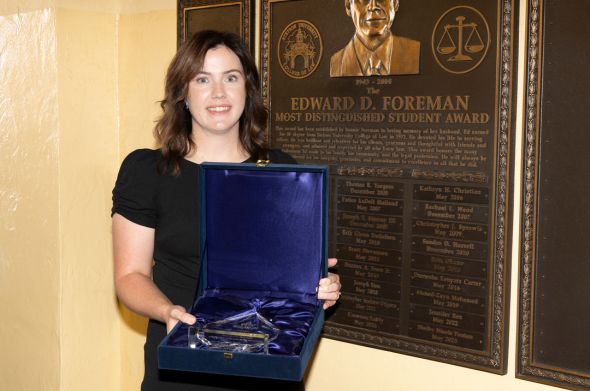
Named for 1971 Stetson Law alumnus Edward D. Foreman and established by his wife, Bonnie Foreman, the Foreman Award was first given in 2005. Factoring in community involvement, leadership, and selflessness, the Foreman Award honors a graduating student whose success and promise goes well beyond a top grade-point average.

The award package consists of a flame-shaped statue, a $5,000 award, and engraving of the recipient’s name on a plaque outside the Great Hall. It has been given to 26 students since it was first issued. Past recipients include former Florida House Speaker Chris Sprowls, Stetson Law Professor Erin Okuno, 2024 alumnus Cameron Kubly, and the award’s first recipient, 2005 alumnus Andrew Chiang.

A woman in a black dress speaks at a podium.
Shelby Ponton, winner of the 2025 Foreman Award.

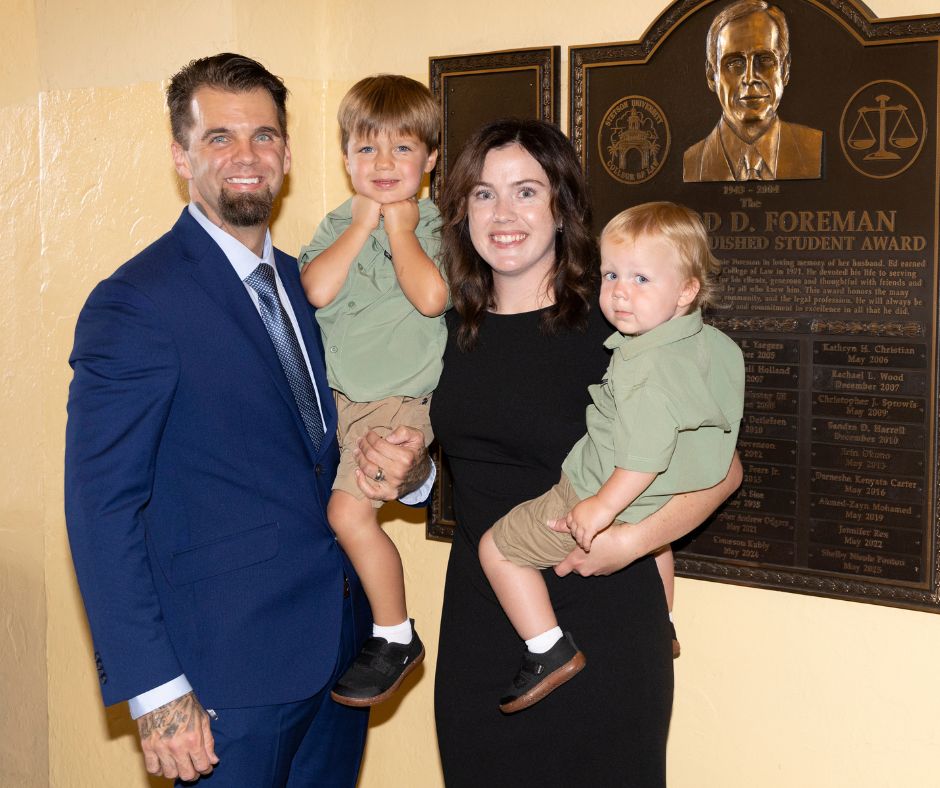
Many were in attendance to cheer on the 2025 recipient, Shelby Nicole Ponton.

A top student in her class, Ponton was on the Moot Court Board and served as editor-in-chief for Stetson Law Review during her time at Stetson – all while being a mother of two small children who are now 3 years old and 18 months old.

“We took a family walk around this campus every day,” she said in her acceptance speech. “Our kids experienced their first ever words here, their first steps here.”

Prior to law school, she worked as an animal cruelty investigator and rescue coordinator.

Ponton thanked those who supported her, from Professors Tomer Stein, Kelly Feeley, and James Hart – whom she said were key in her success as a 1L – to her colleagues on the law review’s editorial board.

She cited the support and wisdom of family members as critical in her accomplishments.

“My mother, she’s instilled many lessons in me, but the number one thing is, no matter where you come from, no matter who you are, whatever obstacles you face, if you have an absolutely relentless work ethic, you can change your life,” Ponton said. “You can do anything.”