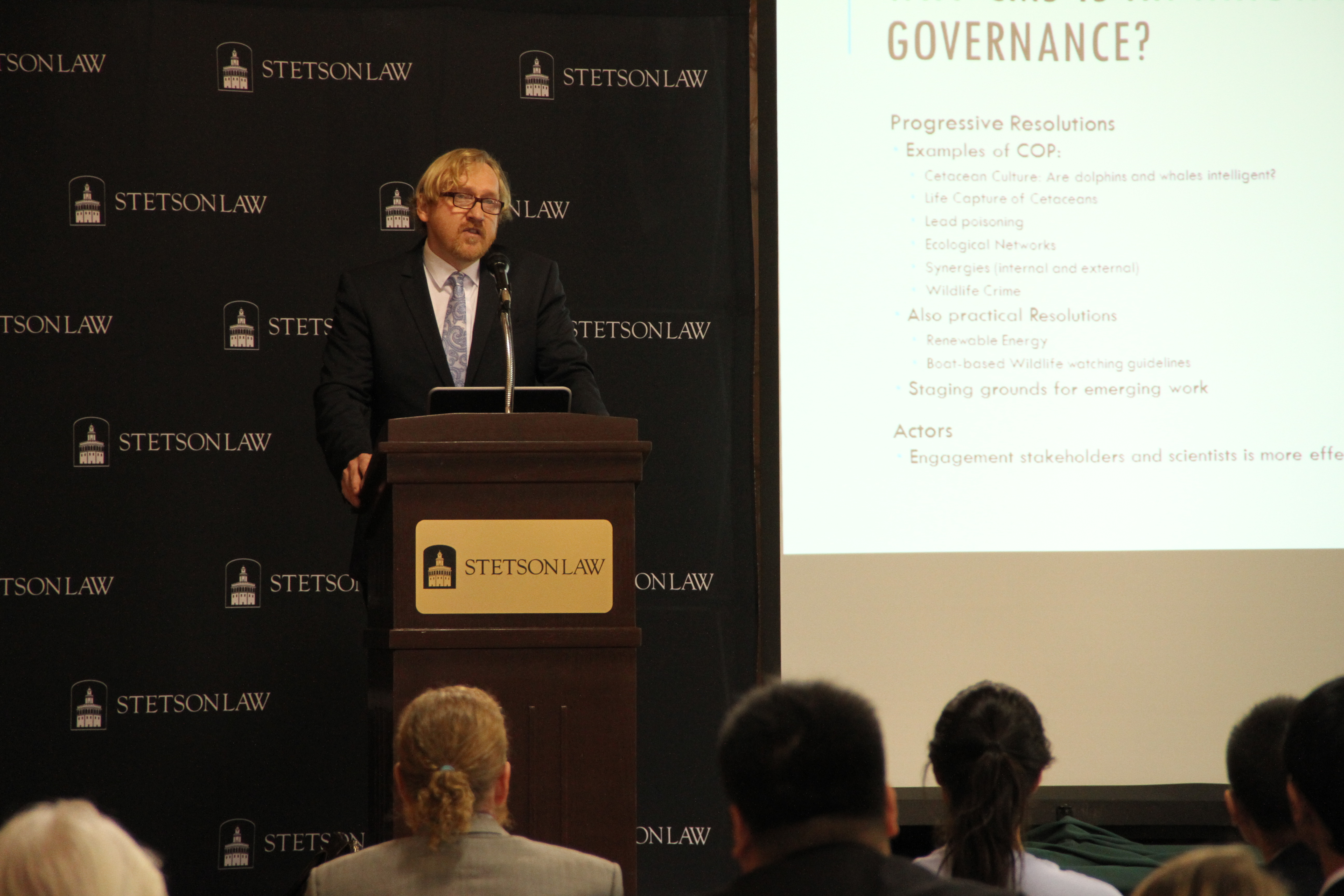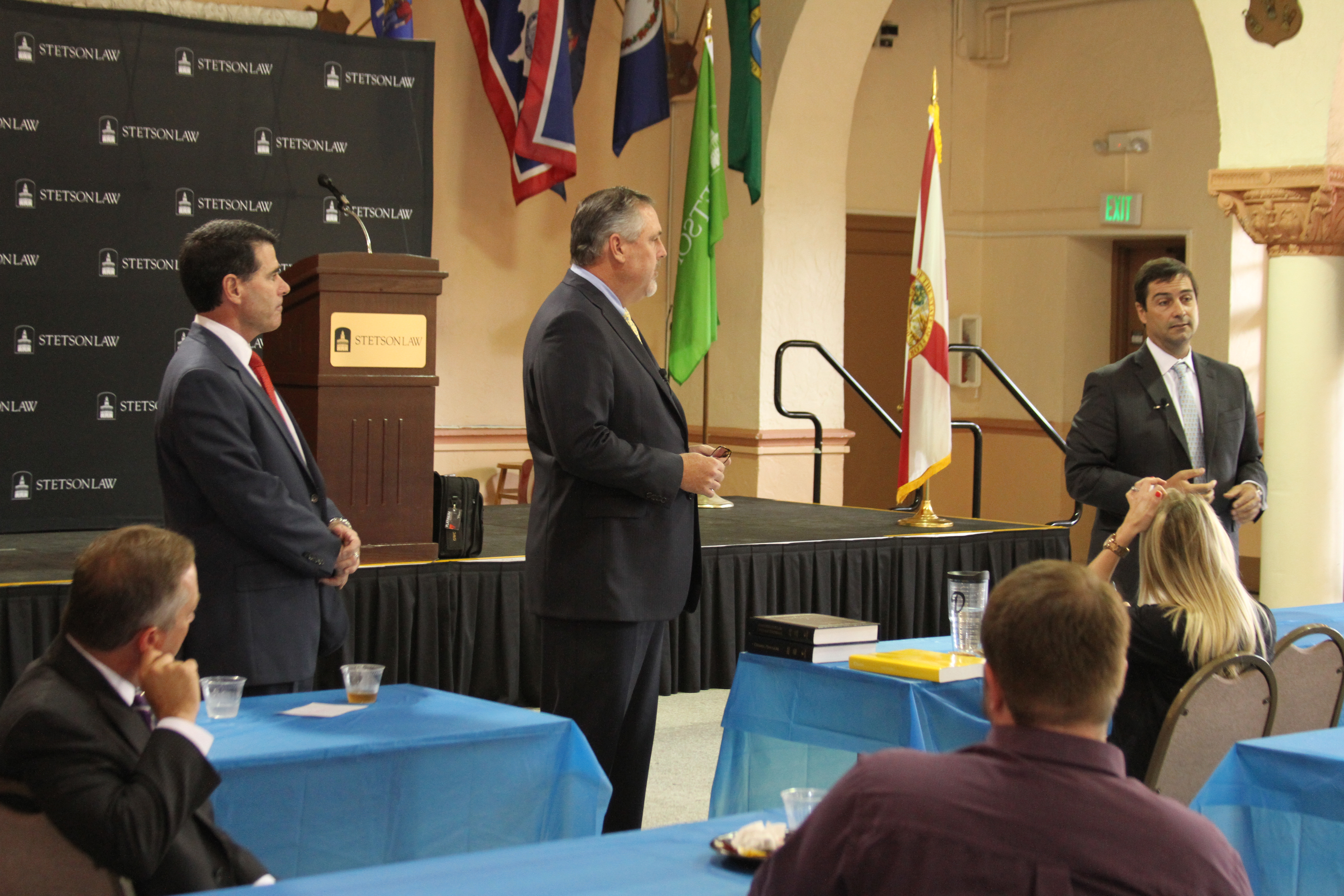
On April 16, Bradnee Chambers, executive secretary of the United Nations Environment Programme Convention on the Conservation of Migratory Species of Wild Animals, delivered the Edward and Bonnie Foreman Biodiversity Lecture at Stetson.
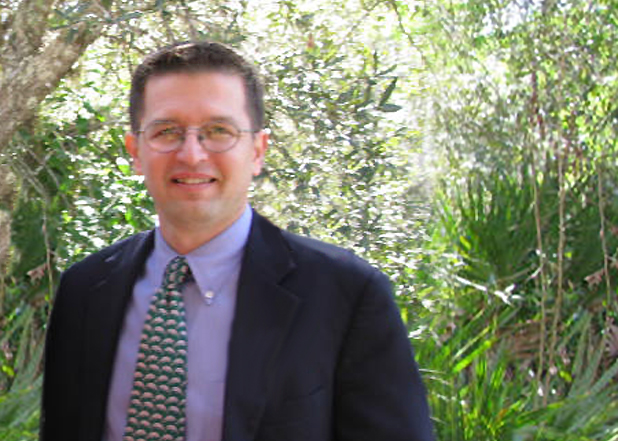
Bradnee Chambers spoke at Stetson.
Chambers spoke to law students at Stetson and student teams who traveled from around the world to attend the 19th International Environmental Moot Court Competition at Stetson Law in Gulfport.
Chambers was also a final round judge of the competition.
This year’s moot court competition focused on shark finning and trade restrictions. Topics are designed to prepare law students from around the world to present on environmental issues that cross national boundaries.
Stetson University College of Law is partnering with the Law Society of Ireland to offer a continuing legal education program (CLE) for U.S. lawyers and legal practitioners July 13-15 in Ireland.
The two-and-a-half-day, 14-credit CLE, “Technology in Litigation in the Silicon Valley of Europe,” is being offered in the destination city of Dublin, Ireland, an international hub for business, law and technology.
Topics cover the benefits and impacts of technology on litigation and evolving developments in technology and the law including:
Possible use of video surveillance, police cameras and cellphone video as evidence
Internet searches and privacy issues
Social media’s impact on impartial jurors and the discovery phase
Technology in the courtroom
For more information, call Stetson’s Office of Professional Education at 727-562-7940 or email [email protected].
Take immediate action to conserve and restore the world’s wetlands, the director of Stetson University’s Institute for Biodiversity Law and Policy, professor Royal Gardner, urges in a briefing note he recently co-authored with scientists from around the world.
Professor Royal Gardner directs the Institute for Biodiversity Law and Policy at Stetson.
The global extent of wetlands is estimated to have declined 64-71% in the 20th century, and loss and degradation continues
People are deprived of ecosystem services provided by wetlands, resulting in more than $20 trillion annually in losses of ecosystem services
Populations of wetland species in Ramsar Sites are decreasing in the tropics
There is a negative trend and negative impacts on biodiversity and other ecosystem services
Policymakers have sufficient information to understand the urgent need to take appropriate actions to conserve wetlands and their services to people
Scientists from the United Nations Environment Programme-World Conservation Monitoring Centre, the European Space Agency, the Japan Aerospace Exploration Agency, the Tour du Valat Research Centre for the Conservation of Mediterranean Wetlands in France, and the Ramsar Scientific and Technical Review Panel contributed to the briefing note.
Stetson’s Professor Gardner chairs the STRP, which is the scientific advisory body for the Ramsar Convention, an intergovernmental treaty with 168 countries.
The briefing note, published in three languages, will be made available to all countries that are member states to the Ramsar Convention at the upcoming Ramsar Conference of the Parties, which will be held in Uruguay in June.
Stetson Law students volunteered for Fun in the Sun, Gulfport’s annual springtime celebration, at the Gulfport Recreation Center on April 4. The City of Gulfport and Stetson’s Public Service Fellows co-presented this year’s event, sponsored by local businesses and associations.
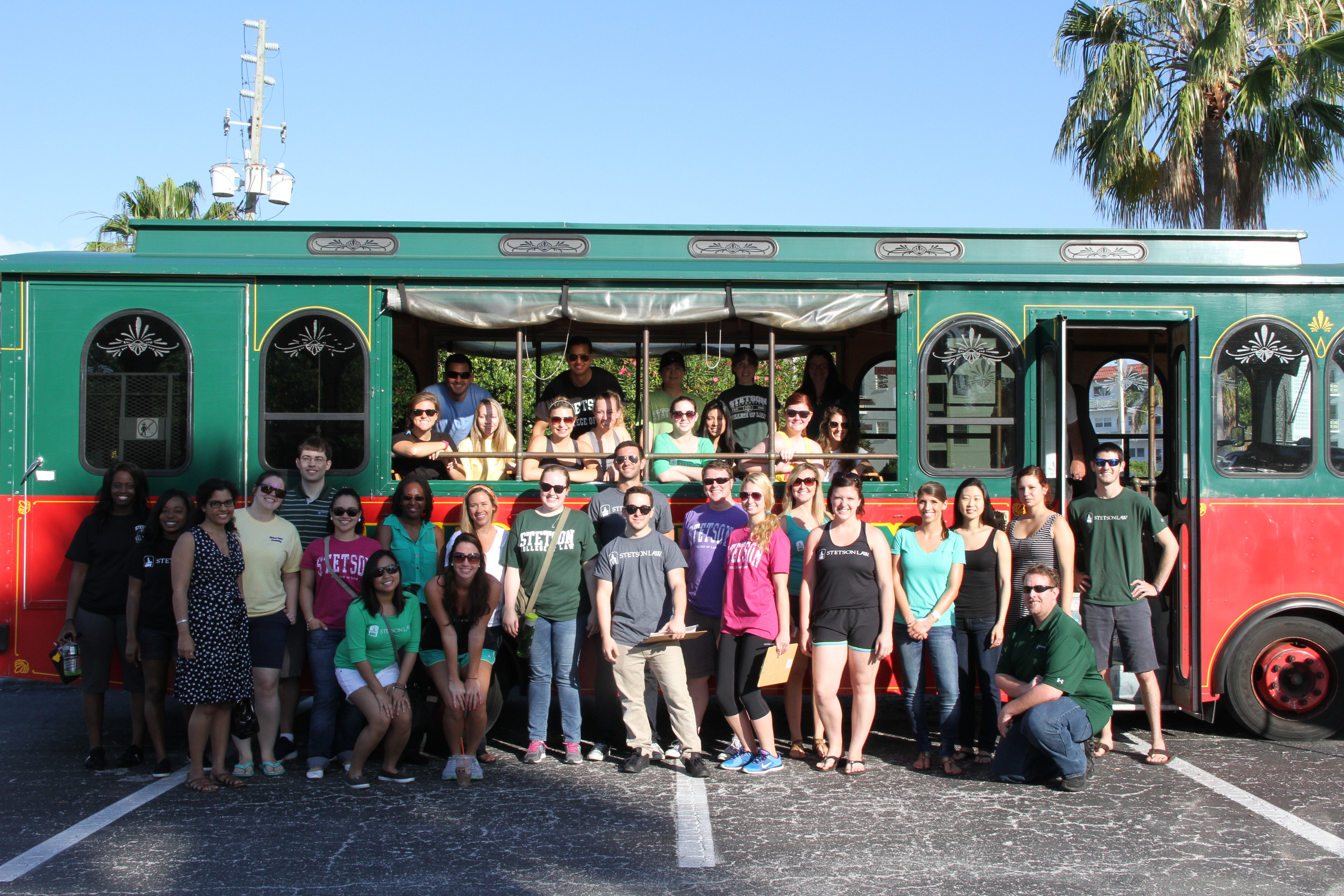
The Stetson Law volunteers take a break for a photo with the trolley and Fun in the Sun in Gulfport. Photo by Brittany Brochard.
The event featured an egg hunt for children, face painting, entertainment and demonstrations. In addition to Stetson’s Public Service Fellows, the student organizations Stetson Law Democrats, Dream Defenders, Stetson Law Parents, International Law Society and Elder Law Society volunteered to help with the event. Stetson Law’s library staff also volunteered.
On March 27, four faculty members celebrated the publication of their books.
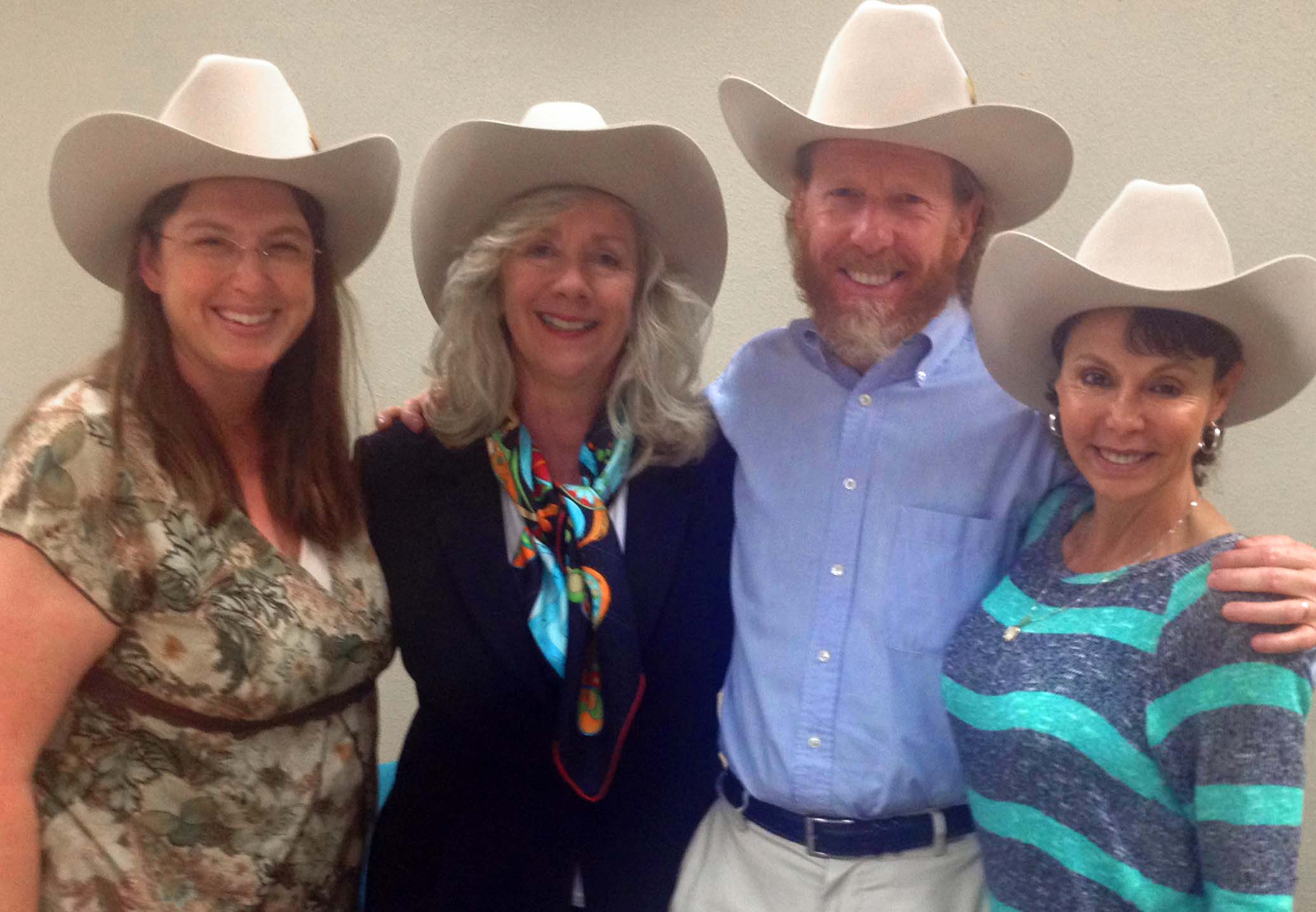
(L-R): Professors Catherine Cameron, Carol Henderson, Lance Long and Luz Nagle. Photo by Professor Jason Palmer.
Professor Catherine Cameron and Lance Long are the authors of The Science Behind the Art of Legal Writing. Professor Luz Nagle has most recently authored “The Rule of Law in Latin America,” in Latin American Democracy: Emerging Reality or Endangered Species? and a chapter in Comparative Counter-Terrorism Law. Professor Carol Henderson recently co-authored Scientific Evidence Review: Monograph No. 9 with Cynthia Cwick and Jules Epstein.
Cameron teaches and researches in the areas of legal writing and media law. She has written several articles on media law and legal writing topics and has given presentations at national conferences.
Henderson is the founding director of the National Clearinghouse for Science, Technology and the Law and the former president of the American Academy of Forensic Sciences. She is co-director of the Life & Physical Sciences Division of the American Bar Association’s Science & Technology Law Section. Professor Henderson has presented hundreds of lectures and workshops worldwide on scientific evidence, courtroom testimony, and professional responsibility and has lectured in more than a dozen countries. She has authored or co-authored more than 60 publications on scientific evidence, expert testimony and ethics, including one that won a prize from the British Medical Association.
Long’s scholarship currently focuses on environmental advocacy and language patterns in appellate briefs and opinions. His most recent article, “When Justices (Subconsciously) Attack: The Theory of Argumentative Threat and the Supreme Court,” in the Oregon Law Review with William F. Christensen, analyzes differences between the language used by Supreme Court Justices in majority and dissenting opinions.
Nagle specializes in international law and international criminal law. She has authored and co-authored dozens of book chapters, monographs, book reviews and articles and has made presentations and taught around the world. Professor Nagle currently sits on the International Bar Association’s Legal Practice Division Council. She has participated in several rule of law, judicial reform, and hemispheric security projects sponsored by USAID and the U.S. Department of Defense, Department of Justice, and Department of State throughout Latin America. She has served with the American Bar Association Criminal Justice Council, the ABA Task Force on the Vienna Convention on Consular Affairs, and the ABA Corruption and the Rule of Law Working Group.
Faculty members at the College of Law are given Stetson hats to celebrate publishing books as part of a Stetson University tradition.
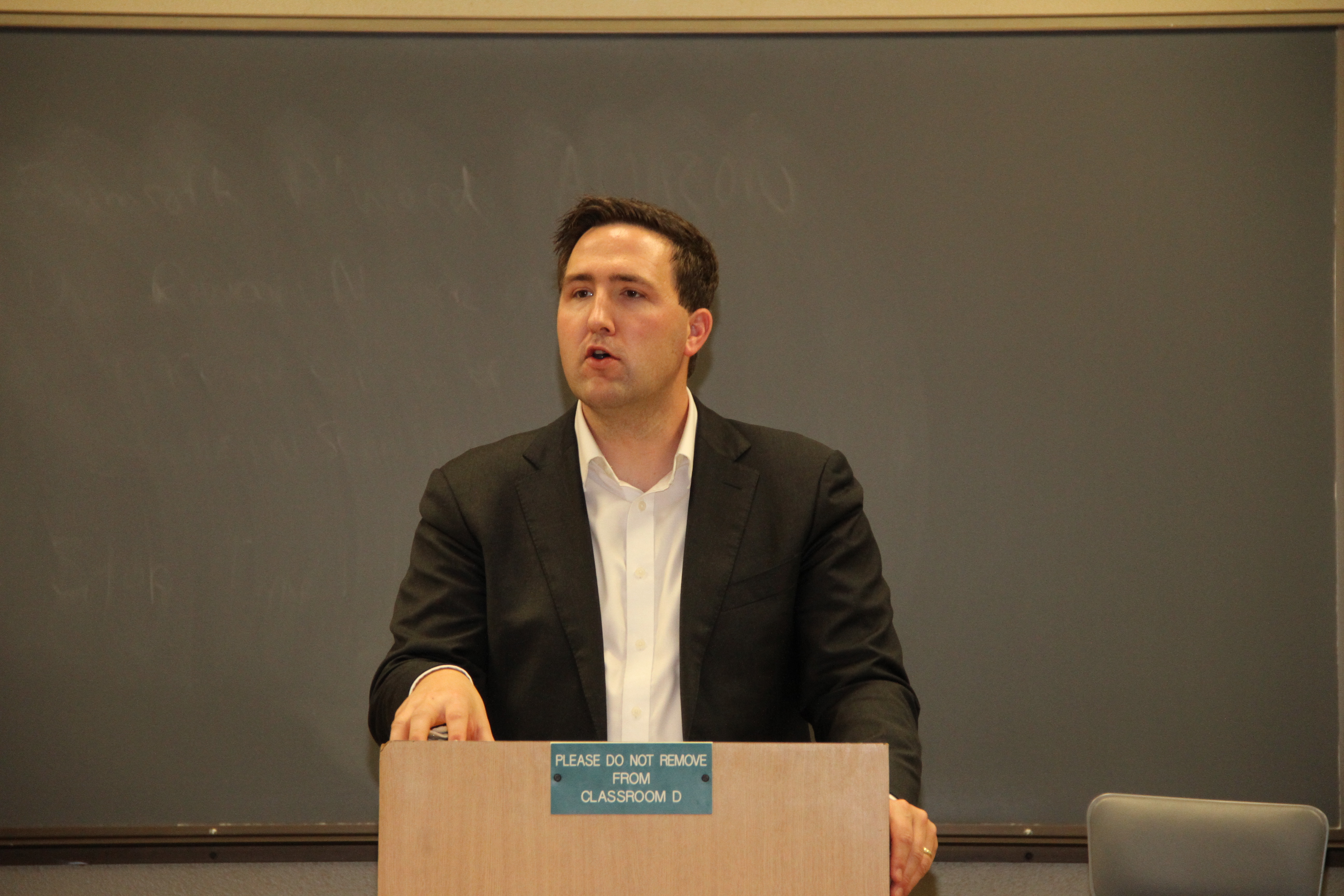
Former Colorado Assistant Solicitor Michael Francisco spoke at Stetson Law. Photo by Brittany Brochard.
The Stetson Law student Federalist Society recently sponsored a talk on March 31 by former Colorado Assistant Solicitor Michael Francisco on “Marijuana & Federalism.”
Francisco discussed the Colorado citizens ballot initiative to legalize medical marijuana that passed in 2012 and the aftermath of the amendment.
Francisco explained that marijuana is still illegal under federal law and federal prosecution for possession of medical marijuana is still possible after the passage of state amendments legalizing the substance. He said that banks are not permitted to open checking accounts for marijuana businesses and attorneys are not permitted to assist marijuana businesses in committing illegal activity associated with the industry.
Francisco also discussed legal cases that have resulted from the Colorado amendment. The states of Nebraska and Oklahoma accuse Colorado’s marijuana laws of breaking federal laws and the states of Washington and Oregon have filed amicus briefs supporting Colorado. A RICO case has been filed in federal district court in Colorado against groups of people involved in marijuana businesses. He said that RICO claims have the potential to change Colorado’s marijuana laws. At the national level, Francisco discussed how the next U.S. president elected in 2016 chooses to enforce drug laws at the federal level will act as a signal to states and citizens.
(L-R): Elizabeth Harbaugh, Patrick Iyampillai, Daniel Kavanaugh and Colby Connell.
The Harry Latimer Center for Professionalism and the Florida Bar Standing Committee on Professionalism selected four Stetson University College of Law students as the winners of the 2015 Law Student Professionalism YouTube Contest.
Using the Florida Bar’s newly adopted Professionalism Expectations as their guide, students Colby Connell, Elizabeth Harbaugh, Patrick Iyampillai and Daniel Kavanaugh created, wrote and acted in the award-winning, two-and-a-half-minute video about the Florida Bar’s expectations of professionalism in Florida.
Harbaugh wrote the script and Connell and Iyampillai acted in the short film, narrated by Kavanaugh.
“We had a great time shooting the whole short. One of the larger study rooms on the second floor of the library was transformed into a movie studio,” said Iyampillai.
“Patrick had the great inspiration of using the queue video at an amusement park for inspiration, so we talked about some ideas with Dr. Davis and then I wrote the script,” said Harbaugh, who has a directing background.
The students first learned of the contest in Dr. Kirsten Davis’ Professional Responsibility class. The awards presentation for the video takes place on June 25 during The Florida Bar’s Annual Convention at the Boca Raton Resort and Club during Stetson’s Alumni Reception.
The Florida Bar hosted a town hall meeting on Stetson University’s Gulfport campus on March 25 for the law school community.
Florida Bar President Gregory W. Coleman B.B.A. ’85, J.D. ’89 joined 2015 President-Elect Ramón A. Abadin and 2016 President-Elect William J. Schifino for a discussion about issues facing lawyers in Florida.
Abadin will begin serving as Florida Bar president in June of 2015.
Schifino, Coleman and Abadin led a town hall discussion at Stetson. Photo by Amadu Wiltshire.
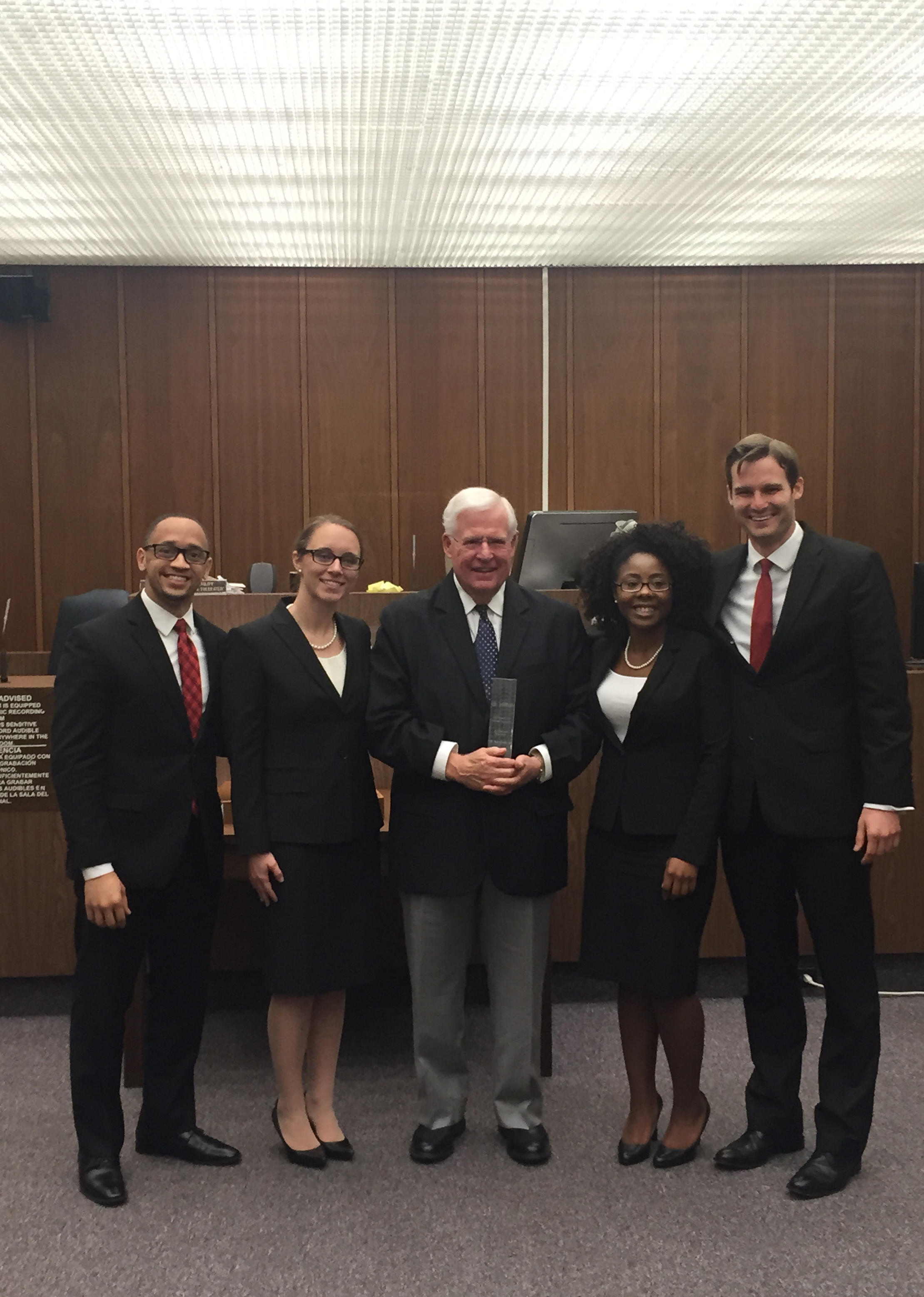
Stetson University College of Law’s trial team won the southeast regional of the American Association for Justice Student Trial Advocacy Competition in Ft. Lauderdale, Florida.
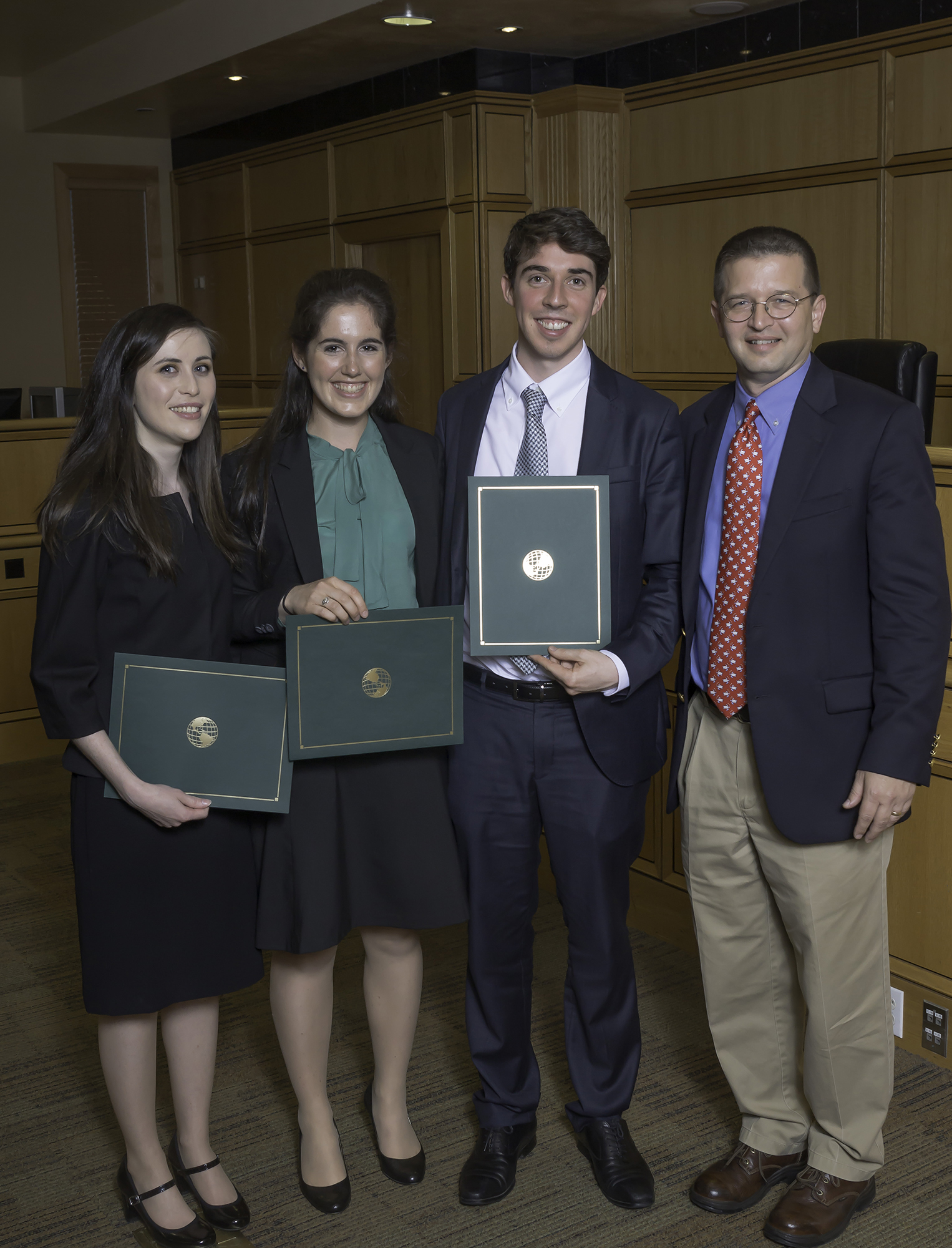
(L-R): Stanton Fears, Brooke Batton Charlan, Judge Gary Farmer Sr., Phylicia Pearson and Kyle Ross.
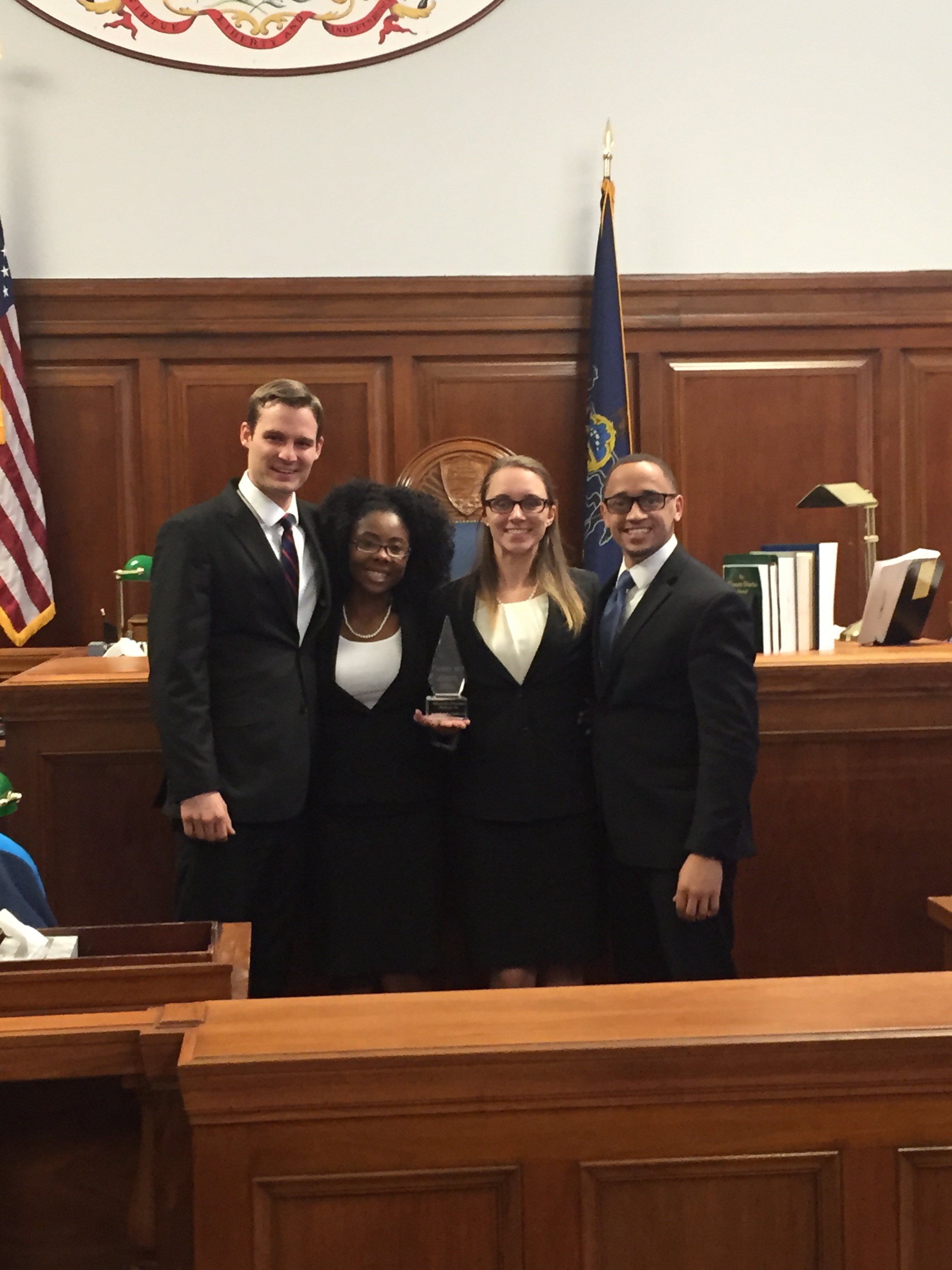
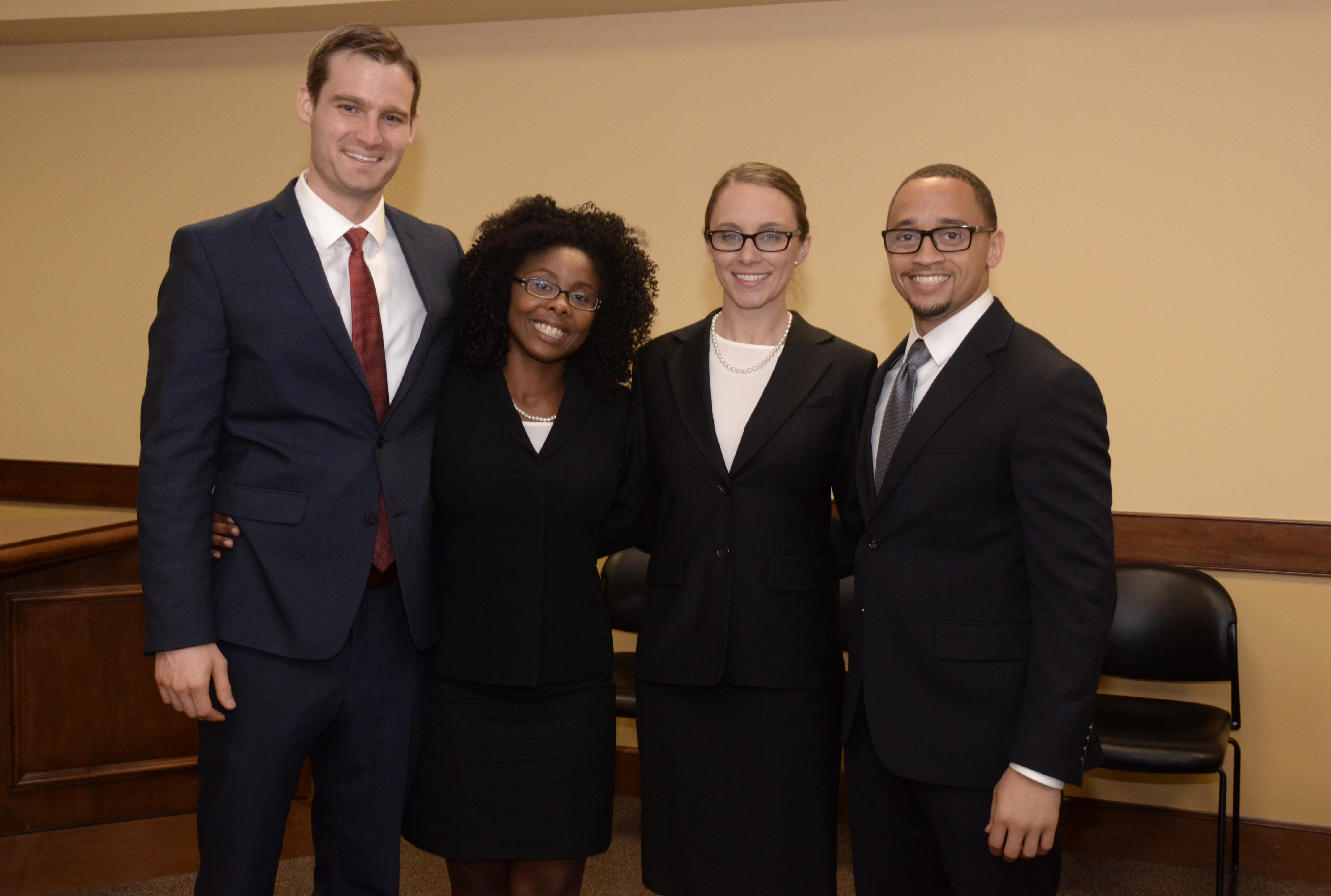
Students Brooke Batton Charlan, Stanton Fears, Phylicia Pearson and Kyle Ross won the AAJ regional on March 22 and earned the right to compete in the national competition April 16-19, in Pittsburgh, Pennsylvania.
The AAJ Student Trial Advocacy Competition is one of the largest mock trial competitions in the country. This year, 224 law school teams competed in the qualifying rounds in 14 regions. Stetson’s trial team tried a products liability case.
“Stetson’s team stood out in the competition,” said Associate Professor of Legal Skills and Trial Advocacy Coordinator Michele Joiner. “Through its preparation, talent and professionalism, our team illustrated why Stetson is the best advocacy program in the country.”
A second team of Stetson students, Franklin Farago, Chad Florin, Daniel Miles and Allison Stevenson, also competed, and Stetson Law graduate Shaun Cummings ’14 and Professor Joiner coached the teams.
For more information about Stetson’s award-winning advocacy program, visit www.stetson.edu/advocacy.
Desmond Meade recently completed law school at Florida International University, studied for and passed the bar exam, but is not permitted to apply to the bar.
Desmond Meade spoke with Stetson students about felony disenfranchisement. Photo by Brittany Brochard.
Meade is a former homeless man who is among the more than one million people in the state of Florida who have been convicted of a felony and lost civil rights for life.
On March 10, Meade led an afternoon talk, “Felony Disenfranchisement and the Florida Constitution,” for students at Stetson University College of Law in Gulfport, Florida. Stetson’s student organization, Dream Defenders, hosted the talk.
Meade said that the majority of people who are disenfranchised are convicted of nonviolent felonies. The process of rights restoration after a felony conviction includes a lengthy waiting period after completion of a sentence and a hearing.
“Restoration of civil rights is an important part of re-entry,” Meade said. “One out of every four African-American males in the state of Florida cannot vote.”
In his current role as state director for the Faith in Florida Live Free Campaign, Meade is leading efforts to restore the civil rights of Floridians, empower and re-engage local communities, and reshape local, state and national policies.
Meade discussed a constitutional amendment petition, the Voting Restoration Amendment, sponsored by Floridians for a Fair Democracy, Inc., that would be a constitutional amendment to Article VI, § 4 of the Florida constitution. The amendment would restore civil rights to people convicted of felonies, with the exception of persons convicted of murder or a felony sexual offense, who complete all terms of their sentences including parole or probation.
Meade is also engaged in a national campaign to reduce mass incarceration, reduce gun violence in urban communities, and re-enfranchise the millions of citizens across the nation who served time and are prevented from voting.
The outgoing president of the Florida Rights Restoration Coalition, Meade chairs the Florida Coalition on Black Civic Participation’s Black Men’s Roundtable. He has testified before the United Nations in Geneva as well as the U.S. Congress concerning felony disfranchisement.
Retired Justice David A. Erickson. Photo by Jacqueline Seaberg.
Retired Justice David A. Erickson will receive Stetson University’s Lifetime Achievement Award for Excellence in Teaching Advocacy during the Educating Advocates: Teaching Advocacy Skills Conference on May 19 on the Gulfport campus. The Edward D. Ohlbaum Professionalism Award will be presented to professor Adam Shlahet.
The Lifetime Achievement Award recognizes those who have fundamentally changed the way in which the world approaches the teaching of advocacy. Justice Erickson’s distinguished career as a lawyer, jurist and law professor began in 1976. Erickson served as an assistant state attorney, was appointed to the bench where he served between 1988-1996, and became a first assistant state’s attorney in Cook County. In 2001, Erickson was recalled to the bench by the Illinois Supreme Court and presided for three years in the Juvenile Court, serving as trial judge and as acting supervisory judge until his appointment to the Appellate Court. In 2006, Erickson retired as justice of the Illinois Appellate Court, First District, and became senior lecturer in law at IIT Chicago-Kent College of Law, where he has directed the school’s nationally ranked trial advocacy program, Criminal Law Certificate Program, and “Rule of Law” initiative in Mexico.
The Edward D. Ohlbaum Award honors an individual whose life and practice display sterling character and unquestioned integrity, coupled with ongoing dedication to the highest standards of the legal profession and the rule of law. The award is designed to recognize a trial team coach and program director who exemplifies the late Professor Ohlbaum’s commitment to doing things with a high degree of professionalism, integrity and competency. In choosing this year’s recipient, the selection committee was charged with finding a rising star in the advocacy coaching world. The committee selected Shlahet, a special assistant attorney general with the New York State Attorney General Medicaid Fraud Control Unit and adjunct professor at Fordham Law School. Shlalet received the Travis H.D. Lewin Outstanding Coach Award from the Trial Lawyers Section of the New York State Bar Association. He has coached Fordham law students competing in 23 national trial competitions and was named director of Trial Competitions at Fordham Law School in 2012.
Adam Shlahet.
The annual Educating Advocates conference, May 18-21 on Stetson University’s Gulfport campus, draws law professors, lawyers and legal practitioners from across the U.S. to learn the Stetson method of advocacy, developing teaching skills, new techniques and networking with some of the most recognized names in advocacy teaching. To register for the conference, visit https://www.stetson.edu/eats/.
Hank Asbill accepted his 2015 White Collar Criminal Defense Award at Stetson.
On Saturday, March 14, the National Association of Criminal Defense Lawyers (NACDL) and Stetson Law presented Hank Asbill with the 2015 White Collar Criminal Defense Award. Asbill received his award during NACDL’s White Collar Criminal Defense College at Stetson University College of Law in Gulfport, Florida. NACDL and Stetson co-present the award annually to individuals who have made a profound impact on the field of white collar criminal defense advocacy.
Asbill is a partner at the Washington, D.C., office of Jones Day, where he has a distinguished national practice. He has successfully defended individual and corporate clients facing criminal and related civil charges for more than three decades and is presently representing former Virginia Gov. Robert McDonnell in a public corruption conviction appeal. Asbill frequently lectures on legal matters and was profiled in The National Law Journal‘s special “Winning” report on the nation’s top litigators and in SmartCEO magazine as a “go to” lawyer for commercial litigation and white-collar criminal defense. He is a fellow of the American College of Trial Lawyers and Litigation Counsel of America and a member of NACDL’s advisory committee. Asbill is past president and fellow of the American Board of Criminal Lawyers, past president of the D.C. Association of Criminal Defense Lawyers, and has served two terms on NACDL’s Board of Directors.
In presenting the award, Stetson Professor Ellen Podgor, who serves as chair of the Advisory Committee for the College, said: “Hank Asbill is a lawyer who truly cares about the client; he is a
(L-R): Professor Ellen Podgor with Hank Asbill.
lawyer who never gives up until justice is done.”
Asbill completed his undergraduate degree at Princeton University and earned his J.D. at Georgetown University.
The NACDL White Collar Criminal Defense College at Stetson is an educational “boot-camp” program for legal practitioners from across the country wishing to gain key advocacy skills and learn substantive white collar law from masters in the field.