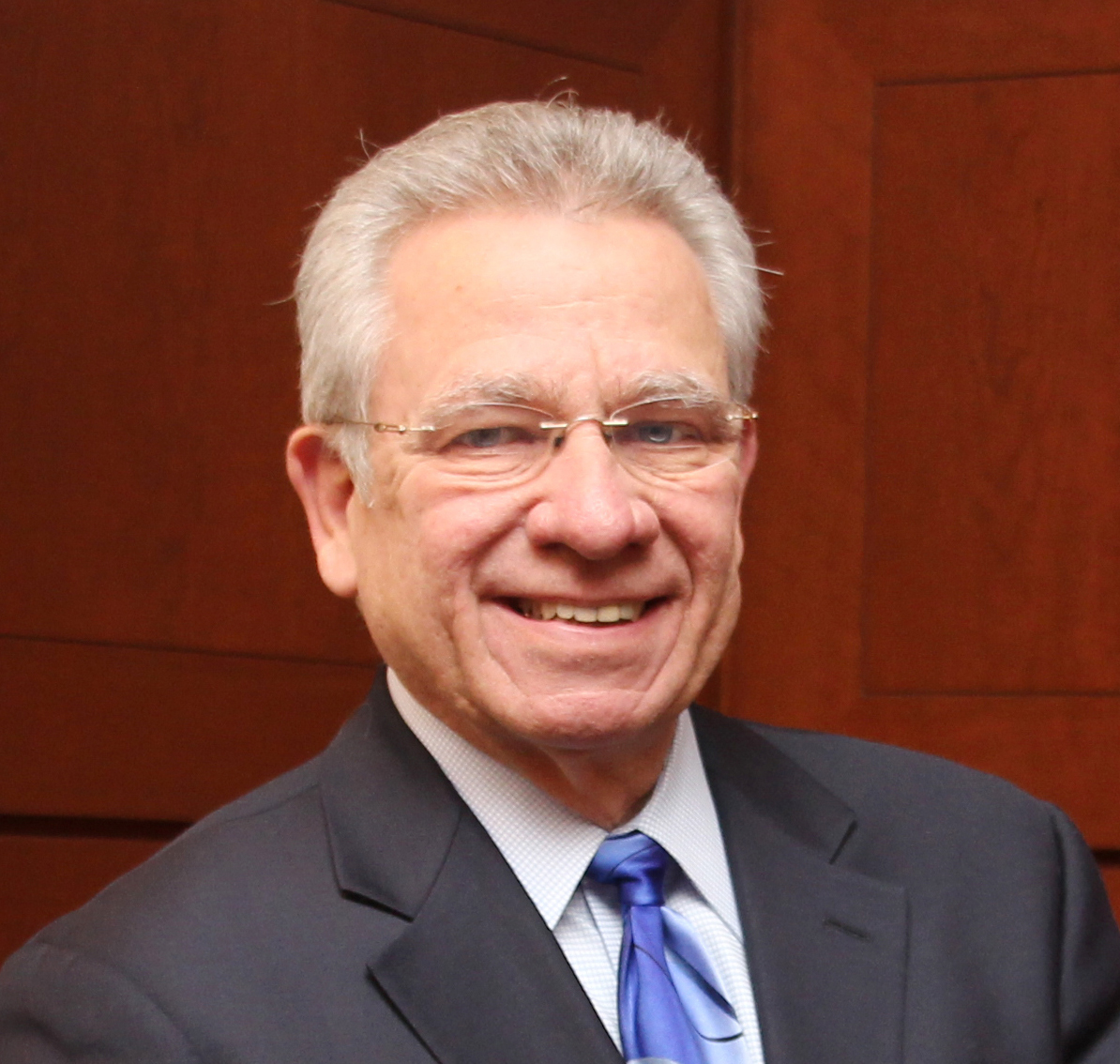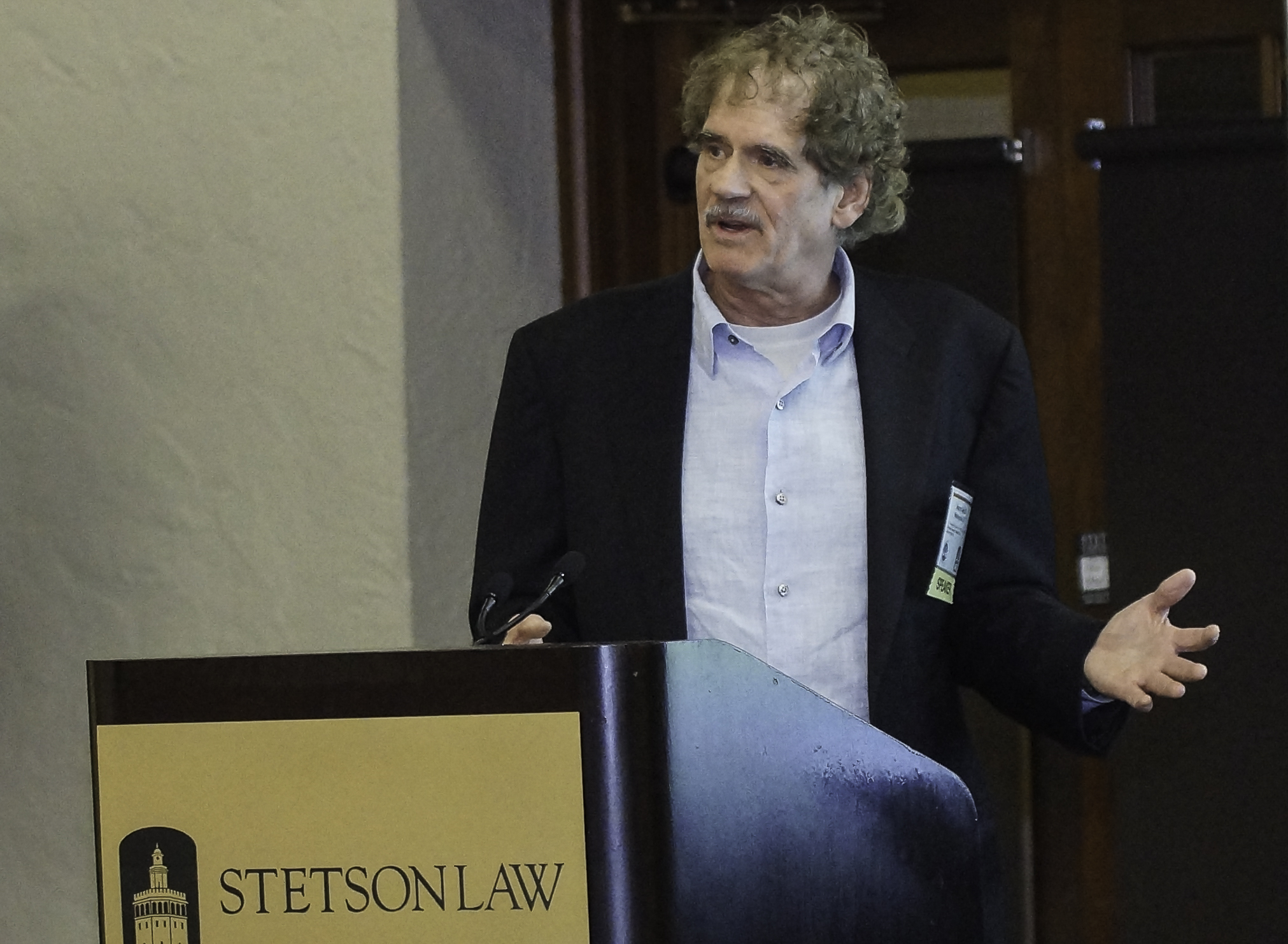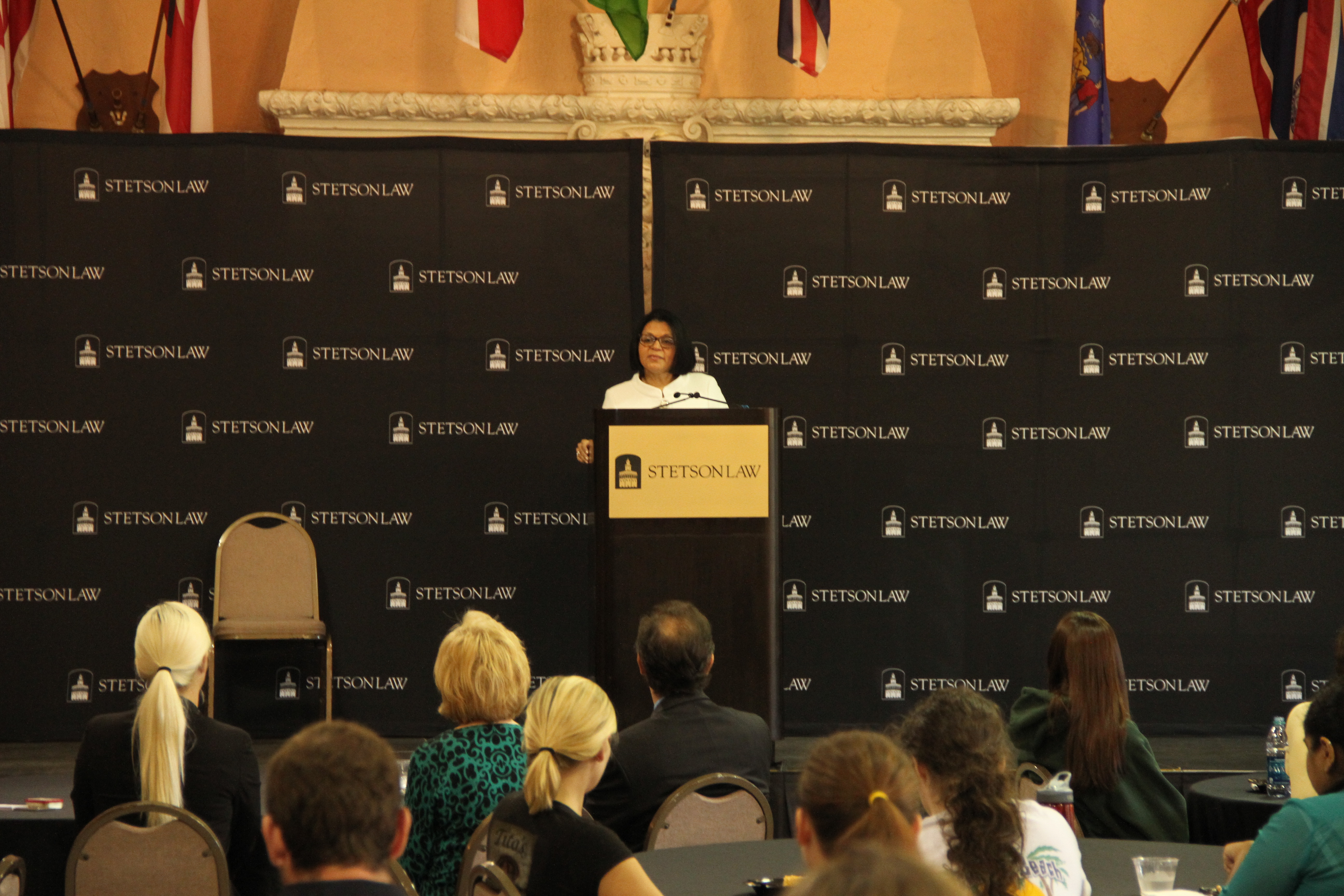
Former U.S. Assistant Attorney General Ignacia Moreno spoke with students at Stetson University College of Law on March 11. Moreno discussed “Environmental Litigation in the 21st Century.”
Former U.S. Assistant Attorney General Ignacia Moreno spoke with Stetson Law students in the Great Hall. Photo by Amadu Wiltshire.
Moreno talked about the challenges she faced and overcame as a young person who came to the U.S. from Cartagena, Colombia. She answered questions from the students in the audience about how she approached a range of environmental issues in her work.
As assistant attorney general for the U.S. Department of Justice Environment and Natural Resources Division from 2009-2013, Moreno managed the division’s response to the Deepwater Horizon oil spill. Originally from Colombia, Moreno was named one of the 100 Most Influential Hispanics in the United States by Hispanic Business Magazine.
“You are the future, and as I look out at you, you look beautiful to me,” Moreno told the students. “Go out there and be great.”
Stetson’s Edward and Bonnie Foreman Biodiversity Lecture Series brings leading experts to campus to speak on a range of environmental topics directly impacting the state, as well as topics with national and global impacts. Professor Royal C. Gardner directs the Institute for Biodiversity Law and Policy at Stetson.
U.S. News & World Report ranked Stetson University College of Law first in trial advocacy for the 17th time. Stetson ranked second in the nation for legal writing, advancing from sixth last year.
“Advocacy is a significant strength at the College of Law,” said Stetson University President Wendy Libby, Ph.D. “When Stetson Law students graduate, they are prepared to walk into a courtroom with the advocacy and communication skills they need to succeed in representing their clients professionally and persuasively.”
“Our acclaimed programs in the areas of advocacy and legal writing distinguish Stetson Law graduates. Two of the most important skills for lawyers throughout their careers are advocating on behalf of their clients both orally and in writing and Stetson’s success in these areas demonstrates that our students are better prepared for practice,” said Dean Christopher Pietruszkiewicz. “We are enthusiastic about continuing our legacy of educating top advocates.”
Stetson has been recognized as the top law school in the nation for trial advocacy 17 times since 1995 and has ranked in the top six legal writing programs since the inception of the legal writing rankings.
“Advocacy education at Stetson enjoys a reputation for excellence across the country,” said Charles H. Rose III, professor of excellence in trial advocacy at Stetson. “The Stetson method of advocacy is sought by scholars at other law schools and legal practitioners around the world.”
“Legal writing is the centerpiece of Stetson’s broader emphasis on legal communication,” said Kirsten K. Davis, Ph.D., Stetson’s director of the Institute for the Advancement of Legal Communication. “Stetson’s legal research and writing curriculum teaches students to communicate ethically and effectively in today’s evolving legal workplace.”
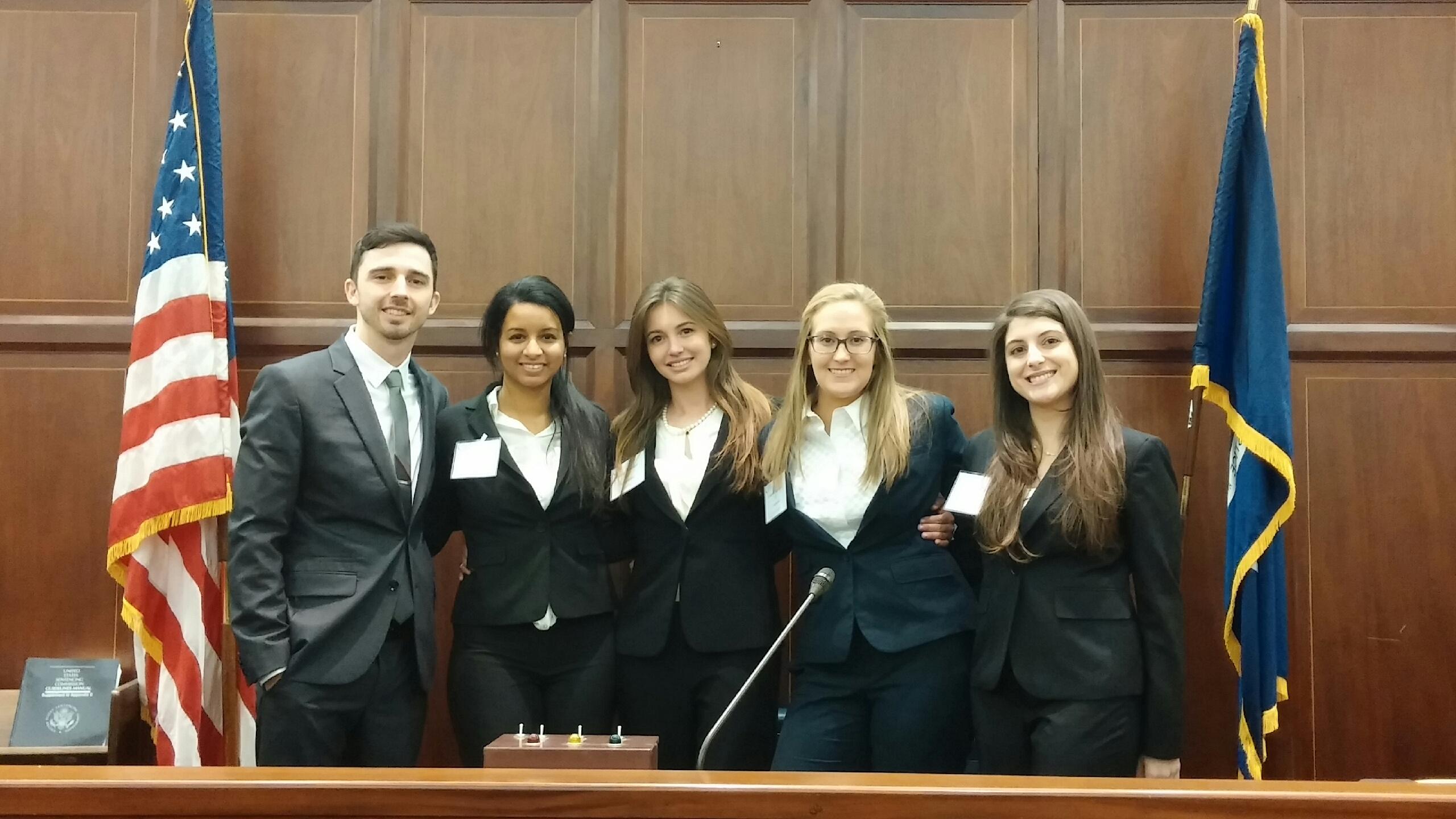
A team of Stetson University College of Law students were finalists at the Southern Regional of the Philip C. Jessup International Law Moot Court Competition, on March 8 in New Orleans, Louisiana, and earned the right to advance to the international rounds in Washington, D.C., April 5-11.
(L-R): Ryan Hedstrom, Sunai Edwards, Lauren Fernandez, Lauren Eliopoulos, and Nicole Santamaria.
“We are thrilled that our Jessup team will have an opportunity to advocate on the world stage,” said Professor Brooke Bowman, Stetson’s moot court adviser. “This is a priceless educational opportunity for our advocates.”
Jessup is the largest moot court competition in the world. Every eligible law school around the world is permitted to send one team to the regionals. This year, more than 550 schools are competing in 55 qualifying rounds January through March in order to advance to the international rounds.
Stetson Law professor Jason Palmer and alumni Caitlein Jammo and Bradley Muhs coached the team.
Stetson law school’s advocacy record includes five world titles, 67 national championships, and 111 best advocate/oralist awards.
Questioning how labor and employment laws can address growing workplace inequality was the topic of the Stetson Law Review symposium on March 6 at Stetson University College of Law in Gulfport, Florida.
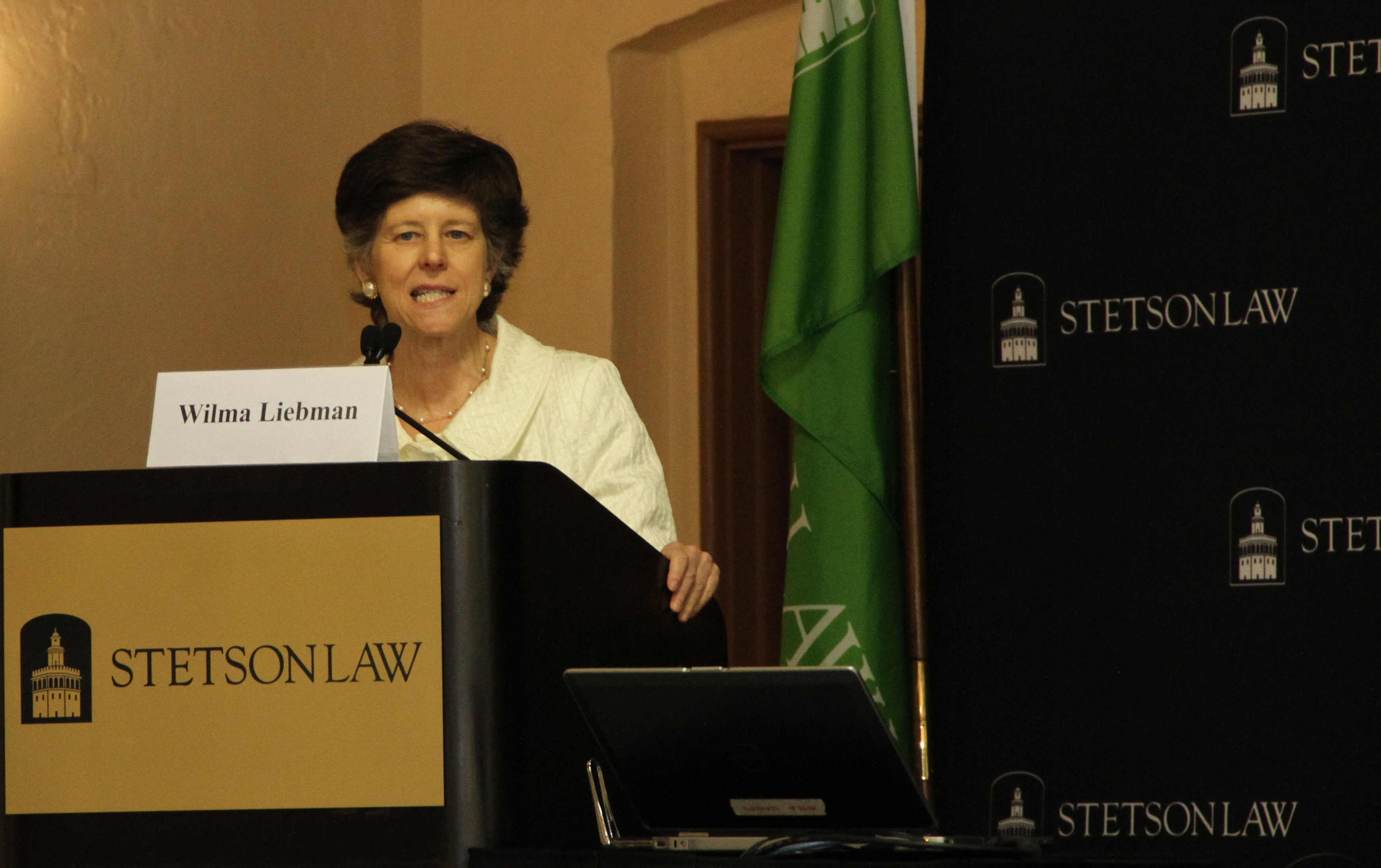
Wilma Liebman, former NLRB chair, provided the keynote.
The program included keynote speaker Wilma Liebman, former chair of the National Labor Relations Board; featured speaker Timothy Noah, the labor and employment editor for Politico and author of The Great Divergence; and moderator David Cay Johnston, a Pulitzer-Prize winning journalist, distinguished visiting lecturer at Syracuse University College of Law and the editor of Divided: The Perils of Our Growing Inequality.
“The law didn’t create labor power, labor did, ” said Liebman.
The symposium topic, “Inequality, Opportunity, and the Law of the Workplace,” explored growing economic inequality in the U.S., opportunities for upward mobility, and the proper role of labor and employment laws in ensuring adequate opportunities for mobility.
Symposium articles will be published in the Stetson Law Review. To learn more about the Stetson Law Review, visit https://www.stetson.edu/law/lawreview/.
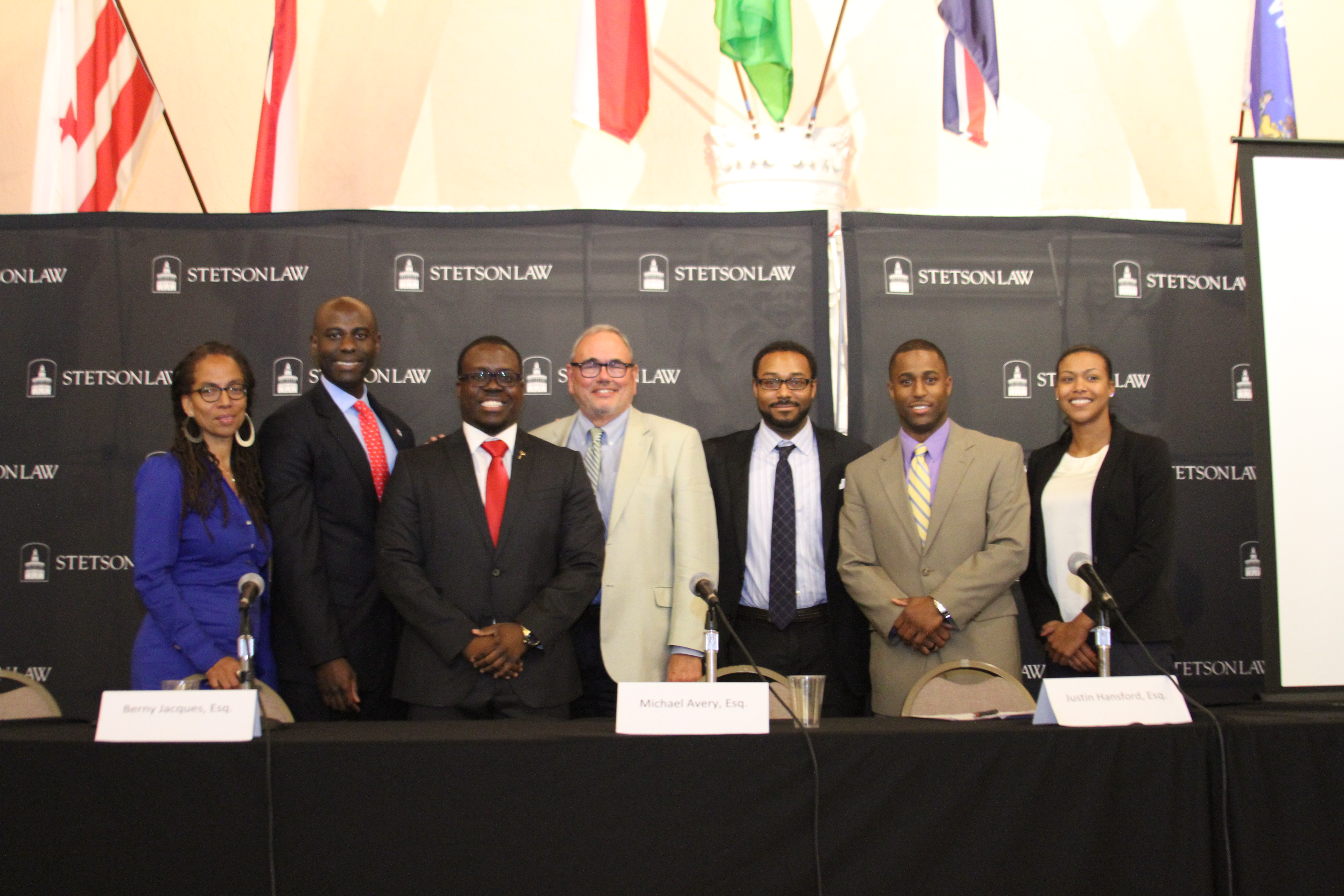
A distinguished panel gathered on Monday night on Stetson’s Gulfport campus to discuss ways to achieve equal justice in black communities. The panel of Saint Louis University School of Law Professor Justin Hansford, Suffolk Law School Professor Emeritus Michael Avery, and Berny Jacques J.D. ’12, addressed how public perceptions impact policing and crime in black neighborhoods. Stetson’s Black Law Students Association sponsored the event, “Disparate Treatment: Examining Policing in Black Communities and the Relevance of State Grand Juries.”
Panelists and students gathered in the Great Hall Monday night. Photo by Brittany Brochard.
Hansford teaches critical race, international human rights law and economic & global justice at SLU School of Law. He has a B.A. from Howard and J.D. from Georgetown University where he founded the Georgetown Journal of Modern Critical Race Perspectives. He has been involved as an advocate, activist and legal consultant on a number of issues related to policing in the Ferguson, Missouri area. His activism addressing police violence has taken him across the country as well as to the United Nations.
Avery taught constitutional law, individual rights and evidence at Suffolk Law School, where he was also the Director of Litigation. He received his B.A. as well as his law degree from Yale University. Avery is the former president of the National Lawyer’s Guild and the National Police Accountability Project. He authored a treatise on police misconduct entitled Law & Litigation, and received the largest judgment against the FBI in a misconduct case: $102 million.
Jacques moved to the U.S. from Haiti at the age of seven and was raised in Naples, Florida. He received his B.A. from Washington Adventist University and is a recent graduate of Stetson University College of Law. During college, he served as a legislative intern to Congressman Mario Diaz-Balart. He currently serves as an assistant state attorney and is president of the Pinellas County Young Republicans and a member of the Pinellas Leadership Council for Big Brothers Big Sisters of Tampa Bay.
Professor Judith Scully, director of Stetson’s Innocence Initiative, Juvenile Justice Initiative, Street Law program, and co-director of the Social Justice Advocacy Concentration Program, introduced the panel.
Panelists discussed a range of issues including the cycle of crime, police misconduct, grand juries and disparate treatment.
Avery said that the lack of statewide or national police force databases, and the absence of a standard method for police departments across the country to use to determine police accountability, makes it difficult to analyze policing in black communities.
“We believe in accountability. We believe in bringing people to justice,” said Professor Hansford.
“It starts with interacting with one another, with police officers being engaged in the community through Big Brothers Big Sisters program and mentoring,” said Jacques.
“We do have to change the image of the black community,” said Stetson Law student Diriki Geuka. “We can advocate for people who don’t have the opportunity to sit in rooms like this.”
Geuka, along with fellow Stetson Law student Zachariah Wade, both work with The Pillars, a subsidiary of Stetson’s Black Law Students Association that partners with the Public Defender’s Office to mentor young men navigating the juvenile justice system.
Brian Tannebaum J.D. ’94 visited Stetson’s Gulfport campus on Feb. 26 to meet with the Stetson community and discuss his new book, The Practice: Brutal Truths About Lawyers and Lawyering.
The book offers advice on how to operate a law practice and develop into a top professional lawyer.
Tannebaum is a criminal and bar defense lawyer in Miami and managing partner at Tannebaum Weiss. He practices in state and federal court and lectures frequently at statewide and local seminars. Tannebaum is past president of the Florida Association of Criminal Defense Lawyers and its Miami Chapter. He was appointed by the president of The Florida Bar to the Criminal Procedure Rules Committee. Tannebaum was also appointed to a three-year term on a Florida Bar Grievance Committee.
Tannebaum’s legal career began in 1995 working as a trial lawyer in the largest public defender’s office in Florida before entering into private practice. He was elected to the Board of Directors of the Florida Association of Criminal Defense Lawyers, and is one of only two members of the association to have received all three Presidential Service Awards.
Tannebaum met with students, discussed his new book, at Stetson Law.
Tannebaum was voted “Best of the Bar” by the South Florida Business Journal and was named the top 1.6% of all Florida criminal defense attorneys by Florida Trend magazine. He has also been named one of South Florida’s “Top Lawyers” in the South Florida Legal Guide, and named a “SuperLawyer” in every edition of the nationally published SuperLawyers magazine.
Professor of Law Peter L. Fitzgerald and wife Susan received the Golden Retriever Rescue of Mid-Florida’s Top Dog Award at the GRRMF annual “Rescue Reunion” on Feb. 21.
Professor Peter Fitzgerald and wife Susan visit the Dolly & Homer Hand Law Library at Stetson with their therapy dogs.
The Fitzgeralds received the award for donating numerous hours to GRRMF in 2014, including transporting and fostering rescued animals, and assisting with fundraising activities including bringing novelist and animal rescue advocate David Rosenfelt to Stetson’s Gulfport campus to speak at an event co-sponsored by Stetson’s student chapter of the Animal Legal Defense Fund.
Professor Fitzgerald is a specialist in domestic and international commercial law and policy, with an additional interest in animal law. Professor Fitzgerald’s latest book is International Issues in Animal Law.
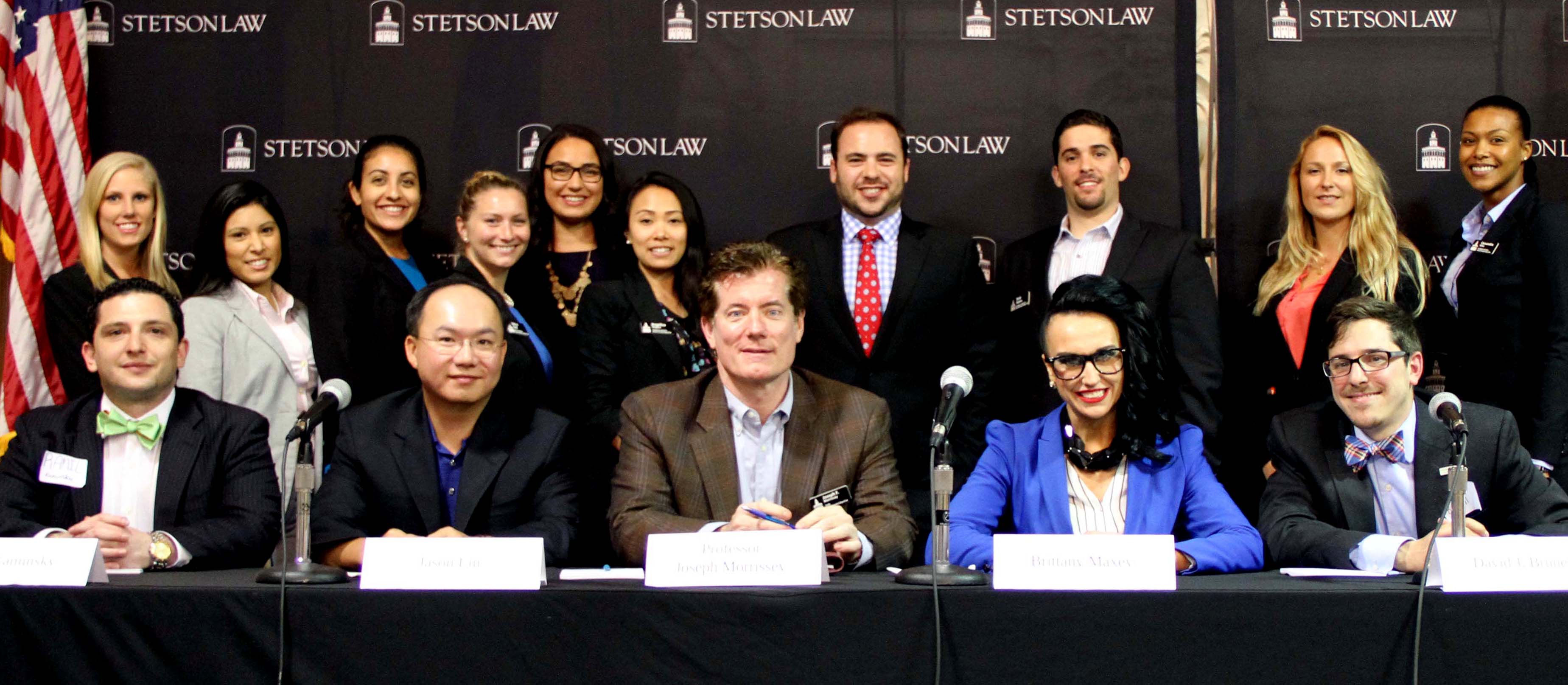
Equality Florida CEO Nadine Smith spoke at Stetson University College of Law in Gulfport on March 2. The Stetson Lambda Legal Society sponsored the event.
Nadine Smith. Photo by Amadu Wiltshire.
Smith founded Equality Florida in 1997, and led its work to end discrimination including the ban on gay adoption and gay marriage. She is an award-winning journalist turned organizer who was one of four national co-chairs of the 1993 March on Washington. Smith was part of the historic oval office meeting between then-President Bill Clinton and gay community leaders. She has met with President Barack Obama and Michelle to discuss LGBT issues. Smith also served on the founding board of the International Gay and Lesbian Youth Organization. Smith has spoken frequently in Professor Joseph Morrissey’s constitutional law class at Stetson.
Smith’s talk kicks off Diversity Week at Stetson. Her talk explored how Equality Florida has shaped the law.
“There is change,” Smith told the students gathered to hear her talk. “Over time, I know we’ve had an impact.”
Equality Florida is the largest civil rights organization dedicated to securing full equality for Florida’s lesbian, gay, bisexual, and transgender (LGBT) community.
“It is a profound act to stand up for yourself and live your life authentically,” said Smith.
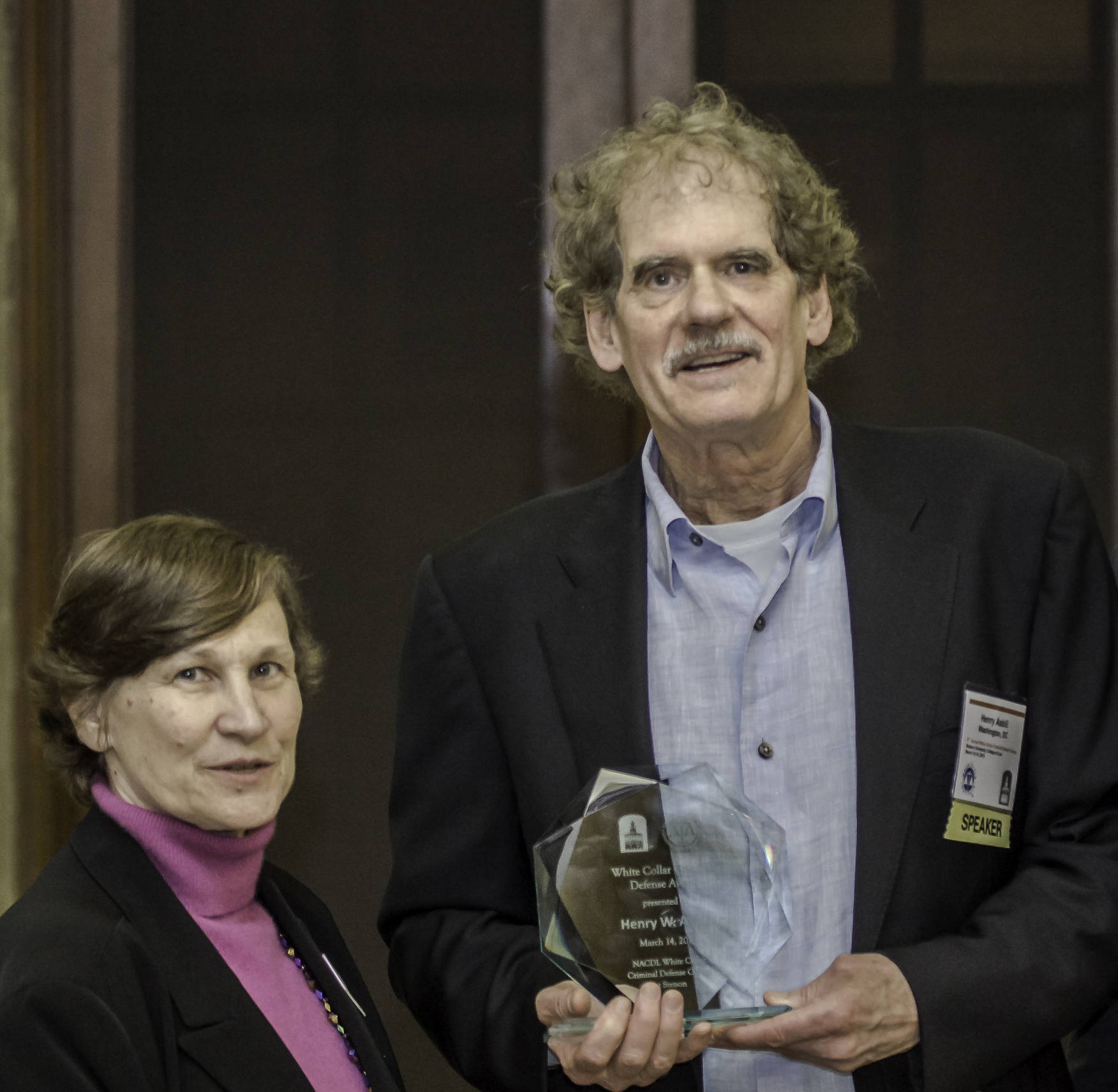
Hank Asbill, an acclaimed white collar defense attorney based in the Washington, D.C., office of Jones Day, will be presented the 2015 White Collar Criminal Defense Award on March 14 at Stetson University College of Law in Gulfport, Florida. This event is not open to the public but members of the media are invited to attend.
Hank Asbill of Jones Day. Photo courtesy Jones Day.
WHAT: The National Association of Criminal Defense Lawyers and Stetson Law co-present the award annually to individuals who have made a profound impact on the field of white collar criminal defense advocacy.
WHEN: Saturday, March 14, 6:30 p.m.
WHERE: Great Hall, Stetson University College of Law, 1401 61st St. S., Gulfport, Florida.
WHO: Hank Asbill frequently lectures on legal and trial strategy and has a distinguished national practice. He has successfully defended individual and corporate clients facing criminal and related civil charges for more than three decades and he is presently representing former Virginia Gov. Robert McDonnell in a public corruption conviction appeal. Mr. Asbill was profiled in The National Law Journal‘s special “Winning” report on the nation’s top litigators and in SmartCEO magazine as a “go to” lawyer for commercial litigation and white-collar criminal defense. Mr. Asbill is a fellow of the American College of Trial Lawyers and Litigation Counsel of America and a member of NACDL’s advisory committee. He is past president and fellow of the American Board of Criminal Lawyers, past president of the D.C. Association of Criminal Defense Lawyers, and a former two-term director of the National Association of Criminal Defense Lawyers.
The NACDL White Collar Criminal Defense College at Stetson, March 12-15, is a legal education “boot-camp” program for practitioners from across the country wishing to gain key advocacy skills and learn substantive white collar law from masters in the field.
Judge Patrice Moore ’95 presented the Feb. 18 leadership luncheon for students on the topic of community.
Judge Patrice Moore ’95 presented at Stetson on Feb. 18. Photo by Amadu Wiltshire.
“A good leader is a team player,” Judge Moore told the audience.
As a judge serving in the Sixth Judicial Circuit Unified Family Court in Pinellas County, Florida, for more than four years, Judge Moore works with children in civil dependency cases and criminal court. Before being elected as a judge in the Sixth Judicial Circuit, Judge Moore served the community as an assistant public defender.
The Student Leadership Development Committee coordinated the luncheon, part of Stetson’s Leadership Certificate program.
Stetson Law News recently asked law librarians and adjunct professors Sally Waters and Wanita Scroggs to participate in a Q & A about their new book, Free Internet Legal Research, a guide attorneys can use to find and effectively use the best free legal sites.
(L-R): Adjunct professors and law librarians Sally Waters and Wanita Scroggs were given Stetson hats to celebrate the publication of their new book.
Scroggs is Stetson’s Foreign and International Law Librarian. Waters is Stetson Law’s self-proclaimed “Queen of Reference.” Both Scroggs and Waters teach courses in Advanced Legal Research and have presented to professional groups, librarians and others about research methods and sources.
Stetson Law News: Tell us what inspired you to write Free Internet Legal Research?
Waters & Scroggs: We know from our experience here that attorneys don’t have time to learn the new resources like we do. But we also know that there are so many useful resources, we just can’t keep them to ourselves.
Stetson Law News: Who are the audiences for this book?
Waters & Scroggs: We originally wrote this with practicing attorneys in mind. However, we have heard from law students, professors and other librarians that they are enjoying it too. And we know of at least one Australian library that has the book.
Stetson Law News: How much of today’s legal research is done on the internet? How many legal research resources are out there and available and free?
Waters & Scroggs: Like everything else, it seems that legal research has gone digital. There is a myriad of legal resources out there freely available on the internet from city or county ordinances all the way through international laws. Because practice doesn’t involve only law, we also talk about how to find other types of information.
Stetson Law News: How does this book help guide people to free legal sites on the internet?
Waters & Scroggs: We not only introduce specific legal resources and websites, we also talk a lot about search strategy. Because websites change so frequently, that is both the advantage and disadvantage of electronic research. It helps to know how to find online resources for yourself.
Stetson Law News: Do most people know about all the free legal sites out there?
Waters & Scroggs: We constantly hear from attorneys how surprising it is to them that legal resources are available online for free. So, no, people don’t realize what’s out there.
Stetson Law News: You both work in a law library with many legal research tools available—how does the internet add to research methods and sources?
Waters & Scroggs: The internet is an essential part of legal research. It has wonderfully transformed the practice of law. Having said that, the content available is limited to the “digital age” or post 1980s, which means older materials can still best be found in print. Also, practical materials such as forms, practice manuals and other analytical material can be difficult to find for free online.
Stetson Law News: You teach a course on Advanced Legal Research—is internet research part of the curriculum?
Waters & Scroggs: Sally’s class meets in person and while the majority of the class deals with online sources, she still familiarizes students with print and why print resources still matter. Wanita’s class is held 100 percent online so she mentions print, but concentrates on electronic sources. For both of us, since our goal is to prepare students for law practice, we show them the most efficient and cost effective methods of research, whether print or electronic.
Stetson Law News: What is the most important takeaway you want people to remember from this book?
Waters & Scroggs: Don’t pay for stuff that you don’t have to, if you don’t have to.
Stetson Law News: Finally, tell us why you are wearing Stetson hats in your photo outside the Dolly & Homer Hand Law Library?
Waters & Scroggs: We received the hats as a congratulations from our colleagues on having published our book. We are wearing them because (tongue in cheek) as the song suggests, we have always dreamed of being cowgirls, but we’re afraid of cows.
Stetson University graduate Patrick Davis ’88, CEO of Davis Brand Capital and co-founder of the anti-bullying foundation StandUp, presented the Social Justice Lecture on “Entrepreneurism for Social Change: Inside Stories of Making the World Better, One Company at a Time” on Stetson’s Gulfport campus.
Davis’ presentation on Feb. 19 outlined his business model for StandUp, and discussed how entrepreneurship is an aspect of the battle for social justice.
Patrick Davis ’88. Photo by Brittany Brochard.
“Put social good ahead of personal greed,” Davis urged the audience of law students attending his lecture.
In just three years, and with the support of Coca-Cola, Kiehl’s and Nike, the StandUp brand shipped to 53 countries – and released enough profits to fund global anti-bullying education programs and award more than 50 grants in the U.S. and the U.K. to assist anti-bullying efforts. Davis described how animal and human welfare practices, safe-ingredient standards, or inclusion and anti-bullying policies in businesses can drive social change.
Davis also presented a lecture and discussion on Feb. 18 at Stetson University in DeLand as part of the Social Justice Lecture series.
During the fall semester of 2013, Stetson University launched the lecture series focused on social justice to explore issues central to its mission and values — values that speak to human freedom, personal and social responsibility, the connections we have with each other, and the obligations that flow from our shared humanity.