Stetson University College of Law students are participating in a special course from May 27-June 6 to learn about the threats facing endangered sea turtles and the legal and policy initiatives in place to protect them.
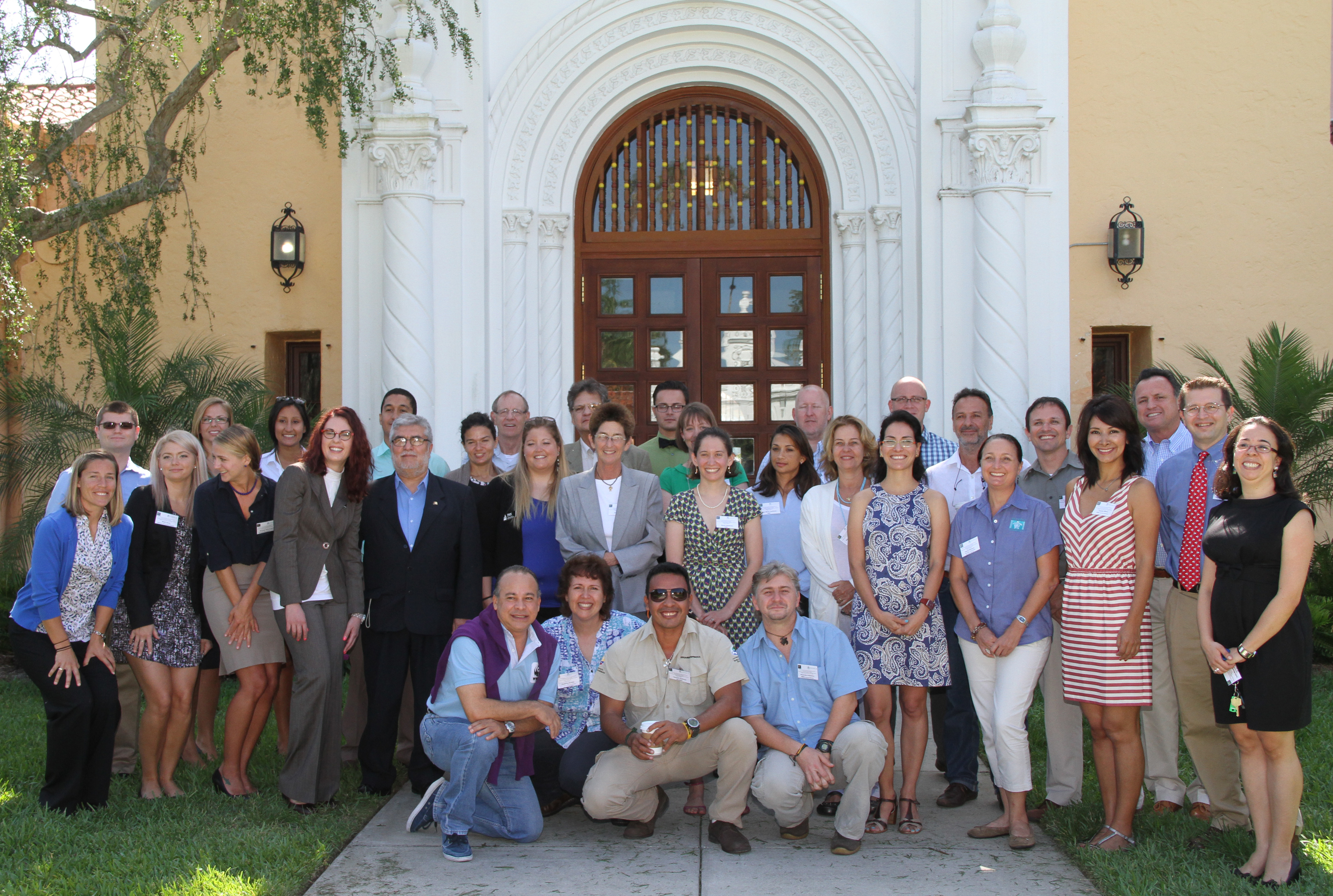
Sea turtle experts from Latin America and the Caribbean gathered at Stetson Law in Gulfport.
Students enrolled in the course are invited to join sea turtle experts on campus for the Consultative Committee Meeting of the Inter-American Convention for the Protection and Conservation of Sea Turtles.
Sea turtle experts from Latin America and the Caribbean traveled to Stetson’s Gulfport campus for the meeting.
For more information about Stetson’s new summer course on sea turtles, visit www.stetson.edu/turtles.
The U.S. Department of Justice recently announced a new clemency initiative, designed to prioritize clemency applications for certain non-violent offenders who would likely receive lesser sentences if they were sentenced today. To date, more than 35 Stetson Law students have signed on to assist the Office of the Federal Defender for the Middle District of Florida in identifying former clients who may qualify for the new clemency initiative. The Stetson Law students will help gather information relevant to the clemency criteria as part of a new pro bono project on campus.
“I had heard about this on the news and was ecstatic, but didn’t imagine Stetson students would have the opportunity to help,” said student Kathryn Hamilton, who signed on to assist the pro bono project.
“I am interested in the clemency project because it is such a rare and unique opportunity to apply some of the skills I have learned in law school for a cause that can drastically change people’s lives,” said student Kevin Lonzo.
Donna Elm, the Federal Defender for the Middle District of Florida, stated, “We are delighted to expand our internship program to include students working pro bono on this important project. The students will be instrumental in helping us collect the information we need to assess which former clients may be eligible for relief under the new clemency initiative.”
Stetson Law professors Ellen Podgor, Judith Scully, James Sheehan and Dean Emeritus and Professor of Law Bruce Jacob are spearheading the pro bono project with the Federal Defender’s Office.
“This is an exciting project that will be ongoing, allowing students to learn more about federal criminal law while assisting the Federal Defender’s Office in the Middle District of Florida,” said Professor Podgor, the Gary R. Trombley Family White-Collar Crime Research Professor at Stetson Law.
A book launch at the John F. Germany Public Library in downtown Tampa on May 22 benefited the Frederick B. Karl Scholarship for Veterans at Stetson University College of Law.
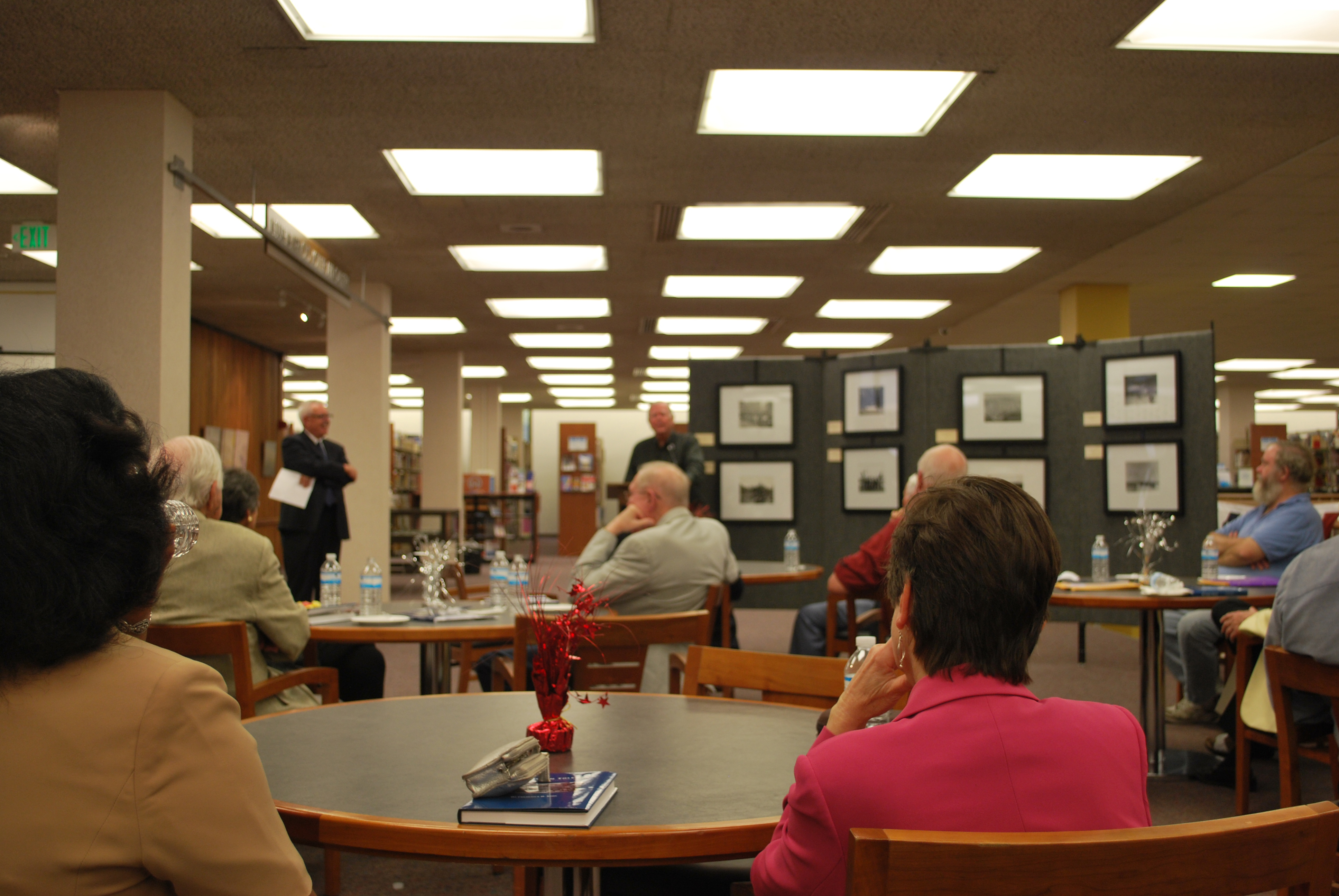
A group gathered at the Frederick B. Karl book launch in Tampa.
The Friends of the Library of Tampa-Hillsborough County, Inc., celebrated the publication of Karl’s book, “Python Tales: World War II Memories of a Young Soldier,” which chronicles Karl’s experiences as a young soldier in World War II.
Karl, a 1949 Stetson Law alumnus and 2004 Stetson Law Hall of Fame inductee who died last March, participated in the dedication of Stetson’s Veterans Law Institute on May 31, 2012, on the Gulfport campus.
Karl was a dedicated public servant, former Florida Supreme Court justice, member of the Florida House of Representatives and state senate, who served with numerous community organizations, as well as the Stetson University College of Law Board of Overseers. He served in the U.S. Army and fought in the Battle of the Bulge, and was awarded a Silver Star, Bronze Star, and Purple Heart medal. READ MORE ABOUT KARL IN THE OBSERVER NEWS HERE>>
Frederick B. Karl attended the dedication of Stetson’s Veterans Law Institute.
The May 22 book launch celebration drew local leaders including former Tampa Mayor Pam Iorio and members of the Stetson Law faculty.
Stetson University College of Law mourns the death of James J. Brown, Attorneys’ Title Insurance Fund Professor Emeritus, who died at his home on May 26 in London, England.
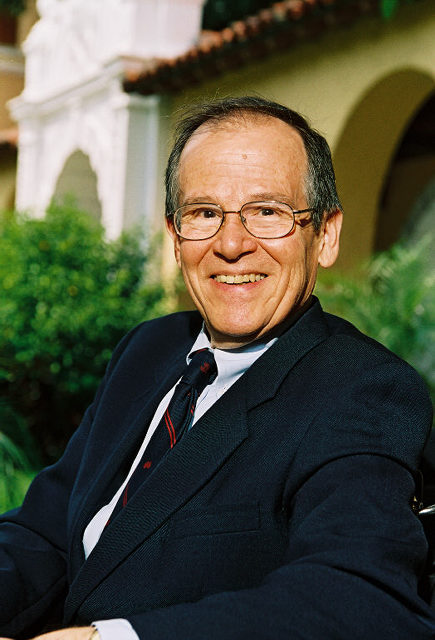
Attorneys’ Title Insurance Fund Professor Emeritus James J. Brown
Professor Brown was the first Attorneys’ Title Insurance Fund Professor at Stetson University, where he taught property, real estate law, land use planning and local government for more than three decades. He began teaching law in 1970, following five years of practice in Cleveland, Ohio. He retired from Stetson in 2010.
A leader in serving his profession, Professor Brown served on the executive councils of the Florida Bar sections for Environmental and Land Use Law; City, County and Local Government Law; and the Real Property, Probate and Trust Law. In 1980, he was appointed to the Governor’s Advisory Committee on Secret Land Trusts. In 2006, the Florida Bar City, County and Local Government Law Section presented him with the prestigious Ralph A. Marsicano Award, for his significant contributions to the development of local government law in Florida. Professor Brown also received the section’s Paul S. Buchman Award for outstanding legal contributions to the field at the municipal level.
Professor Brown was past president of Scribes, the American Society of Writers on Legal Subjects. He wrote and edited several treatises and publications on land use law, real property and environmental law.
Professor Brown received his LL.M. from Washington University, his J.D. from Cleveland State University and his B.S. from the University of Pennsylvania, Wharton School of Finance. He was a member of the Florida and Ohio Bar Associations.
In lieu of flowers, the family has asked that donations in memory of James J. Brown be directed to the Professor James J. Brown Merit Retention Scholarship Fund at Stetson University College of Law.
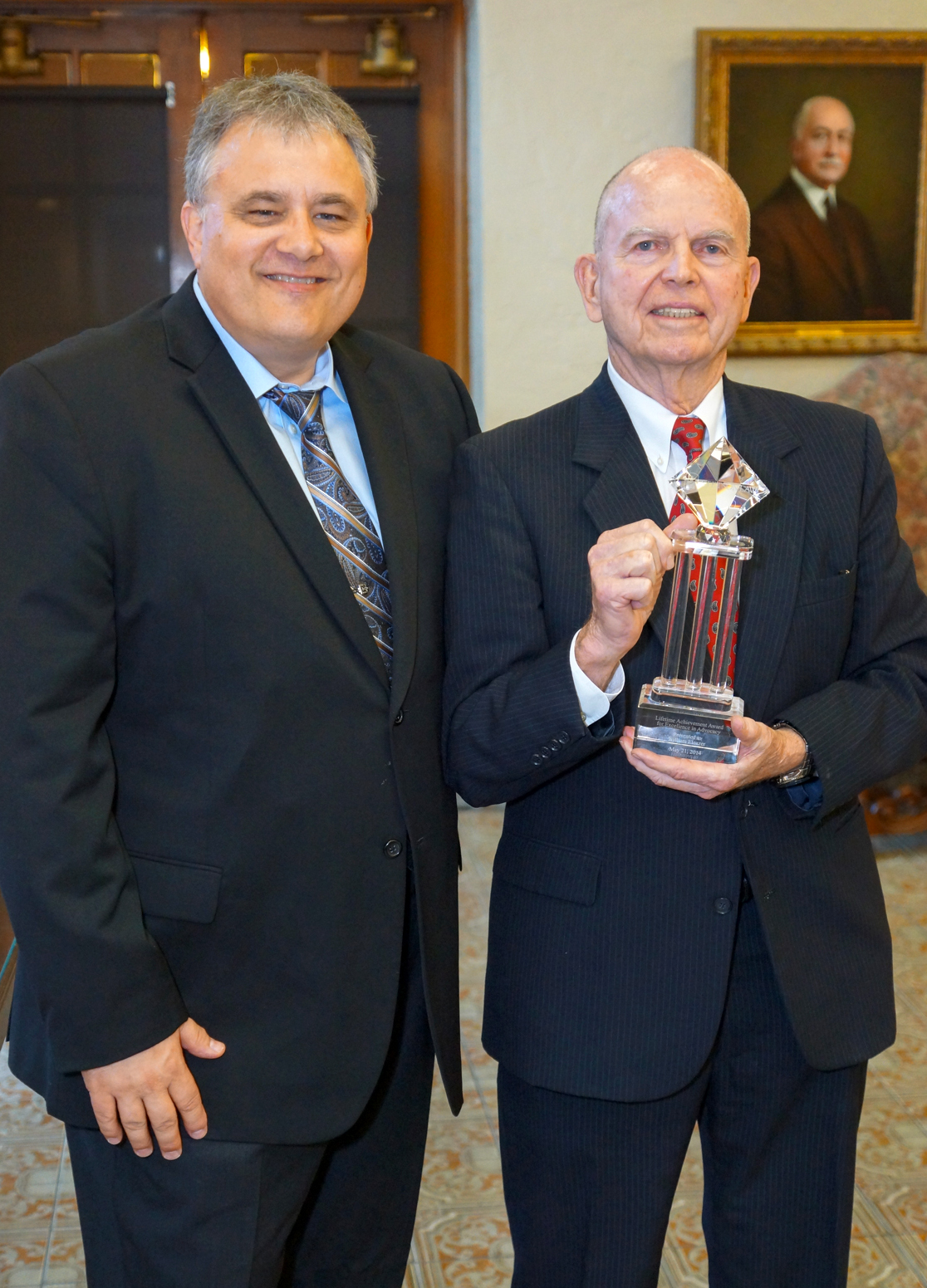
(L-R): Director of the Center for Excellence in Advocacy Professor Charles Rose and Professor Emeritus William Eleazer. Photo by Barry Lively.
Professor Eleazer helped to establish Stetson’s reputation for excellence in ethical and effective trial advocacy. He challenged his students to maintain the highest standards of both professionalism and competency in the art of advocacy and the ethical practice of law. Professor Eleazer was inducted into Stetson Law’s Hall of Fame in 2005. He is the author of the 2010 Gold Medal-winning novel Savannah Law and The Indictments.
Stetson’s trial advocacy program has consistently ranked at or near the top nationally by U.S. News & World Report since 1995. Stetson has been named the best school in the U.S. for trial advocacy 16 times by U.S. News.
This year’s three-day intensive Educating Advocates: Teaching Advocacy Skills conference, presenting the Stetson method for teaching advocacy, drew law professors and legal practitioners from across the U.S.
Retired Illinois district justice David A. Erickson, director of the Trial Advocacy Program and Program in Criminal Litigation at IIT Chicago-Kent College of Law, has attended more than a half-dozen EATS conferences. He described Stetson’s annual EATS conference as a gathering of people from around the country who care about ethical advocacy.
Stetson University College of Law awarded professor Ciara Torres-Spelliscy the Dickerson-Brown Award for Excellence in Faculty Scholarship during the evening Honors & Awards ceremony on May 16 on the Gulfport campus. Professor Torres-Spelliscy writes about the intersection of corporate law and election law.
Professor Ciara Torres-Spelliscy
“The issue of corporate political spending continues to be a hot topic for voters and investors alike in the aftermath of Citizens United v. FEC, the 2010 Supreme Court decision which allows unlimited corporate spending in American elections,” said Professor Torres-Spelliscy. “Unfortunately, this spending suffers from a lack of transparency, a lack of shareholder consent and a lack of internal controls. This is why research in this idea is necessary—so that policy makers responding to the new campaign finance landscape have the facts to make informed decisions.”
Since joining the Stetson faculty in 2011, she has published a book chapter, “Corporate Political Spending & Shareholders’ Rights: Why the US Should Adopt the British Approach” in the 2011 Risk Management and Corporate Governance, Jalilvand & Malliaris, eds., Routledge.
She has published four law review articles: “Safeguarding Markets from Pernicious Pay to Play: A Model Explaining Why the SEC Regulates Money in Politics” in the 2012-2013 Connecticut Public Interest Law Journal, “Taking Opt-In Rights Seriously: What Knox v. SEIU Could Mean for Post-Citizens United Shareholder Rights” in the 2013 Montana Law Review, “How Much Is an Ambassadorship? And the Tale of How Watergate Led to a Strong Foreign Corrupt Practices Act and a Weak Federal Election Campaign Act” in the 2012 Chapman Law Review, and “The $500 Million Question: Are the Democratic and Republican Governors Associations Really State PACs Under Buckley’s Major Purpose Test?” in the Spring 2012 NYU Journal of Legislation & Public Policy.
She co-authored with Dr. Kathy Fogel “Shareholder-Authorized Corporate Political Spending in the United Kingdom” in the Spring 2012 University of San Francisco Law Review and the policy report “The SEC and Dark Political Money: An Historical Argument for Requiring Disclosure” for the Corporate Reform Coalition 2013.
Professor Torres-Spelliscy also writes frequently for policy blogs and the popular press including the New York Times, L.A. Times, Slate, USA Today, Tampa Bay Times and Huffington Post.
A graduate of Harvard (AB) and Columbia Law School (JD), Torres-Spelliscy is a member of the board of directors of the National Institute on Money in State Politics and a Brennan Center fellow. She has been promoted from assistant professor of law to associate professor of law at Stetson University, effective August of 2014.
Stetson University College of Law is seeking attorneys to volunteer civil legal services to military members, veterans and their families as part of its Veterans Pro Bono Initiative Team.
With more than a million veterans, Florida is home to one of the largest populations of veterans in the country. Stetson’s new Veterans Pro Bono Initiative Team will serve Tampa Bay area veterans through its Veterans Law Institute.
“We are looking for volunteer attorneys with a passion to serve the veterans, members of our military and their families,” said Trista Miller, assistant director of clinical education and Veterans Law Institute pro bono supervisor at Stetson.
Volunteer attorneys will receive a weekly email message containing current case digests outlining pro bono opportunities in their geographical and legal practice areas. After selecting a case, attorneys will be provided with client and student volunteer contact information. Volunteers will also gain access to future Stetson CLE workshops focused on veterans law.
Attorneys interested in volunteering may apply with no obligation at stetson.edu/veteransprobono. For more information about volunteering with Stetson’s Veterans Pro Bono Initiative Team, contact [email protected] or call 727-562-7333.
Stetson University College of Law student Kathryn Hamilton said that the idea for Justice Grows germinated in professor Marleen O’Connor’s Food Law & Policy seminar and professor James Fox’s class on poverty law. What started as a research assignment in the classroom in Gulfport, Fla., has blossomed into collaborating with the Florida Farm to School program on a new project that will bring edible gardens to local juvenile residential centers.
Student Kathryn Hamilton.
Hamilton, a student in Stetson’s Social Justice Advocacy Concentration program, said she is finalizing plans for the first garden at a site St. Petersburg, Fla. Ultimately, she said that her goal is to help already established garden programs unite as part of the Florida Farm to School program.
“In 2011, Florida Governor Rick Scott asked juvenile justice centers to improve vocational and educational programs for our youth, and gardens and greenhouses were recommended as low-cost solutions,” Hamilton said. “Youth working on edible garden projects in juvenile residential centers can learn gardening skills and have opportunities to do a service to the community. They also have access to healthy food.”
Hamilton found that many people live in food deserts, areas of town in Florida where it is nearly impossible to access fresh fruits and vegetables unless you own a car. Hamilton’s research shows that about 20% of Florida residents are food insecure, meaning that at some point during one month every year, families aren’t sure how they can pay for their next meal.
“I want the youth in the system to see that they can be responsible for bringing that number down,” said Hamilton. “Edible gardens provide youth with a source of income, one that requires no expertise and hardly any start-up money.”
Hamilton is calling the project Justice Grows because it helps instill leadership and responsibility in young people while addressing issues like hunger, poor health, and lack of access to healthy foods.
“Hunger, poverty and crime are related to our eroding food system,” said Hamilton. “My research revealed that the same families that are not able to find or afford healthy food are often the same families with children entering the juvenile justice system.”
Edible gardens in juvenile residential centers can also provide opportunities for victim restitution and community service, Hamilton explained. The food grown can be donated to food banks and young people can plant gardens in their own neighborhoods. There are already successful edible garden programs in place across the state, said Hamilton.
Hamilton is seeking volunteers willing to work with the project to help build the first site garden in St. Petersburg, and is asking for donations of greenhouse resources and seedlings to the Cypress Creek Juvenile Offender Correctional Center garden in the Lecanto area. She has drafted a proposal for the Department of Juvenile Justice, in charge of the juvenile residential centers. She has also done interview spots with WMNF Tampa and WSRQ Sarasota about her project.
Stetson University College of Law is offering a three-week certificate program in U.S. Legal System and Trial Advocacy Skills for foreign attorneys in July and August.
The program, designed to help enhance attorneys’ professional skills and curriculum vitae, teaches the fundamentals of the U.S. legal system, legal analysis, and trial advocacy, taught by faculty at the top-ranked law school in the U.S. for trial advocacy.
During one week of online coursework and two weeks of instruction at Stetson’s Gulfport campus, participants will learn the fundamentals of U.S. torts, constitutional, criminal and civil law; participate in trial exercises; and network with judges, attorneys and fellow participants from around the world.
The online portion takes place July 21-25 completing online coursework and two weeks from Aug. 4-15 on Stetson’s Gulfport campus. Extracurricular trips include the Pinellas County Correctional Center, Florida’s Second District Court of Appeal, and an optional recreational visit to Walt Disney World in Orlando.
Upon completion of the program, participants receive a Certificate of Participation.
Two students in professor Clark Furlow’s Advanced Corporate Law seminar at Stetson University have recently written papers accepted for publication in respected journals.
Clara Arrington, a native of Tampa, has written on the topic of enabling benefit corporations in Florida. Her paper was accepted for publication in the Hillsborough County Bar Association’s monthly magazine, The Lawyer.
Clara Arrington
The paper, “Florida considers enabling benefits corporations,” argues that Florida’s other constituency statute works to support the same goals that benefit corporations support and that a new legal framework is unnecessary.
Benefit corporations balance a stated public benefit, such as the interests of the community in which they operate, with shareholders’ interests. Arrington described how a Florida citrus farmer kept an unprofitable branch of the family business running just to keep his family employed and support the local community. When this practice was challenged by minority shareholders, a Florida court ruled that it was legal under Florida’s constituency.
Arrington said that she is fascinated by the topic of how the law interacts with business. She plans to work in the Tampa Bay region after graduating in May.
Wynn Willard, entering his third year of law school at Stetson and himself a former CEO, wrote about the regulation of executive compensation. His paper and a companion piece were accepted by the Duquesne Business Law Review and the Cornell HR Review, a journal of the Industrial and Labor Relations School.
Wynn Willard
Willard argues that criticism of compensation should first be measured against the value CEOs create for shareholders. He shared the example of Steve Jobs, whose leadership propelled Apple’s shareholder value hundreds of billions of dollars since 2003. In the same time frame, Willard explained that Motorola and Nokia executives achieved minimal and negative returns, respectively, for their shareholders. Willard’s paper cites multiple examples of government regulation of executive compensation producing unintended consequences and great costs. He advocates a cessation of federal regulation in favor of existing state laws and market forces.
Willard worked as a marketing executive at companies including Procter & Gamble, Cadbury Beverages, and Hershey Foods. He served as CEO of Nabisco Canada and New World Pasta Company. He has also taught courses on management at the University of South Florida.
“I have always been interested in law and thought my corporate background could be a good combination with it,” said Willard, who plans to graduate from Stetson in December.
He said that the seminar paper gave him an opportunity to explore a subject with which he has firsthand experience.
“You have to have a passion for what you’re doing,” Willard said.
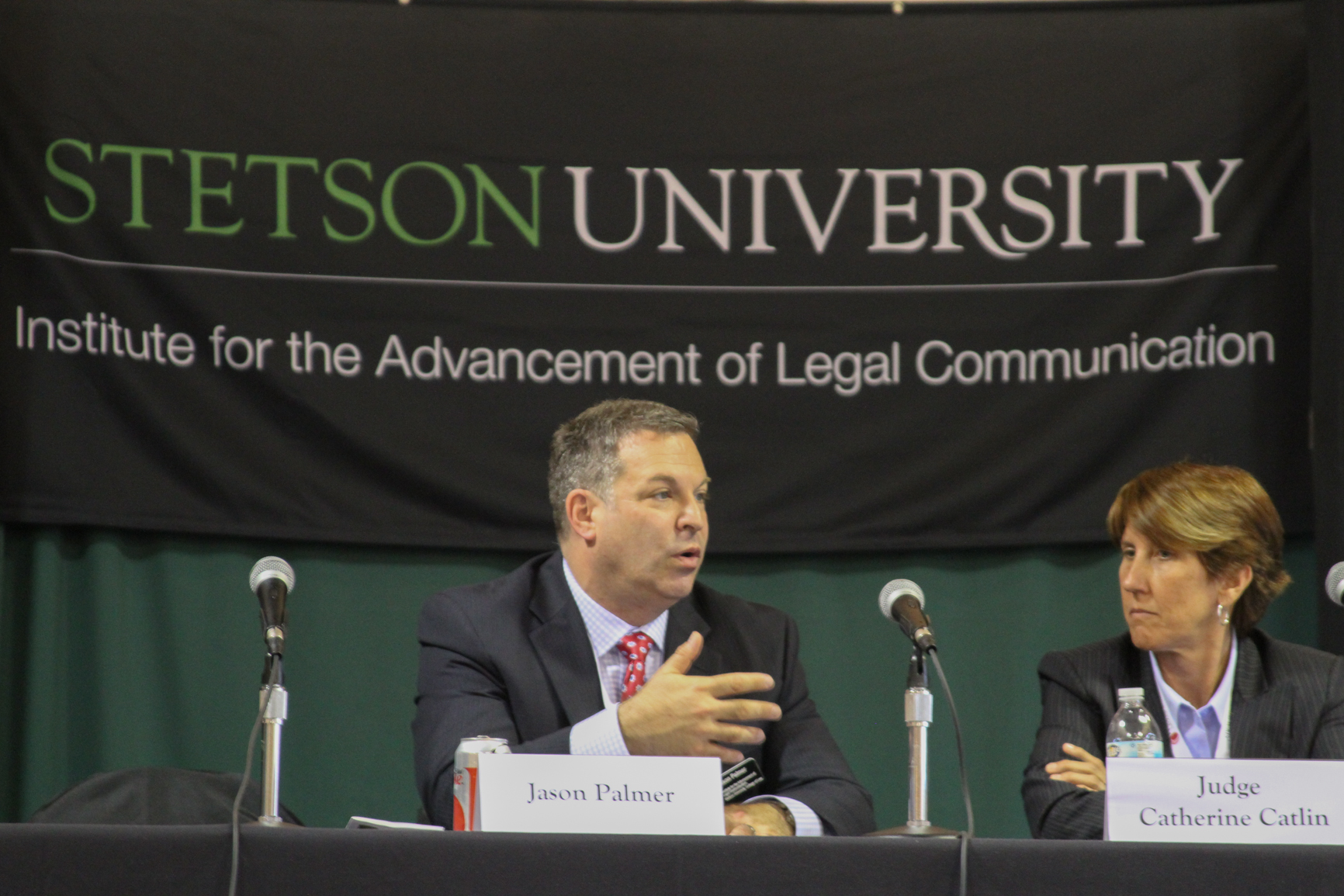
Stetson University College of Law’s Institute for the Advancement of Legal Communication hosted the Southeast Regional Legal Writing Conference, April 25-26, in Gulfport, Fla. The Conference was organized by Institute faculty Jason Palmer, Lance Long, and Kirsten Davis, Ph.D.
Professor Kirsten Davis, Ph.D., greeting speakers at the Southeast Regional Legal Writing Conference.
The conference for law faculty and others who teach legal research and writing courses offered workshops on preparing students to be “practice-ready” and developing writing and research skills for the 21st century. Discussions highlighted developments in legal pedagogy, advances in advocacy, and theory on teaching the digital Millennial lawyer.
“There’s rapid growth in the critical study of legal communication by those who teach it, ” said Professor Davis, director of the Institute for the Advancement of Legal Communication at Stetson. “The Southeast Conference is known for energizing its participants to continue developing new approaches to teaching legal writing and examining how to improve it.”
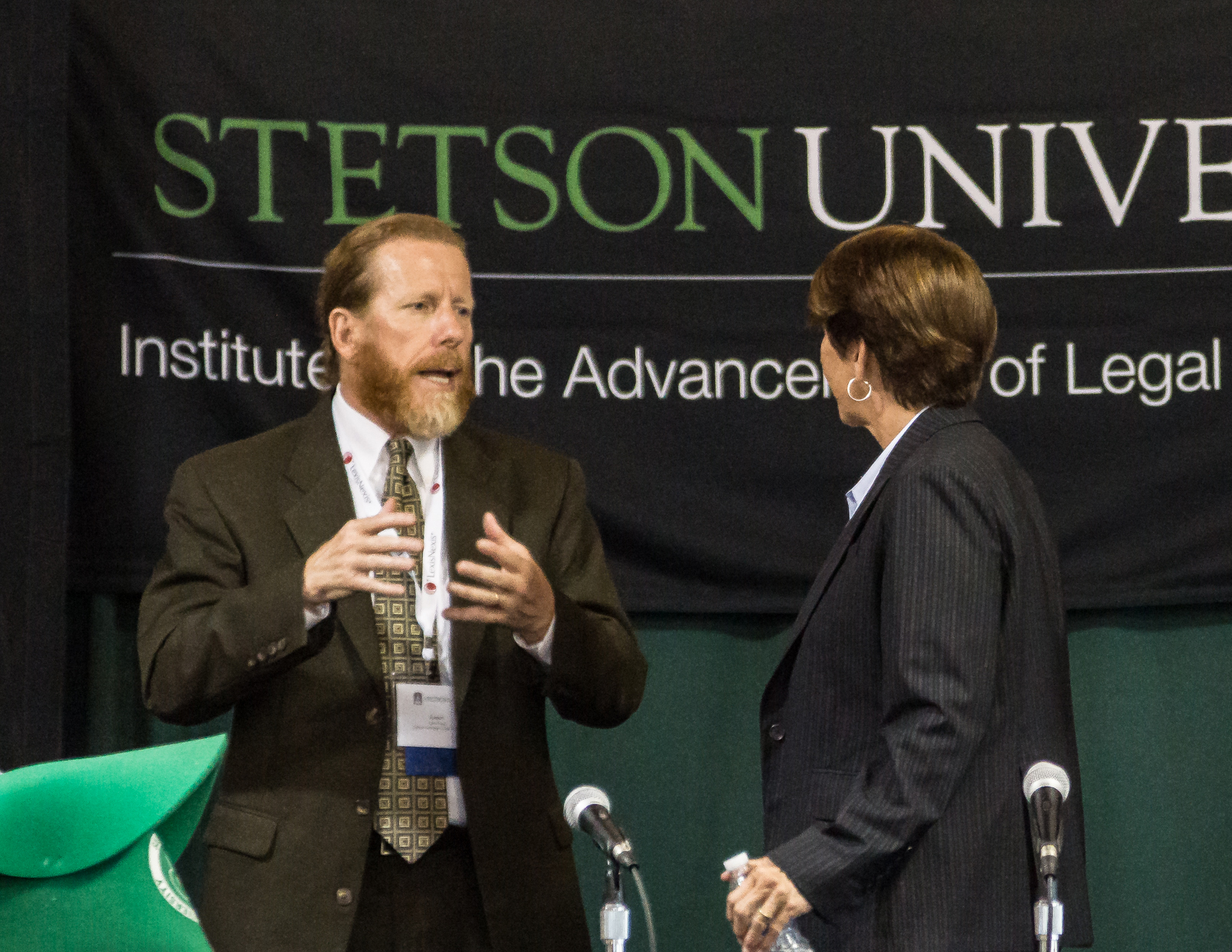
Professor Jason Palmer talks at the Panel discussion with Judge Catherine Catlin at the Southeast Regional Legal Writing Conference.Professor Lance Long at the conference.
Vice President and Senior Scholar, Reporting, Writing & Editing Faculty at the Poynter Institute Roy Peter Clark, Ph.D., presented the Saturday keynote presentation.
Clarke Rountree, Ph.D., professor and chair of the communication arts department at the University of Alabama, Huntsville, was this year’s distinguished speaker. He spoke about the connection between rhetorical theory and the language of judicial opinions.
As part of the Southeast Regional Legal Writing Conference, Stetson hosted an ALWD Scholars’ Forum that focused on legal writing scholarship addressing rhetoric, narrative, and storytelling subjects.
The Association of Legal Writing Directors funded the Forum.
Sponsors of this year’s conference included Wolters Kluwer/Aspen, Bloomberg BNA, LexisNexis and Carolina Academic Press.
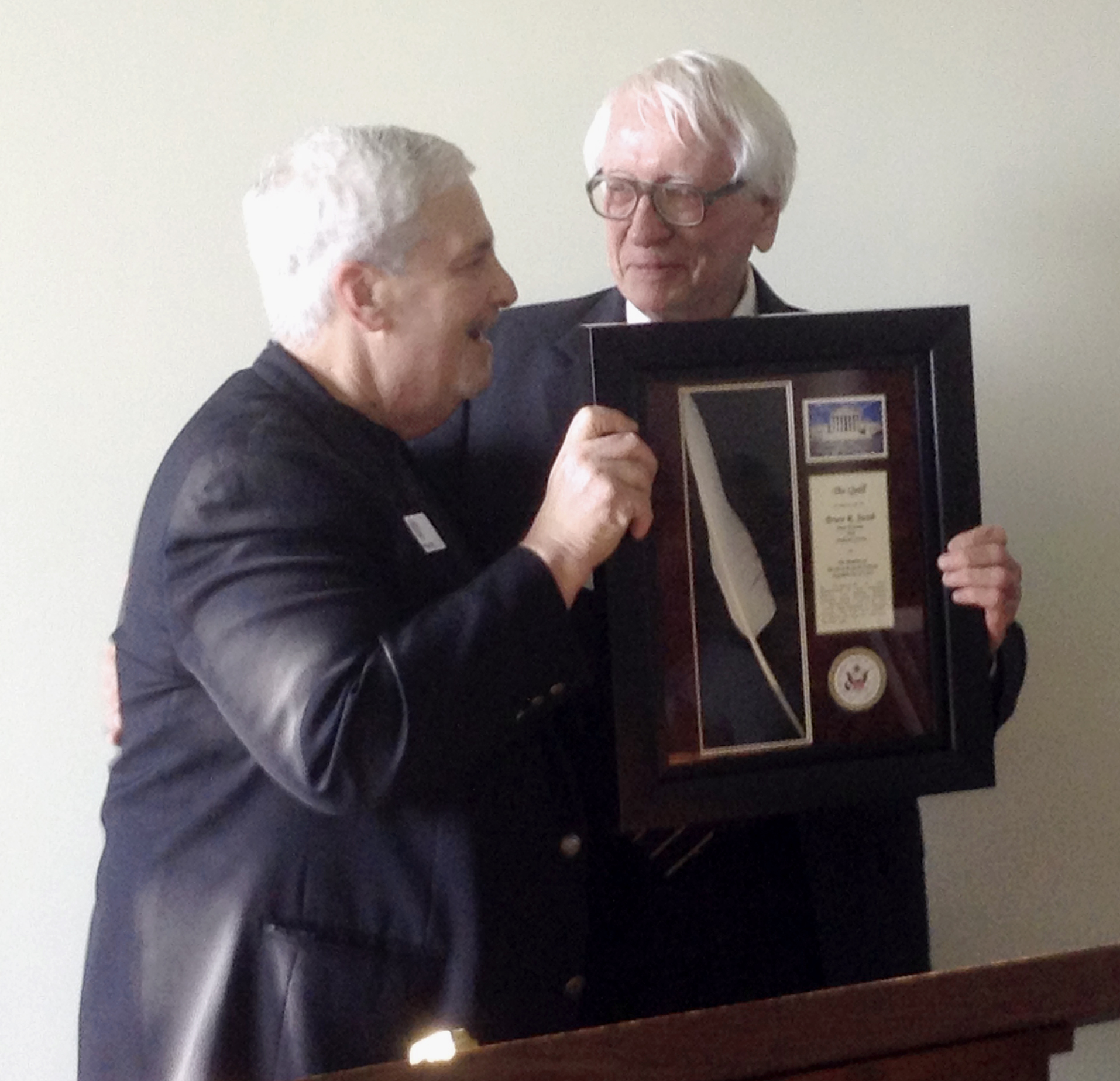
Dean Emeritus and Professor of Law Bruce Jacob was presented with a traditional Supreme Court white quill at the Bruce R. Jacob Criminal Appellate American Inn of Court meeting on April 22 in Tampa. Florida assistant attorneys general Robert Krauss and Diana Bock presented the quill to Jacob to commemorate his work in arguing cases before the U.S. Supreme Court.
Bruce Jacob received a Supreme Court quill from Florida Assistant Attorney General Robert Krauss.
Jacob twice presented before the Court. As a young law graduate working in Tallahassee 50 years ago, Jacob was assigned to represent the respondent as an assistant attorney general of Florida in the landmark 1963 case Gideon v. Wainwright. The Court’s decision was the impetus for the establishment of public defender offices throughout the U.S.
In 1969, Jacob was appointed by the Supreme Court to handle a federal prisoner’s case before the Court and he won the case for the petitioner in Kaufman v. United States.
A white quill is traditionally placed on the counsel table at the U.S. Supreme Court for attorneys presenting before the Court. The attorneys are permitted to take the quill home after the argument.
Jacob never brought a white quill home from the Supreme Court.
“Either I didn’t realize that I was allowed to take one, or I was so nervous I forgot,” Jacob said.