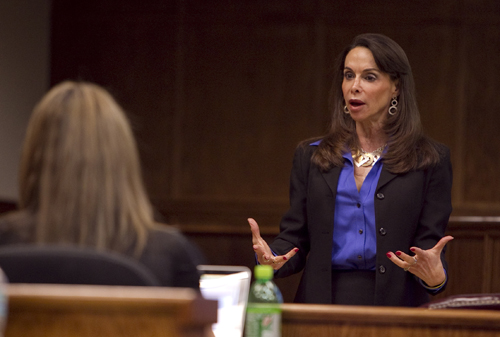
(L-R): Claudette Goyanes, Brandon Blake, Julian Catala and Erica Emas won the regional round of the AAJ Student Trial Advocacy Competition.
Stetson students Brandon Blake, Julian Catala, Erica Emas and Claudette Goyanes will travel to Las Vegas for the national competitiononMarch 22–25. Professor Roberta Flowers is the team coach.
“Winning this competition and others reaffirms Stetson’s excellence in advocacy,” said Trial Advocacy Fellow Lee Coppock. “We are especially pleased to have won this regional event for the fourth year in a row.”
Over its history, Stetson’s trial team has won first place in more national-level trial competitions than any other law school in the nation. Trial competitions require students to demonstrate their trial advocacy skills in a simulated jury trial, where they are evaluated by experienced lawyers and judges and have the opportunity to perfect trial skills to a degree not possible through classroom instruction.
Stetson University College of Law students volunteered time in February at “Raising the Bar,” a community service event organized by law students, lawyers and members of the legal profession. The Stetson Law students helped feed residents of the Pinellas Safe Harbor homeless shelter in Clearwater on Feb. 11.
Members of the Florida Bar Young Lawyers Division and Students Division, Moot Court Board, American Bar Association Law Student Division, and Black Law Students Association at Stetson co-sponsored the project in Clearwater. Law schools across the state of Florida participate annually in “Raising the Bar.”
This year, the goal of the Stetson student volunteers was to help the residents of Pinellas Safe Harbor, a shelter for the chronically homeless and those in need of services. The Safe Harbor serves as a transitional center, providing services for homeless people who are or were in the criminal justice system, and assists them in reentering society.
“It was both a humbling and eye opening experience to see the sheer number of people in our community who were living at the shelter,” said student Katelyn Mae Desrosiers, one of the event organizers and a member of Stetson’s Moot Court Board. “We are all so wrapped up in our own lives and so blind to the fact that there are so many living among us who are in need of just the basic necessities. I feel blessed to be a part of the Stetson community because of its willingness to appreciate what it has and give back to those less fortunate.”
More than 20 volunteers assisted in making sandwiches at Stetson’s Gulfport campus and then transported them to Safe Harbor. The Stetson Law students delivered and handed out approximately 350 bagged lunches to the residents at the shelter.
“It was really amazing to see the overwhelming amount of thanks that both the shelter personnel and residents showed us for the simple act of providing lunch,” said Frank Leung, representative of the Florida Bar Young Lawyers Division. “Many of them appreciated the fact that law students and lawyers took the time and energy to not only prepare the lunches, but to personally hand them to each and every resident.”
Frederick Longmire, chief of Stetson’s Moot Court Board, said he was humbled by the experience. “Pro bono gives me the opportunity to not forget where I came from and an opportunity to help those who are less fortunate,” said Longmire. “But for God’s grace, that could have been me receiving that sandwich instead of giving it.”
Next year, the same organizations will collaborate with other student organizations to continue to grow the Raising the Bar event.
Stetson Law students contributed 19,000 hours to pro bono service in 2009-2010, and Stetson Law is the first law school in the state to require pro bono service of its students and faculty.
“I want everyone to be engaged,” Professor Luz Nagle told a group of students gathered in the Mann Lounge in November at Stetson University College of Law in Gulfport.
Professor Luz Nagle specializes in international law and international criminal law.
Professor Nagle was introducing Luis Argueta, a documentary filmmaker and lecturer from Guatemala, who was visiting to talk with students about the plight of undocumented workers and the need to reform immigration laws. Nagle, whose career before teaching included serving as a judge in her native Colombia, is dedicated to raising Stetson students’ awareness about international human rights.
Professor Nagle serves as a mentor to third-year student Silvia Manzanero, who has worked as the professor’s research assistant and is taking her fourth class with the professor during her last semester at Stetson in the spring. As student president of Stetson’s International Law Students Association, Manzanero helped bring the filmmaker Argueta and other speakers to campus to explore a broad range of human rights topics. From genocide in Rwanda, to the latest revolution in the Arab world, to the ongoing struggle for the protection of women’s rights around the world, Manzanero described organizing the events as “one way of contributing to Stetson’s academic experience.”
Manzanero said in a recent interview, “When we practice law, we practice beyond the state of Florida.” In much the same way, Professor Nagle teaches beyond the classroom.
Professor Nagle brings international visitors from as far away as Yemen, Iraq, China and Argentina to participate in class with her students and introduces media such as video news and film clips to give greater impact to legal subjects. She also asks her students to think about the impact of their choices. In February, approaching Valentine’s Day, she urged students to consider the plight of children enslaved in the chocolate industry in the Ivory Coast.
“Employing a broad range of educational tools allows Professor Nagle to illustrate both the issue and how the law can affect people’s lives,” Manzanero explained. “When you see a child mutilated, or images of genocide, you see what really happened, how people’s lives were torn apart, why the law failed, and what needs to be done.”
Manzanero, who is originally from Spain and grew up during the country’s transition to democracy, said, “I see a law degree not as an end, but as an instrument to help improve the lives of others.” She said that Professor Nagle’s lectures inspire students, and show them ways in which they can help. Professor Nagle has high expectations of her students, Manzanero related.
In the four classes she’s taken with Nagle, Manzanero said that class participation is integral. In addition to lengthy and often complex casebook readings, Manzanero said that students are expected to read news and research current events related to legal cases, and to have a dialogue about the subject matter. Professor Nagle has the same level of commitment to class preparation and participation, Manzanero explained. “She is extremely prepared and always three steps ahead,” Manzanero said.
Professor Nagle is actively engaged in ending human trafficking and modern-day slavery, an advocate who takes part in the conversation about international human rights at conferences around the world. In December, before the Supreme Court of Justice in Brazil, she presented the prestigious Instituto Innovare Annual Award for innovation in the fight against organized crime. It was fitting for Professor Nagle to present this year’s award on behalf of the International Bar Association, as she fought organized crime herself while serving on the bench in Colombia during the reign of the Medellín drug cartel. The award went to the Permanent Group of Proactive Practice of the Brazilian National Attorney General’s Office.
A month prior, Professor Nagle was in Dubai, participating in the annual International Bar Association Conference. Over the summer, Professor Nagle was in Argentina, where she taught a class on the “disappeared.”
“When I saw she was teaching a class in Argentina, I instantly signed up,” said student Nash Licona. Professor Nagle also brought London-born journalist Robert Cox to speak to her class. Cox was editor-in-chief of the English newspaper, the Buenos Aires Herald, during the dictatorship in Argentina.
Thousands of people disappeared in Argentina during the regime of a brutal dictatorship, were brought to secret detention centers, and suffered torture and unknown fates.
“He saw everything that happened with a critical eye,” Licona explained of Cox’s coverage of the “disappeared.” “He saw where the rule of law failed.”
Licona, who has completed three classes with Professor Nagle and is enrolled in a fourth in the spring, said, “Her classes are not just about getting everyone talking. They’re about getting everyone to realize that they have something intelligent to say.”
Stetson University College of Law moot court teams won two competitions, two oralist awards, and a best memorial award over the weekend.
Jessup team (L-R): Diana Evans, Carly Ross, Caitlein Jammo and Sharon Galantino.
The Stetson team of Diana Evans, Sharon Galantino, Caitlein Jammo and Carly Ross won the south regional round of the Philip C. Jessup International Law Moot Court Competition and the best memorial award this past weekend in Houston, Texas. Diana Evans also won the fourth-best oralist award. The team will advance to the international rounds of the world’s largest moot court competition in Washington, D.C., March 25-31. Professor Jason Palmer and attorney Logan Murphy coached the winning team.
The Stetson team of Jhenerr Hines, Christian Leger and Stephanie Sawchuk won the 11th Circuit Bankruptcy Competition, sponsored by the University of Miami and the Bankruptcy Bar Association, in Miami this past weekend. A second team, Amanda Chazal, Erik Johanson and Greg Ludtka, were semifinalists, and Johanson received the Best Oralist award. Students will compete in the 20th Annual Honorable Conrad Duberstein Bankruptcy Moot Court Competition in New York City, on March 10-12.
(L-R): Jhenerr Hines, Christian Leger and Stephanie Sawchuk.
Student Meagan Foley won the best oralist award at the Willem C. Vis International Commercial Arbitration Pre-Moot, sponsored by the Florida Bar International Law Section, in Miami this past weekend. Stetson students have consistently won the first or second place oralist awards in this competition, since its inception in 2005. Professors Stephanie Vaughan, Marco Jimenez, and student John Henley coached the team. Katelyn Desrosiers, Meagan Foley, Ron Hink, Max Holzbaur and Alex Zesch will compete in the Willem C. Vis International Commercial Arbitration in Vienna, Austria, March 29-April 5.
BLSA honored Florida Supreme Court Justice James E.C. Perry at a gala at Stetson Law on Feb. 25. Photo by Meagan Randle.
Justice Perry, who served in the U.S. Army before obtaining his law degree from Columbia Law School in 1972, spoke about the progression of African Americans in the legal profession.
“My goal in going to law school was to kick doors down,” Justice Perry told the Stetson Law students gathered to hear him speak. “There were moments when I didn’t want to move forward, but I would stop to think about others besides myself. I thought, it’s not about me, it’s about future generations.”
After running a successful legal practice, Justice Perry became the first African American to be appointed to the 18th Judicial Circuit in 2000. He was appointed to the Florida Supreme Court in March 2009.
“Having a Florida Supreme Court justice come speak to a student organization was a very humbling experience,” said Howard Williams, student president of BLSA. “To hear Justice Perry’s story and the sacrifices he made for others was extremely inspiring.”
Professors Dorothea Beane and Darryl Wilson, both BLSA faculty advisors, were honored at gala for their contributions to BLSA as well as for being the first African American professors at Stetson Law.
Justice James E.C. Perry and Professor Dorothea Beane at the gala. Photo courtesy Professor Beane.
“Professors Beane and Wilson are the reason for the growth and success of BLSA as an organization,” said Williams. “We can always count on them for guidance and support.”
BLSA co-sponsored the event with the George Edgecomb Bar Association, Fred G. Minnis, Sr., Bar Association and the law firm of Phelps Dunbar.
The gala also featured a historic visual exhibit entitled “Legacy of Courage, Vision & Hope,” celebrating the accomplishments of pioneering African American lawyers in the region. The exhibit was created by the Diversity Committee of the St. Petersburg Bar Association and has been on display in the Great Hall at Stetson for the entire month of February for students, staff and faculty to view.
“I felt as though the exhibit was a very important aspect of the gala,” said second-year student Elizabeth Ufot. “I think it’s important to not only recognize but also to celebrate the contributions of African Americans in Pinellas County since we attend school here.”
BLSA plans to make the gala an annual event during Black History Month with the hopes of continuing to honor the pioneers that paved the way.
Stetson University’s Center for Excellence in Higher Education Law and Policy honored NASPA executive director Gwendolyn Dungy with a Facilitator Award and Syracuse University Professor Gary Pavela with a William A. Kaplin Award at this year’s 33rd National Conference on Law & Higher Education in Orlando on Feb. 19. The conference brings national academic leaders and scholars to Orlando annually to discuss important changes impacting higher education.
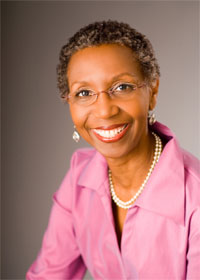
Facilitator Award recipient Dr. Gwendolyn Dungy.
Facilitator Award recipient Dr. Gwendolyn Dungy has been executive director of NASPA-Student Affairs Administrators in Higher Education since 1995. She was honored for her leadership at NASPA, for her contributions to higher education and student affairs scholarship, and for numerous collaborations with organizations including the Center for Higher Education Transformation in South Africa, the National Academy of Education Administration, and Stetson’s Center for Excellence in Higher Education Law and Policy.
Kaplin Award honoree Syracuse University Professor Gary Pavela was honored for his work on the Governor’s Task Force on Campus Safety for Wisconsin, the Symposium for Managing At-Risk Students, and as a fellow for the National Association of College and University Attorneys. He was also recognized for his scholarship in the area of law and policy in higher education and for his dedication to protecting academic integrity at Syracuse University and Duke University.
Kaplin Award honoree Syracuse University Professor Gary Pavela.
Stetson created the Facilitator Award to honor educators who embody the values and principles articulated by Stetson Professors Peter F. Lake and Robert D. Bickel in their book, The Rights and Responsibilities of the Modern University. The Facilitator Model urges educators to be proactive about safety and risk-management and to develop organizational environments that are reasonably safe, educationally relevant and developmentally sound.
The Center for Excellence in Higher Education Law and Policy at Stetson established the William A. Kaplin Award for Excellence in Higher Education Law and Policy Scholarship to recognize scholars who have published works on education law that embrace the intersection of law and policy.
Stetson University invites individual members of the community and area businesses to help support scholarships for students from the Tampa Bay area at the 10th Annual Mad Hatter Golf Classic on April 20. The classic is sponsored by Carlton Fields.
WHAT: The Golf Classic raises funds for scholarships for Stetson University students from the Tampa Bay area. Last year’s golf classic delivered more than $15,000 in scholarship funds to law and undergraduate students.
WHO: Members of the community and area businesses are invited to join Stetson University for the Golf Classic fundraiser at the Emerald Greens Golf Resort and Country Club. Participants will compete in teams of four and prizes will be awarded for top scores including the coveted Esquire Cup. Sponsors will be recognized for supporting the golf classic.
WHERE: Emerald Greens Golf Resort and Country Club, 13903 Clubhouse Dr., Tampa.
WHEN: Tee-time begins at 1:30 p.m.
For more information about participating in the golf classic and sponsorships, contact John Oakley ’75 at the Principal Financial Group at 813-872-5869 or [email protected].
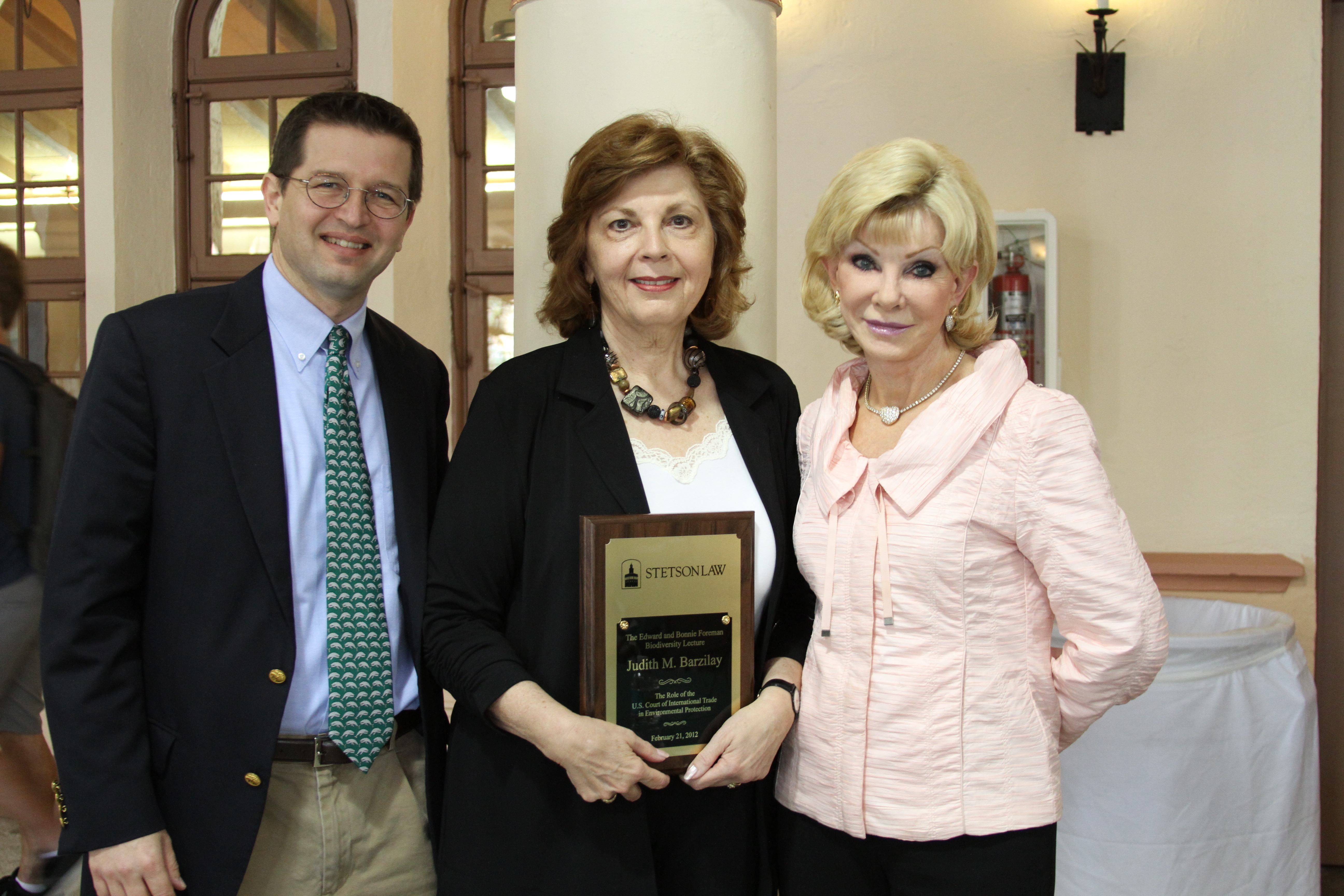
U.S. Court of International Trade Senior Judge Judith M. Barzilay presented the last Edward and Bonnie Foreman Biodiversity Lecture of the semester at Stetson University College of Law in Gulfport on Feb. 21.
(L-R): Law Interim Dean Royal Gardner, Judge Judith M. Barzilay and Bonnie Foreman, the biodiversity lecture series’ namesake.
Judge Barzilay spoke to students, faculty and staff at Stetson about the role of the court in environmental protection.
She discussed her 20-year career practicing in both the public and private sectors of international trade, as well as key cases including the Shrimp/Turtle and Tuna/Dolphin.
The lecture was co-sponsored by the Institute for Biodiversity Law and Policy, the Environmental Law Society and the Maritime Law Society at Stetson.
The NACDL White Collar Criminal Defense College at Stetson has announced the recipients of the inaugural White Collar Criminal Defense Award. Jan Lawrence Handzlik and Janet Levine have both been selected by the NACDL White Collar Criminal Defense College advisory board to receive the award, which honors individuals who have made a profound impact on the field of white collar criminal defense advocacy.
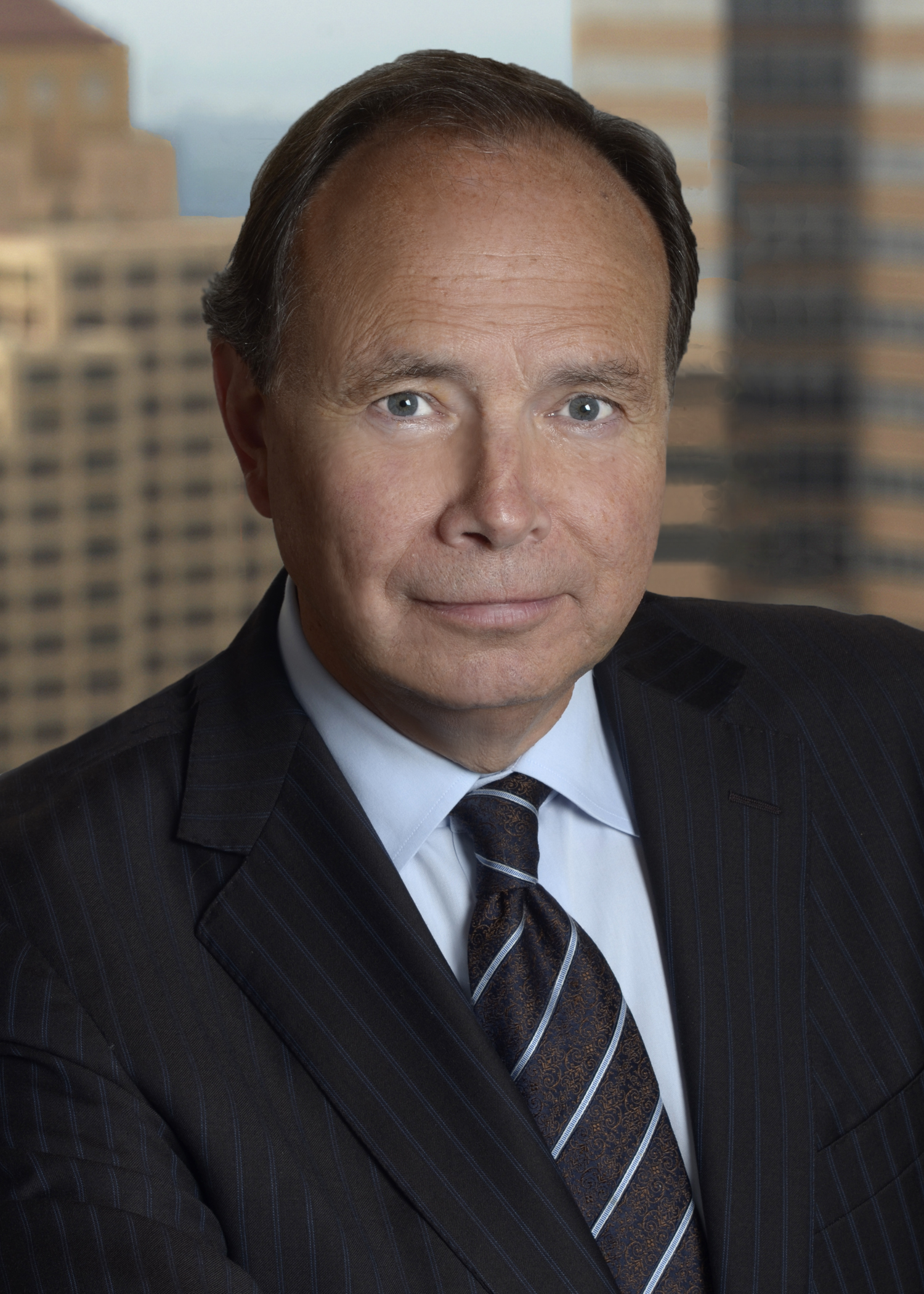
Jan Handzlik is a partner in Venable’s national SEC/White Collar Criminal Defense Group and a nationally recognized trial lawyer specializing in white collar criminal defense and complex business litigation. He has represented individuals and companies across the country in business crime investigations and prosecutions. Earlier, Handzlik served as a federal fraud prosecutor in Los Angeles and was one of the first independent Foreign Corrupt Practices Act compliance monitors.
Mr. Jan Handzlik
Janet Levine is a partner in Crowell & Moring’s Los Angeles office and chair of the firm’s White Collar & Regulatory Enforcement Group. As a trial and appellate attorney with extensive experience in securities, health care, tax fraud and public corruption matters, she has represented politicians, judges, directors, officers and executives and licensed professionals in several industries. Before entering private practice, Levine served as a Deputy Federal Public Defender in Los Angeles.
Ms. Janet Levine
Handzlik and Levine recently successfully defended Lindsey Manufacturing Company and two of its executives on FCPA charges. Following a nearly six-week trial, and as the result of Handzlik and Levine’s tenacious and steadfast efforts, the judge threw out the convictions and dismissed the FCPA indictment with prejudice. Among other notable aspects of the case, for the first time in the 30-plus year history of the FCPA, Handzlik and Levine launched a full-scale challenge to the meaning and application of several key terms in the statute. In addition, Lindsey was the first corporate defendant to challenge the DOJ at trial and submit its fate to a jury. As a result, Handzlik and Levine are two of a few select lawyers who have tried a Foreign Corrupt Practices Act case.
The White Collar Criminal Defense Award recipients will be presented their awards during the “White Collar Criminal Defense College” legal education program on March 15-20, at Stetson University College of Law in Gulfport, Fla.
Practitioners and those new to white collar criminal defense will gain key advocacy skills and learn substantive white collar crime law from masters in the field while attending the program, which covers practical training in handling a white collar case, including client retention, investigating a white collar case, handling searches and grand jury subpoenas, litigating pre-trial motions, seeking discovery and securing evidence favorable to the defense, and dealing with parallel proceedings.
For more information about the White Collar Criminal Defense College, contact NACDL Meetings Manager Tamara Kalacevic at (202) 872-8600 x641 or [email protected] or Stetson Law Professor Ellen S. Podgor at (727) 562-7348 or [email protected].
Stetson Law students learned more about the impacts of hydrofracking during a Feb. 16 presentation about “Natural Gas Development and Hydrofracking: Environmental Risks and Legal Responses.”
The fracking or hydraulic fracturing process involves pumping millions of gallons of water, sand, and toxic chemicals hundreds of feet underground to break up rock and release tiny pockets of gas or oil. The extracted gas or oil is then used as an energy source.
Geologist Mauricio Roma co-presented the Edward and Bonnie Foreman Biodiversity Lecture.
Watershed Inspector General Philip Bein talked to students at Stetson Law Feb. 16.
Geologist Mauricio Roma and Watershed Inspector General Philip Bein discussed whether there is a need for a legal response to hydrofracking and natural gas development.
Read more in a news article about the presentation at Stetson on “Natural Gas Development and Hydrofracking: Environmental Risks and Legal Responses.”
The final presentation in Stetson’s lecture series takes place on Feb. 21 at 12 p.m. in the Great Hall on the Stetson Law Gulfport campus.
Judge Judith M. Barzilay of the U.S. Court of International Trade will discuss the Shrimp/Turtle and Tuna/Dolphin cases, and others involving the intersection of environmental protection and international trade. The Institute for Biodiversity Law and Policy, Environmental Law Society and Maritime Law Society are co-sponsoring this lecture.
RSVP to attend the lecture to Marcela Bonells by Feb. 19 at [email protected].
Stetson University College of Law and the American Bankruptcy Institute will co-present the36th annualJudge Alexander L. Paskay Seminar on Bankruptcy Law and Practice on March 15-17, at the Hyatt Regency in Tampa, Fla.
Attorneys may register now to learn about the latest developments in commercial and consumer bankruptcy at continuing legal education sessions taught by prominent national speakers.
The seminar includes a primer course, “Bankruptcy Fundamentals: Nuts & Bolts for Young and New Practitioners,” presented by the sitting judges in the Middle and Southern Districts of Florida, a plenary session featuring “Views from the Bench” with eight Florida judges, and an optional Friday afternoon consumer workshop on effective trial techniques.
Approval is pending with the Florida Bar for 16 hours of CLE credits, including 3.25 hours of ethics.
Accommodations for seminar attendees are available at the Hyatt Regency in Tampa. The seminar includes optional networking events including a New York Yankeesspring training game and a private tour and dinner at the Salvador Dalí Museum in St. Petersburg.
The program begins with an opening reception at 5 p.m. on March 15. Sessions begin at 8:45 a.m. with registration and continental breakfast at 8 a.m. on March 16.
For more information, contact the American Bankruptcy Institute at 703-739-0800 or Stetson University College of Law’s Office of Conferences and Events at 727-562-7312.
Doctors and lawyers can learn more about emerging issues in health law at a seminar entitled “Medical School for Lawyers and Law School for Physicians” on March 3 at Stetson’s Tampa Law Center.
WHO: Lawyers and physicians can attend the one-day seminar. Faculty members include leading experts in health law, white-collar crime and fraud, public health and medicine.
WHAT: Seminar attendees will learn more about healthcare reform and legislation, accountable care, health information exchange and records, confidentiality, and non-compete agreements.
WHEN: March 3, 8 a.m.-5:30 p.m. Registration begins at 7:30 a.m.
WHERE: Stetson’s Tampa Law Center, 1700 N. Tampa St., Tampa.
Application has been made to the Florida Bar for 9 hours of general CLE credit.
For more information about CLE credits, please contact Irena Milasinovic at 727-562-7312 or [email protected]. For information about CME credits, contact Dr. Adam Levine at 727-512-1969 or [email protected].