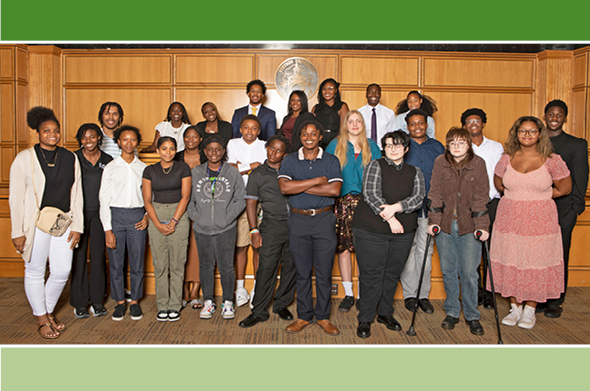
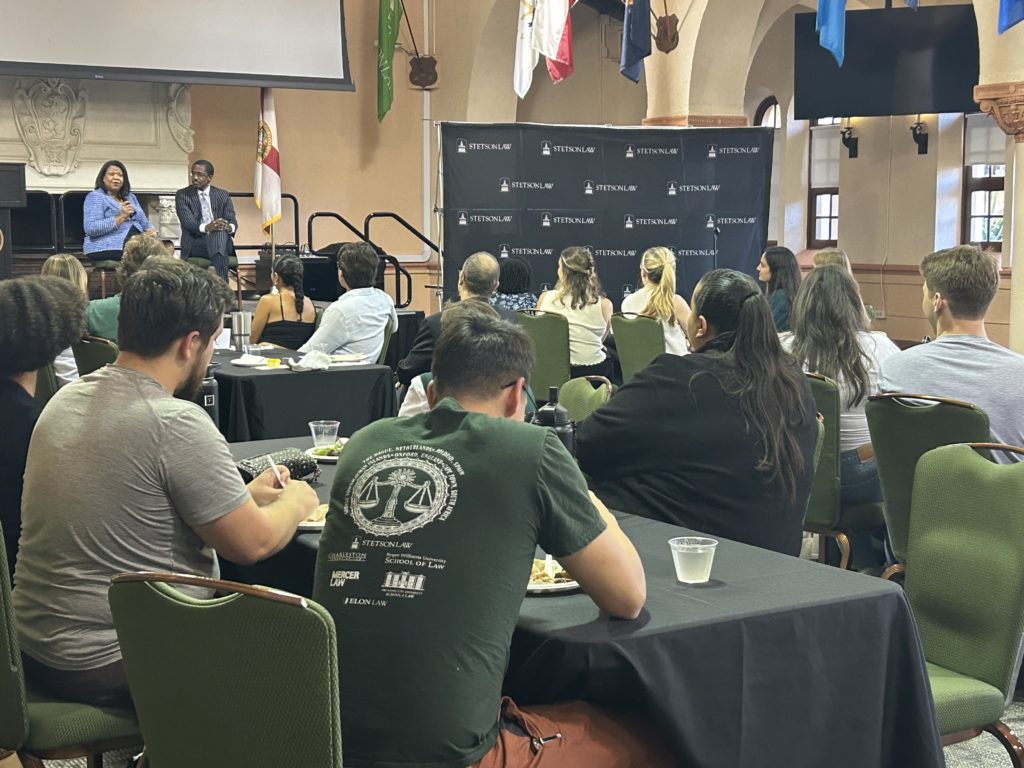
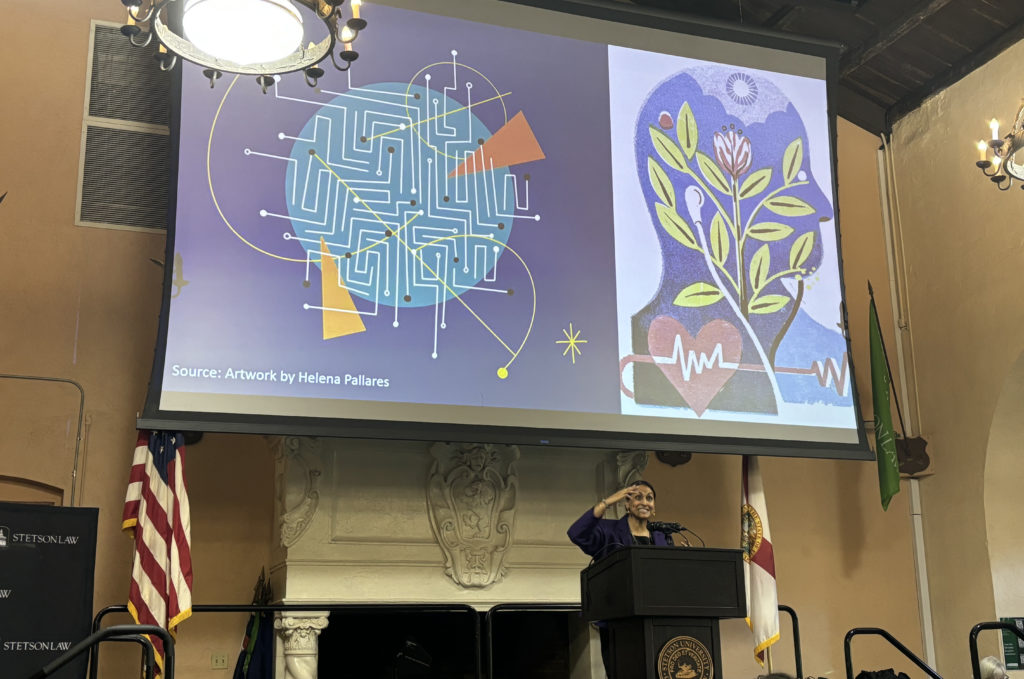
Students in the Pinellas County, Florida area who are aged 15-17 are eligible and encouraged to apply, including those who identify as underrepresented due to race/ethnicity, sexual orientation, gender identity, socio-economic status, and other underrepresented identities. The program empowers students with the tools and skills they need to foster positive change in their communities and the world at large through in-depth lessons in local government, social justice advocacy, and community engagement. The deadline to apply is Monday, June 17.
Organizers say they felt the need for such a program in the wake of deep cuts to civics education in public schools, which can have a profound effect on public policy and justice. In partnership with Community Tampa Bay’s acclaimed ANYTOWN® Advocacy Academy Program, Stetson Law will continue to engage with and mentor interested participants throughout the 2024-2025 academic year.
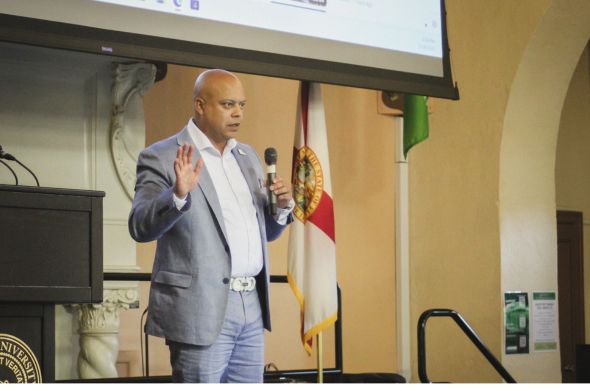
“As a steward of legal education and the principles of justice, Stetson Law is uniquely positioned to empower local high school students to learn about and advocate for civil discourse and human rights through our societal structures – structures that they engage with every day,” said Carmen Johnson, Stetson University’s Executive Officer of Diversity, Collaboration, and Inclusion. “We’ve found that students throughout our local communities are passionate and eager to connect around these concepts.”
There is no cost to take part in the program; those chosen will be paid a small stipend.
Inspiring future changemakers
This year’s events will take place both in-person and virtually. Participants will attend classes on Stetson Law’s historic campus, where they will interact with faculty, local attorneys, judges, and other professionals.
“This type of initiative is an important component of our greater university’s commitment to promoting social responsibility and community engagement” Johnson said.
Last year’s program was a remarkable success. Among key takeaways for alumni were the value of voting, the importance of human rights, and how to engage in civil debate.
Kuiper Elza, a student from St. Petersburg High School who participated in the program in 2022, said they learned new ways to be an activist.
“I found it really interesting to learn different tools for how to be an activist and advocate for yourself and communities – and different ways you can educate yourself, educate other people,” Elza said.
What the Youth Civic Engagement program looks like
Law Professor Christine Cerniglia has led several modules within the academy. One included an activity featuring a hypothetical “island” where students built a society from the ground up.
“They took off with it,” she said. “It was awesome.”
Other modules she led were “Human Rights and Global Citizenship” and “Mindfulness and Civil Dialogue.”
Law Professor Judith Scully led “Advocacy, Activism and Social Change,” which introduced students to the critical role young people play in social progress. It stressed the importance of voting and showed students how to be better advocates.
“Students really believe that when they’re ‘right,’ they need to get their point across,” she said. “I think that when they learn that the point of advocacy and the point of activism is to get other people to understand their position – not to be ‘right,’ not to ‘win,’ but to actually help others understand the issues, I think that was a big ‘aha’ moment for many of them.”
The program will take place July 15-19 between 10:00 a.m. and 3:00 p.m. Prospective participants are invited to complete this application by Monday, June 17.
A new approach to orienting 1L students offers a variety of immersive activities to help students acclimate to law school life.
For 1L Christian Sweeney, who earned his undergraduate degree from a small liberal arts college, being part of a close-knit community is integral to his academic success.
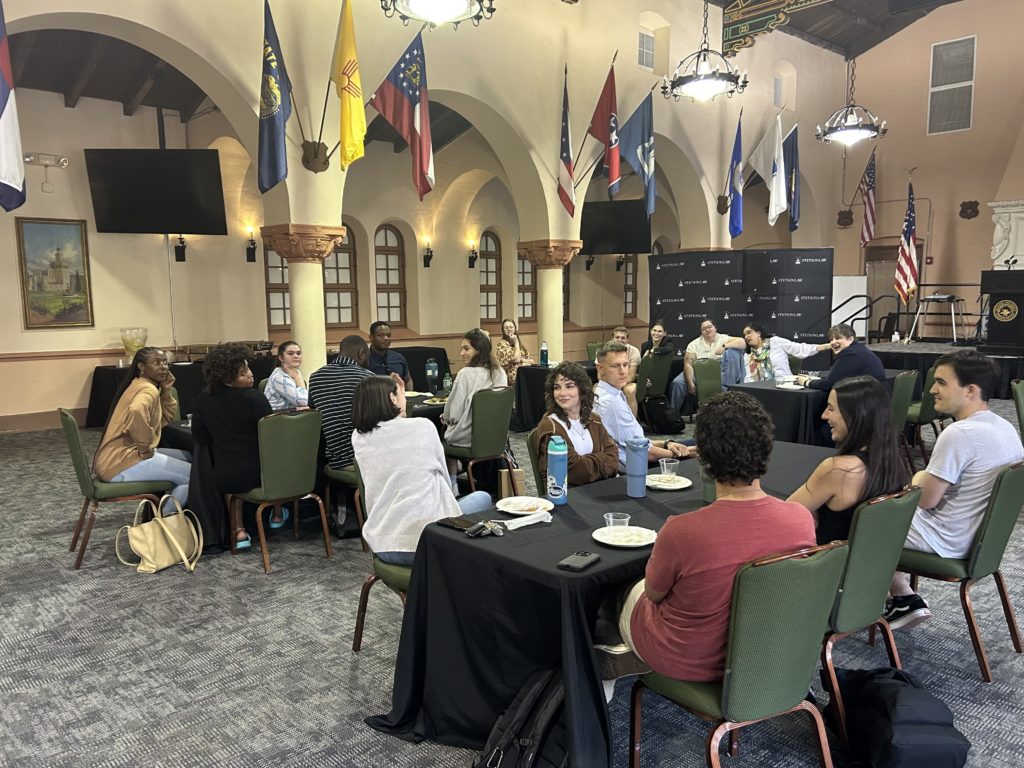
Sweeney was part of Stetson Law’s inaugural “Inns” program for 1Ls. Modeled after the English Inns of Court – wherein seasoned legal professionals, scholars, students, and prominent visitors lived, worked, and dined together – the program connects new students with mentors, opportunities, and one another via small groups of students led by a faculty “Bencher” and supported by upper-class “Readers.”
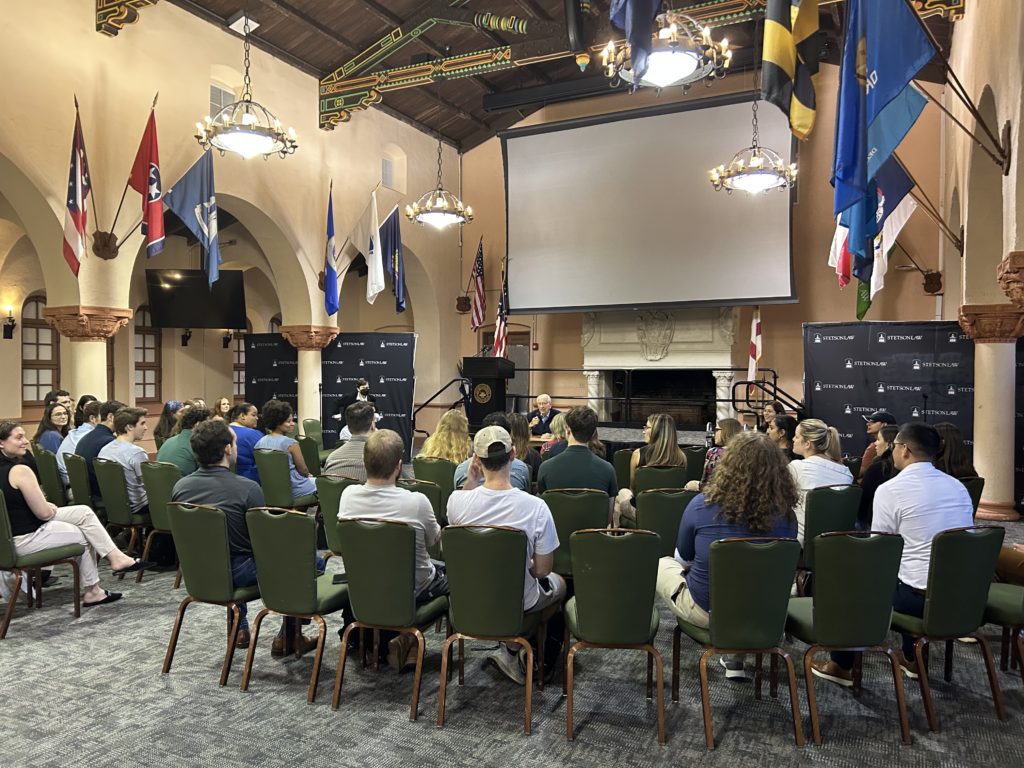
In April 2024, the Podgor, Adams, and Boudreaux Inns heard from the Honorable Mary Scriven, District Court Judge on the United States District Court for the Middle District of Florida, and Lanse Scriven, a local attorney.
As Law Professor Tim Kaye – one of the inaugural Benchers – put it, the program is a way of “training law students by osmosis.”
Part of an Inn led by Law Professor Kristen Adams, Sweeney said the program was an opportunity to interact with classmates and professors in a low-pressure setting before the rigors of life as a full-time law student took hold.
“The transition from undergrad to law school would not have been nearly as easy without the help of my peers, mentors, and Professor Adams,” Sweeney said.
A fresh approach to student development
The program’s genesis is twofold: leadership’s recognition of the need to create a greater sense of belonging for students after the pandemic and the American Bar Association’s new accreditation criteria requiring law schools to offer more opportunities for development of a professional identity.
College leadership did not want to simply create a compulsory course in professional development for 1Ls – as many law schools have. Instead, an opportunity for a more holistic approach emerged.
“Transformation is hard work, and it requires a lot of introspection, exploration, and vulnerability. As a result, we knew that our response had to promote a deep sense of belonging and truly authentic engagement,” said Associate Dean for Assessment and Professional Engagement Anne Mullins. “With the Inns, we created a dynamic in which the students felt connected to each other, to their upper-level Readers, and their faculty Bencher.”
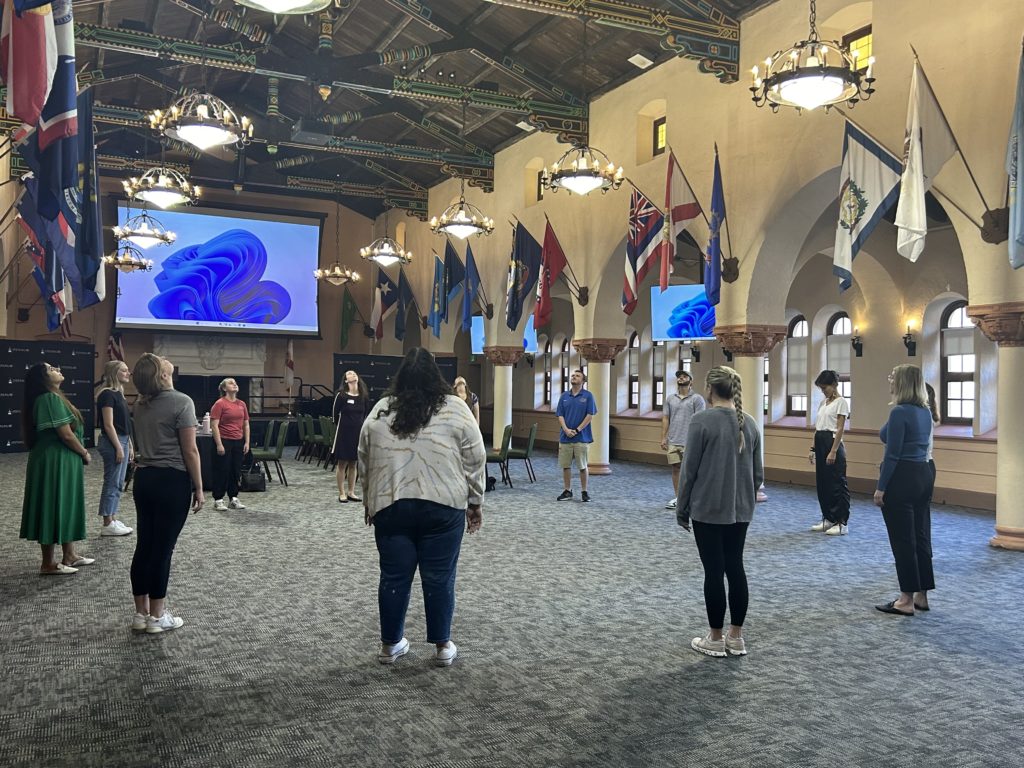
In April 2024, the Kaye Inn participated in interactive activities designed to reduce stress and foster resiliency. The activities were led by local American Stage Teaching Artist Marguerite Boissonnault.
Students joined their Inns at orientation, and events took place throughout the year. Both part- and full-time students took part. After orientation, students could choose to engage in Inn activities they found useful to them based on where they were in their professional identity formation journey.
For his Inn, Professor Kaye organized a variety of presentations and activities, all aiming to promote critical attributes like resiliency, self-reflection, and a deeper absorption of what it means to be a part of the legal profession. This included a presentation by an alumnus who discovered the murder of his staff attorney and video featuring a rock band from Mexico consisting of three sisters who achieved global success despite predatory behavior and other challenges within the music industry.
To Kaye, the experience seemed to help 1Ls gain clarity during a critical point in their legal education journey.
“The message throughout the year has been simple,” said Kaye. “If they take good advice, develop their skills, and work hard in collaboration with others, the students can achieve great things.”
In April 2024, the Vaughan Inn and Nagle Bowman Inn participated in a game of “Stump the Readers” in which the 1Ls asked the upper-level student mentors (“Readers”) questions about law school.
While Stetson Law has always been a close community where mentorship is woven into life and culture, the Inns program’s organizers believe it will set students up for success like never before.
“Support matters for mental health and wellbeing, and it also matters for their academic experience in the first few months of school,” Mullins said. “I think students got a lot out of their Inns, and I am excited to watch the Inns develop.”
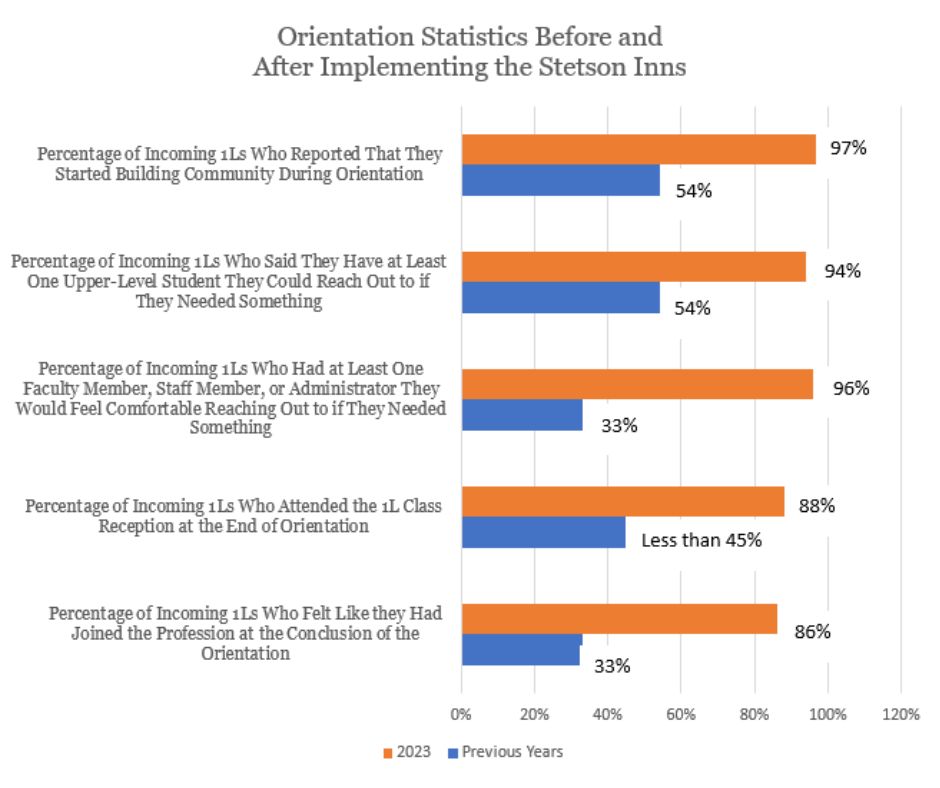
The numbers suggest the program is already effective. According to an informal survey taken after Fall Orientation, 97 percent of students said they “started building community during orientation” – up from 54 percent in prior years. Meanwhile, 94 percent of students said they had at least one upper-level student they could reach out to and 96 percent said there was at least one faculty, staff, or administration member they felt comfortable reaching out to. In prior years, those percentages were 55 and 33 percent, respectively.
An informal survey of 1L students after orientation suggests that more immersive programming gives students a greater sense of belonging.
More reflections on the new Inns program for 1Ls
“I wanted to serve as an Inn Bencher because working with our students and talking with them about their professional plans and aspirations is my favorite part of being a law professor. My favorite memory from this year was the field trip that our Inn sponsored to the Florida Holocaust Museum, where we received a private tour from Michael Igel, Chair of the Board for the FHM and a local attorney with a powerful personal narrative to share.” – Law Professor Kristen Adams, Bencher
“I thought the program was impactful considering that it was the first time being implemented at Stetson; I’ve met people who have since become great friends.” – Emily Alan, Part-Time 1L (Podgor Inn)
Dean Emeritus Bruce Jacob visited with the Podgor and Adams Inns in October 2023.
“Being a part of the Vaughan Inn as a first-generation college and law student has allowed me to connect with second- and third-year students who were in the same shoes as me. Professors Vaughan and Bowman have created such a welcoming and uplifting environment even in the midst of appellate briefs by having us come to Inn dinners. Even the mentors that were not my leaders have taken part in checking in on me and making sure I know that no question is dumb. It’s something that I have found is unique to Stetson and the positive environment that this school is known for.” – Adriana Louth-Ciaccio, Full-Time 1L (Vaughan Inn)
“Stetson has always provided a caring community for our students. The Inns went a step further in making that community more accessible for 1Ls… The Inns help us to connect the dots of many aspects of a legal education. From the initial struggle of learning a new language – law, to recognizing bias in interactions with others, to understanding the new profession that they are about to embark upon, the Inns provide a path for students to comfortably maximize the multi-faceted aspects of a legal education.” – Law Professor Ellen Podgor, Bencher
“I think it gave them a great foundation for success. They had friends, mentors, and a professor they could rely on before their first day of law school… Interestingly, all the Inns are different but have core values in professionalism and mentoring.” -Law Professor Stephanie Vaughan, Bencher
“This was a great way to get to know people quickly and make friends throughout my class, not just my section. One of my best friends I’ve made so far is in the part-time program and the chances of us crossing paths outside the Inn would have been slim… Overall my experience with Podgor Inn has been extremely rewarding and worth taking time out of my study schedule to participate in. I look forward to becoming a resource for new students as I was provided and help them in any way I can.” – Robert Willis, Full-Time 1L (Podgor Inn)
When she enrolled at Stetson Law, Irene Sullivan’s three children were 7, 6, and 2 years old.
At the time, she wasn’t planning on spending her career advocating for youth in the legal system – but given her own experience as a mother, cases involving minors always caught her eye.
Though she started out in private practice in corporate and family law, an opportunity to run for a judgeship led to years of passionate work in the area of juvenile justice.
“Kids deserve kind and nurturing treatment everywhere, even when committed, and that people will listen to make that happen,” she said in a 2012 interview.
On Sunday, April 21, Sullivan, who graduated from Stetson Law in 1977, was given the 2024 Wm. Reece Smith, Jr. Public Service Award during Stetson Law’s annual Inns of Court Banquet.
“Judge Sullivan is a champion for children and families and a true trailblazer,” said Law Professor Alicia Jackson, who specializes in juvenile and family law. “Through her work as a child advocate, judge, and author, she has made a meaningful difference in the lives of countless children. She has committed her career to being the voice for our nation’s children.”
The importance of asking why
Sullivan grew up in the Midwest and attended Northwestern University’s lauded Medill School of Journalism for her undergraduate years, and worked as a magazine writer and editor for a decade. When she moved to the Tampa Bay region with her family, including her small children, she decided to pursue a J.D. at Stetson Law.
After graduating, she spent years as a trial lawyer, including several years at a firm focusing on family law.
“I was just a general practice kind of attorney in St. Pete – I didn’t focus on juvenile law, but I was always more interested in cases that involved children,” she said.
She ran to be a circuit judge in 1998 and won a judgeship in the Unified Family Court of Florida’s Sixth Judicial Circuit.
Sullivan had a strong affinity for children whose circumstances, one way or another, led them to her courtroom. She handled cases involving kids in the dependents court, who were often abused, abandoned, and neglected as well as youth who were accused of committing crimes.
It didn’t take long for her to see the connection between the two groups.
“The same kids that were abused abandoned and neglected as toddlers, little kids, were out there committing crimes as teenagers,” she said.
Understanding the snowball effect the criminal justice system can have on a young person with a challenging background, Sullivan and her colleagues knew that, when it came to weighing potential outcomes involving minors who had committed crimes, they had to dig deeper.
“You have to focus on the kids and not so much what they did, which is horrible sometimes, but why they did it,” she said. “Juvenile judges all over the country that like being juvenile judges are always asking why.”
If abuse and neglect were the root causes, their approach to deterring a child from committing further offenses could focus on healing rather than locking them up. Sullivan and three other juvenile judges shared a floor with three child psychologists, which she said was incredibly helpful for the children who ended up at the courthouse.
“We could get help from those psychologists immediately, to do evaluations of kids and make recommendations for treatment, et cetera,” she said. “We were very, very fortunate and I think those child psychologists are wonderful people.”
She wrote an acclaimed book while on the bench, Raised by the Courts, about cases involving kids she had seen in court as a judge using pseudonyms to protect their identities.
Continued commitment to advocacy
Due to a state constitutional amendment requiring judges to retire at a certain age, Sullivan left the bench in 2010 – but she never stopped advocating for at-risk youth. She spent more than a decade working as a guardian ad litem acting on behalf of children.
She taught juvenile law as an adjunct professor at Stetson Law – a role she particularly enjoyed.
“Teaching about kids always connects with people because people always want to do good for kids,” Sullivan said. “My students felt the same way.”
Later this spring, she has a new book coming out called Born and Raised to Murder: a Failure of Foster Care, which tells the story of death row inmate Leo Boatman, whom she considers “the most abused and neglected foster kid in Florida.” Incarcerated from age 13 to 19, he killed two strangers upon his release. Sullivan took interest in the case and began writing Boatman to learn why his life took such a violent path. What she found was a horrific pattern of abuse, neglect, and systemic failure.
“I think what [the system] does to kids who start out smart and bright and normal, like every little kid, and then get neglected and abused in the system, and how they can turn out, is unfortunate for the people they kill and their families,” she said.
Most people working in the foster care system, she said, are caring.
“I’ve met excellent teachers and counselors,” she said. “I think most foster parents are very good. There are a few that aren’t, but overall, they take on a heavy load and they’re very good at what they do; very loving and kind to the children that they have in their homes.”
Sullivan joined the Stetson Law Hall of Fame in 2021, and her latest honor – named for William Reece Smith, Jr., a celebrated advocate for legal services who taught at Stetson Law – is yet another accolade recognizing her tireless advocacy for at-risk youth.
“There are lots of people out there doing good things for kids, so I’m honored that they chose me,” Sullivan said.
Teams came from law schools around the globe to participate in the 2024 International Environmental Moot Court Competition.
For the 28th year, the final rounds of the Stetson Law International Environmental Moot Court Competition brought teams from law schools around the world to compete on the Gulfport campus.
Kicking off, per tradition, with a special edition of the Foreman Biodiversity Lecture and a welcome reception, the event took place from April 10 to April 13.
Greeting the audience as the lecture began, Dean D. Benjamin Barros commended the faculty, staff, and students who worked to organize what he called an “incredibly impressive” competition.
“This is a fantastic event,” Barros said. “I think it builds on the strengths of Stetson. We are internationally known as an advocacy school and an environmental school – and I think, increasingly, as an international school.”
Exploring a complex environmental issue
Competing teams hailed from multiple continents, representing law schools in Brazil, China, Colombia, India, Indonesia, Ireland, Korea, Northern Ireland, Pakistan, the Philippines, Singapore, and the U.S.
The teams explored a fictional case involving protections for endangered gorilla populations, and argued on either side of the case before volunteer judges, including Associate Dean for Academic Affairs and Professor of Law Jason Palmer, whose specialty is International Arbitration and Litigation.
A proceeding from the 2024 International Environmental Moot Court Competition.
Ultimately, the winner was University of the Philippines College of Law, and the runner up was Singapore Management University. Ateneo de Naga University won Best Memorial and Institute of Professional Legal Studies, Queen’s University Belfast won the Spirit of Stetson Award.
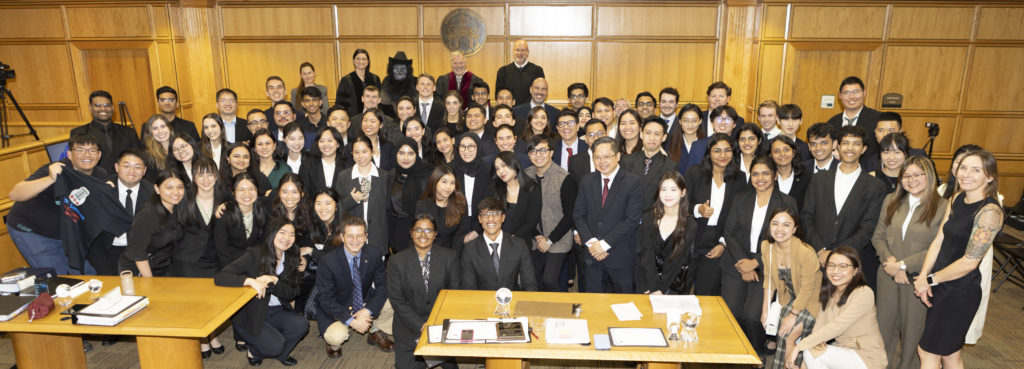
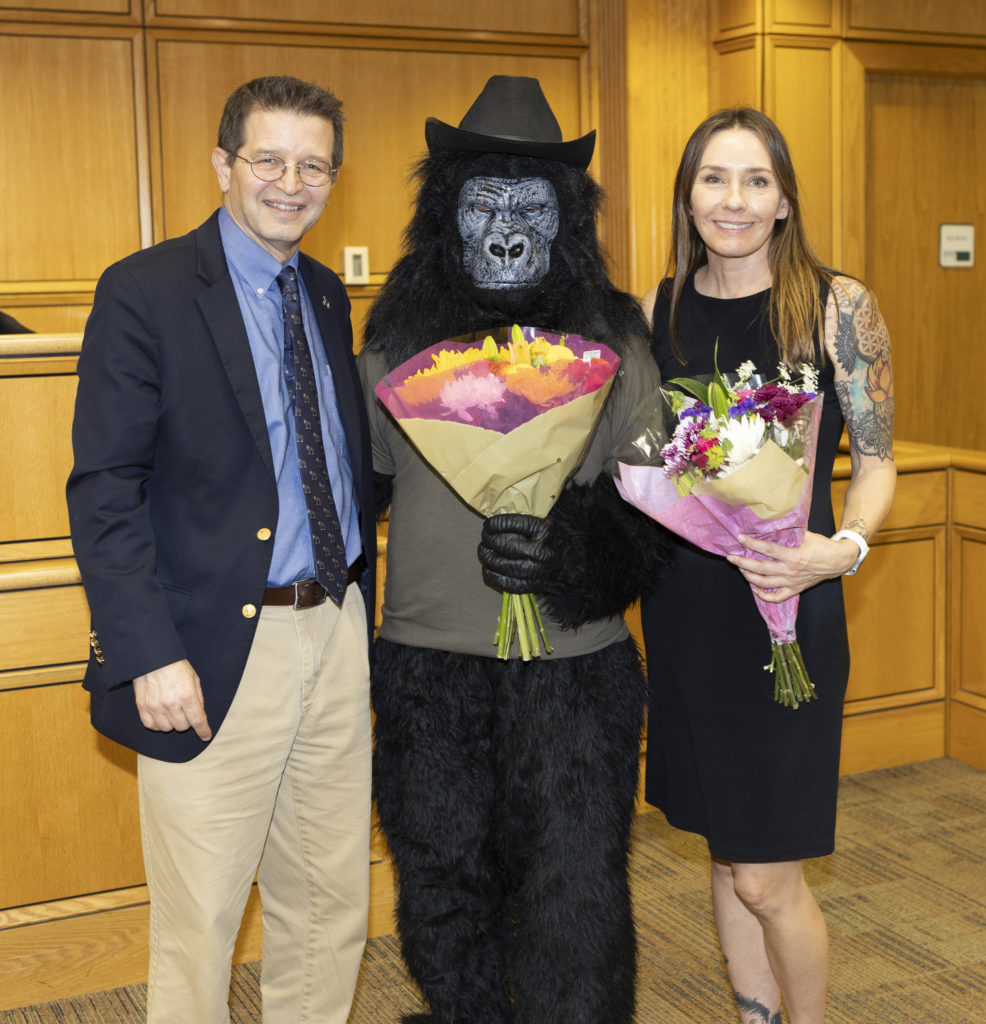
Much of the activity took place in Stetson Law’s new Advocacy Institute, a facility that is perfectly outfitted for simulated trial proceedings. There was even an appearance from a “gorilla.”
Exploring the legal deficiencies of international wildlife protections
The opening lecture featured James Wingard, J.D., who is partner and legal director at consulting firm Legal Atlas, and coauthor of “Legal Assessment of the Implementation of the Convention on Migratory Species and the Gorilla Agreement in Cameroon and Nigeria.”
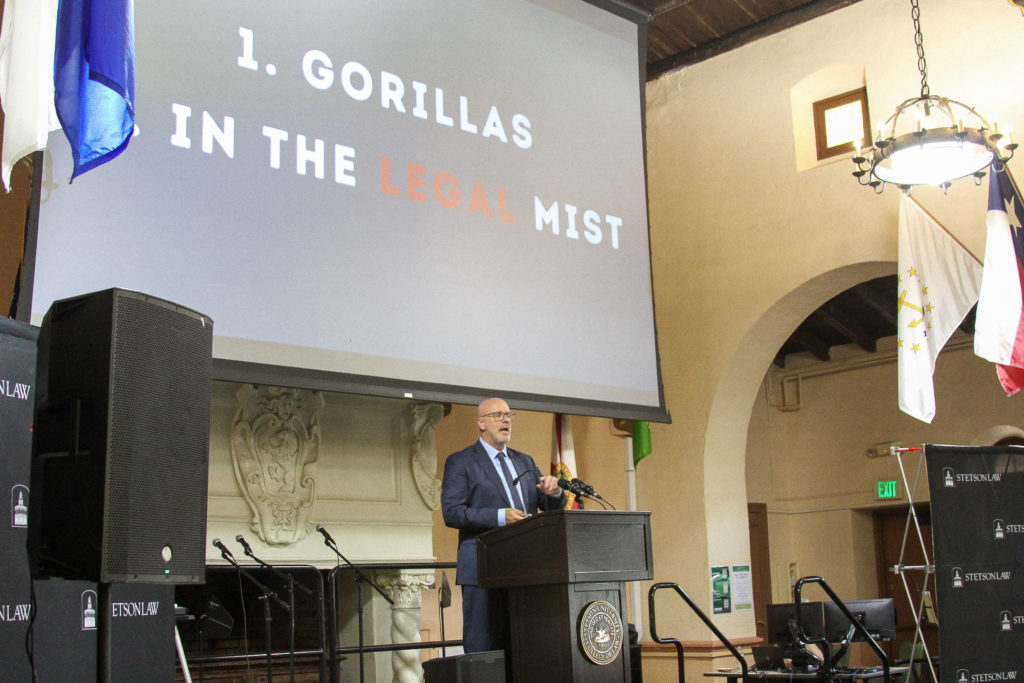
His lecture, “Gorillas in the (Legal) Mist: Wildlife Trafficking & the Geography of Law,” took attendees along a hypothetical international journey along which a poached mountain gorilla might be trafficked.
After Law Professor and Co-Director of Stetson Law’s Institute for Biodiversity Law & Policy Director Royal Gardner introduced him, he asked the audience to imagine they’re a gorilla residing on protected land in a country where, despite stringent legal protections for your species, economic conditions make poaching you the only ticket out of extreme poverty.
James Wingard, J.D., partner and legal director at consulting firm Legal Atlas
“Legally, you are a protected species. You’re critically endangered, that’s a legal designation in that country, and you reside in a protected area, which means you have further legal protections,” he said.
Things get foggy once a gorilla or member of another protected species is taken through multiple jurisdictions before reaching a buyer in, say, Saudi Arabia. These jurisdictions have different sets of laws, and some might have few laws against certain weapons, money-laundering, or other factors that aid poachers.
IEMCC 2024 participants were able to ask questions after the Foreman Diversity Lecture.
“Over 3,000 great apes are traded every year. Once they move into the world of trade, they move through many more jurisdictions,” he said. “They don’t just stay where they are.”
While there are international agreements in place to prevent poaching and trafficking of protected species like mountain gorillas, the geography of the crime makes it difficult to enforce them, let alone investigate potential incidences of the crime.
Closing his lecture with another hypothetical, Wingard encouraged the law students in the audience to explore potential solutions to the global problem.
“Now I’d like to ask everyone to imagine you’re a lawyer,” he said. “What will you do?”
Left to right: 2L Mia Bartolomei-Negron, Dean Benjamin Barros, AccessLEX financial advisor LeAndra Ross
Given her focus on tax law, April 15 was always going to be a significant date for Stetson 2L and J.D./M.B.A. candidate Mia Bartolomei-Negron.
But Tax Day 2024 – Monday, April 15 – will now hold even greater significance for her.
Faculty, staff, and students gathered in Crummer Courtyard in the early afternoon to surprise her with the news that she was one of three law students in the nation – and the first ever in Florida – to be awarded the 2024-2025 MAX by AccessLex® $40,000 Grand Prize Scholarship.
Naturally, the fanfare included an oversized check.
A welcome surprise
The scholarship will cover costs associated with her 3L year.
Bartolomei-Negron said she was “absolutely shocked” when she was presented with the check – but thrilled about the significant financial relief.
“It was completely unexpected, but it came at the perfect time,” she said. “With my 3L year right around the corner, I feel incredibly grateful and at peace that my last year’s tuition will be completely covered. Thank you, Access Lex, for this wonderful gift.”
Supporting student financial literacy
Bartolomei-Negron was surprised for a good reason.
Nonprofit legal and financial education organization AccessLex supports law students in a variety of ways, including offering free insights on financial health as well as webinars via MAX by AccessLex®. The program automatically enters participating students into the drawings for multiple scholarships of varying financial awards, from $5,000 to $40,000.
Most American Bar Association-accredited law schools participate in the program. This means Bartolomei-Negron was one of thousands of students in the running.
Financial coach LeAndra Ross traveled to campus to present the award.
“I am excitedly here today to let you know, Mia, that you have been the winner of our $40,000 scholarship out of thousands – thousands – of students who have engaged in this program, which is free to any of you who are law students,” she said.
Both of these rankings remain unchanged from U.S. News’ 2024 voting cycle. College of Law leadership believes this continued recognition is a reflection of the community’s steadfast commitment to student success.
“We are honored that U.S. News & World Report continues to recognize Stetson Law for its outstanding advocacy and legal writing programs,” said Stetson Law Dean Benjamin Barros. “As a community, we invest in these programs because they build competencies that are critical to the practice of law. We pride ourselves on doing an outstanding job in preparing our students for practice, and this continued recognition of our national reputation for excellence in advocacy and writing reflects our dedication to student professional success.”
Overall, the College of Law ranked No. 98 for its full-time J.D. program and No. 30 for its part-time J.D. Program. See all rankings.
A national leader in advocacy
Last fall, the College of Law opened the doors of its state-of-the-art Advocacy Institute, a large facility dedicated to the study and practice of this fundamental skill – but the college’s legacy as a national advocacy leader is deeply rooted.
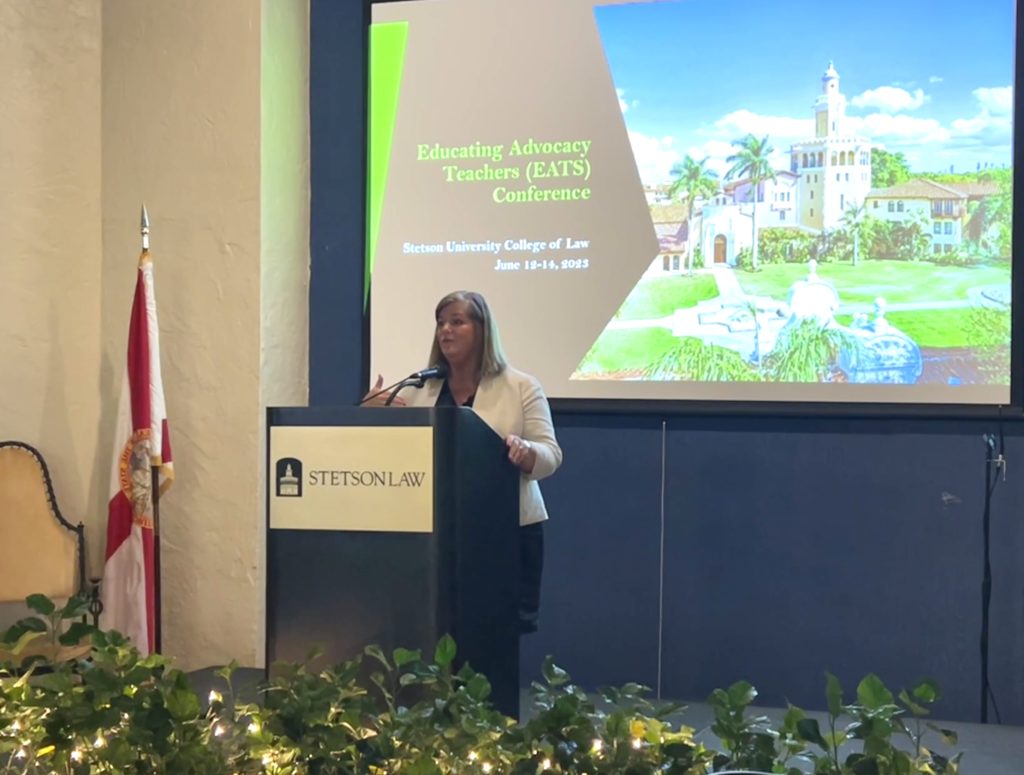
Law Professor Elizabeth Boals at the 2023 Educating Advocacy Teachers Conference.
With support from faculty, staff, alumni, and other members of the community, students are invited to cultivate strong lawyering skills through competitive advocacy, transformative pro bono work, and immersive experiences like clinics and externships. Students have the support they need to not only win state, regional, and national competitions, but to apply their growing skills in all areas of work and life.
“This is wonderful news for the Stetson Law community,” said Law Professor Elizabeth Boals, Director of Stetson Law’s Center for Excellence in Advocacy. “It is especially meaningful to our students, who work so hard to represent our program at advocacy team competitions across the world. I want to express my deepest thanks for our faculty, staff, coaches, and volunteer judges who give so much to our students and support us at all our advocacy events. We are Stetson and it shows!”
Innovation in legal writing
The Stetson Law community understands that legal communication is fundamental to the study and practice of law. Stetson Law’s celebrated Legal Writing program ranking at No. 3 for the third year in a row reflects this.
This program utilizes proven methods of developing legal communication skills while program leadership works diligently to ensure the curriculum evolves as emerging cultural and technological patterns continue to shape legal scholarship and practice.
Dr. Kirsten Davis, a Professor of Law at Stetson, presented on artificial intelligence’s impact on law careers at Campus to Career 2024.
One such example of this is artificial intelligence, which is poised to have an immeasurable impact on legal writing in the classroom and the courtroom. Dr. Kirsten Davis, who is a Professor of Law who teaches legal writing, Faculty Director of Online Legal Education Strategies, and Provost Faculty Fellow for Generative Artificial Intelligence and Higher Education, has become a national leader in this area. Earlier this year, the American Association of Law Schools Section on Technology, Law, & Legal Education honored her with its inaugural Technology Mentorship Award.
Through strategic investments and innovative initiatives, Stetson Law is committed to offering students opportunities to successfully launch meaningful careers.
Efforts to grow and sustain enrollment include the J.D. Flex, a new iteration of Stetson Law’s part-time J.D. program that invites working professionals to pursue a law degree part-time while limiting required commute time and incorporating more virtual courses and coursework. In the fall of 2024, the college will also begin to incorporate flat-rate tuition to ease financial stress for incoming students.
As always, Academic Success and Bar Preparation starts with first-year students, while career services and student support aim to equip our students with everything they need to be practice-ready upon graduation.
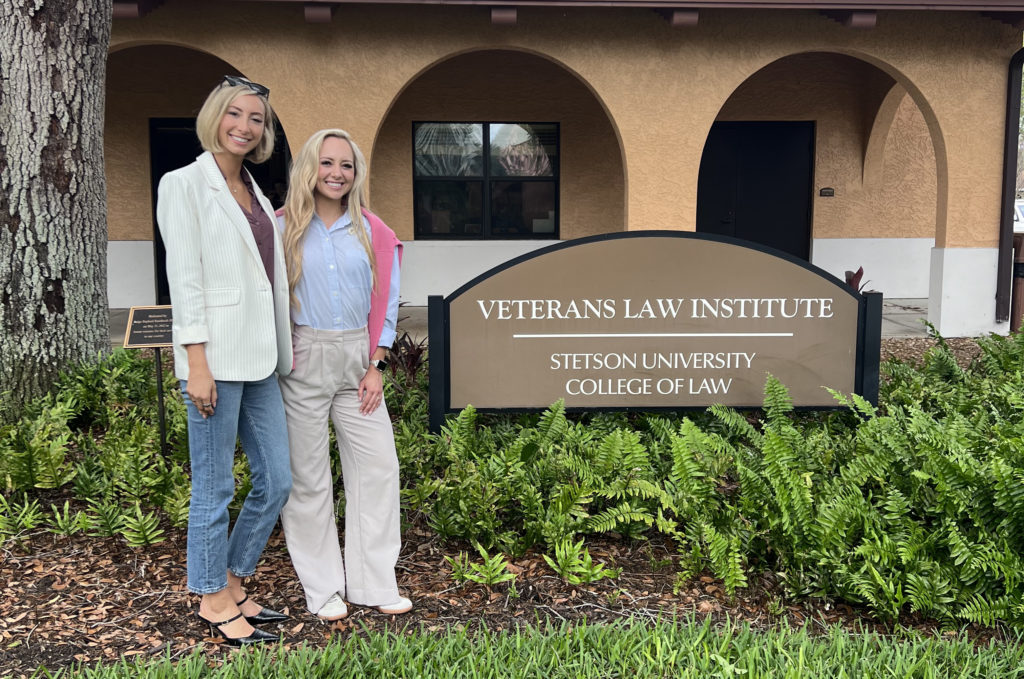
Grace Paul and Victoria Tamayo spoke to students about pursuing careers in veterans law in March 2024.
Speaking to Veterans Advocacy Clinic and Advanced Veterans Advocacy Clinic students earlier this month, two Stetson Law alumni shared insights on how to pursue a career rooted in veterans law.
Grace Paul ’23 and Victoria Tamayo ’19 were both involved with Stetson’s Veterans Law Institute, where they gained hands-on experience fighting on behalf of military veterans whose benefit claims had been denied.
Paul is now an appellate attorney with National Veterans Legal Services Program (NVLSP), and Tamayo is an attorney at Centonzio Law, a firm founded by Stetson Law alumnus Javier Centonzio that advocates for veterans seeking to have denials of benefits overturned). The two spoke to the students about their path from law school to careers in veterans law and what their day-to-day work lives are like.
They gave students advice about working with clients, writing effectively, and setting themselves up to be solid candidates for post-graduate jobs – and shared stories about cases they have worked on.
Learning while making an impact
Paul, a Double Hatter, said she had no exposure to veterans law prior to her involvement with the Veterans Law Institute, but taking the Veterans Advocacy Clinic and Advanced Veterans Advocacy Clinic courses gave her critical insights and tools. As a student with the clinic, she successfully argued at the federal court of appeals for a reversal of a client’s Board of Veterans’ Appeals decision, resulting in a retroactive grant of education benefits – an extremely rare feat.
“The Clinic not only exposed me to a new area of law, but it allowed me to see what it would be like to practice veterans law after graduation,” Paul said. “I now use the tools and experience that I gained through the Clinic every day at my job as an Appellate Attorney with the National Veterans Legal Services Program (NVLSP).”
Left: Victoria Tamayo ’19; Right: Grace Paul ’23. Both women participated in the Veterans Law Clinic at Stetson Law.
Returning to campus to show students they can harness their passion to help veterans was one way to give back.
“It was amazing to have the opportunity to come back to the clinic and share how the Veterans Advocacy Clinic sparked a passion for veterans law and influenced my career path,” she said.
Inspired to be a changemaker
Tamayo said her time at the clinic exposed her to the harsh realities veterans are experiencing in order to obtain the benefits to which their service entitles them.
Within her first few years of practicing as an attorney, she helped create new case law through her work on a precedential case at the U.S. Court of Appeals for Veterans Claims.
She said the Veterans Law Institute was instrumental in her ability to find a career she loves immediately after graduation, and that the clinic equipped her with the background, knowledge, and skills to become a successful veterans advocate even before passing the bar exam.
Visiting the Veterans Law Institute as an alumna and guest speaker was an opportunity to share her enthusiasm and insight into veterans law with students who are in the exact position she was as a student.
“I am forever grateful for Professor Simcox, Professor MacIsaac-Bykowski, and the other wonderful staff at the Veterans Law Institute for the experiences during law school and after,” Tamayo said. “I hope my journey thus far inspires other students to follow in my footsteps of assisting veterans in need.”
On Thursday, April 4, Tamayo will speak about what it’s like to work in veterans law in Sebring Courtroom at noon. See more details and register via Engage.
Jon-Adrian “JJ” Velazquez speaks at a Stetson Law Innocence Initiative event.
A young father of an infant and a toddler, Jon-Adrian “JJ” Velazquez walked into a New York City police station in 1999 thinking he was helping solve a murder.
His father, who had died recently, had been a police officer and Velazquez trusted the system. Plus, he was on the other side of town when the crime occurred.
“It was the last choice I made as a free man,” Velazquez said.
What ensued were more than two decades in prison fighting his incarceration at Sing Sing Correctional Facility – and not knowing if he would ever experience freedom again.
Now a vocal advocate for criminal justice reform, Velazquez spoke March 18 at Stetson Law at an event relaunching the Stetson Law Innocence Initiative, a student organization guided by Professor Judith Scully, co-director of Stetson Law’s Social Justice Advocacy Concentration.
Law Professor Judith Scully introduces speaker JJ Velazquez.
Scully said that conservative estimates place the number of wrongfully incarcerated individuals in the U.S. between 30,000 and 170,000.
“Many people in prison are innocent and they are locked up behind bars,” Scully said. “As part of the legal profession, we are responsible for addressing this problem.”
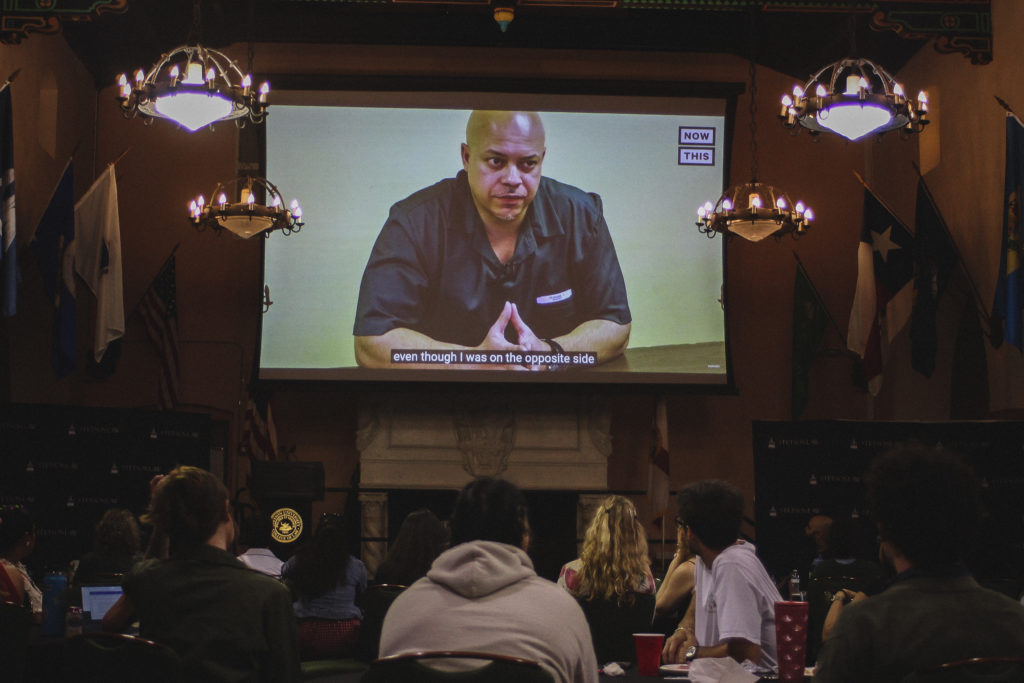
Early on in his sentence, his fight led him to contact Dan Slepian, an investigative journalist whose work has helped overturn multiple wrongful convictions. Slepian’s work ultimately helped prove Velazquez’s innocence.
Still, it took years for Velazquez’s clemency application to receive the governor’s signature – it was one of the last things outgoing New York Governor Andrew Cuomo signed before he left office. On August 17, 2021, after nearly 24 years in prison for a crime he did not commit, Velazquez was granted clemency. On September 9, 2021, he was released.
His efforts to fight the systemic issue of wrongful incarceration – beyond just his own – began when he was still behind bars with projects like Voices from Within, a multimedia initiative that explores the criminal justice system from the perspective of the incarcerated. As national program director for the Frederick Douglass Project for Justice, he now advocates for criminal justice reform – a mission that brought him to the Oval Office not long after he left Sing Sing.
“I feel like I was placed in prison for a purpose,” Velazquez said. “And while I’d never raise my hand and volunteer to do that time all over again, I won’t change what happened, either. What I’ve learned is instrumental to help change this country in the future.”
Advice for students
Calling wrongful conviction “the worst nightmare any person in this world can face,” Velazquez said such occurrences do not only affect individuals incarcerated for crimes they did not commit, but also families and entire communities.
“All of us, in some way, form or fashion, help each other get through the day,” he said. “And when you start taking those members out of the community, what you’re doing is fracturing your community. And if you fracture it enough, it can break.”
While advocating for systemic change is critical, Velazquez said law students should look to their own work as they seek to transform society – and practice things like listening to their own instincts when defending a client or, as prosecutors, not letting the pursuit of convictions get in the way of doing what is right.
“We’re amenable to peer pressure. We’re amenable to whatever society believes success is,” Velazquez said. “As lawyers, don’t allow a culture to change who you are.”
Wrongfully incarcerated for nearly 24 years, Jon-Adrian “JJ” Velazquez has been telling his story to national media outlets – and even the President of the United States.
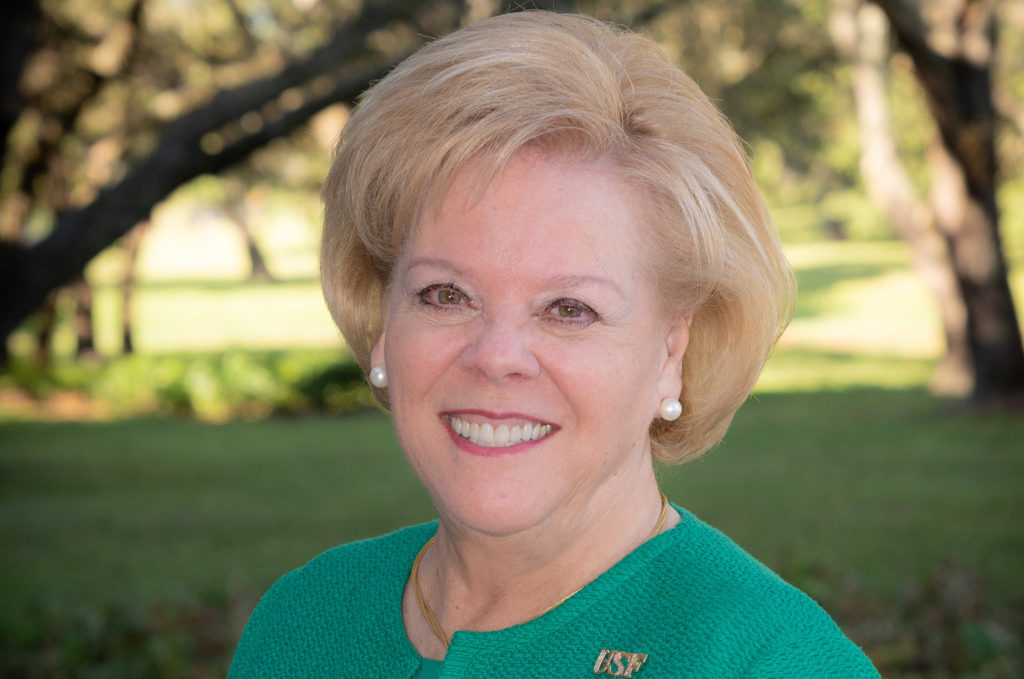
University of South Florida President and Stetson Law alumna Rhea Law ’79.
Reflecting Stetson Law’s deep ties to higher education institutions throughout the region, Rhea F. Law, University of South Florida president and CEO, will be the commencement speaker at Stetson Law’s Spring 2024 Commencement on May 18, 2024.
A Stetson Law alumna, Law has led an exemplary career that includes leading a large merger between a state and national law firm, holding leadership positions at top Florida organizations, and helping USF secure an invitation to join the Association of American Universities, a prestigious group of leading research institutions.
The first USF graduate to serve as university president, Law began serving as USF’s interim president in August 2021 and was confirmed to the role in a unanimous vote by the Florida Board of Governors in March 2022. She has previously served on Stetson Law’s Board of Overseers, including as chair, as well as on Stetson University’s Board of Trustees, and was inducted to the Hall of Fame.
To College of Law leadership, Law personifies what it means to be a Stetson Lawyer whose drive and passion for her community are inspiration to others.
“President Law is a tireless leader whose impact you can see throughout the Tampa Bay region and the State of Florida,” Stetson Law Dean Benjamin Barros. “I couldn’t think of a better person to inspire our spring 2024 graduating class to do great things.”
A passionate community advocate
Before her appointment as President and CEO of USF, President Law held numerous leadership positions with many important Florida-based organizations, including the Tampa Hillsborough Economic Development Corporation, Tampa Bay Partnership, Tampa Electric, and Moffitt Cancer Center.
In 2014, as President and CEO of Fowler White Boggs, Law led the merger with national firm Buchanan Ingersoll & Rooney. Over 35 years as a legal professional, her work focused on environment and land use, economic development, and government.
Her contributions to higher education, the state of Florida, the College of Law community, and the law and business communities demonstrate how determination and optimism can lead to great things. In light of her transformative work, she will be given an honorary Doctor of Laws during the commencement ceremony – a gesture Law said she will cherish.
“Receiving an honorary degree from the Stetson University College of Law is both a privilege and a profound honor,” Law said. “The education I received from Stetson has served me well throughout my career, and I have treasured my connection to the university for many years. I am sincerely grateful to Dean Benjamin Barros and the College of Law for this incredible recognition.”
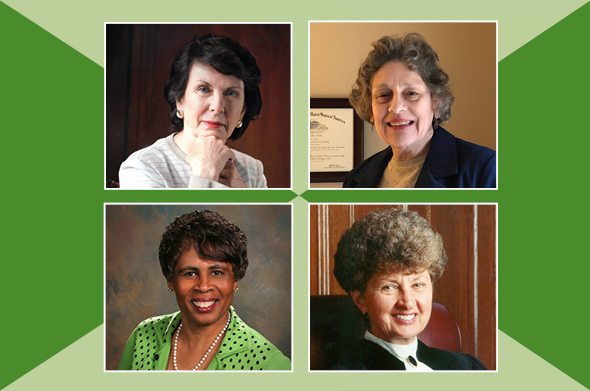
Clockwise from top left: Former GA Supreme Court Chief Justice Carol Hunstein; Retired USDA General Counsel Eunice Luke; Senior Judge for the Middle District of Florida Elizabeth Kovachevich; Former FL Supreme Court Chief Justice Peggy Quince.
By Curtis Krueger
More than half the students at Stetson University College of Law are women, and this has been true for more than a decade – but some pioneering lawyers from Stetson remember a far different time.
Eunice Luke, for example, graduated from Stetson Law in 1966. She was talking not long ago to some younger female lawyers in Atlanta.
“They couldn’t get their head around the fact that I was the only woman in my class,” she said.
But when Luke visited the Stetson campus a few years ago for her 50th reunion, she was the one trying to get her head wrapped around what she saw.
“I looked around the campus and there are all these women all over the place,” Luke said. “And I’m thinking, ‘Oh my gosh this is so different.’”
Luke and other women in the Stetson Law community were trailblazers, even if they don’t often use such words about themselves. They can remember the people, sometimes their own classmates, who didn’t believe they belonged in law school and the skeptical looks they got in their first job interviews, in spite of their newly minted Stetson Law diplomas.
Making change on campus & the legal profession
Against unlikely odds, these women made an impact — not just on Stetson Law, but on the legal profession as a whole.
There’s Elizabeth Kovachevich, who graduated from Stetson Law in 1961 and went on to become a U.S. District Court Judge for the Middle District of Florida.
There’s Carol W. Hunstein, who graduated in 1976 and went on to become chief justice of the Georgia Supreme Court.
There’s Luke, who graduated from Stetson, went on to a career in the federal government, and then established a scholarship to help other Stetson students.
And there’s Peggy A. Quince, the first African-American woman to become chief justice of the Florida Supreme Court. Although she received her law degree from the Catholic University of America, she has been closely associated with the Stetson legal community as a friend, supporter, board of overseers member, and inductee into the Stetson Law Hall of Fame.
A history of elevating women
Stetson, which is Florida’s first law school, also holds the distinction of having the state’s first female law school graduate, in 1908. That didn’t make it a common occurrence. While female lawyers did exist in the 1960s, they were, as Luke put it, “as rare as hen’s teeth.”
When Hunstein enrolled in the 1970s, she was one of six female law students, the largest number of any class in Stetson Law history up to that point.
“We were sort of an oddity,” she said. “The men frankly thought we were there to marry a lawyer.”
The men also could be heard grading the women by appearance, on a scale of 1 to 10.
“But all the women graduated,” she said of the six in her class.
Kovachevich recalls what she terms “the Stetson shuffle.” When a female student presented in class, “the fellows in the class would shuffle their feet and make that noise, like you’re on your way out of here.”
“It wasn’t a very pleasant experience and I for the first time in my life experienced discrimination, and it was gender discrimination,” she said.
In spite of the slights, these women persevered, each believing they had to make the most of their opportunity. Kovachevich’s grandfather, an immigrant from Croatia, had urged her to study the law because of his deep love for the freedoms guaranteed by the U.S. Constitution. She wanted to honor his wish.
Hunstein first thought of going into law after a college aptitude test suggested she would excel in a legal or military career. Once in law school, she was determined to succeed.
“It was so important to me to have this opportunity, something that I never dreamed would be available to me,” said Hunstein, who was the first in her family to graduate from college.
Facing early-career challenges
For these women, earning a law degree was a huge accomplishment, just as it is today. They knew that after passing the bar exam, they could reach out to any law office and seek a job – but that didn’t mean anyone would listen.
Luke said some law firms simply ignored her applications. One lawyer asked how many children she intended to have. It took her by surprise. All she managed to blurt out was, “I’m not even engaged.”
When she realized the federal government paid men and women the same, she applied. She was hired by the U.S. Department of Agriculture and worked there for 34 years.
Kovachevich became a sole practitioner who “specialized in anything that walked through the door.”
After she was appointed by Florida Gov. Claude Kirk to serve on the Board of Regents, friends told her she should run for office. She set her sights on a circuit judgeship.
“There was not any support from the local Bar, even though I was secretary of the (St. Petersburg) Bar Association,” she said. “But here again when a woman had the audacity to offer herself for public service, wow that wasn’t acceptable.”
But Kovachevich was successful, winning election as a circuit judge in 1982. President Ronald Reagan appointed her as a U.S. District Judge in 1982. She is now a senior judge in Florida’s Middle District. After more than four decades on the bench, she feels she has been exactly in the right place.
“I just had the feeling that this was what I was meant to do…. I have a firm religious belief in God and I felt that this is what God wanted me to do. And I’ve tried to do it to the best of my ability,” Kovachevich said.
Hunstein, who had managed to make it through law school as a single parent, began her job search in Georgia.
“I couldn’t get a job searching titles,” she said. “That’s true.”
But a program in Fulton County allowed attorneys to come to the Atlanta jail on Mondays and be assigned misdemeanor cases, which needed to be resolved by the end of the week.
“After which you would be paid $50,” she recalled. “And that’s slowly how I built my practice.”
She handled litigation, criminal defense, domestic relations, and more.
“I loved being in the courtroom,” she said.
She said she was generally treated well by fellow attorneys and by juries, but sometimes found judges could be surprisingly condescending. She remembers one in particular.
“He was absolutely horrible to me,” she said. “He called me ‘little lady’ and any time he could rule against me he would.”
But this judge gave her inspiration once she realized, “I could be a better judge than he was. That was the motivation for me running for a Superior Court judgeship in DeKalb County.”
With help from friends who knew how to run a good campaign, she was elected in 1984. She eventually applied to be named to the Georgia Supreme Court. Then-Gov. Zell Miller appointed someone else, also a woman, and conventional wisdom was that two women would not be appointed to the high court in a row.
But a friend encouraged her to apply again anyway, and Miller did appoint her. When she got the call, she said, “There was just this flood of emotion. I was just so grateful to have that opportunity. I still call him my governor.”
A common thread
All these women showed the acumen and grit to succeed. And all say Stetson has been an important part of their story.
“Without an excellent education, with all the challenges academically and professionally, where would I be?” Hunstein said. “They were there for me and they gave me the foundation to become a good lawyer, a good judge and really honor the law.”
Luke, the retired USDA attorney, established a scholarship because she received one in her third year at Stetson Law that was crucial to helping her finish school. She wanted to make sure others would have the same opportunity. The scholarship is open to women and men.
Kovachevich has given back much to Stetson also, through an extensive judicial internship program in the federal court.
Inspiring future generations
Quince says that while she did not attend Stetson Law, “the law school was and is important to me because it was a part of the legal community that I was also a part of.”
“I don’t necessarily consider myself a pioneer,” she said, but she strongly believes in the value of women and minorities having the opportunity to succeed in areas once closed to them.
“I take pride in the fact that I was the first African American female to be appointed to both a district court of appeal and the Florida Supreme Court,” she said. “It was also an honor and a privilege to be the first African American female to head a Florida branch of government when I was the chief justice of the Florida Supreme Court.”
Yes, she said, these firsts were important to her. But what she really hopes is for them to be an inspiration to others.
“I hope that young people will look on these accomplishments as a chance to say ‘I can do this too and more,'” she said.
An earlier version of this story ran in the Spring 2019 edition of Stetson Lawyer magazine.
Dr. Rajni Shankar-Brown speaks at Stetson Law in February, 2024.
Coinciding with World Day of Social Justice, Dr. Rajni Shankar-Brown, a prominent eco-justice scholar, spoke on the link between environmental problems and social injustices.
Her moving address, which she gave Tuesday, February 20 in the Great Hall, was the first installment of the Edward and Bonnie Foreman Biodiversity Lecture Series of the spring 2024 semester.
“You may be familiar with the phrase ‘a comic’s comic,’” Law Professor Royal Gardner, Director of Stetson Law’s Institute for Biodiversity Law and Policy, told the audience as he introduced her. “Dr. Shankar Brown is not a comic’s comic. She’s a teacher’s teacher – wonderful in the classroom. She puts into practice what she preaches.”
Thinking differently about environmental policy
An internationally renowned professor, environmental justice scholar, artist, author, and activist, Shankar-Brown opened her talk by commending the students, faculty, staff, and others gathered for their commitment to the fields of environmental law and social justice.
“I am just so grateful for all of the amazing work and the passion that all of you have, and that you are launching into our world – especially because our world needs all of you – us, collectively,” she said. “My hope is, it will stimulate conversations, it will give pause to wrestle, to start to ponder and ask questions, and to engage in meaningful conversations.”
She urged the audience to employ intersectionality in their approach to developing strategies and policies to fight climate change and other environmental challenges as future legal professionals or policymakers.
Coined in 1989 by legal scholar Kimberle Crenshaw, intersectionality refers to the way multiple aspects of an individual’s identity – race, economic status, sexual orientation, gender identity, housing status, and more – create a unique lived experience worthy of consideration and respect, especially when it comes to environmental disasters like storms and sea-level rise.
Vulnerable, underserved communities such as the unhoused are disproportionately affected by flooding, inadequately infrastructure, heat exposure, pollutants, and other consequences of unsustainable practices.
“One of the things that we have to actively and intentionally do in our work is to break silos and make sure that we are honoring intersectionality to understand the interconnective web of all of these huge, massive challenges that our world is facing today,” Shankar-Brown said.
An urgent call to action
Shankar-Brown ended her talk by imploring her audience to practice “radical empathy” in their advocacy work, and to be actively engaged in their communities. She read aloud a passage from Caste by Isabel Wilkerson, a book she heartily encouraged the audience to read:
“Radical empathy is not about you and what you think you would do in a situation you have never been in and perhaps never will,” she recited. “It is the kindred connection from a place of deep knowing that opens your spirit to the pain of another, as they perceive it.”
As for staying engaged, she said activism can come in many forms: finding others to be “coconspirators” in the cause of eco-justice, attending demonstrations, and speaking at city council and county commission meetings when monied interests promote policies that could potentially harm communities.
“There is greed but there is also good,” she said. “My hope is that we refuse to just give up and be apathetic.”
From standing up to violent drug cartels in Medellin, Colombia to spending nights and weekends tailoring lesson plans to meet the evolving needs of students, Law Professor Luz Nagle has spent decades in selfless pursuit of a more just world.
After 25 years of tirelessly leading Stetson’s international law courses and programs, Nagle has retired from her full-time faculty role.
Stetson Law Professor Luz Nagle
A passionate human rights advocate, she was Stetson Law’s first Hispanic tenured faculty member. Her deep commitment to her students – and, off campus, to fighting human trafficking and other international crimes – has helped earn her the honor of Professor Emerita. Nagle’s time at Stetson Law follows a long, varied career that began in her native Colombia, where she served as a young judge during serious sociopolitical violence in the 1980s.
Asked what she will miss the most about life at Stetson Law, Nagle said she’ll miss her students and watching them evolve into legal professionals.
“It’s so great to see the transformation of the students, from the first two weeks of class until the end,” she said. “The students taught me a lot, and that is what I treasure the most and what I miss the most.”
Tireless commitment, innovative approach
Colleagues say Nagle’s passion for teaching international law was contagious – and that she had a unique ability to engage students on the subject.
“While she continued to pile up awards and accolades throughout her career and was highly sought as a speaker around the world, Luz’s real passion was teaching and she excelled at it,” said Stetson Law Professor Mark Bauer. “Students were excited and inspired by Luz’s classes.”
He added that Nagle modeled exemplary professionalism and achievement for students, faculty, staff, and alumni of the College of Law.
Law Professor Linda Anderson said Professor Nagle is a beacon of knowledge in the realm of international law whose unwavering commitment to her students and passionate advocacy against human trafficking have left an indelible mark that will persist long after her retirement.
“Her profound dedication to shaping the next generation of legal minds and her tireless efforts in addressing global issues showcase a legacy that extends far beyond the classroom,” Anderson said. “Luz exemplifies the intersection of expertise and empathy, leaving an inspiring imprint on the lives she has touched.”
In photos: Professor Luz Nagle Abroad
LuzNagleBogotaOmbudsmanoffice1August2022
LuzNaglefaith-basedorgvisit1August2022
LuzNaglefaith-basedorgvisit2August2022
LuzNagleLGBTQorgvisit1August2022
LuzNagleBogotaAGofficeAugust2022
LuzNagleMayorsofficeCartagenaforum2022
LuzNagleFundacionDignitasAugust2022
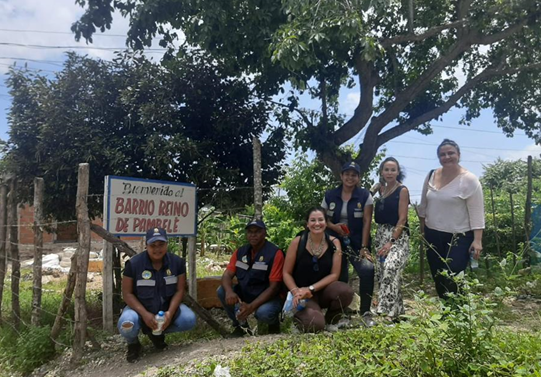
LuzNagleBarriodePalambe3August2022
LuzNagleBarriodePalambe4August2022
LuzNagleBarriodePalambe5August2022
NigeriaVisitNagle1
premioIBA
NigeriaVisit22
NaglewIraqidelegation2009
NaglespeakingwithEcuadorNationalPolice
Nagle’s approach to teaching was unconventional. Every semester, for every course she taught, she would tailor the coursework to the unique needs of her students.
“My first two weeks of class were always a thermometer for me,” Nagle said. “I would try to learn who my students were to see what method I was going to use for them to better understand and absorb the material.”
Nagle also went to great lengths to ensure her coursework was informed by current events, such as the war in Ukraine.
“In international law, events change every single semester and year,” she said. “I would grab events to create simulations for the students to be able to apply the cases and what we were covering.”
One year, as wildfires impeded California winemakers’ ability to grow grapes, she learned about the domestic and European wine industries and the laws governing them to develop a fact pattern that reflected the real-world complexities of international business.
Deep-seated passion for justice
Nagle’s commitment to student success seems to run in the family. The dean of a chemical engineering department at a university in Colombia, her father would invite struggling students to their home for tutoring sessions to help them grasp the material. His practices provided an early foundation for her own teaching techniques when she became a law professor.
The eighth of nine siblings, she grew up keenly aware of the poverty others were experiencing, and of her own privilege.
“I grew up in a country where the gaps between the haves and have-nots were huge,” Nagle said. “I remember being a little girl and my mom would always tell my younger brother and me to serve a plate equal to the ones we were serving ourselves and put it to the side because little kids would be knocking at the door asking for food. I saw a lot of kids going through trashcans looking for food.”
As a teenager, she was debating whether to study chemistry or law. She chose the latter after witnessing the way the justice system treated children living at local orphanages, whose legal troubles snowballed as the root cause of their behavior went unaddressed.
“I always thought that the children were not to blame for a lot per se; that there were issues in society that needed to be fixed,” Nagle said.
Seeking justice at all costs
Nagle’s early career was often harrowing.
She worked as a judge in a time and an area of Colombia where drug cartels paid off public officials – and targeted those who wouldn’t take a bribe. Unlike the justice system in the U.S., Colombia’s is inquisitorial, which means members of the judiciary conduct investigations. Nagle took her role seriously, regularly standing up to violent criminals and corrupt officials.
She faced death threats and multiple attempts on her life. Her car was tampered with. She was followed while driving to work by men on motorcycles who shot out her windshield.
One day, a drug cartel member came to Nagle’s office and tried to shoot her – but his gun got stuck in its holster. Nagle managed to draw a revolver she had been given for protection and shot him in the leg.
“When you’re young, you think you’re invulnerable,” Nagle said. “You think that you can change the world alone.”
The final straw was a warning from a concerned family friend, who asked her if she could stomach her family members being killed, one by one, if she persisted.
“And that’s when I said ‘Shoot. This is for real,’” Nagle said.
A new beginning
Nagle’s now-husband, Jerry, who she met years earlier while studying English in Santa Barbara, was planning to join her in Colombia as the threats reached a crescendo. Instead, they married and returned to California, where she had to build her career from scratch.
“I was a house painter,” she said. “I cleaned offices at night. I cleaned toilets. I had told my husband I didn’t want to be a lawyer because I didn’t believe in law. I didn’t believe in lawyers – because I thought they were corrupt.”
Her husband kept encouraging her to pursue law. She was moved to do so when, visiting a local Latin market, she heard stories about people having been brought to the U.S., kept as prisoners, and forced to work with no pay.
“Maybe learning a different system will allow me to be a bridge between countries in Latin America that are so corrupt,” she said. “And maybe the U.S. legal system will have more answers. Maybe the process will be fairer. And that’s how I decided to go back to school.”
In photos: Professor Nagle at Stetson Law
(L-R): Natalia C. Reyna Forero with Professor Luz Nagle.
Professor Luz Nagle presented in Canada.
Panelists (L-R): Professor Royal Gardner, Professor Luz Nagle, Professor Jason Palmer and alumnus Ahmad Yakzan.
(L-R): Professor Luz Nagle, Ahmad Yakzan, Franziska Kues and Gregory W. Kehoe.
(L-R): Stetson Law pioneering educators Professor Dorothea Beane, Ruth Thurman, and Luz Nagle.
HBAPres-DEArep-Nagle2000
Nagle2003Commencement
NagleAlumniOpenHouse2003
LuzNagle2003HonorsandAwards
NagleHonorsandAwards2004
NagleandChildren2004
She earned an M.A. in Latin American studies and an LL.M. in international law at UCLA, then went to the College of William & Mary for her J.D. She clerked for the Supreme Court of Virginia and worked for Microsoft Corporation’s Latin America Copyright Enforcement Practice.
Nagle was looking to transition into a teaching role that would allow her to spend more time with family. She wasn’t pleased with her options – until Dean Gary Vause called. The College of Law was developing an International Law LL.M. and he wanted to see if she was interested in leading the program.
She started in 1998, when Liz Moody was dean – the same year the Dolly & Homer Hand Library opened its doors. The International Law LL.M. launched that year. Over 25 years, her scholarly accomplishments were myriad. She has written extensively on human trafficking, lectured at universities across the world, advised governments, and served as a Fulbright Senior Scholar and Lecturer in the Canary Islands, Spain in 2019. (See Nagle’s full bio.)
No slowing down
Nights and weekends spent tailoring her lesson plans to the ever-evolving needs of her students may be over, but Nagle said she is not done working.
She is wrapping up a project on the link between human trafficking and public corruption for the United Nations Office on Drugs and Crime, working with George Mason University’s Terrorism, Transnational Crime and Corruption Center, and is chair of American Bar Association Rule of Law Initiative for Latin America and the Caribbean.
“I hate the word retirement. If you retire, it’s like you just do nothing. No. I’m just changing,” Nagle said. “I’m going to be busy.”