Students from the National Law University in Jodhpur, India, traveled from the other side of the world to win Stetson University College of Law’s 16th Annual International Environmental Moot Court Competition on March 31 in Gulfport, Fla. More than 80 teams competed worldwide, and the top 26 were invited to Stetson for the International Finals.
A team of students from the National Law University in Jodhpur, India, won the International Environmental Moot Court Competition this year at Stetson University College of Law.
Student Aritra Roy of the National Law University in Jodhpur, India, was named best oralist in the championship round of the international competition. University of California Hastings placed second. A team of students from China University of Political Science and Law received the Spirit of Stetson Award.
The 26 teams represented 12 countries including Australia, Brazil, China, India, Ireland, the Philippines, Nepal, South Korea, Ukraine, U.S., Vietnam and Zimbabwe. Most schools competed in regional rounds around the world for a chance to advance to the prestigious international finals hosted by Stetson Law on March 29-31.
This year, students argued a moot case about a nuclear accident and sovereign default. Last year, students examined a case on the topic of oil pollution and the marine environment.
“The moot gives students an opportunity to engage in discussions about current global environmental challenges,” said Interim Dean Royal Gardner, director of the Institute for Biodiversity Law & Policy at Stetson. “I was greatly impressed with the level of knowledge and advocacy skills that the students demonstrated.”
In addition to hosting the International Environmental Moot Court Competition, Stetson offers an advanced LL.M. degree in international law and is also home to the Journal of International Wildlife Law and Policy.
This semester, Stetson launched the Edward & Bonnie Foreman Biodiversity Lecture Series to raise awareness about important legal and environmental issues and to bring experts in the field to the Stetson University community and public.
Kenneth Feinberg, an attorney who has mediated some of the nation’s most challenging and widely known disputes, met with honors students, visited a class, and presented the Nichols Distinguished Lecture to more than 100 students on March 29 at Stetson University College of Law in Gulfport.
Kenneth Feinberg speaks at Stetson University College of Law during his presentation of the Nichols Distinguished Lecture.
Feinberg presented “Unconventional Responses to Unique Catastrophes: Tailoring the Law to Meet the Challenges.”
Professor Michael Allen introduced Feinberg by saying, “Lawyers are problem-solvers. We help people resolve issues … Our speaker today may be the king of problem-solvers.”
An expert in mediation and alternative dispute resolution who has been appointed to two presidential-level commissions, Feinberg is perhaps best known for his roles with the Federal September 11th Victim Compensation Fund of 2001, the BP Deepwater Horizon Disaster Victim Compensation Fund, and the Hokie Spirit Memorial Fund following the tragic Virginia Tech shootings.
“Every once in a while, a tragedy captivates the public,” Feinberg explained. He said that a tragedy or meltdown that galvanizes the public and officials to think outside the box requires an unconventional response. Feinberg has worked to help victims of the 911 terrorism attack, the 2008 financial meltdown, the Gulf oil spill environmental catastrophe, Virginia Tech shootings and Agent Orange claims.
He cautioned that while compensation programs are largely a success and the right thing to do under the circumstances, it is important to be cognizant of the problems that arise when small segments of the population receive special treatment.
Kenneth Feinberg, left, offers career advice to Stetson Law second-year student Frank Y. Leung. “For me, it was exciting and refreshing to meet someone who has done so much and yet who is also so approachable,” said Leung about Feinberg.
“Bad things happen to good people every day in this country,” Feinberg explained, “and there are not programs put in place to compensate everyone.”
Feinberg stressed that lawyers serving the public interest do vital work. “I think we are all here at Stetson engaged in the most noble of professions,” he said.
“If you want to mediate, arbitrate, problem-solve, get as much experience as you can,” Feinberg told the law students in the audience. “Get involved with CLEs, clinics, pro-bono and get exposure.”
The Nichols Foundation Prominent Speakers Series was established at Stetson in 1995. The series’ namesake is Perry Nichols, who was among the nation’s most successful trial lawyers and past president of both the American Trial Lawyers Association and the International Trial Lawyers Association.
Florida Supreme Court Justices Fred Lewis, Barbara J. Pariente and Peggy A. Quince spoke with students at Stetson University College of Law in Gulfport on March 26 about the role of the judicial system and Florida’s merit retention system. All three justices formerly served as chief justices of Florida’s highest court. Stetson Law Professor Theresa Radwan moderated a noon-time panel discussion with the three justices.
Professor Theresa Radwan led a panel discussion with (L-R) Justice Peggy Quince, Justice Fred Lewis and Justice Barbara Pariente.
Next November, voters will decide whether the justices will keep their jobs for another six-year term.
The process of merit selection of appellate judges was added to the Florida Constitution decades ago at the initiation of Florida then-Governor Reubin Askew and an amendment was added to the Florida Constitution in 1976 requiring appellate judges to stand for merit retention by vote.
Before merit retention, judges were chosen in partisan elections in which candidates ran as nominees of the Republican or Democratic parties. Campaigning judges sometimes used money donated by attorneys who practiced before them in court and several Florida judges were charged with ethics violations.
“If we want to keep a fair judicial system, it’s up to us,” Justice Quince told the Stetson Law students. “I think we have a good system where people have to be vetted to get on the court, and every six years we decide if these judges are doing their jobs.”
Quince said that the judicial system is intended to be a fair and impartial part of a functioning democracy. The one-time zoology major described how watching the Civil Rights Movement unfold piqued her interest in the law and inspired her to pursue a legal career.
“The essential role of any judge is to uphold the constitution and interpret the constitution,” Justice Pariente said, adding that judges cannot allow opinions to be influenced by the politics of the day.
Justice Lewis, a veteran of the U.S. Army, said that he believes firmly in the judicial branch’s ability to resolve human disputes through fairness. He told the law students in the audience, “By offering to participate, you will make the system better.”
Every Tuesday and Thursday morning, students in Professor Robert Batey’s spring seminar class at Stetson University College of Law in Gulfport, Fla., crack open their books to discuss the latest assigned readings. It is a typical law school seminar, except instead of pouring over case law, Professor Batey’s students are reading Kafka and watching Spike Lee’s Malcolm X.
Students review aspects of justice in the latest film and novel in Professor Robert Batey's spring seminar.
“The course draws people who are natural readers, and hungry to read something more than cases and textbooks,” Batey said. Professor Batey explained that through the lenses of film and pages of classic fiction and philosophy, students get another perspective on crime and the social response to crime. “Literature and film create a textured setting for dealing with ethics and jurisprudence,” Professor Batey explained. “The focus in a standard course is on teaching doctrine. This kind of course is more about thinking about what criminal law is there for and how different actors in legal systems play their roles.”
Professor Batey’s course in Law, Literature & Film began in 1992 as part of a winter term cross-disciplinary program on the Stetson University campus in DeLand. Professor Robert Batey initially co-taught the course with the late Professor Michael Raymond for undergraduates at Stetson University.
In 1993, the first course in law and literature on Stetson Law’s Gulfport campus was offered as a two-hour seminar. Interest in the intersection of law and literature had expanded in the 1980s into course offerings across the country, Professor Batey explained. Scholars like Richard Weisberg, author of The Failure of the Word: The Protagonist as Lawyer in Modern Fiction, and James Boyd White, who wrote The Legal Imagination, had helped incubate an interest. The course at Stetson Law later developed into a popular three-hour course with the addition of film, to complement the reading assignments.
Professor Ann Piccard, an English Literature major in college who studied international human rights at the University of London, also teaches the course at Stetson. “The Law, Literature & Film seminar allows students to focus on a theme that might be fiction but that has very real applications and implications in the law. There are endless possibilities, and students are not limited in choosing their topics,” Professor Piccard said. “Writing a seminar paper for this class might be a completely different experience from writing for a more traditional seminar, because literature and film know no limits.”
Student Jared Williams said that he is focused on criminal law and trial work and took the course in part because he would rather write a paper on a good novel than on an obscure section of the law.
Student Jennifer J. Conway is focused on bankruptcy, property law and mortgage law. “I enrolled in the Law, Literature & Film seminar because it combines three of my favorite subjects,” Conway said. “Having studied television and film production, screenwriting and literature in both my undergraduate courses and following academic endeavors, there was no way that I could pass up an opportunity to explore how these concepts interact with law.” Conway, who first worked in the legal field as a paralegal in a small bankruptcy firm in Dallas, Texas, is focused on becoming a consumer protection advocate.
“Attorneys, especially those involved in litigation, must create a narrative that connects with the judge and jury, persuading them to reach a desired conclusion. Literature and film are stunningly similar,” Conway said. “Neither have the goal to win over a judge or a jury, nor to seek or prevent a punishment; but both literature and film seek to create a story that wins over the audience and influences the way they think and perceive. When studying how literature and film portray the law, there is a sense of experiencing a story being created within another story.”
“We start the course with William Shakespeare’s Measure for Measure and focus on the law’s ability to deter crime,” Professor Batey said. In Billy Budd, the class explores the role of judging. In reading Crime and Punishment, students discuss why people confess to crimes. Titles like Native Son, Menace II Society and Malcolm X help students focus on contemporary issues like race in American society. Professor Batey explains how the social and behavioral sciences intersect with criminal law, and how law intersects with history and philosophy.
Professor Robert Batey opens the discussion in the Law, Literature & Film seminar with a question about the assigned readings.
In class, Professor Batey complements literary readings with films that explore similar concepts. “We read The Scarlet Letter and watch Dead Man Walking, or read Kafka and watch a documentary about the legal struggles of the film director Roman Polanski,” Professor Batey said.
Students choose books, often with film components, to focus on for seminar research papers. Recent seminar research projects have included The House of Sand and Fog, Lolita, Watchmen, Heart of Darkness, ThePicture of Dorian Gray and Fahrenheit 451.
“The value of a seminar class like this is giving students a new perspective. If you learn to step back and think about something, later in life and in practice, when lawyers find themselves struggling, they may be able to better perceive how the system is failing and what to do,” said Professor Batey, who’s taught the course at Stetson for almost two decades. “By continually exposing people to ethical questions, I think they learn to think ethically.”
Students at Stetson University College of Law in Gulfport, Fla., had an opportunity to develop and practice their trial advocacy skills at an intramural trial competition sponsored by the American Association for Justice March 9-11 on Stetson’s Gulfport campus.
(L-R): Carmen Johnson, Austin Miniard, Julie Ann Embler and Ashley Donnell won the AAJ competition at Stetson Law. Photo by Bradley Muhs.
Stetson students Ashley Donnell, Julie Anne Embler, Carmen Johnson and Austin Miniard won the competition.
A total of 14 teams of Stetson Law students competed. The competition was open to all students.
“Judges and attorneys came from all over the region to help score this annual competition,” said Grant Gillenwater, the tournament director and a member of Stetson’s award-winning Trial Team. “Scoring judges consistently reported back to me that this year the competitors were more prepared and had more control over their advocacy skills than many practicing attorneys that they see in court.”
Gillenwater, who graduates in May, also spearheaded the Expert Direct Examination Competition, the first of its kind, in the fall at Stetson.
The Black Law Students Association at Stetson celebrated the performing arts at its annual Night of Soul event on Saturday, March 10.
Students celebrated talent with the Black Law Students Association Night of Soul on March 10. Photo by Meagan Randle.
Night of Soul is one of the biggest events BLSA hosts during the school year.
The evening talent showcase provided students with creative release from the rigors of law school, with a night of fun, fellowship and relaxation.
Talented performers expressed themselves through poetry, dance and song. This year’s theme, “A Hollywood Red Carpet Affair,” provided a glamorous backdrop.
BLSA leadership said that the group anticipates making the popular event even better next year.
Stetson University College of Law won the National Professional Responsibility Moot Court Competition this weekend in Indianapolis.
(L-R): Professor Brooke Bowman, Darcie Mulay, Chad Burgess, May Smith and Professor Roberta Flowers.
The championship team of Chad Burgess, Darcie Mulay, and May Smith also won the Best Respondent Brief Award and two oralist awards at the competition. Burgesswas named the best oralist overall and Smith was named the third best oralist. Professors Brooke Bowman and Roberta Flowers coached the team.
“We could not be prouder of our students,” said Professor Brooke Bowman, moot court advisor. “This has been an extraordinary year for the Moot Court Board thus far—we have won six competitions, five best brief awards, and six best oralist awards, and our students are not done competing yet. We expect to be sharing more news in the next two months.”
Stetson also advanced to the National Finals of the ABA National Appellate Advocacy Competition after winning their final round at a regional qualifier in Boston, which attracted 40 law school teams from around the U.S. The co-champion team of Jason Lambert, Scott Stevenson and Jamie Combee was one of five teams to advance to the National Finals in Chicago in April. Stevenson won the best oralist award, and the team was coached by Professor Michael Allen and Stetson graduate Jason Stearns.
Stetson University College of Law is accepting nominations for its Hall of Fame, which recognizes individuals who have reached the pinnacle of their professions and have affected a profound, positive influence on the law school.
New members are inducted into Stetson Law’s Hall of Fame each year in the fall. The 2011 inductees were Professor Robert Batey, who joined the Stetson Law faculty in 1977; Albert Farrah, the inaugural dean of Stetson Law from 1900-1907; and distinguished alumni General Roy Stanley Geiger ’07; Judge Amelia G. Govan ’80; Judge Kenneth A. Marra ’77; Judge Irene H. Sullivan JD ’77; and C. Allen Watts BA ’67, JD ’71.
For biographies and videos about past winners, please see the Hall of Fame website.
To submit a nomination, please use the 2012 Hall of Fame Nomination Form (PDF) and send by April 13 to Patricia Toups in the College Relations Office at Stetson University College of Law, 1401 61st St. S., Gulfport, FL 33707. E-mails are also accepted at [email protected]. See Nominations for more information.
Stetson University College of Law students volunteered time in February at “Raising the Bar,” a community service event organized by law students, lawyers and members of the legal profession. The Stetson Law students helped feed residents of the Pinellas Safe Harbor homeless shelter in Clearwater on Feb. 11.
Members of the Florida Bar Young Lawyers Division and Students Division, Moot Court Board, American Bar Association Law Student Division, and Black Law Students Association at Stetson co-sponsored the project in Clearwater. Law schools across the state of Florida participate annually in “Raising the Bar.”
This year, the goal of the Stetson student volunteers was to help the residents of Pinellas Safe Harbor, a shelter for the chronically homeless and those in need of services. The Safe Harbor serves as a transitional center, providing services for homeless people who are or were in the criminal justice system, and assists them in reentering society.
“It was both a humbling and eye opening experience to see the sheer number of people in our community who were living at the shelter,” said student Katelyn Mae Desrosiers, one of the event organizers and a member of Stetson’s Moot Court Board. “We are all so wrapped up in our own lives and so blind to the fact that there are so many living among us who are in need of just the basic necessities. I feel blessed to be a part of the Stetson community because of its willingness to appreciate what it has and give back to those less fortunate.”
More than 20 volunteers assisted in making sandwiches at Stetson’s Gulfport campus and then transported them to Safe Harbor. The Stetson Law students delivered and handed out approximately 350 bagged lunches to the residents at the shelter.
“It was really amazing to see the overwhelming amount of thanks that both the shelter personnel and residents showed us for the simple act of providing lunch,” said Frank Leung, representative of the Florida Bar Young Lawyers Division. “Many of them appreciated the fact that law students and lawyers took the time and energy to not only prepare the lunches, but to personally hand them to each and every resident.”
Frederick Longmire, chief of Stetson’s Moot Court Board, said he was humbled by the experience. “Pro bono gives me the opportunity to not forget where I came from and an opportunity to help those who are less fortunate,” said Longmire. “But for God’s grace, that could have been me receiving that sandwich instead of giving it.”
Next year, the same organizations will collaborate with other student organizations to continue to grow the Raising the Bar event.
Stetson Law students contributed 19,000 hours to pro bono service in 2009-2010, and Stetson Law is the first law school in the state to require pro bono service of its students and faculty.
Stetson University College of Law moot court teams won two competitions, two oralist awards, and a best memorial award over the weekend.
Jessup team (L-R): Diana Evans, Carly Ross, Caitlein Jammo and Sharon Galantino.
The Stetson team of Diana Evans, Sharon Galantino, Caitlein Jammo and Carly Ross won the south regional round of the Philip C. Jessup International Law Moot Court Competition and the best memorial award this past weekend in Houston, Texas. Diana Evans also won the fourth-best oralist award. The team will advance to the international rounds of the world’s largest moot court competition in Washington, D.C., March 25-31. Professor Jason Palmer and attorney Logan Murphy coached the winning team.
The Stetson team of Jhenerr Hines, Christian Leger and Stephanie Sawchuk won the 11th Circuit Bankruptcy Competition, sponsored by the University of Miami and the Bankruptcy Bar Association, in Miami this past weekend. A second team, Amanda Chazal, Erik Johanson and Greg Ludtka, were semifinalists, and Johanson received the Best Oralist award. Students will compete in the 20th Annual Honorable Conrad Duberstein Bankruptcy Moot Court Competition in New York City, on March 10-12.
(L-R): Jhenerr Hines, Christian Leger and Stephanie Sawchuk.
Student Meagan Foley won the best oralist award at the Willem C. Vis International Commercial Arbitration Pre-Moot, sponsored by the Florida Bar International Law Section, in Miami this past weekend. Stetson students have consistently won the first or second place oralist awards in this competition, since its inception in 2005. Professors Stephanie Vaughan, Marco Jimenez, and student John Henley coached the team. Katelyn Desrosiers, Meagan Foley, Ron Hink, Max Holzbaur and Alex Zesch will compete in the Willem C. Vis International Commercial Arbitration in Vienna, Austria, March 29-April 5.
Stetson University College of Law’s LL.M. in Elder Law offers attorneys a convenient, online program where they can excel and become experts in elder law.
Liz Allen, a partner in the Tampa law firm of Gibbons, Neuman, Bello, Segall, Allen and Halloran, P.A., who has been practicing for more than 20 years, recently graduated from the program at Stetson.
“The LL.M. program was critical for me,” Allen said. “I am a 20-plus year practicing attorney (insurance litigation background) who decided to switch areas of law. In my opinion, there was no way I could have done this transition with any sense of competency and confidence without the LL.M. program. The program has given me a strong academic, ethical and technical foundation to practicing in this area of the law. Because of my participation in this program, my firm now has the ability to offer another much needed area of legal services to our existing clients and our community.”
Professor Rebecca Morgan, director of Stetson’s Center for Excellence in Elder Law, designed the program to be an advanced 25-credit program that can be completed online.
“Since most people in the program are practicing attorneys, the online format works very well,” Allen said. “Plus, the online format allowed participation of so many different people in different parts of the country. For others considering the program, I would tell them to expect excellent, nationally known professors teaching them. They will get practical advice and information about the area of elder law and how to be the best elder law attorney they can be.”
For more information about the program, contact Stetson at 727-562-7393, e-mail [email protected] or visit www.law.stetson.edu/elderlaw/llm. Applicants must have a law degree to be considered for admission.
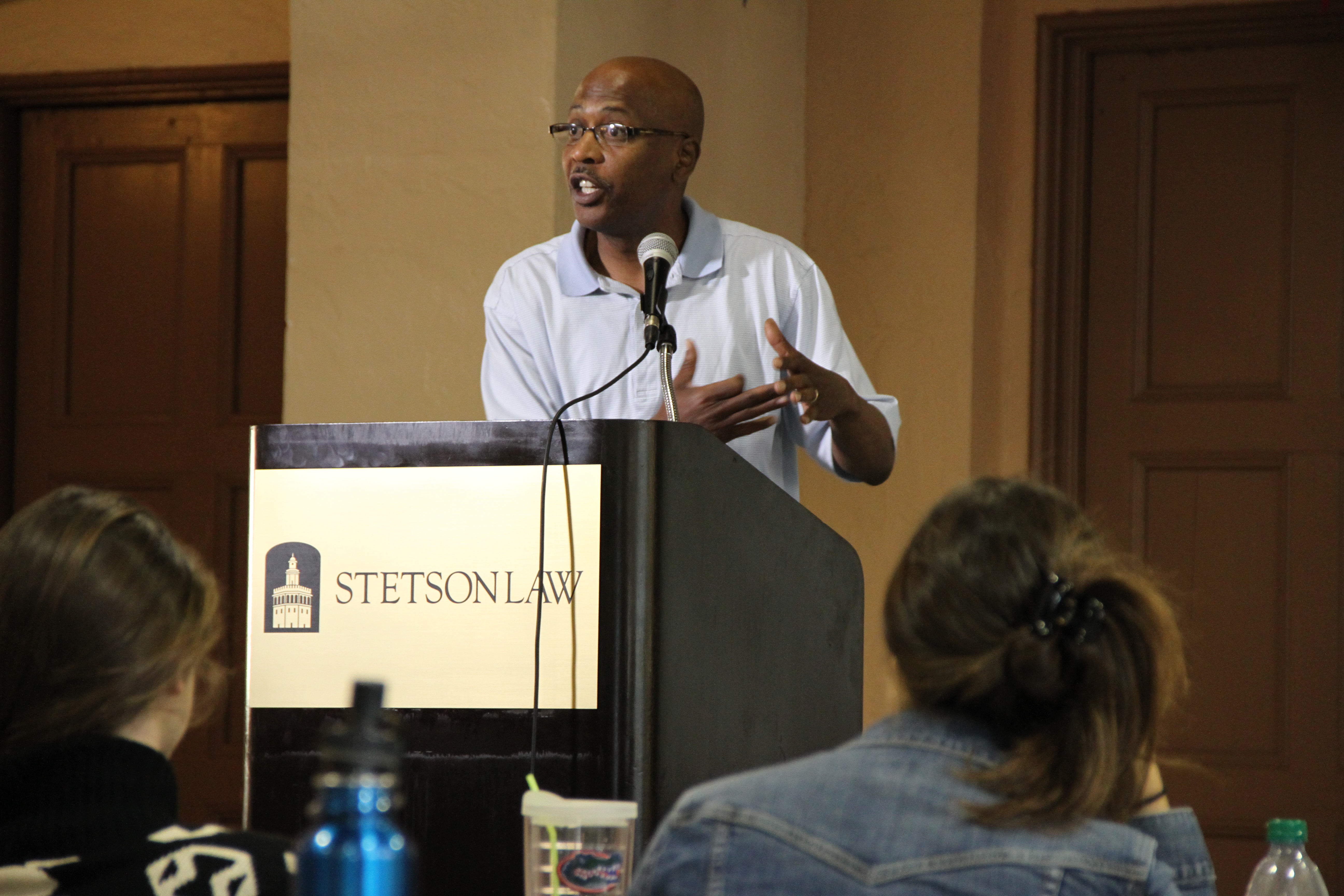
John Thompson spent 18 years in prison and 14 years on death row before being exonerated of a crime he did not commit. On Jan. 26, Thompson shared his experiences with Stetson University College of Law students and spoke about the importance of responsibility and accountability.
John Thompson spoke with Stetson Law students on Jan. 26 in the Great Hall.
“Now is the time for you to decide what you will stand for,” Thompson told the students. Thompson explained how he was accused and convicted of murder and the subsequent years he spent fighting the conviction and death sentence.
“His story tells us about what can go wrong with lawyering, from prosecution to defense,” Professor Judith Scully explained. Scully, the Wm. Reece Smith Jr. Distinguished Professor of Law, directs the Innocence Initiative at Stetson, which assigns students to research potential cases for the Innocence Project of Florida and to work on legislative reform and educational outreach.“John’s story illustrates the importance of confronting injustices and having courage as attorneys.”
After Thompson was exonerated of his crimes, a lower court ruled in a civil case that prosecutorial evidence occurred in his case and awarded him millions of dollars. However, the Supreme Court reversed that decision, explaining that it saw no pattern of prosecutorial misconduct, and the $14 million jury verdict was reversed.
Thompson said the attorney in his civil case risked his own finances and ambitions to follow his conscience to do what was right. He told the students that lawyers have a responsibility to ask questions, to address issues, to listen to their clients and to do the best that they can do at the end of the day.
“When you hear the word ‘exoneree,’ you should hear the word ‘victim.’ Are we ready to stand up and represent victims?” Thompson asked.
Howard Williams, a third-year law student, said that he was inspired by Mr. Thompson’s story.
“I would like to go into criminal law upon graduation, and Mr. Thompson’s words resonated very strongly with me because he may be the type of client that I have one day as an attorney,” Williams said. “To think that he almost died because of dishonest and ineffective lawyering reminds me of the power that attorneys possess and that is something that I will not take lightly. Mr. Thompson’s message reaffirmed the whole reason that I came to law school, which was to try and be a voice for those who need the most.”
Student Gabe Neibergall, who works with the Innocence Initiative at Stetson, said, “In my opinion, Mr. Thompson’s most powerful point was that we all choose to become lawyers, and by making that choice, we are now obligated to stand up for what is right- no matter the personal and professional costs. This seemed to be Mr. Thompson’s idea of true ‘honor,’ and it is something we should all strive to embody.”
After leaving prison, Thompson said that he had an unusually smooth transition. He said he worked with lawyers at the Death Penalty Resource Center to help people on death row. Habitat for Humanity built him a house and a writer worked with him on a book about his experiences. The story of Thompson’s wrongful conviction is told in the book, Killing Time: An 18-Year Odyssey from Death Row to Freedom.
Today, Thompson is the founder and director of Resurrection After Exoneration, a supportive residential program that provides exonerees and long-term prisoners reentering society a transitional home and work environment.
Thompson presented this year’s Wm. Reece Smith Jr. Distinguished Lecture at Stetson Law’s annual Inns of Court, an adopted tradition that brings together prominent lawyers, experienced teachers and law students to exchange ideas.