Stetson Showcase, April 14: ‘One of the Most Exciting Yet’
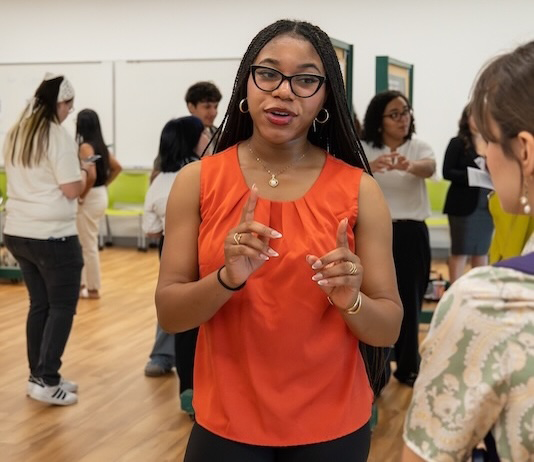
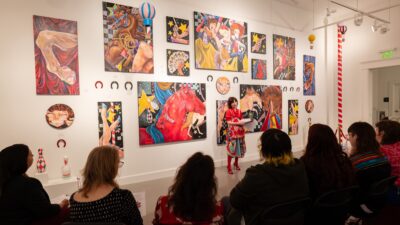
Established in 1999, Stetson Showcase is recognized as one of the oldest and most distinctive comprehensive Undergraduate Research Days nationwide. On April 14, the campus-wide event did not disappoint.
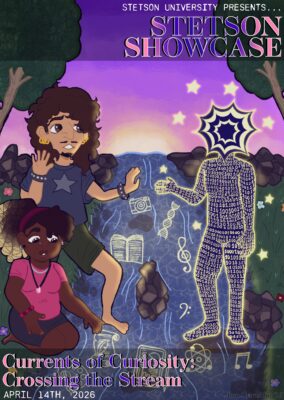
In all, approximately 170 posters, art exhibitions and museum studies, music recitals, oral presentations and more were on display under the theme of “Currents of Curiosity: Crossing Streams.” That theme put a focus opportunities and obstacles surrounding artificial intelligence.
And, let’s just say, curiosity during this Stetson Showcase was met with both very real academic prowess and undeniable creative flair. (See the Stetson Showcase program.)
“I have been involved in almost every Undergraduate Research Day since they started in 1999,” commented Kimberly Reiter, PhD, associate professor of History and chair of the Undergraduate Research Committee. “I have the programs, and every one brings memories. This last Showcase will stay in my mind as one of the most exciting yet, with rigorous research across all years and fields, amazing creativity in music and the arts, including the wildest cover we have ever had, and a keynote speaker who reminded us all that the future of AI in undergraduate research holds more hope than fear.”
For example, there was senior Biology major Adrian Cerrud presenting “A Comparison of Hunting and Capture Behavior Between Lycosidae and Salticidae Spider Families” — research on hunting behavior and the potential translation to prosthetics for people.
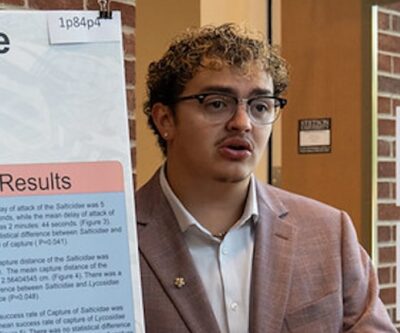
“I wanted to look at how these hunting spiders really go after their prey. And not only that, but their leg movements,” Cerrud said. “I think that could be very useful for prosthetics and biomechanics and robotics. I’m a big sports fan. If you’re able to use my data to help influence people who are going to the Paralympics or creating running prosthetics, I think that would be a huge, huge thing.”
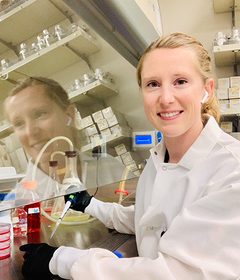
Sophomore Chemistry major Amy King was all smiles as she discussed her poster, “Computational Analysis of Active Site Modifications in [NiFe] Hydrogenase for Enhanced Biomimetic Catalysts.” While current green hydrogen production is limited by its use of expensive and rare platinum electrodes, her research computationally explored biomimetic modifications to the natural hydrogen catalyst [NiFe] Hydrogenase in hopes of supporting the development of an earth-abundant alternative to platinum.
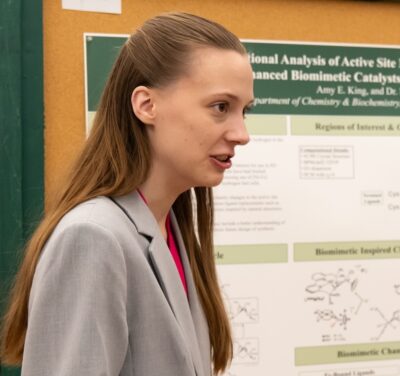
“I find it really exciting to get to talk to people about what I’ve been doing in the lab — to get to hear their feedback and what resonates with them about this really cool science,” King said.
At the Hand Art Center, senior Studio Art major Maria Latour explained her work, “Fish Sermon,” an exploration of the “mysterium tremendum.” The phrase was coined by German theologian Rudolf Otto in reference to man’s experience of the spiritual, awe-inspiring and divine. Latour’s work drew parallels between underwater phenomena and mythology, philosophy and religion. In addition, the research was reflected in her brilliantly colorful art.
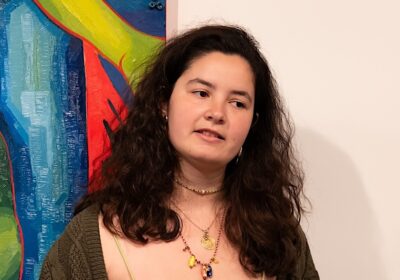
“The portrayal of the human form in conjunction with deep-sea life is symbolic of the ocean’s unknowable nature and of our own ignorance. … I remain fascinated with what man is unable to understand, be it below the depths or high in the heavens,” she described.
Throughout the campus, other projects were similarly mystifying and worthy of marvel. Just to name three, they came with titles such as “Collectivism, Social Responsibility, and Cultural Philanthropy in Taiwan”; “Determining the Role of Nuclear Localization in the Transformative Properties of the Merkel Cell Polyomavirus Small Tumor Antigen”; and the “Economic Evaluation of Increased Green Space in Living Areas of North Central Florida.”
Finally, to help conclude the day’s events, Dr. Antonio Byrd, the Grady Ballenger Keynote Speaker, an associate professor of English at the University of Missouri – Kansas City, presented “GenAI Use from Research to Publishing: A Framework for Setting Boundaries as a Young Scholar.”
The talk was especially fitting. The young scholars at Stetson Showcase, indeed, set their own new boundaries.
-Michael Candelaria
MARIS AWARDS 2026
Poster Presentations
Maris Award:
- Naya Adla Acoustic Indices as Reliability Indicators for Automated Oyster Toadfish Calls Detection
- Raissa Borges de Oliviera Leal Molecular characterization and phylogenetic analysis of a non-canonical nuclear localization signal within the Merkel cell polyomavirus Small Tumor antigen
- Sean Gaudreault Investigating Fus1 and Pea2 Roles in Mating and Protein Localization by Mutating Fus1’s Internal Domain in Saccharomyces cerevisiae
Honorable Mention:
- Jessie Quince TikTok as a learning tool: A cognitive load study
- Raven Hufstetler Determining the Role of Nuclear Localization in the Transformative Properties of the Merkel Cell Polyomavirus Small Tumor Antigen
- Abigail Young When to Deceive: Factors Influencing Caudal Luring in Pygmy Rattlesnakes
- Veronica Okeke Determining whether the FPPTWE region of the Merkel Cell Polyomavirus small tumor antigen has transforming functions independent of nuclear localization
Arts
Maris Award:
- Maria Latour Fish Sermon
Honorable Mention:
- Lily Woolard Danielle Hunt: Evolution in 3D
Junior Music Recitals
Maris Award:
- Andre Caquimbo, Oboe
Honorable Mention:
- Elisabeth Lundstrom, Mezzo soprano
Oral Presentations
Maris Award:
- Noelle Zinn Cell Cycle-Dependent Nuclear Localization of the Merkel Cell Polyomavirus Small Tumor Antigen Suggests a Regulated Import Mechanism
- Diana Godinho From repression to human rights: the case of Michelle Bachelet in Chile
- Nicholas Mauck Microplastic Abundance and Color Distribution in Palaemonetes paludosus across Urban and Protected Freshwater Systems in Central Florida
- Raissa Borges de Oliveira Leal Evaluating the Impact of Vaccination on Dengue Incidence: An Econometric Analysis of São Paulo
- Isabella Degenhardt, Endrik Brettmann, Dietre Griesinger and Kamryn Wilson Lululemon Stockpitch
- Leonardo Giorgioni Figueroa The Influence of Educational Video Interventions on Hurricane Risk Perception: The Role of Affective Response and Graphical Literacy
- Kira Zaitsava Local Impact Score
Honorable Mention:
- Pilar Astigarraga Harper Rapamycin Inhibits Developmental Progression and TOR Signaling in Vanessa cardui Painted Lady Butterfly Larvae
- Miki Ohotaguro Collectivism, Social Responsibility, and Cultural Philanthropy in Taiwan
- Serena Dowling Low Salience, High Opinions: Partisan Cueing and Polarization
- Raissa Borges de Oliveira Leal – Program development for science teaching at afterschool programs
- Sophia Toussaint CRISPR-Cas9 Targeting of aristaless1 in Vanessa cardui Revealed Molecular Effects in Embryonic Developmental with Minimal Effects on Adult Morphology and Wing Pigmentation
- Elena Edwards The Effects of tDCS on Pitch Perception in Musicians and Non-Musicians
- Genevia Gayden Invisible Hand of The Balkans: Post-Soviet Interstate Warfare as a Comparative Confederal Concept
- John Young The United States and the Chimurenga: Evolution of U.S Diplomacy Towards Rhodesia and Zimbabwe, 1965–1987
- Alex Faulkner Economic Evaluation of Increased Green Space in Living Areas of North Central Florida
- Sheridan Macon Posing Oscar Wilde: Surrogation in Gross Indecency and The Judas Kiss
- Amy King The Log Book: Increasing Access to STEM Education through Digital Mentorship
- Eric Ufomadu RAG systems and the illusion of accuracy: Rethinking Attorney Competence Standards for legal AI
Kathleen Johnson Award for Excellence in Arts and Humanities:
- Nico Alonso Conservative State Religion: Miami Cubans as the “Model Minority”
Leonard Nance Award for Justice Studies:
- Abdulraqeeb Oguntade – Building Frameworks for a Recovery Housing Program at Rising Against All Odds
- Patrick Galloway Punishment as Political Language: The Ideational Foundations of Rehabilitation’s Marginalization in U.S. Prisons
Leonard Nance Honorable Mentions:
- Isabelle Condor da Silva A Data-Driven Framework for Optimizing Police Patrol and Response Time
- Tori Watson The Weaponization of Literacy: From enforced illiteracy to Modern Barriers