
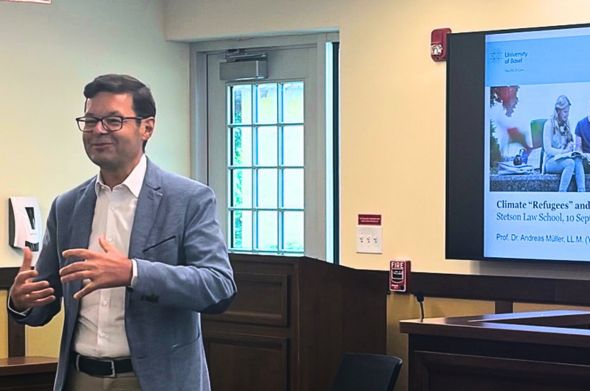
What happens when climate change and disasters force people from their homes, but international law offers no single framework for protecting them?
Before an audience of law students representing a broad range of interests, Dr. Andreas Müller, Professor of international law, human rights law, and European law at the University of Basel (Switzerland), examined the ways nations might work together to support people displaced by rising seas and other effects of climate change – often referred to as climate refugees.
Disaster-related displacement is already occurring on a vast scale: 45.8 million internal displacement movements were recorded worldwide in 2024 alone. Rising sea levels threaten the long-term habitability of low-lying Pacific Island communities and may contribute to migration to more stable locations. Changing weather patterns, including more intense heat and more frequent droughts, may also render some areas no longer livable.
“The tendency is clear,” Müller said. “We have a rising number of people who are displaced due to disasters and climate change.”
Yet existing international law has yet to fully address the scope of the issue.
Most people displaced by climate change or natural disasters do not fall within the legal definition of a refugee, which requires a well-founded fear of persecution on specified grounds. International human rights law, meanwhile, may protect people in particularly serious cases by preventing states from returning them to places where climate-related conditions pose a real threat to life. Because “refugee” has a specific legal meaning, Müller suggested using the broader terminology of climate- or disaster-related displacement and displaced persons.
Regional agreements may offer a path forward
While there are nonbinding policies to guide nations, many factors make it challenging to create a global framework to prepare for large population movements, from political considerations to differences in legal systems and language. The 1951 Refugee Convention grants refugee status to individuals facing persecution based on race, religion, nationality, political opinion, or membership in a particular social group.
Human rights law may prevent nations from returning someone to a place where climate-related conditions pose a serious threat to life. In 2019, the U.N. Human Rights Committee ruled that, in extreme cases, deporting individuals to such conditions could violate human rights obligations.
With no universal framework on the horizon, time may be running out.
“Starting from the bottom, we can say with great likelihood that there will be no universally binding treaties any time soon,” Müller said. “We can’t wait for that.”
Agreements among nations within distinct geographic regions may offer a way forward, he said. The Falepili Union, for example, is an agreement between Australia and Tuvalu that provides a pathway for a set number of Tuvaluan citizens to migrate legally to Australia each year. In Latin America, the Cartagena Declaration on Refugees includes broader protections for people fleeing circumstances that seriously disturb public order, language that could potentially apply to certain climate-related displacement scenarios.
Other regional arrangements, including in Africa and Europe, could also help inform future policy.
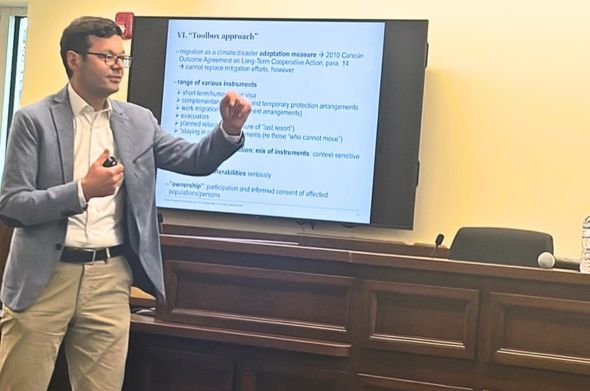
Given the wide array of climate impacts and the distinct challenges they pose, a one-size-fits-all solution likely would not make sense, Müller said, but the constellation of existing frameworks might inform a “toolbox” approach for policymakers.
“We can only solve this together,” Müller said. “It’s a big problem, we know it.”
A cross-campus collaboration
The event was organized by the International Law Society, Immigration Law Student Association, International Programs, and the Institute for Biodiversity Law and Policy. For the more than 30 students in attendance, it demonstrated the value of approaching complex global problems across different areas of law.
“Bringing speakers like Professor Müller to campus is vital for students, and I am happy that the International Law Society, along with our co-sponsors, was able to deliver such an event,” said Chloe Bailey, president of Stetson’s International Law Society. “This intersection is why it is important to work across disciplines and understand how each interacts with the other.”
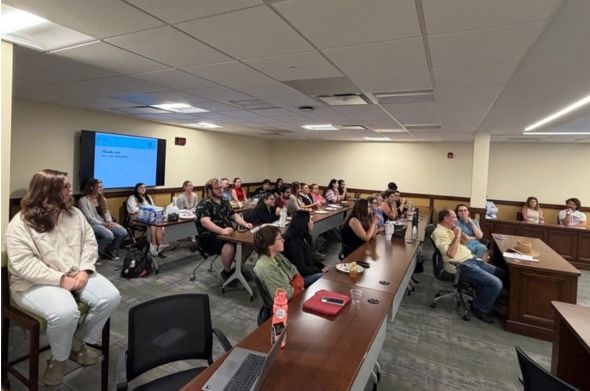
The lecture also reflected Stetson Law’s efforts to expand its international law programming and create opportunities for students to engage directly with scholars from around the world.
“One of the goals of our international law programming is to bring students into direct conversation with international scholars working on legal problems that cross both borders and traditional doctrinal boundaries,” said Dr Klara Polackova Van der Ploeg, Associate Professor and Faculty Co-Director for International Programming. “Professor Müller’s visit was a particularly valuable example: climate-related displacement sits at the intersection of international, human rights, migration, and environmental law, and the discussion showed students how those fields interact when the law is confronted with a genuinely global problem.”
Interested in making a global impact? Learn more about Stetson Law’s international programs.