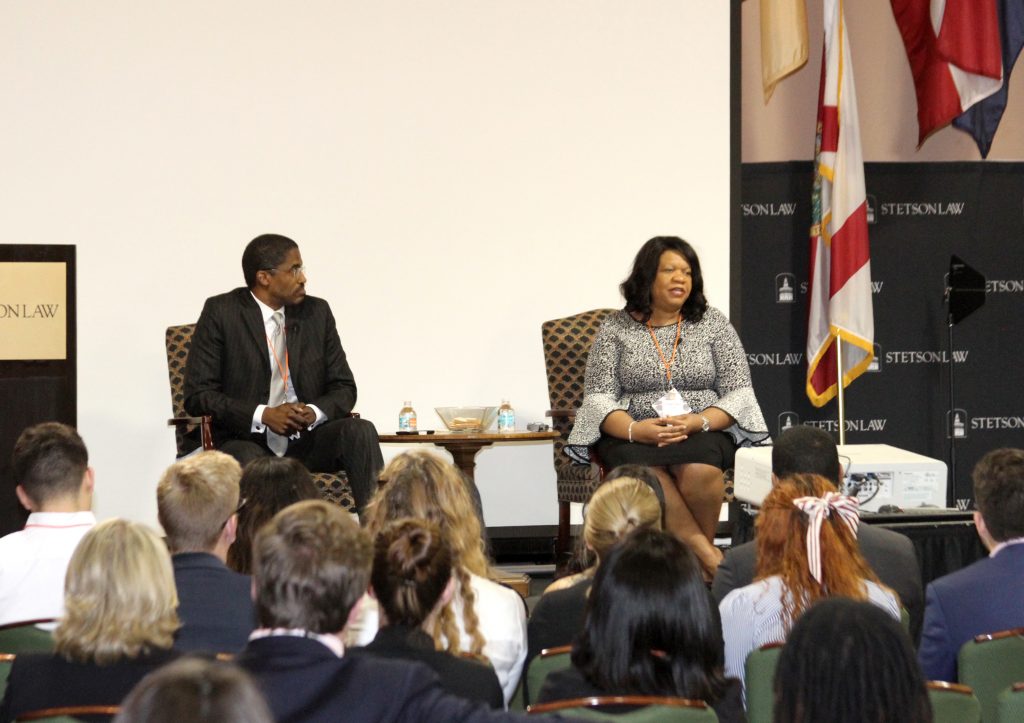
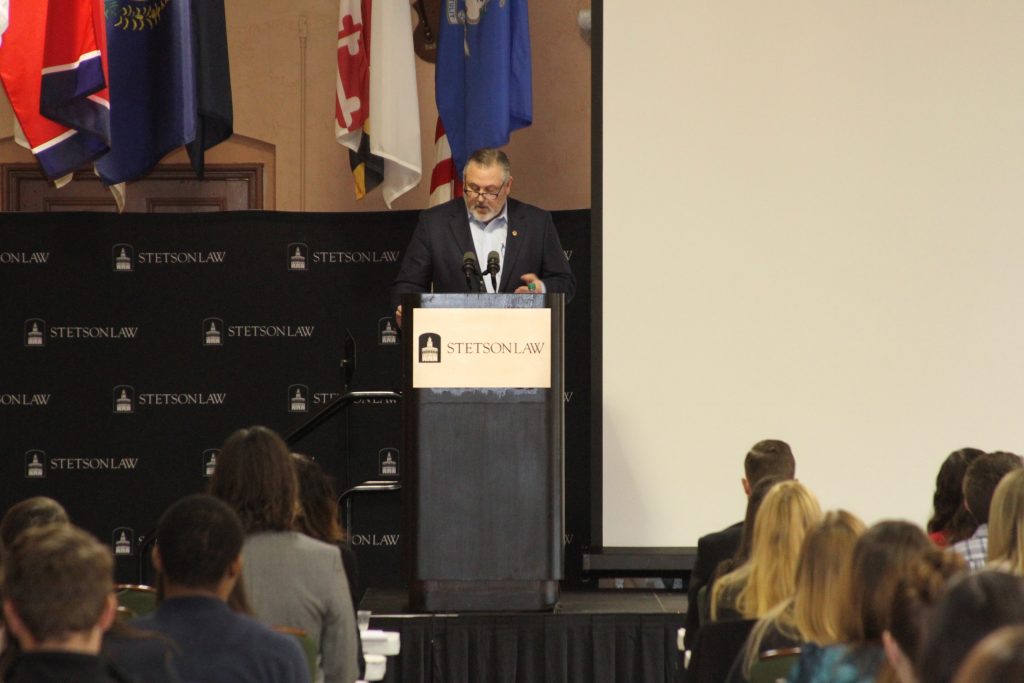
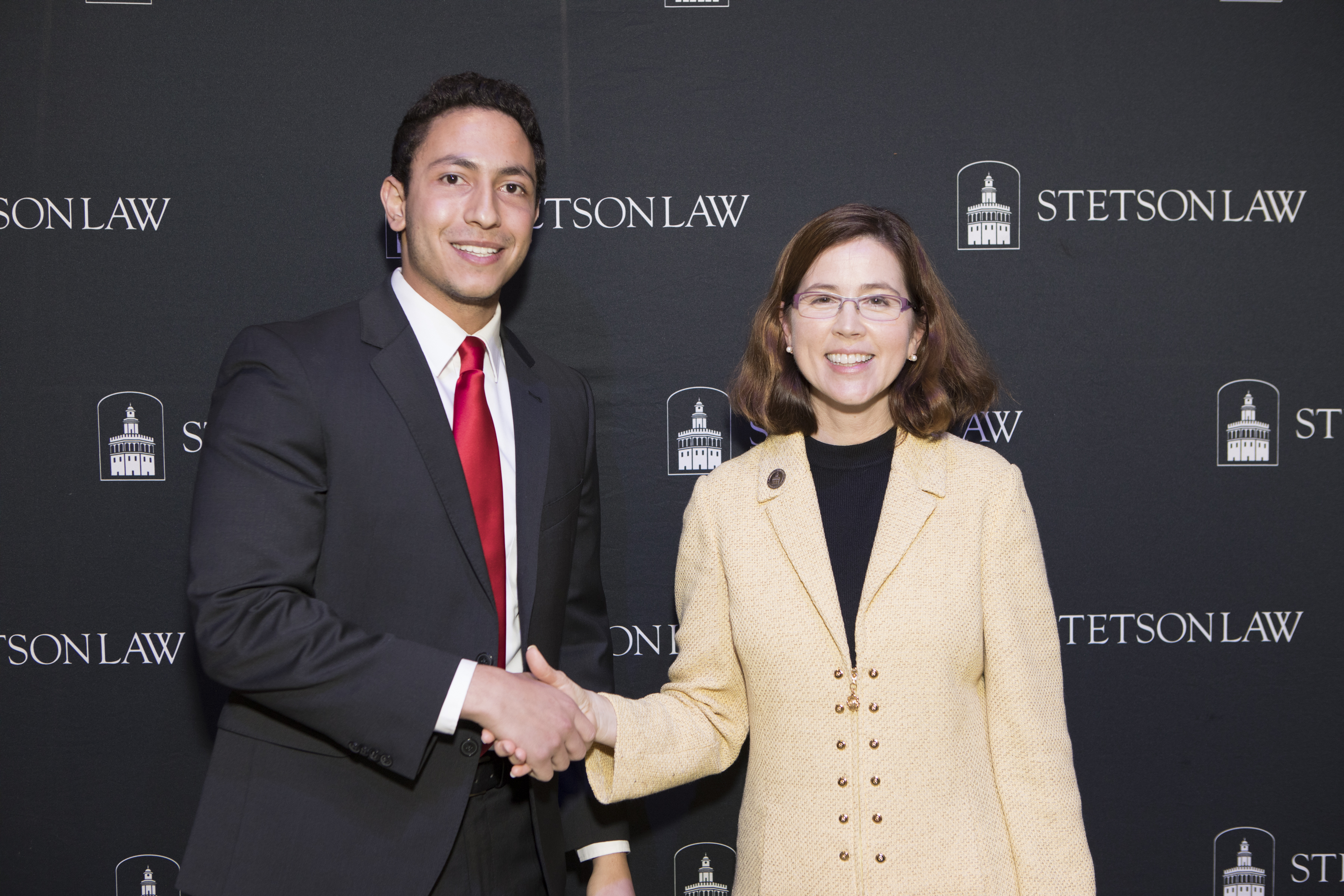
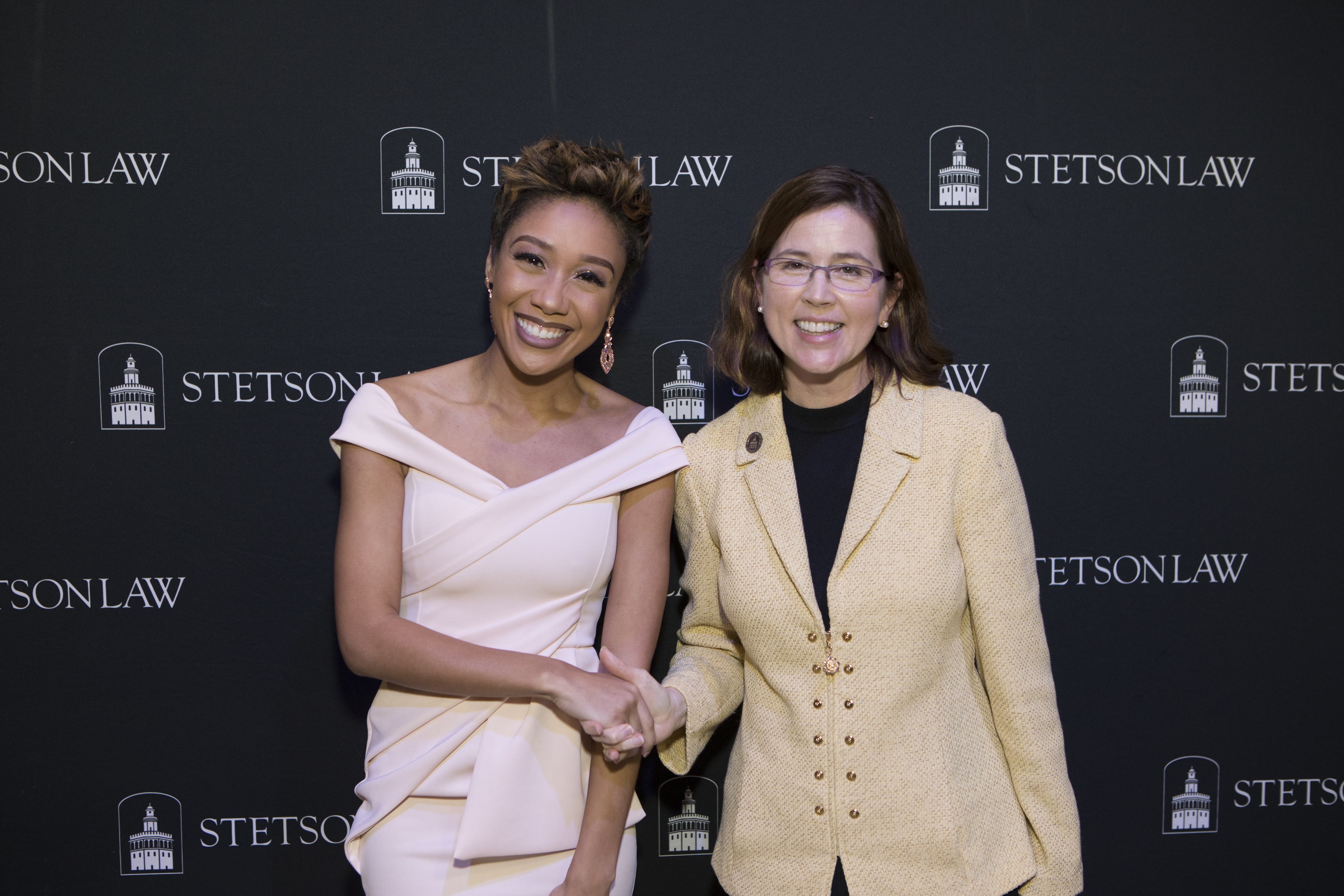
(L-R): Lanse Scriven and Judge Mary Scriven candidly answered students’ questions about the career/life balance during the closing keynote address. Photo by Frédéric Boidin.Greg Coleman presented the opening keynote address. Photo by Frédéric Boidin.
Stetson’s third annual Campus to Career: Professional Development Conference featured programming including more than 20 session speakers and keynote presentations by Florida Bar past-president Greg Coleman J.D. ’89, Judge Mary Scriven and attorney Lanse Scriven. The one-day, co-curricular professional development experience was designed to help students learn key skills like decision-making, develop meaningful partnerships and competencies in the areas of resilience, time management, professionalism, decision-making, planning, civility, self-assessment, mentoring and wellness.
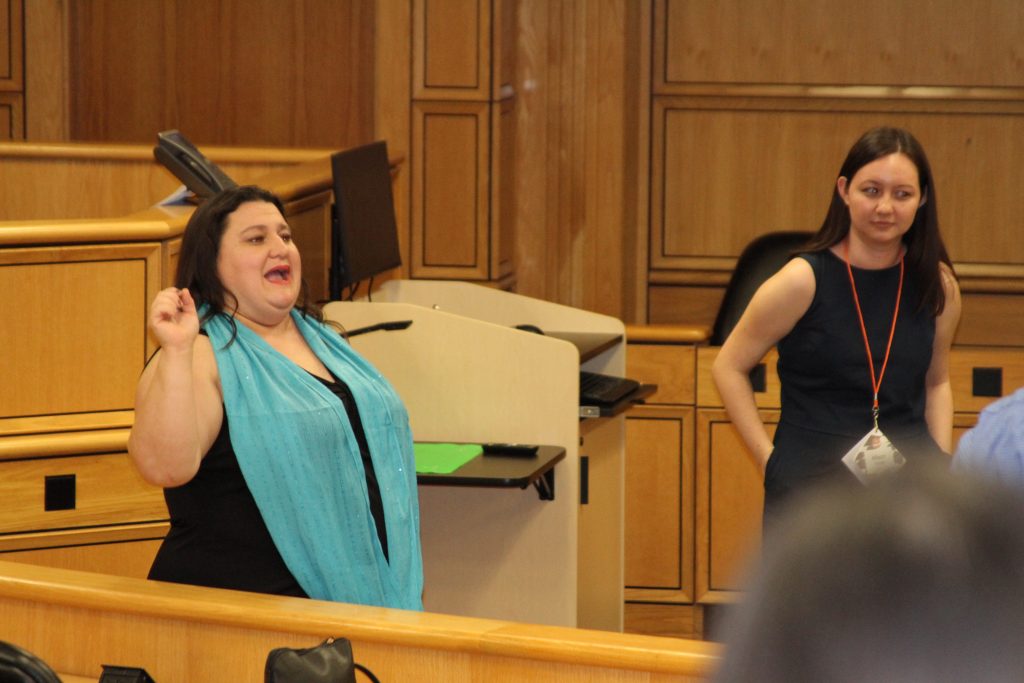
Session topics by faculty, staff and members of the legal community included recognizing diversity in attorney-client communications, time management, advocacy skills, networking, mentoring and using improv exercises to relax and focus. A committee of staff and faculty including Associate Director of Career and Professional Development Joann Burnett, Interim Assistant Dean for Student Affairs Kirsten Davis, Manager of Marketing and Social Media Laura Cheek, and student co-chair Ashly Valenzuela coordinated the event. Student Jose Garcia has worked on the committee for the past two years.
Jennifer Strouf presented on using improv to relax and focus. Photo by Frédéric Boidin.
Tampa Bay Waterkeeper executive director Andrew Hayslip presented the Foreman Biodiversity Lecture on the importance of protecting clean water at Stetson Law’s Gulfport campus on Jan. 31.
“We exist to protect our natural heritage through science, policy, advocacy, and the enforcement of existing environmental laws,” said Hayslip.
Tampa Bay Waterkeeper defends and advocates clean water laws, but Hayslip emphasized that people must start in their own community in order for a positive change to be made on a national level.
Storm water pollution is the largest source of pollution in Tampa Bay waters and is a major vehicle for marine debris and plastic pollution, Hayslip shared.
“It’s our duty to hold polluters accountable,” said Hayslip. “We strive for a positive change so that people can fall in love with our waters and not have to think about sewage while enjoying their right to fishable, drinkable, and swimmable water under the Clean Water Act.”
The next Foreman Biodiversity Lecture is scheduled for noon on March 5 in the Great Hall on Stetson’s Gulfport campus and features U.S. Fish and Wildlife Service Wildlife Inspector Rhyan Tompkins.
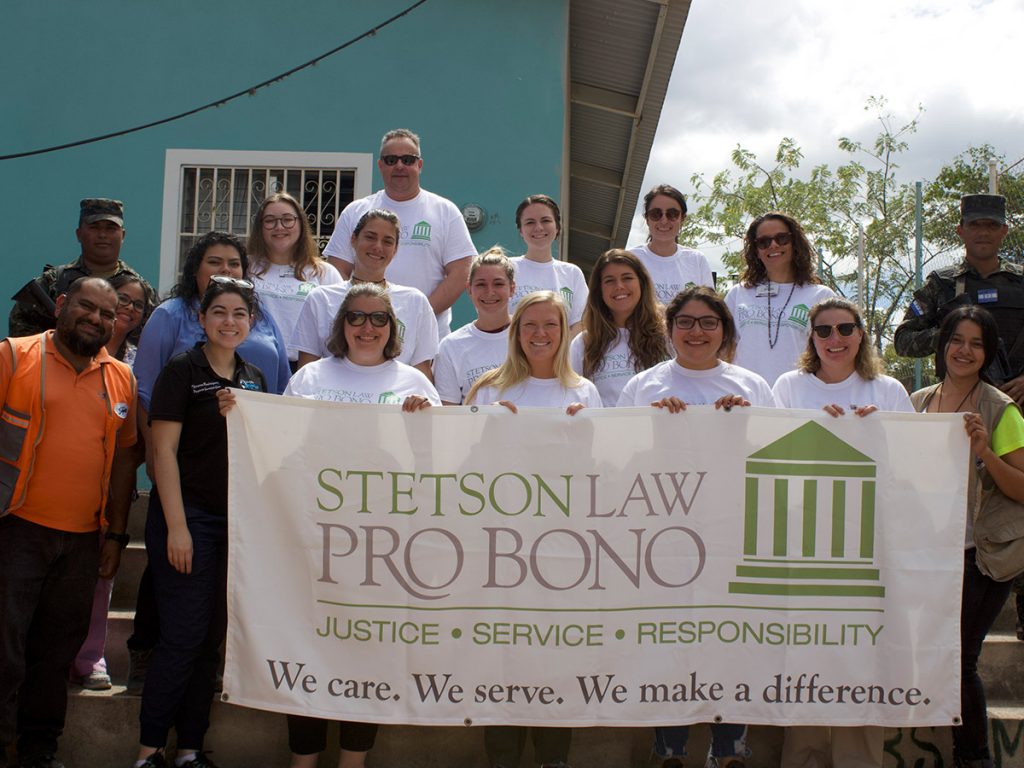
A contingent of Stetson Law students traveled to Honduras in January 2020 to perform pro bono legal services for those in need. Photo by Daniela Gomez
By Daniela Gomez Stetson Law 3L
While most spend their winter break reflecting on the fall semester and relaxing before the spring semester, 12 Stetson Law students spent seven days in Honduras in January as part of the Legal Empowerment Brigade.
This year marked the second time Stetson’s Legal Empowerment Brigade partnered with Global Brigades for the student-led international pro bono initiative. Students worked closely with Honduran attorneys and translators in legal clinics, community client counseling, and adult and child educational workshops on international human rights and legal rights. Issues ranged from land registration to marriage and even labor law.
Students earned 60 hours of pro bono toward the total requirement they must meet for graduation. They primarily processed intake of new cases, including land registration issues where families were living on land that had been given to them by a family member, but the land wasn’t registered, so they feared future problems. Another case involved a woman had assumed the care of her niece after her sister died in childbirth. However, there was never legal adoption or guardianship, so she feared future complications.
Melissa Maher and Maria Ranoni teach community members how to register their own lands. Photo by Daniela Gomez
In 2018, then Stetson Law students Kai Su and Sy-Woei Hao were awarded graduate scholarships from the Tampa Bay Organization of Women in International Trade. The scholarships were used to fund Stetson Law’s first pro bono international trip to Honduras and the creation of The Legal Empowerment Brigade. This year, students did individual fundraising for their trip expenses.
The goal of the Legal Empowerment Brigade is to empower students to advocate for closing the justice gap on an international stage while learning and embracing the power of diversity. Though not an official Stetson Law organization, students who participated hope the Legal Empowerment Brigade pro bono initiative will continue at Stetson for years to come.
Stetson University College of Law is hosting a Spring Open House for future law students from 9:45 a.m.-1:30 p.m. on Saturday, Feb. 23, at 1401 61st St. S. in Gulfport. Stetson Law is home to the top-ranked trial advocacy program in the U.S. Stetson’s legal writing program is ranked second in the nation.
The half-day Open House program is open to the public and includes presentations on the full-time and part-time law school experience, information on admissions, student financial planning, LSAT preparation, student services and organizations, and includes lunch and tours of Stetson Law’s historic Gulfport campus.
Stetson University College of Law invites members of the public to the Great Hall on its Gulfport campus at 1401 61st St. S. for its annual Foreman Biodiversity Lecture Series about the environment, with talks scheduled for January, March and April.
The first lecture of the spring semester kicks off with a talk by Tampa Bay Waterkeeper executive director Andy Hayslip at noon on Jan. 31.
U.S. Fish and Wildlife Service Wildlife Inspector Rhyan Tompkins presents at noon on March 5.
A third lecture is scheduled for noon on April 11 during Stetson’s International Environmental Moot Court Competition, now in its 23rd year, drawing law students from around the world.
Stetson’s award-winning Institute for Biodiversity Law and Policy regularly hosts the Foreman Biodiversity Lecture Series, along with international speakers and conferences, and coordinates courses, seminars and internships on topics ranging from wetland law and policy to natural resources and international environmental law.
Stetson University College of Law celebrated 26 new J.D., four LL.M. in Advocacy, five LL.M. in Elder Law, and two LL.M. in International Law candidates on Dec. 13 in Gulfport.
Among this year’s outstanding class are:
Ahmed Mohamed, a member of Stetson’s Dispute Resolution Board, Stetson Law Review editor who completed his law degree at Stetson and working on a medical degree at the University of South Florida;
(L-R): Ashleigh Thornton with Dean Kristen Adams.
Ashleigh Thornton, an advocate for juvenile justice who is receiving a Certificate of Concentration in Advocacy;
and Marc Wolfson, a veteran graduating with anticipated honors.
Stetson University College of Law in Gulfport is again partnering with the Community Law Program and the St. Petersburg Bar Foundation to prepare free simple wills and advance directives for low income veterans and their spouses aged 60 or older through the annual Wills for Warriors Program in February of 2019.
Walk-in appointments are not available. Veterans or their spouses must schedule individual appointments in advance by calling 727-562-7577 by Feb. 13, 2019.
The Wills for Warriors program is designed to assist veterans and their spouses aged 60 or older who have low incomes and limited assets. Individuals owning real estate outside the state of Florida are not eligible to participate.
Stetson students and volunteer attorneys from the Community Law Program will assist Stetson’s Center for Excellence in Elder Law with this program.
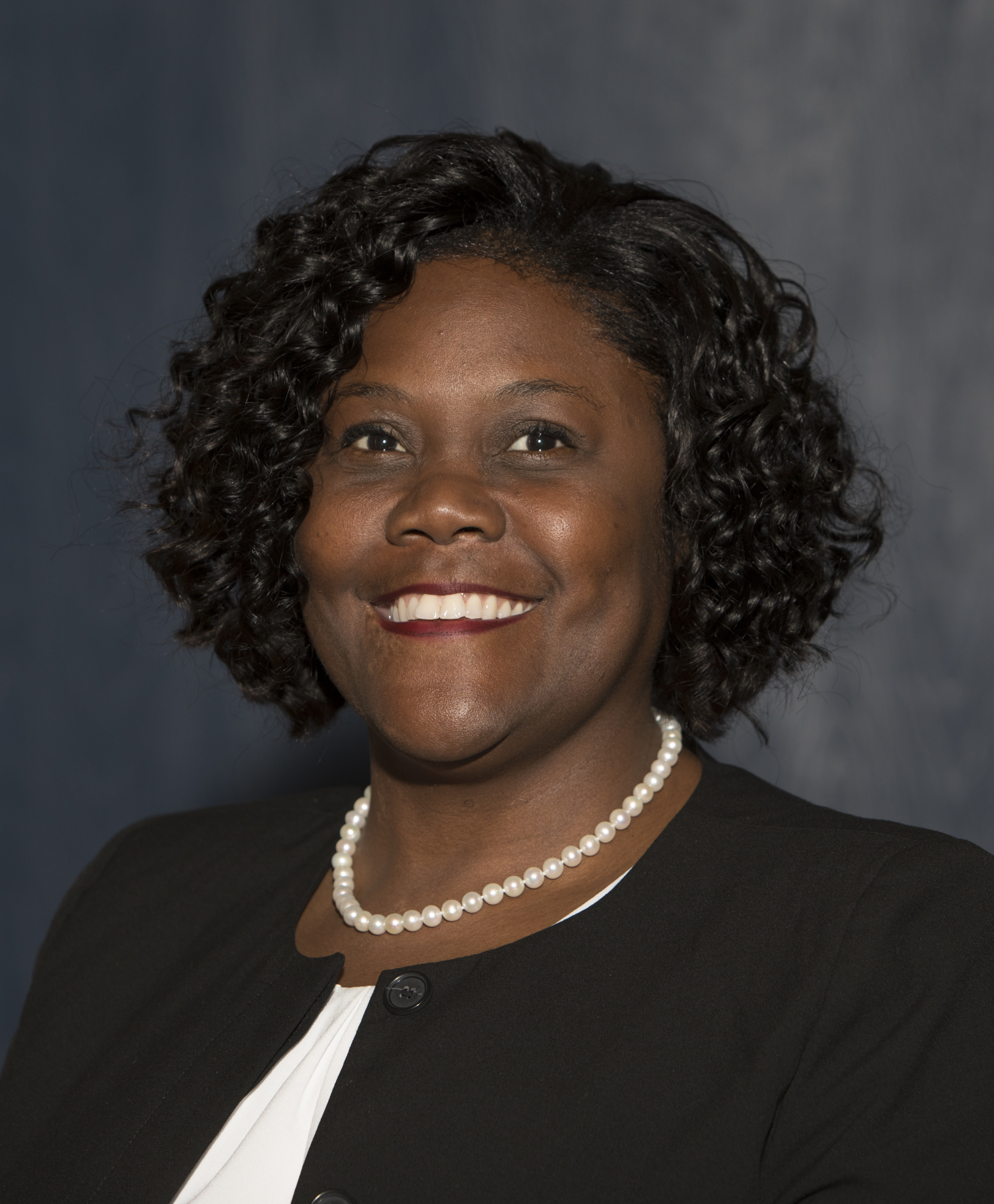
Karla Davis-Jamison has joined Stetson University College of Law in Gulfport, Florida, as the new assistant dean for strategic enrollment management.
Assistant Dean Karla Davis-Jamison.
Dean Davis-Jamison joins Stetson from Northwestern University, where she directed graduate admissions and financial aid for the Medill School of Journalism, Media, Integrated Marketing Communications in Evanston, Illinois. She served with the Northwestern University Change Makers Organization and the Association of Northwestern University Women.
Previous to her four-year tenure at Northwestern, Dean Davis-Jamison directed admissions for the Chicago-Kent College of Law in Chicago and at Florida A&M University College of Law in Orlando. At Chicago-Kent, she also served as the Interim Director of the Pre-Law Undergraduate Scholars program (a program for underrepresented students interested in careers in law) and she led the school’s DiscoverLaw.org initiatives.
At Florida A&M University, Dean Davis-Jamison was a part of the inaugural administration team which led the school’s efforts to successfully attain provisional ABA accreditation. While at Chicago-Kent and Florida A&M University, she was an active member of the National Network of Law School Officers.
Before she began her career in law school and graduate admissions, Dean Davis-Jamison worked in various public relations, marketing and communications roles at Nova Southeastern University, Alltel Communications and WXEL Public Broadcasting.
Dean Davis-Jamison is a member of the National Association of Graduate Admissions Professionals and the National Black MBA Association. She received her bachelor’s degree in public relations from the University of Florida and her M.B.A. from Nova Southeastern University.
Korey L. Henson J.D. ’09 was honored with the J. Ben Watkins Award for Excellence in the Legal Profession at the Stetson Law Review banquet on Nov. 17 at Stetson University College of Law in Gulfport.
(L-R): Korey Henson J.D. ’09 with Kai Su, student editor-in- chief of the Stetson Law Review.
The J. Ben Watkins Award honors individuals who have demonstrated outstanding leadership and accomplishment in the legal community.
Henson is an associate director in the Office of Career and Professional Development at Stetson University College of Law where he coaches students and graduates to find work and workplaces that give them the long-term career satisfaction and fulfillment they need to thrive in their careers. During his time at Stetson, among the thousands of students and graduates he has coached, he has worked with 181 of the 237 members of the Stetson Law Review, including 95 editors.
“The opportunity to help you find work that gives you satisfaction and fulfillment, so that you will go out and help more people in this world, is the point of it all. This honor tonight recognizes the crucial importance of purpose – and the value of those who help lawyers seek and find it – to the success of our profession,” Henson said at the banquet.
This year, Henson was also appointed to two positions with the National Association of Law Placement, was selected to co-present at the 2018 NALP Annual Education Conference, and is treasurer-elect of the South Florida Association for Law Placement.
The award is presented annually in honor of the late J. Ben Watkins LL.B. ’49, a member of the Stetson Law Board of Overseers who helped found the Stetson Law Review. Previous recipients of this prestigious award include outstanding members of the judiciary and bar leadership.
Ashleigh Thornton is scheduled to graduate in December. Photo courtesy Ashleigh Thornton.
By Kathryn Bonti
Cap and gown, check. Final exams, check. Changing the world, still left to do.
Ashleigh Thornton, a soon-to-be Stetson Law grad, may be walking across the stage for an early graduation in December, but her time making a difference in the juvenile justice system is only just beginning.
“We are making progress, but we can always do better,” says Thornton. “That is why I wanted to do this project.”
Thornton is referring to her guidebook entitled “The Art of Asking Why: A School Administrator’s Guidebook for Combating the School-to-Prison Pipeline,” a 20-page practical manual and informational tool for educators to use throughout the state of Florida focused on empowering administrators and others in authority to take a moment and think about the consequences of outdated disciplinary policies.
Blending her passion for justice with her love for children, Thornton set out to create something tangible for minors directly affected by the school-to-prison pipeline. After spending her spring semester interning at the 13th Judicial Circuit State Attorney’s Office in the juvenile division, she experienced first-hand just how troubling sometimes forgetting to ask why can be.
“A lot of these kids have things going on at home, absent parents, no food to eat, no family,” says Thornton. “I am not advocating for a lack of punishment, I am just hopeful that we as a legal body can wake up and recognize that excessive punishment is not the answer.”
Excessive punishment can have dramatic and often-times life changing outcomes for these children. Even a one-time run-in with the court system can almost guarantee future jail and prison time for these students, some of whom are as young as eight years old.
The “Art of Asking Why” is broken up into three different sections: What, Who and How, and Why. The first section goes over Florida specific statistics, introduces the school to prison pipeline, and provides an inside look into why this whole system exists. The next section brings to life the faces behind the closed courtroom doors, the children who society ignores and penalizes for common, harmless adolescent behavior. This section also provides a glossary, where definitions for words like “plea deal, bench trial, no contest” provide guidance and background information for educators before making a decision.
The last section, the section that influenced the whole book, challenges educators to exercise more compassion.
“A little compassion could go a long way,” Thornton explains. “Nelson Mandela told us that ‘education is the most powerful weapon that we can use to change the world.’ We need to keep these children in school and out of the criminal justice system.”
The “Why” section calls for administrators to start examining their disciplinary decisions as opposed to sending students off to out-of-school suspension for issues as minor as being tardy to class. The section then wraps up with a final message of hope and gratitude, acknowledging that change takes time and a lot of help.
Thornton credits the support of her parents and mentors who have helped shape her professional career.
Florida Supreme Court Justice Peggy Quince provided a foreword and professors Ann Piccard and Judith Scully, coordinators of the Social Justice Advocacy Concentration program at Stetson, provided guidance for Thornton’s book.
“Whether it was Professor Piccard assisting me with edits and securing a grant for the publication of my guidebook, or Professor Scully inspiring me to go after my dreams and fight for equality, I’ve had so much support along the way,” said Thornton, who credits her mentors Justice Quince, Professor Piccard and Professor Scully with helping her to succeed.
Thornton will graduate with a concentration in Social Justice Advocacy at Stetson Law. After graduation, she plans to continue to work to help juveniles. She will be working at the Attorney General’s Office while pursuing her graduate degree in criminology.
“And to think I wanted to go into corporate law, and get my M.B.A.,” Thornton says with a smile. “I couldn’t imagine doing anything but this now. I have found what I was meant to do.”
“The Art of Asking Why” will officially be released this spring, finding its way to grade schools across Pinellas County and into the hands of judges and bar associations throughout the Tampa Bay area.
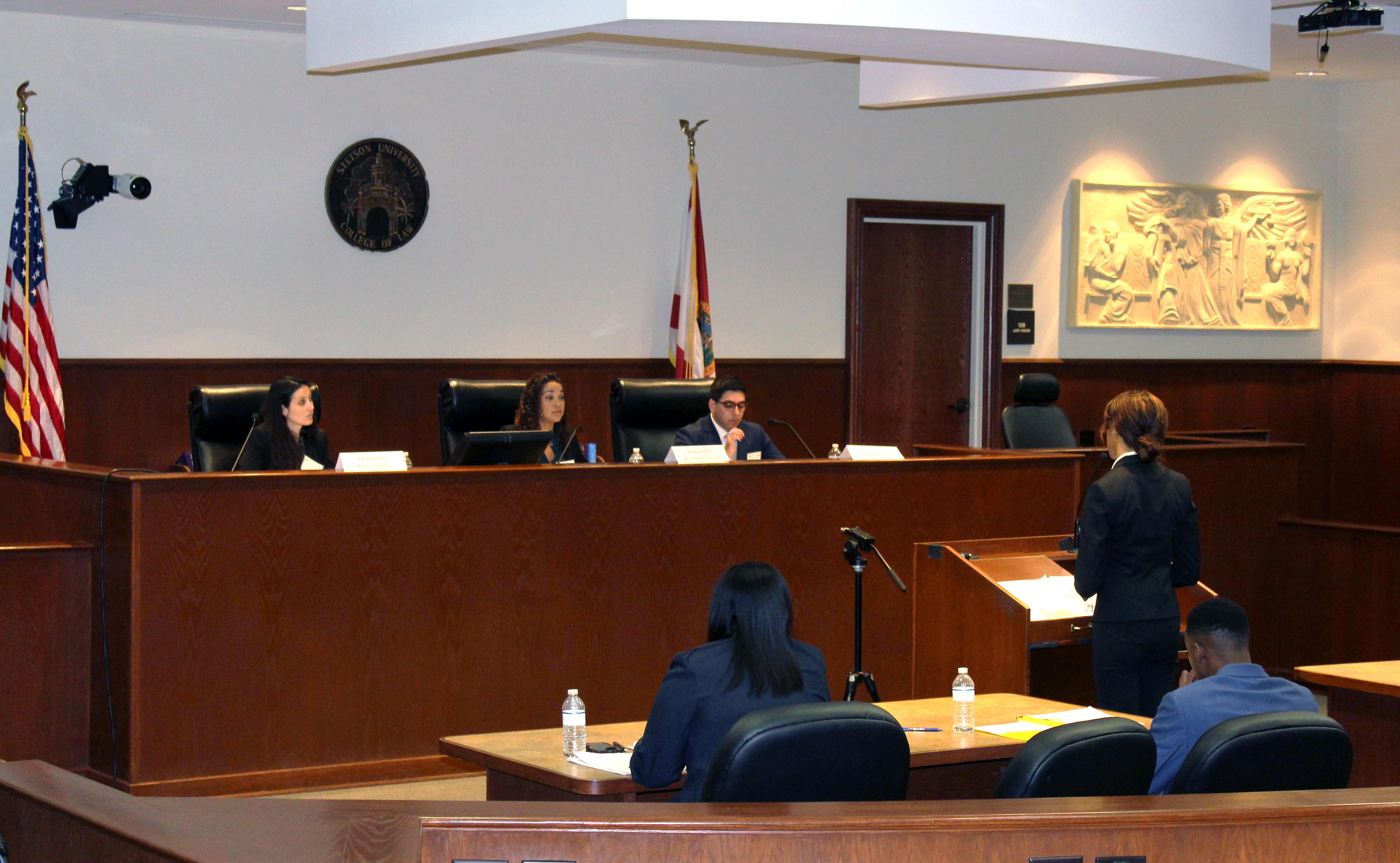
The ACLI meeting at the Tampa Law Center included presentations by students in the William Reece Smith Jr. Courtroom. (L-R): Florida Assistant Attorneys General Katie Ashby and Kiersten Jensen and attorney Shaheen Nouri. Photo by Frédéric Boidin.
The American and Caribbean Law Initiative met at Stetson’s Tampa Law Center on Nov. 9 as part of a three-day event with students, faculty, and four international law school deans participating.
Professor of Law Dorothea Beane facilitated the program, bringing American and Caribbean faculty and students together to work towards solving legal problems. Stetson LL.M. and J.D. students participated.
“It’s a collaborative learning program that allows Caribbean and U.S. law students to work together,” said Professor Beane, vice president-elect of the ACLI.
Fabrizio Gugliuzza, a student in Stetson’s LL.M. program, said, “It was a really nice experience. I worked with students from Trinidad and Tobago, the Bahamas, Antigua and Barbuda, Cayman Island, and Jamaica. We used U.S. law for the cases and it was interesting to learn the students’ points-of-view and learn more about their courts and the link they still have with England.”
An American law school hosts the ACLI in the fall, and a Caribbean law school hosts in the spring.
The Office of the Florida Attorney General presented awards to the students following their presentations.
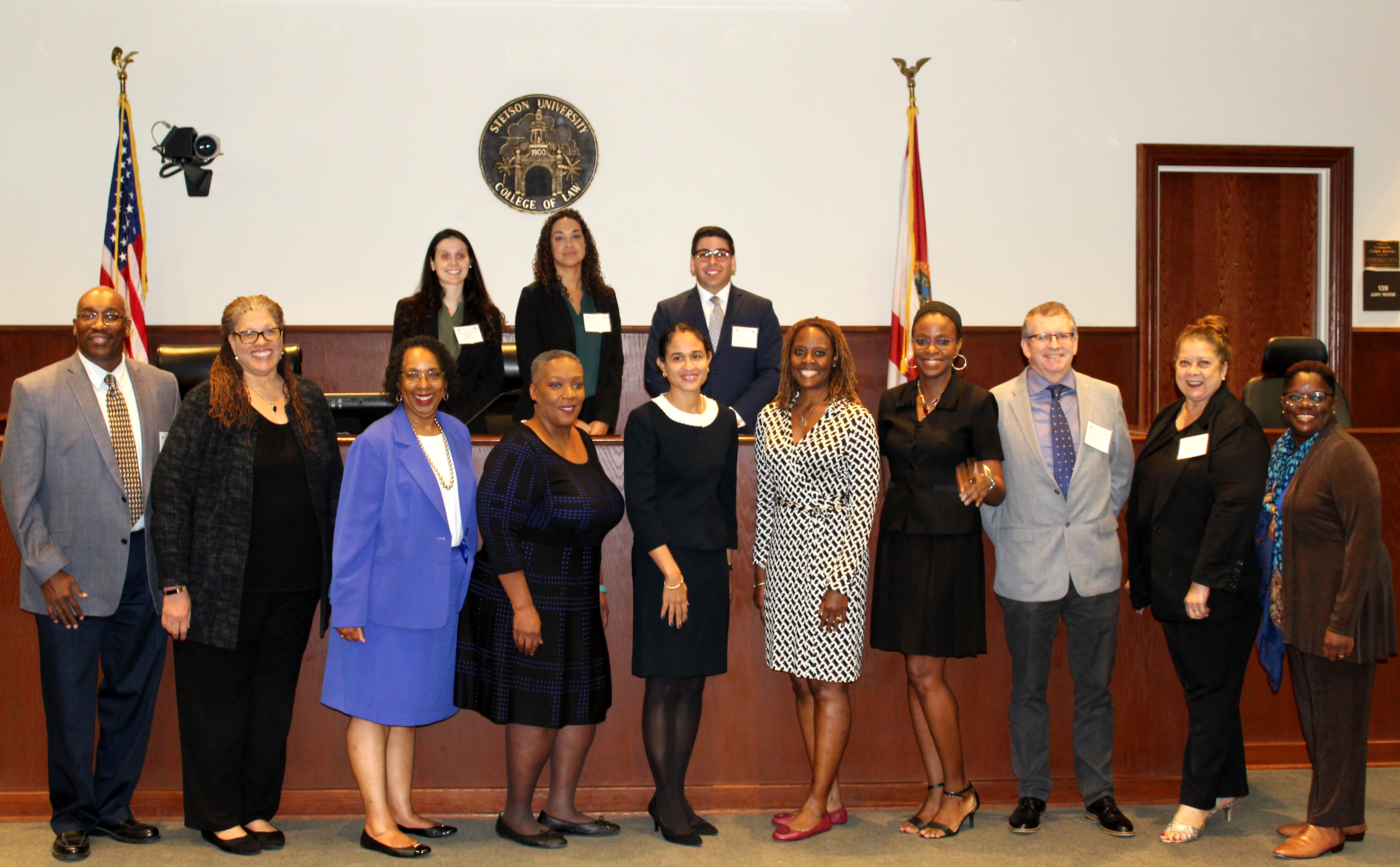
The ACLI met at Stetson’s Tampa Law Center on Nov. 9. (Front Row L-R): Associate Dean Darryl Wilson, Professor Jane Cross, Professor Dorothea Beane, Professor Susan Charles, Professor Raquel Williams, Dean Tonya Galanis, Professor Yolande Whitely, Dean Mitchell Davies, Dean Miriam Samaru and Professor Phyllis Kotey. (Back Row L-R): Katie Ashby, Kiersten Jensen and Shaheen Nouri. Photo by Frédéric Boidin.
Several law schools across the Caribbean and in the U.S. participate in the ACLI, including:
Eugene Dupuch Law School, Nassau, Bahamas
Florida International University, Miami, Florida
Hugh Wooding Law School, Tunapuna, Trinidad and Tobago
Norman Manley Law School, Kingston, Jamaica
Nova Southeastern University Shepherd Broad Law Center, Ft. Lauderdale, Florida
Stetson University College of Law, Gulfport, Florida
Truman Bodden Law School, George Town, Cayman Islands
The ACLI is a membership organization whose mission is to advance the common interest of its members in the growth and development of the Caribbean Basin by facilitating collaborative relationships and by strengthening its legal development and institutions. Stetson hosted the first ACLI in Florida in 2006.
Professor Beane co-directs Stetson’s Institute for Caribbean Law and Policy along with Associate Dean Darryl Wilson, secretary of the ACLI. The Institute provides a scholarly, professional foundation for the coordination of activities mutually beneficial to law students, law faculty, and the bar as well as the greater legal communities both domestically and throughout the Caribbean. These activities include educational exchanges, training, development and internship opportunities that take advantage of past and current relationships, including those related to the dynamic legal environment presently evolving in the Caribbean.
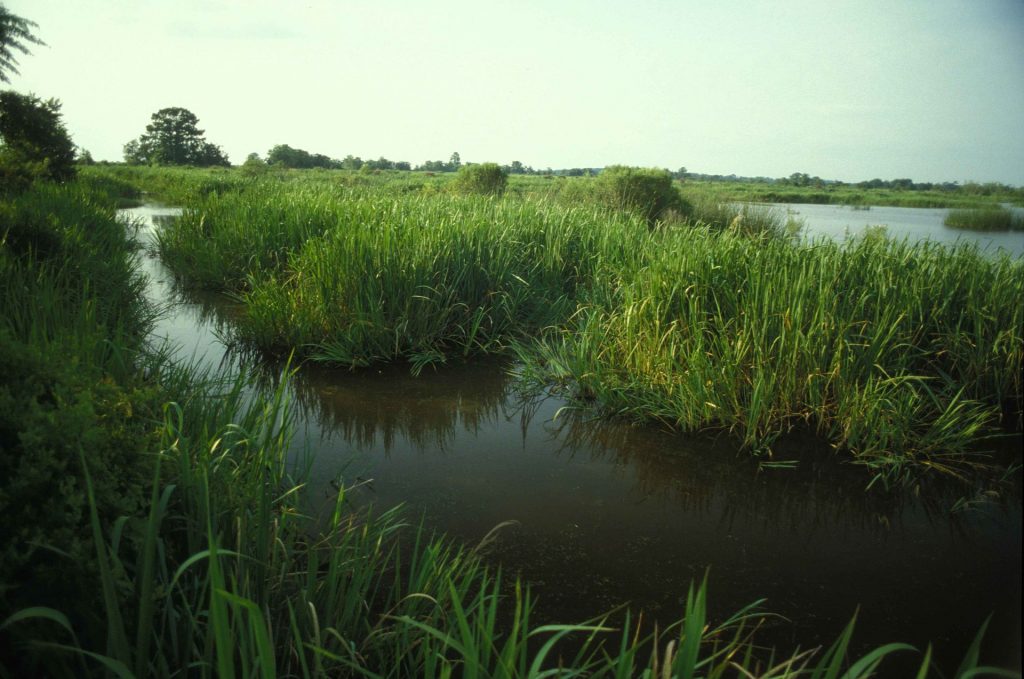
The ELI-Stetson Wetlands Workshop featured lively panel discussions.
Stetson University College of Law hosted the Sixth Annual ELI-Stetson Wetlands Workshop and Edward and Bonnie Foreman Biodiversity Lecture on Nov. 8 in Gulfport.
Dr. M. Siobhan Fennessy presented the Foreman Biodiversity Lecture on “Assessing the Performance of Wetland Restoration for Biodiversity and Ecosystem Services: Is there an App for that?”
Dr. Fennessy discussed the biodiversity and ecosystem services supported by wetlands that are among the most critical for human well-being, the need for wetland restoration projects, and recent developments in evaluating those projects. Fennessy teaches and conducts research on inland and coastal wetlands and their biodiversity.
“I think the most important message is that we have lost an enormous amount of our wetlands,” said Dr. Fennessy. “They’re incredibly important in terms of the biodiversity they support, and the benefits they provide in terms of ecosystems services.”
The Wetlands Workshop included a panel on “In-Lieu Fee Compensatory Mitigation” featuring Dr. Rebecca Kihslinger of the Environmental Law Institute, Erin Okuno of Stetson’s Institute for Biodiversity Law and Policy, Karen Johnson of the Nature Conservancy, Alex Robertson of the Georgia-Alabama Land Trust, and Stetson Institute for Biodiversity Law and Policy Director Professor Royal Gardner.
A second panel on “The Role of Public Mitigation Banks and Programs” featured David Urban of the Ecosystem Investment Partners, Martha Gruber and Philip Rhinesmith of the Southwest Florida Water Management District, Andrew Zodrow of the Environmental Protection Commission of Hillsborough County, Michael Dema of the City of St. Petersburg, and Stetson University Professor Clay Henderson.
A networking reception was sponsored by Mechanik Nuccio Hearne & Wester, P.A.