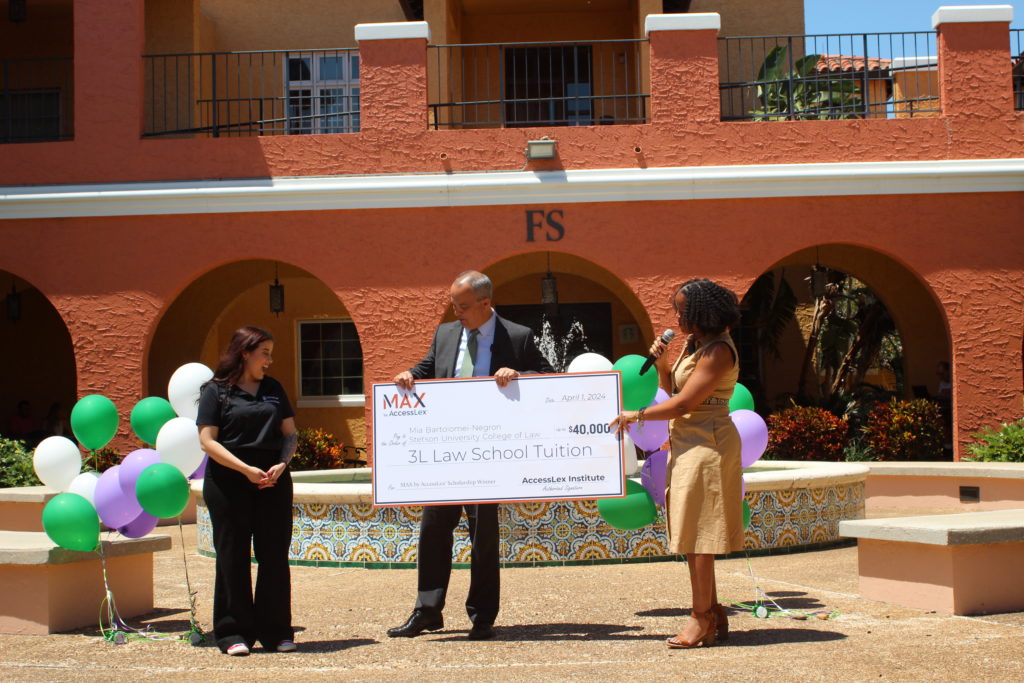
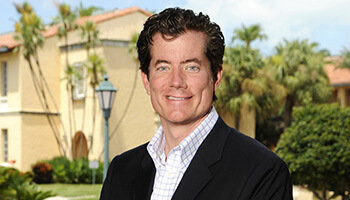
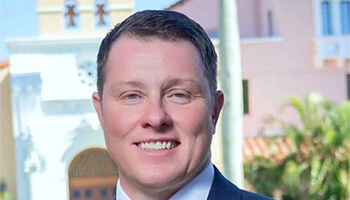
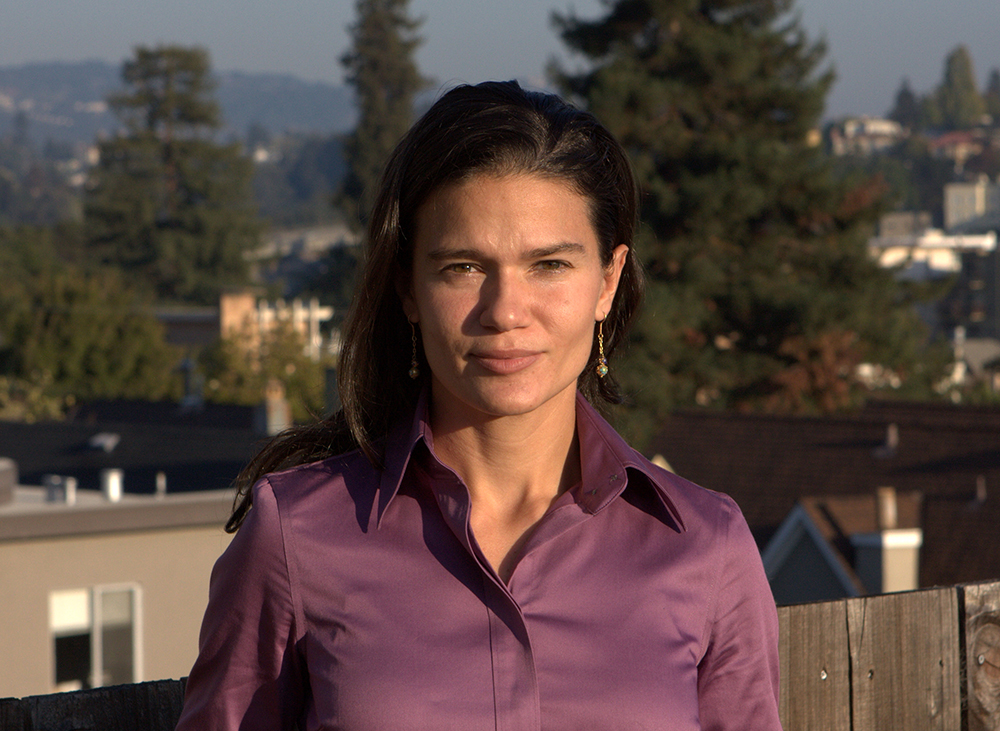
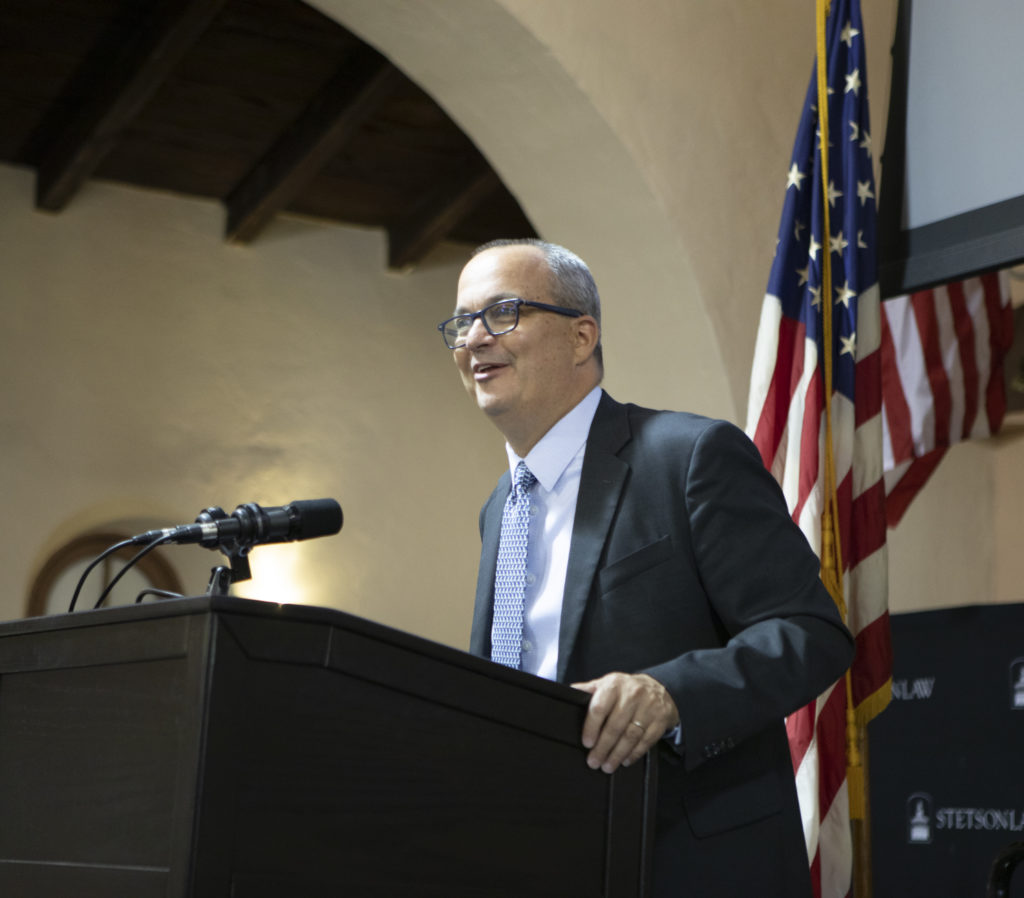
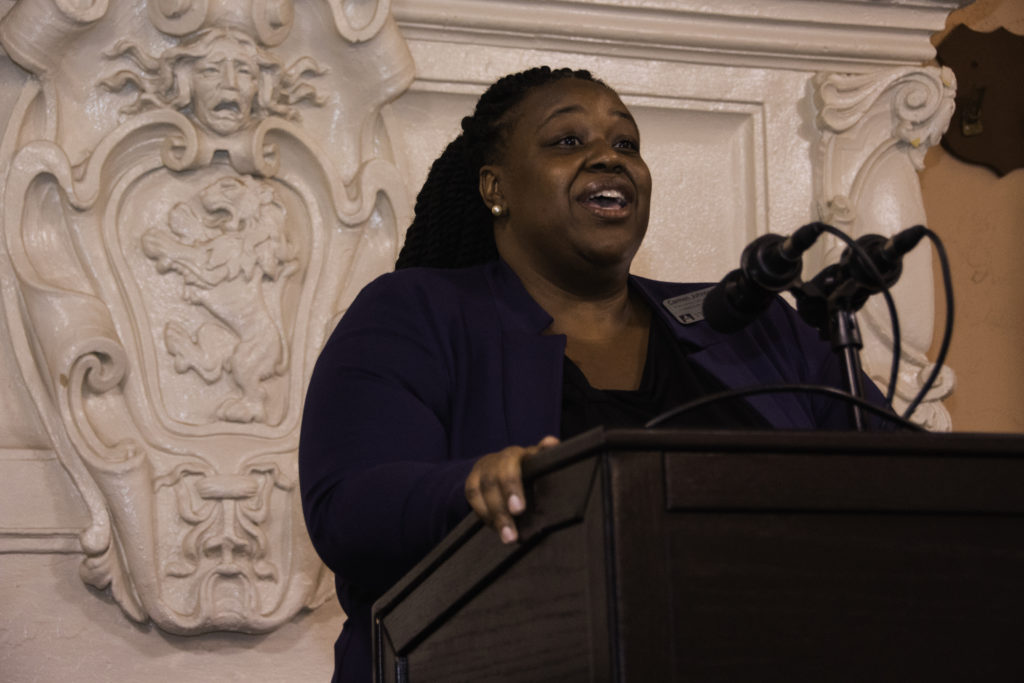
Left to right: 2L Mia Bartolomei-Negron, Dean Benjamin Barros, AccessLEX financial advisor LeAndra Ross
Given her focus on tax law, April 15 was always going to be a significant date for Stetson 2L and J.D./M.B.A. candidate Mia Bartolomei-Negron.
But Tax Day 2024 – Monday, April 15 – will now hold even greater significance for her.
Faculty, staff, and students gathered in Crummer Courtyard in the early afternoon to surprise her with the news that she was one of three law students in the nation – and the first ever in Florida – to be awarded the 2024-2025 MAX by AccessLex® $40,000 Grand Prize Scholarship.
Naturally, the fanfare included an oversized check.
A welcome surprise
The scholarship will cover costs associated with her 3L year.
Bartolomei-Negron said she was “absolutely shocked” when she was presented with the check – but thrilled about the significant financial relief.
“It was completely unexpected, but it came at the perfect time,” she said. “With my 3L year right around the corner, I feel incredibly grateful and at peace that my last year’s tuition will be completely covered. Thank you, Access Lex, for this wonderful gift.”
Supporting student financial literacy
Bartolomei-Negron was surprised for a good reason.
Nonprofit legal and financial education organization AccessLex supports law students in a variety of ways, including offering free insights on financial health as well as webinars via MAX by AccessLex®. The program automatically enters participating students into the drawings for multiple scholarships of varying financial awards, from $5,000 to $40,000.
Most American Bar Association-accredited law schools participate in the program. This means Bartolomei-Negron was one of thousands of students in the running.
Financial coach LeAndra Ross traveled to campus to present the award.
“I am excitedly here today to let you know, Mia, that you have been the winner of our $40,000 scholarship out of thousands – thousands – of students who have engaged in this program, which is free to any of you who are law students,” she said.
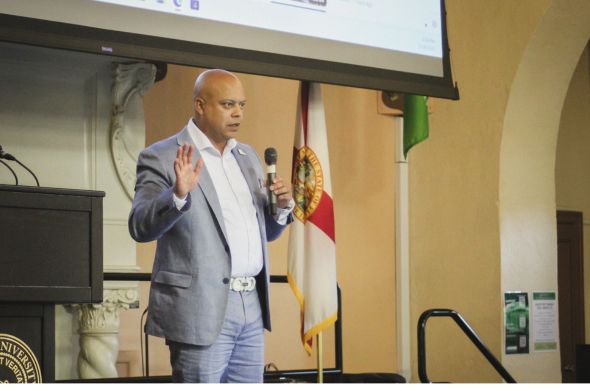
Jon-Adrian “JJ” Velazquez speaks at a Stetson Law Innocence Initiative event.
A young father of an infant and a toddler, Jon-Adrian “JJ” Velazquez walked into a New York City police station in 1999 thinking he was helping solve a murder.
His father, who had died recently, had been a police officer and Velazquez trusted the system. Plus, he was on the other side of town when the crime occurred.
“It was the last choice I made as a free man,” Velazquez said.
What ensued were more than two decades in prison fighting his incarceration at Sing Sing Correctional Facility – and not knowing if he would ever experience freedom again.
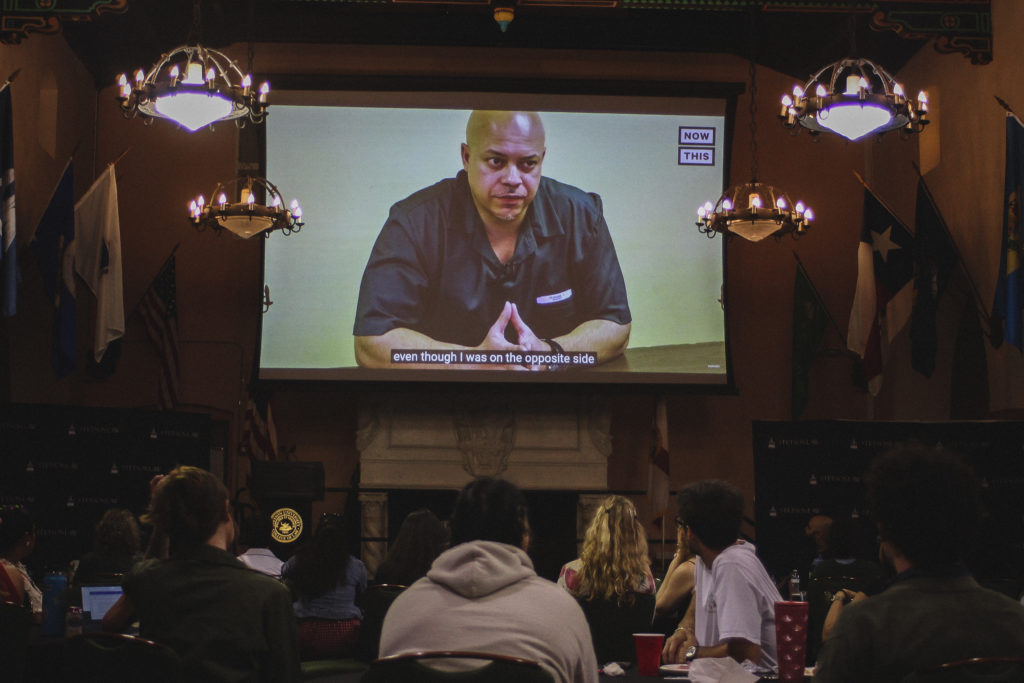
Now a vocal advocate for criminal justice reform, Velazquez spoke March 18 at Stetson Law at an event relaunching the Stetson Law Innocence Initiative, a student organization guided by Professor Judith Scully, co-director of Stetson Law’s Social Justice Advocacy Concentration.
Law Professor Judith Scully introduces speaker JJ Velazquez.
Scully said that conservative estimates place the number of wrongfully incarcerated individuals in the U.S. between 30,000 and 170,000.
“Many people in prison are innocent and they are locked up behind bars,” Scully said. “As part of the legal profession, we are responsible for addressing this problem.”
Early on in his sentence, his fight led him to contact Dan Slepian, an investigative journalist whose work has helped overturn multiple wrongful convictions. Slepian’s work ultimately helped prove Velazquez’s innocence.
Still, it took years for Velazquez’s clemency application to receive the governor’s signature – it was one of the last things outgoing New York Governor Andrew Cuomo signed before he left office. On August 17, 2021, after nearly 24 years in prison for a crime he did not commit, Velazquez was granted clemency. On September 9, 2021, he was released.
His efforts to fight the systemic issue of wrongful incarceration – beyond just his own – began when he was still behind bars with projects like Voices from Within, a multimedia initiative that explores the criminal justice system from the perspective of the incarcerated. As national program director for the Frederick Douglass Project for Justice, he now advocates for criminal justice reform – a mission that brought him to the Oval Office not long after he left Sing Sing.
“I feel like I was placed in prison for a purpose,” Velazquez said. “And while I’d never raise my hand and volunteer to do that time all over again, I won’t change what happened, either. What I’ve learned is instrumental to help change this country in the future.”
Advice for students
Calling wrongful conviction “the worst nightmare any person in this world can face,” Velazquez said such occurrences do not only affect individuals incarcerated for crimes they did not commit, but also families and entire communities.
“All of us, in some way, form or fashion, help each other get through the day,” he said. “And when you start taking those members out of the community, what you’re doing is fracturing your community. And if you fracture it enough, it can break.”
While advocating for systemic change is critical, Velazquez said law students should look to their own work as they seek to transform society – and practice things like listening to their own instincts when defending a client or, as prosecutors, not letting the pursuit of convictions get in the way of doing what is right.
“We’re amenable to peer pressure. We’re amenable to whatever society believes success is,” Velazquez said. “As lawyers, don’t allow a culture to change who you are.”
Wrongfully incarcerated for nearly 24 years, Jon-Adrian “JJ” Velazquez has been telling his story to national media outlets – and even the President of the United States.
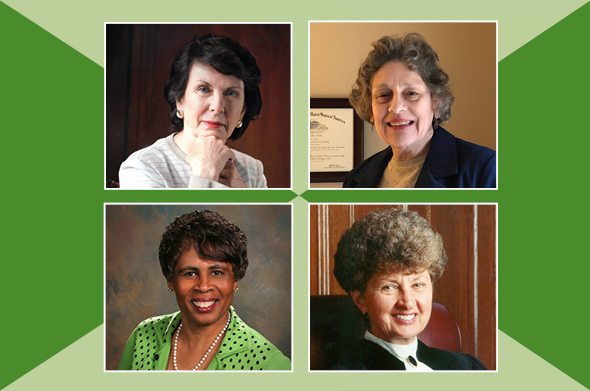
Clockwise from top left: Former GA Supreme Court Chief Justice Carol Hunstein; Retired USDA General Counsel Eunice Luke; Senior Judge for the Middle District of Florida Elizabeth Kovachevich; Former FL Supreme Court Chief Justice Peggy Quince.
By Curtis Krueger
More than half the students at Stetson University College of Law are women, and this has been true for more than a decade – but some pioneering lawyers from Stetson remember a far different time.
Eunice Luke, for example, graduated from Stetson Law in 1966. She was talking not long ago to some younger female lawyers in Atlanta.
“They couldn’t get their head around the fact that I was the only woman in my class,” she said.
But when Luke visited the Stetson campus a few years ago for her 50th reunion, she was the one trying to get her head wrapped around what she saw.
“I looked around the campus and there are all these women all over the place,” Luke said. “And I’m thinking, ‘Oh my gosh this is so different.’”
Luke and other women in the Stetson Law community were trailblazers, even if they don’t often use such words about themselves. They can remember the people, sometimes their own classmates, who didn’t believe they belonged in law school and the skeptical looks they got in their first job interviews, in spite of their newly minted Stetson Law diplomas.
Making change on campus & the legal profession
Against unlikely odds, these women made an impact — not just on Stetson Law, but on the legal profession as a whole.
There’s Elizabeth Kovachevich, who graduated from Stetson Law in 1961 and went on to become a U.S. District Court Judge for the Middle District of Florida.
There’s Carol W. Hunstein, who graduated in 1976 and went on to become chief justice of the Georgia Supreme Court.
There’s Luke, who graduated from Stetson, went on to a career in the federal government, and then established a scholarship to help other Stetson students.
And there’s Peggy A. Quince, the first African-American woman to become chief justice of the Florida Supreme Court. Although she received her law degree from the Catholic University of America, she has been closely associated with the Stetson legal community as a friend, supporter, board of overseers member, and inductee into the Stetson Law Hall of Fame.
A history of elevating women
Stetson, which is Florida’s first law school, also holds the distinction of having the state’s first female law school graduate, in 1908. That didn’t make it a common occurrence. While female lawyers did exist in the 1960s, they were, as Luke put it, “as rare as hen’s teeth.”
When Hunstein enrolled in the 1970s, she was one of six female law students, the largest number of any class in Stetson Law history up to that point.
“We were sort of an oddity,” she said. “The men frankly thought we were there to marry a lawyer.”
The men also could be heard grading the women by appearance, on a scale of 1 to 10.
“But all the women graduated,” she said of the six in her class.
Kovachevich recalls what she terms “the Stetson shuffle.” When a female student presented in class, “the fellows in the class would shuffle their feet and make that noise, like you’re on your way out of here.”
“It wasn’t a very pleasant experience and I for the first time in my life experienced discrimination, and it was gender discrimination,” she said.
In spite of the slights, these women persevered, each believing they had to make the most of their opportunity. Kovachevich’s grandfather, an immigrant from Croatia, had urged her to study the law because of his deep love for the freedoms guaranteed by the U.S. Constitution. She wanted to honor his wish.
Hunstein first thought of going into law after a college aptitude test suggested she would excel in a legal or military career. Once in law school, she was determined to succeed.
“It was so important to me to have this opportunity, something that I never dreamed would be available to me,” said Hunstein, who was the first in her family to graduate from college.
Facing early-career challenges
For these women, earning a law degree was a huge accomplishment, just as it is today. They knew that after passing the bar exam, they could reach out to any law office and seek a job – but that didn’t mean anyone would listen.
Luke said some law firms simply ignored her applications. One lawyer asked how many children she intended to have. It took her by surprise. All she managed to blurt out was, “I’m not even engaged.”
When she realized the federal government paid men and women the same, she applied. She was hired by the U.S. Department of Agriculture and worked there for 34 years.
Kovachevich became a sole practitioner who “specialized in anything that walked through the door.”
After she was appointed by Florida Gov. Claude Kirk to serve on the Board of Regents, friends told her she should run for office. She set her sights on a circuit judgeship.
“There was not any support from the local Bar, even though I was secretary of the (St. Petersburg) Bar Association,” she said. “But here again when a woman had the audacity to offer herself for public service, wow that wasn’t acceptable.”
But Kovachevich was successful, winning election as a circuit judge in 1982. President Ronald Reagan appointed her as a U.S. District Judge in 1982. She is now a senior judge in Florida’s Middle District. After more than four decades on the bench, she feels she has been exactly in the right place.
“I just had the feeling that this was what I was meant to do…. I have a firm religious belief in God and I felt that this is what God wanted me to do. And I’ve tried to do it to the best of my ability,” Kovachevich said.
Hunstein, who had managed to make it through law school as a single parent, began her job search in Georgia.
“I couldn’t get a job searching titles,” she said. “That’s true.”
But a program in Fulton County allowed attorneys to come to the Atlanta jail on Mondays and be assigned misdemeanor cases, which needed to be resolved by the end of the week.
“After which you would be paid $50,” she recalled. “And that’s slowly how I built my practice.”
She handled litigation, criminal defense, domestic relations, and more.
“I loved being in the courtroom,” she said.
She said she was generally treated well by fellow attorneys and by juries, but sometimes found judges could be surprisingly condescending. She remembers one in particular.
“He was absolutely horrible to me,” she said. “He called me ‘little lady’ and any time he could rule against me he would.”
But this judge gave her inspiration once she realized, “I could be a better judge than he was. That was the motivation for me running for a Superior Court judgeship in DeKalb County.”
With help from friends who knew how to run a good campaign, she was elected in 1984. She eventually applied to be named to the Georgia Supreme Court. Then-Gov. Zell Miller appointed someone else, also a woman, and conventional wisdom was that two women would not be appointed to the high court in a row.
But a friend encouraged her to apply again anyway, and Miller did appoint her. When she got the call, she said, “There was just this flood of emotion. I was just so grateful to have that opportunity. I still call him my governor.”
A common thread
All these women showed the acumen and grit to succeed. And all say Stetson has been an important part of their story.
“Without an excellent education, with all the challenges academically and professionally, where would I be?” Hunstein said. “They were there for me and they gave me the foundation to become a good lawyer, a good judge and really honor the law.”
Luke, the retired USDA attorney, established a scholarship because she received one in her third year at Stetson Law that was crucial to helping her finish school. She wanted to make sure others would have the same opportunity. The scholarship is open to women and men.
Kovachevich has given back much to Stetson also, through an extensive judicial internship program in the federal court.
Inspiring future generations
Quince says that while she did not attend Stetson Law, “the law school was and is important to me because it was a part of the legal community that I was also a part of.”
“I don’t necessarily consider myself a pioneer,” she said, but she strongly believes in the value of women and minorities having the opportunity to succeed in areas once closed to them.
“I take pride in the fact that I was the first African American female to be appointed to both a district court of appeal and the Florida Supreme Court,” she said. “It was also an honor and a privilege to be the first African American female to head a Florida branch of government when I was the chief justice of the Florida Supreme Court.”
Yes, she said, these firsts were important to her. But what she really hopes is for them to be an inspiration to others.
“I hope that young people will look on these accomplishments as a chance to say ‘I can do this too and more,'” she said.
An earlier version of this story ran in the Spring 2019 edition of Stetson Lawyer magazine.
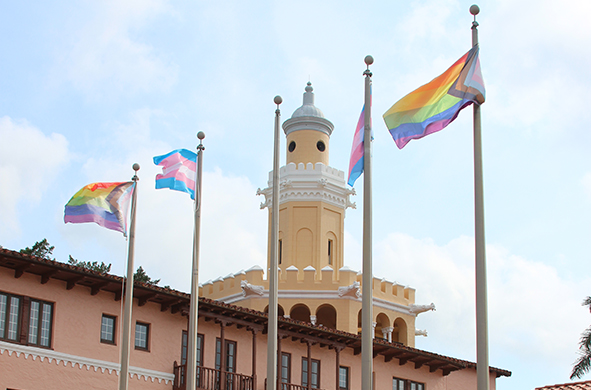
Pride flags fly on Stetson Law’s Gulfport campus every June.
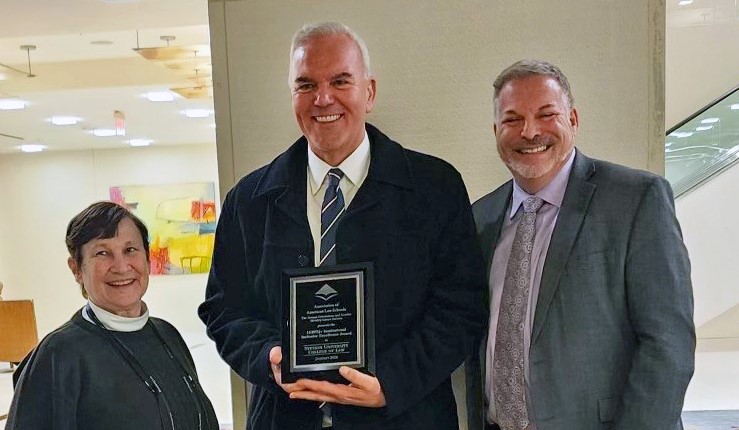
Reflecting Stetson Law’s deep commitment to diversity and inclusion, the Association of American Law Schools Section on Sexual Orientation and Gender Identity Issues (SOGII) has chosen the college for its 2024 LGBTQ+ Inclusive Excellence Award.
The recognition follows years of considerable effort recruiting and enrolling LGBTQ+ students, supporting them in their law school journey and beyond, and creating opportunities for them to advocate for the LGBTQ+ community both on and off campus.
“This award is the result of a long, multifaceted campaign to invite the nation’s brightest aspiring legal professionals to build upon the successes of Florida’s First Law School,” said Admissions and Student Financial Planning Director Darren Kettles. “To call this accomplishment an honor is an understatement – we are absolutely thrilled and inspired to continue this important work.”
Building on years of success
The award follows years of measures aimed at ensuring LGBTQ+ students are not only welcome on campus, but supported and celebrated – and that they have opportunities to network and gain experience advocating on the causes that matter most to them.
Stetson Law Professor Joseph Morrissey
“This is huge,” longtime Stetson Law Professor Joe Morrissey said of the award. “We’ve made incredible progress in the last 20 or so years, culminating in Stetson being able to claim well-deserved, award-winning leadership in the LGBTQ+ inclusivity space.”
Morrissey said much of the credit goes to Kettles, whom he said “has not only communicated to future generations of Stetson lawyers about our inclusive culture, but has also shaped that culture by cultivating more and more diverse cadres of admits.”
Inviting all to study law
Under the leadership of Kettles, the College of Law has for years actively invited members of the LGBTQ+ community from around the nation to consider Stetson Law for their legal education, telling them, “You Belong Here.”
The result? A diverse, thriving community of students eager to explore the law through an LGBTQ+ lens.
Currently, LGBTQ+ students made up five percent of the fall 2023 entering class. The campus community strives to foster an inclusive, supportive environment to help them succeed in their coursework and in their career pursuits.
“We believe that creating a law school community where LGBTQ+ students feel welcome and have opportunities to thrive will have impacts beyond our campus,” Kettles said. “These students go on to cultivate meaningful careers advocating for the people and causes most important to them.”
Thoughtful community engagement
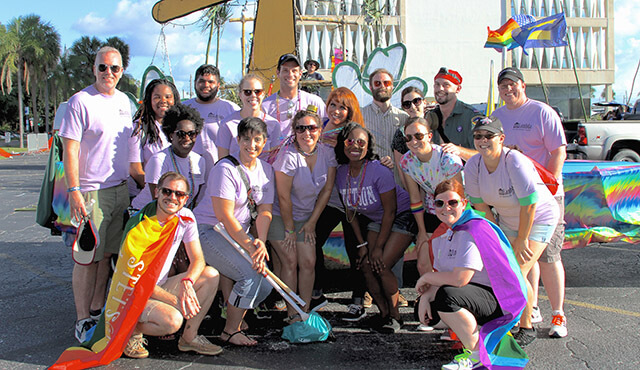
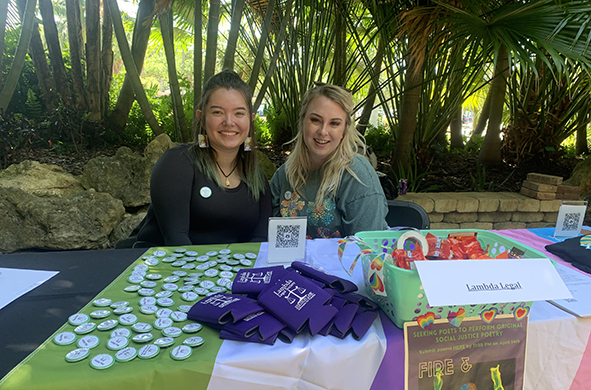
Recognizing the needs and contributions of the growing LGBTQ+ community in the greater Tampa Bay region, the college has for years engaged in community outreach efforts such as marching in and tabling at St. Pete Pride, Florida’s largest Pride parade and street fair. In fall of 2023, in partnership with Lambda Legal Society, Stetson Law’s LGBTQ+ student organization, the college hosted a fundraising event culminating in a drag show.
Stetson Law alumnus Nathan Bruemmer
In partnership with alumnus Nathan Bruemmer, the college developed a Name Change Clinic for students, employees, and local community members. Students also embarked on a collaboration with the City of Gulfport’s LGBT Resource Center, which included establishing a liaison position for a Lambda member on the LGBT Resource Center’s Executive Board.
Bruemmer, a Tampa native, recently served as Florida’s LGBTQIA+ consumer advocate with the Florida Department of Agriculture and Consumer Services, thereby making history as the first transgender statewide appointee in the U.S. He said the AALS SOGII award has been years in the making – and that it comes at a critical time.
“To protect the rule of law and ensure justice for all, it is imperative for law schools to graduate attorneys from a diverse array of backgrounds who are ready to use their skills to tackle the mounting challenges we face,” Bruemmer said. “Stetson Law didn’t just make me feel welcome – this community ensured that real-world opportunities to advocate for the LGBTQ+ community were woven into my legal education. This is a major reason that I remain connected to this community, and why I am proud to call myself a Stetson lawyer.”
Creating a home for diversity
In 2021, Stetson University created the role of Executive Officer for Diversity, Collaboration, and Inclusion to develop measurable ways of advancing leadership in diversity, equity and inclusion while building a community where members of the LGBTQ+ community feel safe and capable of thriving. Stetson Law alumna Carmen Johnson, who was hired for that role, works tirelessly to identify opportunities for fostering a diverse campus community.
“Whether it’s flying the Pride flag over the campus for the duration of Pride Month or offering courses examining LGBTQ+ issues and the law, Stetson Law is home to concrete actions that not only show students from underrepresented communities that they belong, but that they can use what they learn here to make a difference,” Johnson said. “I am proud yet humbled that we are now recognized as a national leader in this space.”
Relevant, impactful programs & course offerings
Home to leading scholars in areas pertaining to the relationship between the law and gender and sexuality, Stetson offers extensive coursework in this area, including Law and Sexual Orientation, Feminist Jurisprudence, Reproductive Technology and the Law, Employment Discrimination, Human Rights in International Family Law, and Civil Rights and the Constitution: DOMA/Marriage.
Stetson Law’s Lambda Legal Society actively provides a forum to explore legal issues related to sexual orientation and gender identity. The organization welcomes students of any sexual orientation interested in raising awareness of the issues attorneys face with the increasing number of LGBTQ+ clients who seek legal protection.
Lambda Legal Society values engaging with the greater community through events like St. Pete Pride.
In 2021, Lambda became a National Affiliate of the LGBTQ Bar, and in 2023, the organization established an endowed Pride Scholarship. Lambda hosts regular events, including displaying a National Transgender Remembrance Day Memorial, hosting important community discussions such as Intersectionality: Black and LGBTQ+ Communities with nationally renowned LGBTQ+ activist and Executive Director and Founder of Equality Florida Nadine Smith, and offering pronoun pins at tabling events like Diversity Week. In June of 2021, the organization spearheaded the raising of the Pride Flag over campus. It flew for the entire month and has done so every June since.
To help students connect their growing legal acumen in this area, Lambda also launched a Student Mentorship Program, drafted a Chosen Pronoun and Chosen Name policy for Stetson students and employees and created an “Inclusive Classroom Training” during Annual Law Faculty Orientation, a comprehensive overview of chosen pronouns and names as well as the college’s expectations towards inclusion.
Lei-Lani Rogers, president of Stetson Law’s Lambda Legal Society (left), and Hunter Wolf, the group’s vice president, in 2022.
“There is no community like the LGBTQ+ community and it is a testament to our resilience that we are one of the largest and most active student organizations on campus,” said Hunter Wolf, vice president of Lambda. “It is incredibly special to be recognized for the work that we have put in to show that Stetson Law is not only an ally to the LGBTQ+ community, but a fierce advocate.”
Supportive faculty & campus leadership
From day one of law school, students will find professors who are members of the LGBTQ+ community or passionate allies eager to help students develop their legal skills.
Former Chair of AALS SOGII Subcommittee and longtime Law Professor Ellen Podgor launched an independent student research project highlighting and creating the Past Chairs of AALS SOGII Leadership and Initiatives Project, with plans to publish it soon.
Left to right: Law Professor Ellen Podgor, Admissions & Student Financial Planning Director Darren Kettles, and Associate Dean of Academic Affairs & Professor of Law Jason Palmer celebrate Stetson Law winning an Association of American Law Schools’ LGBTQ+ Inclusive Excellence Award in January 2024.
Recently, Kettles served as a member of the Law School Admission Council Annual Meeting and Educational Conference Planning Committee, where he developed sessions aimed at assisting law school admission teams in advancing work on behalf of the LGBTQ+ community.
In fall of 2023, Professor Morrissey was a guest on an episode of the Real Cases podcast discussing attracting LGBTQ+ students to law school in states that appear hostile towards them.
With vision, collaboration, and support from executive leadership, Stetson Law will continue to thrive as a place where members of the LGBTQ+ and allies are invited to celebrate their shared passion for the law and for justice for all.
“When it comes to initiatives promoting inclusion and justice for all, we are just getting started,” said College of Law Dean Benjamin Barros. “We look forward to celebrating our diverse campus community in 2024 and beyond, starting with this award.”
Artificial intelligence is poised to transform the way lawyers work. Photo courtesy of Deepak Pal/Wikimedia Commons.
Just over one year after Open AI’s ChatGPT launched, artificial intelligence is transforming workplaces everywhere – including law firms.
Ian McDougall
To London-based expert Ian McDougall, executive vice president and general counsel for LexisNexis’ Legal & Professional Division and president of its Rule of Law Foundation, artificial intelligence (A.I.) is poised to have a transformative impact on how lawyers work – but it will not likely replace them.
Law Professor Luz Nagle recently hosted McDougall for an afternoon lecture in the Florin-Roebig courtroom at Stetson Law to discuss the impact of artificial intelligence on the legal profession.
“I’m not someone usually given to hyperbole, so when I say this is an industrial revolution, on that kind of scale, it really does mean something,” he said.
Necessary, if uncomfortable
Referring to himself as a “dinosaur,” McDougall joked about how he comes from a generation for whom the term “folder” once referred to a physical item used to store paper documents. Meanwhile, generations of lawyers will join the profession never knowing a world without wifi, BlueTooth, or mobile phones. A.I. will likely join that list – even if there will be resistance at first.
“We’re talking about a profession that’s notoriously conservative and reluctant to change,” he said. “That’s been its tradition. But that’s understandable, because the legal profession is on a constant quest for certainty in an increasingly uncertain world.”
It is important, McDougall stressed, to distinguish between different types of AI: generative vs. predictive, for example, and closed systems vs. open systems.
Whereas an open system would scan the entire internet – fiction, satire, and all – to inform a legal brief it was prompted to create, a closed system would be limited to source materials contained within it. The latter could help lawyers create complex, well-sourced legal documents within seconds.
“When it comes to production efficiency, we cannot compete with computers and robots,” McDougall said. “For the legal profession, doing it the same old way is no longer an option.”
Legal strategies could become much more reliant on data and analytics – and less on a lawyer’s own subjective experience.
“I will predict that in the future, the expression ‘professional judgment’ will become a euphemism for a decision that is taken without sufficient data,” McDougall said.
Changing – not replacing – legal expertise
Citing concerns over the possibility of AI posing an existential threat, McDougall pointed to employment rates that were relatively unchanged after previous industrial upheavals.
When the internal combustion engine became ubiquitous, taxis powered by horses went away – but the job of a taxi driver never did.
“It did not replace the taxi driver, but it fundamentally altered the skills a taxi driver needs,” Mc Dougall said.
Likewise, he said, the legal profession has existed for centuries and will still play a critical role in society, but those who are a part of it may have to shift their thinking about how they work – and, importantly, how they are compensated.
“In a world where billing for time is gone because the artificial intelligence can do the same thing in a millisecond, and this is going to shock some people, billing for value will be required,” McDougall said. “Lawyers will actually have to assess how much value they contributed to people rather than just charging for time.”
For the fourth consecutive year, Stetson University College of Law has won INSIGHT Into Diversity‘s Higher Education Excellence in Diversity (HEED) Award, a national honor recognizing U.S. colleges and universities that demonstrate an outstanding commitment to diversity and inclusion.
The 2023 HEED Award recognizes Stetson University as a whole for its diversity initiatives as well as those specific to Stetson Law. This is the first time Stetson University, which is headquartered in DeLand, Florida, has won this award.
A Civil Rights and the Constitution travel course is an immersive experience at Stetson Law.
The winners, announced Oct. 11, underwent a rigorous application process that examined recruitment and retention of students and employees at their institution, as well as supportive leadership for diversity in campus culture.
“Our standards are high, and we look for institutions where diversity and inclusion are woven into the work being done every day across their campus,” said Lenore Pearlstein, publisher of INSIGHT Into Diversity, the oldest and largest diversity-focused publication in higher education.
Years of fostering diversity & inclusion
Stetson Law was recognized for co-founding and co-leading the St. Petersburg Truth, Racial Healing, and Transformation Center in partnership with Eckerd College, the only entity of its kind in Florida. Stetson Law continues to reinvest in the effort by sharing expertise and resources beyond its Gulfport campus, exploring ways to bring communities together, and training lawyers and future leaders to be part of the work.
Law Professor Judith Scully speaks to students who completed the 2023 Youth Civic Engagement Program.
“The TRHT Center’s ultimate goal is to build the bridges necessary to connect our college campuses to community activists, government officials, and other individuals who are working on making our communities stronger, healthier, and more equitable,” said Law Professor Judith Scully, who led efforts to establish the program. “To be involved in organizing around racial healing and transformation at this moment in time in Florida is a challenging opportunity that the St. Pete TRHT Center is perfectly poised to meet.”
Stetson Law Professor Jaclyn Lopez, Director of the Jacobs Law Clinic
Stetson Law has received the HEED Award every year since 2020 for a range of diversity-related initiatives, including an enlightening Civil Rights & the Law travel course and integrating the role of race in the legal system into course materials for required Criminal Law and Legal Writing & Research courses. This year, it received an honorable mention for creating the Dick & Joan Jacobs Public Interest Law Clinic for Democracy and the Environment.
“The Jacobs Law Clinic prioritizes ensuring our next generation of lawyers has practical opportunities to develop leadership skills like empathy and cultural humility,” said Law Professor Jaclyn Lopez, director of the Jacobs Clinic. “Our law students represent diverse clients with challenging legal issues and leave the clinic prepared to bring change to their communities.”
A unique & welcoming environment
Stetson was one of 108 colleges and universities across America selected for the award, joining Columbia University, Cornell, Johns Hopkins and UC Berkeley. Each school will be featured in the November / December issue of the magazine.
Dean Benjamin Barros commends students who took part in the 2023 Youth Civic Engagement Program.
“Cultivating a law school environment that is welcoming to all is a critical part of our efforts to equip our students to advocate for a more just future,” said College of Law Dean D. Benjamin Barros. “It is an honor to be recognized for the investment – of time, energy, and dollars – in meaningful diversity initiatives. Winning our fourth HEED Award in a row speaks to the wonderfully vibrant community of faculty members, staff, students, and alumni we have at Stetson Law.”
“We are elated to receive the HEED Award, which is a wonderful affirmation of our efforts throughout the university to provide an academic and professional experience that is personable and authentic for community members of all backgrounds and identities,” said Carmen Johnson, JD, Stetson’s Executive Officer for Diversity, Collaboration, and Inclusion and a Stetson Law alumna.
Carmen Johnson, Stetson University’s Executive Officer for Diversity, Collaboration, and Inclusion.
“Stetson provides such a unique and welcoming environment, and this is the result of dedicated administrative, academic, and student leadership throughout our campuses. We celebrate our community and this ongoing work and consider the HEED Award as welcomed motivation to keep going and to keep innovating,” Johnson added.
Progress on the main campus
The publication praised Stetson University for its notable investment in a new Cross-Cultural Center on the DeLand campus for underrepresented students and multicultural student groups. At a time when some colleges are facing challenges in investing in diversity and inclusion programs, Stetson renovated a historic home to create this unique, welcoming space.
“This is an incredible honor for Stetson to receive the national HEED Award and for our College of Law to receive it for the fourth consecutive year,” said Stetson President Christopher F. Roellke, PhD. “It is a reflection of the deep commitment and dedicated work of our students, faculty and staff to create inclusive and vibrant campuses that promote a sense of belonging for all our students.”
The DeLand campus also was recognized for its “Be Seen” marketing campaign that amplifies concepts of student belonging and students’ need to be their authentic selves as well as efforts on the DeLand campus to support first-generation college students, who made up a quarter of the student body in the Spring 2023 semester.
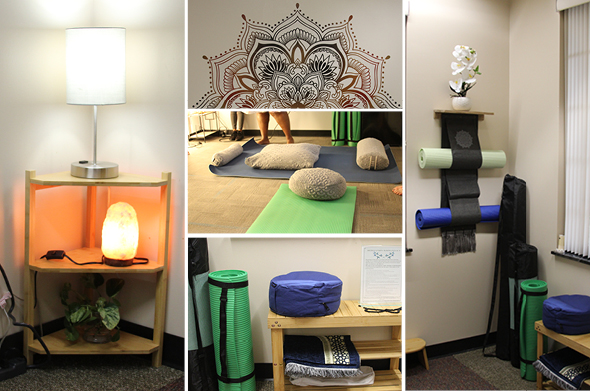
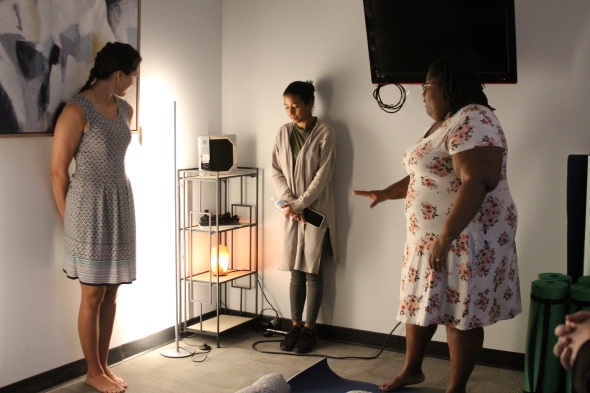
Students will find adjustable lighting, aromatherapy, yoga mats, and other features to help them destress in Stetson Law’s meditation rooms.
Reflecting Stetson Law’s commitment to mental health and wellness, faculty, staff, and students celebrated the opening of two thoughtfully appointed student meditation rooms on campus.
Members of the Office of Student Affairs, the Office of the Dean, the Student Bar Association Health & Wellness Committee, and other groups gathered April 28 to mark the occasion, which is the culmination of a collaboration among students, staff, and administration officials. The rooms, located in the Dolly and Homer Hand Law Library and the Office of Student Affairs, aim to help students balance the challenges they face with mindfulness practices, de-stress, and build resilience, be it through yoga, talking through issues, journaling, prayer, or meditation.
“Students need a place to just quietly relax – or maybe sometimes quietly scream,” said Blake Radford, who is president of Stetson Law’s Calvin Kuenzel Student Bar Association. “It makes campus a safer place to be – not just a place where you’re studying and you’re panicking… It’s a place you can relax.”
Balancing the rigors of law student life
Daily life for law students can feel nonstop as they strive not only to succeed, but to stand out.
Law school is often so focused on competition and other intensive activities, said Associate Dean for Assessment and Professional Engagement Anne Mullins, that wellness can often be an afterthought.
“We don’t always celebrate just being. And as lawyers, that’s really important for us,” Mullins said. “We’re kind of set to go and do – and the be part gets kind of underattended.”
Multifaceted meditation rooms
The two mediation rooms are located in strategic spots on campus.
The library meditation room is located in room 233 on the south side of the building’s second floor and is available 24 hours a day, seven days a week. Items for the room were made possible by the SBA, as well as the library’s Waters Wellness Fund, a donation-based fund dedicated to wellness programming for students.
The other meditation room is currently located in the Office of Student Affairs. This space will operate from 10:00 a.m. to 4:00 p.m., Monday through Friday. Items for the room, including an accessible yoga mat were made possible by the SBA, along with a donation from the Office of Student Affairs.
Dominique Alford-Raymond, right, shows students, faculty, and staff some features of a meditation room at Stetson Law.
The rooms’ ADA-friendly lighting can be adjusted by touch and changed to different colors. They also feature comfortable seating, salt lamps, a notebook for students to write down their thoughts or share inspirational messages, aromatherapy, an ambient sound machine with 50 different relaxing noise options, and more.
Dominique Alford-Raymond, chair of the SBA’s Student Health and Wellness committee, helped lead the initiative. She said the rooms were appointed to help students achieve comfort amid their most stressful moments.
“Mental health and wellness is very complex,” she said. “Just like everything else in law school, the solution to mental health is, “It Depends”. So while some may see an empty set of rooms with a couple of chairs and a salt lamp; it is actually solving a complex set of issues in a few ways.”
These include dimmable lights, aromatherapy, a calming atmosphere, ADA-compliant accessibility measures, and materials like cushioned yoga and prayer mats that vary in size, length, and texture. Such items, she said, can help deescalate anxiety or panic attacks.
“If you don’t feel comfortable, you’re not going to calm down. If you’re not at peace, your mind won’t stop racing,” Alford-Raymond, a 2L enrolled in Stetson Law’s part-time J.D. program, said.
A space for staff
Stetson Law leadership is also creating a space for staff members to relax during the workweek. The Human Resources department has outfitted a room in the Tower building with similar wellness accoutrements.
It will be located on the second-floor dorm hall (D203) and will feature a comfortable sitting area, yoga mats, coloring books, space for a new parent to breastfeed/care for a child, softer lighting, a television for streaming music or meditation videos, and more.
“It was important for us to set aside a space within our community with our employees’ well-being in mind, promoting both physical and mental wellness,” said Stetson Law Director of Human Resources Pamela Skoularakos. “We hope the room will help employees in need of a boost of energy or just a quiet space to get away from their workload for a few minutes of peace.”
She said staff should keep an eye out for a launch in the near future.
Reflecting a cultural shift
Having space where students (and staff) can relax and unwind reflects the College of Law’s commitment to inclusive excellence, said Carmen Johnson, Stetson University’s Executive Officer of Diversity, Collaboration, and Inclusion. It also invites students to process their experience at Stetson Law (and in life, in general) in a manner unique to them.
“This is really thinking about how we create spaces to be our authentic selves in multiple mediums. Whether it’s through advocacy; whether it’s through faith, prayer, meditation, and mindfulness,” Johnson said. “Everyone works collaboratively to make these kinds of spaces happen.”
These spaces also reflect an evolution in the way many individuals choose to approach professional life.
“These days, there is a lot more talk about self-care, mindfulness, and practices that offset the stresses of daily life,” said Interim Dean Theresa Pulley Radwan. “As one of the most challenging – and rewarding – pursuits one can take on, law school should be no different.”
As future lawyers whose work can be transformative for the lives of others, focusing on wellness is paramount.
“It is my hope that the self-care practices our students adopt here at Stetson Law will stay with them as they embark on their careers,” Pulley Radwan said. “You can’t take care of your clients if you don’t take care of yourself first.”
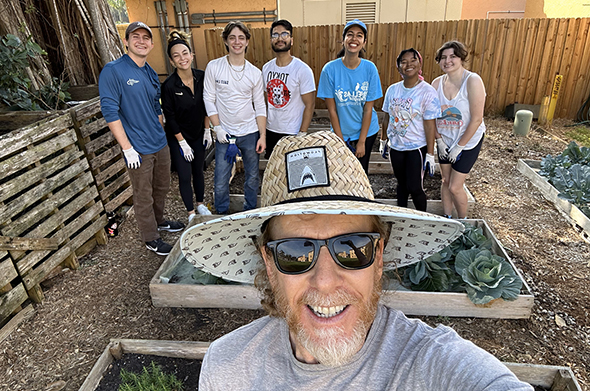
Law Professor Lance Long and members of the Food Law Society enjoy the fruits of their labor.
Obscured by trees along the north side of 15th Avenue South is a garden oasis where good things are growing.
A banyan-shaded green space yielding massive heads of organically grown cabbage and broccoli sprouts, it’s the result of a recently revived Stetson Food Law Society project.
“This year we have a beautiful garden, and I am probably one of the biggest consumers of the crops,” said Law Professor Lance Long, the Food Law Society’s faculty advisor.
Reviving an old tradition
Long said the garden is the latest – and most successful – iteration of a student-run gardening initiative dating back about a decade. Then, a series of container gardens in Crummer Courtyard was productive, but it didn’t create a verdant, sanctuary-like space like the current garden initiative does. More recently, the current site of the project – just west of the Banyan Courtyard – had fallen into disrepair.
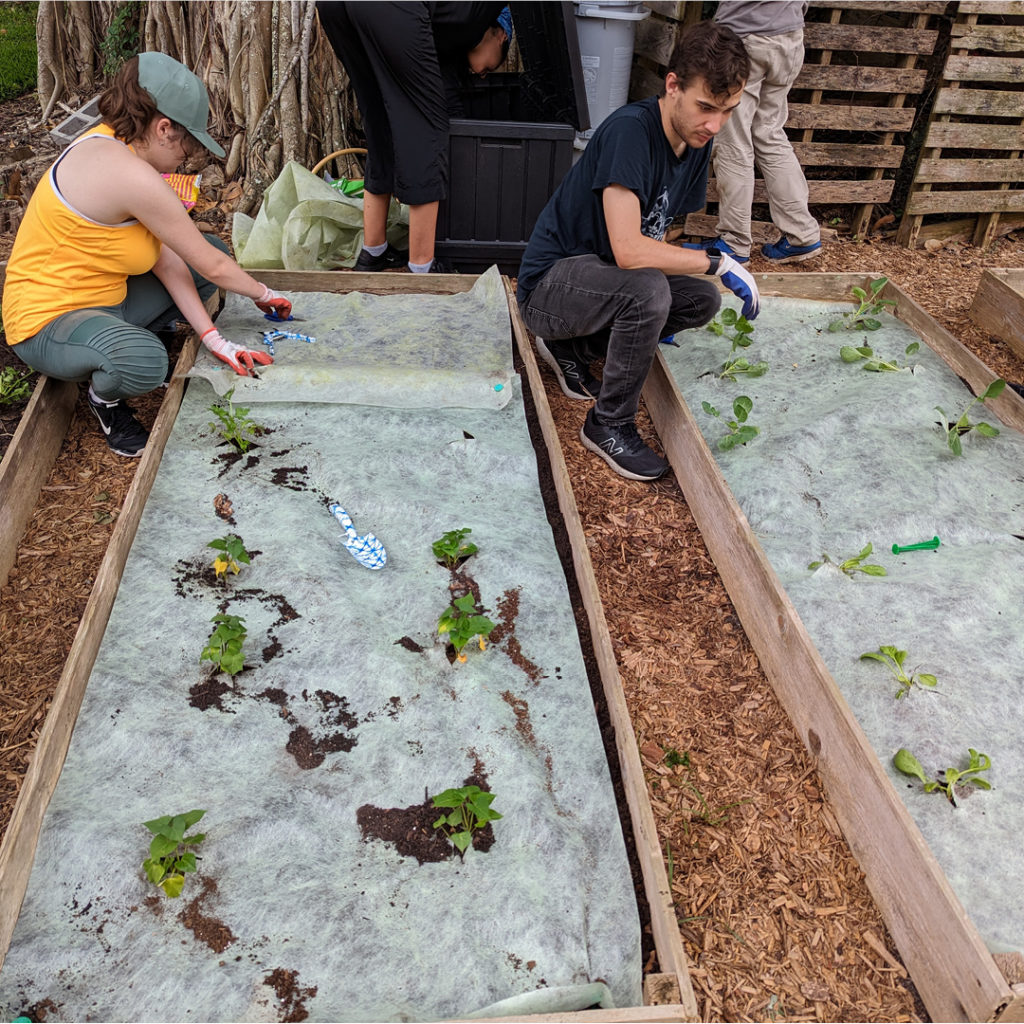
Volunteers tend to Stetson Law’s organic garden,
Fresh membership and a renewed sense of purpose inspired the Food Law Society to revive the project in the fall of 2021.
With help from the facilities department – which installed a hose and let the students use store their tools in a nearby shed – the students began making true progress on the garden in Spring 2022 as part of an environmental law class. Through planning, meticulous work, and a bit of trial-and-error, the space was thriving within six months.
Much of the labor is divided among Food Law Society President Iman Mamdouh, Vice President Jon Burton, and Treasurer Saad Chowdhury.
“The garden became our shared ‘toddler’ on campus,” joked Mamdouh. “Between the three of us, we rotate watering, covering the garden in tarps to prevent weeds, and shop for new seeds, seedlings, soil, manure, and labeling stakes.”
Before students set out to revive the garden in 2021, the space had fallen into disrepair.
It became a community effort among Stetson Law’s eco-conscious students. Other Food Law Society members assisted in de-weeding and replanting each month. One even brought used coffee grounds from the café where she works to use in the fertilizer.
“With the effort we all put in, we share in the literal fruits of our labor but also in the failed attempts that educate us in the dos and do-nots of gardening,” Mamdouh said.
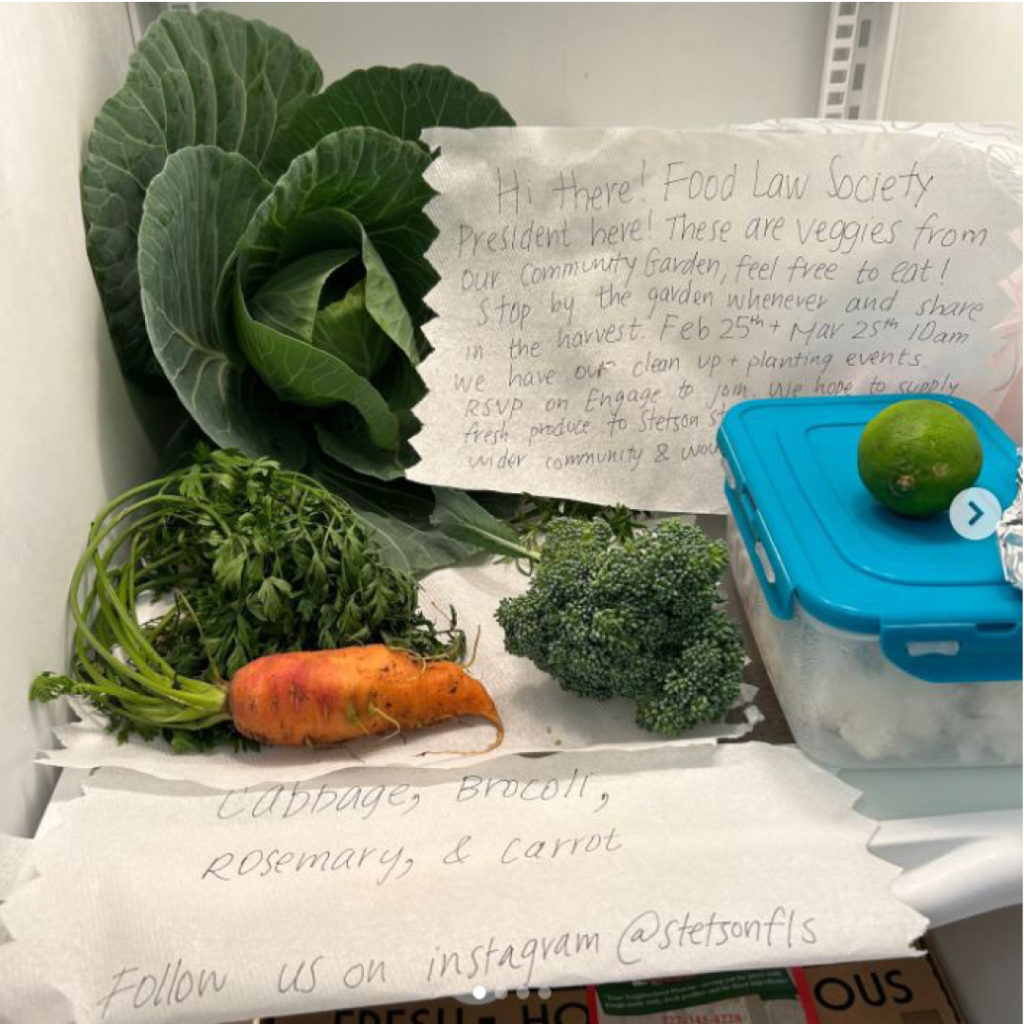
The January harvest yielded produce for all members of the Stetson Law Community to enjoy at no cost. As a shaded green space open to all, the garden is also a great place to de-stress from the rigors of law school.
“Someone can enjoy fresh produce from the garden, or destress with a garden cleanup event, or even sit among the plants under the banyan tree,” Chowdhury said. “Moreover, the garden demonstrates gratitude. Seeing where food comes from and the work needed is a humbling experience.”
Digging deeper: Cultivating conversations around food
There are, of course, much bigger-picture aspects to the undertaking.
For one, economic conditions and broader food policy in the U.S. can result in limited access to nutritionally dense foods in many communities – including, potentially, at Stetson Law.
Vegetables grown in the Stetson Law garden.
“We realized while many schools offer food, there is a deficiency of nutrients – especially for any students who were food insecure because of finances or otherwise,” Burton said.
The group also hopes the project will help individuals think more critically about what it means to “eat local,” given how the current federal-government definition of “local” may cause consumers to buy produce that’s not as sustainably farmed as they think.
“We also realized that in 2022 the transportation and display system of in-store foods when the [United States Department of Agriculture] considered ‘local’ to be within 400 miles or less of product origin introduced spoilage and some nutrient degradation compared to truly local foods,” Burton said. “We hope the garden does draw community education about the localization of foods and the importance of nutrition.”
Keeping it growing
As 3Ls, law school is drawing near its close for Mamdouh and Burton – but the garden will live on. As incoming president of the Food Law Society, Chowdhury will take the reins – and he’s got big plans.
He said he hopes to foster more food justice initiatives, from encouraging students to volunteer at local food banks to creating “an educational space where students can learn about Food Justice issues, such as food deserts, legislative hurdles, and the socio-economic determinants for nutrition in our community,” he said.
That will likely include informative signage in the garden itself as well as walking paths to help invite others to explore the connection between local food and global sustainability. “I’m relieved to graduate knowing we have set solid building blocks for the Stetson Community Garden to further flourish in the upcoming years, and I hope it becomes a Stetson landmark,” Mamdouh said.
Left to right: Jaclyn Foster, Phil Faires, Mary Roseth,, Professor Stephanie Vaughan, Matt Ceriale, Taylor Simonds, and Sam MacDougal.
Over days of intense competition, Stetson Law emerged as the only U.S. team to make it to one of the final rounds of the Willem C. Vis International Commercial Arbitration Moot in Vienna, Austria.
The five-member team representing Stetson Law at the prestigious tournament – consisting of Phillip Faires, Jaclyn Foster, Sam McDougall, Mary Roseth, and Team Captain Taylor Simonds – competed against 378 teams from 89 countries. They were one of 49 teams from the U.S. to compete – and the only U.S. team to make it into the event’s top 16 teams before advancing to become one of the competition’s top eight teams. This was the first in-person Vis competition since 2019, when Stetson’s team also advanced to the top eight.
As a top-eight team, Stetson lost in a split decision to a team from Singapore. The incredible run – which put the Stetson team in the top two percent in the world – serves as a milestone for the five competitors and their coaches, alumni Jason Stearns and Matt Ceriale, as well as Professor Stephanie Vaughan.
“Hearing Stetson’s name called not only for one of the Top 64 teams out of 378 that would be advancing, but also as the (by unanimous vote!) winner of three head-to-head elimination rounds in a row is undoubtedly the highlight of my law school career,” said Simonds.
Prestigious event, extensive preparation
The team spent months preparing for the event, which featured a fictional case involving drone manufacturers in the politically unstable “nation” of Equitoriana. The experience helped them develop their advocacy skills and explore new areas of the law.
“The entire team worked so hard in devoting ourselves to this problem for upward of five months – improving our advocacy skills, researching international standards for niche areas of law, and trying to convince ourselves and others that a helicopter-sized drone might not legally be an aircraft – and seeing all that work pay off was incredibly validating,” Simonds said.
An advocacy milestone
As both a professor and a coach, Vaughan said it was incredible to watch the team members develop their skills through diligent practice – then to advance farther than any other school in the United States.
“To say that I am proud of this team would truly be an understatement,” Vaughan said. “Being a part of this team’s success at Vis has been incredibly rewarding. It was a true feat for Stetson Advocacy.”
To the team, it was an incredible honor to emerge as the top U.S. team after competing with the likes of Harvard Law and Columbia Law School.
“Overall, this was an experience none of us will ever forget, and it allowed us an unparalleled opportunity to grow our skills in communication, research, creative argument, teamwork, and international perspectives in a way I know we will all carry into our careers,” Simonds said.
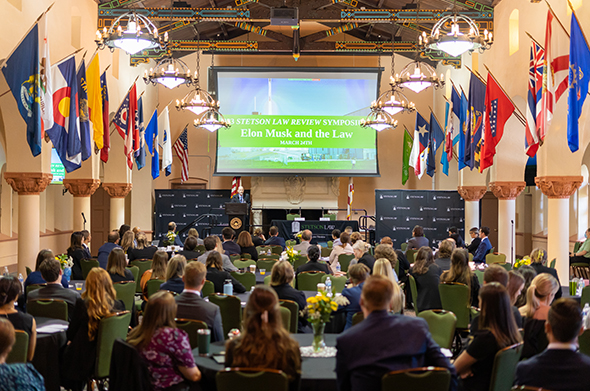
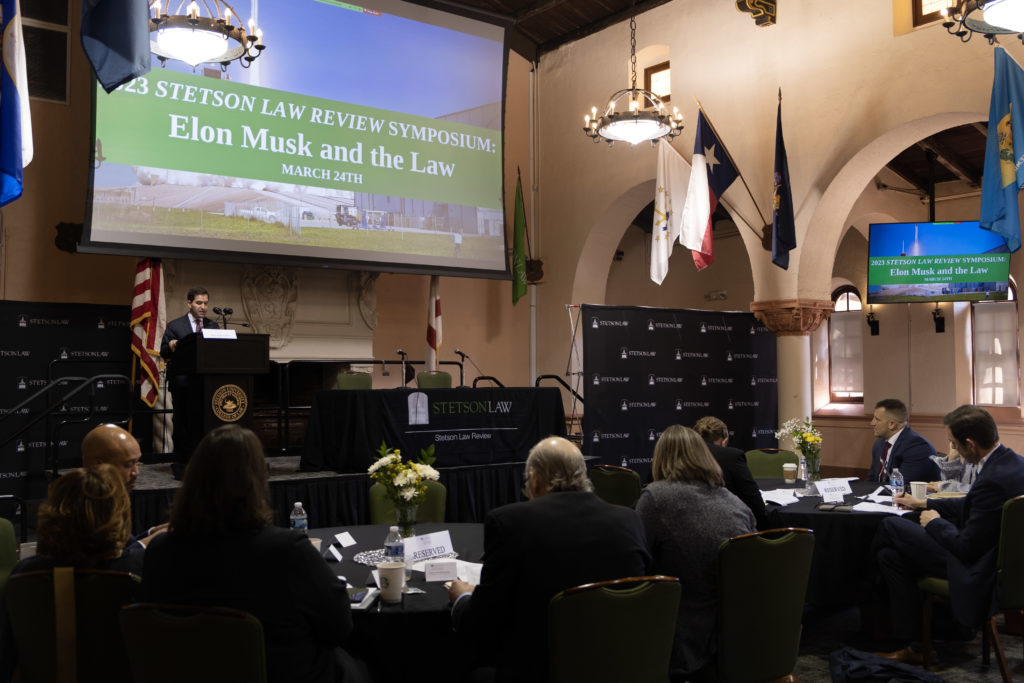
There was an air of excitement on campus as students, faculty, and other members of Stetson Law and the legal community gathered to discuss the timely topic of the 2023 Stetson Law Review Symposium: Elon Musk and the Law.
Throughout the day, esteemed legal scholars examined legal aspects of the famous and controversial billionaire’s many endeavors, from Space-X to Twitter. Speakers included experts from across the U.S. such as The University of Tennessee Rick Rose distinguished Professor Joan Heminway, Stetson Law Bruce R. Jacob Visiting Assistant Professor of Law Tomer Stein, and Florida Supreme Court Justice John Couriel, who gave the event’s thought-provoking keynote address.
One topic, countless perspectives
The symposium covered a range of topics and issues, all exploring an aspect of the eccentric entrepreneur’s multitude of business endeavors through a legal lens.
In the first discussion, for example, Duncan School of Law Vice President and Associate Dean Matt Lyon and Southern University Associate Professor of Law Kenya Smith talked about accountability, from the role of directors and regulators to First Amendment questions surrounding Musk’s purchase of Twitter. It was titled “The Untouchable Elon Musk.”
University of Tennessee Rick Rose Distinguished Professor of Law Joan MacLeod Heminway
Other sessions covered issues like securities disclosure challenges, professional responsibility concerns, and corporate law and governance concerns related to the acquisition of Twitter, Inc.
Breakfast and networking sessions gave attendees the opportunity to connect with colleagues and reflect on the day’s discussions.
A Florida Supreme Court Justice speaks
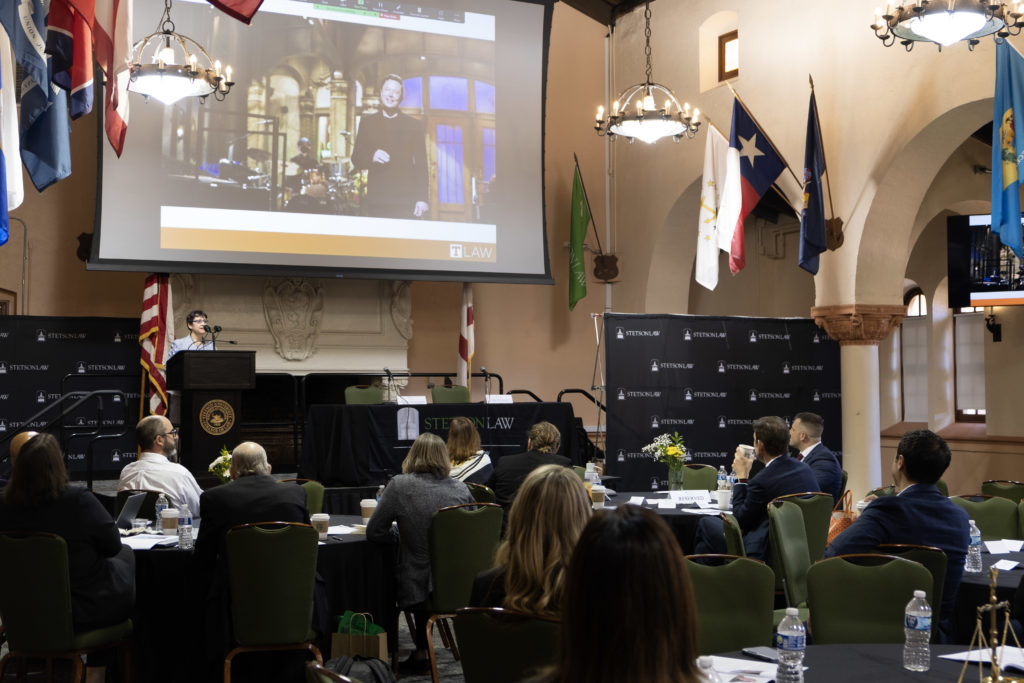
During an engaging keynote address, Florida Supreme Court Justice John D. Couriel took a broader perspective. Using hypothetical legal challenges a Musk-like figure may face when making business decisions like building a new manufacturing facility, Couriel said there’s an untapped resource that can help lawyers win cases on behalf of such clients: a state’s constitution.
Florida Supreme Court Justice John Couriel speaks during the 2023 Stetson Law Review Symposium.
“The lawyer who gets hired is the lawyer who comes up with the solution to the problem that the client hasn’t heard before,” Couriel said. “State constitutional law frequently supplies answers to your problems and lines of attack that the client has never heard. And for that reason alone, to the practitioners in the room, I say, pick up the sword. Develop these areas of the law. To the academics in the room, I say, write those things. Explore them. Because I think they speak to some of the most important challenges of our time.”
A collaborative effort, led by students
The day was a seamlessly run, thought-provoking affair thanks to the students on the Stetson Law Review staff who led it.
Though she worked tirelessly to organize and run the event, Stetson Law Review Editor-in-Chief Kathryn Alkire said she was grateful to everyone who had a hand in the event’s success.
Left to right: Stetson Law Review Editor-in-Chief Kathryn Alkire, Southern University Law Center Associate Professor Kenya J.H. Smith, Gonzaga University School of Law Visiting Assistant Professor Angela Aneiros, LMU Duncan School of Law Vice President and Associate Dean Matt Lyon, Northern Illinois University Associate Professor of Law David Rosenfeld, SMU Dedman School of Law Assistant Professor Carla Reyes, University of Tennessee Rick Rose Distinguished Professor of Law Joan MacLeod Heminway, Drexel University Thomas R. Kline School of Law Assistant Professor Nicole Iannarone, and Stetson University Bruce R. Jacob Visiting Assistant Professor of Law Tomer Stein.
“The event was an enormous success thanks to the fabulous group of speakers, professors, faculty, staff, and students who joined forces and worked hard to create such an engaging program,” Alkire said. “It truly was a team collaboration.” She added that she and her fellow Stetson Law Review staff members are especially thankful for University of Tennessee College of Law Professor Joan Heminway, who curated the group of speakers and constructed the symposium topic, and Justice Couriel for graciously sharing his insights.
Support from the Stetson Law community
Alkire also expressed gratitude for Professor Stein, who, in addition to presenting at the symposium, served as the event’s faculty advisor, as well as the work of the event’s volunteer, student Symposium Planning Committee (Noah Anderson, Caitlin Carey, Cameron Kubly, and Sophia LaFrance) and Marketing Team (Marketing Editor Jacquelyn Christoph and her assistant Sam McDougall).
Support and advising from Stetson Law faculty members as well as staff from multiple departments helped make the symposium the success it was, Alkire added.
“This event’s success is attributable to an entire team of people who surrounded and uplifted Stetson Law Review with their support,” she said. “We are very fortunate to attend a school that so strongly supports its student-run programs.” The panelists who participated will have their forthcoming scholarship on Elon Musk and the Law featured in Stetson Law Review publications throughout the 2023–24 [KLA1] academic year.
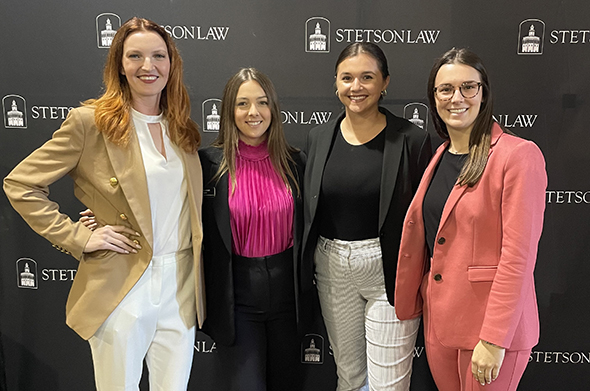
Left to right: Avery Sherrer, Savannah Green, Madison Hanna, Lauren Johansen
Over the last year, there’s been a lot of activity within the Florida Association for Women Lawyers at Stetson (FAWLS), the college of law’s chapter of the Florida Association of Women Lawyers (FAWL). Organization leadership at the state level have taken notice.
Citing the chapter’s effective strategies for growing and engaging membership, encouraging members to become leaders, and involvement with the surrounding community, FAWL has recognized its Stetson Law chapter with the 2023 Outstanding Student Chapter Award.
The Outstanding Student Chapter Award aims to recognize a Student Chapter that has been particularly active both in its local community and in the state FAWL organization.
“Your Chapter has developed innovative ways to build its membership, including by providing programs and services which specifically encourage and assist members to become leaders in the profession and in the community,” said FAWL President Donna Eng, Esq. in a letter congratulating the group. “We recognize how much work chapter leadership has put into these efforts, and we thank you for the investment you have made in the organization.”
Sustained efforts to promote women in law
This award focused on FAWLS’ extensive events, membership, and pro bono activities from the past year, including the group’s annual Women’s Week programming.
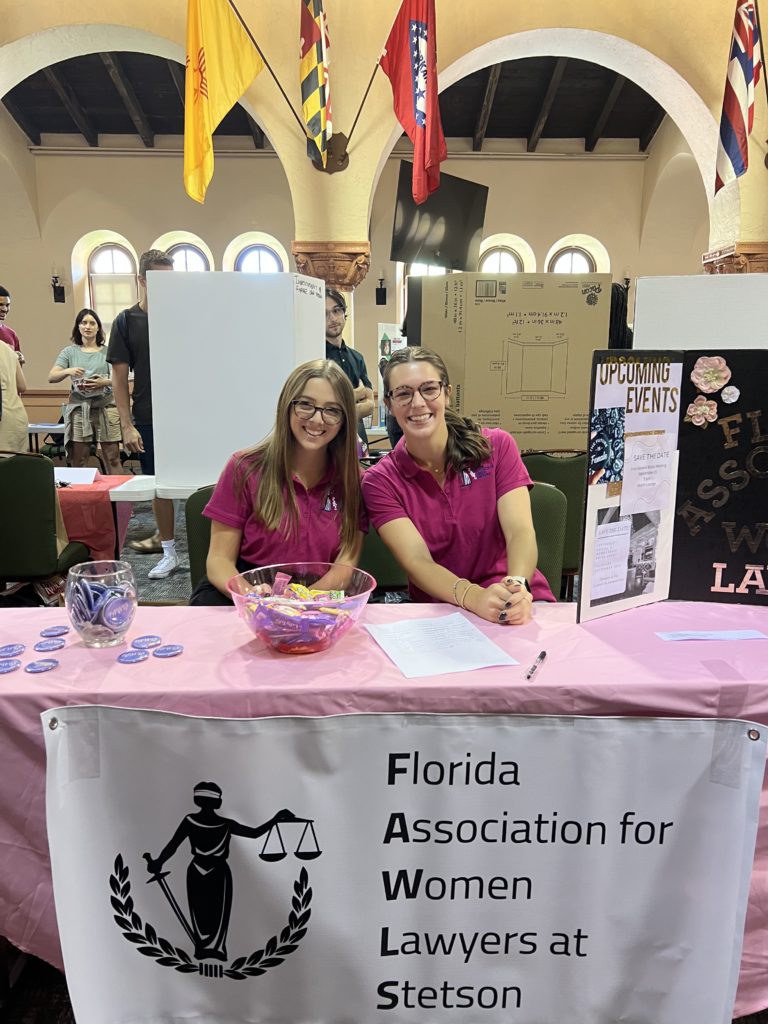
FAWLS President Savannah Green and Pro Bono Chair Lauren Johnson tabling at an event.
Other activities involve partnering with the Pinellas Florida Association for Women Lawyers, Southeastern Women in Financial Services, the Office of Diversity, Collaboration and Inclusion at Stetson, and multiple Stetson Law student organizations to hold events for our members. These collaborations have helped FAWLS’ actively promote gender equality and leadership roles in the legal profession through networking events, informative panels, professional development opportunities, and empowerment activities for students at Stetson.
“Coming in as FAWLS President, I had a focus on increasing membership and expanding our collaboration both on and off campus,” said FAWLS President Savannah Green. “I am so proud that FAWLS has successfully done both over the past year! I am very grateful to have an incredible executive board and passionate members who support one another and exemplify what it means to be strong women leaders.”
FAWLS’ executive board consists of: Green (president), Vice President/Treasurer Cara Zimmerman, Secretary Madison Hanna, Chapter Representative Avery Sherrer, and Pro Bono Chair: Lauren Johansen.
Recognition at the Florida Bar convention
As a recipient the award, the chapter will receive a $250 prize. The check, along with a certificate recognizing the achievement, will be presented at FAWL’s Awards & Installation Celebration in June during The Florida Bar’s annual convention.
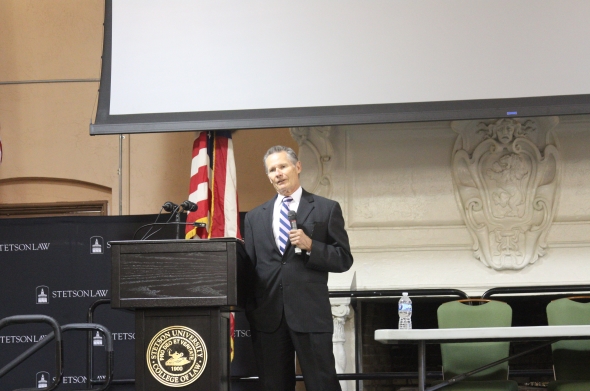
Trial lawyer Guy Burns, Stetson Law’s 2023 Distinguished Nichols Lecturer.
If there’s anything that can keep one’s legal career on a meaningful, decades-long trajectory, said trial lawyer Guy Burns, it’s the ability to set concrete goals – but only if you leave a little room for serendipity.
Burns was speaking as the 2023 Nichols Foundation Prominent Speaker Lecture on his chosen topic, “Where Will You Be in 50 Years?” Often referred to as the Nichols Lecture, the series is named for Perry Nichols, a 1937 Stetson Law alumnus who is considered a trial-law pioneer. Burns, who was admitted to the Florida Bar in 1973 and subsequently built a successful career that has spanned decades, reflected on his years as a prominent trial attorney – but not without a little humility.
“Really, perhaps the reason I’ve been asked to be here is that I’ve been around a long time,” Burns, who is now partner at Tampa-based firm Johnson Pope Bokor Ruppel & Burns, said. “And it pains me to say that, but this is my 50th year practicing law.”
Knowing he’d be speaking to a room full of law students in Stetson Law’s Great Hall that afternoon, he decided his topic would cover the attributes and practices that helped him grow as a lawyer.
A big factor, he said, was regularly stopping to look down the road.
“I have always during my career thought a bit about what’s next,” he said. “And I think regularly about what’s next year, and what’s in five years.”
The importance of setting goals
Hired out fresh out of law school, Burns said he had a rather lucrative starting salary – for the time.
“They offered me $12,000 a year,” he said, as the audience chuckled. “And that was big money.”
He then set a goal to make $30,000 by age 30. As a civil trial lawyer who got his start defending clients in complex commercial matters, he achieved that. He said law students are uniquely equipped to accomplish whatever they set their minds to.
“Your legal education here is a great foundation for whatever you decide to do,” Burns said. “You’re a group of people that sets goals. You wouldn’t be here if you hadn’t set goals already, and you wouldn’t be here if you if you weren’t willing to have some delayed gratification.”
Yet one should also be open to the opportunities that come along with life’s twists and turns.
“With any plan you make, leave room for serendipity, fate, and unexpected things to come into play,” he said.
Following one’s conscience
Though he started out defending companies against accusations of fraud and other legal matters, Burns said he ultimately realized he wanted to use his skills and talents to help those being defrauded and otherwise taken advantage of by large companies with seemingly infinite means. So he set the goal of moving into representing plaintiffs.
“It was a conscious decision to move in that direction,” Burns said. “If you want to spread your wings and you’ve been the best widget lawyer in the world and you think you might want to get into something else, make a plan.”
Now, he primarily represents litigants in cases involving consumer fraud, financial malpractice, and securities, among other matters. Over the years, he has helped clients win record-setting awards as well as settlements totaling well into nine figures.
Burns is also a cofounder of Crypto Lawyers, which helps clients recover lost investments in cryptocurrency and has amassed a long history of representing clients pro bono in cases involving discrimination over race, gender, and sexual orientation.
Telling your story
Fielding questions from students in the audience, Burns turned from the philosophical to the practical at times. Asked what made him excel at persuading jurors to favor his clients, he said the most effective tool he has is storytelling. “Number one is develop a theme,” Burns said. “I’d lay out a theme… and I would try to work that consistently into the case. If it’s a theme I think I can sell, I want to ride that as far as I can.”