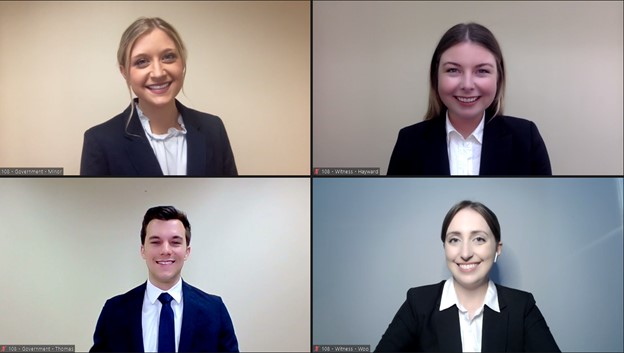
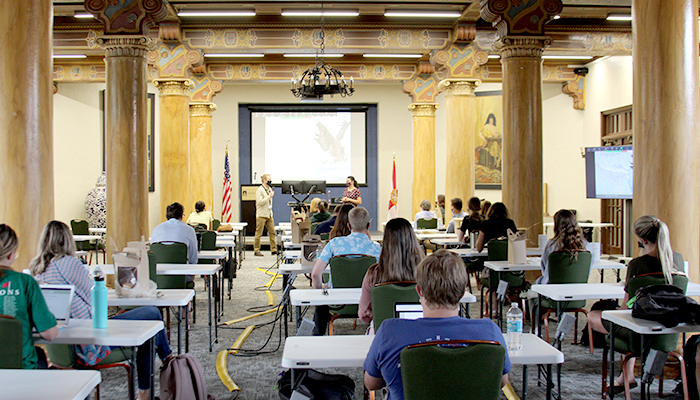
Members of Stetson Law’s Moot Court Board argued before a panel of nine judges in the final round of the 21st Annual Leroy R. Hassell, Sr. National Constitutional Law Moot Court Competition.
Stetson Law’s Moot Court teams wrapped up the first weekend of competitions for the 2021–2022 season with multiple awards.
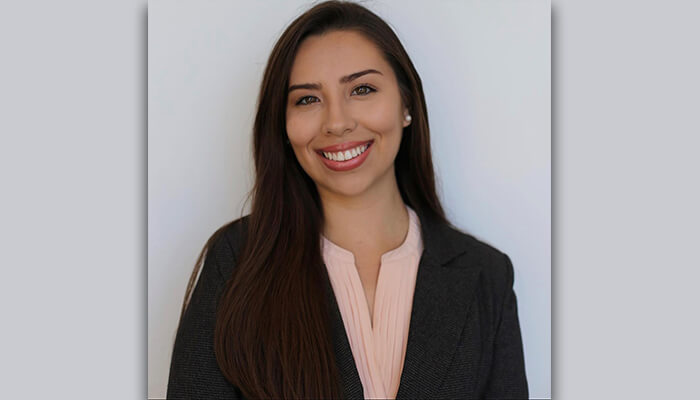
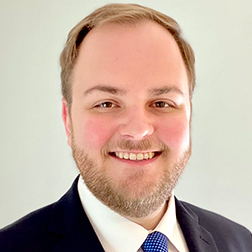
Students Liz Kellar, Tyler Brown, and Travis Grover won the Twenty-First Annual Leroy R. Hassell, Sr. National Constitutional Law Moot Court Competition hosted virtually by Regent University of Law. Out of 38 teams and more than 80 oralists, the team also placed in the top five with an honorable mention award for their brief. Kellar received an honorable mention oralist award.
This marked the third time in four years that Stetson Law has won this competition. They faced Southwestern University Law School in the final round, which was judged by nine distinguished state and federal judges, including four federal appellate judges, one federal district court judge, two state supreme court justices, and two state appellate court judges.
James Nealon, Stetson Law alumnus and a member of the 2018 and 2019 winning Regent teams, co-coached with Professor Brooke Bowman.
Also during the weekend, students Lauren Beames, Lucia Leoni, and Thomas Fuhrman competed in the Fifteenth Annual Civil Rights and Liberties (CRAL) Moot Court Competition hosted virtually by Emory School of Law. The team was narrowly defeated in the quarterfinals but earned awards that Stetson Law teams have not achieved at this competition before: third-best brief award and Best Oralist award. In a field of 28 teams and more than 60 oralists, Fuhrman was named Best Oralist. This team was coached by Professor Bowman.
Students from Regent University School of Law won the 2021 National Pretrial Competition (NPTC)
Stetson University College of Law’s Center for Excellence in Advocacy hosted the 14th Annual National Pretrial Competition (NPTC) for 20 participating teams from around the country Sept. 30 – Oct. 3, 2021.
Regent University School of Law and Baylor University School of Law went head-to-head in the final round, with Regent winning first place. This was Regent Law’s fourth victory in this competition, following 2009, 2018 and 2019 wins. Their team consisted of Steven Thomas (Chair), Morgan Ewing (Vice-Chair), Kimberly “Sloan” Minor, and Jasmine White and was coached by Marcus Mitchell and Arielle Poe.
Baylor University School of Law student Matthew Vitale won Best Advocate in the final round.
See below for a full listing of the winners.
This was Stetson Law’s second time hosting NPTC online. Judges included Stetson Law faculty, adjuncts and staff and more than 100 alumni and practitioners from across the nation.
“We congratulate Regent, their coaches, and all of the teams who participated in this virtual competition,” said Elizabeth Boals, director of Stetson Law’s Center for Excellence in Advocacy. “I also want to recognize the hard work and dedication of everyone involved in planning and hosting this event, and in particular, Stetson Law alumni Lara and Brandon Breslow for writing a challenging and timely COVID related case problem.”
NATIONAL PRETRIAL COMPETITION AWARDS
BEST Memorandum of Law
Best Movant Memo – South Texas College of Law Houston, Team 116
Best Non-Movant Memo – Texas Tech University School of Law, Team 109
Best Advocate, Preliminary Round 1
Daniel Liu – University of Virginia, Team 101
Best Advocate, Preliminary Round 2
Erin Nebbia – Georgetown University Law Center, Team 103
Best Advocate, Preliminary Round 3
Claudia Wu – Golden Gate University School of Law, Team 111
Max Mills – UC Davis School of Law, Team 104
Quarterfinal Awards
Golden Gate University School of Law (Team 111)
Texas Tech University School of Law (Team 109)
LSU Paul M. Hebert Law Center (Team 118)
WMU Thomas M. Cooley Law School (Team 106)
Semifinalist Awards
University of Houston Law Center (Team 114) South Texas College of Law Houston (Team 116)
Second Place
Baylor University School of Law (Team 119)
First Place
Regent University School of Law (Team 108)
Best Overall Advocate
Matthew Vitale – Baylor University School of Law (Team 119)
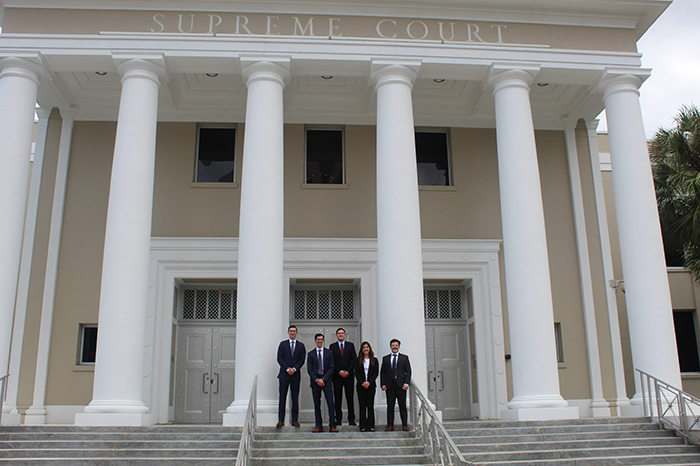
Stetson Law 3L Adam Poe, far left, is participating in the Florida Supreme Court Internship Program for Distinguished Florida Law Students this fall. (Photo courtesy of the Florida Supreme Court)
Stetson Law students have made back-to-back appearances in the prestigious Florida Supreme Court Internship Program for Distinguished Florida Law Students.
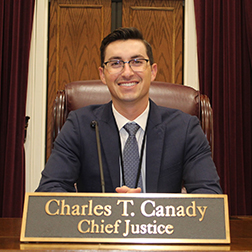
Stetson Law 3L Adam Poe is spending this fall 2021 semester in Tallahassee serving as a law clerk to Florida Supreme Court Chief Justice Charles T. Canady, while his classmate, Sabina Fernandez, served as a law clerk to Justice Jorge Labarga last spring.
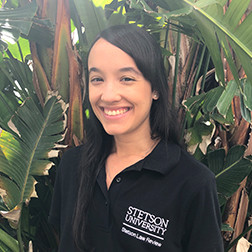
Sabina Fernandez
Poe and Fernandez were among a select group of students chosen for the program, which is open to qualified second or third-year law students from accredited Florida law schools. The unpaid internships are available for the fall, spring, and summer semesters. Opportunities include serving as a law clerk to an individual justice, a central staff law clerk working for all the justices, or a law clerk working for the clerk of court and the administrative justice.
“I felt honored to be selected for this incredible opportunity and was hoping to learn as much as I could about the Court and Florida law,” Fernandez said, adding she applied because she wanted the opportunity to further develop her legal research and writing skills.
Poe sought advice from Fernandez when he considered applying for the position, and she helped him understand what the role entailed.
“This is a prestigious and invaluable opportunity to work within the highest court in Florida,” Poe said. “Many people learn and know how the Florida Supreme Court operates, but not many people get to learn this information from the inside. This gives me a unique perspective to gain practical skills I can take with me throughout my career.”
Intern duties include reviewing and making recommendations on petitions for discretionary review, attorney discipline matters, and extraordinary writ petitions, as well as conducting legal research and preparing memoranda on pending cases. They also get the opportunity to attend oral arguments, assist in the drafting of orders or opinions, and attend special lectures, group discussions and training sessions.
“The most interesting part of the externship so far has been learning about the operations of the Florida Supreme Court,” Poe said. “I love learning about how all the Justices work together; how all the offices work in conjunction to maintain an efficient operation; learning about the very specific and narrow jurisdiction this Court has; and about the life cycle of a case from step one to the final opinion. The most challenging aspect has been the memorandums I was tasked to write. Knowing Chief Justice Canady will eventually be reading my work, there is a lot of pressure to compose the best writing I can offer.”
Fernandez agreed she found learning about the Court’s jurisdiction the most fascinating part of the experience. She completed her internship remotely and said the most challenging part was balancing that with her coursework. Still, it was worth it: Her hard work earned her a full-time job offer (which she accepted) as a Staff Attorney for Justice Labarga upon her graduation this spring.
Poe chose to move to Tallahassee for the semester and is taking one remote class. He will join Rumberger, Kirk & Caldwell in the Tampa office after graduation.
How to Apply
Student Adam Poe at Justice Canaday’s seat
Selection for the Court Internship Program for Distinguished Florida Law Students is based on the student’s overall record, including courses taken, grades, research and writing skills, experience, expected graduation date, and satisfactory background checks. Requirements include:
Second or third year student;
Outstanding academic record (generally top 25 percent) and exceptional research and writing skills;
Completion of Civil Procedure and Evidence required; Criminal Practice and Procedure, and Florida Constitutional Law recommended;
Certified by law school as being of good character and competent legal ability to perform as an intern for the Florida Supreme Court;
Letter of clearance as to character and fitness from the Florida Board of Bar Examiners; and
Satisfactory background check by the Florida Supreme Court Marshal’s Office.
Poe, who is an Assistant Research Editor for Stetson Law Review and a member of Moot Court Board, recommends students who are thinking of applying do their research, speak with Professor Lance Long (who oversees this particular internship), and contact previous Florida Supreme Court Externs for their insight.
“The reason I would advise this is because it is a big commitment to pack up and move 250 miles away from Stetson campus for a full semester,” he said. “It is no doubt worth it, but I would just make sure you know what you are getting into before you apply.”
Fernandez, who is Local Government Editor of Stetson Law Review and a Teaching Assistant for Research and Writing I & II, added that interested students should focus on building key skills.
“I would encourage fellow students who are interested in this internship to pursue opportunities at Stetson to develop their legal research and writing skills,” she said. “These opportunities will help prepare them for the significant amount of writing they will do in the internship.”
In August, the American Bar Association House of Delegates passed Resolution 608 urging federal, state, local, territorial and tribal governments to enact laws and policies to provide all employees a living wage. A Stetson Law student was instrumental in crafting the resolution’s supporting documentation.
“Not only did I think it would be a wonderful opportunity to get some pro bono hours, but I am also passionate about a living wage for all, so this project meant a lot to me,” said Diana Estrada, a 3L in the Social Justice Advocacy Concentration. “As a future attorney, I hope to make research and writing a large part of my career, so I also thought it would be a great experience for that reason.”
The resolution defined “living wage” as the minimum hourly wage that an individual in a household must earn to support themselves and their family to a basic standard of living through employment without the need of any government subsidies. The resolution further stated the ABA supports legislation, such as the Raise the Wage Act (S. 53) that would raise the minimum wage to meet a living wage standard for an average household.
The resolution is now part of the organization’s official policies, explained Stetson Law Professor Kristen Adams.
“The ABA is the largest professional organization in the world, and ABA resolutions have historically been meaningful and influential in our country’s democratic process,” she said.
While the resolutions themselves are typically quite short – just a few sentences – a lengthier report supports the resolution, much like a legal memorandum, by citing authority and precedent. The report Estrada drafted is exceedingly important and is closely scrutinized by members of the ABA House of Delegates in deciding how to vote, Adams said.
Professor Kristen Adams
“I am not sure we have had a Stetson Law student participate in drafting a report supporting a successful ABA resolution before, and this is truly a wonderful accomplishment!”
Adams is a member of the Commission on Homelessness and Poverty and its Economic Equity Subcommittee for the ABA, and the group decided to propose a living wage resolution at one of its subcommittee meetings. She thought learning about the resolution process would be a good opportunity for a student, and when she posed the idea to Social Justice Advocacy Concentration students, Estrada jumped at the chance.
“Through this experience, I learned about the benefits a living wage for all brings to everyday people and to society as a whole,” Estrada said. “Additionally, I learned the importance of seizing opportunities that are presented to you.”
Estrada, who plans to work in public interest law upon graduation, said she recommends this experience to other students because it was not only a great learning opportunity and interesting way to earn pro bono hours, but it was also a “chance to be a part of something bigger than myself that directly benefits people in the community.”
Students who might be interested in working on future ABA resolutions should contact Professor Adams for more information.
Kyle Ridgeway, 2L, spent his summer as a Kozyak Minority Mentoring Foundation Fellow, a distinction that enabled him to work in an unpaid position as a law clerk for the Southern Legal Counsel.
“As a law clerk for the Southern Legal Counsel I conducted research and legal coding for ongoing litigation,” Ridgeway said. “The SLC is a public interest non-profit law firm that is focused on ending homelessness, protecting civil rights, and promoting LGBTQ equality. All of the projects I worked on were related to these goals.”
The Kozyak Minority Mentoring Foundation was created by Miami attorney John W. Kozyak and his law partner, Detra Shaw-Wilder, to use mentoring as a platform to increase diversity in the legal profession. Kozyak had spent years as an active mentor and launched a program to match minority law students with experienced lawyers and judges in the legal community. The foundation became a way to amplify those efforts.
Each year since 2016, KMMF has awarded summer fellowships to law students who are academically and professionally driven. The fellowships are funded through the support of law firm sponsors, including Pillsbury Winthrop Shaw Pittman, Hunton Andrews & Kurth and Kozyak Tropin & Throckmorton.
“The Kozyak Fellowship is a great opportunity to work for a non-profit or public service organization in an unpaid role and still earn some money during the summer,” Ridgeway explained. “Too often students are forced to decide between work that is interesting to them and work that pays. This fellowship is a wonderful chance for students to pursue the areas of the law that are interesting to them and give back to their communities, without the burden of that work being unfunded.”
Impactful work
Ridgeway began his tenure with SLC during a fall 2020 clerkship. At that time, he was part of a team of law students from around the country who analyzed over 16,000 cases involving driver’s license suspensions, affecting nearly 10,000 individuals who had their driver’s licenses suspended for failure to pay fines/fees related to municipal ordinance violations. The students looked up each case, gathering data such as the underlying municipal ordinance and the amount of fines/fees assessed, explained Samantha Howell, the pro bono director of SLC.
With the information gathered by the students, SLC successfully advocated with the Department of Highway Safety and Motor Vehicles (DHSMV) to change their policy so that individuals with municipal ordinance violations would no longer lose their licenses if they failed to pay related court fines/fees. The DHSMV sent notices to 30 Clerks of Court in Florida, resulting in 23 counties reinstating the licenses in question. Altogether, 13,508 driver’s license suspensions were lifted, affecting more than 7500 people statewide, Howell said.
SLC continues to work to change the practice in the seven counties that did not reinstate licenses, and six additional counties that have continued to issue driver’s license suspensions for failure to pay fines/fees related to municipal ordinance violations.
Thanks to the Kozyak Fellowship, Ridgeway was able to return to SLC for another clerkship in summer 2021. He helped investigate the availability of behavioral and mental health care services throughout Florida and monitored city commission meetings for references to a variety of issues affecting homeless individuals.
Kozyak Fellowships are open to 1Ls and 2Ls who are either enrolled in a Florida law school or are verified Florida residents attending an out-of-state law school. Applications for the Summer 2022 fellowships will open early next year.
The first Edward and Bonnie Foreman Biodiversity Lecture Series event of the 2021-2022 academic year featured Jaclyn Lopez, Florida director and senior attorney for the Center for Biological Diversity in St. Petersburg. Her presentation, “The Red Tide Blues: What’s Causing It and Where Do We Go From Here?” covered red tide (a/k/a Karenia brevis) and some of its causes.
Karenia brevis is a type of algae that occurs in marine waters. It normally lives 40 miles off the coast of Florida and prefers a salty environment, but winds and other elements can push it to shore, where it can move into brackish and estuary waters. It occurs naturally in small amounts but can become concentrated – or a bloom known as red tide – when fed a diet of phosphorus and nitrogen.
Concentrated levels of red tide produce neurotoxins that can kill marine wildlife and make humans sick. Humans can experience respiratory issues leading to hospitalization or get sick from eating contaminated seafood. It can even kill people, though that is rare, Lopez said.
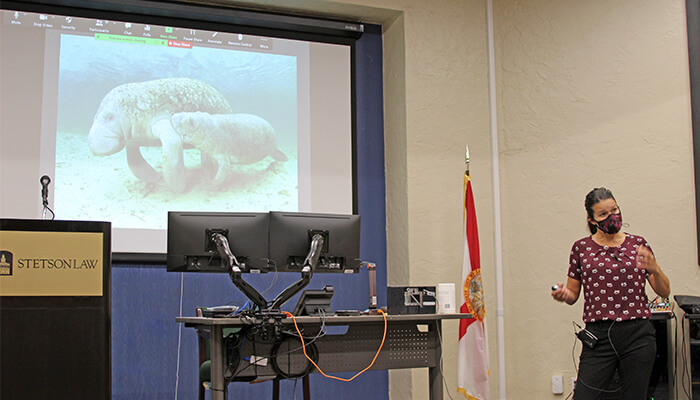
For marine wildlife, the effects of red tide are more serious. Manatees are especially vulnerable because they inhale aerosolized red tide particles when they emerge for air, as well as consume the toxic algae when they eat sea grasses. The Tampa Bay area alone logged about two dozen manatee deaths since June that were likely attributable to red tide, Lopez said.
Jaclyn Lopez explains how red tide poses a greater threat to manatees.
Where does red tide come from?
Predominantly from human activity, Lopez said. Pollutants reach the ocean though both “point sources” and “non-point sources” (as defined by the Clean Water Act). Fertilizers and other pollutants, including lawn clippings and animal droppings, create toxic runoff from cities and residential neighborhoods that end up in the water systems. Corporations discharge pollutants directly into streams and rivers. Farms generate fertilizer and animal waste that can runoff or seep into ground water. Wind erosion and spray drift pull pollutants into the atmosphere, which end up in the ocean when it rains. The phosphorus and nitrogen from these various sources fuel harmful algal blooms.
Lake Okeechobee
A 2020 lawsuit, Center for Biological Diversity, Calusa Waterkeeper, Waterkeeper Alliance v. U.S. Army Corps of Engineers, focused on the management of Lake Okeechobee. In 2018, Florida saw sustained red tide on the west coast for about a year, as well as blue green algae (a cyanotoxin with similar effects to red tide) on both coasts. Marine wildlife and residents had nowhere to go to escape the blooms, Lopez said.
Lake Okeechobee is hydrologically connected to both coasts, and the U.S. Army Corp of Engineers is the federal agency responsible for pushing the lake levels out to the estuaries when water gets too high. Center for Biological Diversity attorneys argued in their lawsuit that the Army Corps’ management of the lake was contributing to harmful algae blooms. The Army Corps, in its defense, acknowledged that red tide is harmful to marine wildlife but claimed that discharge and nutrients from Lake Okeechobee do not fuel red tide. They agreed the discharges could contribute to blue green algae, but claimed the blue green algae posed no threat to marine wildlife.
A 2020 research paper by Miles Medina, who was working on his Ph.D. at the University of Florida, showed how the discharge of nutrients contributed to the persistence of red tide, demonstrating the phenomenon is driven by humans, Lopez said. She added that the common argument that red tide is “naturally occurring” is a “throw away, fluff adjective” meant to distract from the key point: Yes, Karenia brevis is a natural occurrence, but concentrated blooms of it are not.
The non-profit agencies were successful in their lawsuit in compelling the Army Corps to reinitiate consultation, under the Endangered Species Act, with the Fish and Wildlife Service to figure out how the discharges are impacting manatees and other marine wildlife. The Corps also is in the process of reviewing how they handle discharges from Lake Okeechobee.
The first lecture was held in person in the Mann Lounge with limited attendance.
Piney Point
Phosphogypsum is the waste leftover from producing phosphoric acid, which is used in fertilizer. Florida is the largest producer of phosphoric acid in the United States. For every one ton of phosphoric acid produced, five tons of phosphogypsum are created. This byproduct, which contains concentrated levels of lead, cadmium, chromium and other radioactive carcinogens, is dumped into large ponds called phosphogypsum stacks or “gyp stacks” designed to hold the waste indefinitely.
It was well known among industry and government leaders that the Piney Point gyp stack near Bradenton was in a state of severe disrepair and at risk of failure, Lopez said. Over Easter weekend of 2021, a series of catastrophic issues led the Florida Department of Environmental Protection (DEP) to authorize the discharge of up to 480 million gallons of water from the top of the gyp stack to try to prevent it from collapsing completely and flooding area homes.
From April 30-May 9, 2021, about 215 million gallons of waste, including 200 tons of concentrated nitrogen, was discharged from Piney Point into Tampa Bay. Essentially, Lower Tampa Bay got as much nitrogen in under two weeks as it usually sees in an entire year because of the dump. Localized algae blooms were observed shortly thereafter, with significant red tide blooms by mid-May. It continued through mid-July, along with concentrated fish kills along Pinellas County coasts.
Center for Biological Diversity is now suing the DEP, arguing state officials were aware of the potential failures of Piney Point and yet pushed the gyp stack beyond its limits. About 10 years ago, DEP authorized Piney Point to receive dredge material from the Bishop Harbor dredge. The Army Corps, which was part of that permitting process, objected, citing in its report that not only are gyp stacks not engineered to hold dredge material, but Piney Point, with its history of failures, would almost certainly collapse under the added material. Despite the warning, the DEP and Piney Point owners moved forward with the plan.
What’s next?
Piney Point is only one of 24 other phosphogypsum stacks covering 11.1 square miles of Florida. Another 837.9 square miles of the state are either current phosphate mines, planned mines, closed mines built before 1974 and therefore have no plans to restore or reclaim them, or land owned by mining companies. There are 50,000-100,00 acres of phosphate mining left in Florida – not being dug yet, but that will be dug in the next 20-30 years, Lopez said. That will likely result in the addition of another half billion tons of phosphogypsum over time, all of which will remain in Florida. Meanwhile, more than 50 percent of the phosphoric acid produced is exported. The rest goes to produce food crops, primarily corn and soy, for cows and chickens, which are either eaten or exported.
“But we keep all of the waste,” she said.
How can you help?
Lopez says the “simplest” answer is to vote – and not only for the people who make the laws, but for those who implement and enforce them. Executive agencies such as the DEP fall under the office of the governor, so “it’s really important that we’re electing a governor that prioritizes environmental protection – or whatever your issue is. And not just on paper, not just to get the photo op, not just for running for reelection, but for tangible results.”
Stetson students should also consider joining the Environmental Law Program, as well as explore internship or externship opportunities with agencies such as National Oceanic and Atmospheric Administration, Florida Fish and Wildlife Conservation Commission, and the Summer Honors Program for Law Clerks in the Environmental Protection Agency’s Office of General Counsel. Placements in private law firms with strong mentorship programs that will help them learn critical advocacy skills and gain real life experience can also be useful, Lopez said.
Lopez, a Florida native, insists the story is not all doom and gloom. The state has a resilient ecosystem, and the time and money put into Tampa Bay so far have helped its recovery over the last 20 years, but the effort is ongoing.
“We have a lot of work to do in our region to take care of our water bodies,” Lopez said.
About the speaker
Jaclyn Lopez
Lopez holds a Master of Laws degree in environmental and land-use law from the University of Florida, a J.D. from the University of Denver Sturm College of Law, and a master’s degree in urban planning from the University of Arizona. She coordinates campaigns in the Southeast and Caribbean, focusing on protecting imperiled species and ecosystems. The Center for Biological Diversity is a nonprofit organization with offices across the country that works to use biological data, legal expertise, and the citizen petition provision of the powerful Endangered Species Act to obtain sweeping, legally binding new protections for animals, plants, and their habitat.
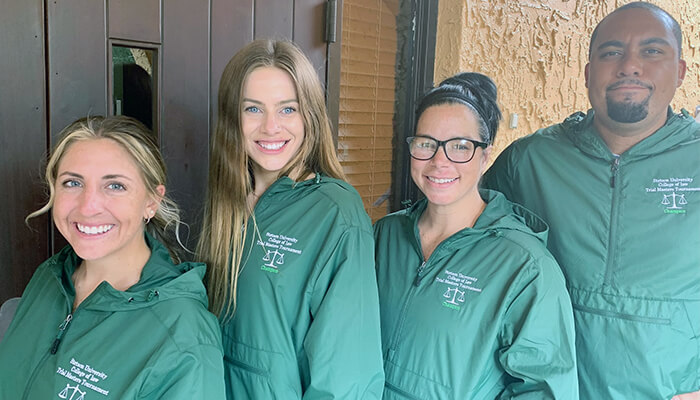
The winners of the inaugural Stetson Trial Masters Tournament – sporting their new, green championship jackets – are Sierra Purden (3L), Jacquelyn Christoph (2L), Tiffany Hilton (3L), and Stevin Smith (2L).
The champions of the inaugural Stetson Trial Masters Tournament are Jacquelyn Christoph (2L), Tiffany Hilton (3L), Sierra Purden (3L), and Stevin Smith (2L).
The team of Katherine Castaner (3L), Kierstyn Jennings (2L), Pamela Marsh (3L evening), and Samuel Newlon (3L) came in a close second.
The Center for Excellence in Advocacy started a new summer training program this year for coaches and students, part of Director Elizabeth Boals’ goal to create meaningful advocacy training experiences for students outside of the classroom.
The Trial Team members collaborated in small teams composed of veteran and new members. Throughout the summer, they worked through a six-witness fact pattern and submitted recorded openings, witness examinations and closing arguments for feedback. They then tried the full case multiple times over a four-day tournament earlier this month.
“It was grueling, but the students did an amazing job with the support of their dedicated coaches Donnie Anderson, Stanton Fears, Courtney Olivier, and Zachariah Wade,” Boals said.
Stetson Law faculty and Advocacy Center staff – including Elizabeth Berenguer, Roberta “Bobbi” Flowers, Ellen Podgor, Jim Sheehan, Stephanie Vaughan, Stacey Turmel and Jay VanDerZee – served as judges.
To keep up with what is happening at Stetson’s Advocacy Center, follow us on Facebook, Twitter and Instagram.
A new Racial Justice Fellows pilot program aimed at putting college students at the center of creating systemic racial change is being launched by a coalition of Pinellas County higher education institutions and a non-profit organization.
Eight students will be selected to participate in the pilot program. They will receive up to $2,000 each during the 2021-2022 academic year. Participating institutions include USF’s St. Petersburg campus, St. Petersburg College, Eckerd College and Stetson College of Law.
Together with the Foundation for a Healthy St. Petersburg, the organizations formed the St. Petersburg Higher Education Consortium for Racial Justice last year, which is working to dismantle racial hierarchies in the region.
The fellowship program was created to support the consortium’s efforts to create a Truth, Racial Healing and Transformation (TRHT) Center. Two students will be selected from each of the consortium institutions and work to develop a TRHT center for Pinellas County. Applications are being accepted through September 13. To learn more or apply, students can visit this site.
“The idea for the fellowship started because we wanted to have a strong student voice through the process of creating a consortium for higher education focused on racial justice,” said Caryn Nesmith, director of community relations at USF’s St. Petersburg campus. “Our vision is that it will equip students to advocate for systemic change.”
The fellows will learn about shaping policy and systems through a racial justice lens. They will also discuss the mechanisms that enable racial healing and work on projects that support racial healing and transformation.
Fellows will participate in biweekly planning meetings with consortium institution representatives to help shape the vision, goals and activities of a TRHT Center. This may likely include participating in other meetings at their home institutions as well as engaging with community members.
Over the course of the academic year, students must participate in seven approved activities, events or discussions related to race equity and racial justice. Students will find and complete a six-week internship in summer 2022 that focuses on deepening their understanding of the impact of systemic racism and influential opportunities to drive healing and transformation.
In addition, each institution may offer specific opportunities to its fellows, such as assisting with the creation of student activities or participating on advisory boards.
Judith Scully
“It is our hope that the Stetson law students involved in this fellowship will develop a deep commitment to diversity, equity and activism with a keen understanding of the need for cultural humility in our society,” said Judith Scully, a Stetson Law professor and director and co-founder of Stetson’s Social Justice Advocacy program. “Ultimately, it is our hope that these students will become leaders in our profession, blazing the way forward for a more equitable and just legal system.”
“Eckerd students already have a strong desire to make a positive impact on the world,” added Beverly Warren, executive director of inclusive excellence at Eckerd College. “We hope that this fellowship will provide them an opportunity to develop into conscious leaders who understand the challenges to and importance of working toward racial equity and inclusivity within our campus and surrounding community.”
“SPC students represent a wide array of diverse backgrounds and perspectives,” SPC Provost Tashika Griffith said. “Through the fellowship, our hope is that students will gain the knowledge and tools to actively engage in equity, diversity, inclusion (EDI) efforts and see themselves as a part of, and not apart from, the work that is needed to move EDI forward.”
The St. Petersburg Higher Education Consortium for Racial Justice was created in 2020 when USF’s St. Petersburg campus and community leaders in St. Petersburg and Pinellas County convened a task force to explore how to connect efforts to address inequalities that exist in the region. Through their discussions, the task force members identified the TRHT framework as a beneficial tool that could help strengthen each campus’ commitment to community and inclusion.
In addition to launching the Racial Justice Fellows program, the consortium is working toward other shared goals, including creating a professional learning community for faculty on incorporating issues of race into curricula and providing more truthful narratives about racial history, while developing community seminars related to racial justice from a national, state and local perspective.
The first Edward and Bonnie Foreman Biodiversity Lecture Series event of the 2021-2022 academic year will be Thursday, Aug. 26 at noon and will feature Jaclyn Lopez, Florida director and senior attorney for the Center for Biological Diversity in St. Petersburg.
Lopez’s presentation is titled “The Red Tide Blues: What’s Causing It and Where Do We Go From Here?” and will cover red tide, (a/k/a Karenia brevis) a type of algae that occurs in marine waters. It produces neurotoxins that can kill marine wildlife and make humans sick. Water pollution in the form of phosphorous and nitrogen can worsen red tide blooms. The lecture will explore what sources of water pollution may be fueling the red tide, as well as what is and is not being done about it.
Lopez is a Florida native and holds a Master of Laws degree in environmental and land-use law from the University of Florida, a J.D. from the University of Denver Sturm College of Law, and a master’s degree in urban planning from the University of Arizona. She coordinates campaigns in the Southeast and Caribbean, focusing on protecting imperiled species and ecosystems. She has presented, written, and taught courses on environmental law and policy issues.
The Center for Biological Diversity is a nonprofit organization with offices across the country that works to use biological data, legal expertise, and the citizen petition provision of the powerful Endangered Species Act to obtain sweeping, legally binding new protections for animals, plants, and their habitat.
The Foreman Biodiversity Lecture will be a hybrid event, with the in-person portion open only to Stetson Law students. All other attendees, including the public, can watch via live webcast. The in-person session will be limited to 25 people, and lunch will be served. All interested attendees – whether in person or remote – must RSVP by Aug. 19 to [email protected].
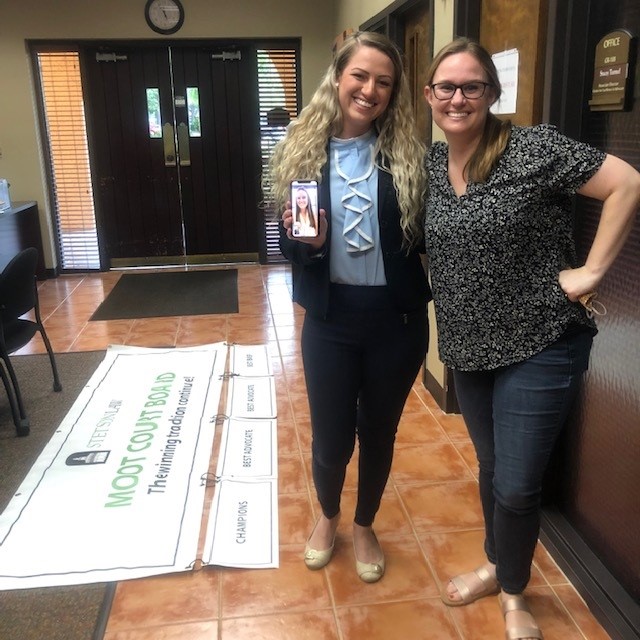
Stetson’s Moot Court team members Liz Kellar, left, and Jessica Merker with teammate Lauren Beames via FaceTime as they prepare to fly the winning banner in the Crummer Courtyard.
Stetson Law, for the first time ever, swept all the awards at the Annual Robert Orseck Moot Court Competition hosted by The Young Lawyers Division of The Florida Bar on June 9, 10 and 16.
The action began on June 9 virtually as part of the 2021 Florida Bar Annual Convention when law school teams from across Florida vied for the most prestigious Moot Court Championship in the state. Quarterfinals were June 10, with the final round on June 16.
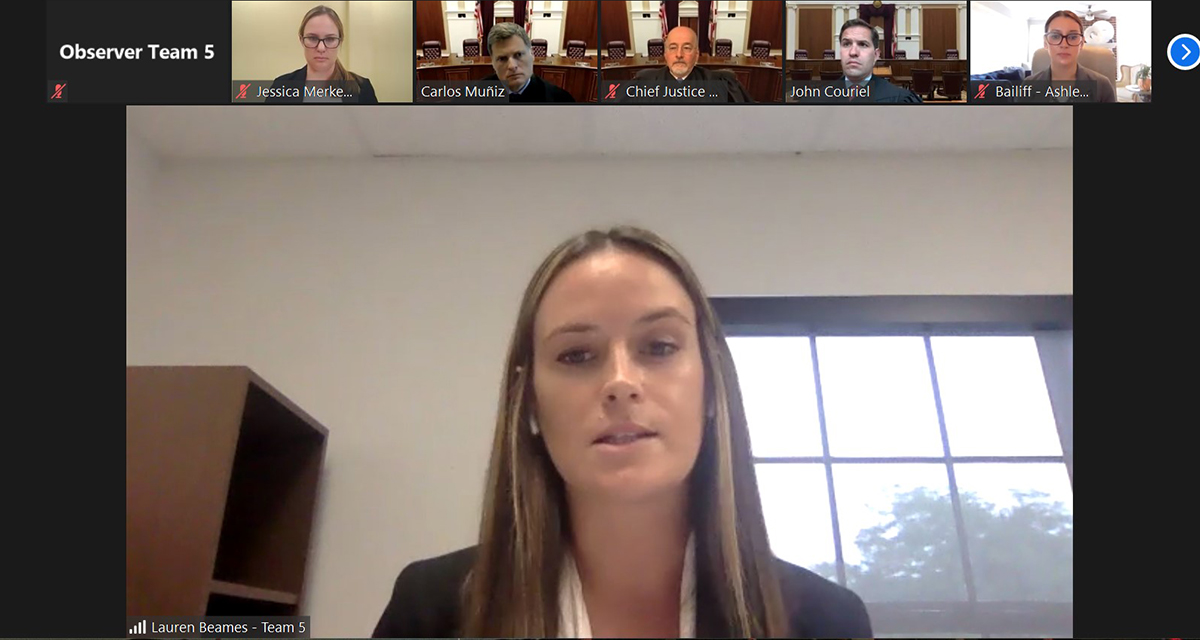
Lauren Beames competed from a law firm in Orlando.
Members of Stetson’s team—Lauren Beames, Liz Kellar, and Jessica Merker—argued through three preliminary rounds, the quarterfinal round, and the semifinal round to earn a spot in the final round on June 16. On their way to making the finals, the team won the Best Brief Award, and Jessica Merker won the Best Oralist, Preliminary Rounds Award.
Professor Brooke Bowman, director of Moot Court Board, said this was an amazing competition for three reasons: (1) in the preliminary rounds, the team was judged by actual trial court judges; (2) in the quarterfinal and semifinal rounds, the team was judged by actual appellate court judges; and (3) in the final rounds, the team was judged by the justices of the Florida Supreme Court. Only a small percentage of Florida attorneys ever have an opportunity to argue at the Florida Supreme Court, and Stetson’s team earned that distinction as students.
The Florida Supreme Court justices unanimously named Stetson as the champions of the competition and awarded Jessica Merker the Best Oralist, Final Round Award!
Never before has a Stetson team won all four awards. Prior to this year’s accomplishments, Stetson had won 8 Best Brief Awards; 4 Best Oralist, Preliminary Rounds Awards; and 5 Best Oralist, Final Round Awards. In 2003, a Stetson student won both the Best Oralist Awards.
Professor Paul Boudreaux, Professor Roberta Flowers, Professor Erin Okuno, Professor Lou Virelli, and several alumni helped the team prepare and judged their practices.
By Christine Cerniglia Associate Professor of Law and Director, Department of Clinical and Experiential Education
Christine Cerniglia
In mid-March 2020 and one week before spring break, the Department of Clinical and Experiential Education began to plan for an immediate transition to an online format. With 67 students in externships and 37 students in clinics during the Spring semester, we immediately surveyed our clinic and externship professors and field placement supervisors to determine the pandemic’s impact to their offices. Each office faced challenges, with local government clinics truly at the front line of analyzing legal issues related to mask ordinances and public health mandates. Overwhelmingly, our community partners responded with commitment to see the semester through and provide remote work assignments and connections for the students.
The summer 2020 semester provided additional administrative challenges as we transformed clinics and externships and responded to the diminishing placements in courthouses. In anticipation of fewer externship placements, Stetson Law faculty worked to innovate, creating three new summer courses: Covid-19 and the Criminal System, Covid-19 and the Civil System and Judicial Practice. Each course allowed students to engage in learning over the summer and prepare for future practice. Over 35 students were enrolled in these three courses.
As we approached the summer, the need for flexibility in administration became evident. Stetson Law’s faculty approved allowance for variable credit, which provided the students with choice for participating at their needed level of commitment. As the semester progressed, we monitored the student experiences and health issues, as well as the need to build a virtual community. We hosted virtual coffee talks on Wednesdays and happy hours on Friday evenings where students could meet and reflect on the week.
By the Fall semester, we continued to be thankful for our community partners, who remained committed to providing clinical or externship experiences. The incredible story this past year is the commitment by our clinic and externship faculty and supervisors to make it all happen. This past year student enrollment in clinics and externships was up by 15-20 percent of the clinic and externship placement capacity.
Even more exciting were the moments of innovation, such as our Compassionate Release Practicum and the Advanced Compassionate Release. The mantra that necessity is the mother of all invention proved true. As we continue to persevere through the pandemic, the innovation of the Stetson Faculty, and the dedication of our community partners has ensured the greatest benefit to our experiential community: the opportunity to watch students engage in real work relevant to the pandemic and the mounting legal issues across the country.
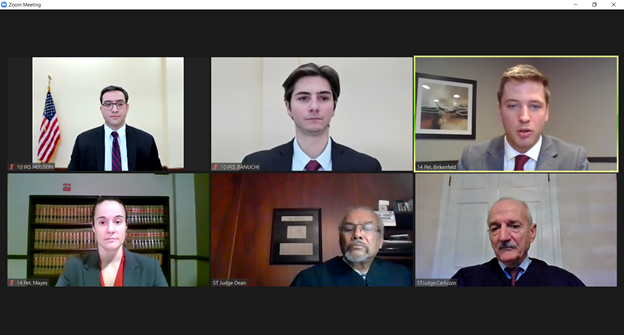
Stetson team members Omar Hussein (top left) and Erik Banuchi (top center) compete during the final rounds of the 2021 National Tax Moot Court Competition.
Stetson’s team of Erik Banuchi, John Bartel, and Omar Hussein not only won the 2021 National Tax Moot Court Competition, but the team also won the Best Brief Award, and Hussein won the Best Oralist Award.
The National Tax Moot Court Competition, sponsored by the Tax Section of The Florida Bar, started in the 1980s. Stetson has won the competition eight times; the first time in 1984. Only once before—in 2001—has a Stetson team swept all three awards.
It is a challenging competition, as the judges in the early rounds are tax attorneys, Internal Revenue Service attorneys, and attorneys from the Tax Section of Department of Justice. In the final round of the competition, the advocates had the opportunity to argue in front of judges from the United States Tax Court.
“The judges praised our advocates on their high level of advocacy and skill, as well as their outstanding knowledge of the law and the record and their ability to respond to the judges’ questions and pivot back into their arguments,” said Professor Brooke J. Bowman, director of Moot Court Board.
Professor Andrew Appleby and alumna Katie Everlove-Stone (whose team won the National Tax Competition when she attended Stetson) coached the team.