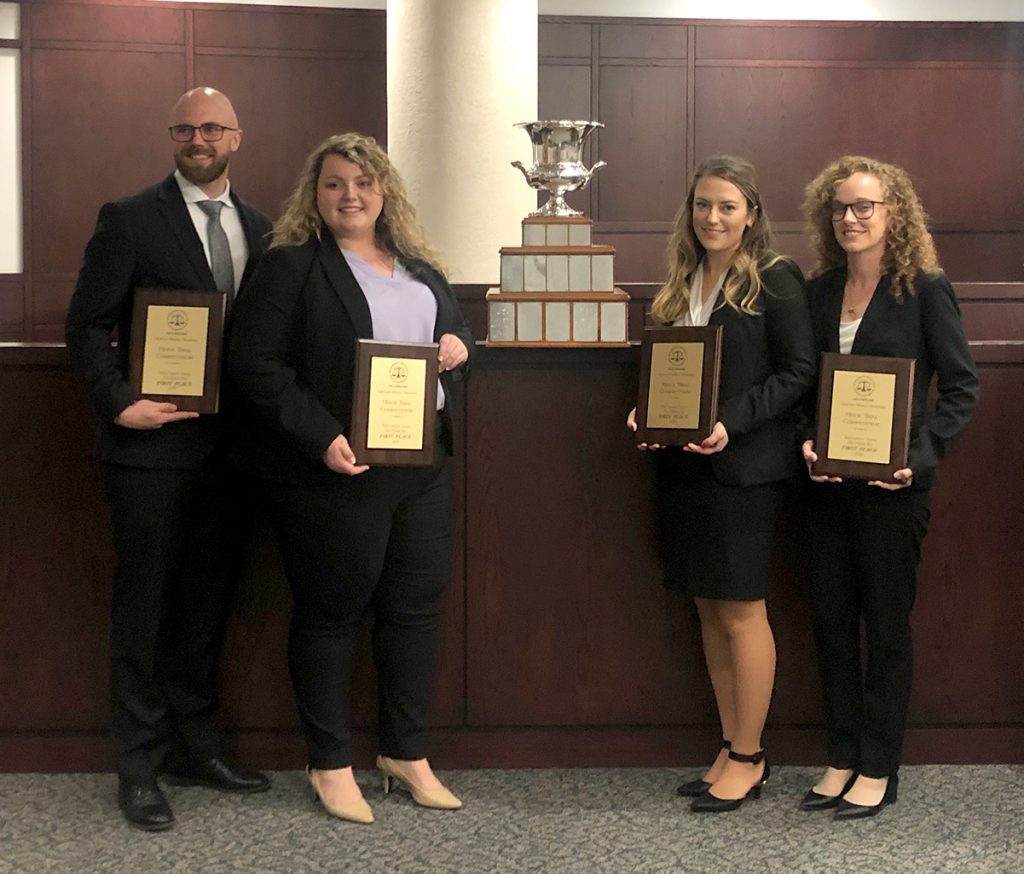
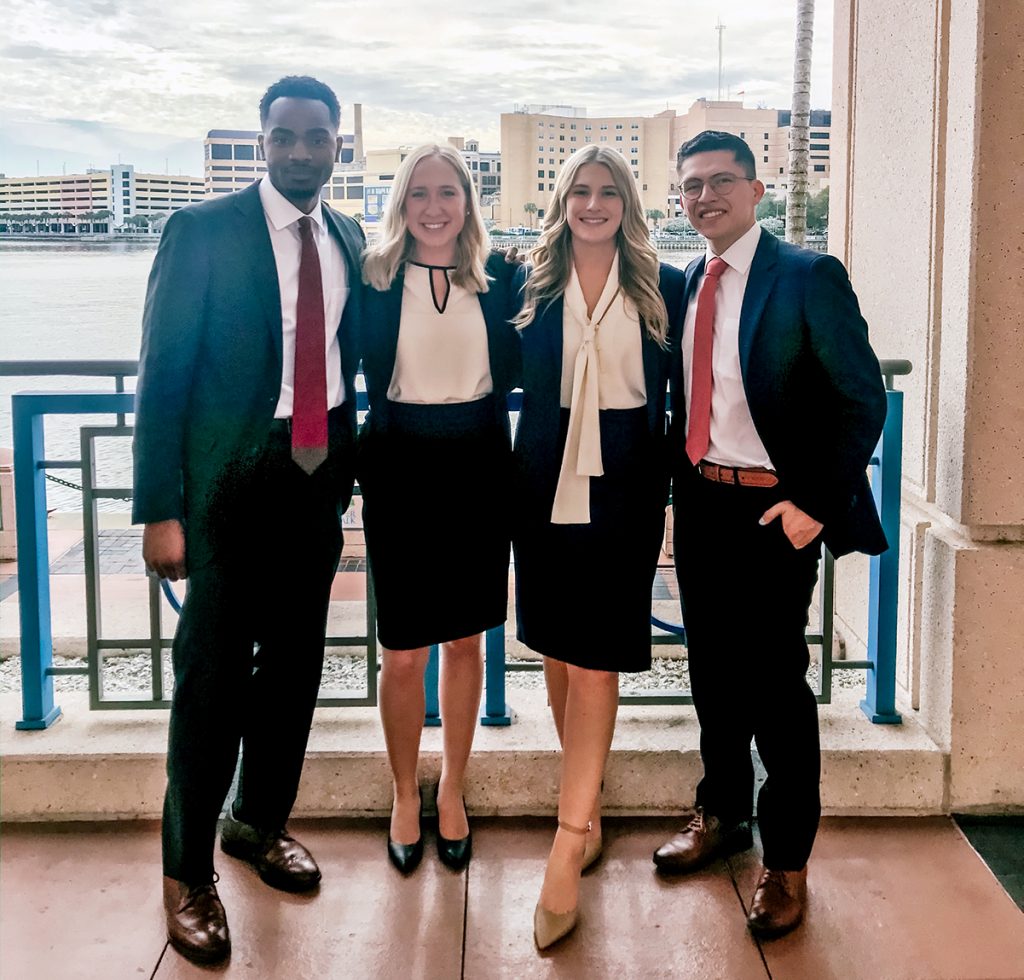
Stetson Law’s Vis International Arbitration Moot team won the Richard DeWitt Memorial Vis Pre-Moot competition in Miami on Feb. 29, 2020. From left: Huda Awan, Audrey Gangloff, Melissa Micceri, Prof. Stephanie Vaughan (coach), Joe Cuffel, Devin Dudley, Pedro Aranguez Diaz, Clare McQueen (student coach) and Prof. Joseph Morrissey (coach).
Stetson University College of Law’s Vis International Arbitration Moot team won the Richard DeWitt Memorial Vis Pre-Moot on Saturday, Feb. 29, 2020, in Miami. The victory prepares the team to advance to the Willem C. Vis International Commercial Arbitration Moot competition in Vienna in early April.
Team members are Huda Awan, Melissa Micceri, Devin Dudley, Audrey Gangloff, Pedro Aranguez Diaz, and Joe Cuffel. This was the first competition for Awan, Diaz, Dudley, and Micceri, and the first dispute resolution competition for Gangloff, who is also a member of the Moot Court Board. Cuffel was the lone veteran on the team.
Professor Joseph Morrissey, Professor Stephanie Vaughan, and student Clare McQueen coached the team. McQueen was part of last year’s team that advanced to the Elite 8 in Vienna. They said the competition was especially fierce this year, with international (Finnish Lapland University) and out-of-state (American University Washington College of Law and Tulane Law School) teams joining the usual Florida schools.
The Florida Bar International Law Section hosts the Richard DeWitt Memorial Vis Pre-Moot for teams competing in the Willem C. Vis International Commercial Arbitration Moot competition in Vienna and Hong Kong. The day-long event includes four rounds between the competing law schools with seasoned practitioners serving as arbitrators. The event gives students an opportunity to practice and sharpen their skills by presenting and defending their legal arguments and receiving feedback from some of the best practitioners in international law.
Students must argue the jurisdictional, procedural and substantive issues raised by the case before a panel composed of practitioners, under the applicable international treaties and rules. The subject matter of the competition is typically a controversy that arises out of a dispute governed by the United Nation’ Convention on Contracts for the International Sale of Goods.
Dean Michèle Alexandre, far left, takes a question from Stetson Law student Kia Tolbert during the town hall meeting on the Campus Climate Survey.
By Molly Kaelin
Dean Michèle Alexandre hosted a town hall meeting to discuss the Campus Climate Survey with students, faculty, and staff in the Great Hall on Feb. 18. The informal gathering gave participants a chance to express concerns and exchange ideas.
The Campus Climate Survey is currently open for students
faculty and staff; the deadline for completion is March 6. The purpose is to gauge
the institution’s progress on becoming a more
diverse, equitable and inclusive community and identify new initiatives that
could be implemented or any action areas that should be addressed.
Wonderful changes can come from our collective voice, and we
need continued participation in the survey for this reason, Dean Alexandre
said.
“This is something that can be meaningful, and you can tell
your honest truth.”
The survey is confidential. Submitted surveys go directly to
neutral third party provider, Pryor Education Insights, which will compile and
analyze the data. Results will be available in the fall, and Dean Alexandre
hopes to have representatives from the company on campus to explain the
findings.
The last campus climate survey was conducted in 2016, and it
led to such programs as the Food Pantry and Sexual Health Resource Area and the
identification of gender-neutral bathrooms on campus, as well as the creation
of a Diversity and Inclusion Committee and Staff Advisory Committee. That year,
the response rate from the College of Law (including students, staff and
faculty) was 34 percent. This year, Dean Alexandre said she hopes to have at
least 50 percent participation.
Professor Lance Long said they hope to have robust student participation in the Campus Climate Survey.
Professor Lance Long, a member of the Diversity and Inclusion
Committee, beseeched students to take the time to complete the survey.
“We really want more input from the students,” he said. “They’re
why we exist.”
During the meeting, students expressed the need for more
involvement in the community – specifically, the school’s need to reach out to
local organizations such as the St. Petersburg Bar Association and other similar
organizations. The emphasis was on going out in the legal community and not
merely inviting people to speak or network on campus. More visibility will only
lead to more opportunities for Stetson Law students and the College of Law
overall, students said.
Other student concerns included greater support for students
that commute and students with families, as well as easier access to member of
the administration. Faculty and staff concerns centered on tension between
different departments and staff changes. There was a request to have staff
change information available in real time. With these needs voiced, the College
of Law can now work to address them.
Dean Alexandre reiterated the best way to have your voice heard in a confidential manner is to fill out the survey before the March 6 deadline. Check your email for a link to the survey or pick up a paper copy in the Student Affairs office.
Culverhouse Chair and UCLA Law Professor Devon Carbado lectures on critical race judgements in a special class for students on Saturday, Feb. 8, 2020.
By Brittany Given Stetson Law 3L Feb. 14, 2020
Devon Carbado, distinguished UCLA law professor and author, returned to Stetson Law on Feb. 8, 2020, as the new Culverhouse Chair to teach “Critical Race Judgments: Critical Race Theory and Supreme Court Decision making.”
Carbado launched the Saturday morning class with a racial determination exercise where he first described one parent as black and another parent as white. He then asked students to classify the child as black, white, biracial, multiracial, or other. He repeated this exercise multiple times with different combinations of the child’s parents including white, black, Latino, and Asian. The takeaway from this exercise was to see that society does not take into account how a person identifies himself or herself. Rather, society primarily views people based on their physical features.
At the end of the exercise, Carbado posed the question: Should people have the right to choose their own race? It was a topic he would circle back to at the end of the class.
This icebreaker segued into a discussion on the landmark 1954 U.S. Supreme Court decision in Brown v. Board of Education, which declared that racial segregation in public school was unconstitutional. It was a decision that went against the will of the majority Americans and an achievement that was not without controversy. Carbado explained that progress has not been linear, but rather can be described as ebb and flow. When slavery was abolished, there was a backlash and Jim Crow laws were enacted. After the victory in Brown v. Board of Education, more lynchings started to occur. When the Civil Rights Act was passed, many people and businesses resisted integration.
Students participated in a special Culverhouse Chair lecture.
The class discussion about the ebb and flow of progress led Carbado to explain the concept of “racial math.” Slavery produced racial inequality. Then there was some civil rights intervention during the period of Reconstruction. If you take the racial inequality and subtract the civil rights intervention during Reconstruction, Carbado explains that you can only get two possible answers: The first answer is that there is zero racial inequality. The second answer is that there is still some racial inequality. After Reconstruction, most everyone agrees there was still some racial inequality, and Jim Crow laws increased the divide, but Brown v. Board of Education helped offset some of the inequality. Still, society was left with some racial inequality rather than zero racial inequality.
Carbado continued in this vein, going through much of the history of the United States and giving examples of when more racial inequality was added and when some racial inequality was subtracted. His point was that there has never been a moment in our history when the intervention has been enough to completely clear the slate or to have zero racial inequality. The accumulation of racial inequality has been a problem over hundreds of years.
After providing students this historical context, Carbado then broached how race is a social construction. He broke it down into five parts: The first part is the moment when people say that race matters now. People agree that race is a thing that is recognized. The second part is when people decide the relevant categories of race, such as black, white, or yellow. He encouraged students to look at the U.S. census over the years because there have been different racial categories over time. The third part is to determine what criteria to employ to stick people in the categories. Phenotype hasn’t been the only criteria used. Language, accent, and demeanor also are used to place people into racial categories. The fourth part is to map some experience such as slavery, freedom, or internment. The final part is to assign meanings to the different groups, such as those enslaved are inferior. Race, he said, is bound up with questions of social meaning.
The Hon. Tangela M. Barrie was the 2020 recipient of the Wm. Reece Smith, Jr. Public Service Award.
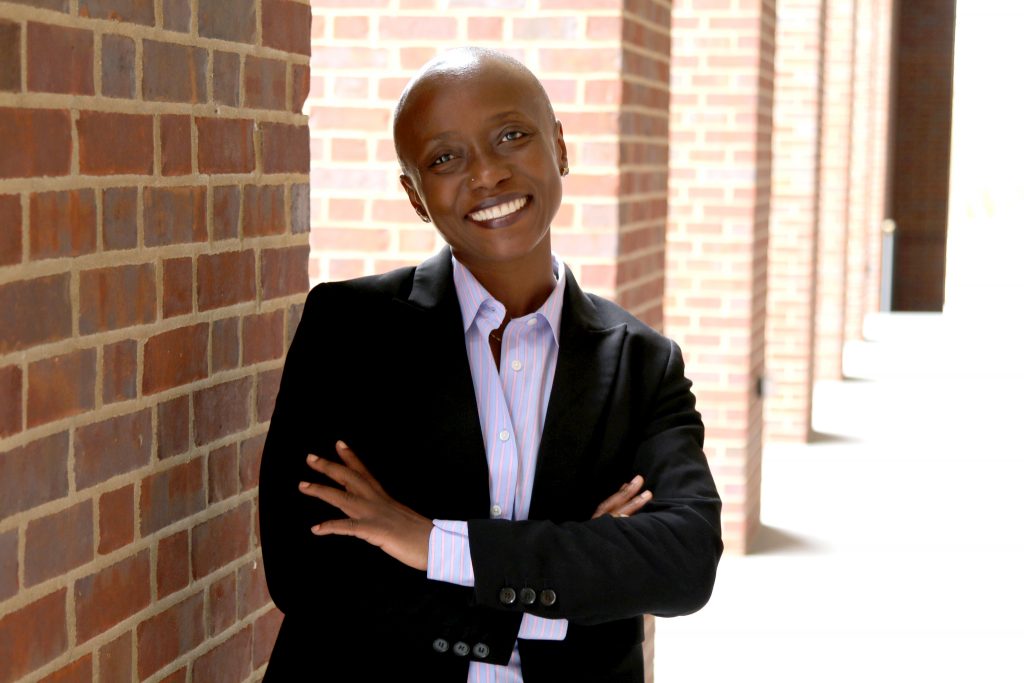
The Hon. Tangela M. Barrie received the Wm. Reece Smith, Jr. Public Service Award during the annual Inns of Court Banquet at Stetson University College of Law on Feb. 5, 2020.
The prestigious Wm. Reece Smith, Jr. Public Service Award recognizes
individuals who have provided outstanding contributions to public service, the
justice system, and the community.
Judge Barrie, a 1997 Stetson Law alumna, is the youngest
Superior Court judge ever elected to the circuit court in DeKalb County,
Georgia. Elected in 2008 at the age of 35, Judge Barrie handles felony cases
ranging from theft to murder and a civil case load that includes adoptions,
divorces, and more. In 2015, she was selected as Chief Judge for DeKalb County
Superior Court and continues to serve as the presiding judge of Division 10 of
the Stone Mountain Judicial Circuit.
With her strong family roots and commitment to community
safety, Judge Barrie has dedicated herself to educating and empowering the community.
She is an ardent advocate for young lawyers, offering an active Intern in
Chamber Program.
“She has mentored me and other young lawyers active with the
bar, teaching points of law and a commitment to professionalism in our field,” wrote
Marisa Cioffi Dunn, a 2017 Stetson Law graduate who works as a staff attorney
in Judge Barrie’s chambers and who nominated her for the award.
Judge Tangela M. Barrie speaks during the annual Inns of Court Banquet.
Prior to taking the bench, Judge Barrie was assigned to the
DeKalb County District Attorney’s Office Domestic Violence/ Sexual Assault
Unit. There, she worked vigorously advocating for the safety of women and other
victims and was selected the 2007 Prosecuting Attorney of the Year for the
successful prosecution of her cases.
Judge Barrie has received many other accolades throughout
her career, all marking her devotion to bettering her community. For example,
she earned:
The Boundless Commitment to the Community Award
from the DeKalb County District Attorney’s Office in 2006;
The Bensonetta Tipton Lane Award in 2009 from
the Georgia Association of Black Women Attorneys for her tireless dedication to
family safety;
The DST 2016 Public Policy Change Agent Award from
Delta Sigma Theta Sorority, Inc.; and several others.
She is an active member of numerous service organizations,
such as Delta Sigma Theta Sorority, Inc. and the National Council of Negro Women.
She is also on the board of various professional organizations, including the
Wade Walker YMCA of Decatur and the Georgia Association of Black Women
Attorneys.
“As a law clerk, I observe Judge Barrie’s courtroom almost
daily,” Dunn wrote. “She is an excellent jurist with a deep
knowledge and understanding of
the law. My favorite attribute of Judge Barrie is that she always does what she
believes is right, never compromising her integrity to take an avenue that may
be easier. Judge Barrie has taught me what it means to be a public servant, as
she has committed her life and career to public service.”
Dean Michèle Alexandre with The Hon. Tangela M. Barrie
Judge Barrie’s tireless work in her community is truly in
keeping with the spirit of and inspiration for the Wm. Reece Smith, Jr. Public
Service Award. Smith was a legendary Florida lawyer who dedicated more than 60
years to the legal profession, working to increase the legal services available
to people who could not afford them. He was a member of the Stetson University
College of Law Hall of Fame,
joined the Stetson University College of Law faculty in 1954, and was named a
distinguished professorial lecturer in 1991.
From left: Christine Cerniglia, associate professor and director of Clinical and Experiential Education; Linda Anderson Stanley, ABA director of Disaster Legal Services and the senior manager for Disaster Programming at Equal Justice Works; and Jean-Luc Adrien, Community Justice Project of Miami – Equal Justice Works Disaster Recovery Legal Corp. Fellow.
Stetson Law now offers a new course and corresponding externship experience designed to train students in an increasingly essential area of advocacy: disaster law.
The Disaster Law Primer is a one credit course offered over two weekends that provides a basic overview of disaster law including FEMA benefits, highlights systemic legal issues in a post-disaster world, and prepares students to complete and file a Federal Emergency Management Agency (FEMA) appeal.
With hurricanes and rising sea levels, not to mention other less predictable disasters such as oil spills, it behooves young lawyers – and their communities – to build the knowledge and skills needed to navigate FEMA benefits. Even for those who have studied the law, the government agency’s processes are not always intuitive. Much of the United States is vulnerable to some type of disaster, whether it is a tornado, wildfire, hurricane or winter storm – Stetson students who plan to work elsewhere in the country after graduation are able to utilize the skills to help clients trying to rebuild their lives.
After disasters, the burden often falls heavily on legal aid offices and pro bono attorneys to help victims with legal issues. And despite the seemingly increasing occurrence of disasters, it is an area of law suffering from a dearth of experience and no standardized strategic approach, said Anthony Palermo, the ABA YLD District Representative who presented as part of the course. It is an important long-term problem that calls for a solution, and practical training courses such as the Disaster Law Primer could be the key.
Brittanny Perrigue, Texas Rio Grande Legal Aid Equal Justice Works Disaster Recovery Legal Corp. Fellow, was one of the guest lecturers.
The program was two years in the making, said Christine Cerniglia, associate professor and director of Clinical and Experiential Education. And in just two weekends, all 12 of the participants in the inaugural course reported they felt confident they could effectively tackle a FEMA appeal.
“We just created change agents,” said Cerniglia, who co-teaches the course with Linda Anderson Stanley. Linda is the ABA Director of Disaster Legal Services and also the Senior Manager for Disaster Programming at Equal Justice Works. “We are lucky to have the expertise of Linda in the classroom who works on many systemic issues on a national level. The students are lucky to learn from her.”
Students study the role of agencies, legal aid offices, volunteer efforts, and government at both the state and federal level in a post-disaster context, particularly FEMA’s National Response Framework and the new standards for benefits under its Individual and Households Program. They focus, too, on the launch of Disaster Recovery Centers (DRC’s), legal issues relevant to Legal Aid offices, pro bono attorneys, and the responsibility of the American Bar Association and the State Bar to coordinate a response. Over the two-week period, students researched a specific disaster to understand how each scenario presents a different response and how all disasters impact the most vulnerable in our society. For the final assignment, students had to draft a FEMA appeal based on a fact pattern similar to what they would find after a disaster.
Michelle Walker
Michelle Walker, a part-time student in her third year, said the material was unlike anything she had been exposed to so far in law school and that it was a great, practical, hands-on opportunity. It helped put a personal, human face on the application of administrative law, which she found very helpful.
Walker was selected as the first Disaster Law Extern. The Primer course is a prerequisite for the Disaster Law Externship where students have a chance to put their newfound skills to use and work on actual FEMA appeals under the supervision of Equal Justice Works disaster fellows. Students who have successfully completed the primer may apply for the 1 credit externship at any point in their law school career.
Stetson University, Stetson
University College of Law and Pryor Education Insights will conduct a Campus
Climate Survey to ask students, faculty and staff about the institution’s
progress on becoming a more diverse, equitable and inclusive community.
The confidential survey will arrive by email on Monday, Feb.
3. The deadline to respond is Friday, March 6.
Stetson University conducted its first campus climate
survey in 2016, and the College of Law instituted a number of initiatives
to promote diversity and improve campus climate as a result of its findings. For
example:
A Diversity and Inclusion Committee, comprising faculty, staff and student members, was created to track the college’s progress on these issues. The group engaged the Student Bar Association’s diversity committee as it worked to increase cross-cultural interaction on campus.
The College of Law followed up on the committee’s suggestions by sponsoring several diversity and inclusion education sessions by Elon, Prism, Community Tampa Bay and others.
For students, various on-campus health resources were created in April 2017 to help with wellness, and at students’ request, results of Honor Code violations are published (anonymously) online, so that they know those are addressed and resolved appropriately.
Efforts to increase transparency and inclusion for staff included creating an internal, online organizational chart of the school’s leadership. A Staff Advisory Committee was created in 2018 to give them a stronger voice in College of Law decisions.
The College of Law’s search processes for open positions was changed to attract diverse candidates, resulting in more inclusive hiring for faculty and staff throughout the school.
Dean Michèle Alexandre
“These and other tangible accomplishments are important
to show students, faculty and staff that their opinions matter and can bring
about change,” said Dean Michèle Alexandre. “I hope that each of you will take
the time to complete the survey and provide meaningful feedback. The results
will help us embark on new initiatives and take any needed
action.”
The survey consultant, John Pryor and his Pryor Education
Insights, is expected to present the results in fall 2020.
Jan. 30, 2020 – Stetson University College of Law is excited to welcome Pulitzer Prize-winning author and Yale Law School Professor James Forman Jr. to campus as the keynote speaker for the Annual Inns of Court Banquet and Wm. Reece Smith, Jr. Distinguished Lecture on Feb. 5, 2020.
Professor Forman is the J. Skelly Wright Professor of Law at Yale Law School, and his book, Locking Up Our Own: Crime and Punishment in Black America, was awarded the 2018 Pulitzer Prize for General Nonfiction and featured on the New York Times’ 10 Best Books of 2017.
He has devoted much of his career to working with people who
have been incarcerated. As a member of the Public Defender Service in
Washington, D.C., he spent six years representing juveniles and adults charged
with crimes.
During his time as a public defender, Forman became so frustrated with the lack of education and job training opportunities for his clients that he started the Maya Angelou Public Charter School, an alternative school for school dropouts and youth who had previously been arrested. A decade later, the institution expanded and agreed to run the school inside D.C.’s juvenile prison. That school, which had long been an abysmal failure, has been transformed under the leadership of the Maya Angelou staff. The court monitor overseeing D.C.’s juvenile system called the turnaround “extraordinary.”
Professor Forman, a graduate of Brown University and Yale Law School, taught at Georgetown Law from 2003 to 2011 before joining the Yale faculty. At Yale, he teaches Criminal Law and a seminar called Inside Out: Issues in Criminal Justice, in which Yale law students study alongside men and women incarcerated in state and federal prisons.
He teaches and writes in the areas of criminal procedure and
criminal law policy, constitutional law, juvenile justice, and education law
and policy. His particular interests are schools, prisons, and police, and
those institutions’ race and class dimensions.
Wm. Reece Smith, Jr.
Professor Forman’s lecture will be a wonderful addition to
Stetson Law’s Annual Inns of Court Banquet, which brings together prominent
lawyers, experienced teachers, and law students to exchange ideas, experiences,
and education. The event includes The Wm. Reece Smith, Jr. Distinguished
Lecture in Ethics, as well as the Wm. Reece Smith, Jr. Award. Both are named in
honor of the legendary Florida lawyer who served as founder of Florida Legal
Services, president of the International, American and Florida Bar Associations,
a distinguished professorial lecturer at Stetson Law, and a member of the
Stetson Law’s Hall of Fame.
Jan. 27, 2020 — Stetson University College of Law has selected Leland Ware as the recipient of this year’s William A. Kaplin Award.
The Center for Excellence in Higher Education Law and Policy
at Stetson University established the award in honor of Professor William A. Kaplin
to recognize scholars who have published works on education law that embrace
the intersection of law and policy.
Ware is the Louis L. Redding Chair and Professor of Law
& Public Policy at the University of Delaware where he also teaches
Africana Studies. He has a bachelor’s degree in history from Fisk University
and a Juris Doctor from Boston College Law School.
Ware’s research focuses on civil rights and civil liberties
law, employment law and constitutional law. His book, A Century of Segregation:
Race, Class, and Disadvantage, (Lexington Books 1998), explains how race and
class intersect in ways that uniquely disadvantage African Americans and other
racial minorities.
He has authored more than 100 articles in academic journals
and other publications on various aspects of civil rights law and co-authored
two books, “Brown v. Board of Education: Caste, Culture and the
Constitution” and “Choosing Equality: Essays and Narratives on the
Desegregation Experience.” Prior to his work in academia, Ware was a trial
attorney with the U.S. Department of Justice.
The award ceremony will take place as part of the 41st
Annual National
Conference on Law and Higher Education, Jan. 29-Feb.3, 2020, in Clearwater
Beach, Florida. The conference, now in its 41st year, is designed to provide
attendees with the vision, motivation, and intensely practical tools needed to
return to campus to meet the dynamic law and policy challenges in higher
education. It features the top thinkers, lawyers, and authors in the field.
The Stetson University College of Law Trial Team of, from left, Drew Trautman, Rachel Wise, Megan Tiralosi and Amy Trentalange won the 2020 Chester Bedell Mock Trial Competition.
Jan. 24, 2020 — The Stetson University College of Law Trial Team of Drew Trautman, Amy Trentalange, Megan Tiralosi, and Rachel Wise won the Chester Bedell Mock Trial Competition Jan. 22-24 in Tampa, Florida.
Megan Tiralosi also won the best advocate award. A second
Stetson team of Olivia Bergert, Justin Bell, Magner Tiuso, Molly Goodwill made
it to the quarterfinal round.
This marks the 24th time in 38 years a Stetson team has won
the competition. Hatters claimed the inaugural trophy as well in 1983. The
Trial Lawyers Section of the Florida Bar conducts the prestigious competition
for mock trial teams from across the state annually, and distinguished members
of the judiciary preside over the final round.
A Stetson University College of Law Trial Team of, from left, Justin Bell, Molly Goodwill, Olivia Bergert, and Magner Tiuso made the quarterfinal round of the competition.
All eight students sacrificed their winter break to prepare for the competition, and the winning team was ultimately made better by having practiced against their schoolmates, said Julia A. Metts, director of Trial Programs and professor of practice.
“Iron sharpens iron, and that is how Stetson stays consistent,” she said. “Together we make each other better. Together we push towards a goal of personal and professional growth. Together we advocate with a purpose!”
Stetson’s program in trial advocacy is nationally ranked No.
1 by U.S. News & World Report. To learn more about the advocacy program,
visit stetson.edu/law/advocacy.
Donation will provide security awareness training to employees, create scholarships and internships, and help develop the school’s cybersecurity law program.
KnowBe4, the provider of the world’s largest security awareness training and simulated phishing platform, today announced it will make a $250,000 donation to Stetson University College of Law.
The donation includes:
Creation of the KnowBe4 Cybersecurity Law Scholarship Fund that will provide $5,000 merit-based scholarships for the next five years;
Creation of the KnowBe4 Cybersecurity Law Program Fund to support the establishment and growth of the cybersecurity law program at Stetson Law; and
A subscription to KnowBe4’s diamond-level new-school security training platform to enhance security and data protection awareness with Stetson’s staff, faculty and students.
“We see this donation as a great opportunity to contribute to and build our community,” said Stu Sjouwerman, CEO of KnowBe4. “It’s also an opportunity to help fulfill the need to educate and train more cybersecurity talent. We’re excited to work with Stetson University College of Law to help develop an entire collegiate program that’s focused on cybersecurity in the Tampa Bay area.”
The agreement includes the creation of other initiatives, such as a weekend course on the topics of cybersecurity and data privacy for Stetson Law students, speaking events, student-led research, student organizations, internship opportunities for law students, and providing general support for business law initiatives at Stetson Law with cyberlaw course offerings and other resources related to cybersecurity law.
“We strive to be at the forefront of all that we do at Stetson Law – whether it is educating students in emerging areas of law or ensuring our faculty and staff are highly trained in new technology – so this collaboration with KnowBe4 is a fantastic opportunity to advance both our mission and theirs,” said Michèle Alexandre, dean of Stetson University College of Law.
About KnowBe4
KnowBe4, the provider of the world’s largest security awareness training and simulated phishing platform, is used by more than 30,000 organizations around the globe. Founded by IT and data security specialist Stu Sjouwerman, KnowBe4 helps organizations address the human element of security by raising awareness about ransomware, CEO fraud and other social engineering tactics through a new-school approach to awareness training on security. Kevin Mitnick, an internationally recognized cybersecurity specialist and KnowBe4’s Chief Hacking Officer, helped design the KnowBe4 training based on his well-documented social engineering tactics. Tens of thousands of organizations rely on KnowBe4 to mobilize their end users as the last line of defense.
Jan. 3, 2020 – Stetson University College of Law, as part of the annual Wills for Warriors event, will again partner with the Community Law Program in Pinellas County and the St. Petersburg Bar Foundation to prepare free simple wills and advance directives for low income veterans and their spouses aged 60 or older.
The event will take place on Stetson Law’s campus in mid-February. Walk-in appointments are not available. Veterans or their spouses must schedule individual appointments in advance by calling 727-562-7577 by Feb. 4, 2020.
The Wills
for Warriors program is designed to assist veterans and their spouses aged 60
or older who have low incomes and limited assets. Individuals who own real
estate outside the state of Florida are not eligible to participate.
Stetson
students and volunteer attorneys from the Community
Law Program will
assist Stetson Law’s Center for Excellence in Elder Law with this program. The Center for
Excellence in Elder Law was established to meet the increasing need for legal
education and research in the field of law and aging. The Center provides legal
education to law students, attorneys, and judges in the field of elder and
special needs law and produces scholarly research and writing on issues
impacting those who are older and/or have special needs.
Stetson University will launch an additional
layer of online security known as multi-factor authentication this month for
students, faculty and staff to log in when they are off-campus.
Stetson will be a pioneer in cybersecurity initiatives as it is the first higher-education institution in the country to develop its own multi-factor authentication for its online services. The multi-factor authentication process will require students, faculty and staff to verify their identity in two ways when they log in from an off-campus location.
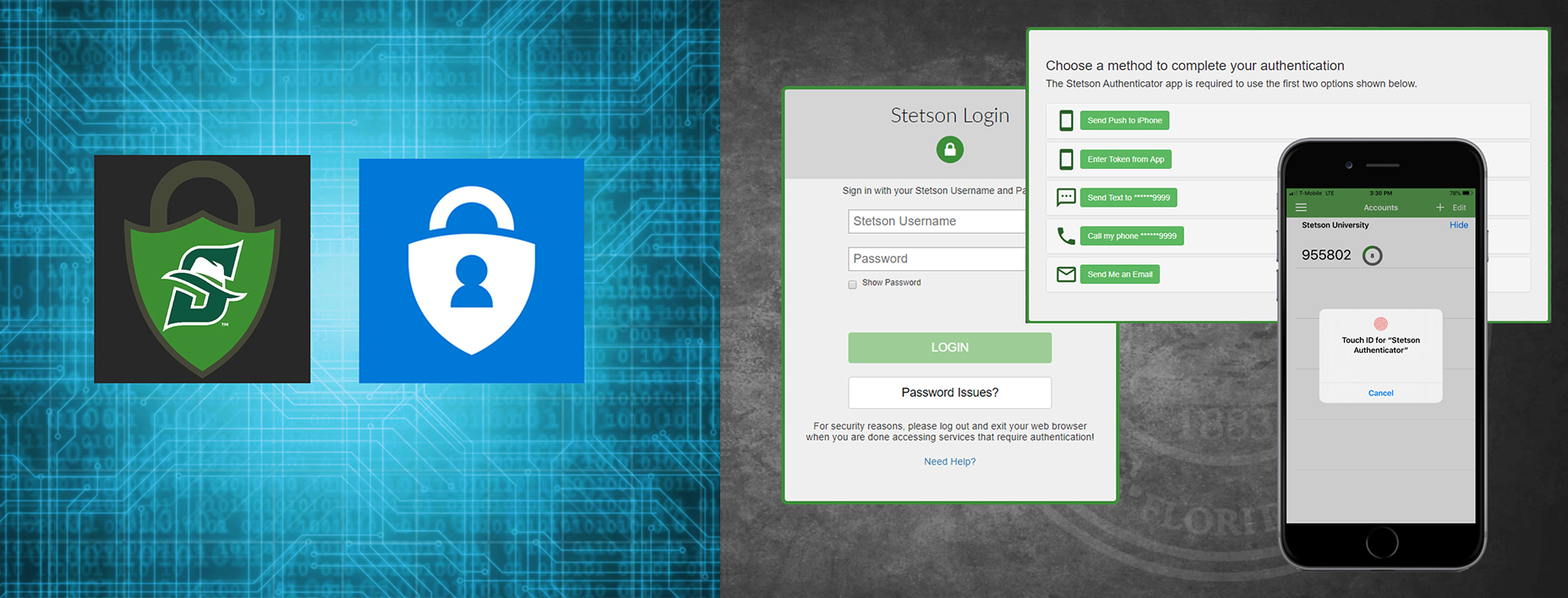
For example, users will need their password and a numeric code texted to their mobile phone. The Stetson multi-factor authentication will offer the added flexibility to use biometrics, such as a fingerprint or facial recognition, to confirm one’s identity in addition to other options, such as passwords, tokens, text messages and push notifications.
The new security feature will go live on
Stetson’s four campuses in DeLand, Celebration, Gulfport and Tampa on:
Monday,
Jan. 20, for non-faculty employees
Monday,
Feb. 3, for faculty
Monday, March 9, for students
How to use Multi-Factor Authentication?
Stetson Authenticator icon
Users will be required to complete an extra step (typically on their mobile phones) after they enter their User ID and Password to log in while they are off campus. Users will be required to use two authenticators and will be prompted to download these to their mobile device when they log in:
• Stetson Authenticator –
for all Stetson services, such as myStetson, Banner and Blackboard
Microsoft Authenticator icon
• Microsoft Authenticator – for all Microsoft services, such as Outlook email, Office 365, OneDrive, etc.
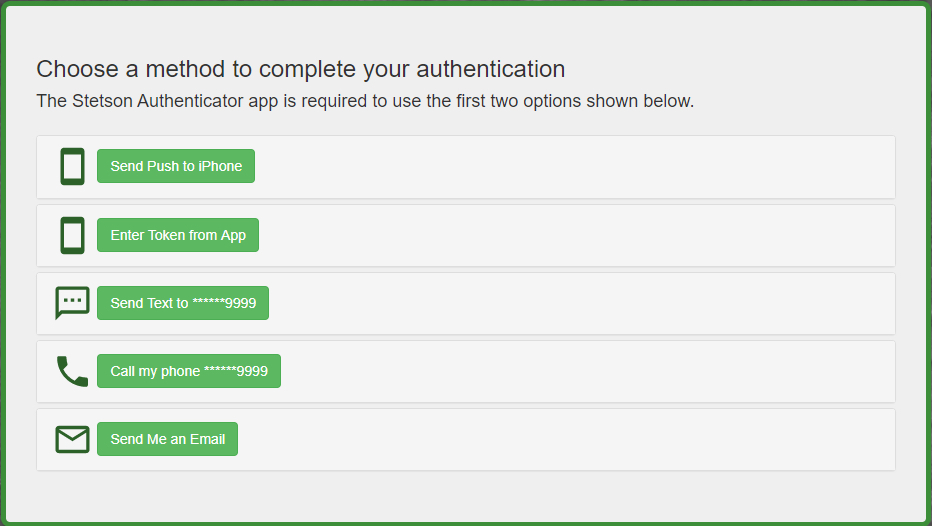
There are five main options for these authenticator
apps:
A. Users receive a notification on their mobile
devices via the Authenticator app. They can then accept or decline it.
B. Users read a one-time-use token from the
Authenticator app and enter it on the screen provided.
C. Users receive a one-time-use token via text
message on their registered phones and enter it on the screen provided.
D. Users receive a phone call on their
registered phones and respond to it using the prompts.
E. Users receive a one-time-use token via a non-Stetson email that they will indicate during sign up. They will then need to enter it on the screen provided (This option is only available for Stetson Authenticator).
Options in Stetson Multi-Factor Authentication, such as “Send push to Phone,” and “Enter Token from App.”
Although the multi-factor authentication is designed by default to be used off-campus, users have the option to choose to use it on-campus, as well. They will need to indicate their preferences during registration or subsequently through their settings page on the MyStetson portal. Certain users with access to confidential and sensitive information like Banner administrative users and IT users will be required to use this security feature irrespective of their location.
Users will also have the option to trust their frequently used browsers, so that they will not be prompted to use multi-factor authentication for 30 days while using those browsers.
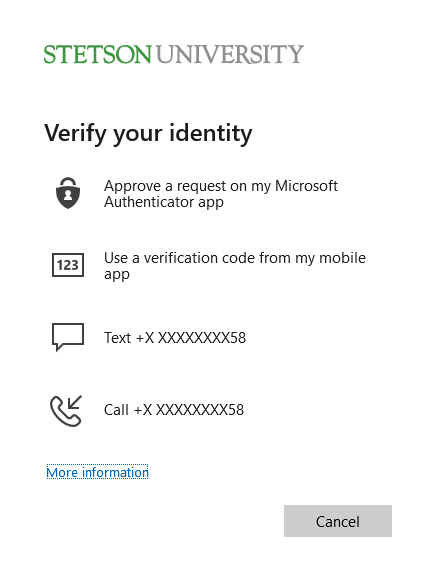
Options in Microsoft Multi-Factor Authentication
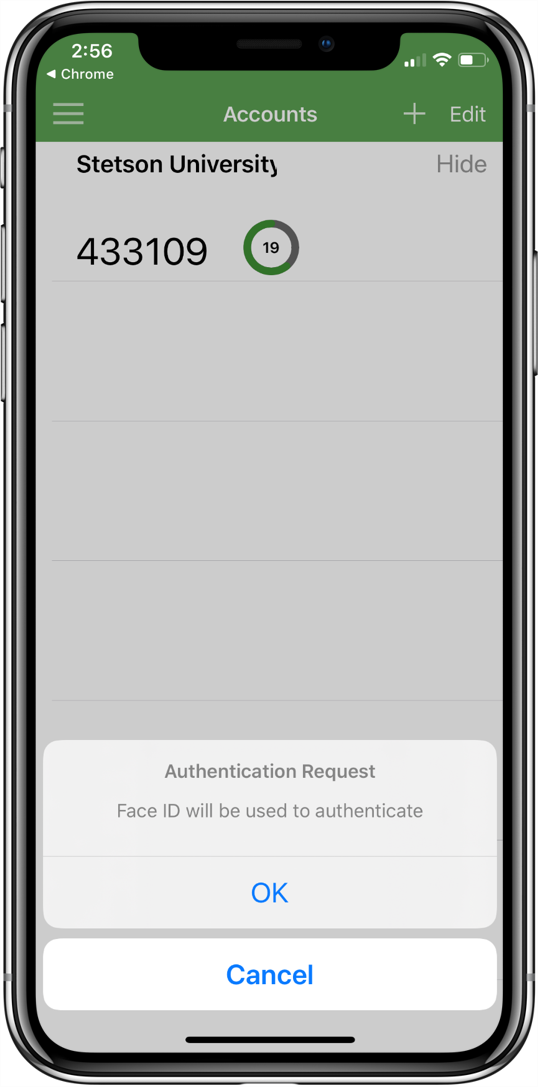
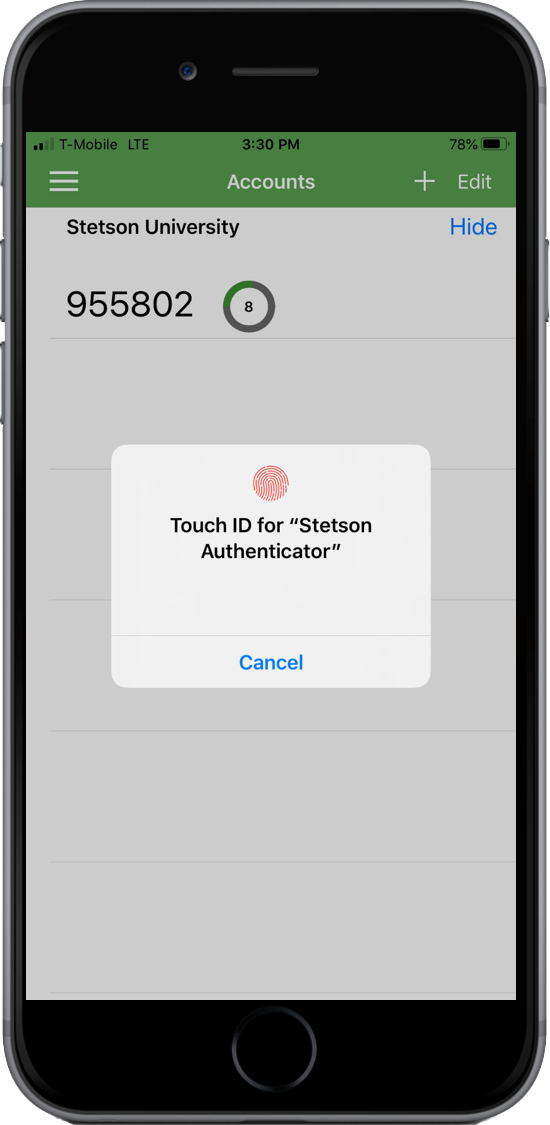
In addition, since the Stetson Authenticator mobile app has biometric authentication capabilities, users can use their phone’s TouchID or FaceID (fingerprint and face recognition capabilities), if applicable, while responding to the notifications received (Select Option A above: “Send Push to Phone”).
Go-Live dates for Multi-Factor
Authentication
Starting in fall 2019, both the Stetson and Microsoft multi-factor authentication systems were tested on a pilot basis by users in IT and by students in a Management Information Systems (MIS) class, taught by Vikram Ahmed, EdD, director of Stetson’s Enterprise Information Systems (EIS).
The first group to go live was Banner administrative users on Nov. 4. The security feature will be launched to the three remaining groups of users on all Stetson campuses starting Monday, Jan. 20, for all non-faculty employees; Monday, Feb. 3, for all faculty; and Monday, March 9, for all students.
When users log in on or after the go-live date for their respective group, they will receive a prompt to download the Stetson Authenticator Mobile App and the Microsoft Authenticator Mobile App (available on Apple App Store and Google Play) on their iOS or Android phone, set up their preferences (including phone numbers to receive text messages and calls, and an external non-Stetson email address for the Stetson multi-factor authentication); and follow the instructions to complete the login.
They also have the option to enroll to use this
feature before the respective go-live dates. The link: https://my.stetson.edu/apps/mfainfo/
has all the details and instructions.
IT will continue to send updates as the launch dates approach, as well as dates for trainings and demonstrations. For any questions or concerns, please contact I.T. at [email protected].
One of the first steps of cybersecurity is access
control, which involves the identification and authentication of users. There
are three common factors used for authentication:
Something users know (such as their
passwords)
Something users have (such as their mobile
phones)
Something users are (such as their
fingerprints or face recognitions)
Identification occurs when users indicate their identity (such as with a username), and authentication occurs when users prove their identity. For example, users are authenticated when they provide both their username and their correct password. Permissions, rights and privileges are then granted to users based on their proven identities. Among the three authentication factors indicated above, passwords are the most commonly used, but are also the least secure. As Verizon’s 2018 Data Breach Investigations Report noted, “Eighty-one percent of hacking-related security breaches leveraged stolen and/or weak passwords.”
Multi-factor authentication is a method in which a user is granted access only after successfully presenting two or more of the above factors for authentication. For example, users may enter a password (something they know) and respond to a notification on their phone (something they have) to complete the login process. The idea behind this approach is the understanding that a perpetrator may somehow obtain a user’s password, but is very unlikely to have access to the user’s phone as well. Thus, the security of the authentication process is enhanced.
Vikram Ahmed, director of Stetson’s Enterprise Information Systems (EIS), watches as Matthew Samuels, Applications analyst/developer, demonstrates the new Stetson Multi-Factor Authentication process. Samuels was the chief architect of the Stetson Multi-Factor Authentication system.
Multi-Factor Authentication at Stetson
University
Over the past 18 months, the Stetson Information
Technology (IT) department has been researching Multi-Factor Authentication
solutions to increase security, as well as to address IT security audit
suggestions.
After the research was completed, the department received proposals from a couple of vendors of multi-factor authentication solutions that included an annual price in the range of $25,000-$30,000 to cover all of the university users. Additional research showed that a common practice in academia is to separate Microsoft products (email, OneDrive, Office365, etc.) from the institution’s enterprise systems.
For Stetson, those systems include Banner, MyStetson,
Blackboard, Slate and many others. Following this design, the IT department
took advantage of the university’s existing Microsoft License to deploy
Microsoft multi-factor authentication for the Microsoft products at no
additional cost to Stetson.
Stetson Authenticator using Face ID
Stetson Authenticator using Touch ID
At the same time, the Enterprise Information Systems (EIS) unit of IT developed a multi-factor authentication system using internal resources. This solution known as Stetson multi-factor authentication has been designed to be used with the university’s enterprise systems.
Stetson’s multi-factor authentication comes with a mobile app that has been tested and validated by both Apple and Android prior to being included in their respective app stores. In addition, this Stetson Authenticator app advances the security component by incorporating biometrics (fingerprint, face recognition) as an authentication factor.
Ahmed, director of Enterprise Information Systems, said, “Effective cybersecurity is a balance between convenience and security for the user. Stetson MFA combines the best of these two diametrically opposite goals to create an efficient, convenient and secure solution. Very few (if any) MFA commercial solutions offer the use of biometrics as a standard option, and the fact that this solution was completely developed in-house underlines the quality of talent available in EIS.
“In addition, since this solution has been built in-house, we have the flexibility to make required changes quickly and easily, something that would not be available with a commercial solution,” he added.
Matthew Samuels, Applications analyst/developer in EIS and the chief architect of the Stetson Multi-Factor Authentication system, shared his experiences working on this solution, “Developing Stetson MFA was a massive, ambitious project involving many different technologies, such as our single sign-on system (CAS), cloud services in Amazon Web Services (AWS), and various software frameworks.
“After quite a bit of research and development, our year-long endeavor has culminated in a system that provides a variety of methods to finish logging in using MFA and provide an extra layer of security to the Stetson community,” he added.