Skip to content

Conference Explores Landmark Immigration Case 15 Years On

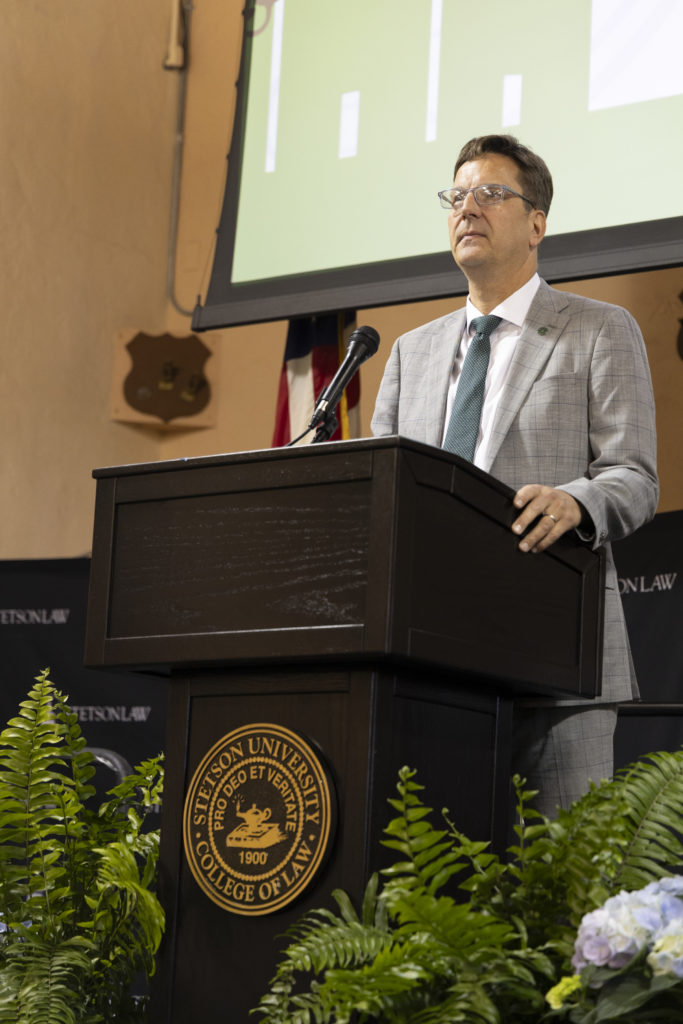
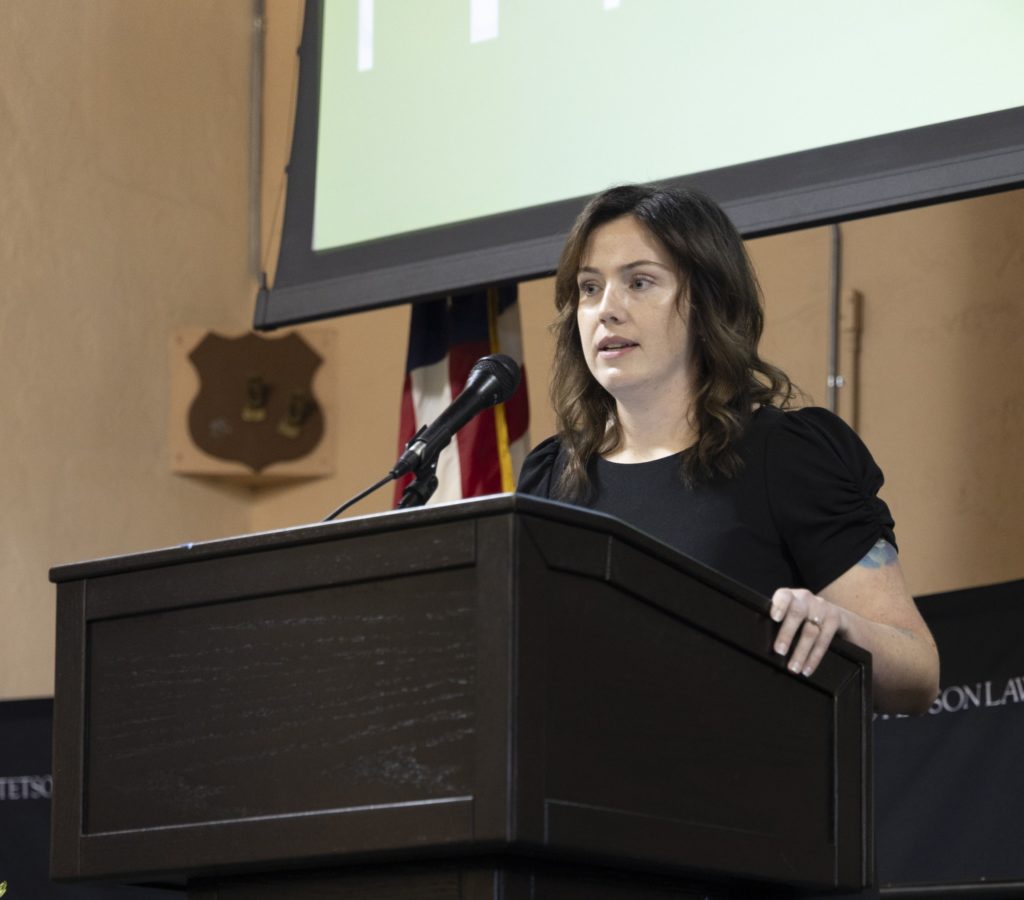
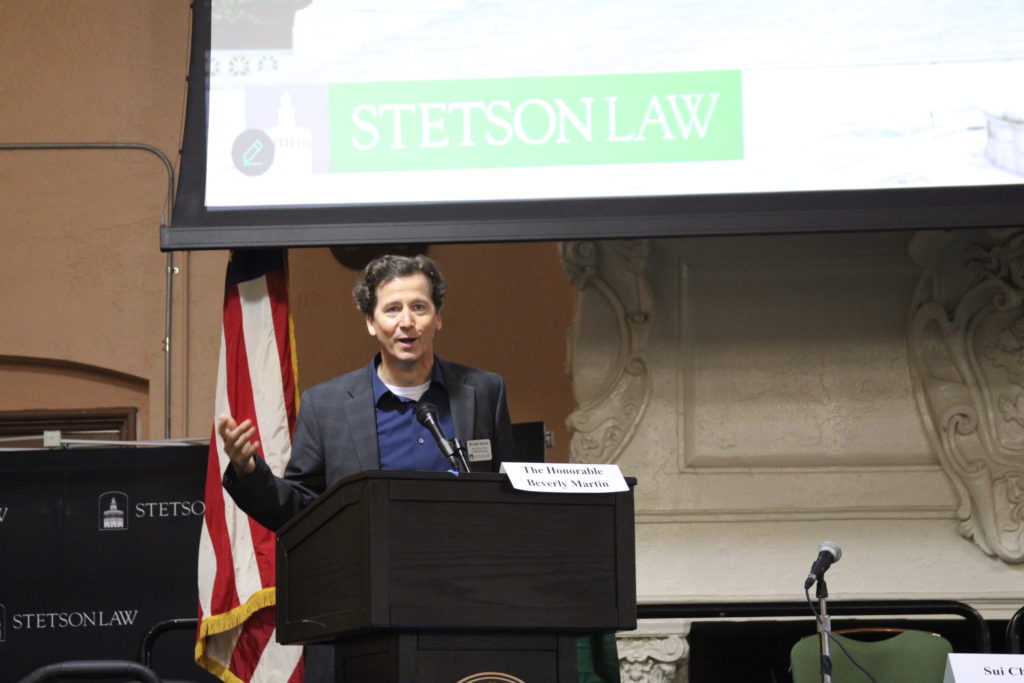
A man stands at the podium in Stetson's Great Hall
Visiting Director of Clinical and Experimental Learning Michael Vastine at a conference examining landmark case Padilla at 15.

Stetson Law’s Office of Clinical and Experiential Education recently invited defense attorneys to reflect on their work through the lens of a key case involving immigrants’ constitutional rights in criminal proceedings.

The conference, “Padilla v. Kentucky at 15 Years: Asserting the Constitutional Rights of Immigrant Defendants,”examined Padilla, a landmark case the U.S. Supreme Court decided in 2010, and all that has happened since. The decision recognized that constitutional rights of immigrants accused of crimes include accurate information about how the outcome of their case might affect their ability to remain in the U.S.

Led by Visiting Director of Clinical and Experiential Education Michael Vastine, a nationally recognized immigration law expert, the conference explored established issues and what Vastine called “hot issues” alike in the area of law where immigration law and criminal law overlap. In the early planning stages of the event in the fall of 2024, organizers had not anticipated the seismic shifts in the national conversation on immigration policy that have since ensued.

“We couldn’t expect that this issue – which some people find controversial; we think it’s just part of our day-to-day work – of immigration consequences of crimes would almost be quaint as opposed to the issues we’re all confronting with civil rights, constitutional freedoms around the country all converging,” Vastine said as the day-long event started.

A gathering of national experts

The day’s conversations included panel discussions among legal scholars, elected public defenders, and non-government organization leaders. They explored structural changes resulting from Padilla, the intersection of constitutional questions and immigration law, and other questions stemming from the case. 

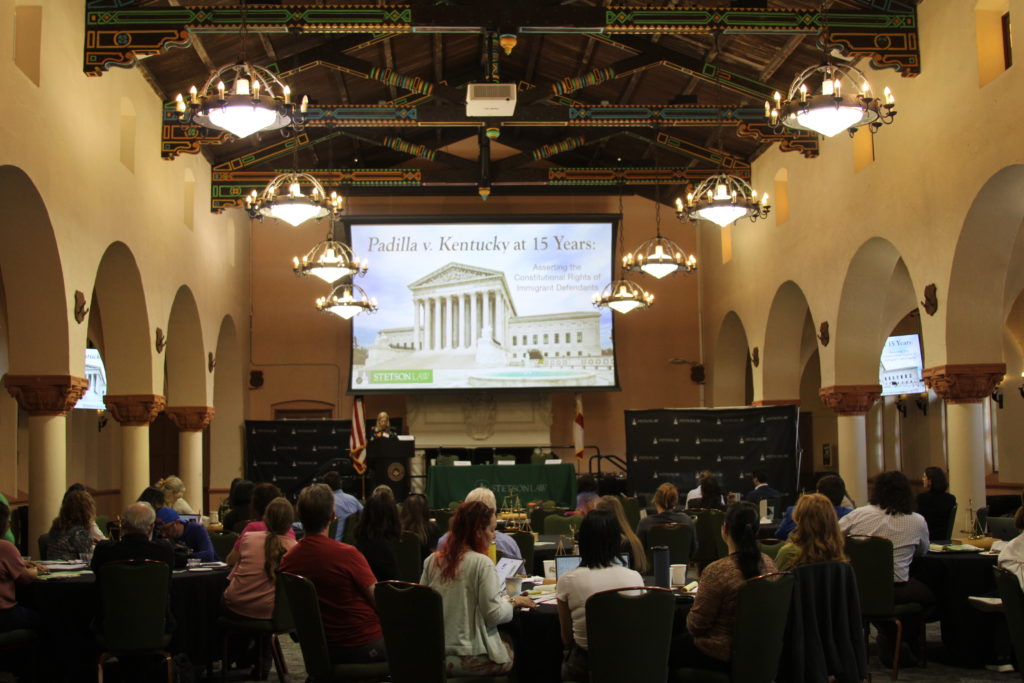
A large audience looks to the front of the room in Stetson's Great Hall.
Practitioners from across the country participated in the Padilla Conference in April of 2025.

Practical discussions delved into the immigration consequences of specific crimes, Padilla’s role in determining the appropriate consequences within the specific circumstances of a given case, the pragmatic impacts of current events as well as federal and state legislation (including the Laken Riley Act) on criminal-immigrant defense, and other topics.

An inspiring perspective

The event’s keynote speaker was Hon. Beverly Martin, a retired judge for the U.S. Court of Appeals for the Eleventh Circuit who now volunteers extensively for an organization that helps former gang members reintegrate into society after incarceration.

Vastine referred to her as a hero.

“Her passion for justice is just infectious,” he said.

Citing historical figures like Dr. Martin Luther King, Jr. and the late Congressman Jon Lewis, she encouraged her audience to remain steadfast in their commitment to their clientele, who are among the most vulnerable.

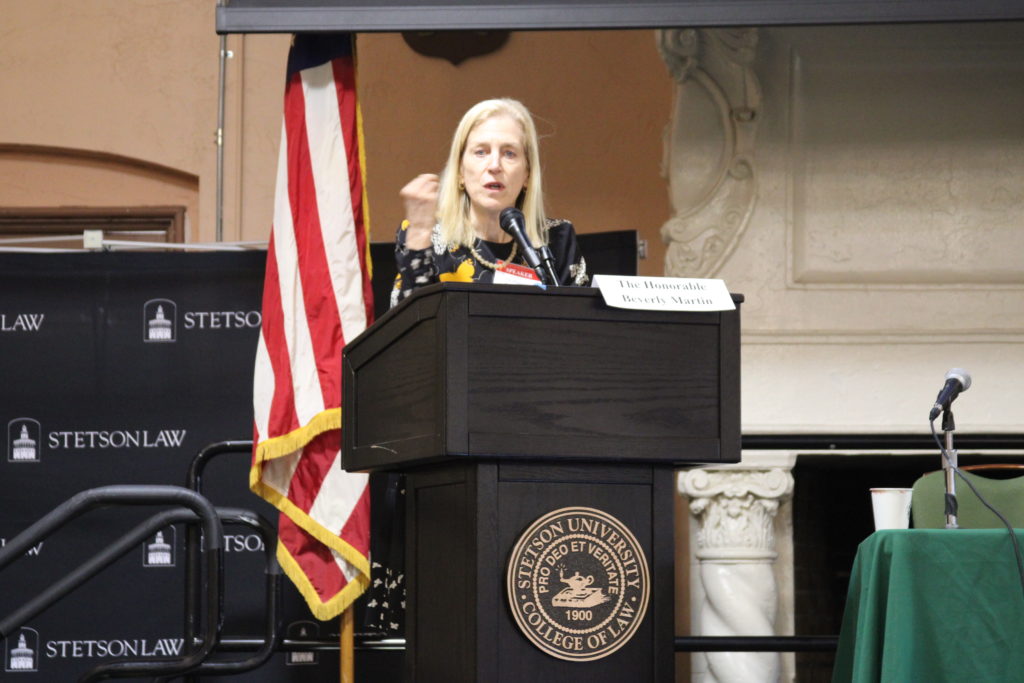
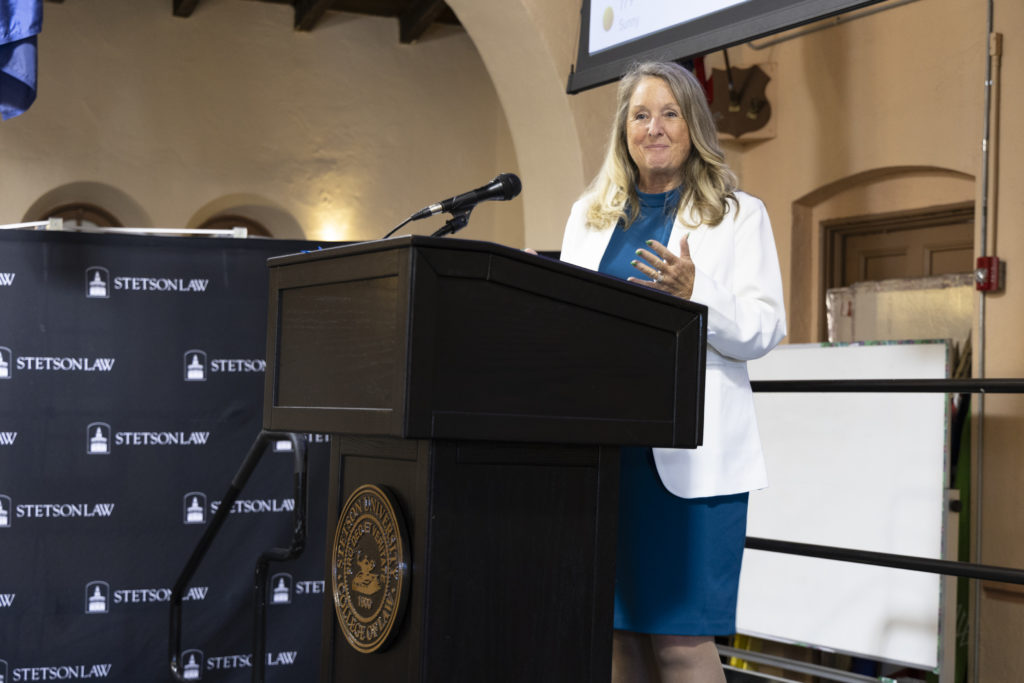
A woman with blonde hair makes a fist as she speaks at a podium.
Hon. Beverly Martin gives a keynote speech at an April conference exploring Padilla, a landmark 2010 case.

“The work you do is hard and I think that’s one of the most important things about us being able to be here today,” she said. “In this work, not only will you be sad – that helps you see things better – you will be underestimated.”

She also urged her audience to understand the perspectives of others and to see a silver lining in often emotionally draining nature of their work.

“First, we should be grateful, or certainly I’m grateful, that you have seen things that make you cry so that you can see the world more clearly. I’m appreciate that you are willing to do that, that you have those eyes,” Martin said. “But I think we also should be grateful that we found our path.”

Learn more about the Padilla v. Kentucky at 15 Years conference.

Recap: International Wildlife Conference & IEMCC 2025

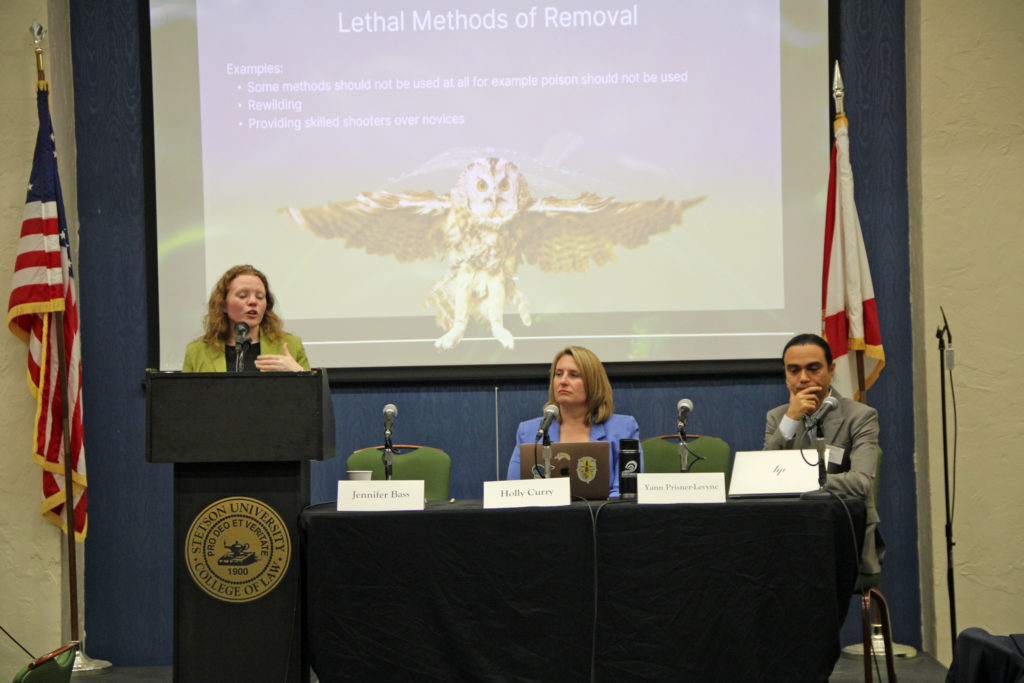
A woman leads a panel discussion about humane wildlife management methods.
The 2025 International Wildlife Law Conference consisted of numerous compelling panel discussions.

For the first time since the onset of the Covid 19 pandemic, experts in wildlife law gathered on the Stetson Law campus for the 21st International Wildlife Law Conference. The two-day event transitioned seamlessly into the final rounds of Stetson’s International Environmental Moot Court Competition, which takes place each year on Stetson Law’s Gulfport campus.

The back-to-back events brought legal scholars and law students together to explore laws relating to wildlife conservation and how it often interconnects with ethics, environmental sustainability, culture, public health, and many other facets of human society.

The conference kicked off with two tours of natural spaces near campus that teem with wildlife, Boyd Hill Nature Preserve and an exploration of the aquatic area near the nonprofit Tampa Bay Watch Discovery Center at the St. Pete Pier.

“There is nothing like being in each other’s presence – sharing a meal and having exchanges during the breaks can be almost as valuable, or even more so sometimes, than what we hear in the formal sessions,” said Law Professor and Director of Stetson’s Institute for Biodiversity Law and Policy Royal Gardner as the event began. “And of course, if you’re online, you can’t go on the field trip.”

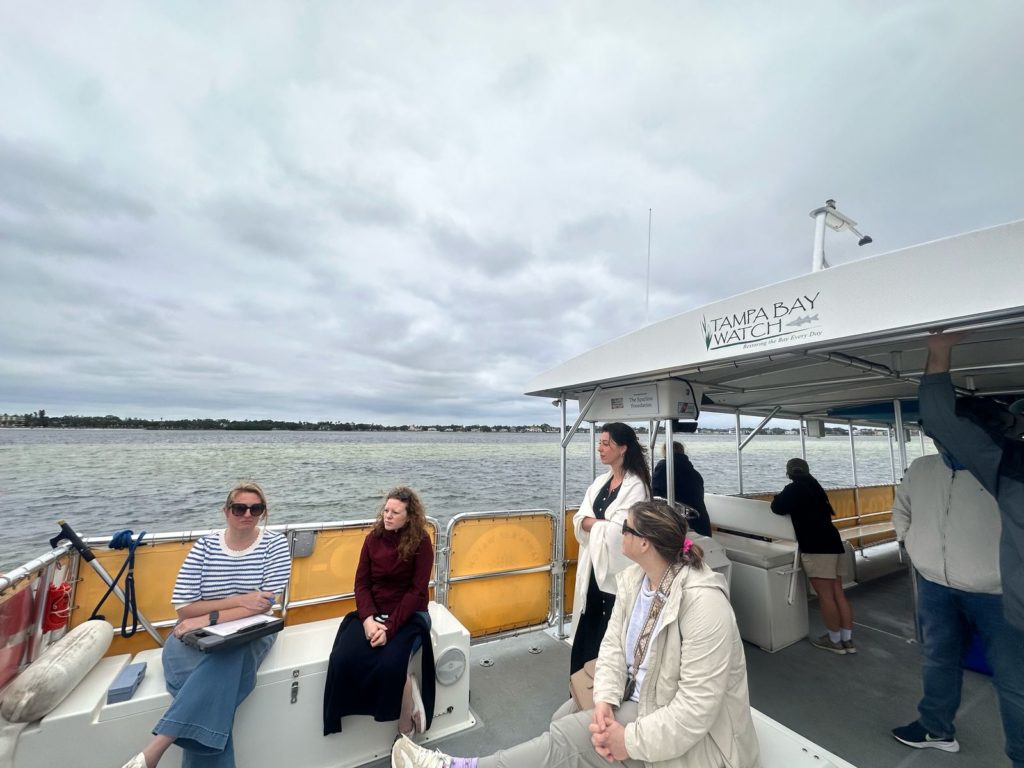
A group of women sit on a boat overlooking the calm waters of Tampa Bay.
Attendees of the 2025 International Wildlife Conference got to explore the complex coastal and inland ecosystems of St. Petersburg and Tampa Bay.

Fresh ideas, lively conversations

The wildlife conference featured a broad array of panel discussions with presenters from around the globe. They explored such topics as the rights of Indigenous communities, animal rights and animal welfare, wildlife trade, and US and Florida wildlife issues.

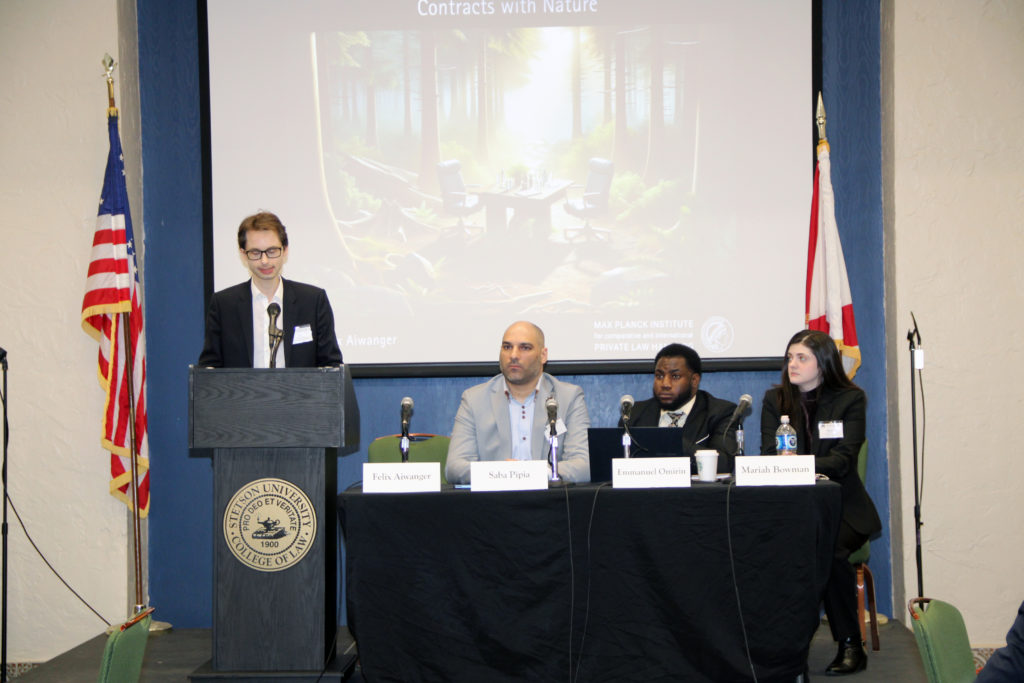
During the panel on animal rights and welfare, Dr. Felix Aiwanger of the Max Planck Institute for Comparative and International Private Law in Hamburg, Germany, presented his paper titled “Contracts with Nature: Getting Nonhuman Interests at the Negotiating Table,” which explored ways to foster environmental conservation through contract law despite nature’s inability to advocate for itself.

“Contract negotiations allow us, or even force us, to understand another person’s needs and interests, and to factor them in when making decisions,” he said. “’You cannot negotiate with nature’ is a phrase that is often used. But contract law could lend itself to a framework that fosters holistic environmental policy.”

A panel discussion with four wildlife experts who sit at the front of a meeting room.
A panel discussion at the 2025 International Wildlife Conference examines animal rights and animal welfare.

The event’s keynotes included a lecture by Dr. Same Ur Rahman, dean of Green International University in Lahore, Pakistan, who spoke about the species that inspired the IEMCC’s proceedings, the markhor, and national and international efforts to preserve the majestic goat species, which is the national animal of Pakistan.

Rahman gave a virtual presentation since he was unable to travel to the U.S. for the conference.

Welcoming international teams to the IEMCC

As the second day of the wildlife conference drew to a close, Stetson Law welcomed competitors to campus as it does each year, with a special edition of the Edward and Bonnie Foreman Biodiversity Lecture and IEMCC Welcome Reception.

The lecturer, Dr. Arie Trouwborst of Tilburg University in Tilburg, Netherlands, gave a lively presentation titled “Thinking Big and Aiming High: Taking the Objectives of Biodiversity Law and Policy Seriously.”

“He thinks deeply about how to improve the contribution of law at all levels to promote the conservation, restoration, and sustainable use of biodiversity,” Gardner said, introducing him. “But he’s not a mere academic. He frequently advises international entities such as wildlife conventions, the European Commission, the IUCN, national governments, and NGOs.”

Referencing The Simpsons and Lord of the Rings among other pop culture favorites, Trouwborst discussed humans’ tendency to place themselves at the center of everything, including their legal and moral codes, thereby destroying the species and ecosystems around them. Noting the extrinsic and intrinsic value of being considerate of non-human animals, he urged his audience to consider the ways in which legal systems can compel societies to operate from a place of compassion toward all species.

“We are not alone as a community, as a person, as a country. But we are also not alone as a species,” he said. “A key role is reserved for law to keep selfishness in check.”

See the full 2025 International Wildlife Conference agenda.

IEMCC 29 – problem & results

The International Wildlife Conference transitioned into a multi-day competition in which the world’s top environmental law moot court teams contended for the IEMCC championship.

The 2025 roster included two teams from Ukraine and, for the first time, a team from Bangladesh.

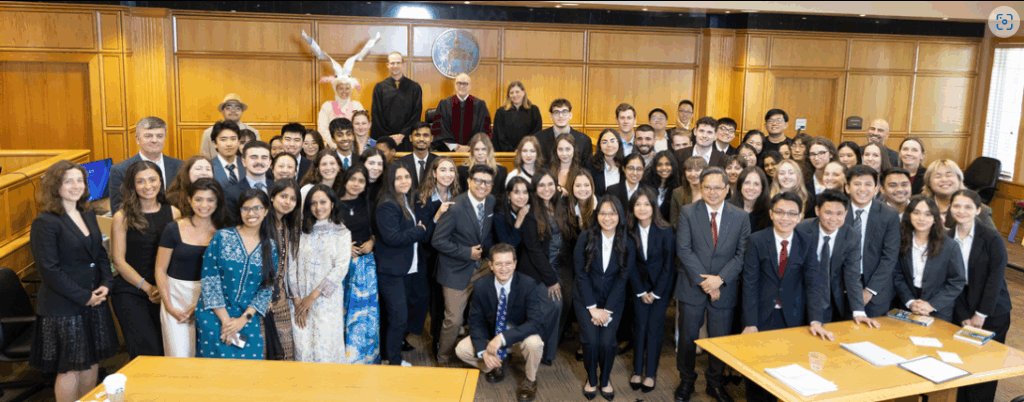
Dozens of students, faculty, and staff members stand in a practice courtroom. They are professionally dressed, except for a person who as dressed as a markhor, a species of goat that is the national animal of Iran.
The teams, faculty, staff, and volunteer judges made the 29th Annual International Environmental Moot Court Competition a great success in 2025.

This year’s problem (or, in layman’s terms, fictional case around which the teams build their performance) involved a dispute between two fictional countries over trophy hunting of the (also fictitious) Royal Markhor.

Eighteen teams from twelve countries and four continents competed. The University of Chicago team prevailed. TheUniversity of the Philippines College of Law team was the runner-up. A competitor from the latter team, Sarahlyn Dato Revill,won best oralist in the final round.

The IEMCC continues to expand; Middlesex University Dubai is scheduled to hold the inaugural Middle East and North Africa Rounds in February 2026.

Learn more about the 2025 IEMCC finals.

Stetson Law Recognized as Top 10 Military Friendly® School

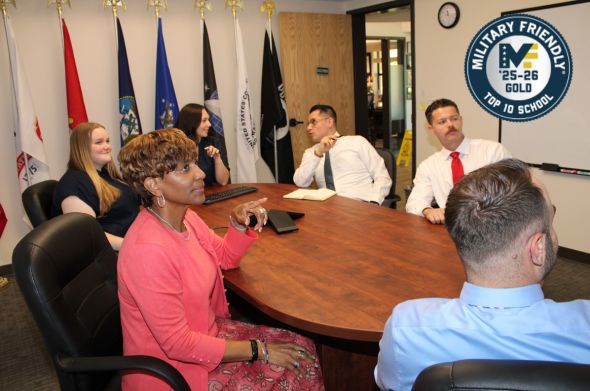
A meeting room with six Veterans Law Clinic students sitting around an oval-shaped wooden table.
Many students who work with Stetson’s Veterans Advocacy Clinic are themselves veterans who are passionate about giving back to others who have served.

After numerous years of earning a Military Friendly® School designation, Stetson Law is now rated a Top 10 Military Friendly School for 2025-2026, the organization announced.

This elevated status parallels the College of Law’s growing efforts to support individuals who have served our nation, particularly those who choose to pursue legal education.

Resources the college offers veteran students include the Veterans Law Institute (VLI), staff specially trained to navigate veterans’ educational benefits, and the Student Veteran Organization – all tailored to foster a supportive environment in which they can thrive.

“Stetson Law’s move into the top ten military friendly schools is the result of hard work by the entire Stetson Law community,” said Law Professor and VLI Director Stacey-Rae Simcox.  “We are dedicated to ensuring a bright future for the veterans who choose Stetson and look forward to welcoming many more of these quality students to the Stetson family.”

The college ranked #8 in the Top 10 Military Friendly Schools and #9 on the list of Top 10 Military Spouse Friendly Schools.

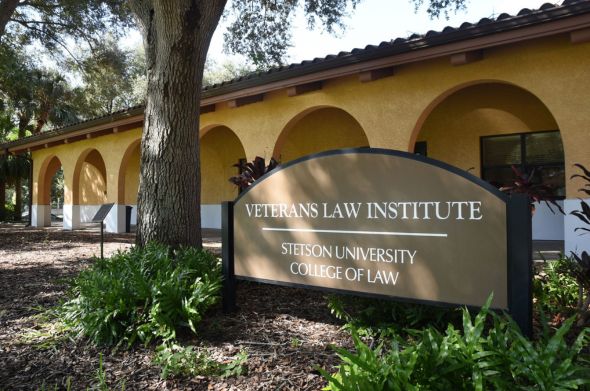
An external shot of Stetson Law's Veterans Law Institute
The exterior of Stetson’s Veterans Law Institute in Gulfport, Fla.

How the rankings work

For the 2025-2026 ranking period, more than 1,800 schools were evaluated using a variety of factors, including public data sources and responses from a proprietary survey. Some 830 institutions earned the Military Friendly® School designation for going above the organization standard.

The 2025-2026 Military Friendly® Schools list will be published in the May and October issues of G.I. Jobs magazine and found at www.militaryfriendly.com.

With input from the Military Friendly® Advisory Council of independent leaders in the higher education and military recruitment community, the firm Viqtory developed the methodology, criteria, and weightings. To determine the final ratings, institutions’ survey scores were combined with the assessment of institutions’ ability to meet thresholds for data points like student retention, graduation, job placement, and loan default rates for all students and, specifically, for student veterans.

Professor Stacey-Rae Simcox meets with students working with the Veterans Advocacy Clinic.

“Military Friendly® is committed to transparency and providing consistent data-driven standards in our designation process, Kayla Lopez, vice president of Military Friendly®. “Our standards provide a benchmark that promotes positive outcomes and support services that better the educational landscape and provide opportunity for the Military Community. This creates a competitive atmosphere that encourages Institutions to evolve and invest in their programs consistently. Schools who achieve awards designation show true commitment in their efforts, exceeding the standard.”

At Stetson Law, honoring those who have served is part of the campus culture – but the college endeavors to extend this support to the broader veteran community.

Through its Veterans Advocacy Clinic, the college offers pro bono legal services to veterans seeking benefits they feel were wrongly denied. With guidance from seasoned VLI staff and leadership, students enrolled in the clinic gain hands-on experience helping those who have served.

Learn more about Stetson’s Veterans Law Institute and Veterans Advocacy Clinic.

Stetson Tops U.S. News Rankings for Advocacy, Legal Writing in 2025

The latest U.S. News & World Report graduate school rankings are out, and Stetson Law remains at the head of the class in two key areas.

 The College of Law is Number 1 in Trial Advocacy and Number 3 in Legal Writing, per the publication’s 2025 rankings. This is the third year in a row Stetson has ranked as such in these areas. The college has been at or near the top of the list for trial advocacy for decades. Ranking 99th overall for its full-time juris doctor program, it is also a top-100 law school in the nation.  Flex JD, Stetson Law’s part-time law program, ranked 33rd in that category.

The recognition is the direct result the Stetson Law community’s tireless dedication to equipping students with the practical tools they need to succeed in the legal profession regardless of their area of practice.

“These rankings are the result of the substantial time, energy, and resources the Stetson Law community invests in our students,” said Stetson Law Dean Benjamin Barros. “We are once again honored that U.S. News & World Report recognizes the passion our faculty, staff, alumni, and friends have for preparing our students for success as legal professionals.”

Situated on a historic campus in Gulfport, Florida, Stetson Law is Florida’s first law school and poised to celebrate its 125th anniversary. It is part of Stetson University, which has a main campus in DeLand, Florida.  University leaders believe the spirit of advocacy fits well within the culture and values the entire university embraces.

“We are incredibly proud of our College of Law, which receives national recognition — year after year — for providing a world-class legal education,” said Stetson University President Christopher F. Roellke, PhD. “These rankings reflect Stetson’s unwavering pursuit of excellence across the institution.”

A national leader in advocacy

From premier events like the Educating Advocacy Teachers (EATS) conference that takes place on campus every June to the campus culture that encourages students to advocate for themselves and others in daily life, Stetson Law offers a supportive community for those interested in developing their advocacy skills.

In its 25 years of existence, the College of Law’s Center for Excellence in Advocacy has been steadfast in its mission of and holistic in its approach to cultivating the next generation of advocates, including trial, dispute resolution, and moot court teams that have won more than 100 national competitions.

“We take a holistic approach to advocacy skills education that incorporates emerging trends to ensure that are teaching methods remain relevant in an ever-evolving legal landscape,” said Elizabeth Boals, director of the Center for Excellence in Advocacy. “We are once again honored by U.S. News’ recognition and inspired to continue innovating and building on our success.” 

In fall of 2023, the College of Law celebrated the opening of its state-of-the-art Advocacy Institute, a large facility dedicated to the study and practice of this fundamental skill.

The beautiful 16,000-square-foot Advocacy Institute symbolizes the college’s deep advocacy roots while offering extensive space for scholarship, collaboration, and practice.

With state-of-the-art spaces for practice and instruction, including the most practice courtrooms of any law school in the nation, it empowers students with essential advocacy skills to thrive in an ever-evolving world. It houses Stetson’s Center for Excellence in Advocacy, Center for Elder Justice, and the Jacobs Law Clinic for Democracy and the Environment.

A balanced approach to teaching legal communication

Stetson Law’s celebrated Legal Writing program ranking at No. 3 for the third year in a row reflects this community’s understanding that legal communication is fundamental to the study and practice of law. Through its Institute for the Advancement of Legal Communication, the college fosters passion for exploring legal writing’s many aspects.

“Through rigorous and critical exploration of the discipline, we play an essential role in leading the ongoing development of our discipline both at the academic, as well as at the practical, level,” said Elizabeth Berenguer, who directs the institute. “Through this work, we set a high bar for practice, ensure access to justice, and protect the very systems that sustain our democracy. We are honored to be recognized as a top destination for legal writing by our colleagues and by U.S. News & World Report.”

While the program uses methods of developing legal communication skills, its leadership closely monitors evolving technology trends such as artificial intelligence and how these trends may impact the ways in which legal writing is taught and conducted by legal professionals.

Learn more about Stetson Law’s Institute for the Advancement of Legal Communication.

Author Cynthia Barnett Explores the Many Facets of Seashells

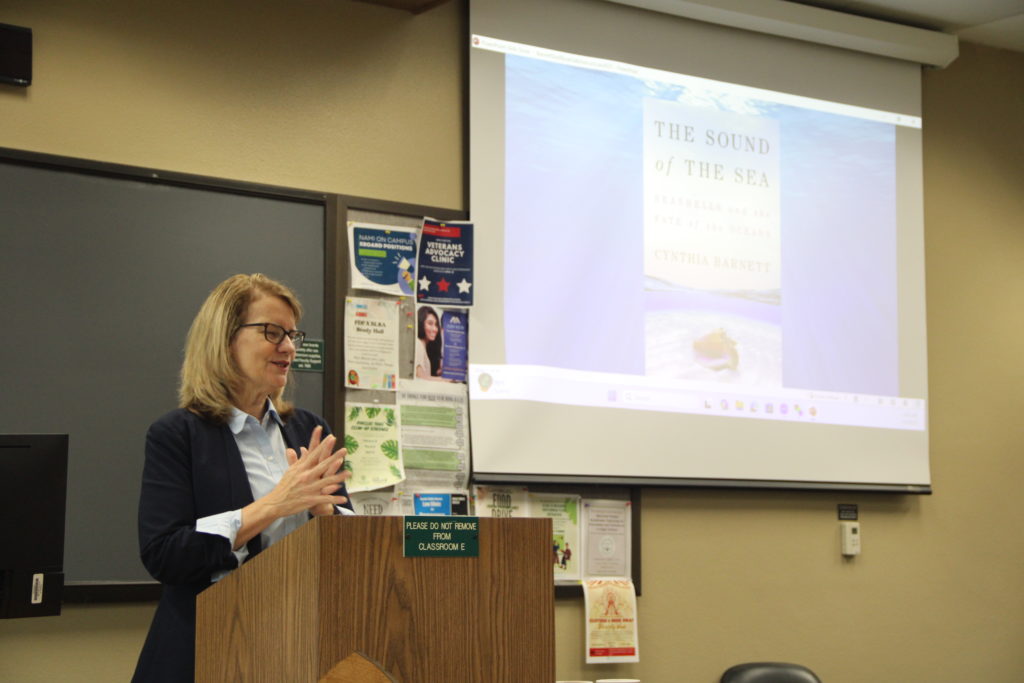
A woman speaks at the front of a classroom. a photo of her book, "Sound of the Sea," is projected on the wall behind her.
USF Professor Cynthia Barnett talks about her recent book, “Sound of the Sea” at Stetson Law.

After giving a talk at the Bailey-Matthews National Shell Museum in Sanibel, Cynthia Barnett was haunted by something she learned during her visit.

A survey of mostly out-of-state museum-goers revealed an overwhelming majority of visitors – some 90 percent – did not know that seashells are built by a living animal.

“Most people thought they were some kind of rock or stone,” Barnett said. “I was so disturbed by that fact I couldn’t even sleep that night.”

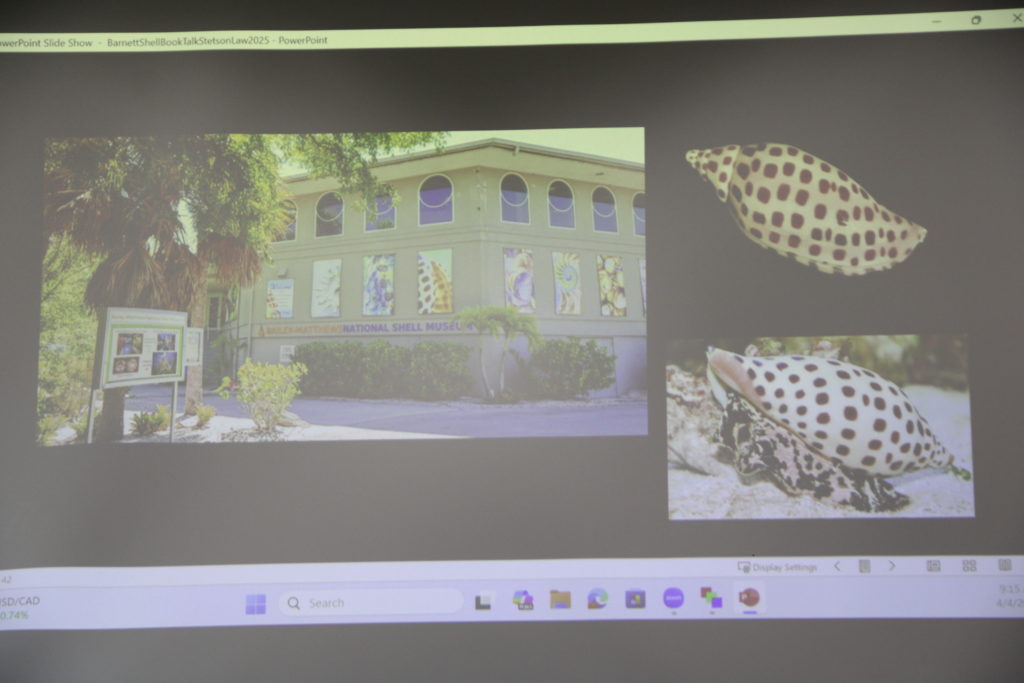
The Bailey-Matthews National Shell Museum & Aquarium in Sanibel, FL.

An award-winning author and University of Florida journalism professor who covers water and climate, Barnett was looking to write a book about oceans at the time, but she needed an entry point. Eventually, she fell asleep.

“By the time I woke up the next morning, I knew I was going to write about seashells,” Barnett said.

Shared passion among disciplines

Barnett was speaking at Stetson Law as part of the Institute for Biodiversity Law & Policy Foreman Biodiversity Lecture Series. Introducing her, Law Professor and Institute Director Royal Gardner said it is important to hear from environmental advocates from other sectors.

“The point of the lecture series is to not just bring in environmental attorneys… but also people from other disciplines, because if we’re going to make any progress on environmental issues, it’s through a multidisciplinary approach,” Gardner said.

Throughout her lecture, Barnett encouraged her audience to use storytelling in their work advocating for the environment, given how persuasive it can be.

Universally beloved, but misunderstood

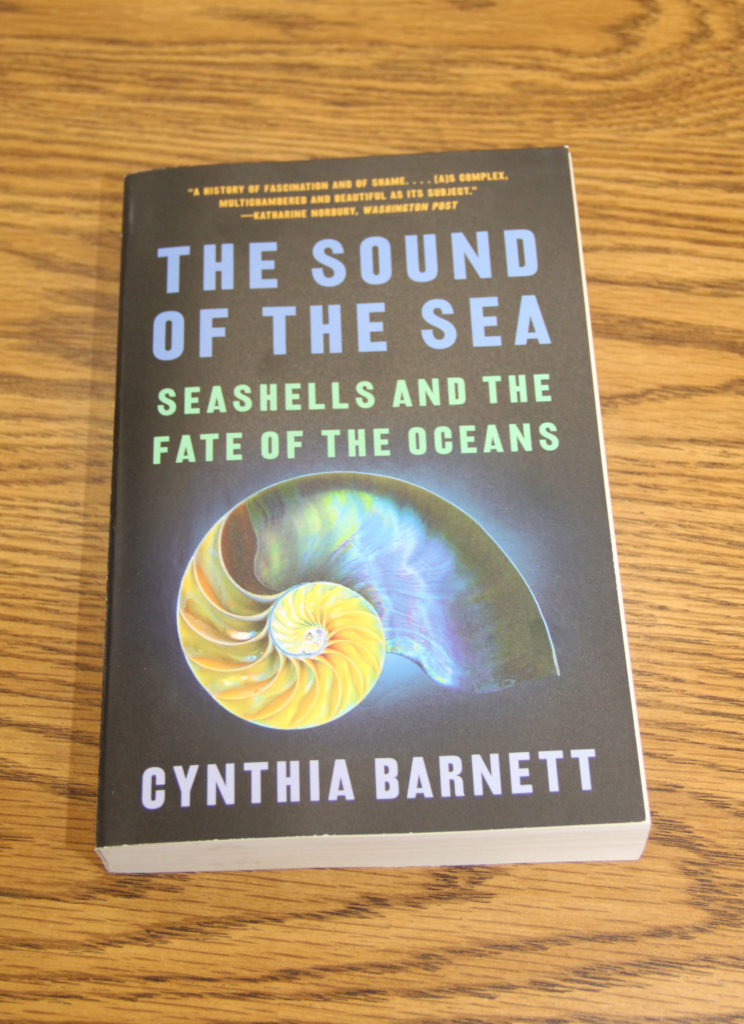
A picture of the front cover of a book titled "The Sound of the Sea: Seashells and the Fate of the Oceans."
USF Professor Cynthia Barnett’s latest book explores seashells and their intertwinement with human history.

In her acclaimed book, The Sound of the Sea: Seashells and the Fate of the Oceans, each chapter is built around a mollusk species whose shell had significance to humanity. Throughout history, humans have used seashells in tools, dye, jewelry, and even as currency.

Their universal appeal has captivated families of beachcombers, great painters, and countless others.

“There’s something fundamental about seashells that pleases the brain,” Barnett said.

Their presence throughout the fossil record has led to landmark scientific discoveries about the age of the earth, the complexity of neanderthal brains, and ancient trade routes.

Her book covers everything from the presence of lightning whelk shells from Florida’s Gulf Coast in the Cahokia Mounds near St. Louis to the “shell madness” sparked by the gorgeous tropical shells Dutch sailors brought back from trade expeditions.

From shell shop to major conglomerate

Barnett told the story of a shop owner named Marcus Samuel, who sold shells in London’s East End, in particular, popular shell-encrusted boxes.

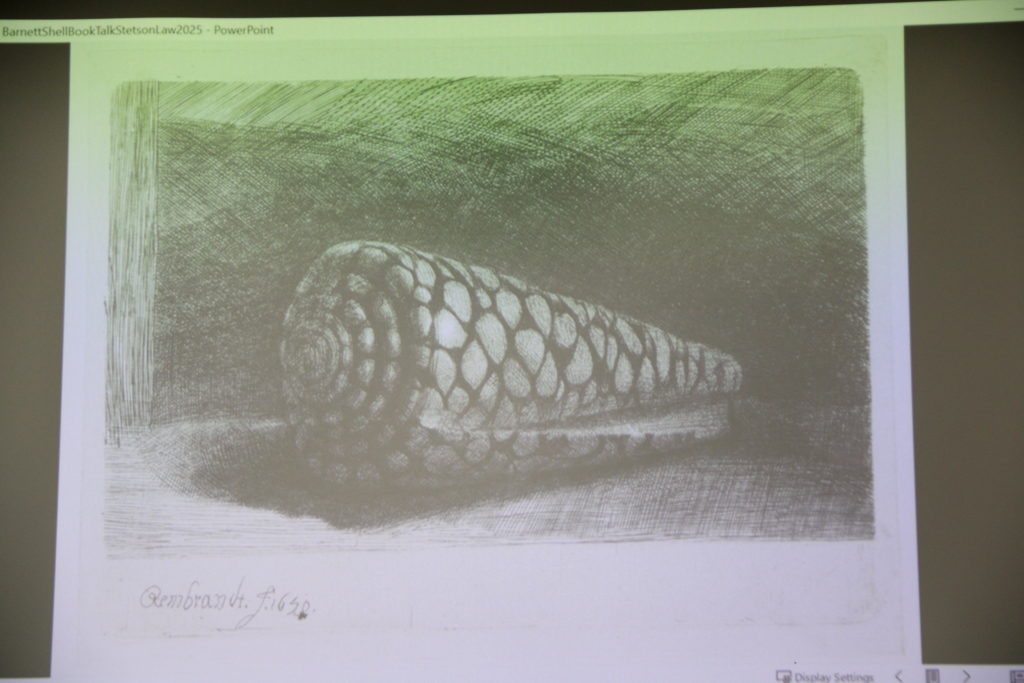
A photo of The Shell, also known as Rembrandt's Shell or Conus Marmoreus.
The Shell, also known as Rembrandt’s Shell or Conus Marmoreus, an etching the artist created during what USF Professor Cynthia Barnett called “shell mania” that gripped Europe.

His company partnered with another that started trading kerosene and, eventually, oil. They built the first tanker that could safely transport oil through the Suez Canal. The vessel was named after the murex (the mollusk from which the Phoenicians extracted purple dyes).

Eventually, the company changed its name to Shell Oil.

Barnett noted the irony that climate change associated with the burning of fossil fuels is causing the Mediterranean Sea to warm faster than others part of the ocean – so much so that a scientist Barnett knows in the region told her that murex are struggling to survive.

Mollusks in peril

Shellfish can “whip somersaults” and “look at you with curious eyes,” but they are also “extraordinary architects,” Barnett said, that build their shells using minerals from the marine environment, namely calcium carbonate.

 “They layer minerals to build their shells, and their reliance on those minerals is making them sentinels for what’s happening to the ocean,” she said.

An image of an ammonite fossil.
USF Professor Cynthia Burnett said shells in the fossil record can tell us a lot about the earth’s history.

Since oceans absorb nearly a third of the extra carbon dioxide humans have sent into the atmosphere since the beginning of the industrial revolution, they are now 30 percent more acidic. This has become a problem for mollusks that use calcium to form their shells.

“Shelled animals are really showing us what’s happening to the ocean in just the same way that they once showed us evolution and geologic change,” she said. Scientists have also noticed mollusks having trouble locomoting, pockmarks on their shells, and mass die-offs during major heat events.

Ending on a high note

A photo of a live bay scallop with its shell slightly opened. It is surrounded by tendrils of seagrass and sand.
A bay scallop. Photo courtesy of the Florida Fish & Wildlife Conservation Commission.

Concluding her lecture, Barnett said that while it is important to inform audiences of environmental perils, too much gloom-and-doom can cause audiences to shut down. She ended her talk by highlighting a thriving population of bay scallops in Florida’s Big Bend, a protected stretch of coastline with sparse development.

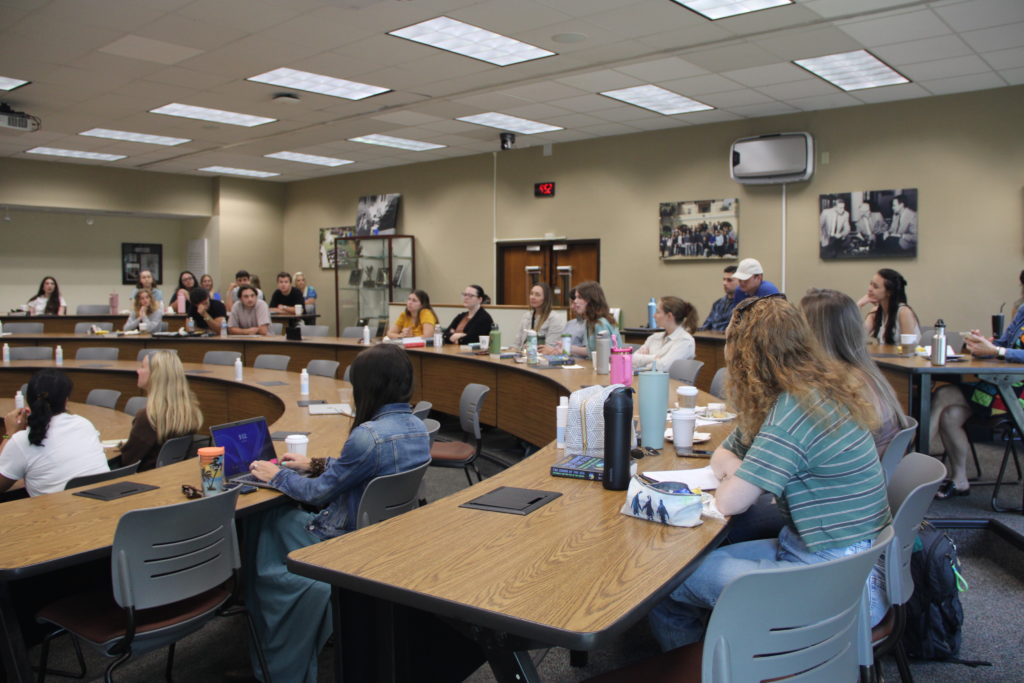
Students sit at several rows of semicircular classroom tables and engage in a discussion.
USF Professor Cynthia Barnett led an engaging discussion about seashells and their importance for humanity during the April 4, 2025 Biodiversity Lecture.

Florida’s bay scallop populations have been lost in almost every other bay in Florida, she said, including Tampa, Pensacola, and Biscayne bays.

“They are alive and well in the Big Bend, where the seagrass meadows are healthy,” she said. “I will also say that the manatees are not dying in that part of Florida as they are in so much of the rest of Florida. I think there are some really important comparisons to be made about the Big Bend and why it’s relatively healthy.”  

Prof. Morgan Honored With Wm. Reece Smith, Jr. Public Service Award

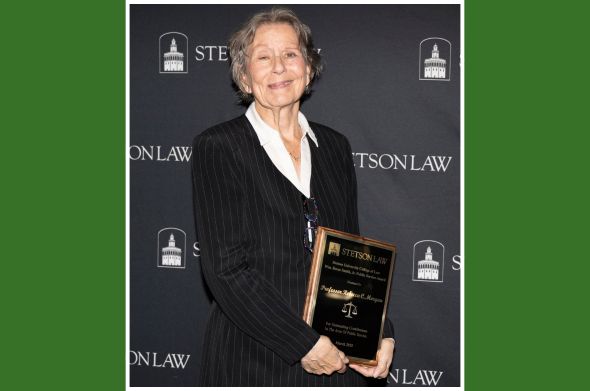
A woman with short hair smiles as she holds a rectangular award in front of a backdrop that has the words "STETSON LAW' printed on it.
Law Professor Rebecca Morgan ’80, the 2025 Wm. Reece Smith, Jr. Public Service Award recipient

Known for her tireless work as a scholar, advocate, mentor, and educator who continues to inspire and shape the field of elder law, Law Professor Rebecca C. Morgan is the recipient of the 2025 Wm. Reece Smith, Jr. Public Service Award.

Decades ago, Morgan identified a gap in expertise when it came to legal, financial, social, and other challenges aging populations face. The 1980 Stetson Law alumna launched into decades of pioneering work to develop and evolve this area of practice. These efforts include inviting leading experts to share knowledge at the Stetson’s National Conference on Special Needs Planning and Special Needs Trusts for nearly three decades, directing Stetson’s Center for Elder Justice (formerly the Center for Excellence in Elder Law), and leading the LL.M. in Elder Law program.

“The landscape of elder law has very few voices who are as knowledgeable, who are as compassionate, and who have been as transformative as Becky Morgan,” said Professor Roberta Flowers, who teaches elder law alongside Morgan, in her introduction. “Many, many of our colleagues and students and staff do not realize where Becky Morgan sits in the elder law arena in the United States of America.”

A prolific career

Morgan’s work in the elder law arena went well beyond the Stetson Law campus. It includes serving as president of the National Academy of Elder Law Attorneys (NAELA) and the Board of Directors of the National Senior Citizens Law Center (now Justice in Aging).

As a mentor and educator, she has inspired countless students through her courses on trusts and estates, elder law, and related topics with a teaching approach that emphasizes the importance of empathy, ethical practice, and a deep understanding of the unique challenges faced by aging populations.

Alumnus and Stetson Law Board of Overseers Chair Jason Turner ’04 served as a teaching assistant to Morgan, and they developed a dear friendship in the years since. She helped him navigate the challenges of losing his grandfather to ALS. Turner said she embodies the spirit of community and mentorship at the core of Stetson Law’s culture.

“Becky is Stetson,” Turner said in 2024.

Her contributions have been recognized with numerous awards, including a NAELA Award for her accomplishments in elder law and the Rosalie Wolf Memorial Elder Abuse Prevention Award. Morgan has also helped shape public policy as it relates to elder populations, including on state task forces addressing elder abuse and guardianship reform, and as a reporter for the Uniform Guardianship and Protective Proceedings Act.

“Her remarkable career, and it is remarkable, is not just a testament to legal expertise but a profound commitment to serving others and proving that the truest success is not the awards on the wall, but the lives that you’ve impacted,” Flowers said.

A woman in a white suit jacket speaks on a stage in Stetson Law's Great Hall.
Professor Roberta Flowers introduces Professor Rebecca Morgan, who was being honored for her tireless public service.

Briefly remarking after accepting the award, Morgan encouraged the audience to be brave and to use their legal abilities to help others.

“I want you to think about being brave, and I want you to think about giving more of your time volunteering for legal services folks, writing a letter on behalf of someone can make a huge difference,” she said. “Being a lawyer is an incredible privilege. A lot of folks would like to go to law school, but not all of us get to do it. We make a difference. If we can be brave, we can make life better for people who are willing to stand up.”

About the award

Named for former Stetson Law Professor William Reece Smith, Jr., a legal powerhouse who is credited with saving legal services, the award is given annually to an individual who has provided exemplary service to the legal profession and society writ large. 

“Reece was truly a mentor. He was truly a colleague. He was truly a friend. But he was also a leader,” Flowers said. “He was president of the International Bar Association, president of the American Bar Association, president of the Florida Bar Association.”

Wm. Reece Smith Jr. at Stetson University College of Law
Wm. Reece Smith, Jr., a beloved former Stetson Law professor and national leader in the legal profession

The award is given in conjunction with the annual Wm. Reece Smith, Jr. Lecture. The 2025 lecturer was Civil Rights veteran Janice Kelsey Wesley, who shared stories about life as a teen “foot soldier” at the height of the Civil Rights Movement in Birmingham, Alabama. Wesley is a fixture of Stetson Law’s popular summer Civil Rights Travel course, which is offered through the Social Justice Advocacy Concentration Program and stops in her hometown of Birmingham, Alabama.

Learn more about Professor Rebecca Morgan.

In Moving Talk, Janice Wesley Kelsey Reflects on Civil Rights Era

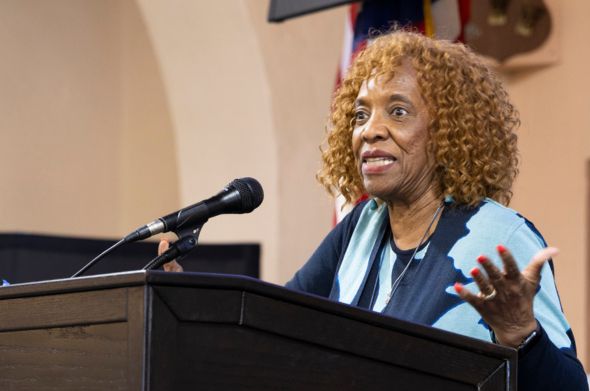
A woman with curly brown hair and a vibrant expression speaks at a podium.
The 2025 Wm. Reece Smith, Jr. Lecturer, Janice Wesley Kelsey.

In the Great Hall at Stetson Law, Civil Rights Era veteran Janice Wesley Kelsey and 2025 Wm. Reece Smith, Jr. Lecturer, drew laughter and tears from her audience as she shared stories of civil disobedience and thoughts on activism in 2025.

It was a rare opportunity for the community to get a glimpse of Stetson Law’s popular Civil Rights Summer Travel Course. Offered through the college’s Social Justice Advocacy concentration, the course explores the era through a legal lens and introduces students to important scholars and activists from the area, including Kelsey.

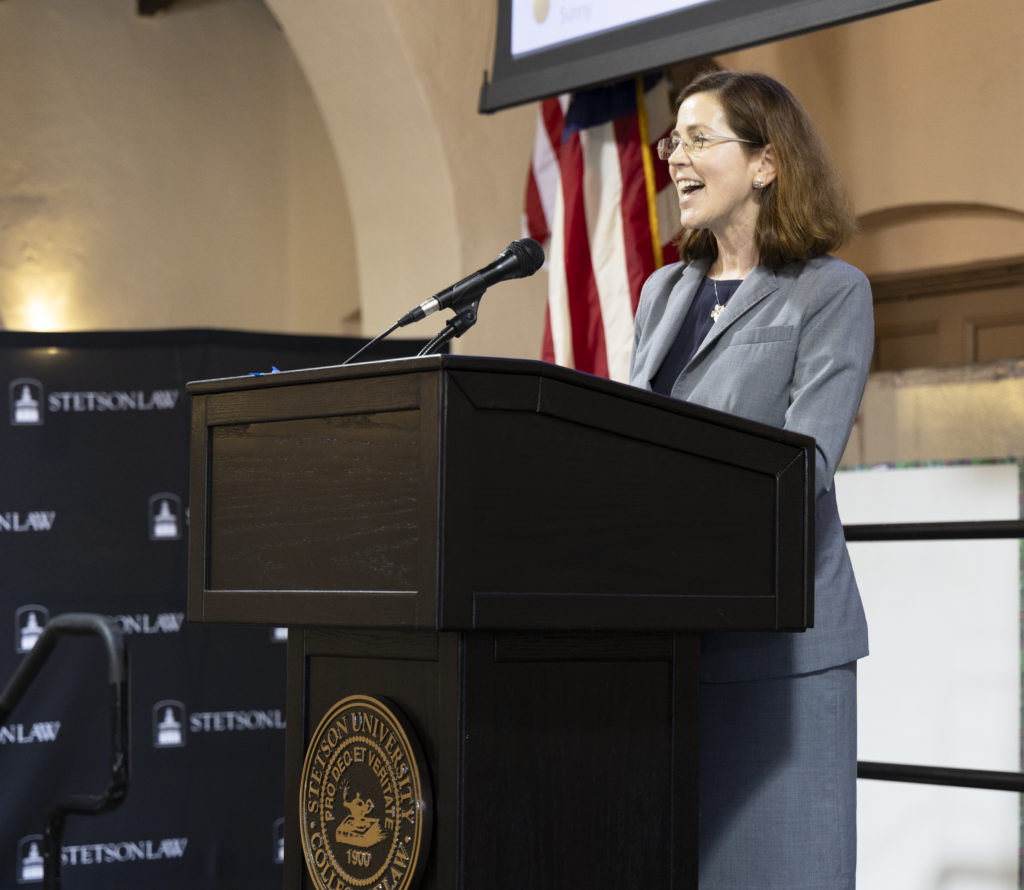
A woman with shoulder-length brown hair and glasses wearing a great suit and smiles as she speaks at a podium with the Stetson Law seal.
Law Professor Kristen Adams introduces the 2025 Wm. Reece Smith, Jr. Lecturer, Janice Wesley Kelsey.

“Normally we go to her hometown of Birmingham, Alabama, but this evening we are absolutely thrilled to host her in our home,” said Law Professor Kristen Adams, noting how Kelsey is one of the course’s most beloved speakers as she introduced Kelsey. “She is a national treasure, and we are enormously honored to host her.”

Kelsey’s book, I Woke Up With My Mind on Freedom, chronicles her experience as a “foot soldier” in the Birmingham, Alabama Children’s Crusade. In her lecture, she recounted how she first got into the movement.

Becoming a Civil Rights “foot soldier”

Until the spring of 1963, 16-year-old Janice Wesley Kelsey hadn’t thought much about civil rights. The Birmingham, Alabama native was focused on things you’d expect to be on a teen’s mind.

“I was in 11th grade, and I thought all was well in my world,” she said. “I was interested in dancing and dating and being popular.”

All around her, the seeds of a movement were sprouting. A friend who attended Monday evening meetings discussing how to fight segregation would speak passionately about the movement at school on Tuesday.

“What she was saying sparked my interest,” Kelsey said.

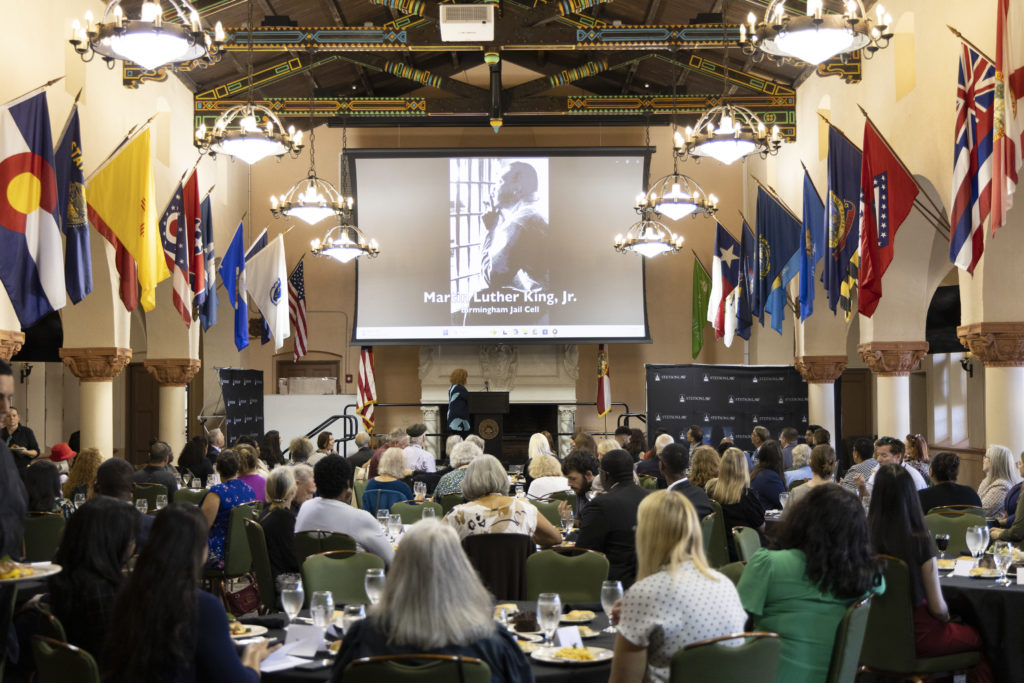
The back of the room as an audience watches a video. Footage of Dr. Martin Luther King, Jr. is on the screen.
Attendees were shown a video ahead of Civil Rights Era veteran Janice Wesley Kelsey delivery of the 2025 Wm. Reece Smith, Jr. Lecture.

She started to attend student nonviolence workshops where she was shown filmstrips of demonstrations in other cities during in which demonstrators were spit on, hit, and pulled off the lunch counter stools. The organizer warned that similar things would happen to those who got involved in the movement, but they cannot fight back. “This is a nonviolent movement,” she recalls being told.

Skipping school to join a movement

Before the first demonstration took place in early May of 1963, organizers warned the marchers they would likely be arrested.

Kelsey went to school that morning, but wasn’t planning to stay. During first period, she asked a young teacher about potential consequences of leaving for the march.

“I asked her, ‘suppose some kids walked out of class today. Are they all going to fail?’” Wesley recalled. “And she said, ‘if everybody walks, there’s nobody to fail.’ That gave me all the encouragement I needed.”

The marchers gathered at the 16th Street Baptist Church, Kelsey recalled, and people were everywhere, including police.

Singing ‘We Shall Overcome,” they walked out of the sanctuary in pairs. But they didn’t get far.

“The officer who stopped us was carrying a baton, he was wearing a gun, and he said we were in violation of a city ordinance. He said ‘you cannot parade without a permit.’”

Some of her fellow demonstrators began chanting ‘we are not afraid,’ which gave her the courage to stay in the line and face being arrested.

When it happened, Kelsey lied about her age so she could go to the same jail as her best friend, who was one year her junior.

Things intensified in the coming months. Authorities targeted protestors with high-powered firehoses that tore away demonstrators’ hair and clothes. President John F. Kennedy praised the teenagers who marched during a television broadcast.

“I thought ‘wow, we are really in it now,’” Kelsey said.

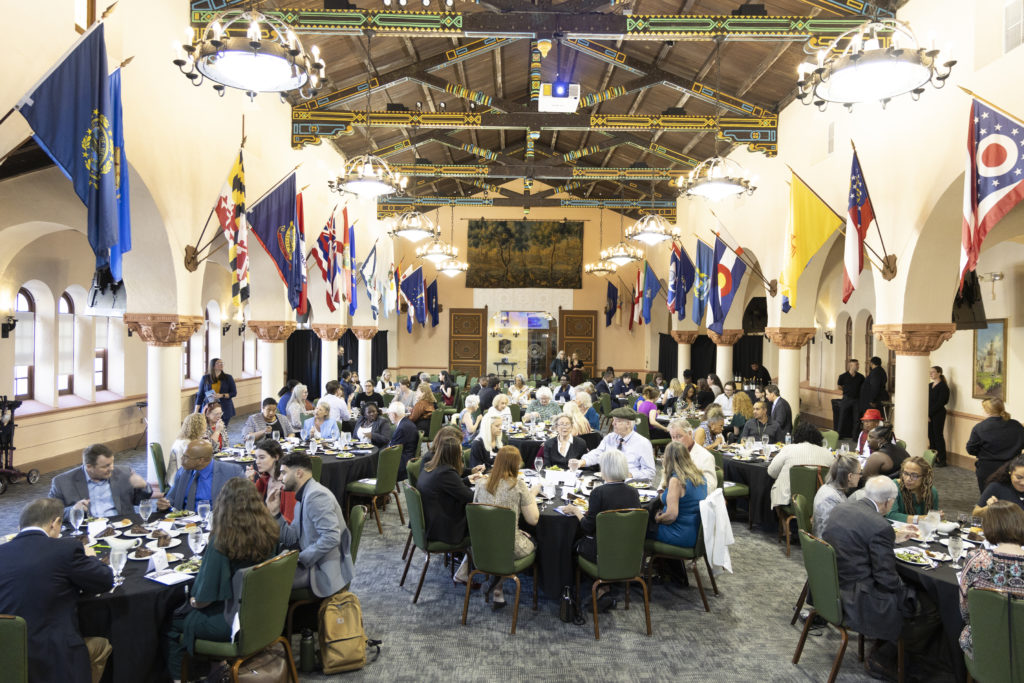
Stetson Law's Great Hall is packed with banquet attendees seated at tables throughout the room.
A packed house for the 2025 Wm. Reece Smith, Jr. Banquet (formerly known as Inns of Court).

Progress and tragedy

Successes came as the movement grew and national sentiment shifted in favor of the movement – but so did more violence, including bombings.

On Sunday, September 15, white supremacists bombed the 16th Street Baptist Church, killing four Black girls. Kelsey didn’t go to that church, but she knew the victims and their families.

“The surprise wasn’t that the church had been bombed, but on a Sunday morning?” Kelsey said.

The following year, the Civil Rights Act of 1964 was passed and forced the desegregation of schools and other public places.

Kelsey went on to become an educator, but said she often experienced survivor’s guilt. Although it took years to bring those responsible for the 16th Street Baptist Church bombing to justice, Kelsey said she felt encouraged when it finally happened.

Inspiring others to be brave

In a question-and-answer session following her talk, Kelsey was asked how students and legal professionals can tackle current-day efforts to roll back civil rights. Suggesting that law students “are in the perfect position” to be advocates for their communities, she urged the audience to put their talents, knowledge, and passion to work on good causes.

“My hope is in you. You young people,” Kelsey said. “I’m too old to go back to jail. There is hope because you have prepared yourself for the challenges you are now facing.”

Following the lecture, Law Professor Rebecca Morgan, a nationally known scholar in elder law and founder of Stetson’s Center for Elder Justice, was honored with the Wm. Reece, Smith, Jr. Public Service Award.

Stetson Law Hosts Veteran Claim Oral Argument

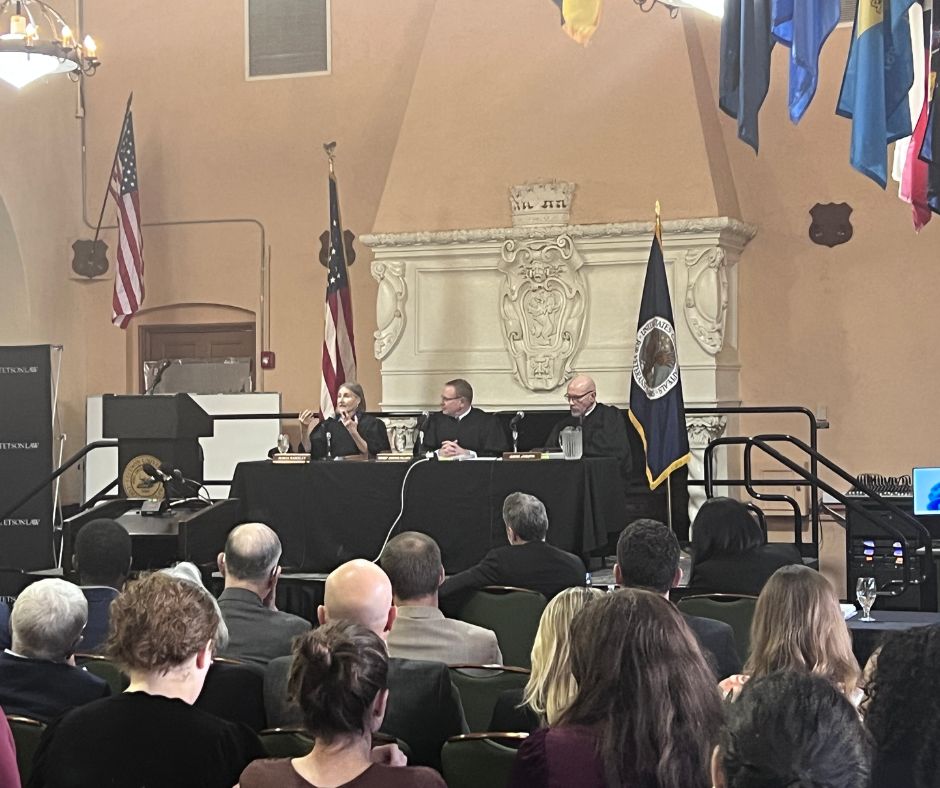
The oral argument took place in the Great Hall at Stetson Law.

On Monday, February 10, 2025, Stetson Law hosted an oral argument for the United States Court of Appeals for Veterans Claims.

Consisting of Chief Judge Michael Allen (a former Stetson Law professor and Stetson Veterans Law Institute director), Judge Margret Bartley, and Judge Grant Jaquith, the panel heard argument in the case of a veteran appealing a decision of the Board of Veterans’ Appeals.

Though based in Washington, DC, the court is authorized to meet anywhere in the U.S. throughout the year. The February 10 oral argument took place in the Great Hall with support from Stetson’s Veterans Law Institute (VLI).

VLI leadership saw the proceeding as an opportunity to invite students to witness veterans law unfolding in a live setting.

“It was an honor to help facilitate these learning experiences and contribute to the growth of the Veterans Law Institute,” said Morgan MacIsaac-Bykowski, an adjunct professor and associate director of the VLI and Veterans Advocacy Clinic. “I’m grateful for the opportunity to be involved in such impactful events. Moments like these remind me of why I’m passionate about legal education and the importance of providing students with real-world perspectives.”

After the argument, select students, faculty, and guests of Stetson joined the judges, court staff and attorneys for a luncheon co-sponsored by the VLI, the Federal Bar Association, and the U.S. Court of Appeals for Veterans Claims Bar Association.

The day’s events were on the heels of a VLI-facilitated weekend course, Veterans Benefits: Law, Practice, and Policy, taught by Zach Stolz and Robert Chisholm of Chisholm, Chisholm, and Kilpatrick, Meg Krahl and Ken Walsh from the VA Office of General Counsel, and Chief Judge Allen.

“I am immensely proud of my colleagues, specifically Director Stacey-Rae Simcox, Assistant Director Johnny Pruiett, and VLI Fellow Mary Samarkos, who pulled this event together flawlessly,” MacIsaac-Bykowski said. “I wish to extend thanks to our guests – the parties on both sides of the aisle and the Court – all of whom traveled during a snowstorm to join us.”

Learn more about our Veterans Law Institute.

Alum Celebrates Mentor by Raising Funds for Student Veterans

A man in a suit stands next to a portrait of a  judge who is his former mentor.
Jeffrey Harvey ’12 stands next to a portrait of his mentor, former Florida Supreme Court Justice Fred Karl.

In a moving tribute to a mentor and fellow Stetson Law alumnus, Jeffrey D. Harvey ’12 has donated a special edition copy of Python Tales, a memoir written by former Florida Supreme Court Justice Fred Karl ’49, to the Florida Supreme Court archives.

Harvey hopes the gesture will raise awareness of Karl, a man who embodied the spirit of service, ethical governance, and passion for helping others in a time in the profession of law where role models for lawyers are as important as ever. He also hopes that it might inspire others to contribute to a scholarship created in Karl’s honor for Veterans attending Stetson Law.

The book chronicles Karl’s time serving overseas in World War II, after which he returned to the U.S. a decorated veteran bound for Stetson Law and, after that, incredible success in his field. Published just after Karl’s death in 2013, the book’s proceeds benefit Stetson’s Frederick B. Karl Veterans Scholarship.

“One of Fred’s final wishes was for the proceeds of this book to continue to support the Fred Karl Veterans Scholarship, and it is one of my life’s missions to see that others can benefit from the lessons I was fortunate enough to learn from such a hero first hand,” Harvey wrote in the book’s afterward. 

The donation serves to bolster an effort by Florida Supreme Court Justice Jamie Grosshans to promote civics education at the Supreme Court building. This includes new and accessible information about the history of the Supreme Court, the judiciary’s role as one of three branches of government, and the court’s landmark decisions. Grosshans has also worked to improve the display of artifacts and materials within the Supreme Court building as well as those on display at the Florida Supreme Court Library.

Harvey said he hopes Karl’s legacy inspires legal professionals during their most trying times.

“While the scholarship might help students get through law school, the legacy of Fred Karl may help lawyers get through difficult times in their practice,” he said.

Inspiration for veterans returning home

Fred Karl’s life is a testament to dedication, resilience, and unwavering commitment to public service, including fellow veterans.

Harvey, a veteran who is now chief executive officer of Community Legal Services in Orlando, learned of Karl as a student at Stetson Law during a seminar on professionalism for which Karl was the namesake.

“After hearing about this fellow veteran and his reputation for honesty, integrity, and service to the community, I remember feeling an overwhelming level of inspiration and comfort that someone who has taken the very path I am on was able to be so successful and stay true to the values ingrained in us through military service,” he wrote.

Inspired by his story, he wrote a letter to Karl, asking if they could meet. Karl responded, and the two met for breakfast or lunch multiple times over the ensuing semesters. “During our visits he would mentor me about life as an attorney and a public servant,” Harvey continued. “Most of all he taught me that it is possible to be an attorney and a public servant and not only maintain honor, integrity and ethics, but that you can be known and sought after for those qualities.”

An early call to serve

A young man in a World War II-era military uniform.
Former Florida Supreme Court Justice Fred Karl ’49 during his military service

Born in Daytona Beach in 1924, Karl spent most of his childhood on Florida’s east coast. A good student and popular among his peers, he was voted “Most Personable” by his senior class at Seabreeze High School.

Following the bombing of Pearl Harbor, Karl was moved to join the Army in 1942 at 18. Commissioned as an officer, he led a tank platoon in the European campaign during World War II. Despite being severely injured, Karl’s strong will saw him through. His bravery in the Battle of the Bulge earned him the Bronze Star, Silver Star, and Purple Heart.

Upon returning home, he pursued a bachelor’s at the University of Florida and a law degree from Stetson. He graduated from Stetson Law in 1949.

A commitment to community

After practicing for several years, Karl went into politics in 1956 when he was elected to the Florida House of Representatives. Known for his devotion to fairness and high ethical standards, he earned the nickname “conscience of the House.” He was then elected to the State Senate and the Florida Supreme Court.

In 1988, Karl accepted an offer from the Hillsborough County Board of County Commissioners to become the county’s lead attorney and was appointed as the county’s chief executive officer within two years. As County Administrator, Karl was known to be decisive and get things done.

He established a healthcare program for low-income residents, promoted diversity in county government, and led efforts to consolidate county offices into a centralized location in downtown Tampa. The building was later named the Frederick Karl County Center in his honor.

Seizing on Tampa’s potential

Karl’s impact extended to healthcare as well. As chair of the board of Tampa General Hospital, he helped transform it into one of the best hospitals in the state.

He also played a pivotal role in bringing the New York Yankees’ Spring Training Complex to Tampa and laid the groundwork for what is now Amalie Arena. His efforts were recognized with the Tampa Bay Sports Commission’s Tom McEwan Distinguished Community Advocate Award in 2013.

Alumni and former Florida Supreme Court Justices Harris Drew ’32 (left) and Fred Karl ’49 attend an alumni luncheon.

Despite numerous retirements, Karl’s dedication to public service never waned. In 2004, newly elected Tampa Mayor Pam Iorio appointed him as city attorney, a role he held for six months before stepping down at the age of 80. His influence and guidance were invaluable during this period.

“Fred Karl was born to be a public servant. He tackled issues with a sense of fairness, respect, and honesty, always reflecting his personal and professional high standards,” Iorio said of Karl in 2013.

Fred Karl passed away on March 7, 2013 at 88 after a long battle with Parkinson’s disease, leaving behind a legacy of integrity and transformative community service.

“Fred represented everything good about public service and carried himself with the moral dignity of a man whose ethical compass always pointed true north,” former Tampa Mayor Bob Buckhorn said at the time.

More than a decade following his passing, Karl’s impact on the State of Florida, the Tampa Bay region, and Stetson’s vibrant veteran community remain an inspiration to all who follow in his footsteps, including Harvey.

“Anyone who is called to serve should learn the story of this resolute public servant,” he said. “Our community and state are a better place because of him, and I hope his legacy inspires others to lead with integrity and a deep commitment to fairness.”

USF’s Chris Meindl Talks Florida Springs at Foreman Lecture

A man in a red shirt and glasses speaks at a podium. A picture of a large cavern is on the screen behind him.
Dr. Chris Meindl of the University of South Florida speaks on the geology, history, and ecology of Florida’s springs.

Thanks to a layer of porous limestone underlying much of the state, Florida has one of the world’s largest concentrations of freshwater springs. They’re an important source of drinking water for millions of Floridians as well as the site of quintessential Florida experiences like kayaking and manatee-spotting.

But, as Dr. Chris Meindl put it, “all is not well in Florida’s springs.”

The native Floridian, University of South Florida geography professor, and director of USF’s Florida Studies program spoke during the first 2025 installment of the Edward & Bonnie Foreman Biodiversity Lecture series.

His recent book, Florida’s Springs: From Geography to Politics and Restoration, is a multidisciplinary exploration of Florida’s springs system: how they formed, their cultural significance over the centuries, the modern factors imperiling them, and politics of their conservation.

The event took place on the heels of the Florida Springs Summit, which happened on February 8 on the Stetson Law campus.

“Springs are much discussed, but there’s an ongoing struggle for truth about springs – what ails them and how to fix them,” Meindl said. “There is very often a very genuine  misunderstanding about selected aspects of springs.”

A critical yet vulnerable resource

The Florida Geological Survey has documented 1,115 springs throughout the Sunshine State, many of which constitute the Floridan Aquifer, a sponge-like rock formation lying beneath much of the state.

Much of Florida’s rainfall – which averages 54 inches annually – filters through soil on the surface down into the aquifer, where it eventually reemerges via springs that feed Florida’s rivers. Meindl said most Floridians would recognize the state’s “Big Five”: Homosassa Springs, Rainbow Springs, Silver Springs, Wakulla Springs, and Weeki Wachee Springs.

Crystal-clear and consistently cool year-round (72 degrees in many cases), they’ve been home to turn-of-the-20th-Century wellness retreats, the filming of Creature from the Black Lagoon, “mermaid” shows viewed via an underwater theater, and other aquatic activities. They are a source of municipal drinking water for much of the state as well as commercial bottled water sold nationally.

In winter, manatees seek springs to escape the chilly Gulf and Atlantic waters. In the summer, Floridians flock to them for a break from the heat.

Yet due to the aquifer’s porous nature, a variety of factors connected to industrialization and population growth in the Sunshine State are afflicting Florida’s springs with a variety of maladies: algae overgrowth connected with nitrogen and phosphorous pollution, slowed or even reversed flow, pollution from leaking septic tanks, and other ecological factors. “If it’s making its way to the surface, it’s going out throughout Florida’s springs,” Meindl said. “So we’ve got to be careful about what’s going on with land use.”

Complex problem, multifaceted solution

Since Florida’s springs underlie a variety of different landscapes with different geography, population density, and other environmental factors, Meindl said there is no blanket diagnosis or solution.

“Different springs need different prescriptions,” he said.

Conserving water use may be helpful in some areas, while addressing agricultural, residential, or industrial pollution would help in others.

The will among policymakers to pass comprehensive springs conservation laws also varies.

Over the years, the Florida Springs Task Force has published multiple reports with recommendations, though their proposals rarely make it into state law. In 2010, the state legislature passed a law requiring septic tank inspections and repairs when necessary, but later repealed it. The Springs Act, passed in 2016, relies on existing policy tools that have been around for decades, Meindl noted, but two-thirds of “springs restoration” money goes toward sewage treatment.

One of the most effective ways, Meindl said, to ensure that springs thrive might not be popular: leave them alone.

He noted how in 2020, when authorities closed springs to the public due to the pandemic, staff at Ichetucknee Springs State Park noticed how the vegetation surrounding the springs quickly grew back.

Learn more about Dr. Meindl.

Student, Professor Win National Pro Bono Awards

A pair of side-by-side headshots. On the left is a man in a suit wearing glasses. On the right is a woman wearing a white shirt and a plaid vest.
Left: Law Professor Andrew Appleby. Right: December 2024 graduate La’Tonya Lynn.

While pro bono service is a cultural cornerstone at Stetson Law, sometimes a student, professor, or staff member will go well beyond what is expected of them.

The Association of American Law Schools (AALS) has chosen to honor two such individuals from the Stetson Law community by inducting them into the organization’s Pro Bono Honor Roll. The designation aims to recognize individuals whose work providing pro bono legal services enhances their law school community and their communities at large.

This year, the organization named Professor Andrew Appleby and December graduate La’Tonya Lynn to its Pro Bono Honor Roll for their outstanding contributions to their community through legal pro bono work.

In the case of this award, pro bono is defined as work that is primarily legal in nature, supervised by a licensed attorney (for law students), not for pay or academic credit, and of service to underserved individuals, groups, or those with barriers to access to justice.

Veteran supporting veterans

For her extraordinary work with providing legal pro bono assistance to disabled veterans with Stetson’s Veterans Law Institute, Lynn, a December 2024 graduate, completed approximately 1,000 hours of pro bono service. During her time with the VLI, she directly assisted in the institute’s representation of 27 veterans, drafted numerous briefs in support of their claims, and successfully represented a veteran at a hearing before the Board of Veterans’ Appeals.

She was nominated for the award by Professor Morgan MacIsaac-Bykowski, associate director at VLI, who worked closely with Lynn throughout her time at Stetson Law.

“Throughout her time working on these cases, La’Tonya demonstrated unwavering dedication, compassion, and a remarkable work ethic,” MacIsaac-Bykowski said. “Her commitment to advocating for those who served our country has had a profound impact, and her contributions have been invaluable to the VLI. While she has now graduated and will be moving on to new endeavors, her work will continue to resonate with those she helped. We are deeply grateful for all she has done.”
Lynn, who served in the Army as a military police brigade commander, said her service prepared her for the rigors and challenges of law school – and that pro bono work with the Veterans Law Institute was a great way to pay it forward in supporting other veterans.

“The pro bono system gives me a conduit to give back to the community and serve our veterans,” said. “I am deeply grateful to serve the members of our veteran community. I strive to create a strong connection between our veterans and the resources they deserve.” Lynn attended Stetson Law with support from the Judge Steinhardt Veterans Scholarship, an endowed scholarship aimed at helping law students who are veterans, and graduated in December 2024.

Expanding access to tax assistance

Professor Appleby was recognized for his work in overseeing the Stetson-United Way Partnership on Volunteer Income Tax Assistance (VITA) and for collaborating with Gulfcoast Legal Services to develop the Low-Income Taxpayer Clinic Pro Bono Fellowship for students.  Stetson Law students regularly volunteer over 1,000 hours of tax preparation services for low-income individuals each spring. 

These programs are a win-win: they help taxpayers with limited resources keep more money in their pockets and avoid unnecessary audit burdens, while inviting students interested in tax law to sharpen their skills in that area of practice.

“It is truly a privilege to see how passionate Stetson Law students are about applying their skills in service of others,” Appleby said. “These programs help them grow not just as future tax lawyers, but as compassionate advocates for their clients.”

Learn more about Stetson Law’s pro bono service program.

Learn more about the AALS Pro Bono Honor Roll.

Stetson Law Alum Confirmed as U.S. Attorney General

A headshot of a woman with long blonde hair. She is smiling.
Pam Bondi ’90 was the first woman to serve in the role of Florida attorney general.

The United States Senate has confirmed former Florida Attorney General Pam Bondi ’90 for the role of United States Attorney General. She was nominated by President Donald J. Trump in November of 2024 following his election. Bondi is the first Stetson Law alum to assume the top law enforcement role in the nation.

Bondi’s confirmation follows decades of service within the legal profession, and of giving back to her alma mater. In 2010, the Tampa native was the first female to be elected Florida attorney general. She was reelected in 2014. Notable initiatives during her two terms include aggressive efforts to fight the opioid crisis, pursuing action against BP in the wake of the Gulf of Mexico oil disaster, and helping bring forth the National Mortgage Settlement, which resulted in $56 billion in relief to consumers across the nation.

For these achievements and more, the Stetson Lawyers Alumni Association honored Bondi with its 2019 Ben Willard Award, which recognizes “alumni who have expended extra efforts to prevail for the benefit of Florida’s citizens, and whose humanitarian achievements have brought distinction to themselves and Stetson Law.”

“I’m beyond humbled and do not feel deserving of this great honor because so many Stetson Law graduates do so much for Florida and our country,” Bondi said at the time. “I was a career prosecutor and became Attorney General to help people. My Stetson Law professors had a tremendous impact on my career goals and I learned the value of giving back and have tried to make a small impact on the world.”

On May 18, 2013, Bondi spoke at the spring commencement ceremony, telling the graduates, “As Florida’s first female attorney general, I’m here to tell you that you can do anything you want to do, and don’t let anyone stand in your way.”

A fourth-generation Floridian, Bondi earned her juris doctor from Stetson Law in 1990. Prior to this, she earned her bachelor’s in criminal justice from the University of Florida.

Prior to her election to statewide office in 2010, Bondi worked in the Hillsborough County State Attorney’s Office as a prosecutor for 18 years.

Since being term-limited from the role of Florida attorney general and leaving office in 2019, she has been working for Ballard Partners, where she chairs the firm’s Corporate Regulatory Compliance Practice.

If confirmed, Bondi would be the first Stetson Law alum to serve in the role of United States Attorney General.