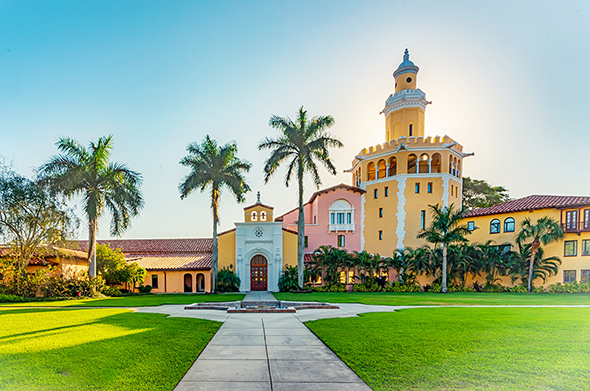
Stetson University College of Law’s Tower building, as viewed from Plaza Mayor.
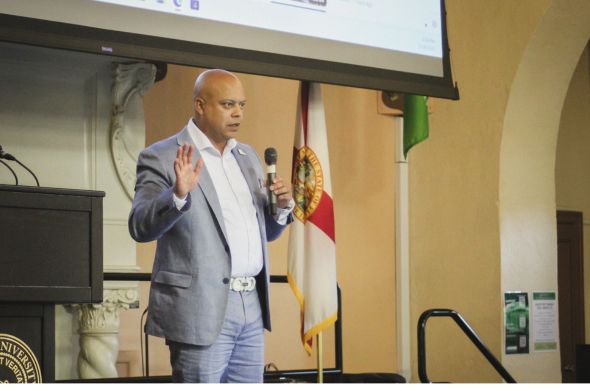
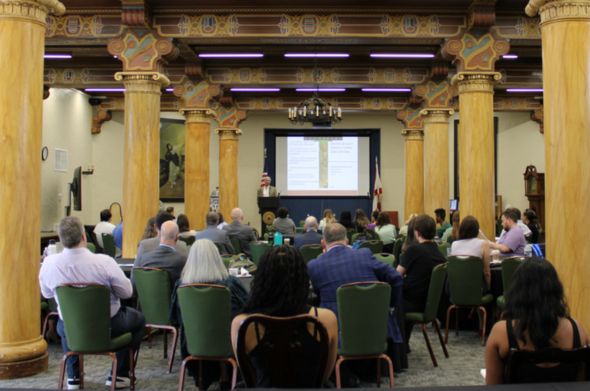
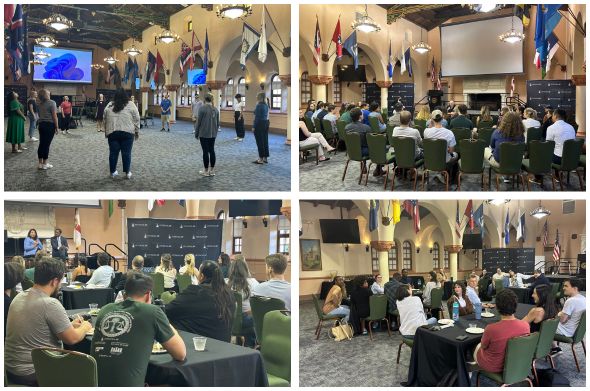
Stetson University College of Law is thrilled to host its White Collar Criminal Defense Training Program on its historic Gulfport campus on Friday, March 21, 2025. The groundbreaking hands-on training event for practitioners of all experience levels will lead participants through a realistic hypothetical from investigation to trial to sentencing.
Prosecutors and defense lawyers alike will gain valuable knowledge and skills from well-versed professionals throughout this day-long program:
Learn key white collar advocacy and trial skills from seasoned trial attorneys
Delve into a realistic hypothetical white collar case with leading practitioners
Discuss trends in white collar law with academics and defense counsel
This event is well suited for new attorneys interested in learning about white collar defense and experienced litigators interested in expanding their practice to include such cases. Participants will engage in opening statements and cross examination with feedback from experienced counsel and hear from panels exploring issues such as client retention, investigations, cross examination, ethics, and sentencing.
The program culminates with a dinner at which the White Collar Defense Award will be presented to a leading advocate or advocates. Stetson is partnering with the Women’s White Collar Defense Association (WWCDA) and the ABA CJS on this program; many of the speakers are members of these organizations.
Pricing is as follows:
$699 regular registration
$599 early-bird registration (prior to Feb. 15, 2025)
$550 co-sponsor members (ABA CJS, WWCDA, Stetson Alums)
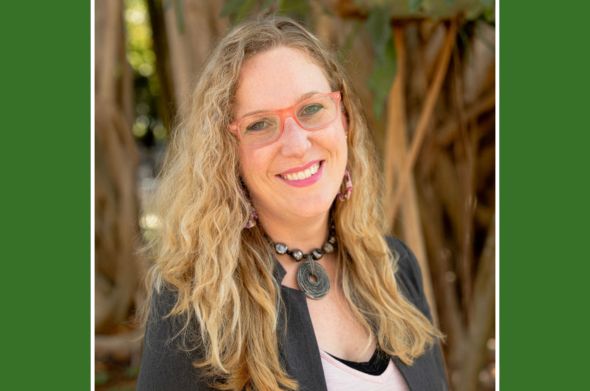
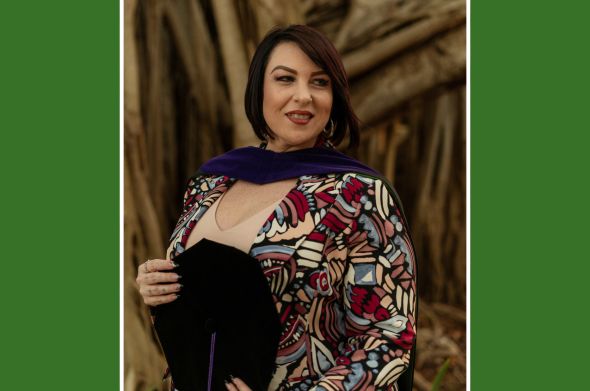
Those with further questions may reach out to Professor Ellen Podgor, Stetson’s Gary R. Trombley Family White-Collar Crime Research Professor: [email protected].
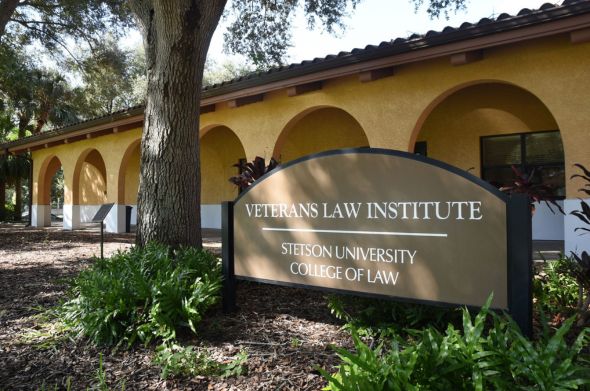
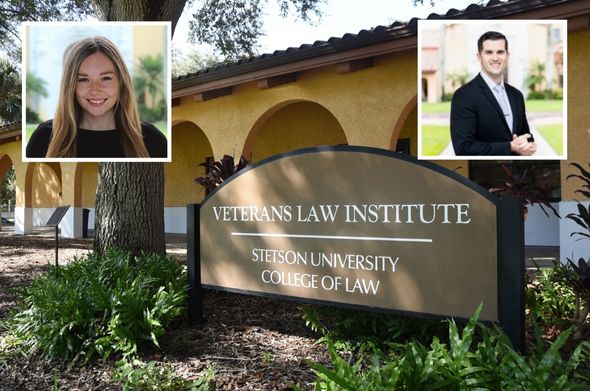
The exterior of Stetson’s Veterans Law Institute in Gulfport, Fla.
To better serve veterans in the Tampa Bay region and beyond, the Raymond James National Veteran Inclusion (Valor) Network has added Stetson’s Veterans Law Institute to the portfolio of organizations that help it support those who have served.
A nationwide alliance of nonprofits, Valor offers a variety of services such as financial support and career development to members of all military branches as well as military spouses and first responders. The VLI is the only nonprofit in the network that can provide free legal services to veterans seeking to appeal denial of benefits from the U.S. Department of Veterans Affairs.
“Our Valor nonprofits support veterans from all over the country, and a key need for veterans and transitioning military, is navigating the VA system/claims process,” said Mercy Ameyaw Aston, national co-chair of Valor. “Legal support ranks as one of the highest unmet needs by veterans and their families. VA Claims are a difficult area for private practitioners because cases can take years, involve extensive investigation, and the final award is uncertain.”
Being part of the alliance will help VLI expand its reach, thereby creating greater impact while also connecting Stetson Law’s veteran community with a broader network of potential resources.
“The VLI’s mission is to improve veterans’ circumstances in the Tampa Bay and national community,” said Professor Morgan E. MacIsaac-Bykowski, Associate Director at the VLI. “Partnering with the Raymond James Valor Network is a natural fit, as their mission is nearly identical. We are thrilled to be part of this network, as it allows us to broaden our reach and connect our veteran students and clients with a wider array of organizations dedicated to supporting individuals just like them.”
Aston said the fact that Stetson’s VLI is teaching law students how to navigate the complex VA claims system through pro bono work adds another layer of positive impact.
“Through our Valor partnership with VLI, we hope that providing legal aid pro bono to help veterans can simultaneously work to change policy,” she said. “I think it’s wonderful that VLI also gives students an opportunity to gain legal experience while helping U.S. military veterans. So, while VLI students may not be able to fix the VA, they are certainly doing their part to help those in need navigate the system to get the help they need and deserve.”
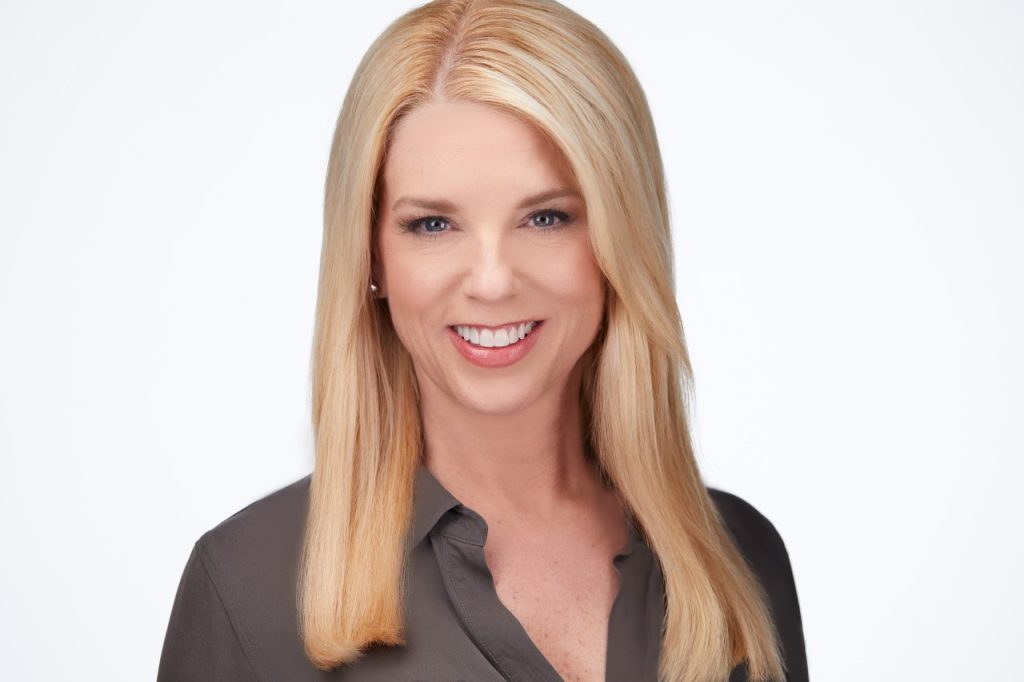
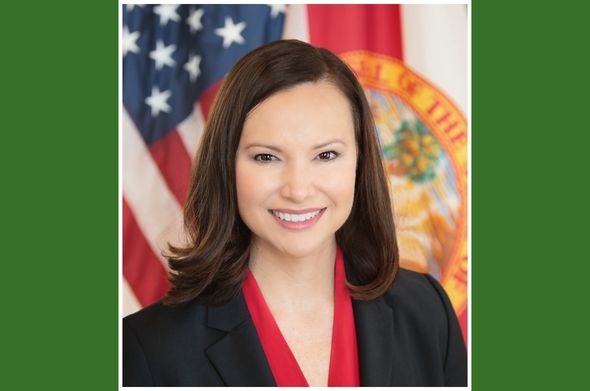
Ashley Moody LL.M. ’10, who was elected Florida attorney general in 2018 and appointed to the U.S. Senate in 2025.
Florida Governor Ron DeSantis has announced he will appoint Florida Attorney General Ashley Moody LL.M. ’10 to the United States Senate seat being vacated by Sen. Marco Rubio, who has been chosen to serve as U.S. Secretary of State.
A fifth generation Floridian and native of Plant City, Florida, Moody earned her Master of Laws in International Law from Stetson in 2010. She attended the University of Florida for her bachelor’s and master’s degrees in accounting, later earning her J.D. at the school.
After earning her LL.M. from Stetson, Moody has since served as an adjunct professor at the College of Law and, as attorney general of Florida, has helped Stetson’s Center for Elder Justice train attorneys on how to help their elder clients avoid fraud.
She began her legal career practicing commercial litigation with the law firm of Holland & Knight while, in her spare time, supporting domestic violence victims who sought protection in court.
Moody went on to prosecute drug, firearm, and fraud offenses with U.S. Attorney’s Office. The U.S. Drug Enforcement Agency commended her for prosecutorial excellence and outstanding initiative in drug law enforcement. The Florida Department of Law Enforcement also recognized her for leading “Operation Round-Up,” which targeted violent and repeat offenders.
In 2006, Moody was elected Circuit Court Judge of the Thirteenth Judicial Circuit in Hillsborough County. At 31, she was the youngest judge in Florida. As a judge, she founded the Attorney Ad Litem program recruiting volunteer attorneys to stand in for absent parents of youth in the court system and developed a mentorship program for at-risk children.
In 2015, Moody was recognized by the National Legal Services Corporation for significant contributions to pro bono legal service and was awarded the Florida Supreme Court’s Distinguished Judicial Service Award.
After winning a statewide election in 2018, Attorney General Moody became Florida’s 38th Attorney General on January 8, 2019. Since then, she served as a commissioner on the Presidential Commission on Law Enforcement and the Administration of Justice, led Florida’s Statewide Task Force on Opioid Abuse, and chaired of Florida’s Statewide Council on Human Trafficking.
Everyone can agree – 2024 was a year like no other. With all of its challenges and triumphs, it was a year in which the Stetson Law community shined – and brilliantly so.
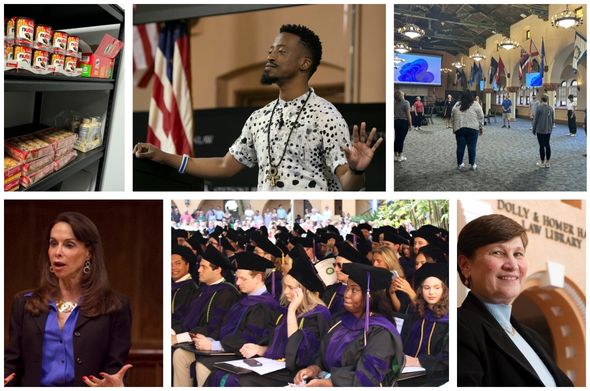
Here are 24 highlights from an unprecedented year. To see a photo slideshow with highlights from the past year, scroll to the bottom of this page.
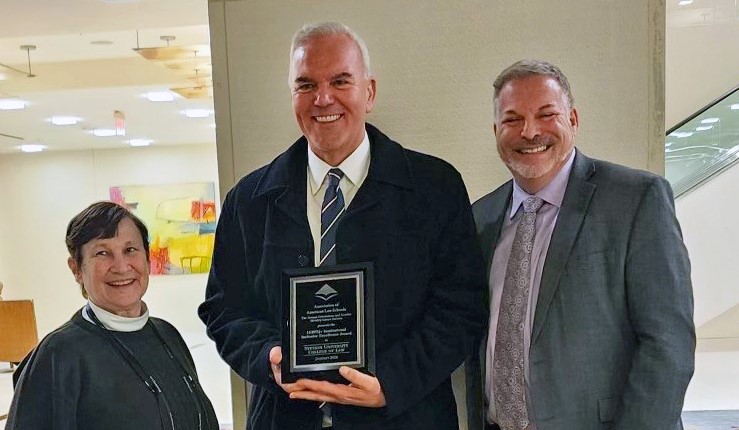
In January, Admissions Director Darren Kettles and others traveled to the American Association of Law Schools’ annual meeting to accept an award from the AALS Section on Sexual Orientation and Gender Identity Issues. The award honored the College of Law for its robust LGBTQ+ inclusion initiatives.
Stetson Law’s award-winning Campus to Career event offered a day of amazing programming that invited students to explore not just job opportunities, but ways to develop their professional identity.
The AALS section on Technology, Law, & Legal Education honored Law Professor Kirsten Davis with its inaugural Technology Mentorship Award for her tireless work training faculty on virtual learning – and for her important work around generative AI and legal education. She was later named Stetson University’s Provost Faculty Fellow for Generative Artificial Intelligence and Higher Education.
The spring 2024 semester marked the end of a groundbreaking career for Law Professor Luz Nagle, who has now earned the status of professor emerita. The first Hispanic member of Stetson Law’s faculty, she is known for her meticulous lesson-planning and passion for international law informed by her early-career experience as a judge in Colombia.
In March, criminal justice reform advocate Jon-Adrian “JJ” Velazquezgave a moving talk about his harrowing experience being falsely accused and convicted of murder – and how future legal professionals like those in the audience have the power to fight for reform.
When it was time for Stetson’s yearly Giving Challenge, Dean Barros did not hesitate to use his influence to inspire others to contribute – even if it meant getting multiple pies in the face!
In April, student Mia Bartolomei – then a 2L – was in for quite the surprise when the nonprofit AccessLEX handed her a giant $40,000 check to help her cover tuition for her final year of law school. She had been automatically entered into a drawing for the generous prize simply by using AccessLex’s services, so it was unexpected, to say the least.
Stetson Law’s 2024 Inns of Court speaker was alumna Irene Sullivan, a retired judge known for her passionate advocacy on behalf of children. She was honored with Stetson’s 2024 Wm. Reece Smith, Jr. Public Service Award.
The conclusion of the 2023-2024 academic year marked the end of the inaugural inns of court-inspired 1L orientation format. The holistic approach to acclimating students to law school and professional life has shown measurable improvement in student confidence.
Nearly 300 students walked across the stage at the spring 2024 commencement ceremony. The commencement speaker was none other than University of South Florida President and 1977 alumna Rhea Law.
Just after graduating from Stetson Law with her J.D., alumna Ana Gabrielle Geigerwas one of three individuals from a national pool of contenders to win the Federal Bar Association Criminal Justice Award.
Leah Burnett, a 2024 alumna of the College of Law’s Social Justice Advocacy Concentration, was chosen by the Immigrant Justice Corps for a fellowship in which she will serve as a staff attorney for Florida Legal Services’ Immigrant and Migrant Rights Project. Starting September 1 of this year, her work has focused on the Unaccompanied Children’s Project.
The Florida Legislature awarded generous support to Stetson Law’s celebrated Veterans Law Institute, which will allow the Veterans Advocacy Clinic to expand its critical work supporting those who have served our nation.
Law Professor Kristen Adams expanded her horizons by publishing a children’s book about the inspirational story of her beloved dog, Allie, and her perseverance against cancer.
Law Professor Ellen Podgordid important work as Co-Chair of the American Bar Association Criminal Justice Section’s Prosecutorial Independence Task Force.
Renowned Florida immigration lawyer Michael Vastinejoined Stetson Law as Distinguished Visiting Director of Clinical and Experiential Education.
In early November, scientists, policy makers, legal professionals, and students joined forces for a day-long symposium exploring the underrated issue of nitrogen pollution and ways to address it.
Alumna and former Florida Attorney General Pam Bondi ’90 was chosen to be the next United States Attorney General.
The fifth instance Stetson Law has filed with the NLSVCC at the Supreme Court, this brief is a collaboration among the University of Illinois at Chicago Veterans Legal Clinic and the University of Florida Levin College of Law’s Veterans and Servicemembers Legal Clinic.
Stetson Law’s Veterans Advocacy Clinic staff and students played a large role in drafting the document, which was submitted in support of the petitioner in the case Frantzis v. McDonough.
The petitioner, Louis Frantzis, filed a petition for a writ of certiorari seeking review of the U.S. Court of Appeals for the Federal Circuit’s June 2024 decision in his case. The consortium supported his Federal Circuit appeal with an amicus brief, so his counsel contacted the consortium to ask that it consider supporting him again.
Morgan MacIsaac-Bykowski, adjunct professor and associate director of Stetson’s Veterans Law Institute, was especially interested in the project, as she had worked on the Federal Circuit brief and has been following the case since its inception at the U.S. Court of Appeals for Veterans Claims.
About the case
In Frantzis v. McDonough, a divided panel of the U.S. Court of Appeals for Veterans Claims upheld an amendment to the Appeals Modernization Act (AMA) ending the requirement that the judge who conducts a hearing concerning a veteran’s claim before the Board of Veterans’ Appeals Veterans Law be the same judge who issues a decision in the case. The Federal Circuit affirmed this decision.
In its brief, the NLSVCC argued that this change to the law is detrimental to a veteran’s due process rights:
“A veteran’s right to a hearing . . . is close to meaningless without a corresponding right to be heard by the judge who will decide the merits of the case and whether the testimony provided is credible.The Board’s recently adopted practice of judge-swapping—allowing one Board member to preside over the hearing, and a different Board member to actually decide a veteran’s case… is especially harmful to veterans because the Board hearing is a veteran’s chance to convince a judge face-to-face of his credibility.”
Integral support from a student
MacIsaac-Bykowski is especially proud of the work Advanced Veterans Advocacy Clinic student Alex Polidan (’25) did on this brief.
“Alex was able to find a reference to an extremely similar issue in a transcript from a 1994 hearing before the Senate Committee on Veterans’ Affairs,” she said. “In that 1994 hearing, a VA representative expressed his concern that a potential change to the statute similar to the change being considered in Frantzis would waste resources and could be harmful to veterans, and this find really supports our argument.”
Professor MacIsaac-Bykowski enlisted Polidan’s help after seeing his impressive work on the case they are working on together at the U.S. Court of Appeals for Veterans Claims. Alex will be returning to the Veterans Advocacy Clinic as a teaching assistant in the spring.
The Veterans Advocacy Clinic prepares law students to become effective and compassionate attorneys through interdisciplinary collaboration and pro bono advocacy. Such work empowers them to be a voice for veterans with disabilities seeking compensation from the Department of Veterans Affairs in the most difficult cases.
If you are a veteran or spouse of a deceased veteran and you need legal help appealing a decision denying Department of Veterans Affairs disability benefits, you can apply for services by submitting a Client Application Form.
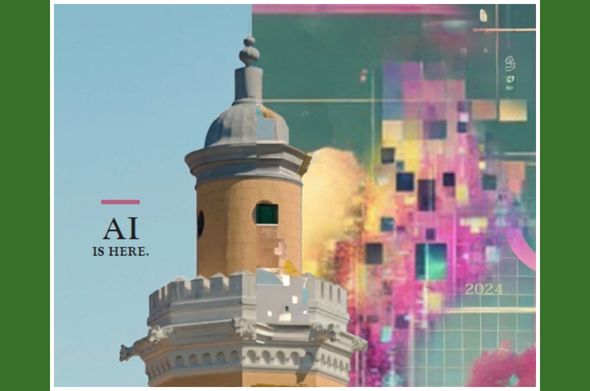
How members of the Stetson Law community are shaping conversations around AI and legal education as well as the profession itself.
On campus and beyond, the Stetson Law community leads in this new frontier.
From Crummer Courtyard to the gym to the Dolly & Homer Hand Law Library, the Stetson Law campus in Gulfport is buzzing with conversations about how artificial intelligence affects what law students – and legal professionals – do.
Kristen Moore ’09
Students and faculty alike have sentiments ranging from skepticism to excitement. Yet all agree that AI is here to stay and it is having a transformative impact on higher education and the legal field – especially on those who teach or study law, for whom research and writing are integral.
“As lawyers are using it, it becomes part of our job to teach how to use it responsibly and to help our patrons, our students, and our faculty use it,” said Kristen Moore ‘09, instructor in law and associate director of the Dolly and Homer Hand Law Library.
Starting in 2025, Moore will co-teach a course called Advanced Legal Research: Artificial Intelligence and Legal Research with References and Student Services Librarian Angelina Vigliotti ‘22.
It is one of many Stetson Law courses directly involving AI and how it relates to ethical implications, and how to assess writing, research, and other skills that are critical to lawyering in a world where generative AI is ubiquitous. In spring of 2025, Stetson Business Law Review will devote its entire symposium to the topic.
New tech, swift action
Dr. Kirsten Davis, Stetson Law’s faculty director of online legal education strategies and a nationally recognized expert in legal communication, jumped at the chance to explore AI’s implications for law schools.
“This was the moment I’ve been waiting on my whole career: the opportunity to study technology that might represent a paradigmatic shift for writing and researching the law,” Davis said.
Law Professor Kirsten Davis
Realizing the likely impact generative AI was about to have on legal education – especially legal writing – Davis engaged colleagues in what became a national conversation. She began teaching her first AI & the Law class in fall of 2023. In spring of 2024, Stetson University named her Provost Faculty Fellow for Generative Artificial Intelligence and Legal Education. She has also been recognized by the American Bar Association and the Association of American Law Schools as a thought leaders in the space. Her work has just begun.
“We are developing foundational policies to keep our community members safe with AI use,” Davis said. “We are starting training for faculty on sensible AI use in the classroom.”
A team of Stetson Law faculty is also participating with the American Association of Colleges and Universities in a year-long institute to explore ways to approach generative AI in the college’s curricula and courses, she said.
Preparing students for a brave new world
As alumni who come into daily contact with students immersing themselves in legal texts, Moore and Vigliotti know the Stetson Law student experience well – particularly the emphasis on ensuring students are practice-ready upon graduating and passing the bar. This is why they find it encouraging that the college is engaging proactivity on AI.
“As these new research tools come up, we’re thinking about when the students go into practice, whether they’re soon to be alumni or might be working for alumni,” Vigliotti said. “Stetson’s really trying to respond.”
Student Services Librarian Angelina Vigliotti ’22
Acknowledging that many students are already using it, a key point they want to stress is that generative AI is a tool – and is by no means a way to evade the deep cognitive work at the heart of lawyering. Moore and Vigliotti want to invite students to see how it compares and contrasts with traditional research methods – and how they can work synergistically.
“As librarians, we’re lovers of information and finding information,” Moore said. “It’s another tool to use in that process.”
An obvious challenge is determining whether an assignment turned in by a student was entirely the product of ChatGPT.
Law professors have long used legal writing assignments to evaluate not just communication skills, but also important underlying lawyering skills like legal reasoning. Students’ use of generative AI to write papers may change that assumption, Davis said, which could mean that new ways of assessing skills need to develop.
“As I tell my students, ‘You need lawyer intelligence to use artificial intelligence,’” she said. “The challenge now is to know how to assess those intelligences.”
While it’s possible that a student at the graduate level would try to pass off an AI-generated paper as their own work, Vigliotti said they are aware of the consequences.
“Students know their name is attached to that work product,” Vigliotti said. “They’re not willing to jeopardize their career, their quality of work, or their integrity.”
In her own work as V.P. and Deputy General Counsel for Turnitin, a platform that develops software to aid educators in detecting AI writing and plagiarism in student assessments, Kristen Chittenden ’10 was so fascinated by the question of how AI affects legal education that she developed a course around it, which she began teaching at Stetson Law as an adjunct in the fall of 2024.
Kristen Chittenden ’10
“In my class, I want them to use AI,” Chittenden said. “I want to see how they’re using it because I would rather learn how they’re thinking about it in a transparent way and what their process is in using it.”
Exploring the tech in an educational setting can allow students to fully grasp its benefits and drawbacks in a setting where there are no consequences for a client.
“Obviously AI doesn’t have genuine understanding and empathy or ethical judgment, so there is the potential for harm or unfair outcomes as a result of that,” she said. “There can also be bias and fairness issues that can be amplified if you don’t have oversight in how you’re using it.”
As the technology – and its use in law firms, courtrooms, and beyond – evolves, Chittenden said she can see classes in the future that are fully devoted to ethics and professional responsibility in the use of AI, to AI rules and regulations, and classes that branch off into specific areas of law, like criminal law or human resources law. “Educating the lawyers of tomorrow in AI and what it can do is critical,” Chittenden said. “Every law school should be thinking about a class in AI.”
How legal professionals use it
AI is now commonly used for tasks such as document drafting, legal research, and even predictive analytics for case outcomes, said Judge Michael Bagge-Hernandez ’07, who presides over Florida’s 13th Judicial Circuit in Hillsborough County. Bagge-Hernandez has been writing and speaking on AI’s uses within the legal profession and its ethical implications.
Some practitioners use it in discovery responses to help quickly identify relevant documents and information and even in client communications, he adds. Applied thoughtfully, it can free up lawyers’ time so that they can focus on duties that constitute the core of what it means to be a lawyer.
Hon. Michael Baggé-Hernández ’07, Florida’s 13th Judicial Circuit
“The advent of AI in legal practice is comparable to other major technological shifts, as it allows attorneys to allocate more time to strategic decision-making and client engagement—areas that require the human touch and deep legal expertise,” Bagge-Hernandez said.
Matt Hitchcock ’07, who is associate general counsel for the insurance company Vault, says he uses it to enhance tasks like brainstorming, rough drafts, evaluating documents, and data review and summarization.
“As an in-house attorney, you often don’t have a support staff, so having a digital assistant that can draft a letter while you do other work is very helpful,” he said.
Although AI is getting better every day, Hitchcock recommends viewing what it produces through a similar lens as one would a junior attorney.
Stetson Law 2007 alumnus Matt Hitchcock
“You should have a base level of trust (if not, there is a problem that needs to be addressed) but you should also review the output with a critical eye because sometimes the AI will get it wrong,” he said. “It’s critical that the attorney using the AI tool has the legal knowledge and skill to know when the AI is getting the law incorrect because at the end of the day, AI is just a tool and the attorney has a professional obligation to their client to ensure they’re providing good legal counsel.”
Knowing where AI can help – and its limits – is critical. It would not be wise, Chittenden said, to let it take over the Shephardizing process completely or generate an entire document, given the tendency for hallucinations. “Can it help you brainstorm ideas that you can then evaluate? Absolutely. Can it help you outline ideas and get organized? One hundred percent. Can it help you with counterpoints? Absolutely,” Chittenden said.
The risks of reticence
While it’s still possible for lawyers to conduct research using traditional methods, like consulting physical law books, the reality is that tools like Westlaw, LexisNexis, and Fastcase have made this approach nearly obsolete.
“Practitioners who resist adopting AI risk being left behind in a rapidly evolving legal landscape,” Bagge-Hernandez said. “It’s no longer practical – or billable – for an attorney to spend hours sifting through books when these advanced platforms can deliver precise results in a fraction of the time.”
He adds that in cases of malpractice or billing disputes, expert witnesses testifying about standard practices in legal research may soon include using AI for certain tasks – just as they currently assert that a competent attorney uses tools like Westlaw or LexisNexis rather than physical books.
Those who hesitate to adopt these tools may end up at a disadvantage that could jeopardize their competitiveness in the field.
Bagge-Hernandez cautions that lawyers “must balance this efficiency with ethical considerations, ensuring that AI is used as a tool to enhance, rather than replace, the critical thinking and judgment that define the legal profession.”
He recommends establishing clear policies for the use of AI that address transparency with clients about use of AI in their cases – and stress that AI is a tool that supports but does not replace a lawyer’s expertise of judgment.
One question Davis is frequently asked by reluctant legal professionals is whether artificial intelligence will eliminate the need for lawyers.
“The discussion of the end of lawyering has been going on for decades, Davis said. “Generative AI changes the calculus, but I think clients and the legal system will always need careful, smart, lawyers with good judgment and even better ideas who can make good use of technology.”
Start here: Recommended resources
Information about AI may seem nebulous and ever-evolving, but legal professionals who are thought leaders in the AI space recommend keeping up with its implications for lawyering via several trusted sources.
Professional organizations including the Florida Bar, New York Bar, and the American Bar Association (ABA) have offered guidance on AI use for legal professionals – and entities like Lexis and Westlaw also are also producing timely articles on the matter.
Hitchcock and Bagge-Hernandez both recommend reviewing Florida Bar’s Ethics Opinion 24-1 in particular. The ABA Model Rules concerning the duty of competence (Rule 1.1) and supervising nonlawyer assistance (Rule 5.3) also offer guidance on sound use of it.
“Lawyers must establish clear policies that include transparency with clients about the use of AI, rigorous oversight of AI-generated work, and ongoing education to stay informed about the evolving capabilities and ethical implications of AI,” Bagge-Hernandez said.
The Nitrogen Pollution & Solutions Symposium brought a a full house on Monday, Nov. 18, 2024.
It may not grab headlines like climate change or forever chemicals, but nitrogen pollution threatens our air, water, and public health.
On Monday, Stetson, supported by a grant from BlueGAP and the National Science Foundation, hosted a day of conversation about the issue and how to address it. The event brought scientists, nonprofit managers, legal professionals, policy makers, academics, and students together to talk about its sources, impacts, solutions, and what (and who) stands in the way of fighting it.
As the day began, Law Professor and Stetson Institute for Biodiversity Law & Policy Director Royal Gardner talked about what makes nitrogen pollution a unique problem.
“I really don’t need to tell this audience that nitrogen is one of the building blocks of life; a necessary nutrient for agricultural production,” he said. “Yet in some forms and in some places, nitrogen is a pollutant. Indeed, nitrous oxide is considered to be a super-pollutant, as it is both an ozone-depleting substance and a greenhouse gas. Nitrogen fertilizer runs off of agricultural fields and that harms water quality; contributes to harmful algal blooms.” He added that nitrogen pollution has “particular salience” for Floridians, whose lives are affected by increased hurricane activity and intensity due to warming seas as well as blue green-algae and red tide outbreaks caused or exacerbated by nutrient pollution.
Examining a lesser-known challenge
Referring to nitrogen pollution as a “wicked problem,” New York University Professor and Chair of the International Nitrogen Initiative Dr. David Kantner pointed out that what separates the global nitrogen pollution problem is that, unlike CFCs or DDT, it is not something we can simply stop using.
“There is no world where you ban nitrogen,” he said. “It is impossible. We rely on it. Not just the natural world, but the human world; the global food system that we depend on.”
About a century ago, he said, scientists combined nitrogen and hydrogen to create ammonium, which made nitrogen more easily absorbed by crops. The synthetic fertilizer products that resulted made industrial-scale agriculture possible, but not without consequences.
As it is routinely over-applied to crops, the excess nitrogen pollutes our air and runs off into waterways. The same nutrient bioavailability that helps crops grow also fosters harmful algae growth in the water – including the Gulf of Mexico dead zone, an area the size of New Jersey so devoid of oxygen that marine life cannot survive there. Fueled by fertilizer runoff from farms along the Mississippi River – largely in Iowa – the occurrence is devastating to the ecology and economy of the region.
Setting the table for a day of talks exploring the interplay between science, law, and policy, Kantner stressed the need for policy solutions that reflect reality.
“You can only develop effective government approaches… if they truly reflect the science,” he said.
Bringing together students, alumni, & the community
Throughout the day, speakers delved into nitrogen pollution – and possible solutions – through a variety of lenses, including recent U.S. Supreme Court decisions like Sackett v. EPA, which affect enforcement of water protections, international agreements like the Ramsar Convention on Wetlands, and the various, often contrasting approaches of states like Iowa and Illinois.
Alumna Angela Xu ’23, who is Municipal Engagement Manager with the Illinois Environmental Council, works on clean energy and water initiatives. She said despite the Illinois Environmental Protection Agency’s goal of reducing nitrogen pollution in waterways by 15 percent by 2025, it has actually increased.
“One response to this issue is to protect our wetlands,” she said. “Wetlands play a crucial role by acting as natural filters, effectively removing excess nitrogen from water bodies, thus helping to mitigate water pollution from agricultural runoff and other sources.”
She noted the state’s major wetlands and smaller aquatic areas near Chicago. Development has cost the state 90 percent of its wetlands, she said, and the lack of protection threatens what remains. Her organization is advocating for legislation that would create long-term protections throughout the state, though it faces headwinds from affected industries.
Other presenters looked at how policy makers are tackling the problem in the Chesapeake Bay, Iowa, and New York.
This event also gave Stetson Law students an opportunity to present on international agreements on waterway protections that could inform nitrogen pollution policy, including the Montreal Protocol and the Convention on Biological Diversity.
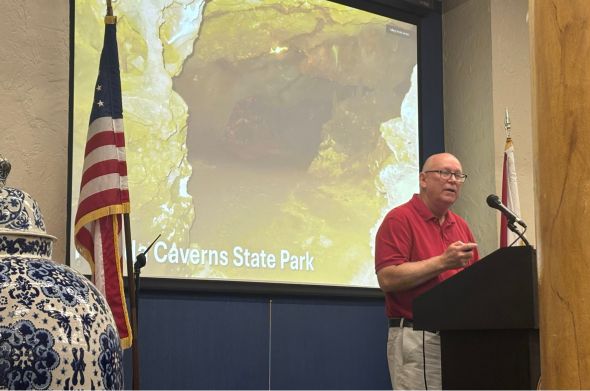
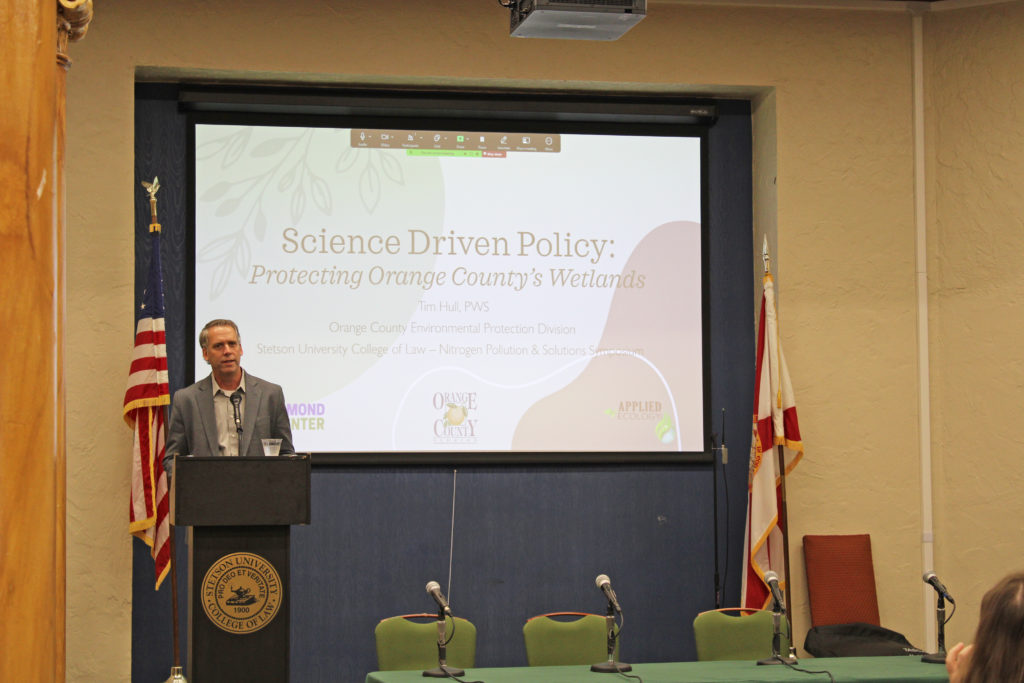
A lunchtime keynote and Foreman Biodiversity Lecture featured the Orange County Environmental Protection Division’s Tim Hull, who talked about the Central Florida county’s efforts to protect waterways despite rapid population growth.
The event culminated with a screening of A Splash of Color: Getting Black in the Water, a film showcasing efforts of Black water advocates in the Tampa Bay region.
The symposium kicked off with remarks from Stetson Law Dean D. Benjamin Barros, who said bringing together students, alumni, and professionals in such a setting reflects the College’s commitment to connecting students with real-world experiences and opportunities.
“Here at Stetson, one of the things we do better than many law schools is train students for practice in a very real-world setting,” he said. “In the environmental space, we have two organizations, the Jacobs Clinic for Democracy and the Environment, led by Professor Jaclyn Lopez, and the Institute for Biodiversity Law and Policy, led by Professor Gardner that do really good work in this area.”
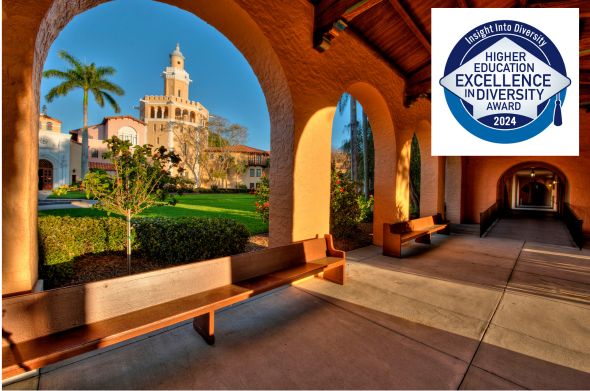
For the fifth year in a row, Stetson Law has won the Insight Into Diversity HEED Award.
For the fifth year in a row, Stetson University College of Law has won the 2024 Higher Education Excellence in Diversity (HEED) Award in recognition of its outstanding commitment to promoting belonging and inclusive excellence.
Insight Into Diversity magazine issues this award each year to honor higher education institutions that excel in their efforts to foster belonging on campus. For Stetson, the award reflects years of hard work and innovative strategies for ensuring diversity remains a core value for the College.
For the second year in a row, this recognition encompasses all of Stetson University, including the main campus in DeLand, which has, in recent years, taken great strides to significantly advance diversity and inclusion on the DeLand campus.
“This national recognition affirms Stetson’s ongoing commitment to put people, culture and inclusive excellence at the forefront of all that we do,” said Stetson President Christopher F. Roellke, PhD. “Providing a sense of belonging to students, faculty and staff, who come from a diverse range of backgrounds and experiences, lies at the heart of our relationship-rich approach to education.”
Key initiatives at Stetson Law
For the College of Law, notable efforts include revamping the way it orients new students and programs aimed at encouraging exploration across cultures.
Assigning full-time and part-time law students into smaller groups called “Inns,” the new orientation format focuses on mentorship, stress management, and belonging among students as they face the rigors of legal education. The “Inns” approach is now in its second year, and leadership has seen measurable differences in student wellbeing.
“With the Inns, we created a space for the 1L students to feel connected to each other, their upper-level colleagues, and their faculty leaders,” said Associate Dean for Assessment and Professional Engagement Anne Mullins. “Student surveys show that the Inns have helped students from a variety of backgrounds and lived experiences develop a real sense of belonging. They learn early on that their presence in the community and their contributions to the community matter.”
A new approach to orienting 1L students offers a variety of immersive activities to help students acclimate to law school life.
The College of Law has also promoted cross-cultural learning opportunities through events and digital awareness campaigns – and continues its efforts to recruit students from a diverse range of communities. “It is such an honor for Stetson’s College of Law to receive this recognition for the fifth year,” said Law Dean D. Benjamin Barros. “Initiatives like our ‘Inns’ Orientation model and cross-cultural learning efforts not only promote an important sense of belonging, but they also empower our law students through thoughtful engagement with their future roles as lawyers and leaders throughout the diversity of communities they will serve.”
Sustained efforts university-wide
On both campuses, the Cross-Cultural Awareness Initiative invites all to celebrate cultural holidays and observances, such as Juneteenth, Pride Month, Disability Pride Month and Hispanic Heritage Month. These celebrations include cultural awareness and education, allowing for a cross-cultural exchange.
To support Stetson employees, Human Resources launched Employee Resource/Affinity Groups to ensure they feel valued and empowered to succeed. Employees who volunteer for the affinity groups share a common purpose, identity or interest, such as groups for LGBTQIA+, working parents/caregivers, and for various hobbies.
“I am so excited about Stetson’s continued momentum in empowering our students, staff, faculty, and alumni from such a wide diversity of backgrounds, experiences, and perspectives to not only thrive as their genuine selves, but to also learn and connect with each other across our celebrated differences,” said Carmen B. Johnson, Executive Officer for Institutional Inclusive Excellence.
Johnson added that the award will bolster future efforts for sustained cultivation of diversity on Stetson’s campuses.
“The HEED Award is an affirmation of our current efforts and for the innovations that lie ahead,” she said.
Stetson, for example, has approved the new Forward Together strategic priorities for 2023-2030, with a core focus on “People, Culture and Inclusive Excellence.” This emphasis is vital for academic excellence, alumni engagement, student success, and more.
Earning the recognition
The HEED Award requires a rigorous application process that considers such factors as an institution’s efforts to recruit and retain students and employees, the campus culture and leadership support for diversity.
“We take a detailed approach to reviewing each application in deciding who will be named a HEED Award recipient,” said Lenore Pearlstein, publisher of Insight into Diversity magazine. “Our standards are high, and we look for institutions where diversity and inclusion are woven into the work being done every day across their campus.”
Stetson and 113 other winners are featured in the November/December 2024 issue of Insight into Diversity magazine, which is a leader in advancing best practices in diversity, equity, and inclusion in higher education.
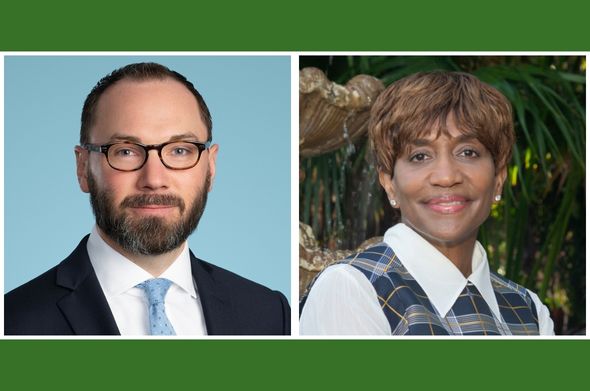
Clockwise, from top left: Jim Moore, Patricia Salkin, Professor Peter Lake, Jonathan Fansmith
Despite their pivotal role in American life, culture, and economic health, colleges and universities face increasing and shifting regulatory mandates, political scrutiny, and legal challenges. The field can expect significant changes in light of the incoming federal administration. With a new roster featuring some of higher-ed’s most prominent thought leaders, Stetson’s annual National Conference on Law and Higher Education will help industry professionals face those challenges.
Taking place March 5-9, 2025 at the stunning Wyndham Grand Clearwater Beach, the conference fosters compelling conversations known to influence law and policy in the higher ed space.
The keynote speakers are:
American Council on Education (ACE) Senior Vice President of Government Relations and National Engagement Jonathan Fansmith
Jim Moore, senior advisor for Clery Act compliance and campus safety operations with the U.S. Department of Education
and Law Professor Patricia E. Salkin, who is senior V.P. of academic affairs and provost of graduate and professional divisions at Touro University Jacob D. Fuchsberg Law Center
A premier event
Throughout the year, staff and leadership of Stetson’s Center for Excellence in Higher Education Law and Policy work tirelessly to identify emerging topics for discussion and secure influential figures in the higher education industry who can offer insights and updates throughout the conference, which is now in its 46th year. Popular sessions include the Crystal Ball session, during which panelists make informed (and often humorous) predictions about higher ed in the coming year.
“Stetson’s leadership in analyzing developments in higher education law and policy has never been more critical than in this moment of transformation at the federal policy level,” said Professor Peter Lake, who directs the Center and chairs the conference.
The event’s 2025 theme is “The 2025 Compliance Reset: Navigating the New Landscape of Federal and State Regulatory Mandates.” It will explore the potentially profound federal law and policy changes – particularly the Supreme Court’s Chevron and Corner Post cases – that will alter higher education compliance requirements.
Lake, a leading higher ed law expert, wrote a piece, “Management by Judiciary,” for Inside Higher Ed following the U.S. Supreme Court’s Chevron decision that garnered the attention of college presidents, boards and administrators across the country.
“Do not be lured into thinking that this is the end of dynamic, challenging, at times inconsistent compliance mandates for higher education. Instead, higher education’s lived regulatory experiences likely will only become more complex and legalistic,” Lake wrote in the article.
Other topics to be explored include artificial intelligence’s impacts on higher education, academic freedom, athletics, and crisis management.
About the keynote speakers
Lake and his team are thrilled to host the high-caliber speakers who will headline the event. They represent a broad range of perspectives from within the federal government, university administration, and beyond.
Jonathan Fansmith, Senior Vice President, Government Relations and National Engagement, American Council on Education (ACE)
Leading ACE’s efforts to engage federal policymakers on issues affecting colleges and universities, Fansmith coordinates the government relations response of approximately 60 higher education associations in Washington, DC. His work involves representation before Congress, administrative agencies, and the federal courts. Fansmith’s writing has appeared in publications ranging from The Washington Post to The Journal of College and University Law, and he is a frequent speaker for association, academic, and corporate audiences.
Jim Moore, Senior Advisor for Clery Act Compliance and Campus Safety Operations, U.S. Department of Education
Serving as the federal government’s top expert on the Clery Act, the Drug-Free Schools and Communities Act, and other campus safety and crime prevention initiatives, Moore has led numerous high-profile investigations, including the Department’s examinations of the Jerry Sandusky and Larry Nassar scandals at Penn State and Michigan State, respectively. He has helped institutions develop sexual assault prevention programs and leads the Department of Education’s Clery Act training, technical assistance, and outreach initiatives. From 2014 to 2017, he served on the White House Task Force to Protect Students from Sexual Assault and joined the ED-DOJ-HHS Task Force on Sexual Violence in Education and the Violence Against Women Act Interagency Working Group in 2022.
Patricia E. Salkin, Senior VP of Academic Affairs, Provost, Graduate and Professional Divisions and Professor of Law, Touro University Jacob D. Fuchsberg Law Center
Dr. Salkin currently serves as Provost, Graduate and Professional Divisions and Professor of Law at Touro University Jacob D. Fuchsberg Law Center. She is co-chair of the NYS Bar Association’s Standing Committee on Legal Education and Admission to the Bar and she was a member of the City Bar’s Task Force on New Lawyers in a Changing Profession. She is a past chair of the American Association of Law School’s State & Local Government Law Section, and is the author of hundreds of articles, columns and books including MAY IT PLEASE THE CAMPUS: LAWYERS LEADING HIGHER EDUCATION (Touro University Press, 2022).
Clockwise from top left: Professors Jeffrey Brooks, Deidré Keller, Robyn Powell, Alfredo Garcia, Nino Monea, and Shailini George.
A big part of what makes Stetson Law so special is the faculty whose scholarship and passion for mentorship foster success for students. These new and visiting faculty are the latest to contribute to this community.
Visiting Assistant Professor Jeffrey Brooks
Joining Stetson Law from Louisiana State University, Brooks is a major force behind the Philip C. Jessup International Law Moot Court Competition, the world’s largest competition of its kind. While at Stetson Law, he will teach international law.
Distinguished Visiting Professor of Law Alfredo Garcia
An eminent scholar and former dean of St. Thomas University College of Law, Garcia brings a wealth of experience as an administrator, faculty member, and legal practitioner. He joined Stetson Law as a visiting professor in fall of 2024 and teaches criminal law.
Distinguished Visiting Professor of Legal Writing Shailini George
Suffolk University Professor Shailini George joined Stetson Law as Distinguishing Visiting Professor of Legal Writing for the 2024-2025 academic year. George’s years of teaching experience in legal writing will help to bolster Stetson Law’s reputation as a national leader in legal writing. George also brings an extensive body of work exploring the role that mindfulness in student success.
Distinguished Visiting Professor of Law Deidré Keller
Deidré A. Keller is the immediate past dean of the Florida A&M University (FAMU Law) College of Law in Orlando. She writes and speaks at the intersections of pedagogy, intellectual property, personhood theory, the Constitution, and diversifying the legal profession. She teaches contracts and intellectual property.
Bruce R. Jacob Visiting Assistant Professor of Law Nino Monea
A 2016 Harvard Law alumni and former editor of the Harvard Journal of Legislation, Monea’s recent work includes serving as a Judge Advocate for the U.S. Army. Prior to that, he clerked for Michigan Supreme Court Justice Mary McCormick. He teaches professional responsibility.
In fall of 2024, Stetson Law welcomed Professor Robyn Powell back to campus as tenure-track faculty. Powell teaches professional responsibility, disability law, public health law, and other courses and is a nationally recognized expert in disability law, particularly where it intersects parental rights.
Stetson Double Hatter Jim Shore B.A. ’77, J.D. ‘80
With dedication to serving his community and an unflappable work ethic, Jim Shore’s path to becoming general counsel for the Seminole Tribe of Florida is as uncommon as it is inspirational.
Even before the Double Hatter set foot on either Stetson campus, his story can best be described as one of spirited perseverance in the face of daunting challenges – all in the name of giving back to the Seminole Tribe.
In 2022, he established the Jim Shore Scholarship for the Seminole Tribe of Florida Endowment, which encourages and supports members of the Seminole Tribe of Florida to follow in Shore’s footsteps by pursuing a legal education at Stetson University College of Law.
Shore said he hopes to encourage others in his community to cultivate careers in which they can use their skills to help the tribe prosper.
“The continued success of the Seminole Tribe of Florida depends on the education of future generations of its members,” Shore said. “We hope Stetson University College of Law becomes an important partner in attracting, educating, and preparing Seminole students to become attorneys.”
Hard work in the face of the unexpected
Jim Shore was born in 1945 in an area just northwest of Lake Okeechobee, where his family raised cattle and lived in chickees with thatched roofs and no indoor plumbing. Despite the challenge of being born blind in one eye, he graduated from Okeechobee High School in 1963 and worked in construction, as a mechanic, and even as a cowboy.
In 1970, an auto accident sent shards of glass into his eyes, resulting in complete blindness. Without the ability to see, he needed to start over with a new career direction; Shore would joke that he couldn’t make a living riding a horse. He turned to education, first earning his B.A. in history from Stetson University’s DeLand campus in 1976. After hearing his classmates talk about going on to study law at the University’s Gulfport law school campus, he applied and was accepted.
His dedication to his legal studies while at Stetson Law became the stuff of legend. The St. Petersburg Times even wrote about his unique method of studying law by taping class lectures on a small reel-to-reel, then listening to the tape for up to seven hours a day before recording his own notes on additional tapes.
His legal colleagues say that experience left him with an uncanny ability to hear what’s said in negotiations – as well as what’s not said.
A few days before graduating from Stetson Law, he slipped on wet pavement and broke his ankle – and attended the ceremony with help from a wheelchair. With his family by his side, he became the first Seminole to earn a law degree.
A career spent giving back
After passing the bar, he worked as deputy counsel for the then-3,000-member Seminole Tribe of Florida in 1981. A year later, he became general counsel for the tribe, now 4,200 strong, a role he has held ever since.
He helped form the Seminole Police Department and effectively negotiated a series of water use challenges between the Seminole Tribe of Florida, the state, and the federal government.
His work has greatly improved the health and welfare of the Seminole people by helping to diversify tribe enterprises, including negotiations between the tribe and the state to secure the 2007 gaming agreement that allowed for Las Vegas-style gaming at the tribe’s six Florida casinos. He also shepherded the tribe’s monumental acquisition of the Hard Rock hotel, restaurant, and casino chain.
Recognition for passionate advocacy
In 2020, Shore won the American Bar Association’s Energy, Environment and Resources Government Attorney of the Year award for his legal work and achievements in the areas of the environment, energy, and natural resources.
He continues to focus on Everglades restoration and Lake Okeechobee management within the Brighton Reservation, which now encompasses the area where he grew up, and the Big Cypress Seminole Reservation. In a video introducing Shore, attorney Michelle Diffenderfer, president of Florida-based firm Lewis, Longman & Walker, who has worked with Shore for years, lauded him for his “incredible listening skills and a penchant for knowing just what to do at the right time.”
In 2023, the Stetson Lawyers’ Alumni Association honored Shore with its Ben Willard Award, which recognizes “alumni whose tireless efforts and humanitarian work have demonstrably benefited Floridians.”
Donations of funds, food, and school essentials are helping our students recover from back-to-back hurricanes.
Back-to-back hurricanes Helene and Milton devastated the community surrounding Stetson University College of Law.
As Gulfport, the Pinellas beaches, and parts of St. Petersburg were particularly hard-hit, some Stetson Law students lost everything from laptops and textbooks to homes and vehicles.
One student reported losing virtually all of their belongings and remains displaced after the storms caused extensive damage to their home. Yet another said they lost all furniture, personal belongings, clothes, and shoes to flooding. Another said they lost two refrigerators’ worth of food due to two consecutive, prolonged power outages.
To support students affected by the storms, Stetson Law put out a call to action urging alumni and friends to contribute to its Student Emergency and Food Pantry funds – and the community responded generously. So far, Stetson Law has raised $30,000 for students in need of post-hurricane aid.
One such contributor is Susan B., whose son is a 2L and graduate of Stetson University in DeLand.
“Our son was not affected by hurricanes Helene or Milton, but he shared that many of his classmates were,” she said. “We just want to help his fellow students who were not as fortunate to recover from loss and damage so they can focus on their studies.”
The family’s contribution will greatly assist students as they work to rebuild their lives amid unprecedented circumstances.
While the amount of contributions so far is impressive, it pales in comparison to the needs of our impacted students.
Whether you have yet to give or would like to provide more than one gift, doing so is easy via the Stetson Law website. Simply visit our Giving Page and, under the drop-down menu titled “Designation,” select “College of Law Food Pantry” or “Student Emergency Fund Law School.”
The College of Law is incredibly grateful to all who have supported our students in the wake of two catastrophic weather events.