Skip to content

Dean Barros Elected to American Law Institute

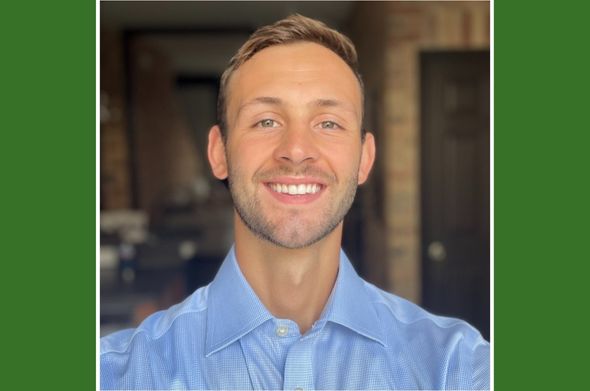
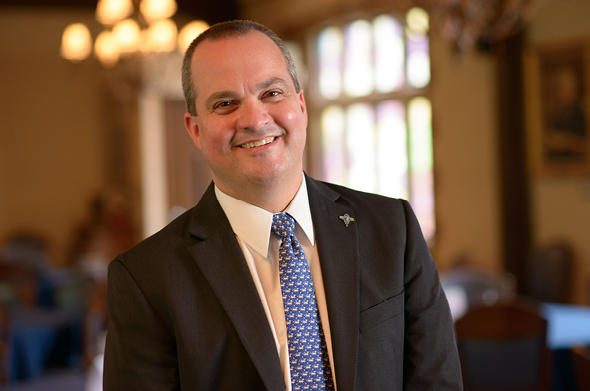
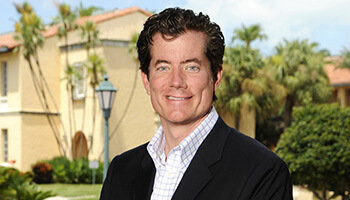
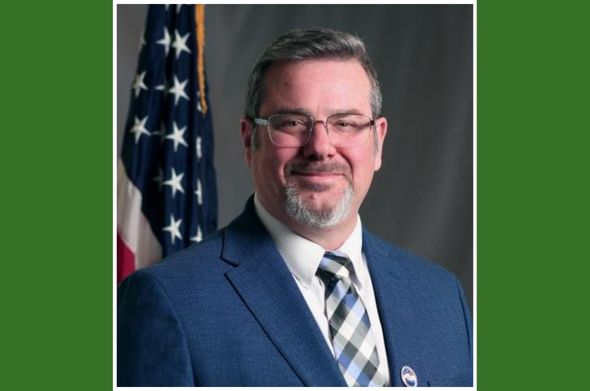
A headshot of Dean Benjamin Barros
Dean Benjamin Barros

After a rigorous nomination and vetting process, The American Law Institute has chosen Stetson Law Dean Benjamin Barros to join its latest incoming class of members.

He is among 47 legal scholars and practitioners chosen to join the elite roster of legal professionals in 2024 (see full list) – and will now be one of numerous current and past Stetson Law faculty members elected to the ALI. The century-old nonprofit invites the nation’s top lawyers, judges, and legal scholars to use their sharp expertise to help shape documents intended to inform the creation and interpretation of laws. Thus, becoming a member of the ALI is both a prestigious affair and a challenging endeavor.

“I am honored to be elected as a member of The American Law Institute,” Barros said. “The ALI is one of our country’s most important legal institutions, and I look forward to taking part in the ALI’s continuing efforts to improve our legal system.”

More than a century of supporting American jurisprudence

Last year, the ALI celebrated the 100th anniversary of its 1923 founding. From its start, the nonprofit has promoted clarification and simplification of laws that are overly complex or ambiguous in their interpretation, which the institute says can “cause useless litigation, often make it difficult to advise persons of their rights, and create delay and expense after litigation begins.”

ALI leadership selects its projects from proposals submitted by members and others, then identifies the appropriate participants to work on them. Projects can often take years, and will result in either Model Code, Principles, or Restatements.

These documents are scholarly publications that aim to aid and inform legislatures, judges, administrative agencies, and others tasked with creating, revising, or interpreting policy. (See frequently asked questions about the ALI.)

A legacy of scholarly contributions to ALI

Barros and seven other current and emeritus faculty who currently represent Stetson Law within the ALI are nationally recognized legal scholars who are passionate about helping the American legal system serve all who live under it.

These members include Professors Kristen Adams, Rebecca Morgan, Theresa Pulley-Radwan, and Louis Virelli III, as well as Professors Emeriti Robert Bickel, Luz Nagle, and Candace Zierdt. Professor Ellen Podgor was named a Life Member of the ALI in 2022. Dean Emerita Elizabeth Moody, who passed away in May of 2023, was also a Life Member.

Learn more about the American Law Institute.

Why Stetson Law Alums Recruit from Their Alma Mater

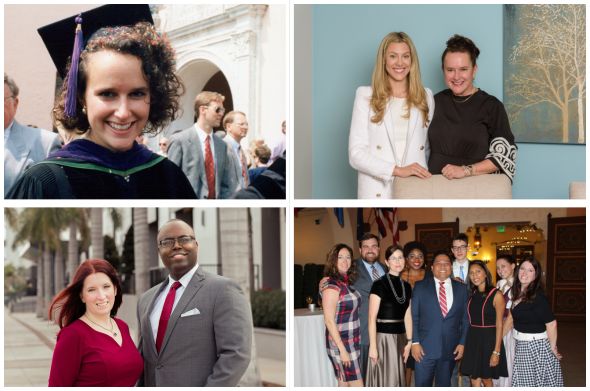
A collection of photos featuring alumni from different generations.
When a Stetson Law alum sees their alma mater on a prospective employee’s resume, they expect good things.

Years before he launched his own firm Robson Powers ’12 suddenly found himself managing a branch of another firm’s civil litigation office. On track to become partner, Powers was building out his department and looking to hire an associate.

After he interviewed several candidates, an applicant named Kara Rogers caught his attention.

“The credentials are there, the work ethic seemed to be there,” he said.

One thing put her at the top of the list: a J.D. from Stetson Law (2017), which meant Rogers was certain to have the kind of professional foundation needed to serve well in the role.

“I know those fundamentals are there, and that’s really important,” Robson said.

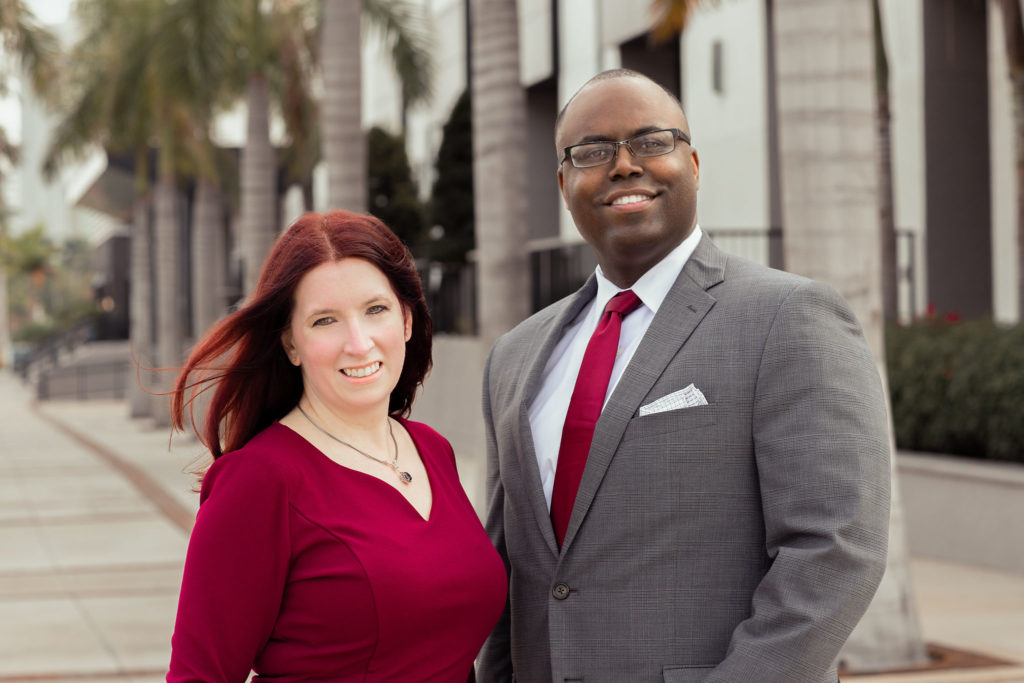
A woman with red hair wearing a red top stands next to a man with glasses wearing a grey suit jacket and red tie.
Kara Rogers ’17 and Robson Powers ’12

A reputation for readiness

Within the legal profession, Stetson Law alumni are known – and often sought after – for the skills they bring to the table on day one. For Robson, an example that comes to mind is the college’s deep focus on practical skills like evidence.

“I’ve seen attorneys gear up for the most important day for their clients without a sound understanding of evidence,” he said. “Stetson is meticulous about trial advocacy and procedure, and they hone it again and again and again.”

This reputation is so strong that University of South Florida President Rhea Law, herself a 1977 graduate of Stetson Law, even mentioned it in her 2024 Commencement speech.

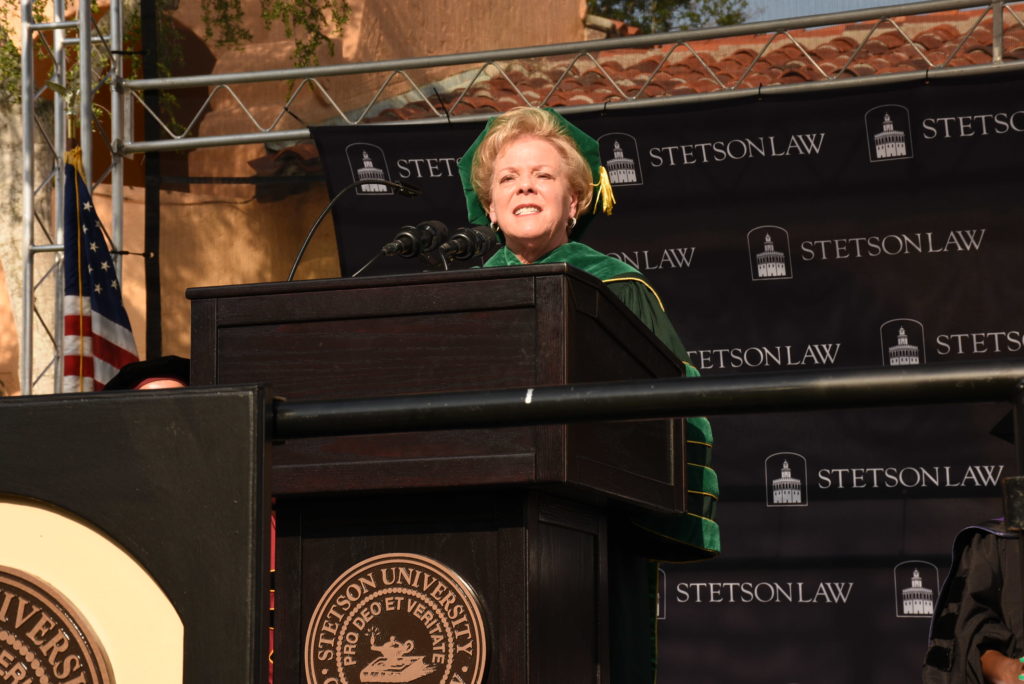
A woman with short hair wearing a green graduation ceremony robe and cap stands behind a podium and delivers a speech.
University of South Florida President and Stetson Law alumna Rhea Law ’77

“During my years of leading my law firm, I can always tell you that when a Stetson graduate would come to apply for a job, I knew right away that that person was well suited for the practice of law,” she said. “They were ready for the rigors that would come before them. I knew that they would be trustworthy. I knew that they would have the right kind of background.”

Since Powers made the decision to hire Rogers, the two have branched off to launch their own private practice, Powers & Rogers, PLLC in Cape Coral. The practice, which launched in April, handles business litigation, specialty and complex litigation, business formation, and more.

Powers, who participated in competitive trial advocacy as a student, said she credits her success and work ethic in large part to the mentorship she found while at Stetson Law – and the focus on studying hard until you get it right.

“I was practicing the skills I was going to need before I ever graduated law school,” she said. “You worked and you worked and you worked.”

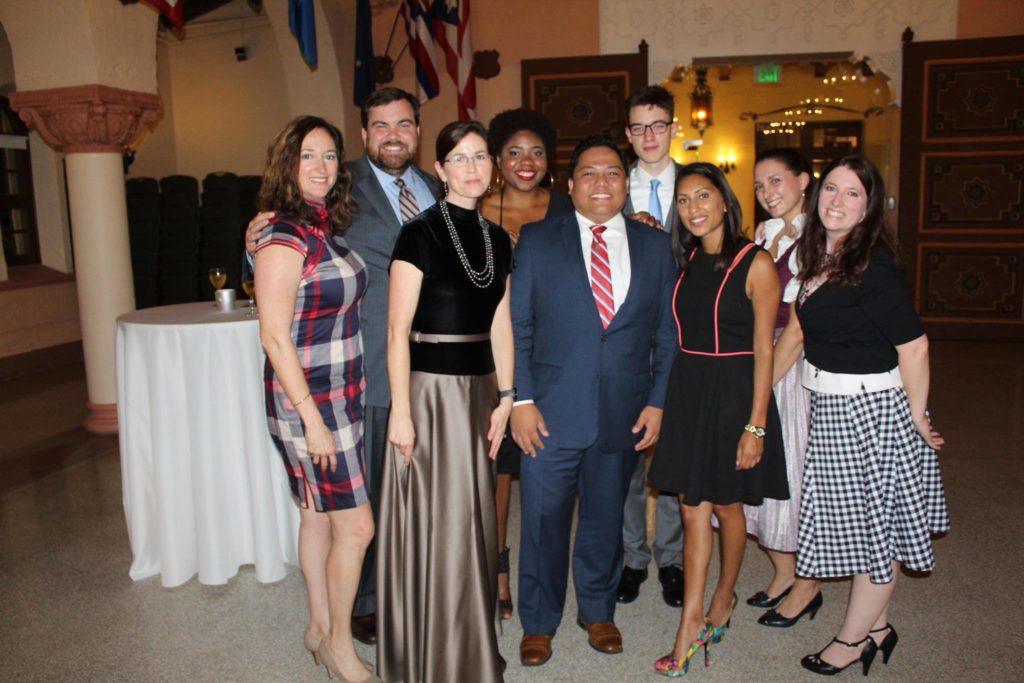
A group of students and professors wearing formal attire smiles at the camera.
Kara Rogers ’17 (right) was on the Dispute Resolution Board during her time at Stetson Law.

Family law, family environment

Rebecca Palmer ’94 knew early on that she wanted to help people through her work – it’s why attending law school made sense to her.

Now a Supreme Court Certified Family Mediator, Palmer leads Orlando-based Rebecca L. Palmer Law Group.

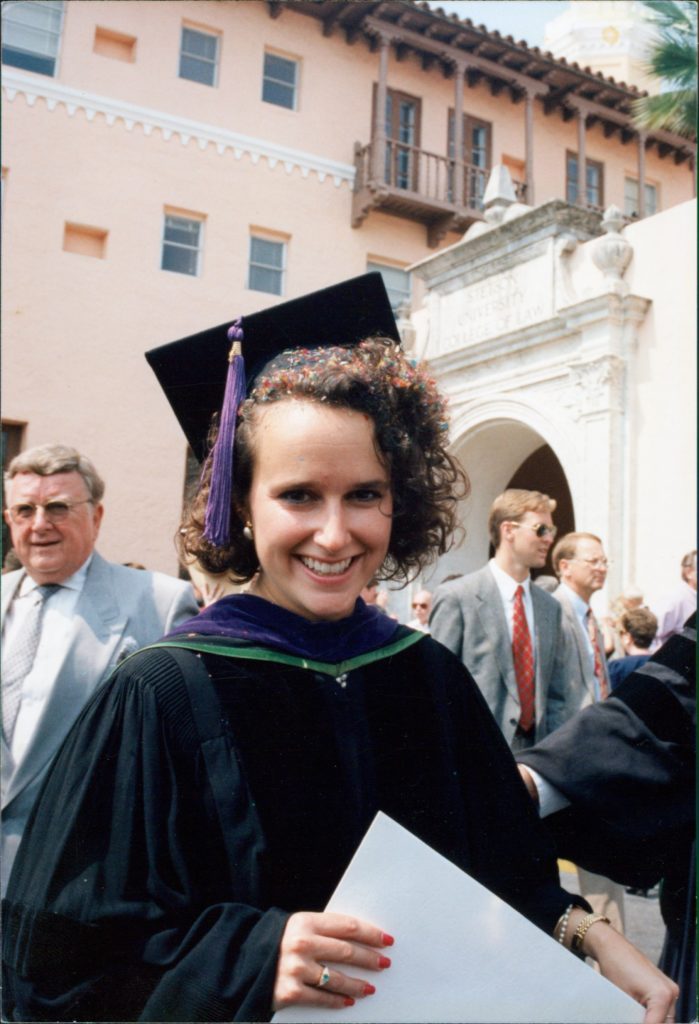
A woman wearing a cap and gown smiles at the camera after a graduation ceremony. There is confetti in her hair.
Rebecca Palmer ’94

“Helping others has always been my calling – family law provided the most direct path to help people going through challenging and emotional times,” she said. “There is a tremendous reward in working with someone who’s going through a tough time and watching them come out on the other side.”

Reflecting on her time at Stetson Law, she said the practical experience she received set her up for success, including internships with the public defender’s office and with Judge Elizabeth A. Kovachevich (also a Stetson Law alum – she graduated in 1961 and was the only woman in her class). She also worked at Harter Secrest and Emery as well as Gunster while in law school.

Palmer has since served as an adjunct professor of Legal Ethics, Business Law, Trial Techniques, and Family Law at Stetson, the University of Central Florida, Barry University, and Southern College. She had a term as the president of the Central Florida Association of Women and has continued to stay involved – and regularly speaks and writes on salient family law topics.

When a resume from her alma mater crosses her desk, she knows she can expect good things.

“I recruit from Stetson Law because the students are prepared, curious, and hard-working,” she said. “I expect alums to demonstrate preparedness and dedication. I look for those who have researched the firm ahead of time – after all, the last thing you want to do is go in blindly and not know anything about the firm, company, or the people you are speaking with.

A shared passion for helping others

Among Palmer’s most recent hires is Lena Fucile, a 2023 Stetson Law alumna from Winter Park.

Fucile had worked at a larger firm practicing business litigation before pursuing her passion, which is family law. A boutique, woman-owned firm, Palmer Law Group seemed like a perfect fit.

A woman with blonde hair and a white suit stands next to a woman with dark hair wearing a black dress.
Left” Lena Fucile ’23; Right: Rebecca Palmer ’94

Her day-to-day work involves developing relationships with clients, attending court hearings, and settling difficult cases at mediation.

“In my current role as an Associate Family Law Attorney, helping great people go through an incredibly challenging time in their lives is quite fulfilling,” she said. “I am grateful to work with a team of wonderful women while aiding our clients.”

Recent Grad Leah Burnett Lands Immigrant Justice Corps Fellowship

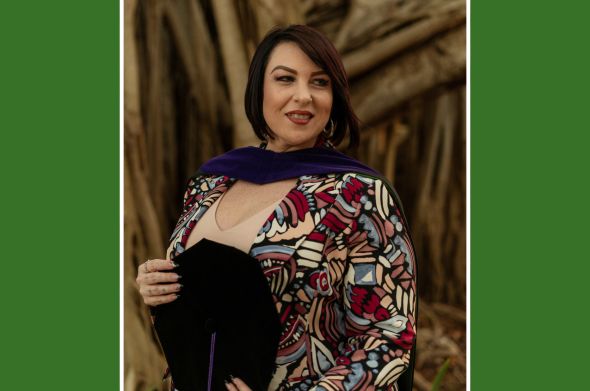
A photo of a woman holding her graduation cap in front of a Banyan tree.
Stetson Law alumna Leah Burnett ’24

From an early age, Leah Burnett ’24 knew she wanted her life’s work to be advocating for social justice.

It is what led her to support underserved youth as an educator and to work with adult immigrants and refugees as part of various English literacy programs.

What she experienced only made her want to do more.

“This work opened my eyes to the challenges that immigrants in the U.S. face and the need for passionate advocates,” she said. “Although I decided to make a career change, my desire to make an impact in the lives of others is still ever-present.”

As a student at Stetson Law who was part of the Social Justice Advocacy Concentration Program, she set out to gain legal experience by working at immigration law firms that provide removal defense to those seeking immigration relief. The experience has since led to her being chosen for a prestigious fellowship with the nonprofit the Immigrant Justice Corps.

“I want to be a part of the efforts to protect the rights of vulnerable immigrants and represent their legal needs as they navigate through the challenges of the immigration system,” Burnett said.

A multi-year endeavor

Those chosen for the fellowship will put their passion and legal skills to work at nonprofit immigrant legal services providers and other community-based organizations throughout the nation over a two-year term. They will help these organizations provide free legal assistance to low-income immigrants who need help navigating legal matters related to immigration, such as removal defense and applications for those fleeing persecution.

Starting September 1, Burnett will serve as a staff attorney with Florida Legal Services’ Immigrant and Migrant Rights Project, wherein she will work on the Unaccompanied Children’s Project.

Burnett said she is thrilled to get started.

“I believe my compassion for marginalized populations will make me an asset, as well as a zealous advocate for those in need of defense,” she said.

Pressing issue, national effort

In all, the total number of incoming fellows in 2024 exceeds 130. To IJC leadership, these early-career lawyers will be part of the next generation of legal professionals working in the growing immigration law space. According to the organization, there are over 3.6 million pending cases in immigration, including those of hundreds of asylum seekers who may be deported back to a country where they face persecution and danger.

“This class will expand IJC’s reach nationwide, level the playing field, and bring relief to immigrant communities,” said Jojo Annobil, chief executive officer of IJC. “Together, our Fellows are transforming immigrant lives and advocating for a just immigration system.”

The IJC was brought about thanks to the late Judge Robert A. Katzmann of the U.S. Court of Appeals for the Second Circuit as well as the Robin Hood Foundation, which in 2014 incubated the organization. The IJC works to identify early-career legal professionals who show great promise in the area of immigration law, places them within organizations where they could have the most impact, and offers support like coaching and other resources in the fellows’ day-to-day work.

So far, over 400 IJC Fellows have worked on cases involving more than 100,000 low-income immigrants.

Learn more about the IJC fellowship program.

Recent Grad Wins Federal Bar Criminal Law Section Award

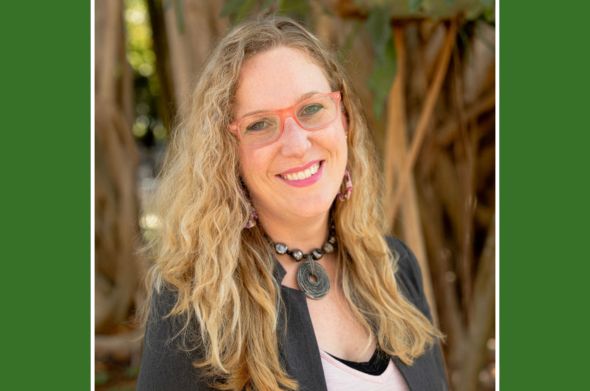
A woman with glasses and long blonde hair smiles. A banyan tree is in the background.
Stetson Law Alumna Ana Gabrielle Geiger ’24

On the heels of graduating from Stetson Law in May 2024, alumna Ana Gabrielle Geiger got even more great news: she is one of three winners of this year’s Federal Bar Association Criminal Justice Section Award.

Given annually, this prestigious national honor includes a $1,500 scholarship award. Recipients are graduating law students who have shown promise in their pursuit of a career in criminal law serving in the public interest. Section officials said Geiger’s application stood out clearly from the others. “You should be very proud,” reads a congratulatory message addressed to Geiger from attorney Madison Bader, chair of the Federal Bar Association’s Criminal Law Section. “We received many applications from very well-qualified and terrific candidates from across the country. Your hard work and dedication was very apparent.”

Inspired by pursuit of justice

For Geiger, her time in law school was an opportunity to steep herself in the U. S. Criminal Justice system – so much so that she says her studies transformed into a “healthy obsession.”

She took a dozen courses outside Stetson Law’s core J.D. curriculum, from Criminal Procedure Investigation to the summer Law and the Civil Rights Movement travel course. During the summer before her 2L year, she voraciously read titles like Bryan Stevenson’s Just Mercy and Richard Rothstein’s The Color of Law, among others. She subsequently applied for – and was admitted to – Stetson Law’s Social Justice Advocacy concentration.

Geiger didn’t start law school knowing her path.

What opened her eyes to the disproportionate impact the criminal justice system can have on underserved populations was pro bono work with a driver’s license clinic offered to Stetson Law students through the Sixth Judicial Circuit’s Public Defender’s Office. She saw how offenders’ loss of driving privileges can have deep social and economic consequences that can lead to more criminal behavior.

Even more experience came through her participation in the public defender clinic in fall 2023. That December, she helped try two cases.

“Defending someone accused of committing a crime is one of the more rewarding joys in my life so far,” she said. “Everyone has a story, and everyone that takes part in criminal conduct or gets criminalized deserves to be treated with humanity and respect.”

Geiger continued to work for the public defender’s office as a Certified Legal Intern, but has since accepted a position as an Assistant Public Defender.

“The most fulfilling part of my job is connecting with clients and helping them,” Geiger said. “I do little things each day that change individual lives; I cannot ask for a better career, because I have found what I am meant to do.”

Recognition on campus

Those who observed Geiger’s work while she was at Stetson Law recall an exceptional student capable of an impactful career.

She received the Paul Barnard Award for Clinic Excellence, the William F. Blews Pro Bono Service Award, and the Student Leadership Development Certificate.

“It is wonderful to see Gabrielle Geiger win this prestigious award for her past and future work in making a difference in the lives of individuals within the criminal justice system,” said Law Professor Ellen Podgor. “Her enthusiasm and hard work are an inspiration to us all.”

Learn more about the Federal Bar Association Criminal Law Section.

Lawyer, Doctor, Exemplary Alum: See What Motivates Zayn Mohamed ’18

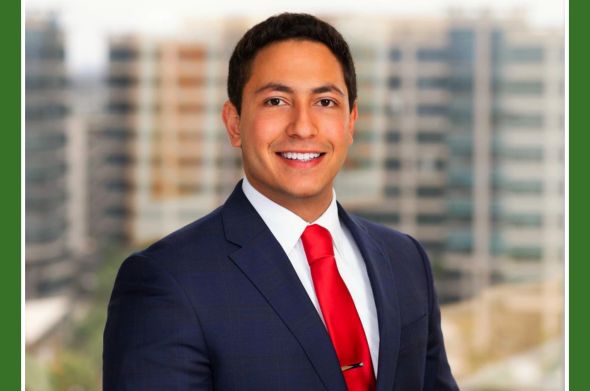
A young man with dark hair wearing a suit and tie smiles for the camera.
Zayn Mohamed, J.D. ’18; M.D. ’22

Ask nearly any ambitious youth what they want to be when they grow up, and you’re likely to get one of two answers: lawyer or doctor. It seems rare that one would say they want to do both.

Then there’s 2018 Stetson Law alumnus Ahmed-Zayn Mohamed, who is both. A lawyer, doctor, triathlete, and accomplished pianist, he tends to excel at whatever he does.

Mohamed enrolled at Stetson in 2016 after becoming the youngest person to graduate from University of South Florida not only at the age of 18, but in just three years with a dual degree (B.S. in biomedical sciences; B.A. in political science) and a 4.0 grade point average. He graduated from Stetson Law in December of 2018, a semester ahead of the traditional J.D. schedule – as valedictorian, no less. He received the prestigious Edward D. Foreman Most Distinguished Student Award for spring 2019 and was a top Florida bar exam scorer. He went on to earn his M.D. from University of South Florida (USF) Morsani College of Medicine in 2022.

Driven from an early age

Born in Cairo, Egypt, Mohamed came to the U.S. with his family as a child. His ambitious life and career goals were heavily influenced by his faith – he often cites a driving factor of Itqan Al Amal, an Arabic term and concept from Islam insisting that when an individual chooses to do something they   must do so to the best of their ability. He also heavily credits not only his mentors, but his dear mother and close-knit brothers who have supported him endlessly throughout his endeavors.

When he graduated from USF, he told WUSF that the 2011 Arab Spring and Egyptian revolution were influential in his decision to pursue a law degree, as was the idea that he could help society progress through his own work.

“That’s been a core motivator since before school,” he said. “But it’s stayed with me since.”

An exemplary law student

Now a Tampa-based patent attorney at Carlton Fields specializing in medical technology, Mohamed said he finds his work compelling – and that he credits Stetson Law with helping him find a career path about which he could be passionate.

“Stetson definitely was life-changing for me,” he said. “I love the school, the family environment, the world-class professors, and the student community.”

Mohamed’s introduction to patent law came from a property law course he took with Professor Kristen Adams, which had a section on intellectual property that piqued his interest. This led to working with Associate Dean Darryl Wilson as well as patent externships with USF and Moffitt Cancer Center.

It is an area of law at the crux of his two chosen professions, one that continues to evolve as technology’s role in healthcare continues to grow.

While at Stetson Law, he was a member of the Dispute Resolution Board and part of the team that competed in the Willem C. Vis International Commercial Arbitration Moot, which culminates each year in Vienna.

Professor Joseph Morrissey, one of that team’s coaches, remembers Mohamed as “one of our best advocates ever,” adding that he brought unmatched enthusiasm to competition preparations.

“In addition to phenomenal advocacy skills, Zayn composed and directed a music video showcasing his advocacy team’s preparations,” Morrissey said. “The video, named “Together,” won first prize as part of a secondary competition the Vis moot had that year to commemorate its 25th year. The video was met with thunderous applause in the historic Concert Hall in Vienna on the opening night of the competition – a night none of us who were there will ever forget.”

Balancing it all out

With such a long list of achievements, it could be hard to imagine someone like Mohamed having time to decompress – but over the years he says he’s managed the stress through activities like swimming and piano. Early in his career, a mentor gave him two pieces of advice he took to heart. The first was to stop and smell the roses.

The second? Find ways to help others succeed, such as offering professional experience to students and service through clinics.

“In anything anyone does, there’s always a way to pay it forward,” he said.

A 2024 Snapshot of LGBTQ+ Inclusiveness at Stetson Law

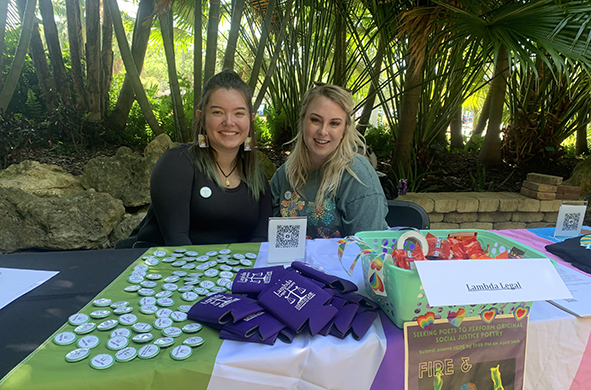
Members of Stetson Law’s Lambda Legal Society table at an event on campus.

As Pride Month 2024 kicks off, Stetson Law celebrates the LGBTQ+ community on campus and beyond. From effective strategic initiatives for increasing LGBTQ+ student enrollment to partnering with local organizations that serve the community, here are some recent ways College of Law students, faculty, and staff have supported and enhanced the LGBTQ+ community.

A newly endowed Lambda scholarship

Last fall, Lambda Legal Society, the LGBTQ+ student organization on campus, celebrated the full endowment of its Pride Scholarship, which will allow exceptional LGBTQ+ students to focus on what is most important: preparing for a long meaningful legal career. It was the culmination of a multi-year effort that included lively fundraising events featuring legislative updates and drag performances.

Continued recruitment & support of LGBTQ students

For years, campus leadership has walked the walk when it comes to recruiting and retaining LGBTQ+ students, equipping them with the tools they need to advocate for the community in meaningful ways as legal professionals and engage with the broader LGBTQ+ community. Telling prospective students “You Belong Here,” admissions officials actively invite members of the community from around the nation to consider Stetson Law for their legal education.

The result is a diverse, thriving community of students eager to explore the law through an LGBTQ+ lens. Self-identified LGBTQ+ students made up five percent of the fall 2023 entering class.

Once they matriculate, a welcoming, supportive community awaits them.

Elevating LGBTQ+ faculty and curriculum

Mentorship is woven into the culture at Stetson Law, where LGBTQ+ students can learn from professors to whom they can relate, from longtime Professors Joseph Morrissey and Ellen Podgor to newer faculty like Professor Em Wright.

A headshot of a man in a suit jacket and plaid shirt smiling.
Law Professor Joseph Morrissey

The course catalog invites students to explore ways in which the law shapes the LGBTQ+ experience and vice versa through courses like Law and Sexual OrientationHuman Rights in International Family Law, and Civil Rights and the Constitution: DOMA/Marriage.

Creating visibility for the community on campus

Since it launched, Stetson Law’s chapter of Lambda Legal Society has become a vibrant and integral element to campus culture – from tabling at events to raising the Progress Pride flag at the start of every Pride Month since 2021.

Lambda Legal Society
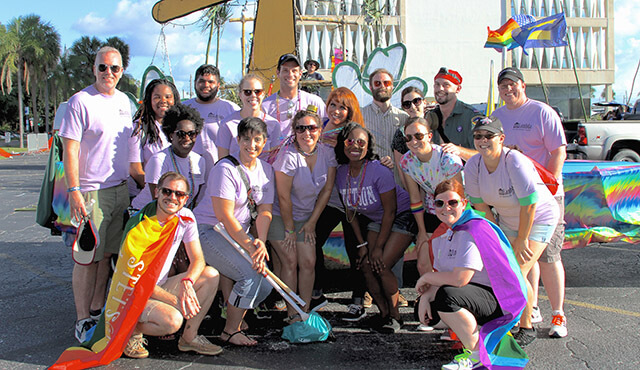
Lambda Legal Society values engaging with the greater community through events like St. Pete Pride.

In November of 2023, Lambda organized a gathering to raise Trans Pride flags for Transgender Day of Remembrance and Transgender Awareness Week as well as a display commemorating the lives of transgender individuals lost to violent acts targeting them for their identities.

National, regional, and local recognition for LGBTQ+ initiatives

Stetson Law’s commitment to inclusiveness is so robust that it has garnered national, regional, and local recognition from a variety of organizations, including:

  • The Association of American Law Schools Section on Sexual Orientation and Gender Identity Issues’ 2024 LGBTQ+ Inclusive Excellent Award
  • The Tampa Bay Business Journal’s 2024 Business of Pride award (Company category)
  • OUT Arts & Culture (formerly the City of Gulfport LGBTQ Resource Center) gave Stetson Law its inaugural “OUTie” Award in the education category for its allyship
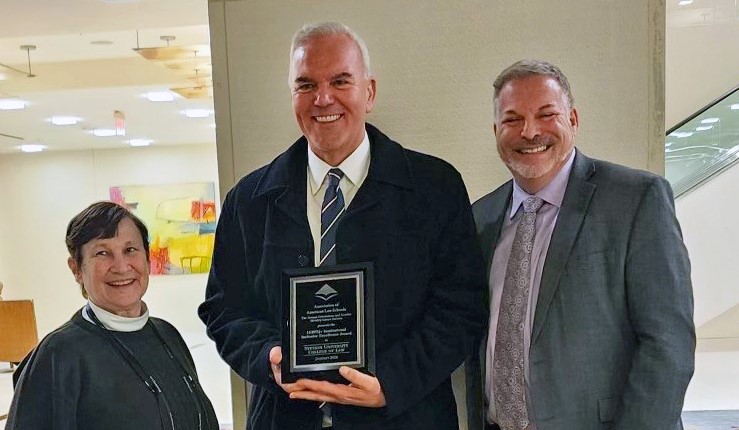
Two professors and one administrator show off an award from the Association of American Law Schools
Left to right: Law Professor Ellen Podgor, Admissions & Student Financial Planning Director Darren Kettles, and Associate Dean of Academic Affairs & Professor of Law Jason Palmer celebrate Stetson Law winning an Association of American Law Schools’ LGBTQ+ Inclusive Excellence Award in January 2024.

The celebration continues

Later this month, the community is invited to join Stetson Law and Lambda in taking part in St. Pete Pride festivities, including the night parade along Beach Drive on Saturday and the street fair the following day in the Grand Central District. See a full list of events and register.

Stetson Law Celebrates Spring 2024 Commencement

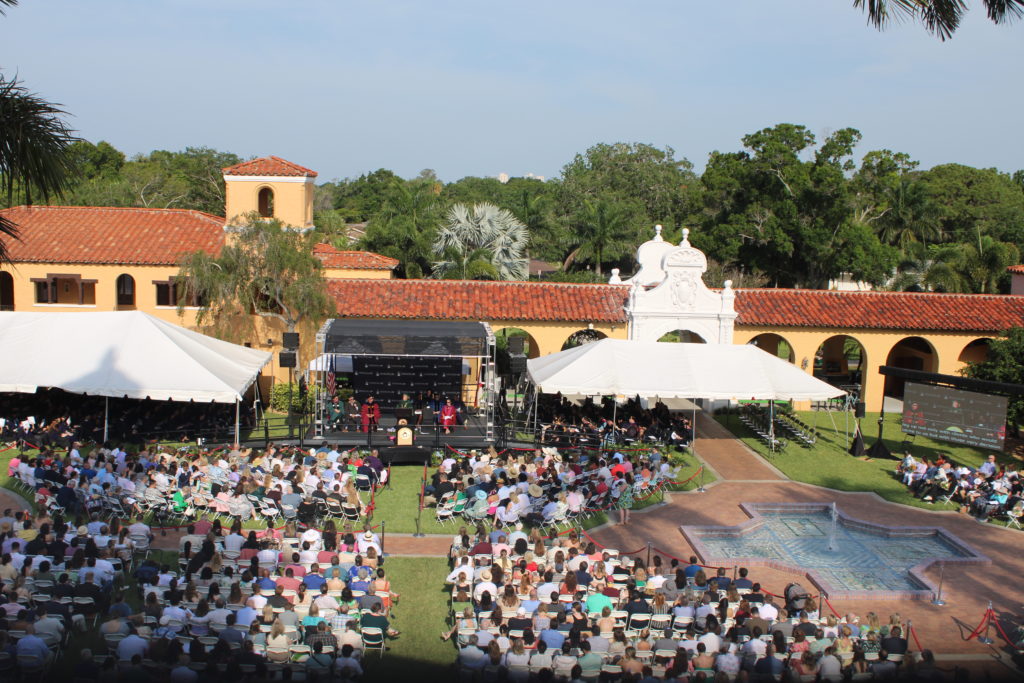
An aerial shot of a large courtyard and stage where hundreds of people are gathered for a graduation ceremony.
A shot of Stetson Law’s Spring 2024 Commencement ceremony from the Tower.

During a sunny morning ceremony in the Plaza Mayor Courtyard, nearly 300 Stetson Law students officially became Stetson Law alumni.

Beginning and ending with the sound of bagpipes heralding the processional, the event invited grads to reflect on their time at Stetson Law, thank the loved ones who supported them, and look ahead to the next leg of their professional and personal journeys.

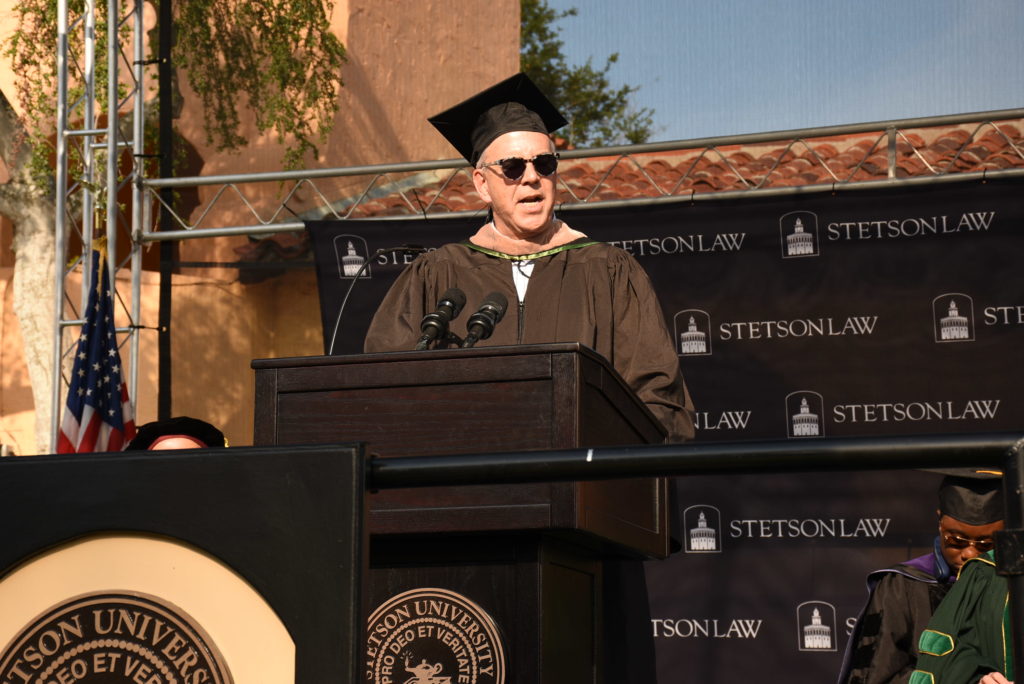
A man wearing sunglasses and a cap and gown speaks at an outdoor graduation ceremony.
Steven Alexander, Chair of the Stetson University Board of Trustees.

“I know that when you entered Stetson, when you decided to study law, you came here to discover what is best about the College of Law and what is best about you,” said Steven Alexander, Chair of the Stetson University Board of Trustees. “For some of you it was to find out if you had what it takes to become a lawyer. Well, look at you now… And then look around you at the faculty…family and friends with you today, because nobody gets to take this journey alone, and that is what makes Stetson special: faculty and staff that care about you and your success.”

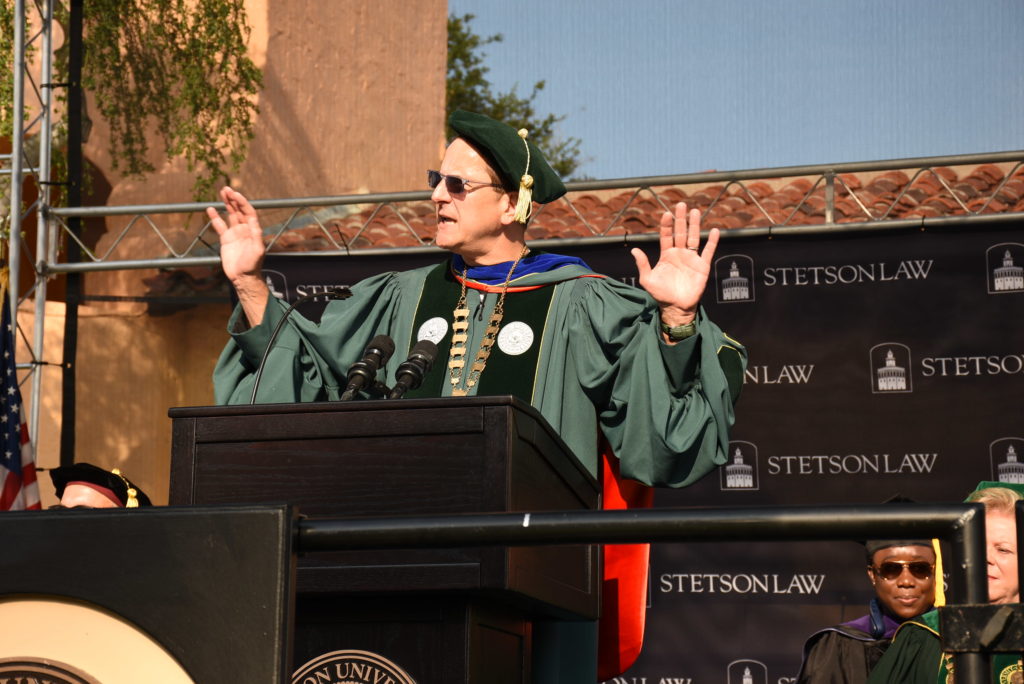
A tall man in a green robe speaks expressively at a podium
Stetson University President Christopher Roellke speaks at Stetson Law’s Spring 2024 Commencement.

Stetson University President Christopher Roellke asked the graduates to show kindness and empathy in all they do.

“Here at Stetson, you have learned the law and the skills required to apply it to legal practice with integrity and professionalism,” Roellke said. “As you grow and thrive, I challenge you to help those around you to thrive, to offer small acts of kindness and empathy to your clients, partners, institutions and organizations.”

Hard work through trying times

The Spring 2024 class matriculated at Stetson Law amid a pandemic as well as significant shifts in the conversation around law and justice – something speakers addressed head-on in their remarks.

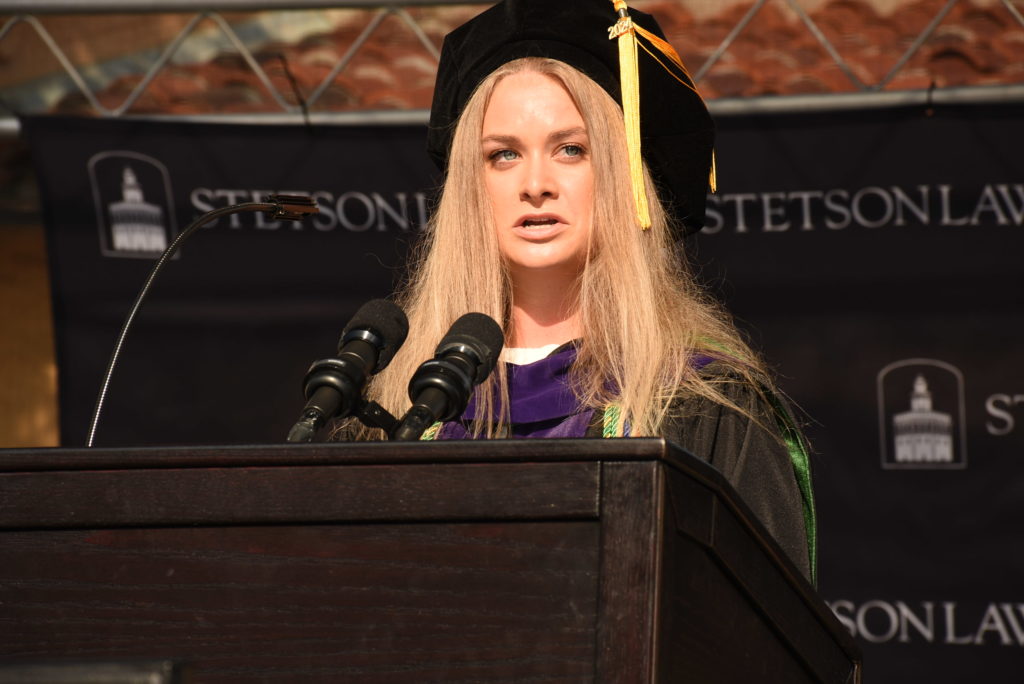
“As a class, we persevered through trying times socially, physically, and mentally,” said Victoria Benson, 2023-2024 President of the Calvin A. Kuenzel Student Bar Association. “Through these hardships and trying times, we have persevered and overcome. We’ve clung tight to our unwavering supports and forged through our uphill battles. Even in the most difficult times, each of us has carried on. And we did not carry on to mere mediocrity. We persevered into success and achievement, and now we stand before our friends and family as law school graduates.”

A close-up shot of a young woman with long blonde hair wearing a cap and gown as she speaks at a graduation ceremony.
Victoria Benson, 2023-2024 President of the Calvin A. Kuenzel Student Bar Association, delivers moving remarks at the Spring 2024 Commencement ceremony.

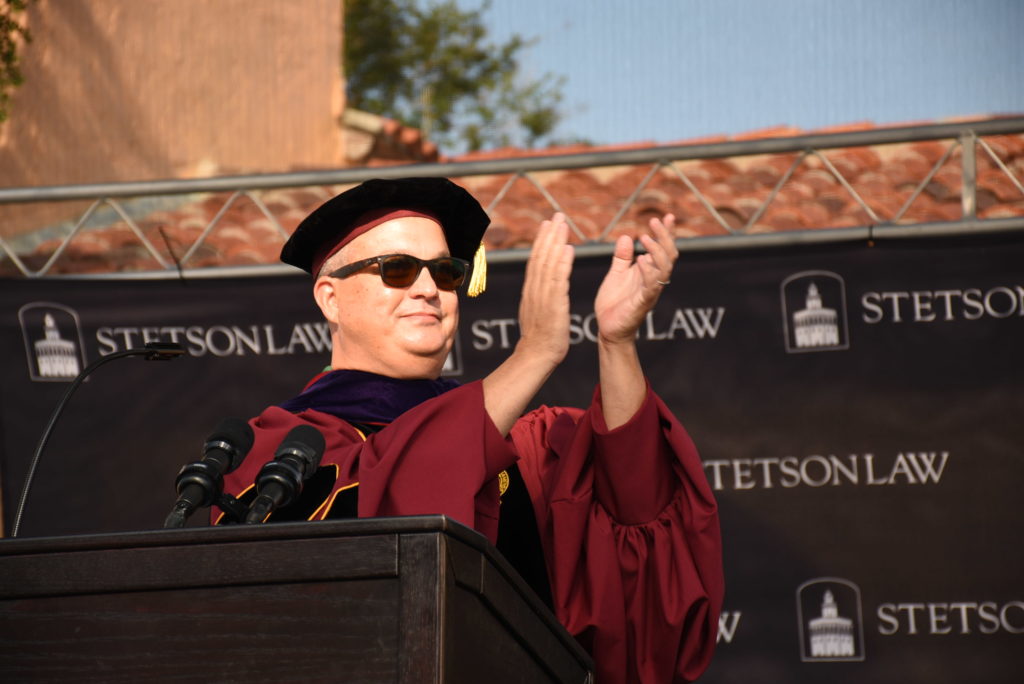
Stetson Law Dean Benjamin Barros commended the class for their commitment to serving the community despite the challenges.

A man wearing a red ceremonial robe, a black cap, and sunglasses claps his hands behind a podium during a graduation ceremony.
Stetson University College of Law Dean Benjamin Barros

“Each of you have done a significant amount of pro bono work during your time at Stetson Law. Together, our graduates volunteered more than 20,000 hours of community service,” Barros said. “My hope is that in doing this work you experienced the joy that service can bring and will continue to seek out pro bono work not as an obligation, but as something that you desire to do.”

Stetson Lawyers Alumni Association President, Brittany Maxey-Fisher told the students that their new law degrees will allow them to work in a variety of ways – and asked them to use their legal skills in a way that will make the world a better place.

A woman with dark hair speaks at a podium during a graduation ceremony
Stetson Lawyers Alumni Association President Brittany Maxey-Fisher ’07

“In a world that is constantly changing, where new challenges emerge as the sun rises daily it is up to each of you to be beacons of hope, champions of justice, and voices for the voiceless,” she said. “Whether you choose to practice law in the courtroom, advocate for policy change, or pursue a career in academia, the power to affect positive change lies within each of you.”

A keynote from an accomplished alumna

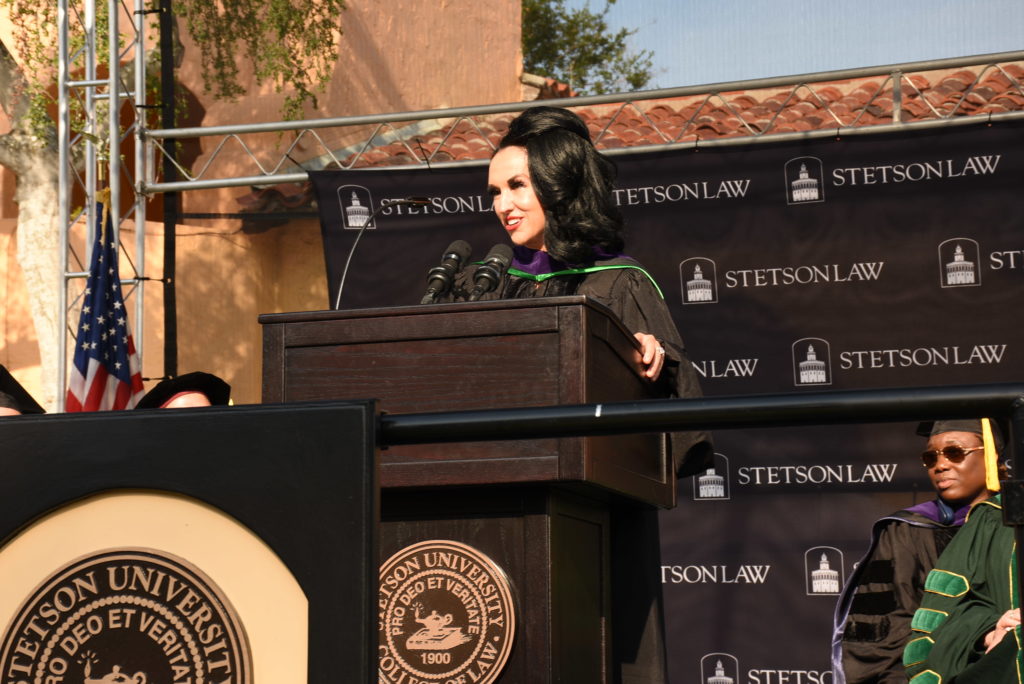
The spring 2024 commencement speaker was University of South Florida President Rhea Law, who earned her J.D. from Stetson Law in 1977 and went on to serve on the University’s Board of Trustees and Board of Overseers. Prior to the start of her remarks, Law was given an honorary Doctor of Laws.

Law reflected on her time at Stetson Law and the impact it had on her life and career.

A woman with short hair wearing a green graduation ceremony robe and cap stands behind a podium and delivers a speech.
University of South Florida President and Stetson Law alumna Rhea Law ’77

“In a way, it’s coming home,” Law said. “It’s coming home to this great campus, and this great faculty and staff. By the way, I’ve had a lot of mentors and champions in my life, but some of the greatest were the faculty and staff right here at Stetson University College of Law.”

She told the graduates they will be joining a cohort of thousands of alumni who graduated as full-fledged, practice-ready lawyers – something not lost on her when she was in private practice.

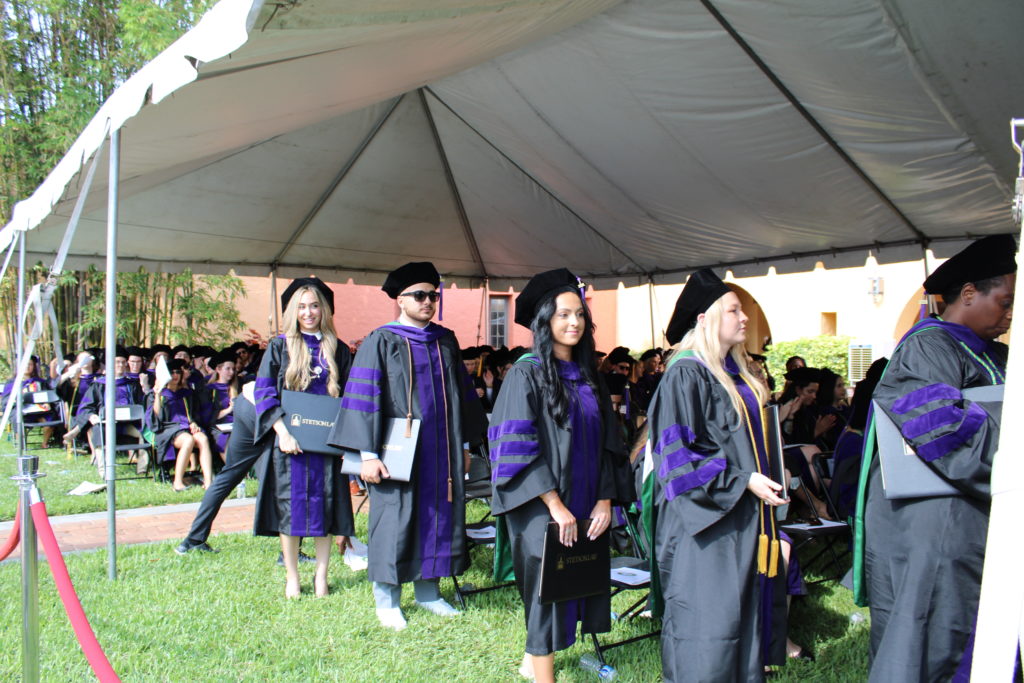
A group of students in black and purple robes and black caps stand in line waiting to walk across the stage during spring 2024 commencement.
Nearly 300 students walked across the stage during Stetson Law’s Spring 2024 Commencement ceremony.

“During my years of leading my law firm, I can always tell you that when a Stetson graduate would come to apply for a job, I knew right away that that person was well suited for the practice of law,” she said. “They were ready for the rigors that would come before them. I knew that they would be trustworthy. I knew that they would have the right kind of background. And because of that, I will tell each of these graduates: you have chosen well by coming to Stetson University College of Law, because they have prepared you and you are going to be very successful.”

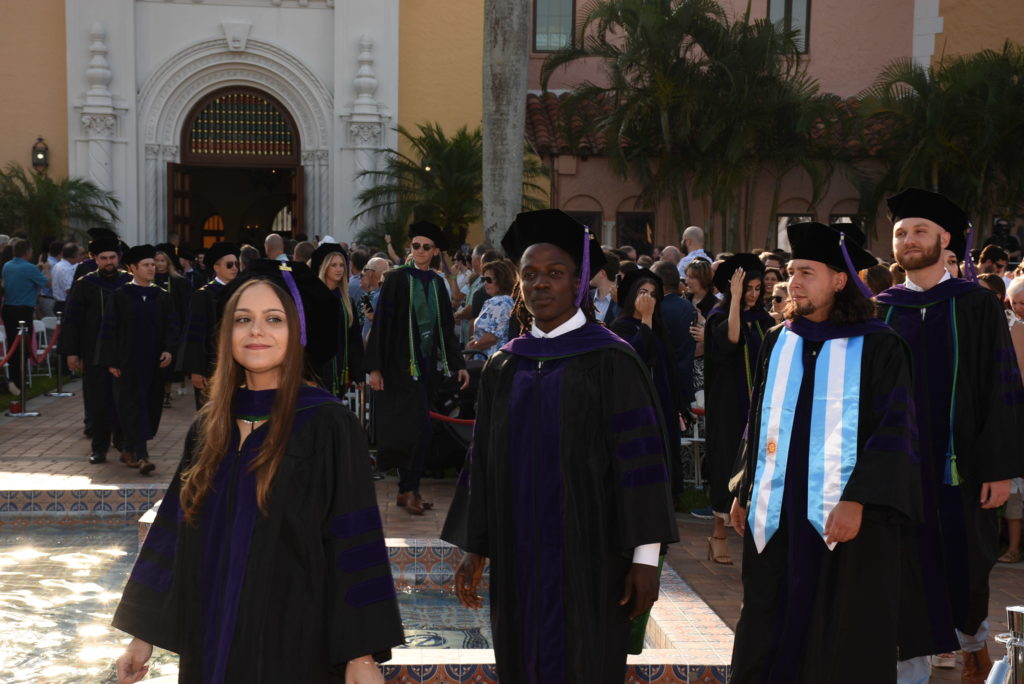
Three young people in graduation caps and gowns stand in a courtyard right after graduating from law school.
Students walk into the Plaza Mayor during Stetson Law’s Spring 2024 Commencement on May 18, 2024.

She urged the graduates to “always remember your why” as they navigate their careers – and never to back down in times of uncertainty.

“Always believe in yourself,” she said. “And when the doubts come, double down and bet on yourself.”

Honors & Awards Ceremony Celebrates Exceptional Grads

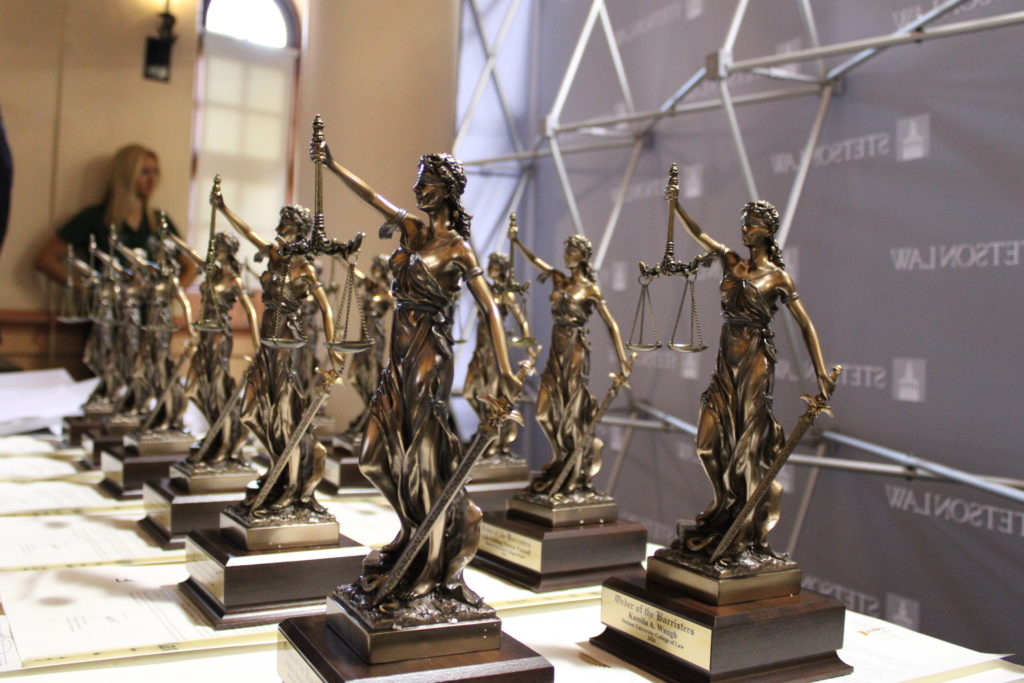
A group of small bronze statues depicting Lady Justice
The Class of 2024’s highest-achieving students were recognized for their exceptional work.

On the eve of the Spring 2024 Commencement, members of the Stetson Law community gathered in the Great Hall to recognize the graduates who went above and beyond during their time in law school.

The event honored those who excelled in their studies, participated in an academic journal, distinguished themselves via the Honors Program, gained professional experience through a clinic or externship, exceeded the minimum pro bono hours requirement, or grew their advocacy skills in the competitive arena via the Dispute Resolution Board, the Moot Court Board, or the Trial Team.

College of Law Dean Benjamin Barros commended the students for seizing on opportunities to develop leadership skills and exceeding the inherently rigorous expectations of law school.

“Law school not only teaches you to be a lawyer — it also teaches you to be a leader,” Barros said. “Not only have you defined yourselves as leaders who are dedicated to justice and public service, you have also defined yourselves as leaders with stellar academic achievements.”

Recognizing a challenging time

Those honored included students who graduated in December of 2023 and May/August of 2024 – a cohort that started law school amid a global pandemic, shifting conversations about justice, and a mental health crisis affecting many students.

Stetson University Provost Elizabeth Skomp commended the students for excelling despite these additional layers of challenge.

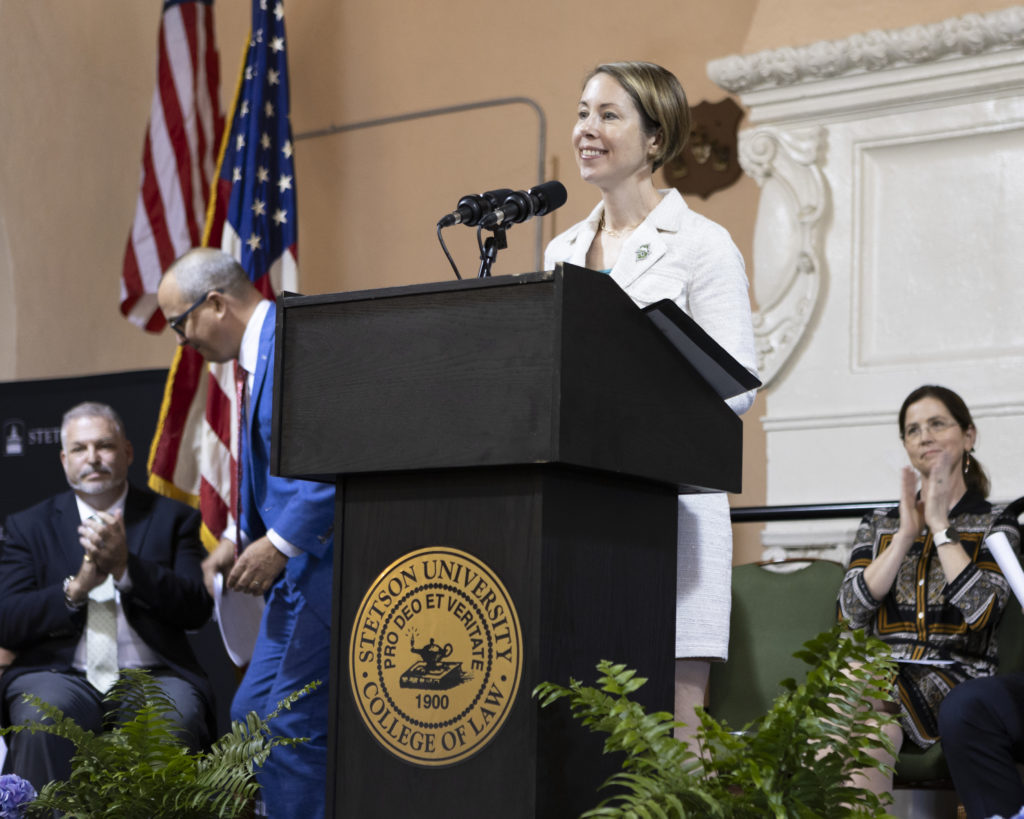
A woman in a white skirt suit stands at a podium.
Stetson University Provost Elizabeth Skomp addresses the honorees at the 2024 Honors & Awards Ceremony.

“Your faculty members have selected you as honorees thanks to your academic excellence and achievements,” Skomp said. “Not only have you distinguished yourselves; you’ve done so and shown bravery and resilience in the midst of these unusual, unpredictable, and challenging last few years. And for that, I believe you deserve double the congratulations.”

Exceptional Public Service

While the number of hours the class of 2024 spent working on journals, volunteering, and preparing for competitions could be impossible to quantify, honors for exceeding Stetson Law’s pro bono service requirement are attached to a number.

Named for Stetson Law graduate and Hall of Fame member, the William F. Blews Pro Bono Service Awardsrecognizes three students in each class who have performed the most pro bono hours – at least 120, which is double the requirement. 

Of all the honorees, Spring 2024 grad Olivia Urban had the largest share, with 414 total hours of public service performed.

High achievement, top awards

The event culminated with the announcement of Stetson Law’s three most prestigious awards.

Honoring the graduating student who has shown the greatest promise of becoming an outstanding leader in the legal profession, the Walter Mann award was given to Victoria Noel Benson.The recipient of the Dean’s Excellence Award, presented each year by the dean to a student for extraordinary service to Stetson Law, was Rylie Ashling Peyton Pennell.

Finally, 11 past recipients of the top honor, the Edward D. Foreman Most Distinguished Student Award, gathered to celebrate the award’s newest honoree, Cameron Kubly.

The award comprises $5,000, a crystal trophy, and the name of the recipient cast in bronze on a plaque prominently displayed at the entrance of the Great Hall.

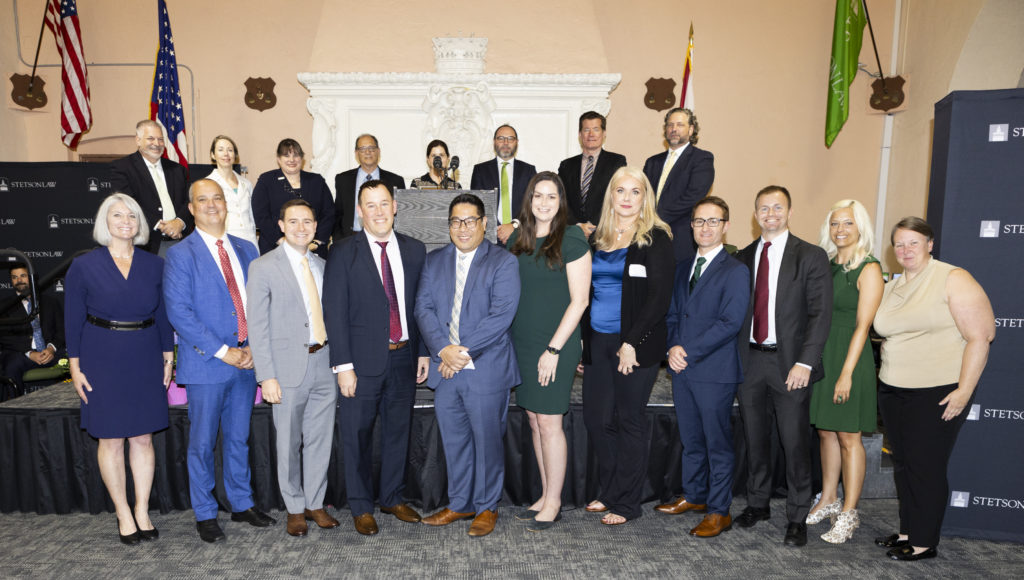
A group of nearly 20 individuals dressed in professional wear stands in front of a stage.
Campus leadership joins recipients of the the Edward D. Foreman Most Distinguished Student Award for a photo op.

Citing such achievements as receiving the highest grade in 11 classes, serving as editor-in-chief of the Stetson Law Review, working as a federal judicial extern to the Honorable Charlene Honeywell, and acting in theatre productions such as freeFall’s God Bless You Mr. Rosewater, past recipients Andrew Chiang and Aleks Jagiella-Litts presented the award to Kubly.

In his brief acceptance remarks, Kubly thanked his family, particularly his wife Emma, faculty members, and his classmates.

“As I look out on this group, I am very proud to call all of you – my colleagues and hopefully to call many of you my lifelong friends,” Kubly said.

Pathways to Justice Academy, A Teen Civic Engagement Course, Seeks Applicants

A group of students in a practice courtroom at Stetson Law
Participants in the 2023 Youth Civic Engagement Program pose with alumni.

Stetson University College of Law is launching the 2024 Pathways to Justice Academy- A Youth Civic Program. Organizers seek applicants for the program, which is set to take place over 5 days in July, from July 15-19.

Students in the Pinellas County, Florida area who are aged 15-17 are eligible and encouraged to apply, including those who identify as underrepresented due to race/ethnicity, sexual orientation, gender identity, socio-economic status, and other underrepresented identities. The program empowers students with the tools and skills they need to foster positive change in their communities and the world at large through in-depth lessons in local government, social justice advocacy, and community engagement. The deadline to apply is Monday, June 17.

Organizers say they felt the need for such a program in the wake of deep cuts to civics education in public schools, which can have a profound effect on public policy and justice. In partnership with Community Tampa Bay’s acclaimed ANYTOWN® Advocacy Academy Program, Stetson Law will continue to engage with and mentor interested participants throughout the 2024-2025 academic year.

“As a steward of legal education and the principles of justice, Stetson Law is uniquely positioned to empower local high school students to learn about and advocate for civil discourse and human rights through our societal structures – structures that they engage with every day,” said Carmen Johnson, Stetson University’s Executive Officer of Diversity, Collaboration, and Inclusion. “We’ve found that students throughout our local communities are passionate and eager to connect around these concepts.

There is no cost to take part in the program; those chosen will be paid a small stipend.

Inspiring future changemakers

This year’s events will take place both in-person and virtually. Participants will attend classes on Stetson Law’s historic campus, where they will interact with faculty, local attorneys, judges, and other professionals.

This type of initiative is an important component of our greater university’s commitment to promoting social responsibility and community engagement” Johnson said.

Last year’s program was a remarkable success. Among key takeaways for alumni were the value of voting, the importance of human rights, and how to engage in civil debate.

Kuiper Elza, a student from St. Petersburg High School who participated in the program in 2022, said they learned new ways to be an activist.

“I found it really interesting to learn different tools for how to be an activist and advocate for yourself and communities – and different ways you can educate yourself, educate other people,” Elza said.

What the Youth Civic Engagement program looks like

Law Professor Christine Cerniglia has led several modules within the academy. One included an activity featuring a hypothetical “island” where students built a society from the ground up.

“They took off with it,” she said. “It was awesome.”

Other modules she led were “Human Rights and Global Citizenship” and “Mindfulness and Civil Dialogue.”

Law Professor Judith Scully led “Advocacy, Activism and Social Change,” which introduced students to the critical role young people play in social progress. It stressed the importance of voting and showed students how to be better advocates.

“Students really believe that when they’re ‘right,’ they need to get their point across,” she said. “I think that when they learn that the point of advocacy and the point of activism is to get other people to understand their position – not to be ‘right,’ not to ‘win,’ but to actually help others understand the issues, I think that was a big ‘aha’ moment for many of them.”

The program will take place July 15-19 between 10:00 a.m. and 3:00 p.m. Prospective participants are invited to complete this application by Monday, June 17.

An INN-ovative Approach to Acclimating Students

A collage of images from the fall 2023 orientation
A new approach to orienting 1L students offers a variety of immersive activities to help students acclimate to law school life.

For 1L Christian Sweeney, who earned his undergraduate degree from a small liberal arts college, being part of a close-knit community is integral to his academic success.

Sweeney was part of Stetson Law’s inaugural “Inns” program for 1Ls. Modeled after the English Inns of Court – wherein seasoned legal professionals, scholars, students, and prominent visitors lived, worked, and dined together – the program connects new students with mentors, opportunities, and one another via small groups of students led by a faculty “Bencher” and supported by upper-class “Readers.”

A man and a woman sit on stage while students dine at several tables.
In April 2024, the Podgor, Adams, and Boudreaux Inns heard from the Honorable Mary Scriven, District Court Judge on the United States District Court for the Middle District of Florida, and Lanse Scriven, a local attorney.

As Law Professor Tim Kaye – one of the inaugural Benchers – put it, the program is a way of “training law students by osmosis.”

Part of an Inn led by Law Professor Kristen Adams, Sweeney said the program was an opportunity to interact with classmates and professors in a low-pressure setting before the rigors of life as a full-time law student took hold.

“The transition from undergrad to law school would not have been nearly as easy without the help of my peers, mentors, and Professor Adams,” Sweeney said.

A fresh approach to student development

The program’s genesis is twofold: leadership’s recognition of the need to create a greater sense of belonging for students after the pandemic and the American Bar Association’s new accreditation criteria requiring law schools to offer more opportunities for development of a professional identity.

College leadership did not want to simply create a compulsory course in professional development for 1Ls – as many law schools have. Instead, an opportunity for a more holistic approach emerged.

“Transformation is hard work, and it requires a lot of introspection, exploration, and vulnerability. As a result, we knew that our response had to promote a deep sense of belonging and truly authentic engagement,” said Associate Dean for Assessment and Professional Engagement Anne Mullins. “With the Inns, we created a dynamic in which the students felt connected to each other, to their upper-level Readers, and their faculty Bencher.”

A group of students stands in a large circle to practice a relaxation exercise.
In April 2024, the Kaye Inn participated in interactive activities designed to reduce stress and foster resiliency. The activities were led by local American Stage Teaching Artist Marguerite Boissonnault.

Students joined their Inns at orientation, and events took place throughout the year. Both part- and full-time students took part. After orientation, students could choose to engage in Inn activities they found useful to them based on where they were in their professional identity formation journey.

For his Inn, Professor Kaye organized a variety of presentations and activities, all aiming to promote critical attributes like resiliency, self-reflection, and a deeper absorption of what it means to be a part of the legal profession. This included a presentation by an alumnus who discovered the murder of his staff attorney and video featuring a rock band from Mexico consisting of three sisters who achieved global success despite predatory behavior and other challenges within the music industry.

To Kaye, the experience seemed to help 1Ls gain clarity during a critical point in their legal education journey.

“The message throughout the year has been simple,” said Kaye. “If they take good advice, develop their skills, and work hard in collaboration with others, the students can achieve great things.”

Students sit at tables in the Great Hall laughing and talking with professors.
In April 2024, the Vaughan Inn and Nagle Bowman Inn participated in a game of “Stump the Readers” in which the 1Ls asked the upper-level student mentors (“Readers”) questions about law school.

While Stetson Law has always been a close community where mentorship is woven into life and culture, the Inns program’s organizers believe it will set students up for success like never before.

“Support matters for mental health and wellbeing, and it also matters for their academic experience in the first few months of school,” Mullins said. “I think students got a lot out of their Inns, and I am excited to watch the Inns develop.”

The numbers suggest the program is already effective. According to an informal survey taken after Fall Orientation, 97 percent of students said they “started building community during orientation” – up from 54 percent in prior years. Meanwhile, 94 percent of students said they had at least one upper-level student they could reach out to and 96 percent said there was at least one faculty, staff, or administration member they felt comfortable reaching out to. In prior years, those percentages were 55 and 33 percent, respectively.

A chart illustrating the results of a survey of students in response to the fall orientation.
An informal survey of 1L students after orientation suggests that more immersive programming gives students a greater sense of belonging.

More reflections on the new Inns program for 1Ls

  • “I wanted to serve as an Inn Bencher because working with our students and talking with them about their professional plans and aspirations is my favorite part of being a law professor.  My favorite memory from this year was the field trip that our Inn sponsored to the Florida Holocaust Museum, where we received a private tour from Michael Igel, Chair of the Board for the FHM and a local attorney with a powerful personal narrative to share.” Law Professor Kristen Adams, Bencher
  • “I thought the program was impactful considering that it was the first time being implemented at Stetson; I’ve met people who have since become great friends.” – Emily Alan, Part-Time 1L (Podgor Inn)
An elder man speaks to a group of over 30 students whose chairs are arranged in a semicircle in front of him.
Dean Emeritus Bruce Jacob visited with the Podgor and Adams Inns in October 2023.
  • “Being a part of the Vaughan Inn as a first-generation college and law student has allowed me to connect with second- and third-year students who were in the same shoes as me. Professors Vaughan and Bowman have created such a welcoming and uplifting environment even in the midst of appellate briefs by having us come to Inn dinners. Even the mentors that were not my leaders have taken part in checking in on me and making sure I know that no question is dumb. It’s something that I have found is unique to Stetson and the positive environment that this school is known for.” – Adriana Louth-Ciaccio, Full-Time 1L (Vaughan Inn)
  • “Stetson has always provided a caring community for our students. The Inns went a step further in making that community more accessible for 1Ls… The Inns help us to connect the dots of many aspects of a legal education. From the initial struggle of learning a new language – law, to recognizing bias in interactions with others, to understanding the new profession that they are about to embark upon, the Inns provide a path for students to comfortably maximize the multi-faceted aspects of a legal education.” – Law Professor Ellen Podgor, Bencher   
  • “I think it gave them a great foundation for success. They had friends, mentors, and a professor they could rely on before their first day of law school… Interestingly, all the Inns are different but have core values in professionalism and mentoring.” -Law Professor Stephanie Vaughan, Bencher
  • “This was a great way to get to know people quickly and make friends throughout my class, not just my section. One of my best friends I’ve made so far is in the part-time program and the chances of us crossing paths outside the Inn would have been slim… Overall my experience with Podgor Inn has been extremely rewarding and worth taking time out of my study schedule to participate in. I look forward to becoming a resource for new students as I was provided and help them in any way I can.” – Robert Willis, Full-Time 1L (Podgor Inn)

Hon. Irene Sullivan Awarded for Decades of Work on Juvenile Justice

A woman with short blonde hair who wears a lime green jacket and glasses smiles at the camera.

When she enrolled at Stetson Law, Irene Sullivan’s three children were 7, 6, and 2 years old.

At the time, she wasn’t planning on spending her career advocating for youth in the legal system – but given her own experience as a mother, cases involving minors always caught her eye.

Though she started out in private practice in corporate and family law, an opportunity to run for a judgeship led to years of passionate work in the area of juvenile justice.

“Kids deserve kind and nurturing treatment everywhere, even when committed, and that people will listen to make that happen,” she said in a 2012 interview.

On Sunday, April 21, Sullivan, who graduated from Stetson Law in 1977, was given the 2024 Wm. Reece Smith, Jr. Public Service Award during Stetson Law’s annual Inns of Court Banquet.

“Judge Sullivan is a champion for children and families and a true trailblazer,” said Law Professor Alicia Jackson, who specializes in juvenile and family law. “Through her work as a child advocate, judge, and author, she has made a meaningful difference in the lives of countless children. She has committed her career to being the voice for our nation’s children.”

The importance of asking why

Sullivan grew up in the Midwest and attended Northwestern University’s lauded Medill School of Journalism for her undergraduate years, and worked as a magazine writer and editor for a decade. When she moved to the Tampa Bay region with her family, including her small children, she decided to pursue a J.D. at Stetson Law.

After graduating, she spent years as a trial lawyer, including several years at a firm focusing on family law.

“I was just a general practice kind of attorney in St. Pete – I didn’t focus on juvenile law, but I was always more interested in cases that involved children,” she said.

She ran to be a circuit judge in 1998 and won a judgeship in the Unified Family Court of Florida’s Sixth Judicial Circuit.

Sullivan had a strong affinity for children whose circumstances, one way or another, led them to her courtroom. She handled cases involving kids in the dependents court, who were often abused, abandoned, and neglected as well as youth who were accused of committing crimes.

It didn’t take long for her to see the connection between the two groups.

“The same kids that were abused abandoned and neglected as toddlers, little kids, were out there committing crimes as teenagers,” she said.

Understanding the snowball effect the criminal justice system can have on a young person with a challenging background, Sullivan and her colleagues knew that, when it came to weighing potential outcomes involving minors who had committed crimes, they had to dig deeper.

“You have to focus on the kids and not so much what they did, which is horrible sometimes, but why they did it,” she said. “Juvenile judges all over the country that like being juvenile judges are always asking why.”

If abuse and neglect were the root causes, their approach to deterring a child from committing further offenses could focus on healing rather than locking them up. Sullivan and three other juvenile judges shared a floor with three child psychologists, which she said was incredibly helpful for the children who ended up at the courthouse.

“We could get help from those psychologists immediately, to do evaluations of kids and make recommendations for treatment, et cetera,” she said. “We were very, very fortunate and I think those child psychologists are wonderful people.”

She wrote an acclaimed book while on the bench, Raised by the Courts, about cases involving kids she had seen in court as a judge using pseudonyms to protect their identities.

Continued commitment to advocacy

Due to a state constitutional amendment requiring judges to retire at a certain age, Sullivan left the bench in 2010 – but she never stopped advocating for at-risk youth. She spent more than a decade working as a guardian ad litem acting on behalf of children.

She taught juvenile law as an adjunct professor at Stetson Law – a role she particularly enjoyed.

“Teaching about kids always connects with people because people always want to do good for kids,” Sullivan said. “My students felt the same way.”

Later this spring, she has a new book coming out called Born and Raised to Murder: a Failure of Foster Care, which tells the story of death row inmate Leo Boatman, whom she considers “the most abused and neglected foster kid in Florida.” Incarcerated from age 13 to 19, he killed two strangers upon his release. Sullivan took interest in the case and began writing Boatman to learn why his life took such a violent path. What she found was a horrific pattern of abuse, neglect, and systemic failure.

“I think what [the system] does to kids who start out smart and bright and normal, like every little kid, and then get neglected and abused in the system, and how they can turn out, is unfortunate for the people they kill and their families,” she said.

Most people working in the foster care system, she said, are caring.

“I’ve met excellent teachers and counselors,” she said. “I think most foster parents are very good. There are a few that aren’t, but overall, they take on a heavy load and they’re very good at what they do; very loving and kind to the children that they have in their homes.”

Sullivan joined the Stetson Law Hall of Fame in 2021, and her latest honor – named for William Reece Smith, Jr., a celebrated advocate for legal services who taught at Stetson Law – is yet another accolade recognizing her tireless advocacy for at-risk youth.

“There are lots of people out there doing good things for kids, so I’m honored that they chose me,” Sullivan said.

IEMCC 2024 Recap: Primate Problem & A Win for U. of the Philippines

A panoramic view of all of the participants in an international environmental moot court competition at Stetson Law in 2024.
Teams came from law schools around the globe to participate in the 2024 International Environmental Moot Court Competition.

For the 28th year, the final rounds of the Stetson Law International Environmental Moot Court Competition brought teams from law schools around the world to compete on the Gulfport campus.

Kicking off, per tradition, with a special edition of the Foreman Biodiversity Lecture and a welcome reception, the event took place from April 10 to April 13.

Greeting the audience as the lecture began, Dean D. Benjamin Barros commended the faculty, staff, and students who worked to organize what he called an “incredibly impressive” competition.

“This is a fantastic event,” Barros said. “I think it builds on the strengths of Stetson. We are internationally known as an advocacy school and an environmental school – and I think, increasingly, as an international school.”

Exploring a complex environmental issue

Competing teams hailed from multiple continents, representing law schools in Brazil, China, Colombia, India, Indonesia, Ireland, Korea, Northern Ireland, Pakistan, the Philippines, Singapore, and the U.S.

The teams explored a fictional case involving protections for endangered gorilla populations, and argued on either side of the case before volunteer judges, including Associate Dean for Academic Affairs and Professor of Law Jason Palmer, whose specialty is International Arbitration and Litigation.

A woman sits in the foreground in a courtroom during a mock trial.
A proceeding from the 2024 International Environmental Moot Court Competition.

Ultimately, the winner was University of the Philippines College of Law, and the runner up was Singapore Management University. Ateneo de Naga University won Best Memorial and Institute of Professional Legal Studies, Queen’s University Belfast won the Spirit of Stetson Award.

A person in a gorilla suit and two professors smile for the camera and hold bouquets of flowers.
A surprise visit from the star of IEMCC 2024.

See full IEMCC 2024 results.

Much of the activity took place in Stetson Law’s new Advocacy Institute, a facility that is perfectly outfitted for simulated trial proceedings. There was even an appearance from a “gorilla.”

Exploring the legal deficiencies of international wildlife protections

The opening lecture featured James Wingard, J.D., who is partner and legal director at consulting firm Legal Atlas, and coauthor of “Legal Assessment of the Implementation of the Convention on Migratory Species and the Gorilla Agreement in Cameroon and Nigeria.”

His lecture, “Gorillas in the (Legal) Mist: Wildlife Trafficking & the Geography of Law,” took attendees along a hypothetical international journey along which a poached mountain gorilla might be trafficked.

After Law Professor and Co-Director of Stetson Law’s Institute for Biodiversity Law & Policy Director Royal Gardner introduced him, he asked the audience to imagine they’re a gorilla residing on protected land in a country where, despite stringent legal protections for your species, economic conditions make poaching you the only ticket out of extreme poverty.

A man gives a speech at a podium
James Wingard, J.D., partner and legal director at consulting firm Legal Atlas

“Legally, you are a protected species. You’re critically endangered, that’s a legal designation in that country, and you reside in a protected area, which means you have further legal protections,” he said.

Things get foggy once a gorilla or member of another protected species is taken through multiple jurisdictions before reaching a buyer in, say, Saudi Arabia. These jurisdictions have different sets of laws, and some might have few laws against certain weapons, money-laundering, or other factors that aid poachers.

A woman with long dark hair and a sleeveless black dress stands with a microphone
IEMCC 2024 participants were able to ask questions after the Foreman Diversity Lecture.

“Over 3,000 great apes are traded every year. Once they move into the world of trade, they move through many more jurisdictions,” he said. “They don’t just stay where they are.”

While there are international agreements in place to prevent poaching and trafficking of protected species like mountain gorillas, the geography of the crime makes it difficult to enforce them, let alone investigate potential incidences of the crime.

Closing his lecture with another hypothetical, Wingard encouraged the law students in the audience to explore potential solutions to the global problem.

“Now I’d like to ask everyone to imagine you’re a lawyer,” he said. “What will you do?”