Stetson University College of Law’s LL.M. in Elder Law offers attorneys a convenient, online program where they can excel and become experts in elder law.
Liz Allen, a partner in the Tampa law firm of Gibbons, Neuman, Bello, Segall, Allen and Halloran, P.A., who has been practicing for more than 20 years, recently graduated from the program at Stetson.
“The LL.M. program was critical for me,” Allen said. “I am a 20-plus year practicing attorney (insurance litigation background) who decided to switch areas of law. In my opinion, there was no way I could have done this transition with any sense of competency and confidence without the LL.M. program. The program has given me a strong academic, ethical and technical foundation to practicing in this area of the law. Because of my participation in this program, my firm now has the ability to offer another much needed area of legal services to our existing clients and our community.”
Professor Rebecca Morgan, director of Stetson’s Center for Excellence in Elder Law, designed the program to be an advanced 25-credit program that can be completed online.
“Since most people in the program are practicing attorneys, the online format works very well,” Allen said. “Plus, the online format allowed participation of so many different people in different parts of the country. For others considering the program, I would tell them to expect excellent, nationally known professors teaching them. They will get practical advice and information about the area of elder law and how to be the best elder law attorney they can be.”
For more information about the program, contact Stetson at 727-562-7393, e-mail [email protected] or visit www.law.stetson.edu/elderlaw/llm. Applicants must have a law degree to be considered for admission.
On Thursday afternoon in Gulfport, Gary Lytton, the director of the Rookery Bay National Estuarine Research Reserve in Naples, Fla., talked with Stetson Law students in the Great Hall about the struggle to protect the coastal environment and one of the few remaining undisturbed mangrove estuaries.
Lytton discussed the tug-of-war between coastal development and environmental preservation.
“It really is like managing a balancing act,” Lytton told the audience. “One of the biggest challenges is managing water. Fertilizers and heavy metals in the water cause problems in the estuary.”
Lytton was visiting campus to deliver the first lecture of the semester in the Edward and Bonnie Foreman Biodiversity Lecture Series at Stetson. He oversees the Rookery Bay, one of 28 estuarine reserves established by partnerships between the National Oceanic and Atmospheric Administration and coastal states in the U.S. The Feb. 9 event was co-sponsored by the Environmental Law Society and the Institute for Biodiversity Law and Policy at Stetson.
(L-R): Law Interim Dean Royal Gardner, Rookery Bay director Gary Lytton and Edward and Bonnie Foreman Biodiversity Lecture Series namesake Bonnie Foreman.
“An estuary is among the most productive biological resources on the planet, and human land use has a direct impact,” Lytton shared.
Lytton explained how an important part of his work at the estuary is educating people. By training landscape professionals about fertilizer and pesticide pollution, directing boaters away from delicate sea grass beds, and enlisting a team of volunteer boaters to monitor the estuary, Lytton said that he hopes that the Rookery Bay can have an impact on improving water quality all along the coast.
“Education helps raise awareness about aesthetic, environmental, and quality-of-life values that come with protecting our natural resources,” said Lytton.
He also explained projects developed to protect wildlife and to restore the Everglades ecosystem, of which Rookery Bay is a part. Non-native Australian pines were removed to improve sea turtle breeding along the beach. Australian pines, uprooted easily because of their shallow root structures, frequently fell during storms and made the beach impassable to sea turtles attempting to nest there. Removing the non-native trees made it easier for the turtles to lay their eggs. After the Deepwater Horizon oil spill in the Gulf, Lytton said that the Rookery Bay was able to provide a safe haven for rescued sea turtles.
Lytton explained that there is a direct connection between human use and behavior in respect to the environment. Water pollution from farming outside Chicago, for example, can have an impact on the Mississippi River, contributing to a massive “dead zone” hundreds of miles away.
Lytton also explained how humans can have a positive impact on native habitats. He told the students how conducting controlled burns in the Rookery Bay habitat mimics the natural lightning strikes that native trees have adapted to over hundreds of years.
Students gathered to hear the first Edward and Bonnie Foreman Biodiversity Lecture on Thursday in the Great Hall at Stetson.
“Some seeds only germinate after exposure to fire,” Lytton said.
Rookery Bay is home to a 16,500 square-foot Environmental Learning Center with four research laboratories, classrooms, a 140-seat auditorium, and a two-story visitor center. The visitor center is home to a 2,300-gallon aquarium and interactive exhibits addressing research and stewardship efforts ongoing within the Reserve, as well as a nature store, gallery and picnic area.
The Reserve works in partnership with local coastal communities for the promotion of coastal stewardship through land management, research and education.
Interim Law Dean Royal Gardner created the Edward and Bonnie Foreman Biodiversity Lecture Series and serves as director of the Institute for Biodiversity Law and Policy at Stetson. He is the author of the recently published book, Lawyers, Swamps, and Money: U.S. Wetland Law, Policy, and Politics.
Stetson offers an environmental law certificate of concentration, and is also the host of the Journal of International Wildlife Law and Policy. Students edit articles submitted by academics, policy makers, and scientists.
Judge Patrice Moore spoke on a panel Feb. 2 at Stetson Law about finding justice for juveniles.
“A lot of juvenile decisions often end up with adult consequences,” Judge Patrice Moore told an audience of students, faculty and community members gathered in the Great Hall at Stetson Law last Thursday evening.
Judge Moore, of the 6th Judicial Circuit, joined a panel of experts on the Gulfport campus on Feb. 2 to discuss the impact of zero-tolerance law on juveniles. The panel included Lily McCarty of the Public Defender’s Office of the 13th Judicial Circuit; Stetson adjunct professor Judge Irene Sullivan; Trenia Cox of the Juvenile Welfare Board; Judge Moore of the 6th Judicial Circuit; Tim Niermann of the Florida Department of Juvenile Justice; and Dr. Valerie Brimm, Director of the Office of Strategic Partnerships in St. Petersburg.
The experts discussed the school-to-prison pipeline and shared statistics that showed that Hillsborough County leads the state with the amount of children in the adult court system. They proposed some solutions and stressed the importance of getting parents involved.
“The problem seen most often is fathers who have criminal records and are parents to these children,” said Cox. “An effort should be made to educate the parents along with the children.”
“One of the most important things that needs to be done is to encourage children to dare to be different, dare to dream and dare to break this cycle,” Judge Moore said.
L-R: Panelists Dr. Valerie Brimm, Tim Niermann, Judge Patrice Moore, Trenia Cox, retired Judge and Adjunct Professor Irene Sullivan, and Lily McCarty.
French exchange student Jenna Coudin said that the presentation opened her eyes to the juvenile justice system in the U.S.
“The juvenile system here in the U.S. is structured very differently than in France,” Coudin said. “In France, juveniles less than 13 years of age cannot be held responsible for their actions and cannot go to jail. Children 13 to 16 years of age are put under judicial control in very limited circumstances. Since 2007, however, juveniles that are older than 16 are treated as adults. In general, juveniles are protected just as much as those who are disabled.”
First-year law student Tiara Greene said, “What was most surprising to me was the average age of juveniles currently in the system. Hopefully, some of the solutions suggested will assist with this problem.”
The Juvenile Justice Initiative and Black Law Students Association at Stetson University College of Law and the American Civil Liberties Union of Florida co-sponsored the panel discussion.
The Juvenile Justice Initiative at Stetson is a new group launched last semester with goals to improve legal representation for children through education, legislative reform, and courtroom advocacy. Stetson students and Professor Judith Scully are developing a Street Law pilot educational program for middle school students in the Pinellas County region.
Professor Judith Scully introduces the panel on Feb. 2 at Stetson Law in Gulfport.
Students from Stetson University College of Law won the Florida Bar Chester Bedell Mock Trial Competition on Jan. 26 at the Florida Bar meeting in Orlando, Fla.
(L-R): Coach and Professor Lee Coppock, students Morgan Anderson, Julian Catala, Kristin Johnson, Jared Williams and Coach Matthew Easterwood.
Stetson has won the competition 19 out of 29 times, and is consistently ranked as a top law school for trial advocacy by the U.S. News & World Report.
The student team of Morgan Anderson, Julian Catala, Kristin Johnson and Jared Williams beat a team from Florida State University in the final round to win the competition. Julian Catala won the Best Advocate Award.
“While every time we go out and compete the outcome is important, there is something truly satisfying about doing well at Florida’s premier mock trial event,” said Stetson Law Professor and team coach Lee Coppock.
Alumnus Matthew Easterwood, whose team won the competition in 2007 while he was still a student, also coached the winning Stetson team.
Twenty-two teams from 11 Florida law schools competed.
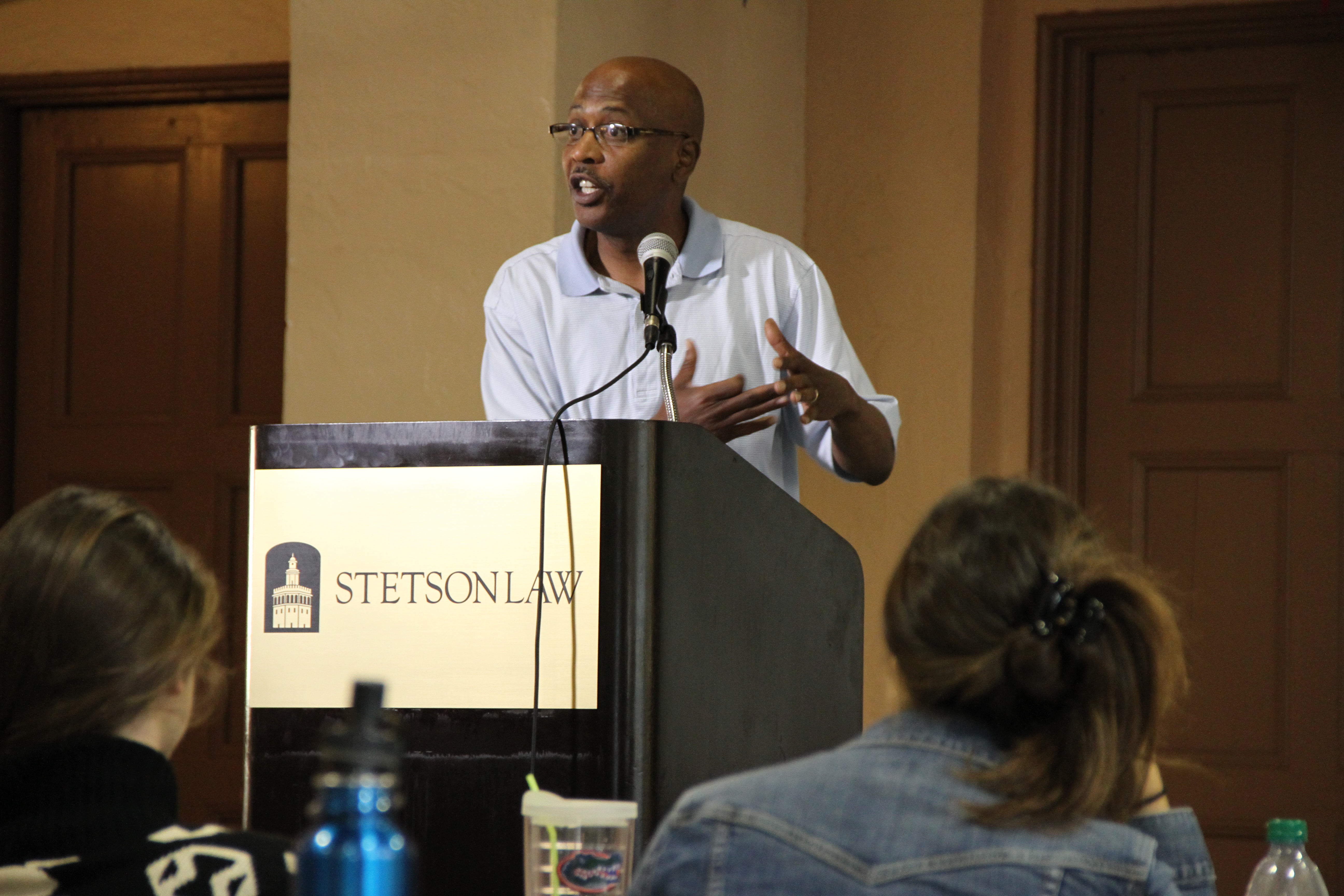
John Thompson spent 18 years in prison and 14 years on death row before being exonerated of a crime he did not commit. On Jan. 26, Thompson shared his experiences with Stetson University College of Law students and spoke about the importance of responsibility and accountability.
John Thompson spoke with Stetson Law students on Jan. 26 in the Great Hall.
“Now is the time for you to decide what you will stand for,” Thompson told the students. Thompson explained how he was accused and convicted of murder and the subsequent years he spent fighting the conviction and death sentence.
“His story tells us about what can go wrong with lawyering, from prosecution to defense,” Professor Judith Scully explained. Scully, the Wm. Reece Smith Jr. Distinguished Professor of Law, directs the Innocence Initiative at Stetson, which assigns students to research potential cases for the Innocence Project of Florida and to work on legislative reform and educational outreach.“John’s story illustrates the importance of confronting injustices and having courage as attorneys.”
After Thompson was exonerated of his crimes, a lower court ruled in a civil case that prosecutorial evidence occurred in his case and awarded him millions of dollars. However, the Supreme Court reversed that decision, explaining that it saw no pattern of prosecutorial misconduct, and the $14 million jury verdict was reversed.
Thompson said the attorney in his civil case risked his own finances and ambitions to follow his conscience to do what was right. He told the students that lawyers have a responsibility to ask questions, to address issues, to listen to their clients and to do the best that they can do at the end of the day.
“When you hear the word ‘exoneree,’ you should hear the word ‘victim.’ Are we ready to stand up and represent victims?” Thompson asked.
Howard Williams, a third-year law student, said that he was inspired by Mr. Thompson’s story.
“I would like to go into criminal law upon graduation, and Mr. Thompson’s words resonated very strongly with me because he may be the type of client that I have one day as an attorney,” Williams said. “To think that he almost died because of dishonest and ineffective lawyering reminds me of the power that attorneys possess and that is something that I will not take lightly. Mr. Thompson’s message reaffirmed the whole reason that I came to law school, which was to try and be a voice for those who need the most.”
Student Gabe Neibergall, who works with the Innocence Initiative at Stetson, said, “In my opinion, Mr. Thompson’s most powerful point was that we all choose to become lawyers, and by making that choice, we are now obligated to stand up for what is right- no matter the personal and professional costs. This seemed to be Mr. Thompson’s idea of true ‘honor,’ and it is something we should all strive to embody.”
After leaving prison, Thompson said that he had an unusually smooth transition. He said he worked with lawyers at the Death Penalty Resource Center to help people on death row. Habitat for Humanity built him a house and a writer worked with him on a book about his experiences. The story of Thompson’s wrongful conviction is told in the book, Killing Time: An 18-Year Odyssey from Death Row to Freedom.
Today, Thompson is the founder and director of Resurrection After Exoneration, a supportive residential program that provides exonerees and long-term prisoners reentering society a transitional home and work environment.
Thompson presented this year’s Wm. Reece Smith Jr. Distinguished Lecture at Stetson Law’s annual Inns of Court, an adopted tradition that brings together prominent lawyers, experienced teachers and law students to exchange ideas.
John P. Cunningham, who has worked with Gulfcoast Legal Services for more than 30 years and served as its executive director since January 1984, was presented with this year’s Wm. Reece Smith Jr. Public Service Award from Stetson University College of Law.
Interim Dean Royal Gardner, John P. Cunningham and William Reece Smith Jr. at the Inns of Court.
The award was presented on Thursday evening, Jan. 26, at the annual Inns of Court Banquet at the Mirror Lake Lyceum, 737 Third Ave. N., St. Petersburg.
Cunningham’s legal career includes serving the Tampa Bay community through numerous organizations including the Community Law Program in St. Petersburg where he was a 13-year board member, the Sarasota Human Services Center, Pinellas Homeless Coalition, Domestic Violence Task Force, Pinellas Refugee Coalition, and Advisory Council to the Advocacy Center for Persons with Disabilities. Cunningham has volunteered as a lecturer at law school clinics and the People’s Law School. He also served in the Legal Aid Society in the Civil Division in New York for eight years.
Stetson established the prestigious public service award more than two decades ago for Wm. Reece Smith Jr., past president of the International, American and Florida Bar Associations and a distinguished professorial lecturer and member of the Stetson University College of Law Hall of Fame.
John Thompson, a man who spent 18 years in prison before being exonerated of a crime he did not commit, presented this year’s Wm. Reece Smith Jr. Distinguished Lecture.
Thompson is the founder and director of Resurrection After Exoneration, a supportive residential program that provides exonerees and long-term prisoners reentering society a transitional home and work environment. Convicted in 1985 in New Orleans and exonerated 18 years later after spending 14 years on Angola’s death row, the story of Thompson’s wrongful conviction is told in the book, Killing Time: An 18-Year Odyssey from Death Row to Freedom.
The Annual Inns of Court brings together prominent lawyers, experienced teachers and law students to exchange ideas, experiences and education. The adopted Stetson Inns of Court tradition has its roots in England.
Stetson University College of Law is offering two information sessions in March for prospective students interested in earning their law degrees part-time. Students taking the LSAT as late as June are eligible for admission in the fall.
The sessions, both offered in the Wm. Reece Smith Jr. Courtroom at the Tampa Law Center, 1700 N. Tampa St., provide an overview of the process of applying to law school. Stetson Law enrolls new part-time students in the fall of every year.
Those interested in attending should RSVP for one of the sessions on either Monday, March 5, or Tuesday, March 20.
Both programs will start at 6 p.m. Registration begins at 5:30 p.m.
Stetson Law students participate in the 2012 MLK Jr. parade in downtown St. Petersburg.
Story by Valeria Obi, 2L Stetson Law student
Stetson University College of Law students and faculty honored the legacy of Dr. Martin Luther King Jr. by marching in the 27th annual parade in St. Petersburg on Monday, Jan. 16. The event drew thousands of spectators to view marching bands, floats and groups of people participating in the parade. They were there to celebrate and honor the life achievements of Dr. King.
“Walking in the parade is an honor,” said Stetson’s Black Law Students Association president, Howard Williams. “It is important for us to continue the legacy that Dr. King created. Walking in the parade is an opportunity for me to do my part to ensure that his legacy is remembered and celebrated. It is because of Dr. King’s efforts that I am able to achieve my dream of being a lawyer.”
Stetson’s participation was coordinated by BLSA and by the Office of Student Life. Approximately 30 students and faculty members walked in the event, which lasted an hour and a half, in downtown St. Petersburg.
Second-year law student and BLSA member La’Keisha Simms said that she felt a lot of community support for Stetson’s participation in the parade.
Williams added, “I walk so that younger generations can see the importance of supporting and continuing the fight for the injustices that plague our society.”
The Juvenile Justice Initiative and Black Law Students Association at Stetson University College of Law and the American Civil Liberties Union of Florida are co-sponsoring a panel discussion on Feb. 2 at Stetson Law in Gulfport to address effectively shutting down the school-to-prison pipeline.
WHAT: A panel of experts will discuss strategies for reducing Florida’s dropout rate and the number of young people in the juvenile and criminal justice system, making schools safer and better, and more efficiently using law enforcement. The educational forum is designed to inspire students to become engaged in making a difference in the field of juvenile criminal law.
WHO: Experts include: Judge Patrice Moore; Tim Niermann, lead probation officer in the Florida Department of Juvenile Justice; Dr. Valerie Brimm of the Office of Strategic Partnership, St. Petersburg; Lily McCarty of the Law Office of Julianne M. Holt, Public Defender’s Office, 13th Judicial Circuit; and Trenia Cox, planning manager for the Juvenile Welfare Board Children’s Services Council of Pinellas County.
WHEN: Feb. 2, 6-8 p.m.
WHERE: Great Hall, Stetson University College of Law, 1401 61st St. S., Gulfport.
For more information, or to RSVP, contact Joyce Hamilton Henry, Ph.D., at the ACLU of Florida at 813-288-8505 or [email protected], or Stetson Law student Mary Day at [email protected].
The Juvenile Justice Initiative at Stetson was proposed in the fall of 2011 by students and Judith Scully, the Wm. Reece Smith Jr. Distinguished Professor of Law at Stetson, to create solutions to juveniles in the criminal justice system.
Stetson University College of Law professors participated in several topical panels and committees at the annual Association of American Law Schools meeting Jan. 4-8 in Washington, D.C.
The following professors served on panels at the meeting:
Associate Dean John Cooper moderated a panel on “The Globalization of the Legal Practice for the Section on International Legal Exchange;”
Professor Kirsten Davis presented “Feedback Mechanisms” at the AALS Day-Long Workshop on Academic Support; and
Professor Louis Virelli organized, moderated and spoke on the panel entitled “Hot Topic Program: Politics, Ethics, and the Supreme Court: The Present and Future of Supreme Court Recusal.”
Several Stetson Law faculty members are serving with diverse committees and special sections of the AALS:
Professor Michael Allen completed his service on the Executive Committee for the Section on Remedies;
Professor Linda Anderson has begun serving as chair of the Section on Part-time Division Programs;
Professor Cynthia Batt co-chairs the Membership, Outreach, and Training Committee and is a member of the Externship Committee for the Section on Clinical Education;
Professor Mark Bauer was elected treasurer of the Section on Aging and Law;
Associate Dean John Cooper completed his service as chair of the Section on International Legal Exchange and will serve on the Executive Committee for the upcoming year;
Professor Kirsten Davis was elected secretary of the Section on Women in Legal Education;
Professor Peter Fitzgerald was elected to the Executive Committee of the Section on Animal Law;
Associate Dean James Fox was elected to the Executive Committee of the Section on Legal History;
Professor Luz Nagle serves on the Committee on the Recruitment and Retention of Minority Law Teachers;
Professor Jason Palmer was elected to the Executive Committee and Professor Ellen Podgor was elected Secretary for the Section on Sexual Orientation and Gender Identity Issues;
Professor Susan Rozelle completed her service on the Executive Committee of the Section on Criminal Justice, continues to serve on the Work-Life Balance Committee of the Section on Women in Legal Education, and remains chair of the Teaching Materials Network for the AALS New Law Professors Section; and
Professor Louis Virelli was elected to the Executive Committee of the Section on Constitutional Law.
Christopher Pietruszkiewicz has been named the new dean of Stetson University College of Law in Tampa Bay, Fla. Pietruszkiewicz joins Stetson from the LSU Law Center at Louisiana State University, where he serves as vice chancellor for business and financial affairs and as the J.Y. Sanders Professor of Law. Pietruszkiewicz will start at Stetson this summer.
Christopher Pietruszkiewicz has been named dean of Stetson University College of Law.
“I am delighted to join the College of Law with a fantastic faculty that is committed to creating an educational environment where students learn both inside and outside of the classroom,” said Pietruszkiewicz. “I look forward to working with a dedicated staff to advance Stetson’s educational mission and with a student body that will become lawyers and leaders, benefiting the profession and society. I am enthusiastic to work with President Wendy Libby, Provost Beth Paul, and Stetson’s vibrant alumni community to advance the College of Law’s national prominence in legal education.”
Pietruszkiewicz was selected following a national search led by a committee of faculty, administrators, students, alumni, overseers and trustees, chaired by Stetson Provost and Vice President for Academic Affairs Elizabeth “Beth” Paul and Professor of Law Michael Allen.
“Chris Pietruszkiewicz is recognized and respected nationally as a leader in legal education. I am confident that with his dynamic leadership, the Stetson University College of Law will continue to flourish as an excellent law school and earn distinction as an exemplar of 21st century legal education,” said Provost Paul.
Pietruszkiewicz has served in many national leadership positions in legal education. He has held several roles for the American Bar Association’s Section of Taxation, and he currently serves on the board of trustees for the Law School Admission Council and the Southeastern Association of Law Schools, where he served as president from 2005 to 2006.
“We are excited to have Chris join our faculty as dean, and we are confident that he is the right person to lead Stetson University College of Law during this changing time in legal education,” said Professor Allen.
Stetson President Libby added, “We owe special thanks to the search committee and the members of the College of Law community for their roles in identifying and attracting a new dean of Chris’s caliber to Stetson.”
Pietruszkiewicz co-authored the book Corporate Reorganizations and is currently working on another book on tax issues. He has published numerous law review articles, and frequently presents on tax law and legal education issues.
At Louisiana State University, Pietruszkiewicz was responsible for strategic planning, budgeting, financial planning and personnel matters, in addition to serving on a variety of committees. Earlier in his career, he worked as a trial attorney in the Tax Division of the U.S. Department of Justice and as an attorney/adviser in the U.S. Department of Education.
He earned a Master of Laws in Taxation from the Georgetown University Law Center, a law degree from the Loyola University New Orleans College of Law and a bachelor’s degree from the University of Scranton, Pennsylvania.
The Dec. 19 issue of The Hispanic Outlook in Higher Education Magazine listed Stetson University College of Law among the top 25 law schools for Hispanics in the nation for the third year in a row. Stetson Law ranks 14th among the 25 law schools across the country conferring the most degrees on Hispanics. Data for this report was compiled by the National Center for Education Statistics for 2010 graduates.
Student members of Stetson's Hispanic Bar Association meet with faculty adviser Professor Luz Nagle in 2010.
Stetson Law’s Hispanic students have established a strong tradition of community and public service. Second-year Stetson Law student Stephanie Favilli helped non-English speakers understand their legal rights by translating legal information into Spanish for pro se litigants in the U.S. Bankruptcy Court for the Middle District of Florida. Favilli served as a Spanish language translator for the Bay Area Volunteer Lawyers Program in the fall of 2010 through the student Hispanic Bar Association at Stetson.
Stetson Law alumnus David Fernandez, a past president of Stetson’s Hispanic Bar Association and Law and Order, became the first law student to receive the Clearwater Bar Foundation Excellence in Pro Bono Award in February 2010. Fernandez received the award for his work to provide Spanish speakers with access to legal documents through a translation project he started under the guidance of Stetson Law Professor Luz E. Nagle.
In 2008, Professor Nagle was named the first full professor of Hispanic descent at Stetson Law. Nagle’s distinguished legal career includes battling drug lords while serving as a district court judge in her native Colombia. Her commitment to improving conditions in Colombia and throughout the world continues through her research and work as a lecturer and expert in the areas of human rights violations and drug war-related foreign policy. Nagle was elected to the International Bar Association Legal Practice Division Council for a four-year term that started in January 2011.