Skip to content

Stetson Lawyers Association honors eight law alumni and friends

The Stetson Lawyers Association presented awards to eight outstanding alumni and friends of Stetson University College of Law during the Florida Bar Annual Meeting in Orlando on June 26.

  • Nestor M. de Armas B.B.A. ’73 and Congressman David W. Jolly received the Distinguished Service Award for their significant, meritorious and continuing contributions to Stetson Law.

Former president of the Stetson University Alumni Association, de Armas has served as trustee emeritus, chair and member of Stetson’s Board of Trustees. He and his wife Donna created the Nestor M. and Donna Hunt de Armas Scholarship to assist Stetson University students with financial need.

Congressman David W. Jolly, who represents Florida’s 13th Congressional District, serves on Stetson Law’s Center for Excellence in Elder Law Advisory Board. Jolly also serves on the Transportation and Infrastructure Committee and Veterans’ Affairs Committee, and was the former senior advisor and general counsel to the late Congressman Bill Young.

  • Judge David Demers B.A. ’68, JD ’72 and Judge Irene Sullivan JD ’77 received this year’s Distinguished Alumni Award.

Demers, elected chief judge of the Pinellas County Circuit Court in 2001, implemented policies and procedures during his six-year tenure that guide the circuit court today. Judge Demers is a 2009 Stetson University College of Law Hall of Fame inductee who has served as an adjunct professor at Stetson, a member of the prestigious Stetson College of Law Skills Training Committee, and a frequent presenter at Stetson University’s Professionalism seminars.

Sullivan is a 2011 Stetson University College of Law Hall of Fame inductee and adjunct professor teaching juvenile law at Stetson. Shepracticed trial law in St. Petersburg for 22 years before she was elected circuit court judge in 1998. Judge Sullivan served on the juvenile and family law bench until 2011 and authored the popular book, Raised by the Courts: One Judge’s Insight into Juvenile Justice.

  • Lawrence P. Ingram JD ’90 received the Paul M. May Meritorious Service Award for continuously supporting Stetson Law and its alumni association.

Ingram, managing partner of the Tampa office of the international law firm Phelps Dunbar, currently serves as vice chair of the executive committee of the Stetson University College of Law Board of Overseers.

  • Brian Tannebaum JD ’94 received the Outstanding Alumni Representative Award for dedication and service to the Stetson Lawyers Association.

Tannebaum is an American Bar Association National Trial Champion and a former member of Stetson’s Trial Team. Tannebaum is a member of the Board of Directors of the Florida Association of Criminal Defense Lawyers where he is one of only two members of the association to have received all three presidential service awards.

  • Gregory Coleman B.B.A.’85,JD ’89, incoming president of the Florida Bar, received the Ben C. Willard Award for humanitarian achievements bringing distinction to himself and Stetson Law.

Coleman has served on and chaired nearly every significant standing and special committee in the Florida Bar and is an unprecedented three-time winner of the Florida Bar’s prestigious President’s Award of Merit. Coleman is also a member of the House of Delegates for the American Bar Association and a director of the Florida Bar Foundation.

  • Stetson Lawyers Association president Jenay Iurato JD/MBA ’00 received the President’s Award in recognition of her leadership.

Iurato works with the Tampa Hispanic Bar Association, the Junior League of Tampa, and advocates for ending human trafficking around the world.

Marc Levine JD ’06 was named incoming president of the Stetson Lawyers Association. Stetson University President Wendy Libby, Stetson University College of Law Dean Christopher Pietruszkiewicz, and Stetson Law alumnus Luis Prats B.A.’78, JD ’81 spoke at the awards program.


Stetson Law hosts open house and part-time info sessions in July, August

Stetson University College of Law will host two open house and information sessions in July and August about the admissions process for part-time law school applicants. Students interested in the full-time program are also invited to attend.

“The part-time program granted me the flexibility to continue to work full-time while attending classes at night,” said part-time Stetson University law student Kevin Lonzo. “This allowed me to gain valuable work experience and build a network of contacts in the Tampa Bay area, while earning my degree.”

“I will be graduating soon and am incredibly grateful for the opportunity the part-time program provided me,” said Stetson Law student Amanda Ortega. “The evening class schedule allowed me to keep working to support my family while still getting a valuable Stetson education.”

Prospective law students interested in attending should RSVP for one of the sessions:

  • Thursday, July 31, at the Tampa Law Center, 1700 N. Tampa St.
  • Thursday, Aug. 28, at the Gulfport campus, 1401 61st St. S.

All programs will start at 6:30 p.m. Registration begins at 6 p.m.

Stetson enrolls new law students every fall.

To RSVP and for more information and directions to Stetson’s Tampa Law Center or Gulfport campuses, visit http://www.law.stetson.edu/parttime or e-mail [email protected].

Student Todd Hoover: Advocating for literary equality

When he is not busy commuting from his home in Palm Harbor, Florida, to Stetson Law school or working full-time at his job of 16 years at Nebraska Printing Company, Todd Hoover is a literacy advocate for at-risk youth.

Student Todd Hoover
Student Todd Hoover

The 45-year-old third-year student at Stetson University College of Law balances raising a family with a full-time job, part-time law school, and his work with a nonprofit literacy program. Hoover recently created the nonprofit, First 25, Inc., to help boost literacy among underprivileged youth in Pinellas County, Florida.

“The time for ineffective measures and impotent bureaucracies is over,” Hoover said. “We will teach these kids to read child by child, until we have fixed the problem.”

First 25 promotes what Hoover calls racial literary equality. Through First 25, Hoover helped grow a community literacy program in an at-risk area of Largo, Florida, which lead to a pilot program at John Hopkins Middle School in St. Petersburg, Florida.

Hoover is also the author of several children’s and young adult fiction books.

Taking center stage: Stetson alumna, staffer co-author play about adapting to change

“It started with three writers talking out a concept around the dining room table,” Stetson University College of Law staffer Julie Saffan shared.

Saffan is the co-author of a new play, “Baggage,” with Stetson Law alumna Jaye Ann Terry, and University of Central Florida cinema studies student Amanda Dodge.

The play portrays two women who help their friend to let go of obstacles and adapt to change.

Terry, an attorney who recently moved to Tallahassee, was a longtime resident of St. Petersburg. She coordinated the Journeys in Journalism Program for elementary, middle and high school students in Pinellas County and worked at the Tampa Bay Times.

Saffan, a native New Yorker, has lived in St. Petersburg for two decades and works in Stetson University’s business office on the Gulfport campus.

“Baggage” will be presented on June 26 at 7 p.m. at the Studio@620 in St. Petersburg. An audience discussion with the playwrights will follow the performance.

103 alumni voted among Florida Trend’s Legal Elite

A total of 103 Stetson University College of Law alumni have been selected for Florida’s Legal Elite in the July 2014 Florida Trend magazine.

Stetson Law graduates walk at a recent commencement.

The Legal Elite Hall of Fame includes two Stetson Law alumni, Mark A. Hanley JD ’80 and Rhea F. Law JD ’79. The Hall of Fame honors attorneys who have consistently ranked in the top tier in Legal Elite voting for several years.

This year, 20 Stetson Law alumni listed among Florida’s Legal Elite were also selected by their peers as “up and coming” attorneys and three Stetson Law alumni were voted outstanding attorneys working in the government and non-profit sectors.

Florida’s Legal Elite, now in its 11th edition, showcases attorneys chosen by their peers who exemplify a standard of excellence in their profession. All in-state members of the Florida Bar are asked to vote. The resulting list of Florida’s Legal Elite represents fewer than 2% of the active Florida Bar members who practice in the state.

Stetson University tops Florida Super Lawyers list again

Stetson University College of Law alumni again top the list of Florida Super Lawyers. Stetson Law is among the top 10 law schools in the state producing the highest number of Florida Super Lawyers this year.

Graduates walk at Stetson Law commencement.

This year, 298 Stetson Law alumni are among the Florida Super Lawyers and 181 Stetson Law alumni are honored among the Florida Super Lawyers Rising Stars.

Stetson Law alumnus Christian D. Searcy is listed among the Top 10 2014 Florida Super Lawyers. Five Stetson Law alumnae are listed among the Top 50 Women Florida Super Lawyers : Tae Kelley Bronner, Tracy Raffles Gunn, Lorena Hart Ludovici, Marian P. McCulloch, and Lynn Welter Sherman. Five Stetson Law alumni are included in the Top 100 Florida Super Lawyers: Stephen A. Barnes, Stephen D. Busey, Mac Richard McCoy, Luis Prats and Searcy.

Super Lawyers magazine rates lawyers from more than 70 practice areas who have attained a high-degree of peer recognition and professional achievement through independent research, peer nominations and evaluations.

No more than 5 percent of attorneys in the state are included in the Florida Super Lawyers list and no more than 2.5 percent are named to Rising Stars.

Course at Stetson explores sea turtle conservation

Stetson University College of Law students are participating in a special course from May 27-June 6 to learn about the threats facing endangered sea turtles and the legal and policy initiatives in place to protect them.

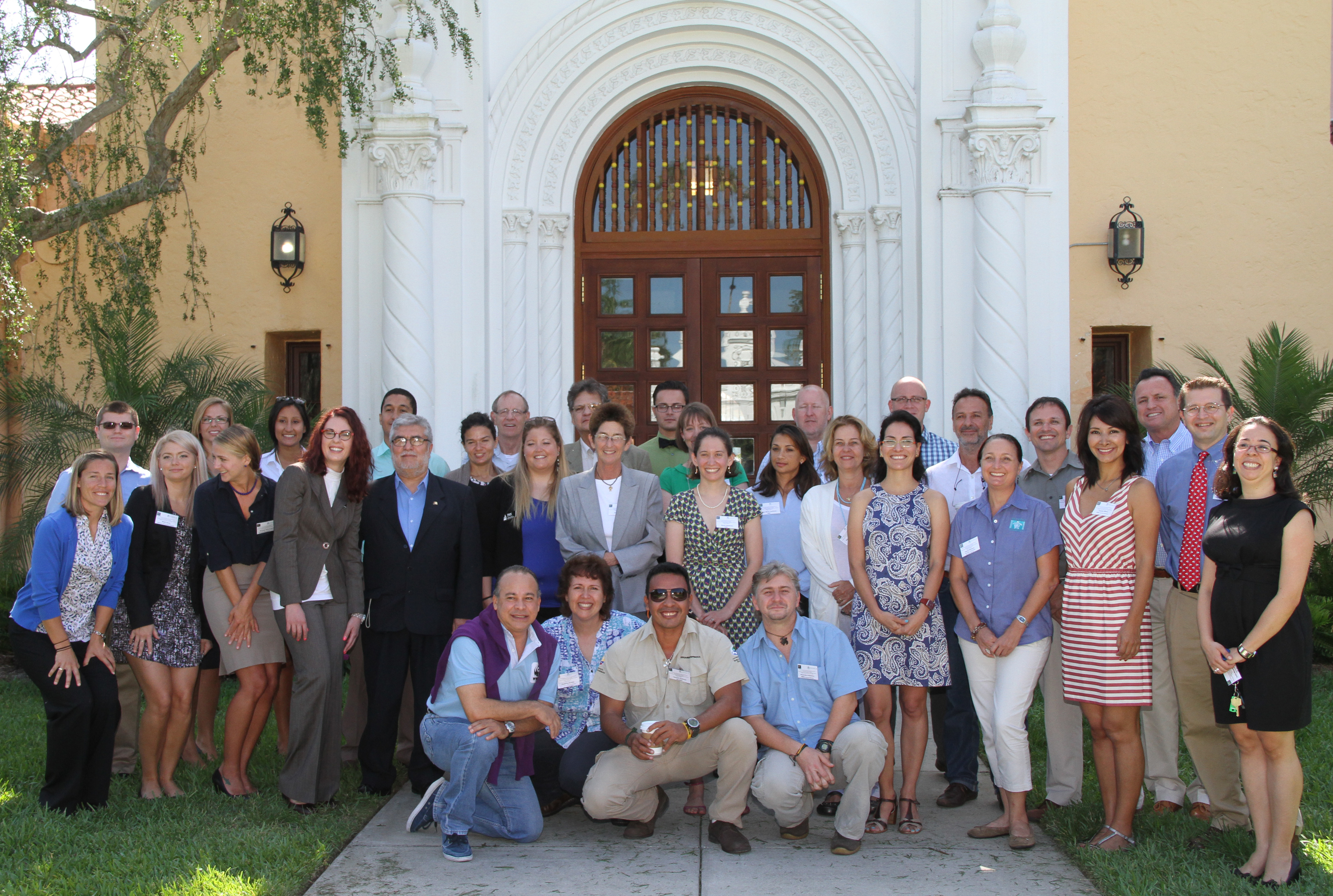
Sea turtle experts from Latin America and the Caribbean gathered at Stetson Law in Gulfport.

Students enrolled in the course are invited to join sea turtle experts on campus for the Consultative Committee Meeting of the Inter-American Convention for the Protection and Conservation of Sea Turtles.

Sea turtle experts from Latin America and the Caribbean traveled to Stetson’s Gulfport campus for the meeting.

For more information about Stetson’s new summer course on sea turtles, visit www.stetson.edu/turtles.

Stetson students respond to President Obama’s new clemency initiative

The U.S. Department of Justice recently announced a new clemency initiative, designed to prioritize clemency applications for certain non-violent offenders who would likely receive lesser sentences if they were sentenced today. To date, more than 35 Stetson Law students have signed on to assist the Office of the Federal Defender for the Middle District of Florida in identifying former clients who may qualify for the new clemency initiative. The Stetson Law students will help gather information relevant to the clemency criteria as part of a new pro bono project on campus.gavel_scale_blue

“I had heard about this on the news and was ecstatic, but didn’t imagine Stetson students would have the opportunity to help,” said student Kathryn Hamilton, who signed on to assist the pro bono project.

“I am interested in the clemency project because it is such a rare and unique opportunity to apply some of the skills I have learned in law school for a cause that can drastically change people’s lives,” said student Kevin Lonzo.

Donna Elm, the Federal Defender for the Middle District of Florida, stated, “We are delighted to expand our internship program to include students working pro bono on this important project. The students will be instrumental in helping us collect the information we need to assess which former clients may be eligible for relief under the new clemency initiative.”

Stetson Law professors Ellen Podgor, Judith Scully, James Sheehan and Dean Emeritus and Professor of Law Bruce Jacob are spearheading the pro bono project with the Federal Defender’s Office.

“This is an exciting project that will be ongoing, allowing students to learn more about federal criminal law while assisting the Federal Defender’s Office in the Middle District of Florida,” said Professor Podgor, the Gary R. Trombley Family White-Collar Crime Research Professor at Stetson Law.

Justice Grows: student Kathryn Hamilton advocates for gardens in juvenile detention centers

Stetson University College of Law student Kathryn Hamilton said that the idea for Justice Grows germinated in professor Marleen O’Connor’s Food Law & Policy seminar and professor James Fox’s class on poverty law. What started as a research assignment in the classroom in Gulfport, Fla., has blossomed into collaborating with the Florida Farm to School program on a new project that will bring edible gardens to local juvenile residential centers.

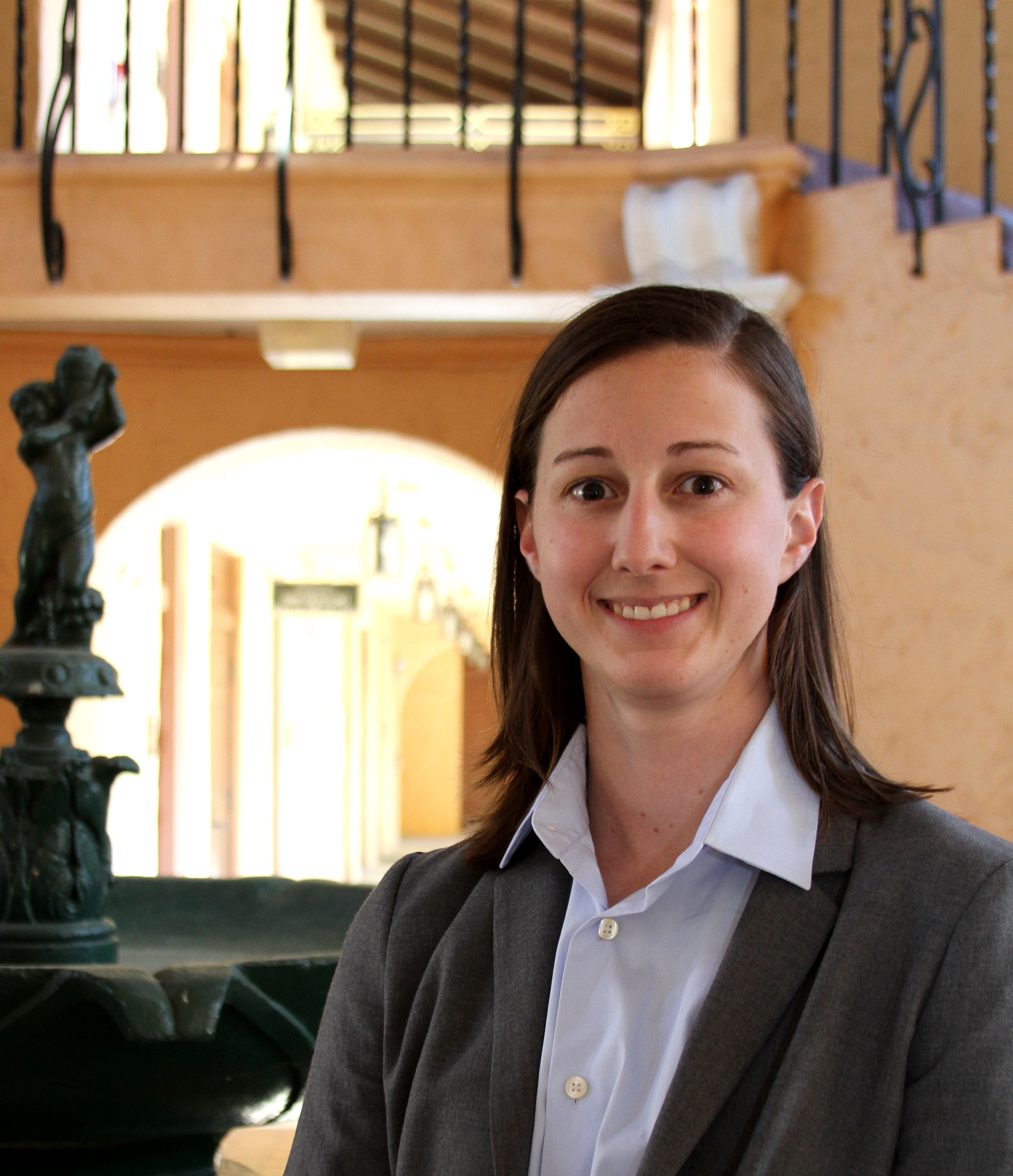
Student Kate Hamilton.
Student Kathryn Hamilton.

Hamilton, a student in Stetson’s Social Justice Advocacy Concentration program, said she is finalizing plans for the first garden at a site St. Petersburg, Fla. Ultimately, she said that her goal is to help already established garden programs unite as part of the Florida Farm to School program.

“In 2011, Florida Governor Rick Scott asked juvenile justice centers to improve vocational and educational programs for our youth, and gardens and greenhouses were recommended as low-cost solutions,” Hamilton said. “Youth working on edible garden projects in juvenile residential centers can learn gardening skills and have opportunities to do a service to the community. They also have access to healthy food.”

Hamilton found that many people live in food deserts, areas of town in Florida where it is nearly impossible to access fresh fruits and vegetables unless you own a car. Hamilton’s research shows that about 20% of Florida residents are food insecure, meaning that at some point during one month every year, families aren’t sure how they can pay for their next meal.

“I want the youth in the system to see that they can be responsible for bringing that number down,” said Hamilton. “Edible gardens provide youth with a source of income, one that requires no expertise and hardly any start-up money.”

Hamilton is calling the project Justice Grows because it helps instill leadership and responsibility in young people while addressing issues like hunger, poor health, and lack of access to healthy foods.

“Hunger, poverty and crime are related to our eroding food system,” said Hamilton. “My research revealed that the same families that are not able to find or afford healthy food are often the same families with children entering the juvenile justice system.”

Edible gardens in juvenile residential centers can also provide opportunities for victim restitution and community service, Hamilton explained. The food grown can be donated to food banks and young people can plant gardens in their own neighborhoods. There are already successful edible garden programs in place across the state, said Hamilton.

Hamilton is seeking volunteers willing to work with the project to help build the first site garden in St. Petersburg, and is asking for donations of greenhouse resources and seedlings to the Cypress Creek Juvenile Offender Correctional Center garden in the Lecanto area. She has drafted a proposal for the Department of Juvenile Justice, in charge of the juvenile residential centers. She has also done interview spots with WMNF Tampa and WSRQ Sarasota about her project.

For more information about Justice Grows, visit https://www.facebook.com/justicegrows or email [email protected].

Passion for writing: two student papers accepted in respected journals

Two students in professor Clark Furlow’s Advanced Corporate Law seminar at Stetson University have recently written papers accepted for publication in respected journals.

Clara Arrington, a native of Tampa, has written on the topic of enabling benefit corporations in Florida. Her paper was accepted for publication in the Hillsborough County Bar Association’s monthly magazine, The Lawyer.

Clara Arrington
Clara Arrington

The paper, “Florida considers enabling benefits corporations,” argues that Florida’s other constituency statute works to support the same goals that benefit corporations support and that a new legal framework is unnecessary.

Benefit corporations balance a stated public benefit, such as the interests of the community in which they operate, with shareholders’ interests. Arrington described how a Florida citrus farmer kept an unprofitable branch of the family business running just to keep his family employed and support the local community. When this practice was challenged by minority shareholders, a Florida court ruled that it was legal under Florida’s constituency.

Arrington said that she is fascinated by the topic of how the law interacts with business. She plans to work in the Tampa Bay region after graduating in May.

Wynn Willard, entering his third year of law school at Stetson and himself a former CEO, wrote about the regulation of executive compensation. His paper and a companion piece were accepted by the Duquesne Business Law Review and the Cornell HR Review, a journal of the Industrial and Labor Relations School.

Wynn Willard
Wynn Willard

Willard argues that criticism of compensation should first be measured against the value CEOs create for shareholders. He shared the example of Steve Jobs, whose leadership propelled Apple’s shareholder value hundreds of billions of dollars since 2003. In the same time frame, Willard explained that Motorola and Nokia executives achieved minimal and negative returns, respectively, for their shareholders. Willard’s paper cites multiple examples of government regulation of executive compensation producing unintended consequences and great costs. He advocates a cessation of federal regulation in favor of existing state laws and market forces.

Willard worked as a marketing executive at companies including Procter & Gamble, Cadbury Beverages, and Hershey Foods. He served as CEO of Nabisco Canada and New World Pasta Company. He has also taught courses on management at the University of South Florida.

“I have always been interested in law and thought my corporate background could be a good combination with it,” said Willard, who plans to graduate from Stetson in December.

He said that the seminar paper gave him an opportunity to explore a subject with which he has firsthand experience.

“You have to have a passion for what you’re doing,” Willard said.

Law students present at Stetson Showcase

Law students Lindsey Plyler Blankenbaker, Matt Newton and Heather Woods were selected to participate in the Stetson Showcase on April 15 at Stetson University in DeLand. It was the first time Stetson Law students were asked to participate in the daylong event for undergraduates, showcasing Stetson’s best and brightest students presenting on a broad range of topics.

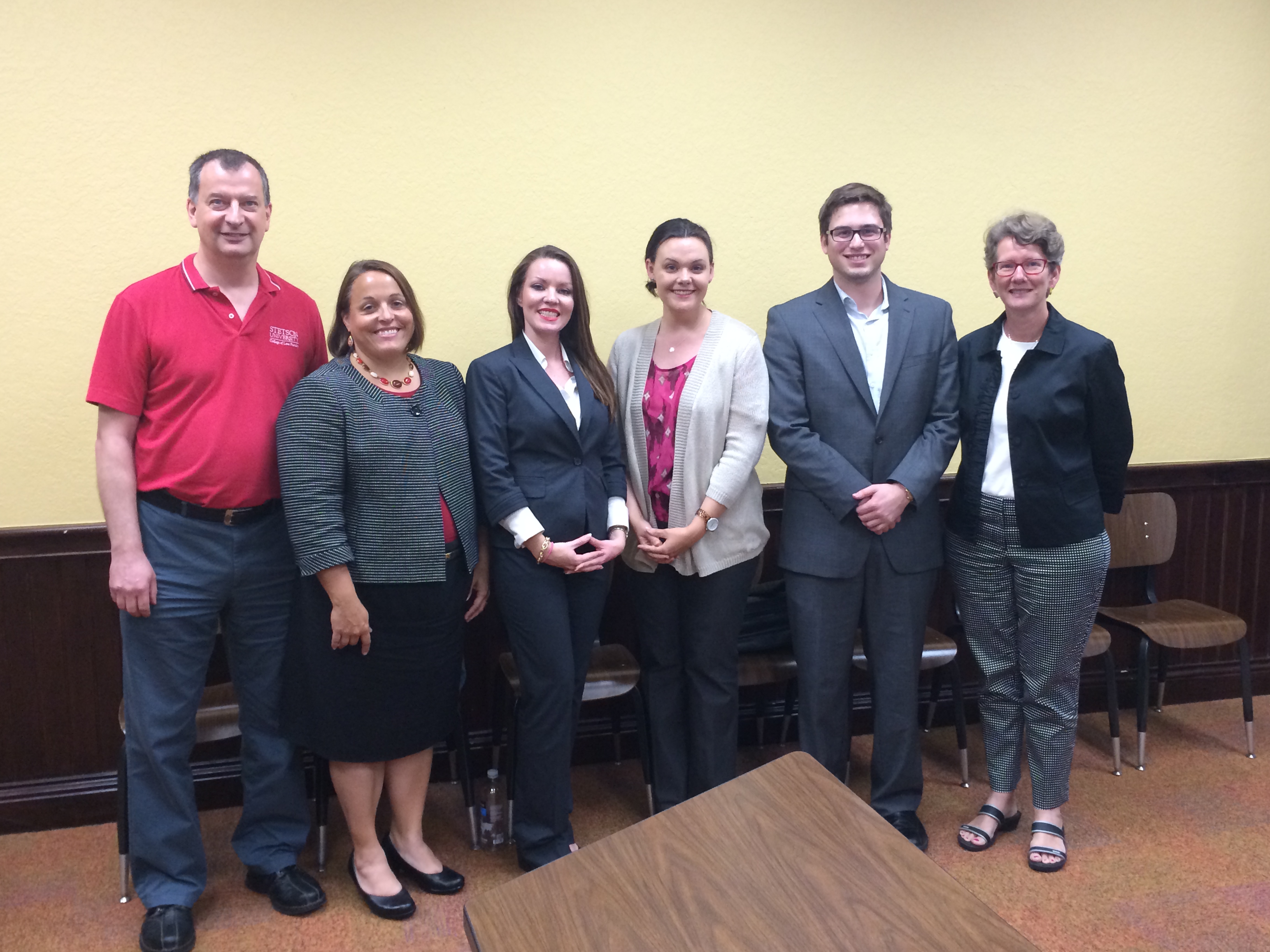
(L-R): Dr. Tim Kaye, Dr. Kirsten Davis, Heather Woods, Lindsey Plyler Blankenbaker, Matt Newton, and Provost Beth Paul.

Each law student had an opportunity to share the findings of their seminar papers, presenting on topics ranging from issues impacting transgender students and First Amendment rights, to the erosion of the right to trial by jury, to the application of the Aristotelian Classical Method.

Woods, a member of Stetson’s Honors Program, said it was a great experience to present her paper and a great honor to present to students, faculty members and the university provost.

Professor Kirsten Davis, Ph.D., and Professor Tim Kaye, Ph.D., traveled to Stetson University with the students.

“We are hoping to bring more law students next time,” said Dr. Kaye.

Stetson Showcase is a celebration of achievement whose aim is to foster an appreciation for academic excellence at Stetson University. Student presenters share their research through presentations, portfolios, posters, readings, music and theater performances, art shows, and multimedia work. They present their programs in professional settings for audiences that include judges, faculty, fellow students and interested members of the community.

To learn more, visit https://www.stetson.edu/other/research/showcase.php.

Part-time student challenges legal ivory trade in China

When part-time Stetson Law student Ethan Arthur began researching an independent study project on ways to end the ivory market and slaughter of African elephants, he had no idea that the project would take him to Arlington, Va.

African Bush Elephant. Courtesy Wikimedia Commons.

As part of his project in Professor Lance Long’s Environmental Advocacy course at Stetson, Arthur was asked to collaborate with a government agency on finding a solution to an environmental crisis.

Arthur spent his spring break presenting his solution to African elephant slaughter and ivory trade at an Advisory Council on Wildlife Trafficking meeting. He presented his proposal to the Council during the public comments portion of the March 20 meeting.

“The U.S. is considering more stringent regulation of its own ivory trade and many people took advantage of the public comment portion of the Council meeting to voice their opinions,” said Arthur.

According to an April 7 article in the New York Daily News, 96 African elephants are killed by poachers every day for their tusks, resulting in the slaughter of approximately 35,000 elephants per year. The African elephant will face extinction in a decade if the slaughter is not curbed, according to the article.

“While most people at the Council meeting seemed to agree that stemming the demand for illicit ivory is vital, there is still some disagreement about the best way to accomplish this goal,” said Arthur.

Stopping the legal trade within China could curb the demand for ivory that elephant poachers are working to supply, Arthur explained. He described a way to classify animals under cultural property law to persuade China to stop its legal ivory market.

Details of Arthur’s proposal on how to stop elephant poaching in Africa will be published in the next issue of the Journal of International Wildlife Law and Policy at the end of the spring semester.