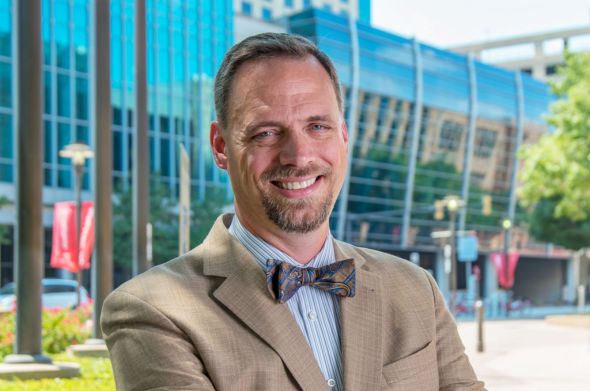
Dr. Brian Larson joins Stetson Law as Distinguished Visiting Professor of Legal Writing in Fall of 2025.
This fall, the Stetson Law community will welcome Dr. Brian Larson to campus as the Distinguished Legal Writing Professor for the 2025-26 academic year. Based at Texas A&M University School of Law, Larson brings with him a deep passion for strengthening scholarly work in the legal writing community.
Larson is known for bringing legal writing and rhetorical scholarship together in meaningful ways. His contributions in this area are substantial. In 2017, he hosted the Classical Rhetoric & Contemporary Law discussion group. The initiative laid the groundwork for a 2019 law school symposium on the topic as well as two peer-reviewed book collections: Rhetorical Traditions & Contemporary Law (Cambridge University, 2025 – open access) and Classical Rhetoric & Contemporary Law (University of Alabama, 2024). Together, these volumes featured contributions from more than 30 scholars across the fields of rhetoric and legal writing.
A tradition of academic vibrancy
Stetson Law Professor Elizabeth Berenguer
Each year, Stetson Law invites a respected scholar whose fresh ideas and unique teaching style add something special to the legal writing program. These distinguished visitors lead lectures, spark engaging conversations, and showcase their work on campus. To Stetson legal writing faculty, he’s an ideal fit.
“Brian’s expertise aligns seamlessly with the mission of the Institute for the Advancement of Legal Communication: to build the legal writing discipline by supporting research and scholarly study in the field,” said Law Professor Elizabeth Berenguer, director of the institute.
Building on established connections
Collaborating with Stetson Law faculty will not be new for Larson, who co-led the Research Methods in Legal Communication reading group with Stetson’s own Dr. Kirsten Davis. That initiative helped introduce scholars to key analytical frameworks, as well as empirical and rhetorical research methods.
Larson’s soon-to-be colleagues are excited for what he will inspire in the year ahead.
“His deep commitment to rhetoric and empirical inquiry has already sparked plans for new workshops and courses, promising to enrich the experience of students, practitioners, and academics,” Berenguer said. “I am delighted to have this opportunity to collaborate with him in the coming year.”
Sackett v. Environmental Protection Agency could determine the extent of Clean Water Act protections across the U.S.
With help from faculty, Stetson Law students contributed significantly to an amici brief filed by Professor Royal Gardner, director of the college’s Institute for Biodiversity Law and Policy filed on behalf of twelve scientific organizations in a case that could prove critical in the fate of the Clean Water Act.
What the case is about
The case, Sackett v. Environmental Protection Agency, may change which waters are defined under the Clean Water Act. Expected to be the first the U.S. Supreme Court hears when its new term starts in October, it is the culmination of a lawsuit stemming from an Idaho couple’s attempt to construct a home on a wetland that the EPA considered to be “water of the United States” (WOTUS). For over a decade, litigation ensued, with environmental groups advocating for maintaining the current standard.
If decided in favor of the petitioners, the ruling could undo protections for millions of acres of wetlands directly connected to lakes, rivers, and other ecosystems.
Behind the brief
Amici curiae (“friends of the court”) briefs have been filed both for and against the Sacketts. Stetson Law faculty and students researched and wrote the brief on behalf of 12 scientific organizations that support stronger protections for waters of the United States (WOTUS).
These scientific organizations are the American Fisheries Society, American Institute of Biological Sciences, Association for the Sciences of Limnology and Oceanography, Coastal and Estuarine Research Federation, Ecological Society of America, Freshwater Mollusk Conservation Society, International Association for Great Lakes Research, North American Lake Management Society, Phycological Society of America, Society for Ecological Restoration, Society for Freshwater Science, and Society of Wetland Scientists.
Professor Royal Gardner, director of Stetson Law’s Institute for Biodiversity Law & Policy.
The brief asserts that science needs to inform the approach to determining whether wetlands should be protected, and the science shows that wetlands, even when one cannot see them connected to other waterways from the surface, support the integrity of other bodies of water.
“If Petitioners’ proposed ‘continuous surface-water connection’ to a traditional navigable water were required for wetlands, more than 50% percent of wetlands in some watersheds would no longer be protected by the Clean Water Act. Were such a standard applied to streams, ephemeral and intermittent streams would not be jurisdictional waters, and thus more than 90% percent of stream length in some watersheds would no longer be protected by the Clean Water Act,” the brief summary reads.
A valuable experience
To the Stetson Law students who participated, it was a chance to use their budding advocacy skills in an area they are passionate about.
“Though work on the brief was challenging, each of us who participated understood the importance of our efforts and the high stakes riding on the case,” said student William McCann, who assisted with the document’s citations.
Recent Stetson Law graduate Lauren Beames said she knew it would be an exciting, collaborative experience. Between sessions studying for the Florida bar exam, she saw Professor Gardner, who gave her a printed copy of the brief after it had officially been accepted.
“Seeing the time I spent sifting through copious amounts of scientific research and legal authority constructed into strong, sound legal arguments in an amicus brief that will go before the United States Supreme Court is an experience, I am extremely proud to have been a part of,” Beames said.
Student Cal Raubolt, who worked on the brief’s citations, said what struck him was how so many people came together to make it come about – something that is not always apparent when one reads a Supreme Court decision and its pertinent documents.
“In reality, there are dozens of hands that put in so much hard work for it to ever get to that point,” he said. “It is beautiful to be able to say that my hands were a part of that hard work, however small a part it was.”
Second-year law student Tyler Vansant, who assisted in research for the brief, said the experience gave him an even closer glimpse of the intricacies of environmental policy.
“Working on this brief was an invaluable way to learn more about the very complex science of wetlands (and WOTUS in general) and gave me a much deeper understanding of the challenges that the EPA and other agencies face in creating rules and policy in this area,” he said.
Brooke M. Cleary, who helped proofread the document, said the project was a critical exercise in legal writing that showcased Stetson Law’s culture of collaboration.
“This unique experience enhanced my writing competencies and furthered my passion for environmental law, specifically waters of the United States,” Cleary said. “I’m so thankful Professor Gardner provided this opportunity to assist with his presentation to the Supreme Court.”
The students were part of a legal team that included Katherine Pratt, Stetson’s Foreman Biodiversity Fellow, Prof. Erin Okuno of the University of Miami, Prof. Steph Tai of the University of Wisconsin, and Kathleen Gardner of Shearman & Sterling LLP, a global law firm that supports the Biodiversity Institute on a pro bono basis.
The brief is not the first Stetson Law project to play a role in a SCOTUS clean water case. In 2018, the college filed an amici curiae in County of Maui v. Hawaii Wildlife Fund et al. The following year, the Court cited the brief in its decision in favor of stronger protection of water resources.
Professor Teri McMurtry-Chubb, Associate Dean for Research and Faculty Development and Professor of Law at University of Illinois
In working to foster just and equitable outcomes on law school campuses and society writ large, legal educators encounter structural racism, implicit bias, and other inequities that limit opportunities for many prospective students.
Stetson Law recognizes this and has been actively cultivating a more inclusive and diverse community on campus at all levels: students, faculty, and staff. To that end, in October 2020, the College approved an anti-racism resolution expressing its commitment to “dismantling all forms of oppressive power dynamics and challenging any assumptions that diminish human dignity, including those that rely on racist assumptions.”
Recently, Stetson celebrated another milestone in its multifaceted approach to eliminating racism, bias, and inequality on campus by hosting Dean Teri A. McMurtry-Chubb in December 2021 for a talk entitled “Assessing Antiracism or Antiracist Assessment?: Strategies & Critiques for Inclusive and Equitable Writing Communities.” Her presentation focused on ways in which law school assessment shapes diversity and inclusivity in the legal profession.
Associate Dean for Research and Faculty Development and Professor of Law at University of Illinois, McMurtry-Chubb is a nationally renowned expert on antiracist and DEI (Diversity, Equity & Inclusion) interventions.
Stetson Law Professor Lance Long
“Bringing Dean McMurtry-Chubb in at this moment to join the conversation on equitable assessment in law schools was the natural next step” in carrying out the College’s commitment to antiracism, said Stetson Law Professor Elizabeth E. Berenguer, one of the hosts of the talk.
McMurtry-Chubb’s book, Strategies & Techniques for Integrating DEI into the Core Law Curriculum, examines equitable assessment in the context of legal education. It is available as a free download.
“It’s not just a scholarly work. It’s a wonderful guide,” said Stetson Law Professor Lance Long, who co-hosted the virtual event, as he introduced McMurtry-Chubb ahead of her remarks.
The Roots & Symptoms of Systemic Inequities
The conversation about anti-racism in legal education goes back to 1951, McMurtry-Chubb explained, when the American Association of Law Schools’ Special Committee on Racial Discrimination rejected a rule proposed by Yale Law School requiring all member schools to integrate in favor of a statement “encouraging” members to avoid “discrimination or segregation on the ground of race or color.”
“As you can imagine, this was a concession to Southern schools who did not wish to integrate,” she pointed out, adding that the committee’s policy surrounding Black students failed to consider their experience, instead regarding them as “ancillary to the needs of white law students.”
Stetson Law Professor Elizabeth Berenguer
“We in legal academia have a lot of reckoning to do with ourselves,” Berenguer said, in order to deconstruct systemic racism at all levels.
During her talk, McMurtry-Chubb elaborated on how long-held beliefs infused with racial bias are reflected in what law schools determine to be “acceptable behavior” in classrooms, which can lead to narrow standards that deny the existence of racial trauma. Consequently, traditional assessment tools like undergraduate and LSAT performance may unfairly exclude qualified prospective students. This phenomenon can reinforce existing hierarchies favoring white male ways of being and knowing, she emphasized, thereby reinforcing the status quo in the classroom and beyond.
Panelists proposed strategies for addressing the pervasive issues of bias and elitism that dominate legal education as well as the legal profession as a whole, including suggesting ways of recognizing the added stress minoritized students must endure in an environment that is already known for its rigorous demands. Panelists described specific strategies educators can adopt in the classroom to foster equity and inclusivity, such as equitable grading techniques to eliminate inherent biases.
“This is really allowing us to do some analysis and some deep thought around some of the existing structures that we have within the legal academy, and also for us to be more thoughtful in terms of how we are thinking of our students and including them in the legal education experience,” said Carmen Johnson, Stetson Law’s Executive Officer for Diversity, Collaboration and Inclusion at the event’s conclusion.
She added that she hopes events like this can offer “a more inclusive lens when it comes to not only education, but, ultimately down the road, practice as we continue to grow the next generation of lawyers and legal experts.”